lock CHEVROLET TRACKER 1998 1.G Repair Manual
[x] Cancel search | Manufacturer: CHEVROLET, Model Year: 1998, Model line: TRACKER, Model: CHEVROLET TRACKER 1998 1.GPages: 386, PDF Size: 21.17 MB
Page 187 of 386

Downloaded from www.Manualslib.com manuals search engine Tie a red cloth to your vehicle to alert police that
you’ve been stopped by the snow.
Put on extra clothing or wrap a blanket around you.
If you have no blankets or extra clothing, make body
insulators from newspapers, burlap bags, rags, floor
mats
-- anything you can wrap around yourself or
tuck under your clothing to keep warm.
I
I ’ A Cb JTION:
Snow can trap exhaust gases under your vehicle.
This can cause deadly
CO (carbon monoxide) gas
to get inside.
CO could overcome you and kill
you. You can’t see
it or smell it, so you might not
know
it is in your vehicle. Clear away snow from
around the base
of your vehicle, especially any
that is blocking your exhaust pipe. And check
around again from time
to time to be sure snow
doesn’t collect there.
Open
a window just a little on the side of the
vehicle that’s away from the wind. This
will help
keep
CO out.
You can
run the engine to keep warm, but be careful.
4-42
Page 189 of 386
Downloaded from www.Manualslib.com manuals search engine NOTICE:
Do not tow your vehicle with the rear wheels in
contact with the ground,
or the transmission
could be damaged.
2. Set the parking brake.
3. If your vehicle is a four-wheel-drive vehicle, set
your manual free-wheeling hubs to
FREE or unlock
your automatic freewheeling hubs. See “Four- Wheel
Drive”
in the Index.
4. Turn the ignition key to ACC to unlock the
steering wheel.
NOTICE:
Make sure that the towing speed does not exceed
55 mph (90 km/h), or your vehicle could be
badly damaged.
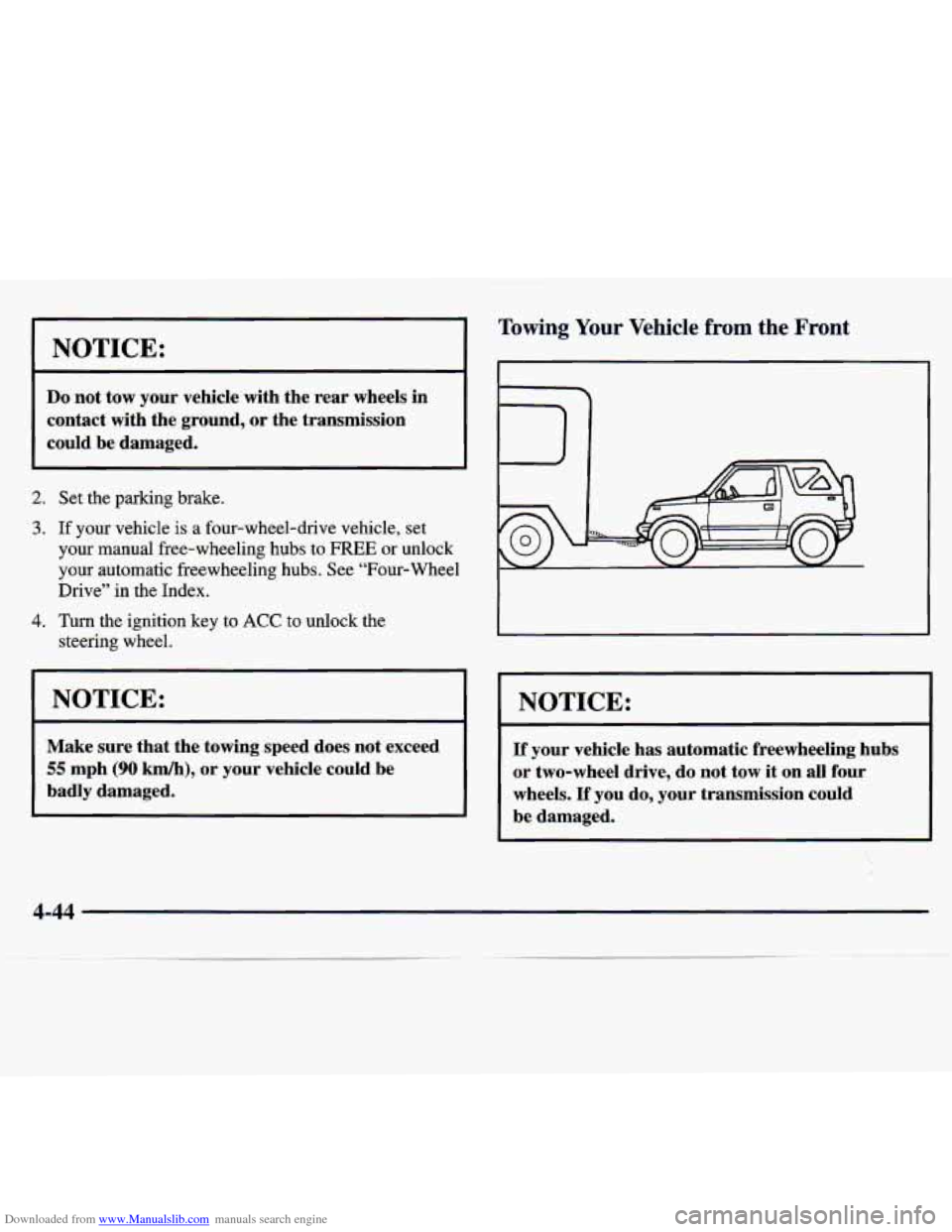
Towil- - Your Vehicle from the Front
I
NOTICE:
If your vehicle has automatic freewheeling hubs
or two-wheel drive, do not tow it on all four
wheels.
If you do, your transmission could
be damaged.
4-44
Page 190 of 386
Downloaded from www.Manualslib.com manuals search engine If you have a four-wheel-drive vehicle with manual
freewheeling hubs,
it can be towed from the front with
all four wheels on the ground. Follow these steps:
1.
2.
3.
4.
5.
6.
Set the parking brake.
Turn the ignition key to ACC to unlock the
steering wheel.
Shift your automatic transmission into
PARK (P), or
your manual transmission to SECOND
(2).
Shift the transfer case to NEUTRAL (N).
Set the hubs to
FREE. See “Four-wheel Drive” in
the Index.
Release the parking brake.
Stop towing every
200 miles (300 km) and start
the engine. Leave the transfer case shift lever in
NEUTRAL (N). Shift your automatic transmission
to DRIVE (D); leave a manual transmission in
SECOND
(2) with the clutch engaged. Run the engine at
medium speed for one minute to circulate oil in the
transfer case.
Turn the ignition key to ACC. Now, you
can continue towing your vehicle.
NOTICE:
The front wheels transmit shocks during towing.
The steering column may not be strong enough to
withstand the shocks. Always unlock the steering
wheel before towing.
I NOTICE:
Make sure that the towing speed does not exceed
50 mph (80 km/h), or your vehicle could be
badly damaged.
4-45
Page 191 of 386
Downloaded from www.Manualslib.com manuals search engine Loading Your Vehicle
TIRES
RIMS
MFD BY CAM1 AUTOMOTIVE
I DATE CANADA
GVWR GAWR FRT GAWR RR
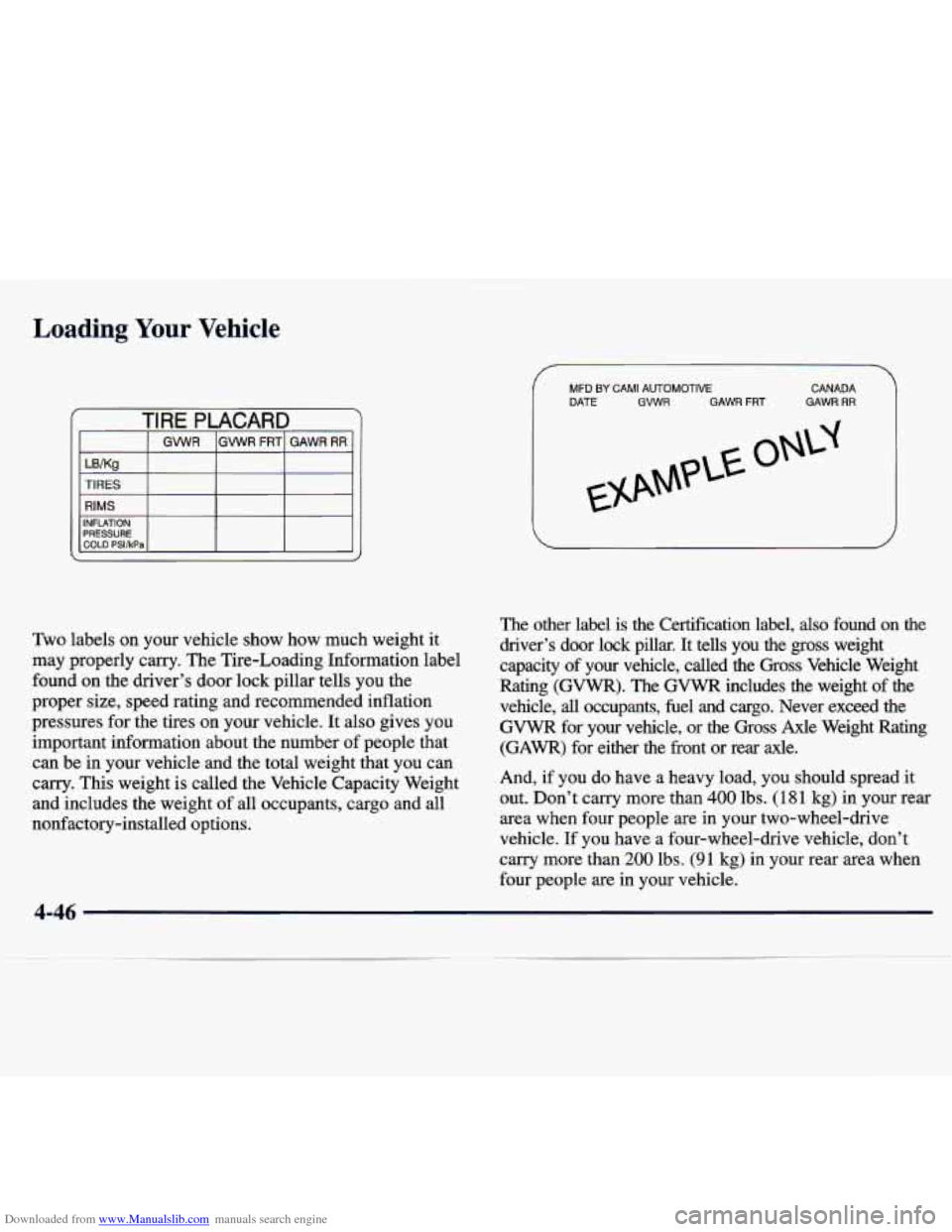
Two labels on your vehicle show how much weight it
may properly carry. The Tire-Loading Information label
found on the driver's door lock pillar tells you the
proper size, speed rating and recommended inflation
pressures for the tires on your vehicle. It also gives you
important information about the number of people that
can be in your vehicle and the total weight that you can carry. This weight is called the Vehicle Capacity Weight
and includes the weight
of all occupants, cargo and all
nonfactory-installed options. The other label is the Certification label,
also found on the
driver's door lock pillar. It tells you the
gross weight
capacity of your vehicle, called the
Gross Vehicle Weight
Rating (GVWR). The GVWR includes the weight of the vehicle, all occupants,
fuel and cargo. Never exceed the
GVWR for your vehicle, or the Gross Axle Weight Rating
(GAWR) for either the front or rear axle.
And, if
you do have a heavy load, you should spread it
out. Don't carry more than
400 lbs. (1 8 1 kg) in your rear
area when four people are in your two-wheel-drive
vehicle.
If you have a four-wheel-drive vehicle, don't
carry more than
200 lbs. (9 1 kg) in your rear area when
four people are in your vehicle.
Page 196 of 386
Downloaded from www.Manualslib.com manuals search engine If you’re using a weight-carrying hitch, the trailer
tongue (A) should weigh
10 percent of the total loaded
trailer weight (B).
If you’re using a weight-distributing
hitch, the trailer tongue (A) should weigh
12 percent of
the total loaded trailer weight
(B).
After you’ve loaded your trailer, weigh the trailer and
then the tongue, separately, to see if the weights are
proper. If they aren’t, you may be able to get them right
simply by moving some items around in the trailer.
Total Weight on Your Vehicle’s Tires
Be sure your vehicle’s tires are inflated to the upper
limit for cold tires. You’ll find these numbers on the
Tire-Loading Information Certification label at the rear
edge of the driver’s door lock pillar or see “Tire
Loading” in the Index. Then be sure you don’t go over
the
GVW limit for your vehicle, including the weight of
the trailer tongue.
Hitches
It’s important to have the correct hitch equipment.
Crosswinds, large trucks going by and rough roads are a
few reasons why you’ll need the right hitch. Here are
some rules to follow:
If you use a step-bumper hitch, your bumper could
be damaged in sharp turns. Make sure you have
ample room when turning to avoid contact between
the trailer and the bumper.
Safety Chains
You should always attach chains between your vehicle
and your trailer. Cross the safety chains under the tongue
of the trailer
so that the tongue will not drop to the road
if it becomes separated from the hitch. Instructions
about safety chains may be provided by the hitch
manufacturer or by the trailer manufacturer. Follow the
manufacturer’s recommendation for attaching safety
chains and do not attach them to the bumper. Always
leave just enough slack
so you can turn with your rig.
And, never allow safety chains
to drag on the ground.
4-51
- ..
Page 210 of 386
Downloaded from www.Manualslib.com manuals search engine When your vehicle is being towed, have the ignition
key turned to OFF. The steering wheel should be
clamped
in a straight-ahead position, with a clamping
device designed for towing service.
Do not use the
vehicle’s steering column lock for this. The transmission
and transfer case, if
you have one, should be in
NEUTRAL (N) and the parking brake released.
Don’t have your vehicle towed on the drive wheels
unless you must.
If the vehicle must be towed on the
drive wheels, be sure to follow any speed and distance
restrictions later in this section, or
your transmission
will be damaged. If these limitations must be exceeded,
then the drive wheels have to be supported on a dolly.
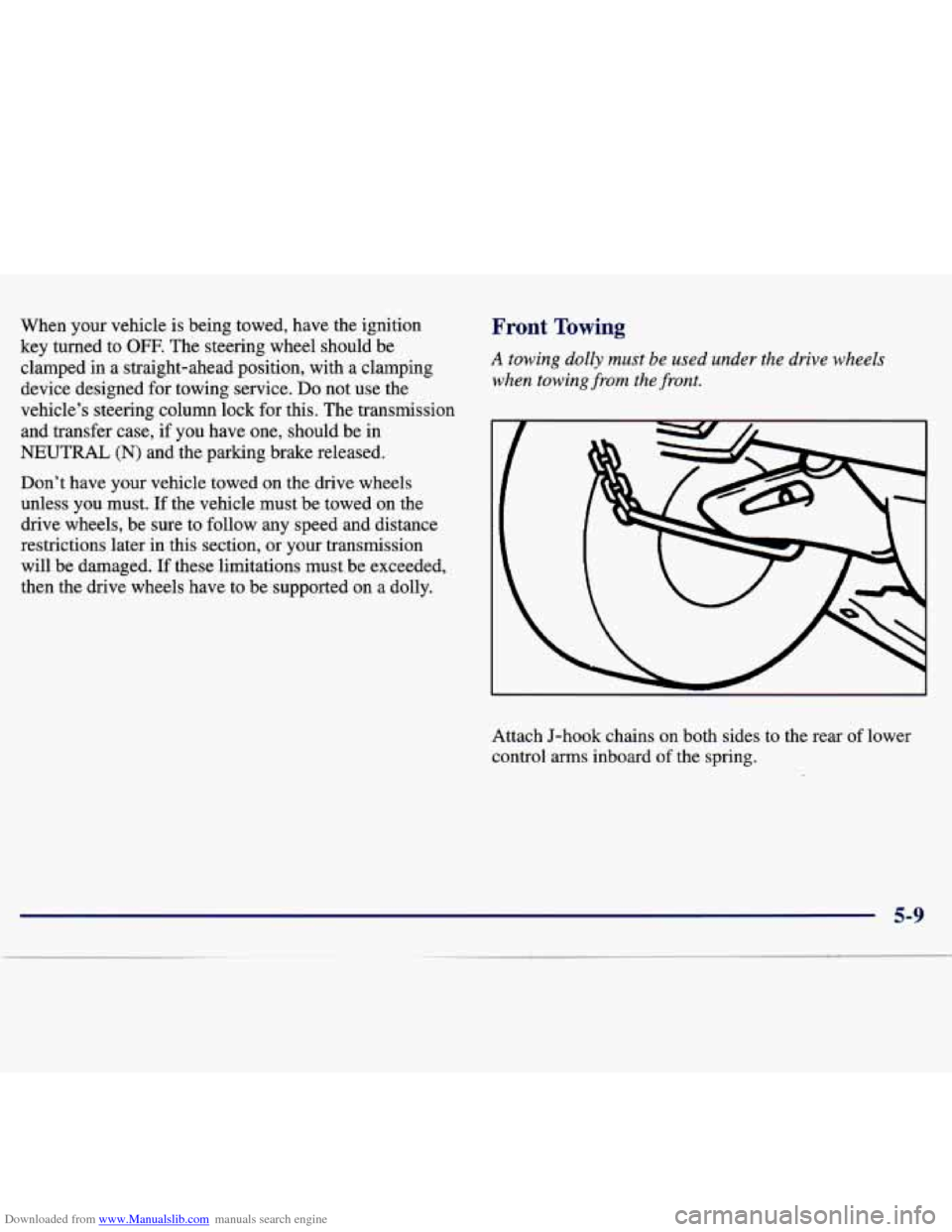
Front Towing
A towing dolly must be used under the drive wheels
when towing from the front.
Attach J-hook chains on both sides to the rear of lower
control arms inboard
of the spring.
5-9
Page 212 of 386
Downloaded from www.Manualslib.com manuals search engine Rear Towing
If your vehicle has four-wheel drive, don’t have it towed
on the front wheels unless you must. If
a vehicle with
four-wheel drive must be towed on the front wheels,, set
your manual, freewheeling hubs to FREE or unlock your
automatic freewheeling hubs, and set your transfer case
to two-wheel drive.
If your vehicle must be towed on
the front wheels, don’t
go more than 55 mph (90 kmh).
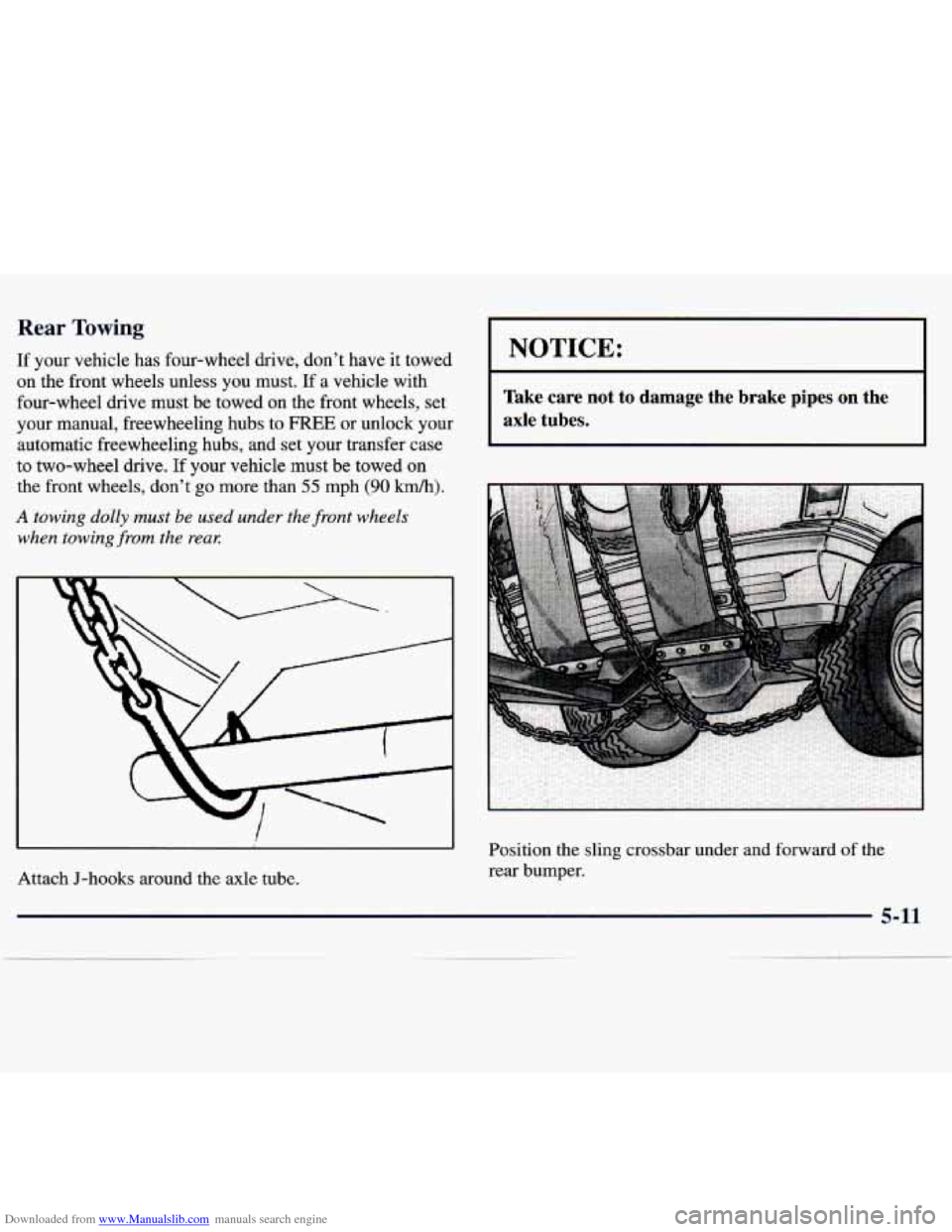
A towing dolly must be used under the front wheels
when towing
from the real:
Attach J-hooks around the axle tube.
I NOTICE:
Take care not to damage the brake pipes on the
axle
tubes.
Position the sling crossbar under and forward of the
rear bumper.
Page 220 of 386
Downloaded from www.Manualslib.com manuals search engine How to Add Coolant to the Radiator
I
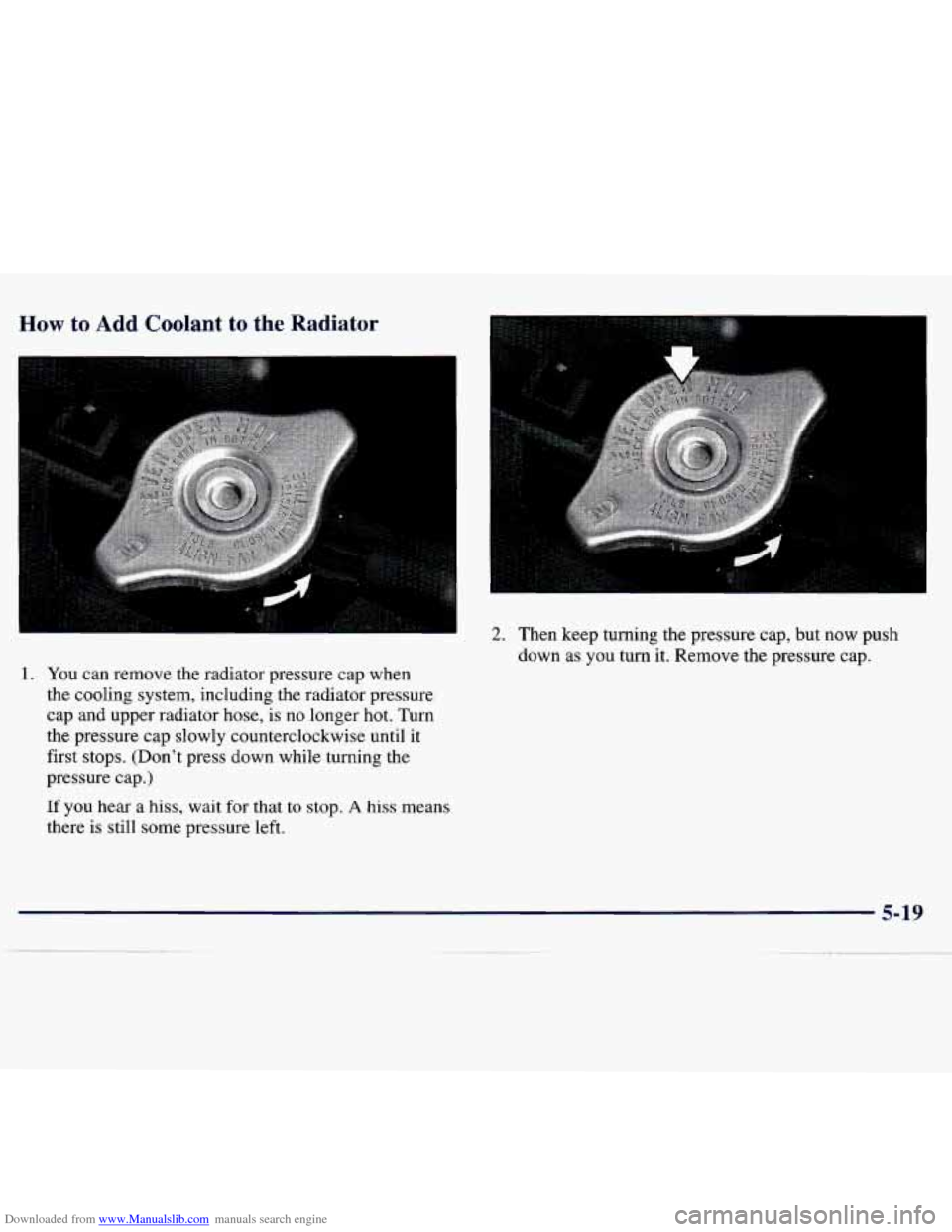
1. You can remove the radiator pressure cap when
the cooling system, including the radiator pressure
cap and upper radiator hose, is no longer hot. Turn
the pressure cap slowly counterclockwise until it
first stops. (Don’t press down while turning the
pressure cap.)
If you hear a hiss, wait for that to stop.
A hiss means
there is still some pressure left.
2. Then keep turning the pressure cap, but now push
down as you turn it. Remove the pressure cap.
5-19
Page 223 of 386
Downloaded from www.Manualslib.com manuals search engine Changing a Flat Tire
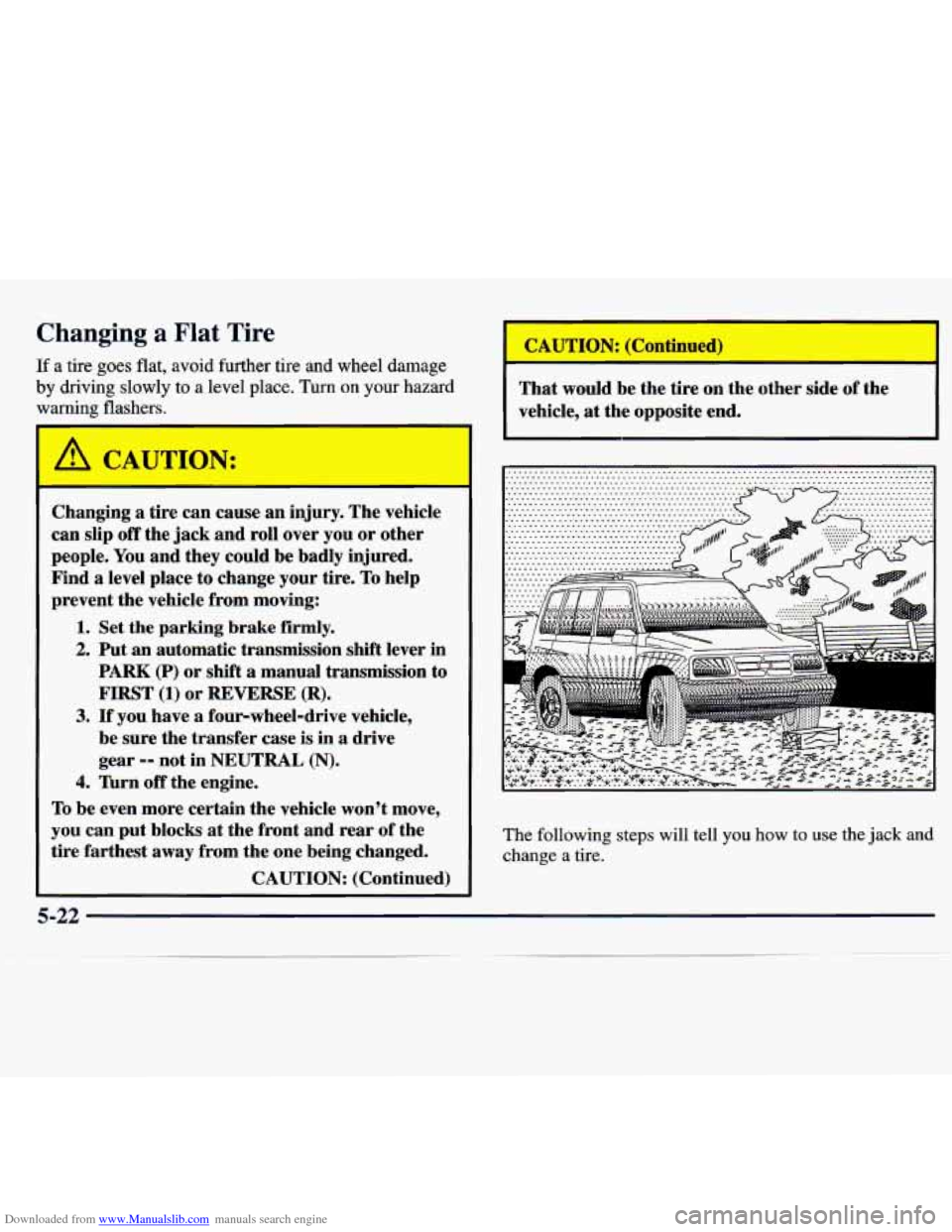
If a tire goes flat, avoid further tire and wheel damage
by driving slowly to a level place. Turn on your hazard
warning flashers.
A CAUTION:
Changing a tire can cause an injury. The vehicle
can slip
off the jack and roll over you or other
people.
You and they could be badly injured.
Find
a level place to change your tire. To help
prevent the vehicle from moving:
1. Set the parking brake firmly.
2. Put an automatic transmission shift lever in
PARK
(P) or shift a manual transmission to
FIRST
(1) or REVERSE (R).
3. If you have a four-wheel-drive vehicle,
be sure the transfer case
is in a drive
gear
-- not in NEUTRAL (N).
4. 'hrn off the engine.
To be even more certain the vehicle won't move,
you can put blocks at the front and rear
of the
tire farthest
away from the one being changed.
CAUTION: (Continued) That
would be the tire
on the other side of the
vehicle,
at the opposite end.
The following steps will tell
you how to use the jack and
change a tire.
Page 226 of 386
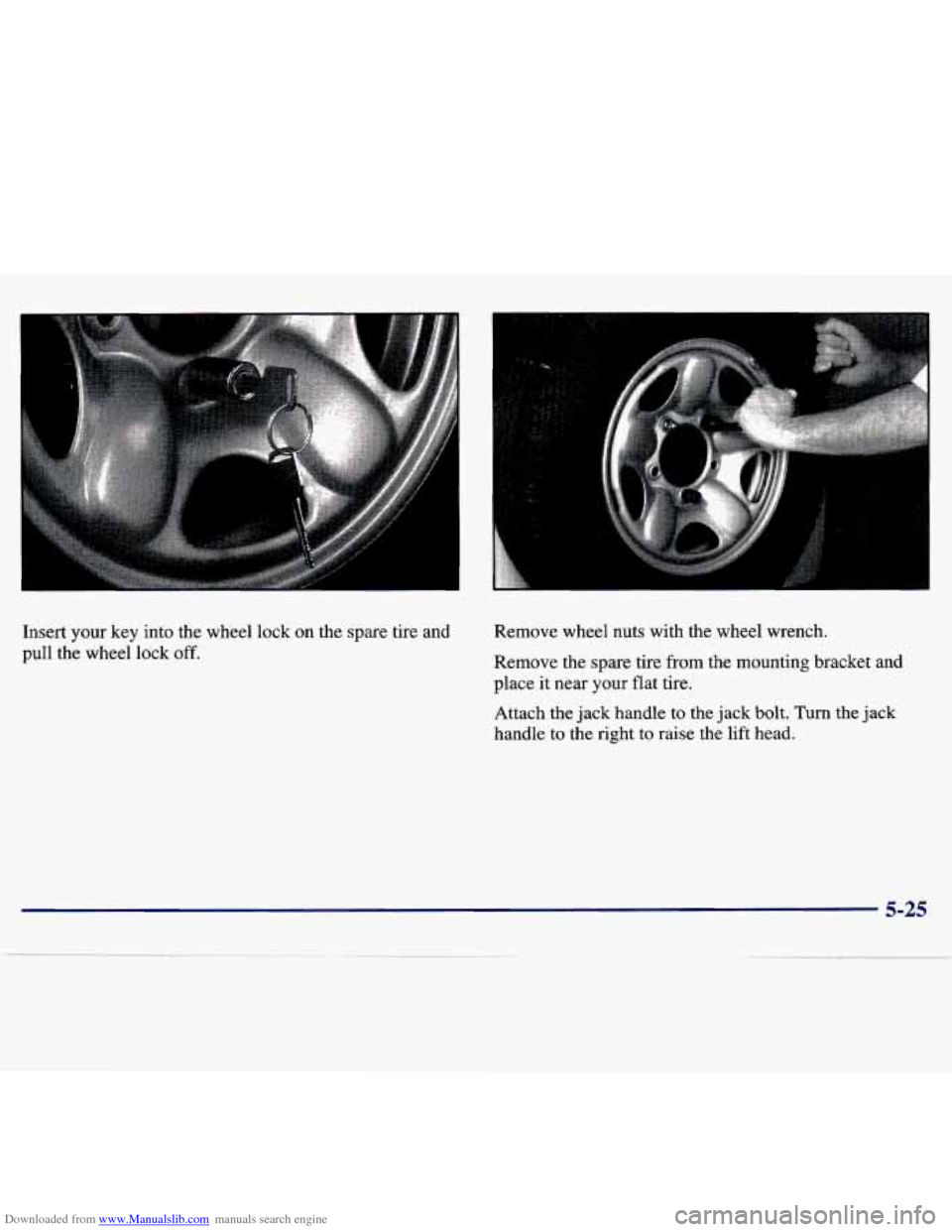
Downloaded from www.Manualslib.com manuals search engine Insert your key into the wheel lock on the spare tire and
pull the wheel lock
off.
Kemove wheel nuts with the wheel wrench.
Remove the spare tire from the mounting bracket and
place it near your flat tire.
Attach the jack handle to the jack bolt.
Turn the jack
handle to the right to raise the lift head.
5-25