lock CHEVROLET TRACKER 2003 2.G Workshop Manual
[x] Cancel search | Manufacturer: CHEVROLET, Model Year: 2003, Model line: TRACKER, Model: CHEVROLET TRACKER 2003 2.GPages: 372, PDF Size: 2.65 MB
Page 174 of 372

Traveling to Remote Areas
It makes sense to plan your trip, especially when going
to a remote area. Know the terrain and plan your
route. You are much less likely to get bad surprises.
Get accurate maps of trails and terrain. Try to learn of
any blocked or closed roads.
It's also a good idea to travel with at least one other
vehicle. If something happens to one of them, the other
can help quickly.
Does your vehicle have a winch? If so, be sure to read
the winch instructions. In a remote area, a winch
can be handy if you get stuck. But you'll want to know
how to use it properly.
Getting Familiar with Off-Road Driving
It's a good idea to practice in an area that's safe
and close to home before you go into the wilderness.
Off-road driving does require some new and different
driving skills. Here's what we mean.
Tune your senses to different kinds of signals. Your
eyes, for example, need to constantly sweep the terrain
for unexpected obstacles. Your ears need to listen
for unusual tire or engine sounds. With your arms,
hands, feet and body, you'll need to respond to
vibrations and vehicle bounce.Controlling your vehicle is the key to successful off-road
driving. One of the best ways to control your vehicle
is to control your speed. Here are some things to keep
in mind. At higher speeds:
·you approach things faster and you have less time
to scan the terrain for obstacles.
·you have less time to react.
·you have more vehicle bounce when you drive over
obstacles.
·you'll need more distance for braking, especially
since you're on an unpaved surfaces.
{CAUTION:
When you are driving off-road, bouncing and
quick changes in direction can easily throw
you out of position. This could cause you to
lose control and crash. So, whether you're
driving on or off the road, you and your
passengers should wear safety belts.
4-18
Page 176 of 372

Driving on Off-Road Hills
Off-road driving often takes you up, down or across a
hill. Driving safely on hills requires good judgment
and an understanding of what your vehicle can and can't
do. There are some hills that simply can't be driven,
no matter how well built the vehicle.
{CAUTION:
Many hills are simply too steep for any vehicle.
If you drive up them, you will stall. If you drive
down them, you can not control your speed.
If you drive across them, you will roll over.
You could be seriously injured or killed. If you
have any doubt about the steepness, do not
drive the hill.
Approaching a Hill
When you approach a hill, you need to decide if it's one
of those hills that's just too steep to climb, descend
or cross. Steepness can be hard to judge. On a very
small hill, for example, there may be a smooth, constantincline with only a small change in elevation where you
can easily see all the way to the top. On a large hill,
the incline may get steeper as you near the tip, but you
may not see this because the crest of the hill is
hidden by bushes, grass or shrubs.
Here are some other things to consider as you
approach a hill.
·Is there a constant incline, or does the hill get
sharply steeper in places?
·Is there good traction on the hillside, or will the
surface cause tire slipping?
·Is there a straight path up or down the hill so you
won't have to make turning maneuvers?
·Are there obstructions on the hill that can block
your path (boulders, trees, logs or ruts)?
·What's beyond the hill? Is there a cliff, an
embankment, a drop-off, a fence? Get out and walk
the hill if you don't know. It's the smart way to
®nd out.
·Is the hill simply too rough? Steep hills often have
ruts, gullies, troughs, and exposed rocks because
they are more susceptible to the effects of erosion.
4-20
Page 178 of 372

Q:What should I do if my vehicle stalls, or is
about to stall, and I can't make it up the hill?
A:If this happens, there are some things you should
do, and there are some things you must not do.
First here's what you
shoulddo:
·Push the brake pedal to stop the vehicle and keep it
from rolling backwards. Also, apply the parking brake.
·If your engine is still running, shift the transmission to
REVERSE (R), release the parking brake, and slowly
back down the hill in REVERSE (R)
·If your engine has stopped running, you'll need to
restart it. With the brake pedal pressed and the
parking brake still applied, shift the transmission to
PARK (P) (or, shift to neutral if your vehicle has a
manual transmission) and restart the engine.
Then, shift to REVERSE (R), release the parking
brake, and slowly back down the ®ll as straight as
possible in REVERSE (R).
·As you are backing down the hill, put your left hand
on the steering wheel at the 12 o'clock position.
This way, you'll be able to tell if your wheels are
straight and maneuver as you back down.
It's best that you back down the hill with your wheels
straight rather than in the left or right direction.
Turning the wheel too far to the left or right will
increase the possibility of a rollover.Here are some things you
must notdo if you stall, or
are about to stall, when going up a hill.
·Never attempt to prevent a stall by shifting into
NEUTRAL (N) (or pressing the clutch, if you have a
manual transmission) to ªrev-upº the engine and
regain forward momentum. This won't work.
Your vehicle will roll backwards very quickly and
you could go out of control.
Instead, apply the regular brake to stop the vehicle.
Then apply the parking brake. Shift to
REVERSE (R), release the parking brake, and slowly
back straight down.
·Never attempt to turn around if you are about to stall
when going up a hill. If the hill is steep enough to stall
your vehicle, it's steep enough to cause you to roll
over if you turn around. If you can't make it up the hill,
you must back straight down the hill.
4-22
Page 181 of 372

Q:Are there some things I should not do when
driving down a hill?
A:Yes! These are important because if you ignore
them you could lose control and have a serious
accident.
·When driving downhill, avoid turns that take you
across the incline of the hill. A hill that's not too
steep to drive down may be too steep to drive
across. You could roll over if you don't drive
straight down.
·Never go downhill with the transmission in
NEUTRAL (N), or with the clutch pedal pressed
down in a manual shift. This is called ªfree-wheeling.º
Your brakes will have to do all the work and could
overheat and fade.
·Unless you have anti-lock: Avoid braking so hard that
you lock the wheels when going downhill. If your
wheels are locked, you can't steer your vehicle.
If your wheels lock up during downhill braking,
you may feel the vehicle starting to slide sideways.
To regain your direction, just ease off the brakes and
steer to keep the front of the vehicle pointing straight
downhill.
Q:Am I likely to stall when going downhill?
A:It's much more likely to happen going uphill. But if
it happens going downhill, here's what to do.
·Stop your vehicle by applying the regular brakes.
Apply the parking brake.
·Shift to PARK (P) (or to neutral with the manual
transmission) and, while still braking, restart the
engine.
·Shift back to a low gear, release the parking brake,
and drive straight down.
·If the engine won't start, get out and get help.
4-25
Page 197 of 372

What's the worst time for this? ªWet ice.º Very cold snow
or ice can be slick and hard to drive on. But wet ice can
be even more trouble because it may offer the least
traction of all. You can get wet ice when it's about
freezing (32ÉF; 0ÉC) and freezing rain begins to fall.
Try to avoid driving on wet ice until salt and sand crews
can get there.
Whatever the condition ± smooth ice, packed, blowing
or loose snow ± drive with caution.
Accelerate gently. Try not to break the fragile traction.
If you accelerate too fast, the drive wheels will spin and
polish the surface under the tires even more.Unless you have the anti-lock braking system, you'll
want to brake very gently, too. If you do have anti-lock,
see
Braking on page 4-7. This system improves your
vehicle's stability when you make a hard stop on a
slippery road. Whether you have the anti-lock braking
system or not, you'll want to begin stopping sooner than
you would on dry pavement. Without anti-lock brakes,
if you feel your vehicle begin to slide, let up on the
brakes a little. Push the brake pedal down steadily to
get the most traction you can.
Remember,unless you have anti-lock, if you brake so
hard that your wheels stop rolling, you'll just slide. Brake
so your wheels always keep rolling and you can still steer.
·Whatever your braking system, allow greater
following distance on any slippery road.
·Watch for slippery spots. The road might be ®ne
until you hit a spot that's covered with ice. On an
otherwise clear road, ice patches may appear in
shaded areas where the sun can't reach: around
clumps of trees, behind buildings or under bridges.
Sometimes the surface of a curve or an overpass
may remain icy when the surrounding roads are
clear. If you see a patch of ice ahead of you, brake
before you are on it. Try not to brake while you're
actually on the ice, and avoid sudden steering
maneuvers.
4-41
Page 199 of 372

{CAUTION:
Snow can trap exhaust gases under your
vehicle. This can cause deadly CO (carbon
monoxide) gas to get inside. CO could
overcome you and kill you. You can not see it
or smell it, so you might not know it is in your
vehicle. Clear away snow from around the
base of your vehicle, especially any that is
blocking your exhaust pipe. And check around
again from time to time to be sure snow does
not collect there.
Open a window just a little on the side of the
vehicle that is away from the wind. This will
help keep CO out.Run your engine only as long as you must. This saves
fuel. When you run the engine, make it go a little faster
than just idle. That is, push the accelerator slightly.
This uses less fuel for the heat that you get and it keeps
the battery charged. You will need a well-charged battery
to restart the vehicle, and possibly for signaling later on
with your headlamps. Let the heater run for a while.
Then, shut the engine off and close the window almost
all the way to preserve the heat. Start the engine
again and repeat this only when you feel really
uncomfortable from the cold. But do it as little as
possible. Preserve the fuel as long as you can. To help
keep warm, you can get out of the vehicle and do
some fairly vigorous exercises every half hour or so until
help comes.
4-43
Page 205 of 372
Stop towing every 200 miles (300 km) and start the
engine. Leave the transfer case shift lever in NEUTRAL.
Shift your automatic transmission to DRIVE (D);
leave a manual transmission in SECOND (2) with the
clutch engaged. Run the engine at 2,000 rpm for
one minute to circulate oil in the transfer case. Turn the
ignition key to ACC. Now, you can continue towing
your vehicle.
Notice:Locking the steering column when towing
your vehicle may damage the steering column.
Always unlock the steering column before towing.
Notice:If you exceed 55 mph (90 km/h) while
towing your vehicle, it could be damaged. Never
exceed 55 mph (90 km/h) while towing your vehicle.
{CAUTION:
Shifting a four-wheel-drive vehicle's transfer
case into NEUTRAL can cause your vehicle to
roll even if the transmission is in Park (P) for
an automatic transmission, or if your vehicle is
in gear, for a manual transmission. You or
others could be injured. Make sure the parking
brake is ®rmly set before you shift the transfer
case to NEUTRAL.
4-49
Page 207 of 372

Loading Your Vehicle
Two labels on your vehicle show how much weight it
may properly carry. The tire-loading information
label found on the driver's door lock pillar tells you the
proper size and recommended in¯ation pressures for the
tires on your vehicle.The other label is the certi®cation label, also found on
the driver's door lock pillar. It tells you the gross weight
capacity of your vehicle, called the Gross Vehicle
Weight Rating (GVWR). The GVWR includes the weight
of the vehicle, all occupants, fuel and cargo. Never
exceed the GVWR for your vehicle, or the Gross Axle
Weight Rating (GAWR) for either the front or rear axle.
4-51
Page 223 of 372
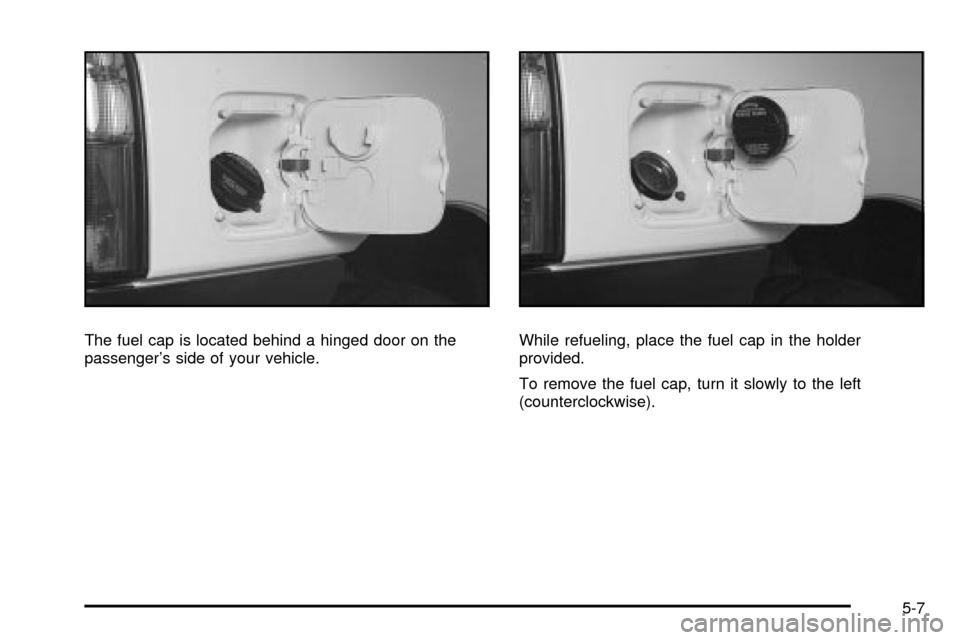
The fuel cap is located behind a hinged door on the
passenger's side of your vehicle.While refueling, place the fuel cap in the holder
provided.
To remove the fuel cap, turn it slowly to the left
(counterclockwise).
5-7
Page 224 of 372

{CAUTION:
If you get fuel on yourself and then something
ignites it, you could be badly burned. Fuel can
spray out on you if you open the fuel cap too
quickly. This spray can happen if your tank is
nearly full, and is more likely in hot weather.
Open the fuel cap slowly and wait for any
ªhissº noise to stop. Then unscrew the cap
all the way.
Be careful not to spill fuel. Clean fuel from painted
surfaces as soon as possible. See
Cleaning the Outside
of Your Vehicle on page 5-82. When ®lling the tank
do not over®ll by squeezing in much more fuel after the
pump shuts off.When you put the fuel cap back on, turn it to the right
(clockwise) until you hear a clicking sound. Make sure
you fully install the cap. The diagnostic system can
determine if the fuel cap has been left off or improperly
installed. This would allow fuel to evaporate into the
atmosphere. See
Malfunction Indicator Lamp on
page 3-31.
Notice:If you need a new fuel cap, be sure to get
the right type. Your dealer can get one for you.
If you get the wrong type, it may not ®t properly.
This may cause your malfunction indicator lamp to
light and may damage your fuel tank and emissions
system. See ªMalfunction Indicator Lampº in the
Index.
5-8