lock CHEVROLET TRACKER 2003 2.G Manual PDF
[x] Cancel search | Manufacturer: CHEVROLET, Model Year: 2003, Model line: TRACKER, Model: CHEVROLET TRACKER 2003 2.GPages: 372, PDF Size: 2.65 MB
Page 287 of 372
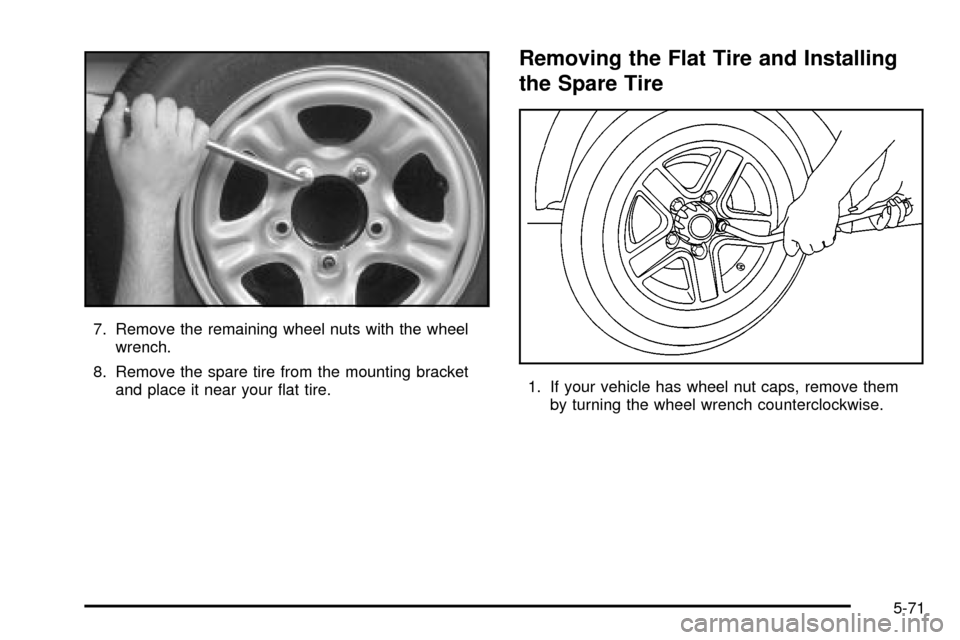
7. Remove the remaining wheel nuts with the wheel
wrench.
8. Remove the spare tire from the mounting bracket
and place it near your ¯at tire.
Removing the Flat Tire and Installing
the Spare Tire
1. If your vehicle has wheel nut caps, remove them
by turning the wheel wrench counterclockwise.
5-71
Page 289 of 372
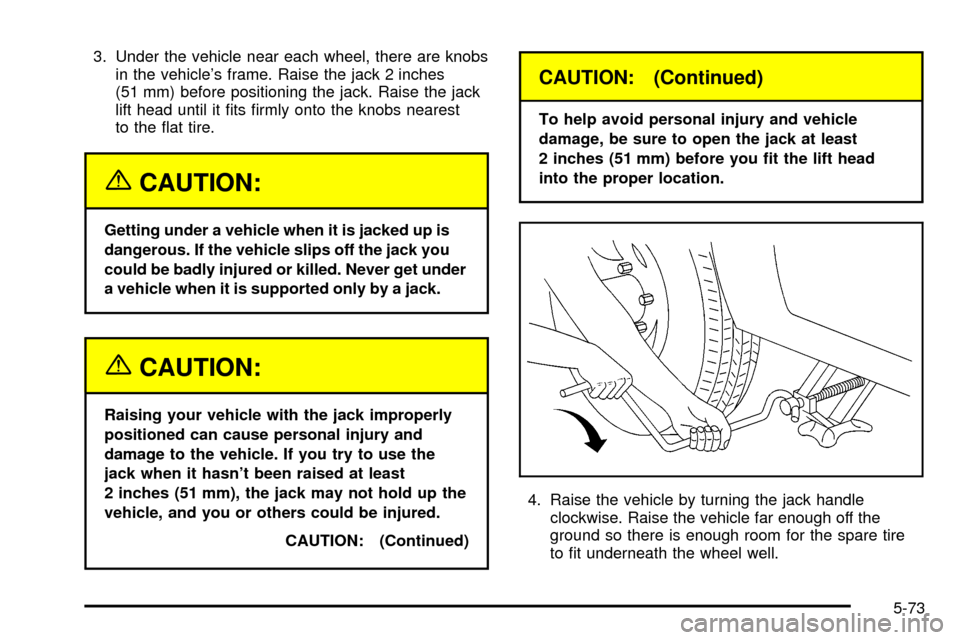
3. Under the vehicle near each wheel, there are knobs
in the vehicle's frame. Raise the jack 2 inches
(51 mm) before positioning the jack. Raise the jack
lift head until it ®ts ®rmly onto the knobs nearest
to the ¯at tire.
{CAUTION:
Getting under a vehicle when it is jacked up is
dangerous. If the vehicle slips off the jack you
could be badly injured or killed. Never get under
a vehicle when it is supported only by a jack.
{CAUTION:
Raising your vehicle with the jack improperly
positioned can cause personal injury and
damage to the vehicle. If you try to use the
jack when it hasn't been raised at least
2 inches (51 mm), the jack may not hold up the
vehicle, and you or others could be injured.
CAUTION: (Continued)
CAUTION: (Continued)
To help avoid personal injury and vehicle
damage, be sure to open the jack at least
2 inches (51 mm) before you ®t the lift head
into the proper location.
4. Raise the vehicle by turning the jack handle
clockwise. Raise the vehicle far enough off the
ground so there is enough room for the spare tire
to ®t underneath the wheel well.
5-73
Page 291 of 372

7. Place the spare on the wheel mounting surface.
8. Reinstall the wheel
nuts with the
cone-shaped end of
the nuts toward
the wheel. Tighten
each nut by hand until
the wheel is held
against the hub.
9. Lower the vehicle by turning the jack handle
counterclockwise. Lower the jack completely.
5-75
Page 294 of 372

4. Put the spare wheel lock back on, if equipped and
lock it.
5. Put the jack, jack handle and wheel wrench back
into the storage area.
To stow the jack, place it in the storage bracket and
turn the shaft clockwise until the jack is securely held in
place. Reinstall the trim cover by inserting the cover
tabs into the slots. Push the cover closed and turn the
knob clockwise to secure the cover.
A. Wrench
B. Jack Handle
C. Jack
{CAUTION:
Make sure the tire is secure. Driving with the tire
not properly secured could injure pedestrians
or damage the vehicle.
5-78
Page 305 of 372

Electrical System
Add-On Electrical Equipment
Notice:Don't add anything electrical to your vehicle
unless you check with your dealer ®rst. Some
electrical equipment can damage your vehicle and
the damage wouldn't be covered by your warranty.
Some add-on electrical equipment can keep other
components from working as they should.
Your vehicle has an air bag system. Before attempting to
add anything electrical to your vehicle, see
Servicing
Your Air Bag-Equipped Vehicle on page 1-60.
Fuses and Circuit Breakers
The wiring circuits in your vehicle are protected from
short circuits by fuses, circuit breakers and thermal links
in the wiring itself. This greatly reduces the chance of
®res caused by electrical problems.
Look at the metallic band inside the fuse. If the band
is broken or melted, replace the fuse. Be sure you
replace a bad fuse with a new one of the correct size.
If you ever have a problem on the road and don't
have a spare fuse, you can borrow one. Just pick
some feature of your vehicle that you can get along
without Ð like the radio or cigarette lighter Ð and use
its fuse, if it is the size you need. Replace it as soon as
you can.
Before replacing a fuse, turn every vehicle electrical
switch off.
There are two fuse blocks in your vehicle: the instrument
panel fuse block and the engine compartment fuse block.
5-89
Page 306 of 372
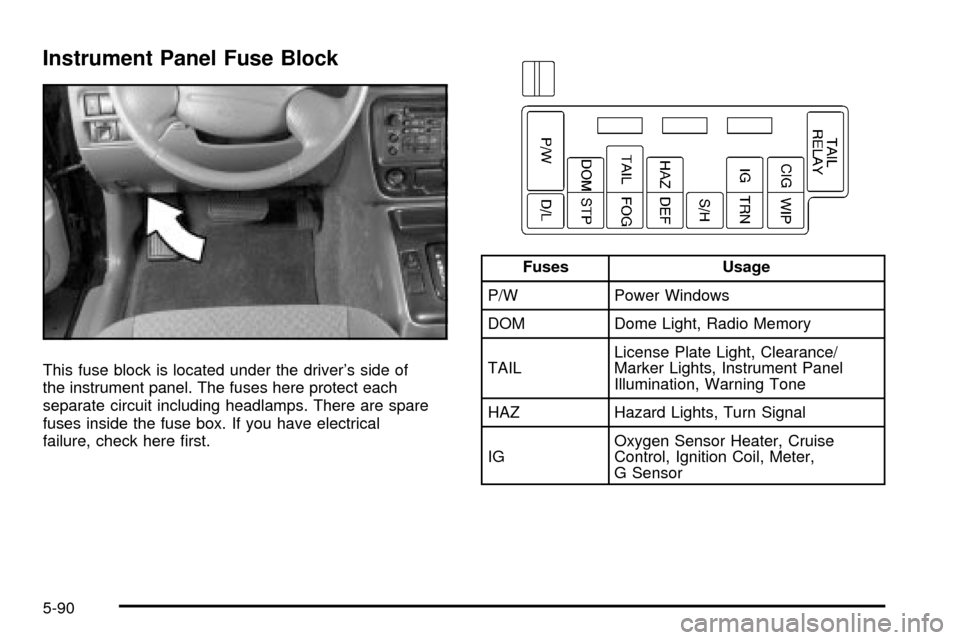
Instrument Panel Fuse Block
This fuse block is located under the driver's side of
the instrument panel. The fuses here protect each
separate circuit including headlamps. There are spare
fuses inside the fuse box. If you have electrical
failure, check here ®rst.
Fuses Usage
P/W Power Windows
DOM Dome Light, Radio Memory
TAILLicense Plate Light, Clearance/
Marker Lights, Instrument Panel
Illumination, Warning Tone
HAZ Hazard Lights, Turn Signal
IGOxygen Sensor Heater, Cruise
Control, Ignition Coil, Meter,
G Sensor
5-90
Page 307 of 372
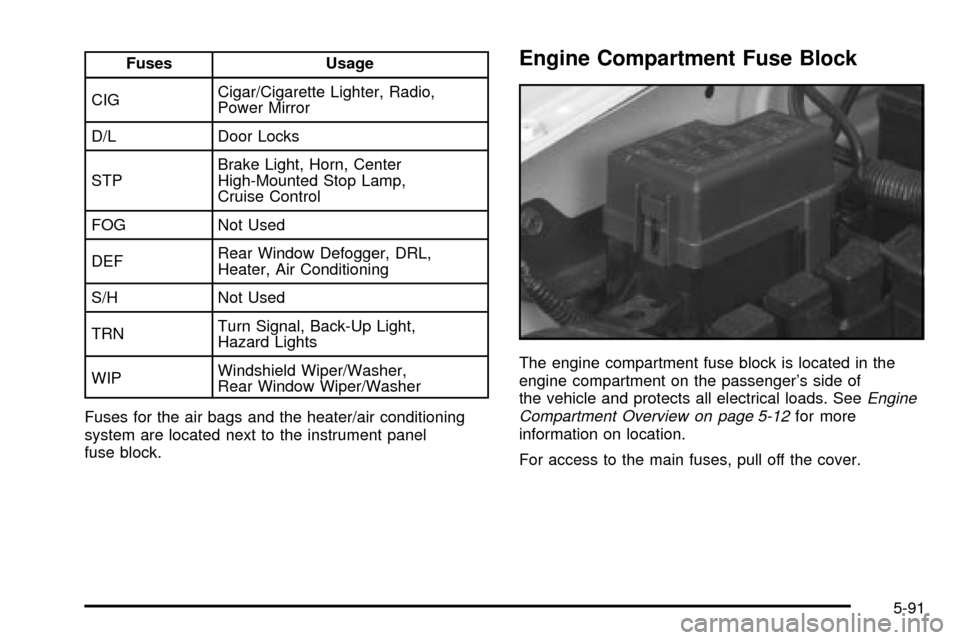
Fuses Usage
CIGCigar/Cigarette Lighter, Radio,
Power Mirror
D/L Door Locks
STPBrake Light, Horn, Center
High-Mounted Stop Lamp,
Cruise Control
FOG Not Used
DEFRear Window Defogger, DRL,
Heater, Air Conditioning
S/H Not Used
TRNTurn Signal, Back-Up Light,
Hazard Lights
WIPWindshield Wiper/Washer,
Rear Window Wiper/Washer
Fuses for the air bags and the heater/air conditioning
system are located next to the instrument panel
fuse block.Engine Compartment Fuse Block
The engine compartment fuse block is located in the
engine compartment on the passenger's side of
the vehicle and protects all electrical loads. See
Engine
Compartment Overview on page 5-12for more
information on location.
For access to the main fuses, pull off the cover.
5-91
Page 308 of 372
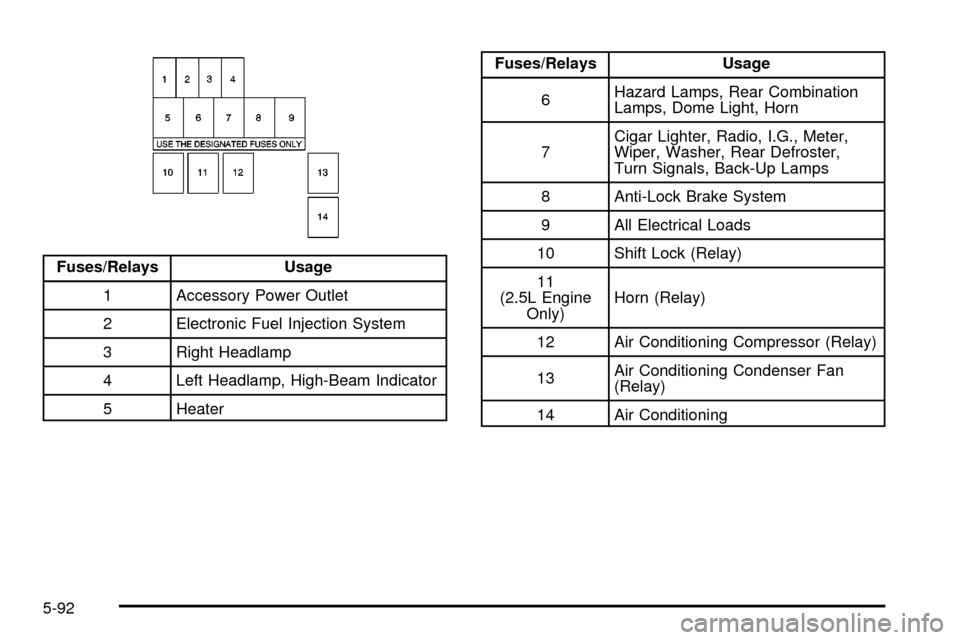
Fuses/Relays Usage
1 Accessory Power Outlet
2 Electronic Fuel Injection System
3 Right Headlamp
4 Left Headlamp, High-Beam Indicator
5 Heater
Fuses/Relays Usage
6Hazard Lamps, Rear Combination
Lamps, Dome Light, Horn
7Cigar Lighter, Radio, I.G., Meter,
Wiper, Washer, Rear Defroster,
Turn Signals, Back-Up Lamps
8 Anti-Lock Brake System
9 All Electrical Loads
10 Shift Lock (Relay)
11
(2.5L Engine
Only)Horn (Relay)
12 Air Conditioning Compressor (Relay)
13Air Conditioning Condenser Fan
(Relay)
14 Air Conditioning
5-92
Page 337 of 372

At Least Twice a Year
Restraint System Check
Make sure the safety belt reminder light and all your belts,
buckles, latch plates, retractors and anchorages are
working properly. Look for any other loose or damaged
safety belt system parts. If you see anything that might
keep a safety belt system from doing its job, have it
repaired. Have any torn or frayed safety belts replaced.
Also look for any opened or broken air bag coverings,
and have them repaired or replaced. (The air bag
system does not need regular maintenance.)
Wiper Blade Check
Inspect wiper blades for wear or cracking. Replace
blade inserts that appear worn or damaged or that
streak or miss areas of the windshield. Also see
Cleaning the Outside of Your Vehicle on page 5-82.
Weatherstrip Lubrication
Silicone grease on weatherstrips will make them last
longer, seal better, and not stick or squeak. Apply
silicone grease with a clean cloth. During very cold,
damp weather more frequent application may be
required. See
Part D: Recommended Fluids and
Lubricants on page 6-30.
Fluid Level Check
Check the transfer case, axle differential(s) and
automatic or manual transmission ¯uid levels and add
as needed. See
Rear Axle on page 5-52,Four-Wheel
Drive on page 5-53, andAutomatic Transmission
Fluid on page 5-23orManual Transmission Fluid on
page 5-26. Check for leaks. A ¯uid loss in these systems
could indicate a problem. Have the system inspected
and repaired at once.
At Least Once a Year
Key Lock Cylinders Service
Lubricate the key lock cylinders with the lubricant
speci®ed in Part D.
Body Lubrication Service
Lubricate all body door hinges. Also lubricate all
hinges and latches, including those for the hood,
rear compartment, glove box door, console door and
folding seat hardware. Part D tells you what to use.
More frequent lubrication may be required when
exposed to a corrosive environment.
6-25
Page 338 of 372
Starter Switch Check
{CAUTION:
When you are doing this inspection, the
vehicle could move suddenly. If the vehicle
moves, you or others could be injured.
1. Before you start, be sure you have enough room
around the vehicle.
2. Firmly apply both the parking brake and the regular
brake. See
Parking Brake on page 2-27if necessary.
Do not use the accelerator pedal, and be ready to
turn off the engine immediately if it starts.
3. On automatic transmission vehicles, try to start the
engine in each gear. The starter should work only
in PARK (P) or NEUTRAL (N). If the starter works in
any other position, your vehicle needs service.
On manual transmission vehicles, put the shift lever
in NEUTRAL (N), push the clutch down halfway and
try to start the engine. The starter should work only
when the clutch is pushed down all the way to the
¯oor. If the starter works when the clutch isn't pushed
all the way down, your vehicle needs service.
Automatic Transmission Shift Lock
Control System Check
{CAUTION:
When you are doing this inspection, the
vehicle could move suddenly. If the vehicle
moves, you or others could be injured.
1. Before you start, be sure you have enough room
around the vehicle. It should be parked on a level
surface.
2. Firmly apply the parking brake. See
Parking Brake
on page 2-27if necessary.
Be ready to apply the regular brake immediately if
the vehicle begins to move.
3. With the engine off, turn the key to the ON position,
but don't start the engine. Without applying the
regular brake, try to move the shift lever out
of PARK (P) with normal effort. If the shift lever
moves out of PARK (P), your vehicle needs service.
6-26