brake CHEVROLET TRACKER 2003 2.G Repair Manual
[x] Cancel search | Manufacturer: CHEVROLET, Model Year: 2003, Model line: TRACKER, Model: CHEVROLET TRACKER 2003 2.GPages: 372, PDF Size: 2.65 MB
Page 274 of 372
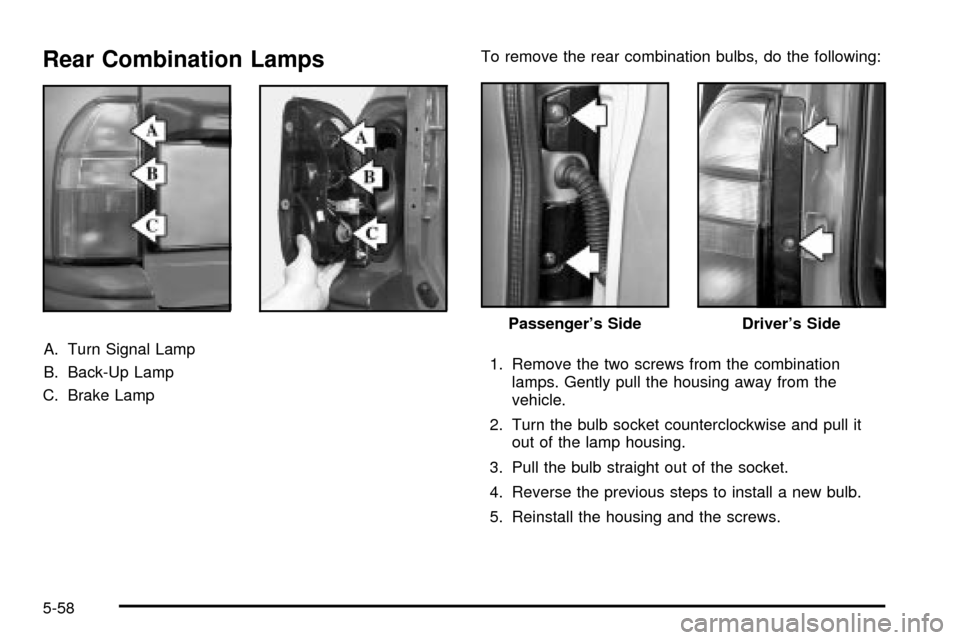
Rear Combination Lamps
A. Turn Signal Lamp
B. Back-Up Lamp
C. Brake LampTo remove the rear combination bulbs, do the following:
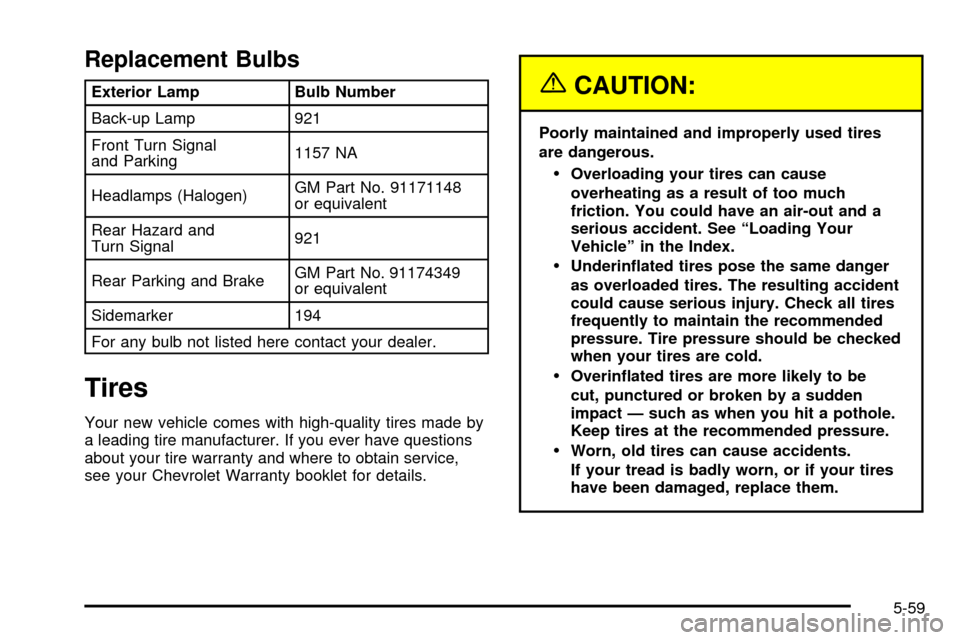
1. Remove the two screws from the combination
lamps. Gently pull the housing away from the
vehicle.
2. Turn the bulb socket counterclockwise and pull it
out of the lamp housing.
3. Pull the bulb straight out of the socket.
4. Reverse the previous steps to install a new bulb.
5. Reinstall the housing and the screws.
Driver's SidePassenger's Side
5-58
Page 275 of 372
Replacement Bulbs
Exterior Lamp Bulb Number
Back-up Lamp 921
Front Turn Signal
and Parking1157 NA
Headlamps (Halogen)GM Part No. 91171148
or equivalent
Rear Hazard and
Turn Signal921
Rear Parking and BrakeGM Part No. 91174349
or equivalent
Sidemarker 194
For any bulb not listed here contact your dealer.
Tires
Your new vehicle comes with high-quality tires made by
a leading tire manufacturer. If you ever have questions
about your tire warranty and where to obtain service,
see your Chevrolet Warranty booklet for details.
{CAUTION:
Poorly maintained and improperly used tires
are dangerous.
·Overloading your tires can cause
overheating as a result of too much
friction. You could have an air-out and a
serious accident. See ªLoading Your
Vehicleº in the Index.
·Underin¯ated tires pose the same danger
as overloaded tires. The resulting accident
could cause serious injury. Check all tires
frequently to maintain the recommended
pressure. Tire pressure should be checked
when your tires are cold.
·Overin¯ated tires are more likely to be
cut, punctured or broken by a sudden
impact Ð such as when you hit a pothole.
Keep tires at the recommended pressure.
·Worn, old tires can cause accidents.
If your tread is badly worn, or if your tires
have been damaged, replace them.
5-59
Page 281 of 372
Each new wheel should have the same load-carrying
capacity, diameter, width, offset and be mounted
the same way as the one it replaces.
If you need to replace any of your wheels, wheel bolts
or wheel nuts, replace them only with new GM
original equipment parts. This way, you will be sure to
have the right wheel, wheel bolts and wheel nuts
for your vehicle.
{CAUTION:
Using the wrong replacement wheels, wheel
bolts or wheel nuts on your vehicle can be
dangerous. It could affect the braking and
handling of your vehicle, make your tires lose
air and make you lose control. You could have
a collision in which you or others could be
injured. Always use the correct wheel, wheel
bolts and wheel nuts for replacement.
Notice:The wrong wheel can also cause problems
with bearing life, brake cooling, speedometer or
odometer calibration, headlamp aim, bumper height,
vehicle ground clearance and tire or tire chain
clearance to the body and chassis.
See
Changing a Flat Tire on page 5-67for more
information.
Used Replacement Wheels
{CAUTION:
Putting a used wheel on your vehicle is
dangerous. You can't know how it's been used
or how far it's been driven. It could fail
suddenly and cause a crash. If you have to
replace a wheel, use a new GM original
equipment wheel.
5-65
Page 282 of 372
Tire Chains
Notice:Use tire chains only where legal and only
when you must. Use only SAE Class²S²type chains
that are the proper size for your tires. Install them
on the tires of the drive axle (four-wheel-drive
vehicles can use chains on both axles). Tighten
them as tightly as possible with the ends securely
fastened. Drive slowly and follow the chain
manufacturer's instructions. If you can hear the
chains contacting your vehicle, stop and retighten
them. If the contact continues, slow down until
it stops. Driving too fast or spinning the wheels
with chains on will damage your vehicle.
If a Tire Goes Flat
It's unusual for a tire to ªblowoutº while you're driving,
especially if you maintain your tires properly. If air goes
out of a tire, it's much more likely to leak out slowly.
But if you should ever have a ªblowout,º here are a few
tips about what to expect and what to do:
If a front tire fails, the ¯at tire will create a drag that
pulls the vehicle toward that side. Take your foot off the
accelerator pedal and grip the steering wheel ®rmly.
Steer to maintain lane position, and then gently brake to
a stop well out of the traffic lane.A rear blowout, particularly on a curve, acts much like a
skid and may require the same correction you'd use
in a skid. In any rear blowout, remove your foot from the
accelerator pedal. Get the vehicle under control by
steering the way you want the vehicle to go. It may be
very bumpy and noisy, but you can still steer. Gently
brake to a stop, well off the road if possible.
{CAUTION:
Lifting a vehicle and getting under it to do
maintenance or repairs is dangerous without
the appropriate safety equipment and training.
The jack provided with your vehicle is designed
only for changing a ¯at tire. If it is used for
anything else, you or others could be badly
injured or killed if the vehicle slips off the jack.
Use the jack provided with your vehicle only for
changing a ¯at tire.
If a tire goes ¯at, the next part shows how to use your
jacking equipment to change a ¯at tire safely.
5-66
Page 283 of 372
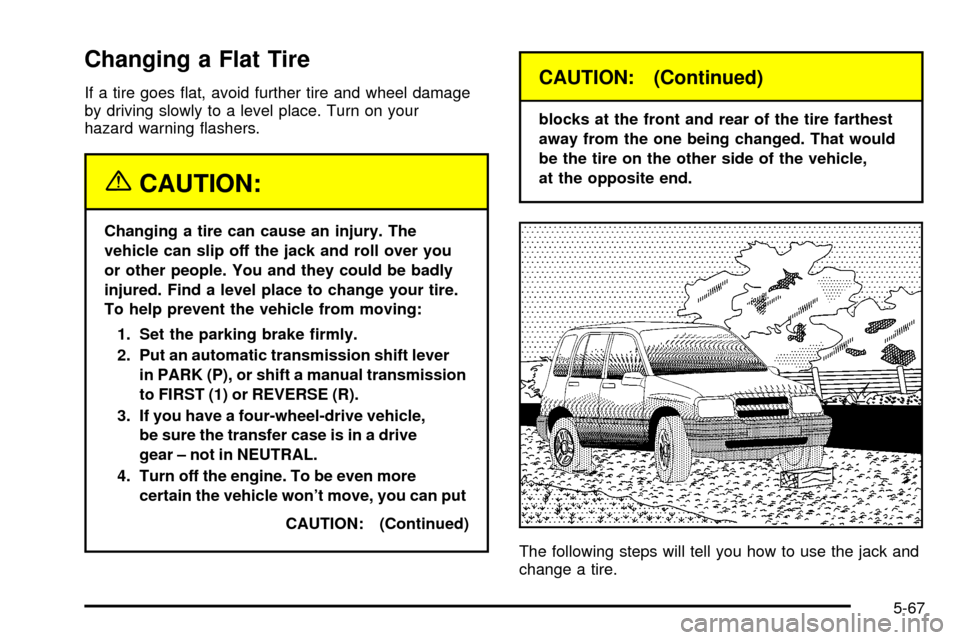
Changing a Flat Tire
If a tire goes ¯at, avoid further tire and wheel damage
by driving slowly to a level place. Turn on your
hazard warning ¯ashers.
{CAUTION:
Changing a tire can cause an injury. The
vehicle can slip off the jack and roll over you
or other people. You and they could be badly
injured. Find a level place to change your tire.
To help prevent the vehicle from moving:
1. Set the parking brake ®rmly.
2. Put an automatic transmission shift lever
in PARK (P), or shift a manual transmission
to FIRST (1) or REVERSE (R).
3. If you have a four-wheel-drive vehicle,
be sure the transfer case is in a drive
gear ± not in NEUTRAL.
4. Turn off the engine. To be even more
certain the vehicle won't move, you can put
CAUTION: (Continued)
CAUTION: (Continued)
blocks at the front and rear of the tire farthest
away from the one being changed. That would
be the tire on the other side of the vehicle,
at the opposite end.
The following steps will tell you how to use the jack and
change a tire.
5-67
Page 292 of 372
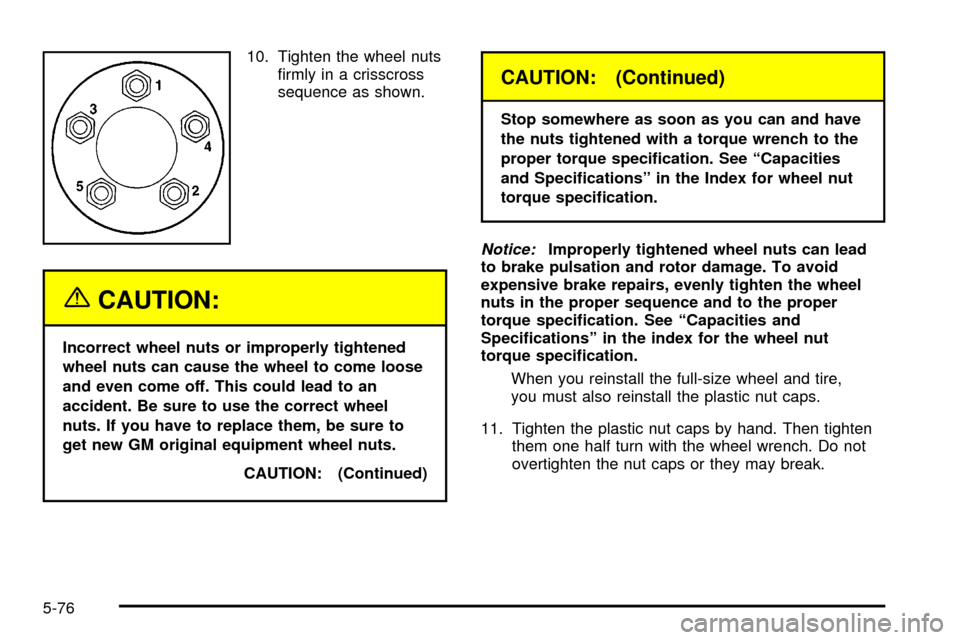
10. Tighten the wheel nuts
®rmly in a crisscross
sequence as shown.
{CAUTION:
Incorrect wheel nuts or improperly tightened
wheel nuts can cause the wheel to come loose
and even come off. This could lead to an
accident. Be sure to use the correct wheel
nuts. If you have to replace them, be sure to
get new GM original equipment wheel nuts.
CAUTION: (Continued)
CAUTION: (Continued)
Stop somewhere as soon as you can and have
the nuts tightened with a torque wrench to the
proper torque speci®cation. See ªCapacities
and Speci®cationsº in the Index for wheel nut
torque speci®cation.
Notice:Improperly tightened wheel nuts can lead
to brake pulsation and rotor damage. To avoid
expensive brake repairs, evenly tighten the wheel
nuts in the proper sequence and to the proper
torque speci®cation. See ªCapacities and
Speci®cationsº in the index for the wheel nut
torque speci®cation.
When you reinstall the full-size wheel and tire,
you must also reinstall the plastic nut caps.
11. Tighten the plastic nut caps by hand. Then tighten
them one half turn with the wheel wrench. Do not
overtighten the nut caps or they may break.
5-76
Page 307 of 372
Fuses Usage
CIGCigar/Cigarette Lighter, Radio,
Power Mirror
D/L Door Locks
STPBrake Light, Horn, Center
High-Mounted Stop Lamp,
Cruise Control
FOG Not Used
DEFRear Window Defogger, DRL,
Heater, Air Conditioning
S/H Not Used
TRNTurn Signal, Back-Up Light,
Hazard Lights
WIPWindshield Wiper/Washer,
Rear Window Wiper/Washer
Fuses for the air bags and the heater/air conditioning
system are located next to the instrument panel
fuse block.Engine Compartment Fuse Block
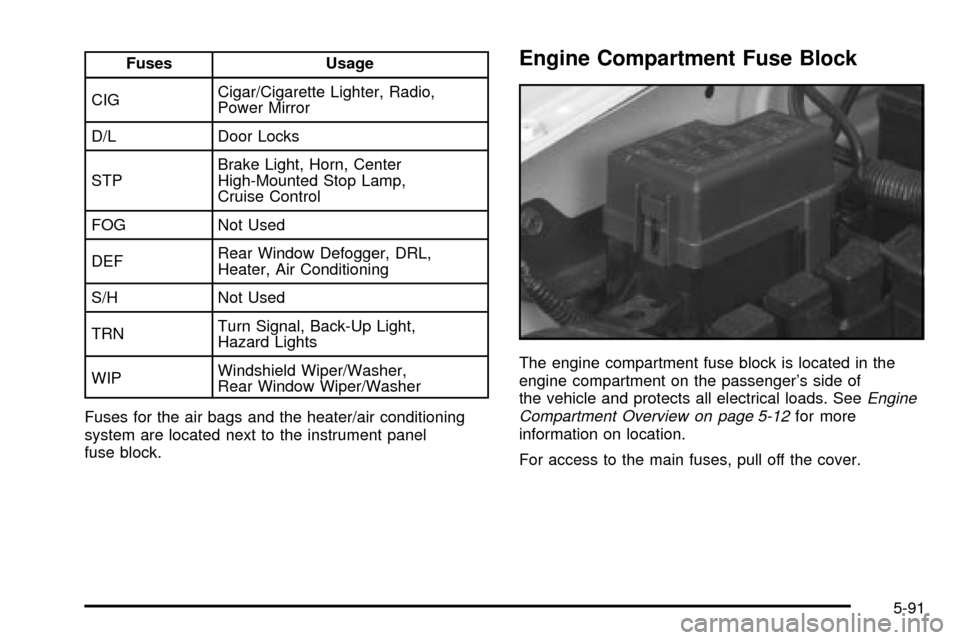
The engine compartment fuse block is located in the
engine compartment on the passenger's side of
the vehicle and protects all electrical loads. See
Engine
Compartment Overview on page 5-12for more
information on location.
For access to the main fuses, pull off the cover.
5-91
Page 308 of 372
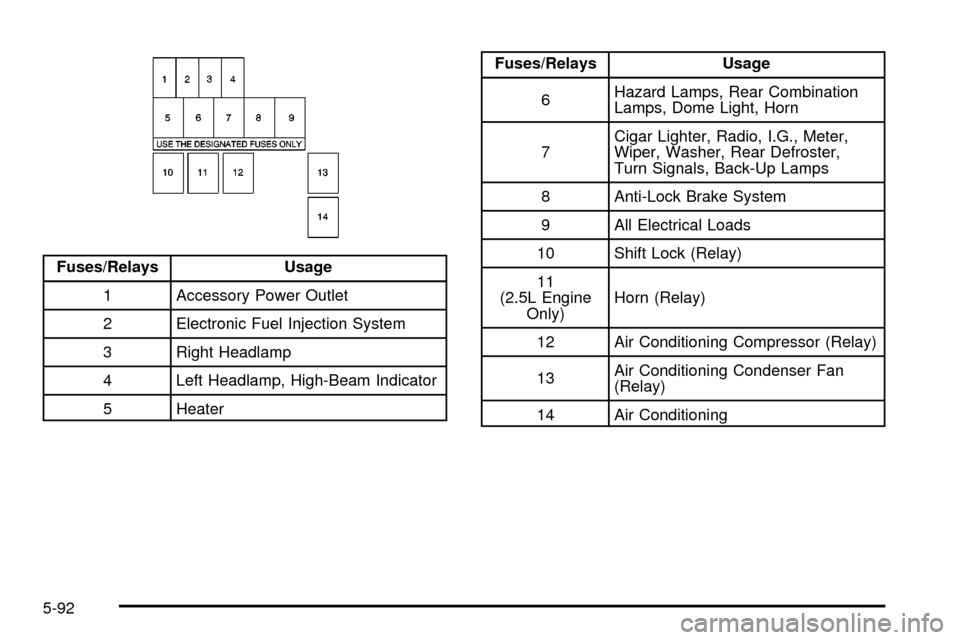
Fuses/Relays Usage
1 Accessory Power Outlet
2 Electronic Fuel Injection System
3 Right Headlamp
4 Left Headlamp, High-Beam Indicator
5 Heater
Fuses/Relays Usage
6Hazard Lamps, Rear Combination
Lamps, Dome Light, Horn
7Cigar Lighter, Radio, I.G., Meter,
Wiper, Washer, Rear Defroster,
Turn Signals, Back-Up Lamps
8 Anti-Lock Brake System
9 All Electrical Loads
10 Shift Lock (Relay)
11
(2.5L Engine
Only)Horn (Relay)
12 Air Conditioning Compressor (Relay)
13Air Conditioning Condenser Fan
(Relay)
14 Air Conditioning
5-92
Page 313 of 372

Maintenance Schedule......................................6-2
Introduction...................................................6-2
Your Vehicle and the Environment....................6-2
Maintenance Requirements..............................6-2
How This Section is Organized.........................6-3
Part A: Scheduled Maintenance Services...........6-4
Using Your Maintenance Schedule....................6-4
Selecting the Right Schedule...........................6-5
Short Trip/City Scheduled Maintenance..............6-7
Long Trip/Highway Scheduled Maintenance......6-17
Part B: Owner Checks and Services................6-24
At Each Fuel Fill..........................................6-24
At Least Once a Month.................................6-24
At Least Twice a Year...................................6-25At Least Once a Year...................................6-25
Part C: Periodic Maintenance Inspections.........6-28
Steering, Suspension and Front Drive Axle
Boot and Seal Inspection............................6-28
Exhaust System Inspection............................6-28
Fuel System Inspection..................................6-28
Engine Cooling System Inspection...................6-28
Throttle System Inspection.............................6-29
Rear Axle and Front Axle
(Four-Wheel-Drive) Service.........................6-29
Brake System Inspection................................6-29
Part D: Recommended Fluids
and Lubricants..........................................6-30
Part E: Maintenance Record...........................6-32
Section 6 Maintenance Schedule
6-1
Page 318 of 372

Every 45,000 Miles (75 000 km):Automatic
Transmission Fluid Hose Inspection (or every
45 months, whichever occurs ®rst).
Every 60,000 Miles (100 000 km):Fuel Tank Cap
Gasket Replacement. Emission System Hoses
Inspection. Brake Fluid Service. Spark Plug
Replacement.
Every 100,000 Miles (166 000 km):Automatic
Transmission Service (normal conditions).
Every 120 000 Miles (200 000 km):Evaporative
Emissions Canister and Air Suction Filter Replacement
(or every 120 months, whichever occurs ®rst). Engine
Accessory Drive Belt Replacement (or every
120 months, whichever occurs ®rst).
These intervals only summarize maintenance services.
Be sure to follow the complete scheduled maintenance
on the following pages.
Long Trip/Highway De®nition
Follow this scheduled maintenanceonlyif none of
the conditions from the Short Trip/City Scheduled
Maintenance are true. Do not use this schedule if the
vehicle is used for trailer towing, driven in a dusty area
or used off paved roads. Use the Short Trip/City
schedule for these conditions.
Driving a vehicle with a fully warmed engine under
highway conditions will cause engine oil to break down
slower.
Long Trip/Highway Intervals
Every 7,500 Miles (12 500 km):Engine Oil and Filter
Change (or every 7.5 months, whichever occurs ®rst).
Tire Rotation.
Every 15,000 Miles (25 000 km):Engine Air Cleaner
Filter Inspection. Automatic Transmission Service
(severe conditions only). Passenger Compartment
Air Filter Inspection (If Equipped). Propeller Shafts and
U-Joints Inspection (or every 15 months, whichever
occurs ®rst).
6-6