wheel CHEVROLET TRACKER 2004 2.G User Guide
[x] Cancel search | Manufacturer: CHEVROLET, Model Year: 2004, Model line: TRACKER, Model: CHEVROLET TRACKER 2004 2.GPages: 374, PDF Size: 2.57 MB
Page 82 of 374
How long should you keep the coolant heater plugged
in? The answer depends on the outside temperature, the
kind of oil you have, and some other things. Instead
of trying to list everything here, we ask that you contact
your dealer in the area where you'll be parking your
vehicle. The dealer can give you the best advice for that
particular area.
Automatic Transmission Operation
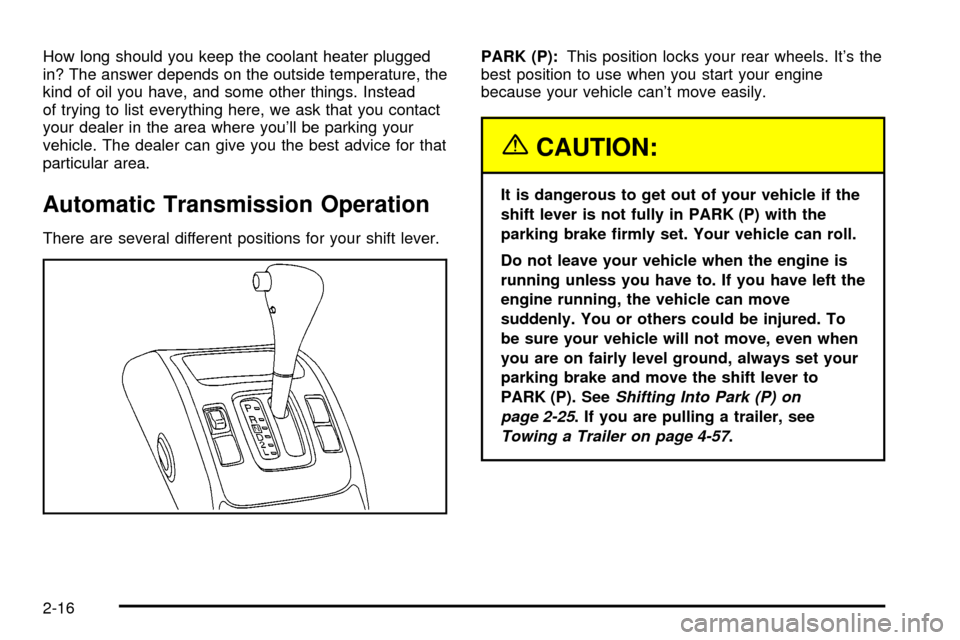
There are several different positions for your shift lever.PARK (P):This position locks your rear wheels. It's the
best position to use when you start your engine
because your vehicle can't move easily.
{CAUTION:
It is dangerous to get out of your vehicle if the
shift lever is not fully in PARK (P) with the
parking brake ®rmly set. Your vehicle can roll.
Do not leave your vehicle when the engine is
running unless you have to. If you have left the
engine running, the vehicle can move
suddenly. You or others could be injured. To
be sure your vehicle will not move, even when
you are on fairly level ground, always set your
parking brake and move the shift lever to
PARK (P). See
Shifting Into Park (P) on
page 2-25
. If you are pulling a trailer, see
Towing a Trailer on page 4-57.
2-16
Page 83 of 374
{CAUTION:
If you have four-wheel drive, your vehicle will
be free to roll Ð even if your shift lever is in
PARK (P) Ð if your transfer case is in
NEUTRAL. So, be sure the transfer case is in a
drive gear, two-wheel high (2H) or four-wheel
high (4H) or four-wheel low (4L) Ð not in
NEUTRAL. See
Shifting Into Park (P) on
page 2-25
Ensure the shift lever is fully in PARK (P) before starting
the engine. Your vehicle has an automatic transmission
shift lock control system. You have to fully apply
your regular brakes before you can shift from PARK (P)
while the ignition key is in ON. If you cannot shift out
of PARK (P), ease pressure on the shift lever, then push
the shift lever all the way into PARK (P) and release
the shift lever button as you maintain brake application.
Then press the shift lever button and move the shift
lever into the gear you wish. See
Shifting Out of Park (P)
on page 2-27.REVERSE (R):Use this gear to back up.
Notice:Shifting to REVERSE (R) while your vehicle
is moving forward could damage the transmission.
The repairs would not be covered by your warranty.
Shift to REVERSE (R) only after your vehicle is
stopped.
To rock your vehicle back and forth to get out of snow,
ice or sand without damaging your transmission,
see If You Are Stuck: In Sand, Mud, Ice or Snow on
page 4-44.
NEUTRAL (N):In this position, your engine doesn't
connect with the wheels. To restart when you're already
moving, use NEUTRAL (N) only. Also, use
NEUTRAL (N) when your vehicle is being towed.
{CAUTION:
Shifting into a drive gear while your engine is
running at high speed is dangerous. Unless
your foot is ®rmly on the brake pedal, your
vehicle could move very rapidly. You could
lose control and hit people or objects. Do not
shift into a drive gear while your engine is
running at high speed.
2-17
Page 84 of 374

Notice:Shifting out of PARK (P) or NEUTRAL (N)
with the engine running at high speed may damage
the transmission. The repairs would not be
covered by your warranty. Be sure the engine is not
running at high speed when shifting your vehicle.
DRIVE (D):This position is for normal driving.
If you need more power for passing, and you're:
·Going less than about 15 mph (25 km/h), push your
accelerator pedal about halfway down.
·Going about 15 mph (25 km/h) or more, push your
accelerator pedal all the way down.
You'll shift down to the next gear and have more
power.
SECOND (2):This position gives you more power but
lower fuel economy. You can use SECOND (2) on
hills. It can help control your speed as you go down
steep mountain roads, but then you would also want to
use your brakes off and on. In this position, if the
power mode selector switch is turned to P, the
transmission will not downshift into LOW (L). See ªPower
Mode Selector Switchº later in this section.
Don't shift into SECOND (2) unless you are going
slower than 63.4 mph (102 km/h) with the transfer case
in FOUR-WHEEL HIGH (4H) and TWO-WHEELHIGH (2H), or 34.9 mph (56.2 km/h) with the transfer
case in FOUR-WHEEL LOW (4L). If you move the shift
lever to a lower gear while driving faster than the
maximum allowable speed for the lower gear, the
transmission will not downshift until your speed drops
below the maximum speed for the lower gear.
LOW (L):This position gives you even more power but
lower fuel economy than SECOND (2). You can use
it on very steep hills, or in deep snow or mud. If the shift
lever is put in LOW (L), the transmission won't shift
into low gear until the vehicle is going slow enough.
Don't shift into LOW (L) at speeds above 28.0 mph
(45.0 km/h) with the transfer case in FOUR-WHEEL
HIGH (4H) or TWO-WHEEL HIGH (2H), or at speeds
above 15.4 mph (24.8 km/h) with the transfer case
in FOUR-WHEEL LOW (4L). If you move the shift lever
to a lower gear while driving faster than the maximum
allowable speed for the lower gear, the transmission will
not downshift until your speed drops below the
maximum speed for the lower gear.
Notice:Spinning the tires or holding the vehicle in
one place on a hill using only the accelerator
pedal may damage the transaxle. If you are stuck,
do not spin the tires. When stopping on a hill,
use the brakes to hold the vehicle in place.
2-18
Page 88 of 374
Four-Wheel Drive
If your vehicle has four-wheel drive, you can send your
engine's driving power to all four wheels for extra
traction. To shift out of two-wheel drive and into
four-wheel drive, move the transfer case shift lever to
FOUR-WHEEL HIGH (4H) or FOUR-WHEEL LOW (4L).
You should use TWO-WHEEL HIGH (2H) for most
normal driving. See ªTransfer Caseº following.
Notice:Driving on pavement in four-wheel drive for
an extended period of time may cause premature
wear on your vehicle's powertrain. Do not drive
in four-wheel drive on pavement for extended
periods of time.
Transfer Case
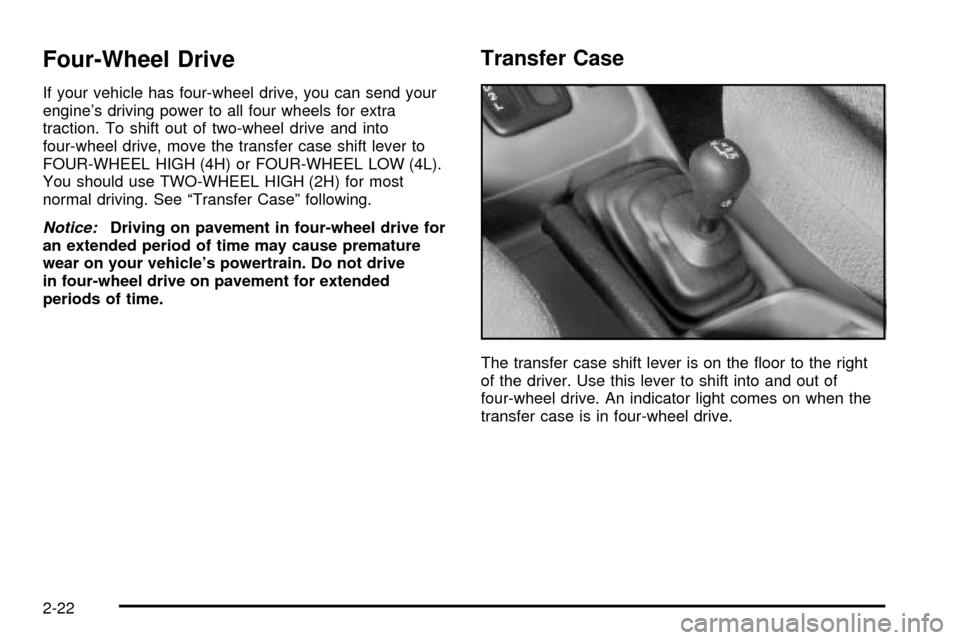
The transfer case shift lever is on the ¯oor to the right
of the driver. Use this lever to shift into and out of
four-wheel drive. An indicator light comes on when the
transfer case is in four-wheel drive.
2-22
Page 89 of 374

Your vehicle's transfer case shift lever may shake or
vibrate. This is normal and your vehicle does not require
service.
TWO-WHEEL HIGH (2H):This setting is for driving in
most street and highway situations. Your front axle
is not engaged in two-wheel drive.
FOUR-WHEEL HIGH (4H):This setting engages your
front axle to help drive your vehicle. Use FOUR-WHEEL
HIGH (4H) when you need extra traction, such as on
wet or icy roads, or in most off-road situations.
NEUTRAL (N):Shift to this setting only when your
vehicle needs to be towed.
{CAUTION:
Shifting the transfer case to NEUTRAL can
cause your vehicle to roll even if the
transmission is in PARK (P), or if you have a
manual transmission, even if you are in gear.
You or someone else could be seriously
injured. Be sure to set the parking brake
before placing the transfer case in NEUTRAL.
See
Parking Brake on page 2-24.FOUR-WHEEL LOW (4L):This setting also engages
your front axle to give you extra traction and can
be used for driving downhill, uphill or on rocky terrain
when you're driving slower than 35 mph (55 km/h).
Remember that driving in FOUR-WHEEL HIGH (4H) or
FOUR-WHEEL LOW (4L) may reduce fuel economy.
Also, driving in four-wheel drive on dry pavement could
cause your tires to wear faster and make your transfer
case harder to shift.
You can shift from TWO-WHEEL HIGH (2H) to
FOUR-WHEEL HIGH (4H) or from FOUR-WHEEL
HIGH (4H) to TWO-WHEEL HIGH (2H) at any speed if
your vehicle is going less than 60 mph (100 km/h)
and
your wheels are straight ahead. Your front axle will
engage faster if you take your foot off the accelerator
pedal for a few seconds as you shift.
Shifting Into or Out of FOUR-WHEEL
LOW (4L)
1. Stop your vehicle and shift your transmission to
NEUTRAL (N).
2. Shift the transfer case in one continuous motion.
Don't pause in NEUTRAL (N) as you shift from
FOUR-WHEEL LOW (4L) to FOUR-WHEEL HIGH (4H),
or your gears could clash.
2-23
Page 91 of 374

Shifting Into Park (P)
{CAUTION:
It can be dangerous to get out of your vehicle
if the shift lever is not fully in PARK (P) with
the parking brake ®rmly set. Your vehicle can
roll. If you have left the engine running, the
vehicle can move suddenly. You or others
could be injured. To be sure your vehicle will
not move, even when you are on fairly level
ground, use the steps that follow. With
four-wheel drive, if your transfer case is in
NEUTRAL, your vehicle will be free to roll,
even if your shift lever is in PARK (P). So, be
sure the transfer case is in a drive gear Ð not
in NEUTRAL. If you are pulling a trailer, see
Towing a Trailer on page 4-57.
1. Hold the brake pedal down with your right foot and
set the parking brake.2. Move the shift lever into PARK (P) by holding in the
button on the lever and pushing the lever all the
way toward the front of your vehicle.
3. If you have four-wheel drive, be sure the transfer
case is in a drive gear Ð not in NEUTRAL (N).
4. Move the key to LOCK.
5. Remove the key and take it with you. If you can
leave your vehicle with the key in your hand, your
vehicle is in PARK (P).
2-25
Page 92 of 374
Leaving Your Vehicle With the Engine
Running
{CAUTION:
It can be dangerous to leave your vehicle with
the engine running. Your vehicle could move
suddenly if the shift lever is not fully in
PARK (P) with the parking brake ®rmly set.
If you have four-wheel drive and your transfer
case is in NEUTRAL, your vehicle will be free
to roll, even if your shift lever is in PARK (P).
So be sure the transfer case is in a drive
gear ± not in NEUTRAL.
And, if you leave the vehicle with the engine
running, it could overheat and even catch ®re.
You or others could be injured. Don't leave
your vehicle with the engine running unless
you have to.
Torque Lock
If you are parking on a hill and you don't shift your
automatic transmission into PARK (P) properly,
the weight of the vehicle may put too much force on the
parking pawl in the transmission. You may ®nd it
difficult to pull the shift lever out of PARK (P). This is
called ªtorque lock.º To prevent torque lock, set
the parking brake and then shift into PARK (P) properly
before you leave the driver's seat. To ®nd out how,
see
Shifting Into Park (P) on page 2-25.
When you are ready to drive, move the shift lever out of
PARK (P)
beforeyou release the parking brake.
If torque lock does occur, you may need to have another
vehicle push yours a little uphill to take some of the
pressure from the parking pawl in the transmission, so
you can pull the shift lever out of PARK (P).
2-26
Page 94 of 374
3. Find the access hole cover on the driver's side of
the console, near the shift lever.
4. Remove the screw and cover.
5. Inside, you'll see the return plate. Using your ®nger,
move the return plate toward the rear of the vehicle
until it stops.
6. Move the shift lever into the gear you want while,
while holding the return plate in the most rearward
position.
7. Have the vehicle ®xed as soon as possible.
Parking Your Vehicle
Before you get out of your manual transmission vehicle,
put your shift lever in REVERSE (R) and ®rmly apply
the parking brake. Once the shift lever has been placed
into REVERSE (R) with the clutch pedal pressed in,
you can turn the ignition key to LOCK, remove the key
and release the clutch.
If you have four-wheel drive, be sure your transfer case
is in a drive gear. Your vehicle could roll if it isn't.
If you are towing a trailer, see
Towing a Trailer on
page 4-57.
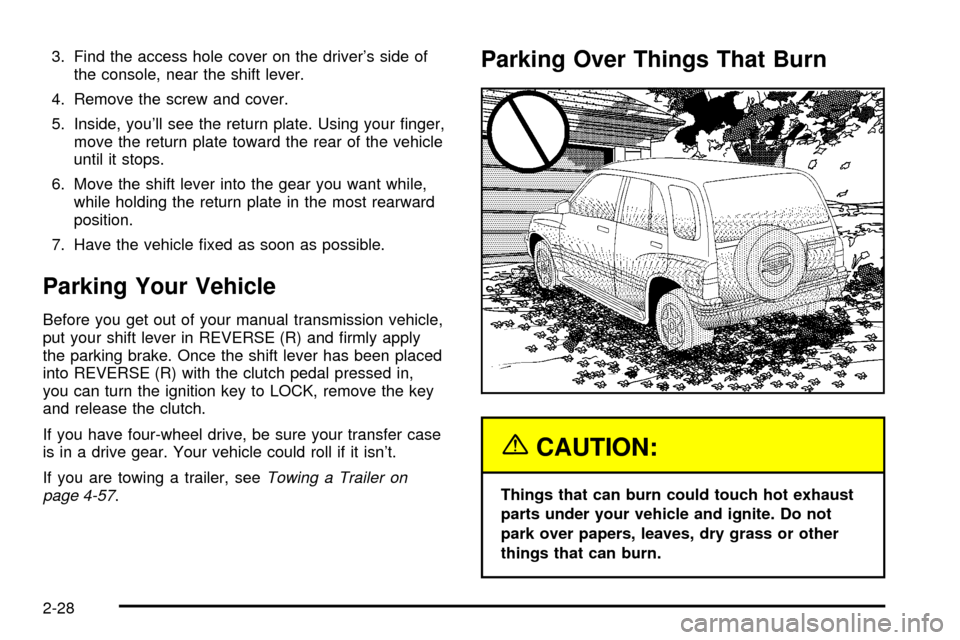
Parking Over Things That Burn
{CAUTION:
Things that can burn could touch hot exhaust
parts under your vehicle and ignite. Do not
park over papers, leaves, dry grass or other
things that can burn.
2-28
Page 97 of 374

{CAUTION:
Four-wheel drive vehicles with the transfer
case in NEUTRAL will allow the vehicle to roll,
even if your shift lever is in PARK (P). So, be
sure the transfer case is in a drive gear Ð not
in NEUTRAL. Always set your parking brake.
Follow the proper steps to be sure your vehicle will not
move. See
Shifting Into Park (P) on page 2-25.
If you are pulling a trailer, see
Towing a Trailer on
page 4-57.
Mirrors
Manual Rearview Mirror
An inside rearview mirror is attached to your
windshield. The mirror can be adjusted up and
down or side to side.
The mirror may also be equipped with reading lamps.
The mirror can also be adjusted for day or night driving.
Pull the tab for night driving to reduce glare. Push
the tab for daytime driving.
2-31
Page 99 of 374

Outside Convex Mirror
Your passenger's side mirror is convex. A convex
mirror's surface is curved so you can see more from the
driver's seat.
{CAUTION:
A convex mirror can make things (like other
vehicles) look farther away than they really are.
If you cut too sharply into the right lane, you
could hit a vehicle on your right. Check your
inside mirror or glance over your shoulder
before changing lanes.
Storage Areas
Glove Box
Use your key to lock and unlock the glove box. To open
the glove box, pull the latch toward you.
The glove box may have a two-position detent for
opening the door. Lower the door to the ®rst detent for
access to the glove box. Pull it to the next detent
for further access.
Cupholder(s)
Two cupholders are on the center console next to the
parking brake lever.
Coinholder(s)
Your instrument panel may have two coinholders
located to the left of the steering wheel.
2-33