Front end CHEVROLET TRAILBLAZER 2021 Service Manual
[x] Cancel search | Manufacturer: CHEVROLET, Model Year: 2021, Model line: TRAILBLAZER, Model: CHEVROLET TRAILBLAZER 2021Pages: 363, PDF Size: 6.75 MB
Page 267 of 363
Chevrolet Trailblazer Owner Manual (GMNA-Localizing-U.S./Canada-
14400528) - 2021 - CRC - 11/7/19
266 Vehicle Care
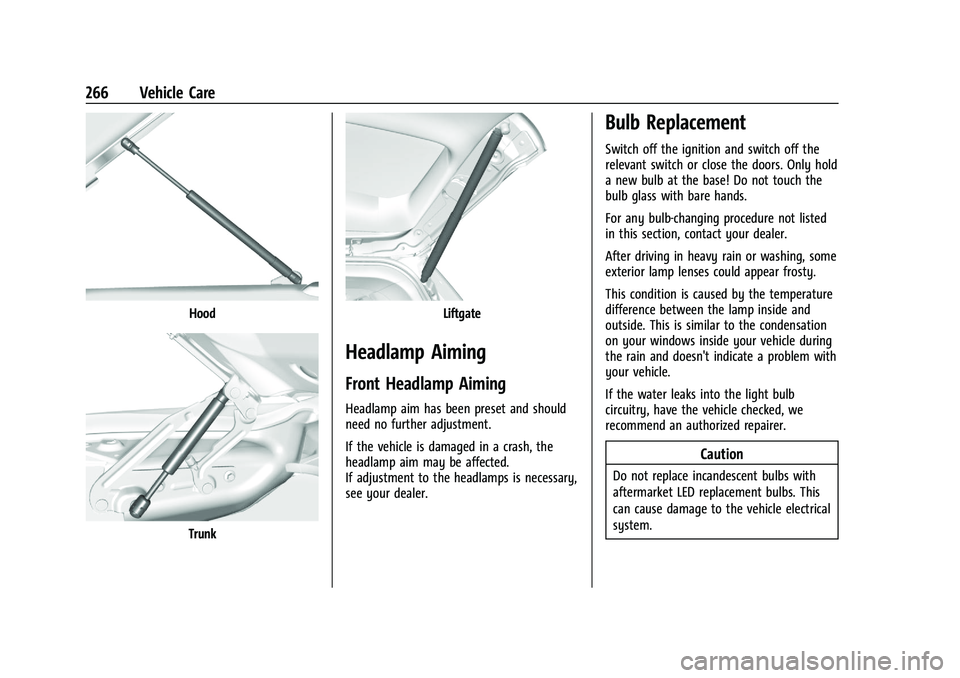
Hood
Trunk
Liftgate
Headlamp Aiming
Front Headlamp Aiming
Headlamp aim has been preset and should
need no further adjustment.
If the vehicle is damaged in a crash, the
headlamp aim may be affected.
If adjustment to the headlamps is necessary,
see your dealer.
Bulb Replacement
Switch off the ignition and switch off the
relevant switch or close the doors. Only hold
a new bulb at the base! Do not touch the
bulb glass with bare hands.
For any bulb-changing procedure not listed
in this section, contact your dealer.
After driving in heavy rain or washing, some
exterior lamp lenses could appear frosty.
This condition is caused by the temperature
difference between the lamp inside and
outside. This is similar to the condensation
on your windows inside your vehicle during
the rain and doesn't indicate a problem with
your vehicle.
If the water leaks into the light bulb
circuitry, have the vehicle checked, we
recommend an authorized repairer.
Caution
Do not replace incandescent bulbs with
aftermarket LED replacement bulbs. This
can cause damage to the vehicle electrical
system.
Page 285 of 363
Chevrolet Trailblazer Owner Manual (GMNA-Localizing-U.S./Canada-
14400528) - 2021 - CRC - 11/7/19
284 Vehicle Care
GAWR FRT:Gross Axle Weight Rating
for the front axle. See Vehicle Load
Limits 0187.
GAWR RR
:Gross Axle Weight Rating
for the rear axle. See Vehicle Load
Limits 0187.
Intended Outboard Sidewall
:The side
of an asymmetrical tire that must
always face outward when mounted on
a vehicle.
Kilopascal (kPa)
:The metric unit for air
pressure.
Light Truck (LT-Metric) Tire
:A tire used
on light duty trucks and some
multipurpose passenger vehicles.
Load Index
:An assigned number
ranging from 1 to 279 that corresponds
to the load carrying capacity of a tire.
Maximum Inflation Pressure
:The
maximum air pressure to which a cold
tire can be inflated. The maximum air
pressure is molded onto the sidewall.
Maximum Load Rating
:The load rating
for a tire at the maximum permissible
inflation pressure for that tire. Maximum Loaded Vehicle Weight
:The
sum of curb weight, accessory weight,
vehicle capacity weight, and production
options weight.
Normal Occupant Weight
:The number
of occupants a vehicle is designed to
seat multiplied by 68 kg (150 lb). See
Vehicle Load Limits 0187.
Occupant Distribution
:Designated
seating positions.
Outward Facing Sidewall
:The side of
an asymmetrical tire that has a
particular side that faces outward when
mounted on a vehicle. The side of the
tire that contains a whitewall, bears
white lettering, or bears manufacturer,
brand, and/or model name molding
that is higher or deeper than the same
moldings on the other sidewall of
the tire.
Passenger (P-Metric) Tire
:A tire used
on passenger cars and some light duty
trucks and multipurpose vehicles. Recommended Inflation Pressure
:
Vehicle manufacturer's recommended
tire inflation pressure as shown on the
tire placard. See
Tire Pressure0285 and
Vehicle Load Limits 0187.
Radial Ply Tire
:A pneumatic tire in
which the ply cords that extend to the
beads are laid at 90 degrees to the
centerline of the tread.
Rim
:A metal support for a tire and
upon which the tire beads are seated.
Sidewall
:The portion of a tire between
the tread and the bead.
Speed Rating
:An alphanumeric code
assigned to a tire indicating the
maximum speed at which a tire can
operate.
Traction
:The friction between the tire
and the road surface. The amount of
grip provided.
Tread
:The portion of a tire that comes
into contact with the road.
Page 290 of 363
Chevrolet Trailblazer Owner Manual (GMNA-Localizing-U.S./Canada-
14400528) - 2021 - CRC - 11/7/19
Vehicle Care 289
{Warning
Overinflating a tire could cause the tire
to rupture and you or others could be
injured. Do not exceed the maximum
pressure listed on the tire sidewall.
SeeTire Sidewall Labeling 0281 and
Vehicle Load Limits 0187.
If the tire is overinflated by more than
35 kPa (5 psi), the horn will sound multiple
times and the turn signal lamp will continue
to flash for several seconds after filling
stops.
To release and correct the pressure, while
the turn signal lamp is still flashing, briefly
press the center of the valve stem. When
the recommended pressure is reached, the
horn sounds once.
If the turn signal lamp does not flash within
15 seconds after starting to inflate the tire,
the tire fill alert has not been activated or is
not working.
If the hazard warning flashers are on, the
tire fill alert visual feedback will not work
properly.
The TPMS will not activate the tire fill alert
properly under the following conditions:
.There is interference from an external
device or transmitter.
.The air pressure from the inflation device
is not sufficient to inflate the tire.
.There is a malfunction in the TPMS.
.There is a malfunction in the horn or turn
signal lamps.
.The identification code of the TPMS
sensor is not registered to the system.
.The battery of the TPMS sensor is low.
If the tire fill alert does not operate due to
TPMS interference, move the vehicle about
1 m (3 ft) back or forward and try again.
If the tire fill alert feature is not working,
use a tire pressure gauge.
TPMS Sensor Matching Process
Each TPMS sensor has a unique
identification code. The identification code
needs to be matched to a new tire/wheel
position after rotating the vehicle’s tires or
replacing one or more of the TPMS sensors.
Also, the TPMS sensor matching process
should be performed after replacing a spare
tire with a road tire containing the TPMS
sensor. The malfunction light and the DIC
message, if equipped, should go off at the
next ignition cycle. The sensors are matched
to the tire/wheel positions, using a TPMS relearn tool, in the following order: driver
side front tire, passenger side front tire,
passenger side rear tire, and driver side rear.
See your dealer for service or to purchase a
relearn tool. A TPMS relearn tool can also be
purchased. See Tire Pressure Monitor Sensor
Activation Tool at
www.gmtoolsandequipment.com or call
1-800-GM TOOLS (1-800-468-6657).
There are two minutes to match the first
tire/wheel position, and five minutes overall
to match all four tire/wheel positions. If it
takes longer, the matching process stops
and must be restarted.
The TPMS sensor matching process is:
1. Set the parking brake.
2. Turn the ignition on without starting the vehicle or place the vehicle in Service
Mode. See Ignition Positions (Key Access)
0 191 or
Ignition Positions (Keyless Access) 0192.
3. Use SELECT or
o/pto select the
Vehicle in the Base Level Driver
Information Center (DIC). Or Use SELECT
or
o/pto select the Info page in the
Uplevel Driver Information Center (DIC).
Page 291 of 363
Chevrolet Trailblazer Owner Manual (GMNA-Localizing-U.S./Canada-
14400528) - 2021 - CRC - 11/7/19
290 Vehicle Care
4. Use the thumbwheel to scroll to the TirePressure Learn Menu Item (Base DIC) or
the Tire Pressure Menu Item screen
(Uplevel DIC).
5. Press and hold
lor the thumbwheel to
begin the sensor matching process.
A message requesting acceptance of the
process may display.
6. If requested, press
lor the
thumbwheel again to confirm the
selection. The horn sounds twice to
signal the receiver is in relearn mode
and the TIRE LEARN or TIRE LEARNING
ACTIVE message displays on the DIC
screen.
7. Start with the driver side front tire.
8. Place the relearn tool against the tire sidewall, near the valve stem. Then press
the button to activate the TPMS sensor.
A horn chirp confirms that the sensor
identification code has been matched to
this tire and wheel position.
9. Proceed to the passenger side front tire, and repeat the procedure in Step 8.
10. Proceed to the passenger side rear tire, and repeat the procedure in Step 8. 11. Proceed to the driver side rear tire, and
repeat the procedure in Step 8. The horn
sounds two times to indicate the sensor
identification code has been matched to
the driver side rear tire, and the TPMS
sensor matching process is no longer
active. The TIRE LEARN or TIRE LEARNING
ACTIVE message on the DIC display
screen goes off.
12. Turn the vehicle off.
13. Set all four tires to the recommended air pressure level as indicated on the Tire
and Loading Information label.
Tire Inspection
We recommend that the tires, including
the spare tire, if the vehicle has one, be
inspected for signs of wear or damage
at least once a month.
Replace the tire if:
.The indicators at three or more
places around the tire can be seen.
.There is cord or fabric showing
through the tire's rubber.
.The tread or sidewall is cracked, cut,
or snagged deep enough to show
cord or fabric.
.The tire has a bump, bulge, or split.
.The tire has a puncture, cut, or other
damage that cannot be repaired well
because of the size or location of the
damage.
Tire Rotation
Tires should be rotated every 12 000 km
(7,500 mi). See Maintenance Schedule
0 316.
Tires are rotated to achieve a more
uniform wear for all tires. The first
rotation is the most important.
Anytime unusual wear is noticed, rotate
the tires as soon as possible, check for
proper tire inflation pressure, and check
for damaged tires or wheels. If the
unusual wear continues after the
rotation, check the wheel alignment.
See When It Is Time for New Tires 0291
and
Wheel Replacement 0295.
Page 292 of 363
Chevrolet Trailblazer Owner Manual (GMNA-Localizing-U.S./Canada-
14400528) - 2021 - CRC - 11/7/19
Vehicle Care 291
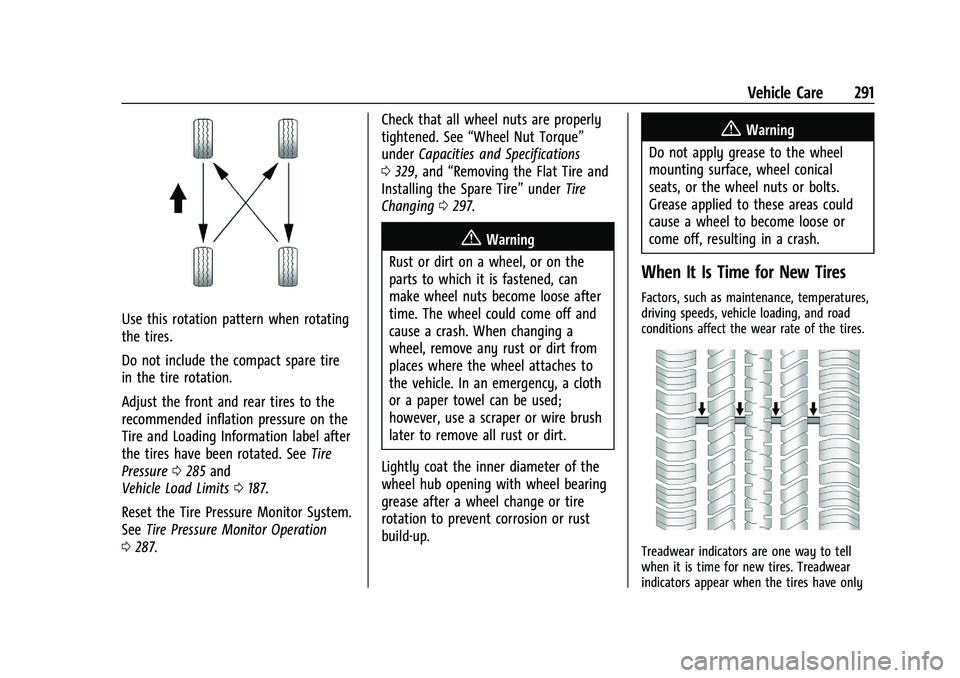
Use this rotation pattern when rotating
the tires.
Do not include the compact spare tire
in the tire rotation.
Adjust the front and rear tires to the
recommended inflation pressure on the
Tire and Loading Information label after
the tires have been rotated. SeeTire
Pressure 0285 and
Vehicle Load Limits 0187.
Reset the Tire Pressure Monitor System.
See Tire Pressure Monitor Operation
0 287. Check that all wheel nuts are properly
tightened. See
“Wheel Nut Torque”
under Capacities and Specifications
0 329, and “Removing the Flat Tire and
Installing the Spare Tire” underTire
Changing 0297.
{Warning
Rust or dirt on a wheel, or on the
parts to which it is fastened, can
make wheel nuts become loose after
time. The wheel could come off and
cause a crash. When changing a
wheel, remove any rust or dirt from
places where the wheel attaches to
the vehicle. In an emergency, a cloth
or a paper towel can be used;
however, use a scraper or wire brush
later to remove all rust or dirt.
Lightly coat the inner diameter of the
wheel hub opening with wheel bearing
grease after a wheel change or tire
rotation to prevent corrosion or rust
build-up.
{Warning
Do not apply grease to the wheel
mounting surface, wheel conical
seats, or the wheel nuts or bolts.
Grease applied to these areas could
cause a wheel to become loose or
come off, resulting in a crash.
When It Is Time for New Tires
Factors, such as maintenance, temperatures,
driving speeds, vehicle loading, and road
conditions affect the wear rate of the tires.
Treadwear indicators are one way to tell
when it is time for new tires. Treadwear
indicators appear when the tires have only
Page 305 of 363
Chevrolet Trailblazer Owner Manual (GMNA-Localizing-U.S./Canada-
14400528) - 2021 - CRC - 11/7/19
304 Vehicle Care
9. Start the engine in the vehicle with thegood battery and run the engine at idle
speed for at least four minutes.
10. Try to start the vehicle that had the dead battery. If it will not start after a
few tries, it probably needs service.
Caution
If the jumper cables are connected or
removed in the wrong order, electrical
shorting may occur and damage the
vehicle. The repairs would not be covered
by the vehicle warranty. Always connect
and remove the jumper cables in the
correct order, making sure that the cables
do not touch each other or other metal.
Jumper Cable Removal
Reverse the sequence exactly when
removing the jumper cables.
After starting the disabled vehicle and
removing the jumper cables, allow it to idle
for several minutes.
Towing the Vehicle
Caution
Incorrectly towing a disabled vehicle may
cause damage. The damage would not be
covered by the vehicle warranty. Do not
lash or hook to suspension components.
Use the proper straps around the tires to
secure the vehicle. Do not drag a locked
wheel/tire. Use tire skates or dollies
under any locked wheel/tire while
loading the vehicle. Do not use a sling
type lift to tow the vehicle. This could
damage the vehicle.
Caution
Improper use of the tow eye can damage
the vehicle. If equipped, use the tow eye
to load a disabled vehicle onto a flatbed
tow truck from a flat road surface, or to
move the vehicle a short distance. Use
caution and low speeds. The transmission
must be in (N) Neutral when moving the
vehicle. GM recommends a flatbed tow truck to
transport a disabled vehicle. Use ramps to
help reduce approach angles, if necessary.
A towed vehicle should have its drive wheels
off the ground. Contact Roadside Assistance
or a professional towing service if the
disabled vehicle must be towed.
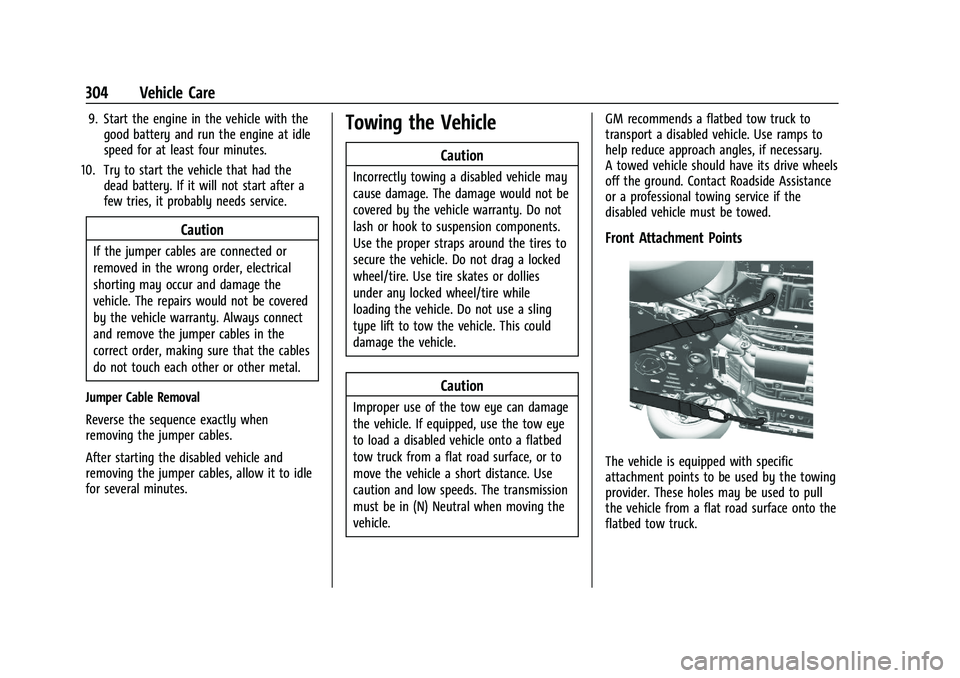
Front Attachment Points
The vehicle is equipped with specific
attachment points to be used by the towing
provider. These holes may be used to pull
the vehicle from a flat road surface onto the
flatbed tow truck.
Page 306 of 363
Chevrolet Trailblazer Owner Manual (GMNA-Localizing-U.S./Canada-
14400528) - 2021 - CRC - 11/7/19
Vehicle Care 305
Recreational Vehicle Towing
Recreational vehicle towing means towing
the vehicle behind another vehicle, such as
behind a motor home. The two most
common types of recreational vehicle
towing are known as dinghy towing and
dolly towing. Dinghy towing is towing the
vehicle with all four wheels on the ground.
Dolly towing is towing the vehicle with two
wheels on the ground and two wheels up
on a device known as a dolly.
Here are some important things to consider
before recreational vehicle towing:
.What is the towing capacity of the
towing vehicle? Be sure to read the tow
vehicle manufacturer's recommendations.
.What is the distance that will be
traveled? Some vehicles have restrictions
on how far and how long they can tow.
.Is the proper towing equipment going to
be used? See your dealer or trailering
professional for additional advice and
equipment recommendations.
.Is the vehicle ready to be towed? Just as
preparing the vehicle for a long trip,
make sure the vehicle is prepared to be
towed.
Caution
Use of a shield mounted in front of the
vehicle grille could restrict airflow and
cause damage to the transmission. The
repairs would not be covered by the
vehicle warranty. If using a shield, only
use one that attaches to the towing
vehicle.
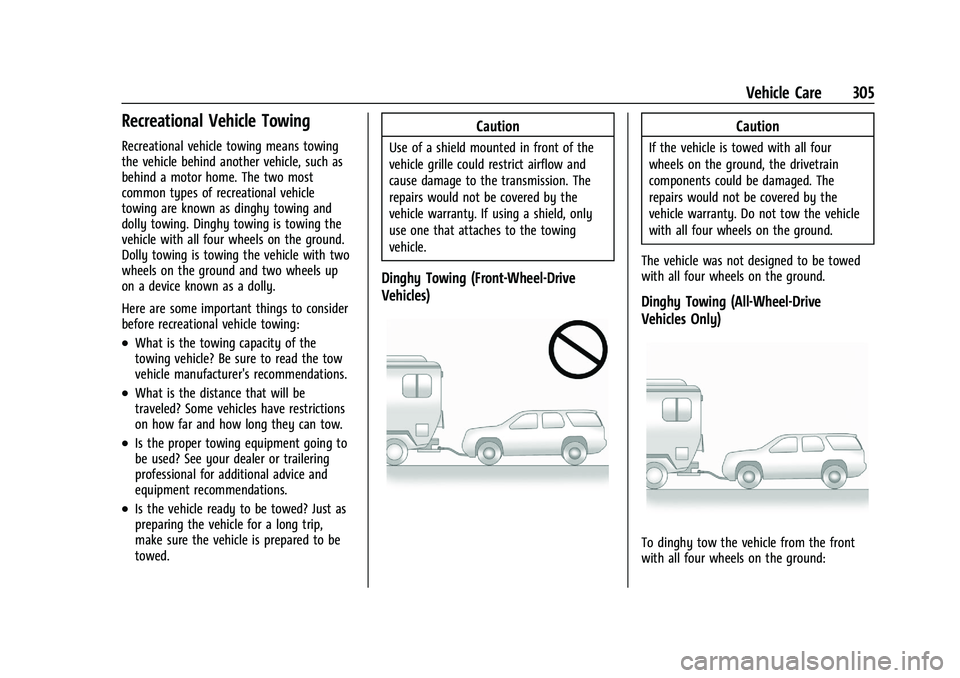
Dinghy Towing (Front-Wheel-Drive
Vehicles)
Caution
If the vehicle is towed with all four
wheels on the ground, the drivetrain
components could be damaged. The
repairs would not be covered by the
vehicle warranty. Do not tow the vehicle
with all four wheels on the ground.
The vehicle was not designed to be towed
with all four wheels on the ground.
Dinghy Towing (All-Wheel-Drive
Vehicles Only)
To dinghy tow the vehicle from the front
with all four wheels on the ground:
Page 323 of 363
Chevrolet Trailblazer Owner Manual (GMNA-Localizing-U.S./Canada-
14400528) - 2021 - CRC - 11/7/19
322 Service and Maintenance
Footnotes—Maintenance Schedule
Additional Required Services - Severe
(1) Or every four years, whichever comes
first. If driving in dusty conditions, inspect
the filter at each oil change or more often
as needed. See Engine Air Cleaner/Filter
0 253.
(2) Or every two years, whichever comes
first. More frequent passenger compartment
air filter replacement may be needed if
driving in areas with heavy traffic, poor air
quality, high dust levels, or environmental
allergens. Passenger compartment air filter
replacement may also be needed if there is
reduced airflow, window fogging, or odors.
Your GM dealer can help determine when to
replace the filter.
(3) Visually check all fuel and vapor lines
and hoses for proper attachment,
connection, routing, and condition.
(4) Do not directly power wash the transfer
case and/or front/rear axle output seals.
High pressure water can overcome the seals
and contaminate the transfer case fluid.
Contaminated fluid will decrease the life of
the transfer case and/or axles and should be
replaced. (5)
Or every five years, whichever comes
first. See Cooling System 0255.
(6) Or every 10 years, whichever comes first.
Inspect for fraying, excessive cracking,
or damage; replace, if needed.
(7) Replace brake fluid every five years. See
Brake Fluid 0260.
(8) Or every 12 months, whichever comes
first. See Wiper Blade Replacement 0264.
(9) Or every 10 years, whichever comes first.
See Gas Strut(s) 0265.
(10) Replace air conditioning desiccant every
seven years.
(11) The oil pump drive belt and the timing
belt on the LIH engine must be replaced at
150,000 miles (240,000 km) or 15 years,
whichever comes first.
Special Application Services
.Severe Commercial Use Vehicles Only:
Lubricate chassis components every oil
change.
.Have underbody flushing service
performed. See "Underbody Maintenance"
in Exterior Care 0307.
Additional Maintenance
and Care
Your vehicle is an important investment and
caring for it properly may help to avoid
future costly repairs. To maintain vehicle
performance, additional maintenance
services may be required.
It is recommended that your dealer perform
these services —their trained dealer
technicians know your vehicle best. Your
dealer can also perform a thorough
assessment with a multi-point inspection to
recommend when your vehicle may need
attention.
The following list is intended to explain the
services and conditions to look for that may
indicate services are required.
Battery
The 12-volt battery supplies power to start
the engine and operate any additional
electrical accessories.
.To avoid break-down or failure to start
the vehicle, maintain a battery with full
cranking power.
Page 355 of 363
Chevrolet Trailblazer Owner Manual (GMNA-Localizing-U.S./Canada-
14400528) - 2021 - CRC - 11/7/19
354 Index
DrivingAssistance Systems . . . . . . . . . . . . . . . . . . . . .222
Better Fuel Economy . . . . . . . . . . . . . . . . . . . . 181
Characteristics and Towing Tips . . . . . . . . 234
Defensive . . . . . . . . . . . . . . . . . . . . . . . . . . . . . . . 182
Environment . . . . . . . . . . . . . . . . . . . . . . . . . . . . 181
Hill and Mountain Roads . . . . . . . . . . . . . . . 185
If the Vehicle is Stuck . . . . . . . . . . . . . . . . . . 187
Impaired . . . . . . . . . . . . . . . . . . . . . . . . . . . . . . . . 182
Loss of Control . . . . . . . . . . . . . . . . . . . . . . . . .184
Off-Road Recovery . . . . . . . . . . . . . . . . . . . . . .184
Vehicle Load Limits . . . . . . . . . . . . . . . . . . . . . 187
Wet Roads . . . . . . . . . . . . . . . . . . . . . . . . . . . . . . 185
Winter . . . . . . . . . . . . . . . . . . . . . . . . . . . . . . . . . .186
Driving the Vehicle . . . . . . . . . . . . . . . . . . . . . . . . .2
E
Electric Brake Boost . . . . . . . . . . . . . . . . . . . . . . 204
Electric Parking Brake . . . . . . . . . . . . . . . . . . . . 205
Electric Parking Brake Light . . . . . . . . . . . . . . . 98
Electrical Equipment, Add-On . . . . . . . . . . . . .241
Electrical System Engine Compartment Fuse Block . . . . . . . .274
Fuses and Circuit Breakers . . . . . . . . . . . . . .274
Instrument Panel Fuse Block . . . . . . . . . . . . 277
Overload . . . . . . . . . . . . . . . . . . . . . . . . . . . . . . . . 273
Rear Compartment Fuse Block . . . . . . . . . .278 Emergency
OnStar . . . . . . . . . . . . . . . . . . . . . . . . . . . . . . . . . 344
Engine Air Cleaner/Filter . . . . . . . . . . . . . . . . . . . . . . .253
Check Light (Malfunction Indicator) . . . . . 96
Compartment Overview . . . . . . . . . . . . . . . . .247
Coolant Temperature Gauge . . . . . . . . . . . . 94
Cooling System . . . . . . . . . . . . . . . . . . . . . . . . .255
Drive Belt Routing . . . . . . . . . . . . . . . . . . . . . . 331
Exhaust . . . . . . . . . . . . . . . . . . . . . . . . . . . . . . . . 200
Heater . . . . . . . . . . . . . . . . . . . . . . . . . . . . . . . . . .198
Oil Life System . . . . . . . . . . . . . . . . . . . . . . . . .252
Oil Pressure Light . . . . . . . . . . . . . . . . . . . . . . .102
Overheating . . . . . . . . . . . . . . . . . . . . . . . . . . . 258
Power Messages . . . . . . . . . . . . . . . . . . . . . . . . 110
Running While Parked . . . . . . . . . . . . . . . . . .201
Starting . . . . . . . . . . . . . . . . . . . . . . . . . . . . . . . . .194
Engine Air Filter Life System . . . . . . . . . . . . . 253
Entry Lighting . . . . . . . . . . . . . . . . . . . . . . . . . . . . 119
Equipment, Towing . . . . . . . . . . . . . . . . . . . . . . 240
Event Data Recorders . . . . . . . . . . . . . . . . . . . . 342
Exit Lighting . . . . . . . . . . . . . . . . . . . . . . . . . . . . . . 119
Extended Parking . . . . . . . . . . . . . . . . . . . . . . . . 200
Extender, Seat Belt . . . . . . . . . . . . . . . . . . . . . . . 49
Exterior Lamp Controls . . . . . . . . . . . . . . . . . . . . 114
Exterior Lighting Battery Saver . . . . . . . . . . 120
F
Filter, Engine Air Cleaner . . . . . . . . . . . . . . . . . . . . . .253
Flash-to-Pass . . . . . . . . . . . . . . . . . . . . . . . . . . . . . . 116
Flashers, Hazard Warning . . . . . . . . . . . . . . . . . 117
Flat Tire . . . . . . . . . . . . . . . . . . . . . . . . . . . . . . . . . 296 Changing . . . . . . . . . . . . . . . . . . . . . . . . . . . . . . 297
Floor Mats . . . . . . . . . . . . . . . . . . . . . . . . . . . . . . . .314
Fluid Automatic Transmission . . . . . . . . . . . . . . . .252
Brakes . . . . . . . . . . . . . . . . . . . . . . . . . . . . . . . . . 260
Washer . . . . . . . . . . . . . . . . . . . . . . . . . . . . . . . . 259
Fog Lamps . . . . . . . . . . . . . . . . . . . . . . . . . . . . . . . . 117 Bulb Replacement . . . . . . . . . . . . . . . . . . . . . . 269
Folding Mirrors . . . . . . . . . . . . . . . . . . . . . . . . . . . . 31
Folding Seatback . . . . . . . . . . . . . . . . . . . . . . . . . . .41
Forward Collision Alert (FCA) System . . . . 223
Frequency Statement Radio . . . . . . . . . . . . . . . . . . . . . . . . . . . . . . . . . . 340
Front Fog Lamp Light . . . . . . . . . . . . . . . . . . . . . . . . . . . . . . . . . . . .103
Front Pedestrian Braking (FPB) System . . . . . . . . . . . . . . . . . . . . . . . . . . . . . . . . 226
Front Seats
Adjustment . . . . . . . . . . . . . . . . . . . . . . . . . . . . . .38
Heated . . . . . . . . . . . . . . . . . . . . . . . . . . . . . . . . . 40
Fuel Additives . . . . . . . . . . . . . . . . . . . . . . . . . . . . . . .232
Page 356 of 363
Chevrolet Trailblazer Owner Manual (GMNA-Localizing-U.S./Canada-
14400528) - 2021 - CRC - 11/7/19
Index 355
Fuel (cont'd)Economy, Driving for Better . . . . . . . . . . . . 181
Filling a Portable Fuel Container . . . . . . . .233
Filling the Tank . . . . . . . . . . . . . . . . . . . . . . . . .232
Foreign Countries . . . . . . . . . . . . . . . . . . . . . . .232
Gauge . . . . . . . . . . . . . . . . . . . . . . . . . . . . . . . . . . .93
Low Fuel Warning Light . . . . . . . . . . . . . . . .102
Prohibited Fuels . . . . . . . . . . . . . . . . . . . . . . . . 231
Recommended . . . . . . . . . . . . . . . . . . . . . . . . . . 231
Top Tier . . . . . . . . . . . . . . . . . . . . . . . . . . . . . . . . 231
Fuses Engine Compartment Fuse Block . . . . . . . .274
Fuses and Circuit Breakers . . . . . . . . . . . . . .274
Instrument Panel Fuse Block . . . . . . . . . . . . 277
Rear Compartment Fuse Block . . . . . . . . . .278
G
Gas Strut(s) . . . . . . . . . . . . . . . . . . . . . . . . . . . . . . 265
Gauges
Engine Coolant Temperature . . . . . . . . . . . . 94
Fuel . . . . . . . . . . . . . . . . . . . . . . . . . . . . . . . . . . . . . .93
Odometer . . . . . . . . . . . . . . . . . . . . . . . . . . . . . . .93
Speedometer . . . . . . . . . . . . . . . . . . . . . . . . . . . .92
Tachometer . . . . . . . . . . . . . . . . . . . . . . . . . . . . . .93
Trip Odometer . . . . . . . . . . . . . . . . . . . . . . . . . . .93
Warning Lights and Indicators . . . . . . . . . . 88
General Information Service and Maintenance . . . . . . . . . . . . . . . 315 General Information (cont'd)
Towing . . . . . . . . . . . . . . . . . . . . . . . . . . . . . . . . 234
Vehicle Care . . . . . . . . . . . . . . . . . . . . . . . . . . . 244
Global Positioning System (GPS) . . . . . . . . . .145
Glove Box . . . . . . . . . . . . . . . . . . . . . . . . . . . . . . . . 78
GM Mobility Reimbursement Program . . . . . . . . . . . . . . . . . . . . . . . . . . . . . . . 335
Guidance Problems with the Route . . . . . . . . . . . . . . . 145
H
Halogen Bulbs . . . . . . . . . . . . . . . . . . . . . . . . . . . 267
Hazard Warning Flashers . . . . . . . . . . . . . . . . . 117
HD Radio Technology . . . . . . . . . . . . . . . . . . . . .128
Head Restraints . . . . . . . . . . . . . . . . . . . . . . . . . . . 36
HeadlampsAiming . . . . . . . . . . . . . . . . . . . . . . . . . . . . . . . . 266
Automatic . . . . . . . . . . . . . . . . . . . . . . . . . . . . . . 116
Bulb Replacement . . . . . . . . . . . . . . . . . . . . . . 266
Daytime Running Lamps (DRL) . . . . . . . . . . 116
Flash-to-Pass . . . . . . . . . . . . . . . . . . . . . . . . . . . . 116
Headlamps, Front Turn Signal,
Sidemarker, and Parking
Lamps . . . . . . . . . . . . . . . . . . . . . . . . . . 267, 268
High-Beam On Light . . . . . . . . . . . . . . . . . . . .103
High/Low Beam Changer . . . . . . . . . . . . . . . 115
Lamps On Reminder . . . . . . . . . . . . . . . . . . . .103
Heated Front Seats . . . . . . . . . . . . . . . . . . . . . . . 40 Heated Mirrors . . . . . . . . . . . . . . . . . . . . . . . . . . . . 31
Heater
Engine . . . . . . . . . . . . . . . . . . . . . . . . . . . . . . . . . .198
Heating . . . . . . . . . . . . . . . . . . . . . . . . . . . . . . 174, 176
High-Beam On Light . . . . . . . . . . . . . . . . . . . . . 103
Hill and Mountain Roads . . . . . . . . . . . . . . . . .185
Hill Start Assist (HSA) . . . . . . . . . . . . . . . . . . . . 206
Hood . . . . . . . . . . . . . . . . . . . . . . . . . . . . . . . . . . . . 245
Horn . . . . . . . . . . . . . . . . . . . . . . . . . . . . . . . . . . . . . . 83
How to Wear Seat Belts Properly . . . . . . . . . 45
HVAC . . . . . . . . . . . . . . . . . . . . . . . . . . . . . . . . 174, 176
I
If the System Needs Service . . . . . . . . . . . . . 146
Ignition Positions . . . . . . . . . . . . . . . . . . . . 191, 192
Immobilizer . . . . . . . . . . . . . . . . . . . . . . . . . . . . . . . 30
Indicator Pedestrian Ahead . . . . . . . . . . . . . . . . . . . . . . 100
Vehicle Ahead . . . . . . . . . . . . . . . . . . . . . . . . . 100
Infants and Young Children, Restraints . . . . 62
Information Publication Ordering . . . . . . . . . . . . . . . . . . . 339
Infotainment System . . . . . . . . . . . . . . . . . . . . 342
Instrument Cluster . . . . . . . . . . . . . . . . . . . . . . . . 89
Instrument Panel Storage Area . . . . . . . . . . . . . . . . . . . . . . . . . . . . .78
Instrument Panel Overview . . . . . . . . . . . . . . . . 4
Interior Rearview Mirrors . . . . . . . . . . . . . . . . . . 31