ignition CHEVROLET TRAVERSE 2009 1.G Owner's Guide
[x] Cancel search | Manufacturer: CHEVROLET, Model Year: 2009, Model line: TRAVERSE, Model: CHEVROLET TRAVERSE 2009 1.GPages: 422, PDF Size: 2.06 MB
Page 136 of 422
When the battery’s state of charge is
low, the voltage is raised slightly to
quickly bring the charge back up.
When the state of charge is high, the
voltage is lowered slightly to prevent
overcharging. If the vehicle has a
voltmeter gage or a voltage display
on the Driver Information Center
(DIC), you may see the voltage move
up or down. This is normal. If there is
a problem, an alert will be displayed.
The battery can be discharged at
idle if the electrical loads are very
high. This is true for all vehicles. This
is because the generator (alternator)
may not be spinning fast enough at
idle to produce all the power that is
needed for very high electrical loads.
A high electrical load occurs when
several of the following are on,
such as: headlamps, high beams,
fog lamps, rear window defogger,
climate control fan at high speed,
heated seats, engine cooling fans,
trailer loads, and loads plugged into
accessory power outlets.EPM works to prevent excessive
discharge of the battery. It does
this by balancing the generator’s
output and the vehicle’s electrical
needs. It can increase engine
idle speed to generate more power,
whenever needed. It can temporarily
reduce the power demands of
some accessories.
Normally, these actions occur
in steps or levels, without being
noticeable. In rare cases at the
highest levels of corrective action,
this action may be noticeable to the
driver. If so, a Driver Information
Center (DIC) message might be
displayed, such as BATTERY
SAVER ACTIVE, BATTERY
VOLTAGE LOW, or LOW BATTERY.
If this message is displayed, it is
recommended that the driver reduce
the electrical loads as much as
possible. SeeDIC Warnings and
Messages on page 3-56.Battery Run-Down
Protection
This feature helps prevent
the battery from being drained,
if the interior courtesy lamps,
reading/map lamps, visor vanity
lamps or trunk lamp are accidentally
left on. If any of these lamps are left
on, they automatically turn off after
10 minutes, if the ignition is off.
The lamps will not come back on
again until one of the following
occurs:
The ignition is turned on.
The exterior lamps control is
turned off, then on again.
The headlamps will timeout after
10 minutes, if they are manually
turned on with the ignition on or off.
3-16 Instrument Panel
Page 138 of 422
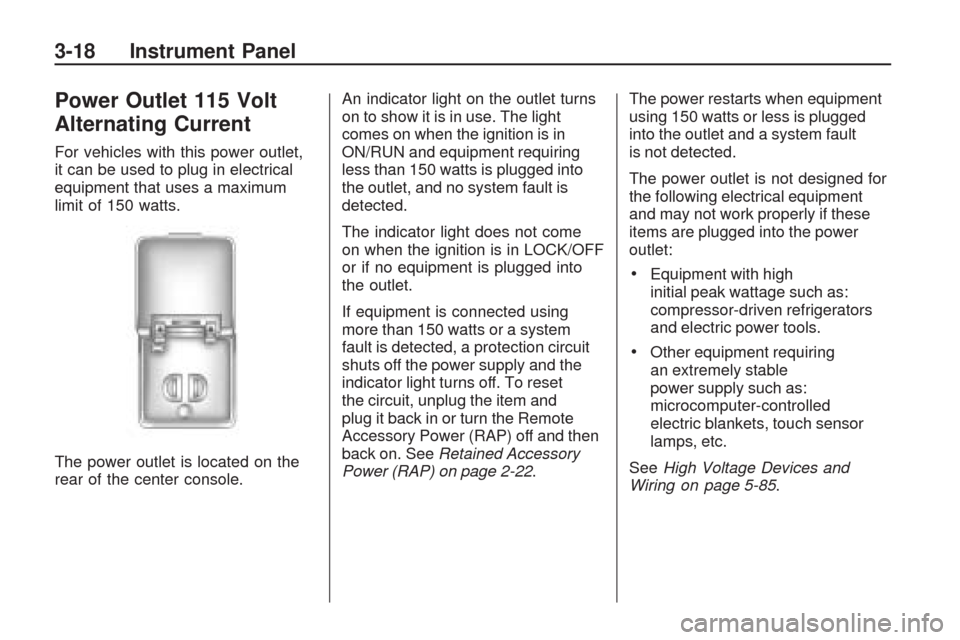
Power Outlet 115 Volt
Alternating Current
For vehicles with this power outlet,
it can be used to plug in electrical
equipment that uses a maximum
limit of 150 watts.
The power outlet is located on the
rear of the center console.An indicator light on the outlet turns
on to show it is in use. The light
comes on when the ignition is in
ON/RUN and equipment requiring
less than 150 watts is plugged into
the outlet, and no system fault is
detected.
The indicator light does not come
on when the ignition is in LOCK/OFF
or if no equipment is plugged into
the outlet.
If equipment is connected using
more than 150 watts or a system
fault is detected, a protection circuit
shuts off the power supply and the
indicator light turns off. To reset
the circuit, unplug the item and
plug it back in or turn the Remote
Accessory Power (RAP) off and then
back on. SeeRetained Accessory
Power (RAP) on page 2-22.The power restarts when equipment
using 150 watts or less is plugged
into the outlet and a system fault
is not detected.
The power outlet is not designed for
the following electrical equipment
and may not work properly if these
items are plugged into the power
outlet:
Equipment with high
initial peak wattage such as:
compressor-driven refrigerators
and electric power tools.
Other equipment requiring
an extremely stable
power supply such as:
microcomputer-controlled
electric blankets, touch sensor
lamps, etc.
SeeHigh Voltage Devices and
Wiring on page 5-85.
3-18 Instrument Panel
Page 154 of 422
Then, after several more seconds,
the status indicator will light either
ON or OFF, or either the on or off
symbol to let you know the status of
the right front passenger frontal
airbag.
If the word ON or the on symbol is
lit on the passenger airbag status
indicator, it means that the right front
passenger frontal airbag is enabled
(may inate).
If the word OFF or the off symbol
is lit on the passenger airbag
status indicator, it means that the
passenger sensing system has
turned off the right front passenger
frontal airbag.If, after several seconds, both
status indicator lights remain on,
or if there are no lights at all, there
may be a problem with the lights
or the passenger sensing system.
See your dealer/retailer for service.
{CAUTION
If the airbag readiness light ever
comes on and stays on, it means
that something may be wrong with
the airbag system. To help avoid
injury to yourself or others, have
the vehicle serviced right away.
SeeAirbag Readiness Light on
page 3-33for more information,
including important safety
information.
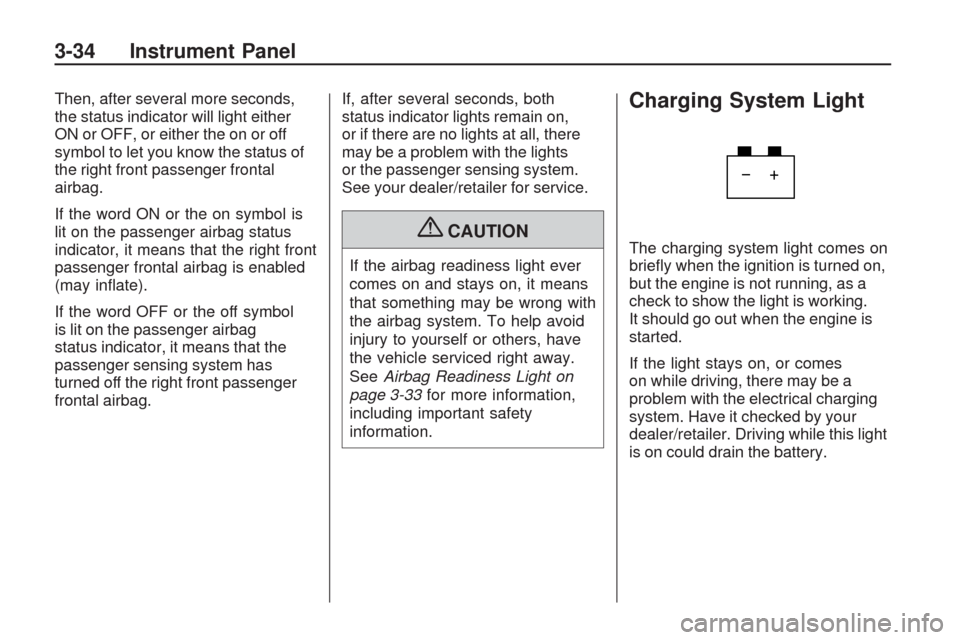
Charging System Light
The charging system light comes on
briey when the ignition is turned on,
but the engine is not running, as a
check to show the light is working.
It should go out when the engine is
started.
If the light stays on, or comes
on while driving, there may be a
problem with the electrical charging
system. Have it checked by your
dealer/retailer. Driving while this light
is on could drain the battery.
3-34 Instrument Panel
Page 155 of 422
When this light comes on, the
Driver Information Center (DIC) also
displays the SERVICE BATTERY
CHARGING SYSTEM message.
SeeDIC Warnings and Messages
on page 3-56for more information.
If a short distance must be driven
with the light on, be sure to turn off
all accessories, such as the radio
and air conditioner.
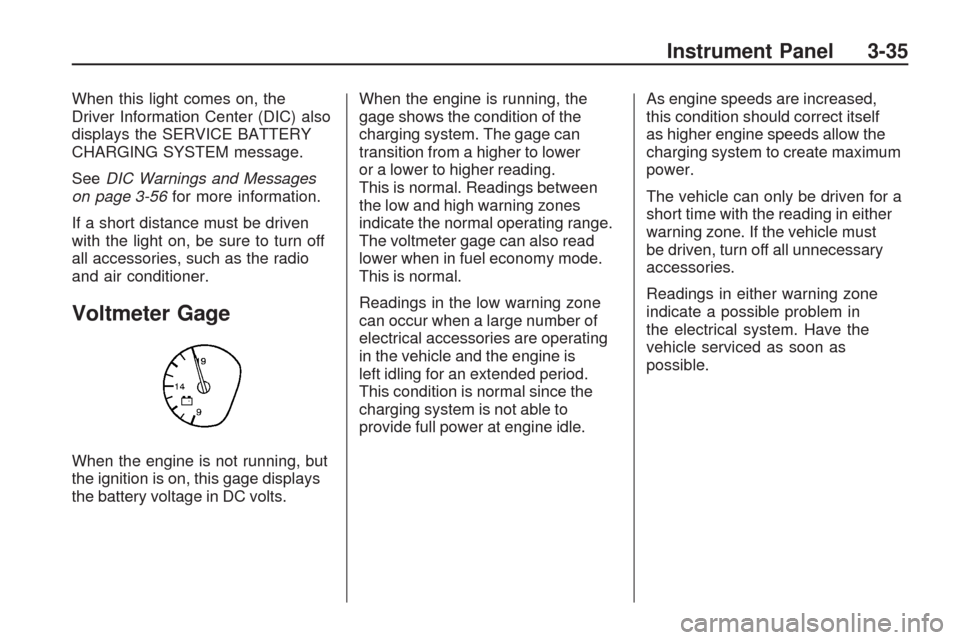
Voltmeter Gage
When the engine is not running, but
the ignition is on, this gage displays
the battery voltage in DC volts.When the engine is running, the
gage shows the condition of the
charging system. The gage can
transition from a higher to lower
or a lower to higher reading.
This is normal. Readings between
the low and high warning zones
indicate the normal operating range.
The voltmeter gage can also read
lower when in fuel economy mode.
This is normal.
Readings in the low warning zone
can occur when a large number of
electrical accessories are operating
in the vehicle and the engine is
left idling for an extended period.
This condition is normal since the
charging system is not able to
provide full power at engine idle.As engine speeds are increased,
this condition should correct itself
as higher engine speeds allow the
charging system to create maximum
power.
The vehicle can only be driven for a
short time with the reading in either
warning zone. If the vehicle must
be driven, turn off all unnecessary
accessories.
Readings in either warning zone
indicate a possible problem in
the electrical system. Have the
vehicle serviced as soon as
possible.
Instrument Panel 3-35
Page 156 of 422
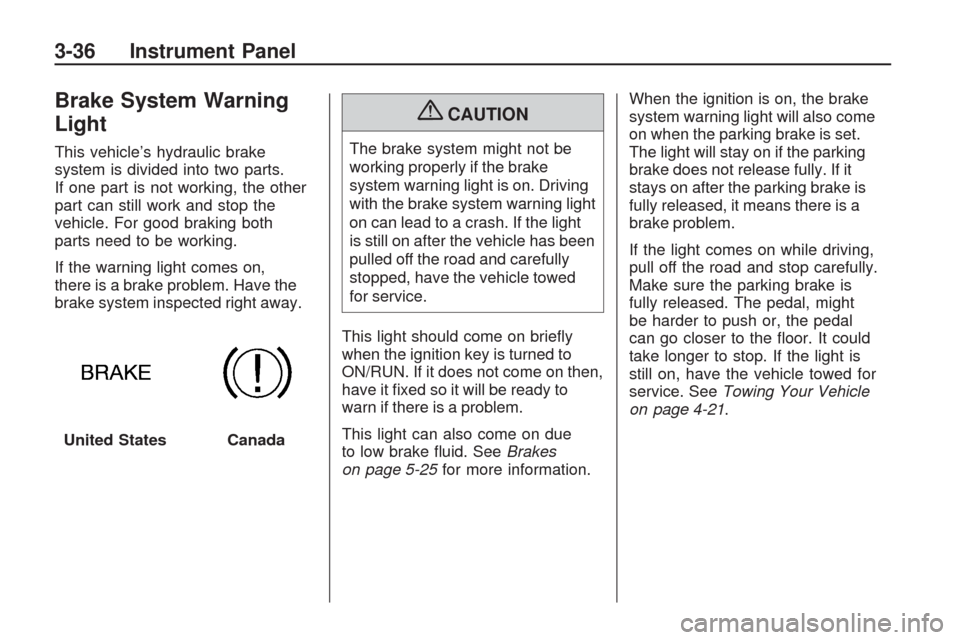
Brake System Warning
Light
This vehicle’s hydraulic brake
system is divided into two parts.
If one part is not working, the other
part can still work and stop the
vehicle. For good braking both
parts need to be working.
If the warning light comes on,
there is a brake problem. Have the
brake system inspected right away.
{CAUTION
The brake system might not be
working properly if the brake
system warning light is on. Driving
with the brake system warning light
on can lead to a crash. If the light
is still on after the vehicle has been
pulled off the road and carefully
stopped, have the vehicle towed
for service.
This light should come on briey
when the ignition key is turned to
ON/RUN. If it does not come on then,
have it xed so it will be ready to
warn if there is a problem.
This light can also come on due
to low brake uid. SeeBrakes
on page 5-25for more information.When the ignition is on, the brake
system warning light will also come
on when the parking brake is set.
The light will stay on if the parking
brake does not release fully. If it
stays on after the parking brake is
fully released, it means there is a
brake problem.
If the light comes on while driving,
pull off the road and stop carefully.
Make sure the parking brake is
fully released. The pedal, might
be harder to push or, the pedal
can go closer to the oor. It could
take longer to stop. If the light is
still on, have the vehicle towed for
service. SeeTowing Your Vehicle
on page 4-21.
United States
Canada
3-36 Instrument Panel
Page 157 of 422
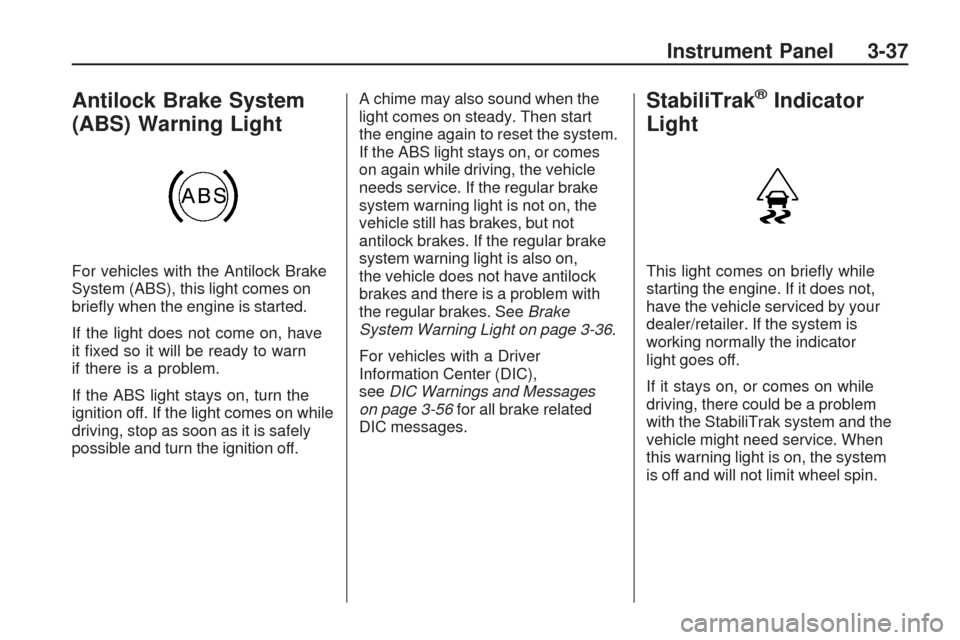
Antilock Brake System
(ABS) Warning Light
For vehicles with the Antilock Brake
System (ABS), this light comes on
briey when the engine is started.
If the light does not come on, have
it xed so it will be ready to warn
if there is a problem.
If the ABS light stays on, turn the
ignition off. If the light comes on while
driving, stop as soon as it is safely
possible and turn the ignition off.A chime may also sound when the
light comes on steady. Then start
the engine again to reset the system.
If the ABS light stays on, or comes
on again while driving, the vehicle
needs service. If the regular brake
system warning light is not on, the
vehicle still has brakes, but not
antilock brakes. If the regular brake
system warning light is also on,
the vehicle does not have antilock
brakes and there is a problem with
the regular brakes. SeeBrake
System Warning Light on page 3-36.
For vehicles with a Driver
Information Center (DIC),
seeDIC Warnings and Messages
on page 3-56for all brake related
DIC messages.
StabiliTrak®Indicator
Light
This light comes on briey while
starting the engine. If it does not,
have the vehicle serviced by your
dealer/retailer. If the system is
working normally the indicator
light goes off.
If it stays on, or comes on while
driving, there could be a problem
with the StabiliTrak system and the
vehicle might need service. When
this warning light is on, the system
is off and will not limit wheel spin.
Instrument Panel 3-37
Page 159 of 422
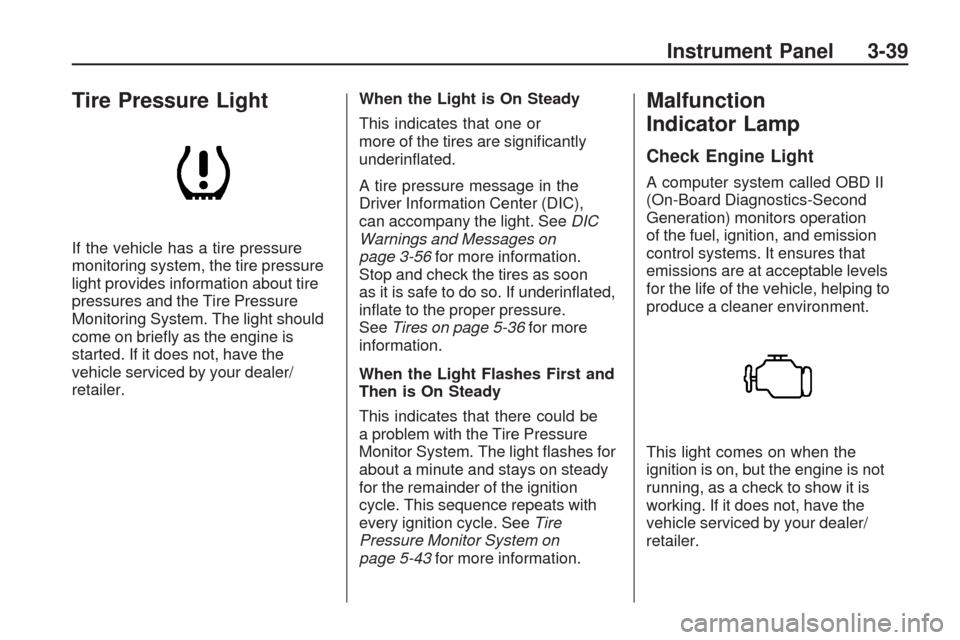
Tire Pressure Light
If the vehicle has a tire pressure
monitoring system, the tire pressure
light provides information about tire
pressures and the Tire Pressure
Monitoring System. The light should
come on briey as the engine is
started. If it does not, have the
vehicle serviced by your dealer/
retailer.When the Light is On Steady
This indicates that one or
more of the tires are signicantly
underinated.
A tire pressure message in the
Driver Information Center (DIC),
can accompany the light. SeeDIC
Warnings and Messages on
page 3-56for more information.
Stop and check the tires as soon
as it is safe to do so. If underinated,
inate to the proper pressure.
SeeTires on page 5-36for more
information.
When the Light Flashes First and
Then is On Steady
This indicates that there could be
a problem with the Tire Pressure
Monitor System. The light ashes for
about a minute and stays on steady
for the remainder of the ignition
cycle. This sequence repeats with
every ignition cycle. SeeTire
Pressure Monitor System on
page 5-43for more information.
Malfunction
Indicator Lamp
Check Engine Light
A computer system called OBD II
(On-Board Diagnostics-Second
Generation) monitors operation
of the fuel, ignition, and emission
control systems. It ensures that
emissions are at acceptable levels
for the life of the vehicle, helping to
produce a cleaner environment.
This light comes on when the
ignition is on, but the engine is not
running, as a check to show it is
working. If it does not, have the
vehicle serviced by your dealer/
retailer.
Instrument Panel 3-39
Page 163 of 422
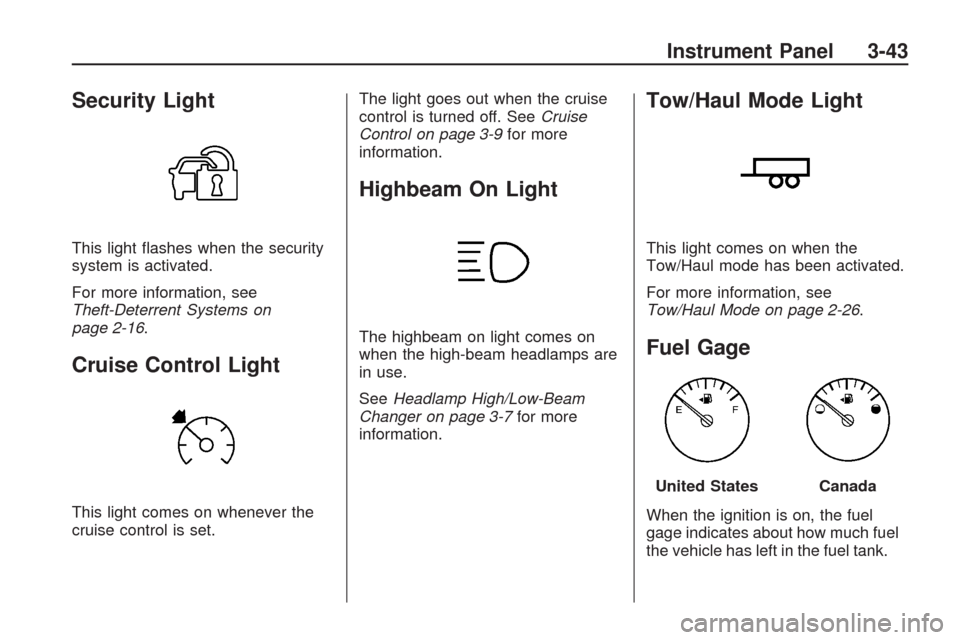
Security Light
This light ashes when the security
system is activated.
For more information, see
Theft-Deterrent Systems on
page 2-16.
Cruise Control Light
This light comes on whenever the
cruise control is set.The light goes out when the cruise
control is turned off. SeeCruise
Control on page 3-9for more
information.
Highbeam On Light
The highbeam on light comes on
when the high-beam headlamps are
in use.
SeeHeadlamp High/Low-Beam
Changer on page 3-7for more
information.
Tow/Haul Mode Light
This light comes on when the
Tow/Haul mode has been activated.
For more information, see
Tow/Haul Mode on page 2-26.
Fuel Gage
When the ignition is on, the fuel
gage indicates about how much fuel
the vehicle has left in the fuel tank.
United StatesCanada
Instrument Panel 3-43
Page 164 of 422
An arrow on the fuel gage indicates
the side of the vehicle the fuel
door is on.
Here are four things that some
owners ask about. None of these
show a problem with the fuel gage:
At the gas station, the gas
pump shuts off before the gage
reads full.
It takes a little more or less fuel
to ll up than the gage indicated.
For example, the gage might have
indicated the tank was half full,
but it actually took a little more or
less than half the tank’s capacity
to ll the tank.
The gage moves a little while
turning a corner or speeding up.
The gage does not go back to
empty when the ignition is
turned off.
Driver Information
Center (DIC)
Your vehicle has a Driver
Information Center (DIC).
The DIC displays information about
your vehicle. It also displays warning
messages if a system problem is
detected.
All messages will appear in the DIC
display located at the top of the
instrument panel cluster.
The DIC comes on when the
ignition is on. After a short delay,
the DIC will display the information
that was last displayed before
the engine was turned off.
The DIC also displays a shift lever
position indicator on the bottom
line of the display. SeeAutomatic
Transmission Operation on
page 2-24for more information.
The outside air temperature
and compass, if equipped, also
displays on the DIC when viewing
the trip and fuel information.The outside air temperature
automatically appears in the top
right corner of the DIC display.
If there is a problem with the system
that controls the temperature display,
the numbers will be replaced with
dashes. If this occurs, have the
vehicle serviced. The compass
will be shown in the bottom right
corner of the DIC display. SeeDIC
Compass on page 3-54for more
information.
If your vehicle has DIC buttons,
see “DIC Operation and Displays
(With DIC Buttons)” later in
this section andDIC Vehicle
Customization (With DIC Buttons) on
page 3-65for the displays available.
If your vehicle does not have
DIC buttons, see “DIC Operation
and Displays (Without DIC Buttons)”
later in this section for the displays
available.
3-44 Instrument Panel
Page 169 of 422
The trip odometer has a feature
called the retro-active reset.
This can be used to set the trip
odometer to the number of miles
(kilometers) driven since the ignition
was last turned on. This can be
used if the trip odometer is not
reset at the beginning of the trip.
To use the retro-active reset feature,
press and hold the set/reset button
for at least four seconds. The trip
odometer will display the number of
miles (mi) or kilometers (km) driven
since the ignition was last turned on
and the vehicle was moving. Once
the vehicle begins moving, the trip
odometer will accumulate mileage.
For example, if the vehicle was
driven 5 miles (8 km) before it
is started again, and then the
retro-active reset feature is activated,
the display will show 5 miles (8 km).
As the vehicle begins moving, the
display will then increase to 5.1 miles
(8.2 km), 5.2 miles (8.4 km), etc.If the retro-active reset feature is
activated after the vehicle is started,
but before it begins moving, the
display will show the number of
miles (mi) or kilometers (km) that
were driven during the last ignition
cycle.
RANGE
Press the trip/fuel button until
RANGE displays. This display
shows the approximate number
of remaining miles (mi) or
kilometers (km) the vehicle can be
driven without refueling. The display
will show LOW if the fuel level is low.
The fuel range estimate is based
on an average of the vehicle’s fuel
economy over recent driving history
and the amount of fuel remaining
in the fuel tank. This estimate will
change if driving conditions change.
For example, if driving in traffic and
making frequent stops, this displaymay read one number, but if the
vehicle is driven on a freeway, the
number may change even though
the same amount of fuel is in the fuel
tank. This is because different driving
conditions produce different fuel
economies. Generally, freeway
driving produces better fuel economy
than city driving. Fuel range cannot
be reset.
AVG (Average) ECONOMY
Press the trip/fuel button until
AVG ECONOMY displays.
This display shows the approximate
average miles per gallon (mpg) or
liters per 100 kilometers (L/100 km).
This number is calculated based
on the number of mpg (L/100 km)
recorded since the last time this
menu item was reset. To reset
AVG ECONOMY, press and hold
the set/reset button.
Instrument Panel 3-49