belt CHEVROLET UPLANDER 2007 1.G Workshop Manual
[x] Cancel search | Manufacturer: CHEVROLET, Model Year: 2007, Model line: UPLANDER, Model: CHEVROLET UPLANDER 2007 1.GPages: 592, PDF Size: 3.04 MB
Page 83 of 592
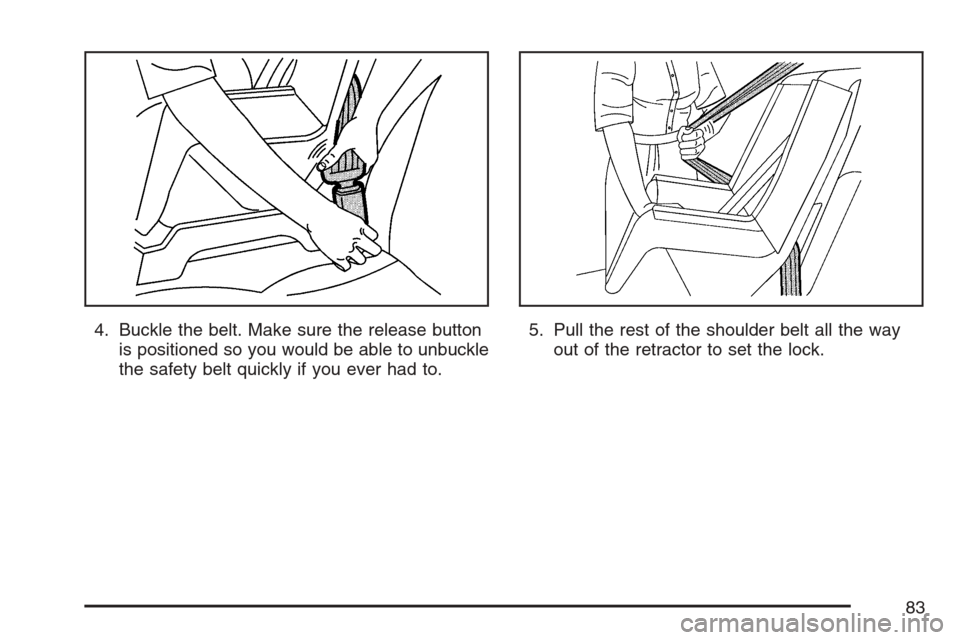
4. Buckle the belt. Make sure the release button
is positioned so you would be able to unbuckle
the safety belt quickly if you ever had to.5. Pull the rest of the shoulder belt all the way
out of the retractor to set the lock.
83
Page 84 of 592
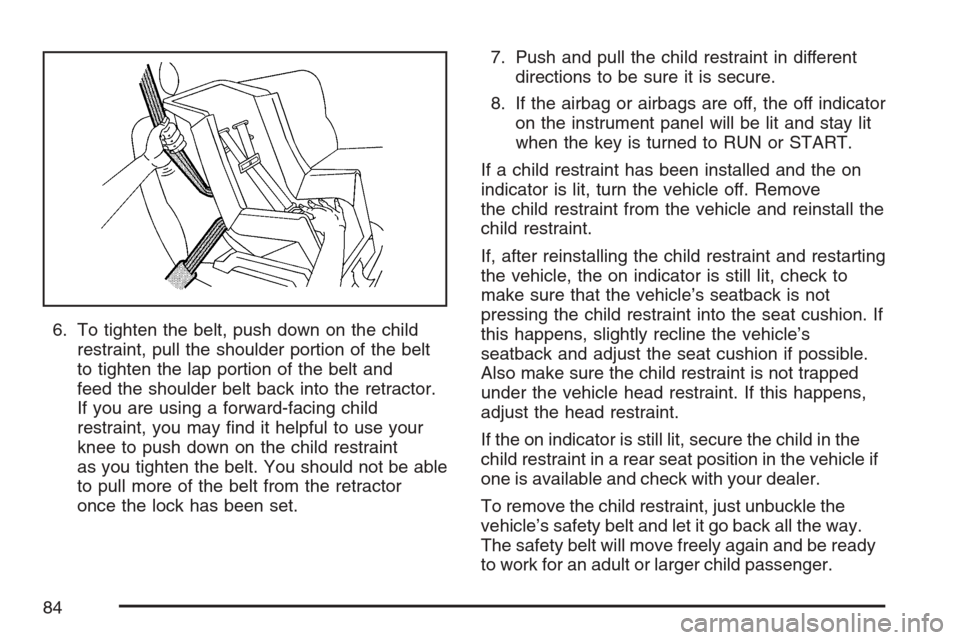
6. To tighten the belt, push down on the child
restraint, pull the shoulder portion of the belt
to tighten the lap portion of the belt and
feed the shoulder belt back into the retractor.
If you are using a forward-facing child
restraint, you may nd it helpful to use your
knee to push down on the child restraint
as you tighten the belt. You should not be able
to pull more of the belt from the retractor
once the lock has been set.7. Push and pull the child restraint in different
directions to be sure it is secure.
8. If the airbag or airbags are off, the off indicator
on the instrument panel will be lit and stay lit
when the key is turned to RUN or START.
If a child restraint has been installed and the on
indicator is lit, turn the vehicle off. Remove
the child restraint from the vehicle and reinstall the
child restraint.
If, after reinstalling the child restraint and restarting
the vehicle, the on indicator is still lit, check to
make sure that the vehicle’s seatback is not
pressing the child restraint into the seat cushion. If
this happens, slightly recline the vehicle’s
seatback and adjust the seat cushion if possible.
Also make sure the child restraint is not trapped
under the vehicle head restraint. If this happens,
adjust the head restraint.
If the on indicator is still lit, secure the child in the
child restraint in a rear seat position in the vehicle if
one is available and check with your dealer.
To remove the child restraint, just unbuckle the
vehicle’s safety belt and let it go back all the way.
The safety belt will move freely again and be ready
to work for an adult or larger child passenger.
84
Page 85 of 592
Built-In Child Restraint
WARNING! DEATH or SERIOUS INJURY can
occur:
Follow all instruction on the child restraint and
in the vehicle’s owner’s manual.
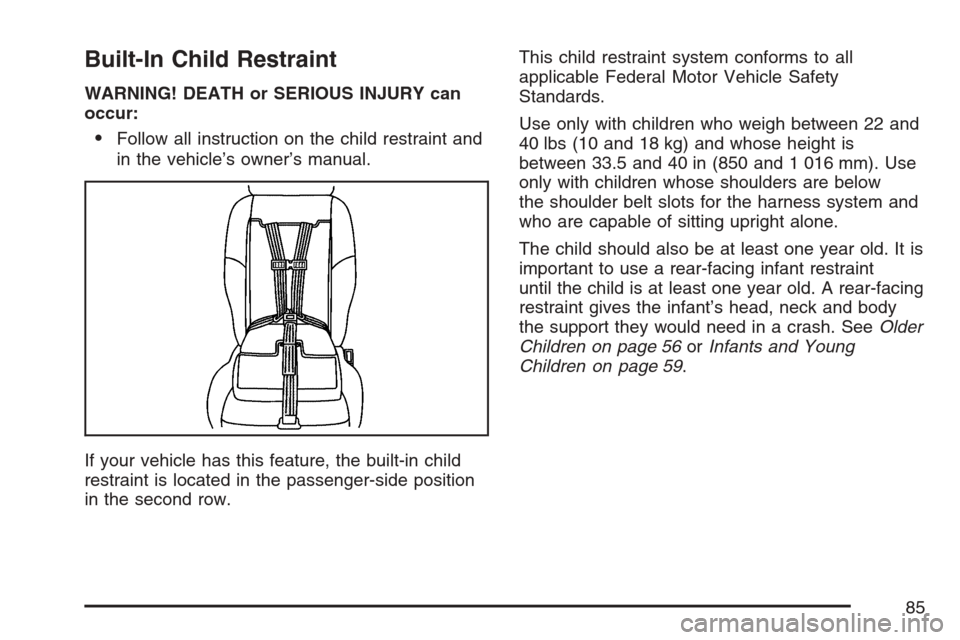
If your vehicle has this feature, the built-in child
restraint is located in the passenger-side position
in the second row.This child restraint system conforms to all
applicable Federal Motor Vehicle Safety
Standards.
Use only with children who weigh between 22 and
40 lbs (10 and 18 kg) and whose height is
between 33.5 and 40 in (850 and 1 016 mm). Use
only with children whose shoulders are below
the shoulder belt slots for the harness system and
who are capable of sitting upright alone.
The child should also be at least one year old. It is
important to use a rear-facing infant restraint
until the child is at least one year old. A rear-facing
restraint gives the infant’s head, neck and body
the support they would need in a crash. SeeOlder
Children on page 56orInfants and Young
Children on page 59.
85
Page 86 of 592
A child whose weight is over 40 lbs (18 kg), whose
height is over 40 in (1 016 mm) or whose
shoulders are above the shoulder belt slots for the
harness system, should be restrained in an
add-on booster seat appropriate for the child’s
size. SeeChild Restraint Systems on page 63.
Once the booster seat is outgrown, the child
should sit on the vehicle’s regular seat and use
the vehicle’s safety belts.
{CAUTION:
Using the vehicle’s built-in child restraint
as a booster seat for a larger child could
cause injury to the child in a sudden stop
or crash. A child whose weight is over
40 pounds, whose height is over 40 inches
or whose shoulders are above the
shoulder belt slots for the harness system
should use a restraint system that is
appropriate for their size, either an add-on
booster seat or the vehicle’s safety belt.
See “Child Restraints” or “Older Children”
in the Index.
Securing a Child in the Built-In Child
Restraint
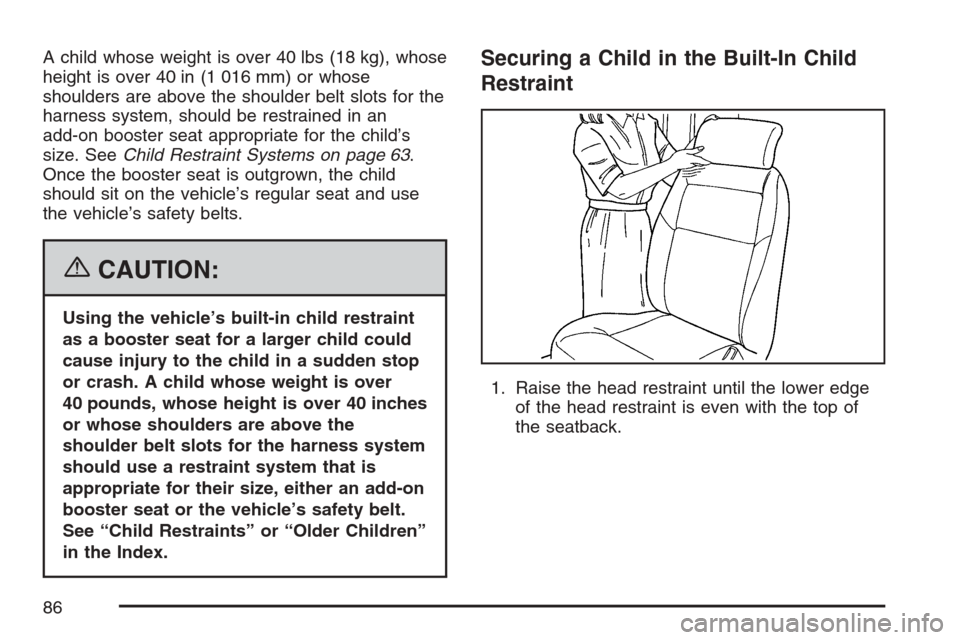
1. Raise the head restraint until the lower edge
of the head restraint is even with the top of
the seatback.
86
Page 88 of 592
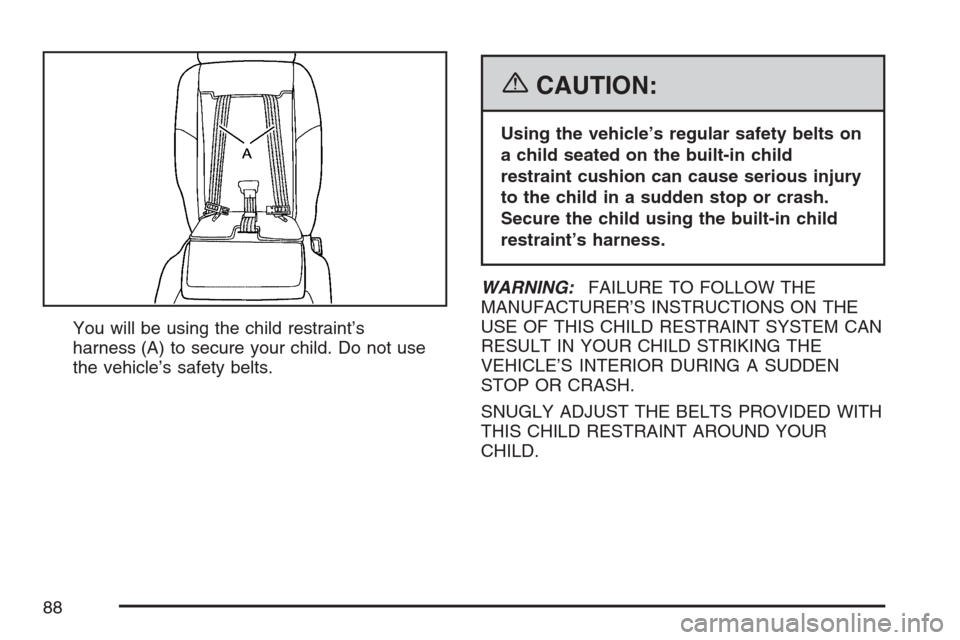
You will be using the child restraint’s
harness (A) to secure your child. Do not use
the vehicle’s safety belts.
{CAUTION:
Using the vehicle’s regular safety belts on
a child seated on the built-in child
restraint cushion can cause serious injury
to the child in a sudden stop or crash.
Secure the child using the built-in child
restraint’s harness.
WARNING:FAILURE TO FOLLOW THE
MANUFACTURER’S INSTRUCTIONS ON THE
USE OF THIS CHILD RESTRAINT SYSTEM CAN
RESULT IN YOUR CHILD STRIKING THE
VEHICLE’S INTERIOR DURING A SUDDEN
STOP OR CRASH.
SNUGLY ADJUST THE BELTS PROVIDED WITH
THIS CHILD RESTRAINT AROUND YOUR
CHILD.
88
Page 94 of 592
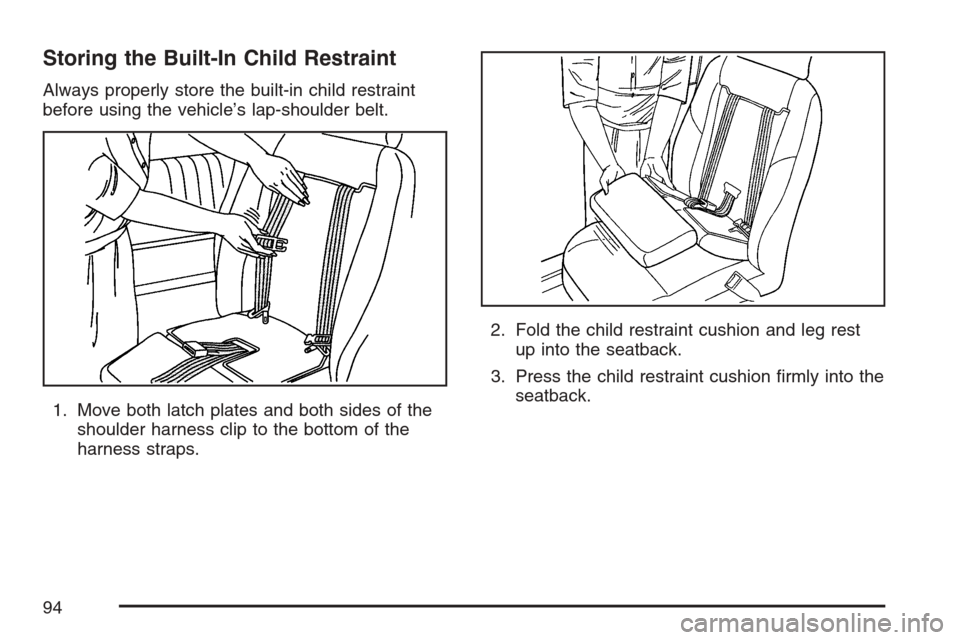
Storing the Built-In Child Restraint
Always properly store the built-in child restraint
before using the vehicle’s lap-shoulder belt.
1. Move both latch plates and both sides of the
shoulder harness clip to the bottom of the
harness straps.2. Fold the child restraint cushion and leg rest
up into the seatback.
3. Press the child restraint cushion rmly into the
seatback.
94
Page 96 of 592
Airbag System
Your vehicle has a frontal airbag for the driver and
a frontal airbag for the right front passenger.
Your vehicle may also have side impact airbags.
Side impact airbags are available for the driver, the
right front passenger and the second row
captain’s chairs (if equipped).
If your vehicle has a side impact airbag, the word
AIRBAG will appear on the airbag covering on
the side of the seatback closest to the door.
Frontal airbags are designed to help reduce the
risk of injury from the force of an inating
frontal airbag. But these airbags must inate very
quickly to do their job and comply with federal
regulations.Here are the most important things to know about
the airbag system:
{CAUTION:
You can be severely injured or killed in a
crash if you are not wearing your safety
belt — even if you have airbags. Wearing
your safety belt during a crash helps
reduce your chance of hitting things
inside the vehicle or being ejected from it.
Airbags are “supplemental restraints” to
the safety belts. All airbags are designed
to work with safety belts but do not
replace them.
CAUTION: (Continued)
96
Page 97 of 592
CAUTION: (Continued)
Frontal airbags for the driver and right
front passenger are designed to deploy in
moderate to severe frontal and near
frontal crashes. They are not designed to
inate in rollover, rear crashes, or in many
side crashes. And, for some unrestrained
occupants, frontal airbags may provide
less protection in frontal crashes than
more forceful airbags have provided in
the past.
Side impact airbags are designed to
inate in moderate to severe crashes
where something hits the side of your
vehicle. They are not designed to inate in
frontal, in rollover, or in rear crashes.
Everyone in your vehicle should wear a
safety belt properly — whether or not
there is an airbag for that person.
{CAUTION:
Both frontal and side impact airbags
inate with great force, faster than the
blink of an eye. If you are too close to an
inating airbag, as you would be if you
were leaning forward, it could seriously
injure you. Safety belts help keep you in
position for airbag ination before and
during a crash. Always wear your safety
belt even with frontal airbags. The driver
should sit as far back as possible while
still maintaining control of the vehicle.
Occupants should not lean on or sleep
against the door.
97
Page 98 of 592
{CAUTION:
Anyone who is up against, or very close
to, any airbag when it inates can be
seriously injured or killed. Airbags plus
lap-shoulder belts offer the best
protection for adults, but not for young
children and infants. Neither the vehicle’s
safety belt system nor its airbag system is
designed for them. Young children and
infants need the protection that a child
restraint system can provide. Always
secure children properly in your vehicle.
To read how, seeOlder Children on
page 56orInfants and Young Children on
page 59.There is an airbag
readiness light on the
instrument panel cluster,
which shows the
airbag symbol.
The system checks the airbag electrical system for
malfunctions. The light tells you if there is an
electrical problem. SeeAirbag Readiness Light on
page 234for more information.
98
Page 104 of 592
How Does an Airbag Restrain?
In moderate to severe frontal or near frontal
collisions, even belted occupants can contact the
steering wheel or the instrument panel. In
moderate to severe side collisions, even belted
occupants can contact the inside of the vehicle.
Airbags supplement the protection provided
by safety belts. Airbags distribute the force of the
impact more evenly over the occupant’s upper
body, stopping the occupant more gradually. But
the frontal airbags would not help you in many
types of collisions, including rollovers, rear
impacts, and many side impacts, primarily because
an occupant’s motion is not toward the airbag.
Side impact airbags would not help you in many
types of collisions, including many frontal or
near frontal collisions, rollovers, and rear impacts.
Airbags should never be regarded as anything
more than a supplement to safety belts, and then
only in moderate to severe frontal or near-frontal
collisions for the driver’s and right front
passenger’s frontal airbags, and only in moderate
to severe side collisions for vehicles with side
impact airbags.
What Will You See After an Airbag
Inates?
After an airbag inates, it quickly deates, so
quickly that some people may not even realize the
airbag inated. Some components of the airbag
module — the steering wheel hub for the driver’s
frontal airbag, the instrument panel for the
right front passenger’s frontal airbag, and for
seating positions with side impact airbags, the side
of the seatback closest to the door — may be
hot for a short time. The parts of the airbag that
come into contact with you may be warm, but
not too hot to touch. There may be some smoke
and dust coming from the vents in the deated
airbags. Airbag ination does not prevent the driver
from seeing out of the windshield or being able
to steer the vehicle, nor does it prevent people
from leaving the vehicle.
104