trunk CHEVROLET VEGA 1976 1.G Owners Manual
[x] Cancel search | Manufacturer: CHEVROLET, Model Year: 1976, Model line: VEGA, Model: CHEVROLET VEGA 1976 1.GPages: 87, PDF Size: 32.36 MB
Page 17 of 87
Downloaded from www.Manualslib.com manuals search engine STARTING AND OPERATING
Engine Exhaust Gas Caution (Carbon Monoxide)
AvoId Inhaling exhaust gases because
they contaIn carbon monoxide, which by
Itselt is colorless and odorless. Carbon
monoxide Is a dangerous gas that can
cause unconsciousness and is potentially
lethal.
If at any time you suspect that exhaust
fumes are entering the passenger compartment, have the cause determined and
corrected as soon as possible. If you must
drIve under these conditions, drive only
with
all windows fully open.
The best protection agaInst carbon
monoxide entry Into the car body Is a
properly maIntaIned engine exhaust system, car body and body ventilatIon system, It Is recommended that the exhaust system
and body be Inspected by a competent
mechanIc.
• Each time the vehIcle Is raised for an 011 change.
• Whenever 8 change Is noticed In the
sound Of the exhaust system.
• Whenever the exhaust system, underbody or rear of the vehicle Is damaged.
See your MaIntenance Schedule folder
for inspection procedure.
To allow proper operation of the car's
ventilation system, keep aIr Inlet grille
forward of windshield and rear ventilation
grille on station wagon quarter. panels
clear ot snow or other
obstruction at all times, and prevent cargo from blocking
the inside vent holes on the underside of the quarter panels.
SITTING IN A PARKED CAR WITH ENGINE RUNNING FOR AN EXTENDED PERIOD IS NOT RECOMMENDED.
Do not run engine In confined areas
such as garages any more than needed
to move vehIcle In
or out of area. When vehIcle Is stopped In an UNCONFINED area with the engine runnIng for any more
than a short perIod, adjust heating or cooling system to force outsIde aIr into
car as follows:
2-1
1. On cars not equipped with air conditioning, set fan to medium or high
speed and upper control lever to any
position except OFF.
2. On cars equipped with air conditIoning, set fan to medium or high speed
and upper control lever to any position
except
OFF or MAX.
The trunk lid should be closed while drIving to help prevent inadvertently drawing exhaust gases into the car. It is
unwise to drIve at high speeds for long
durations with the trunk lid open. However, it tor some reason the trunk must remain
open for a period while moving, or electrical wiring or other cable connections to
a trailer must pass through the seal be
tween trunk
lid and body, the following
precautions should be observed:
• Close all windows.
• Adjust heating or cooling system to
force outsIde air into car as described In Items 1 and 2 above but with fan set
at hIgh speed.
• On cars equIpped with outside aIr vents In or under Instrument panel, open vents
fully.
Page 36 of 87
Downloaded from www.Manualslib.com manuals search engine ventilation comfort, made possible
by the addition of air vent provi
sions in each quarter panel on sta
tion wagon and panel express
models and each rear lock pillar
on notchback and hatchback mod
els. Another feature of the system
is continuous low-speed operation
of the heater and air conditioner
blower, resulting in an uninter
rupted supply of outside air
flow
into the car whenever the ignition
switch
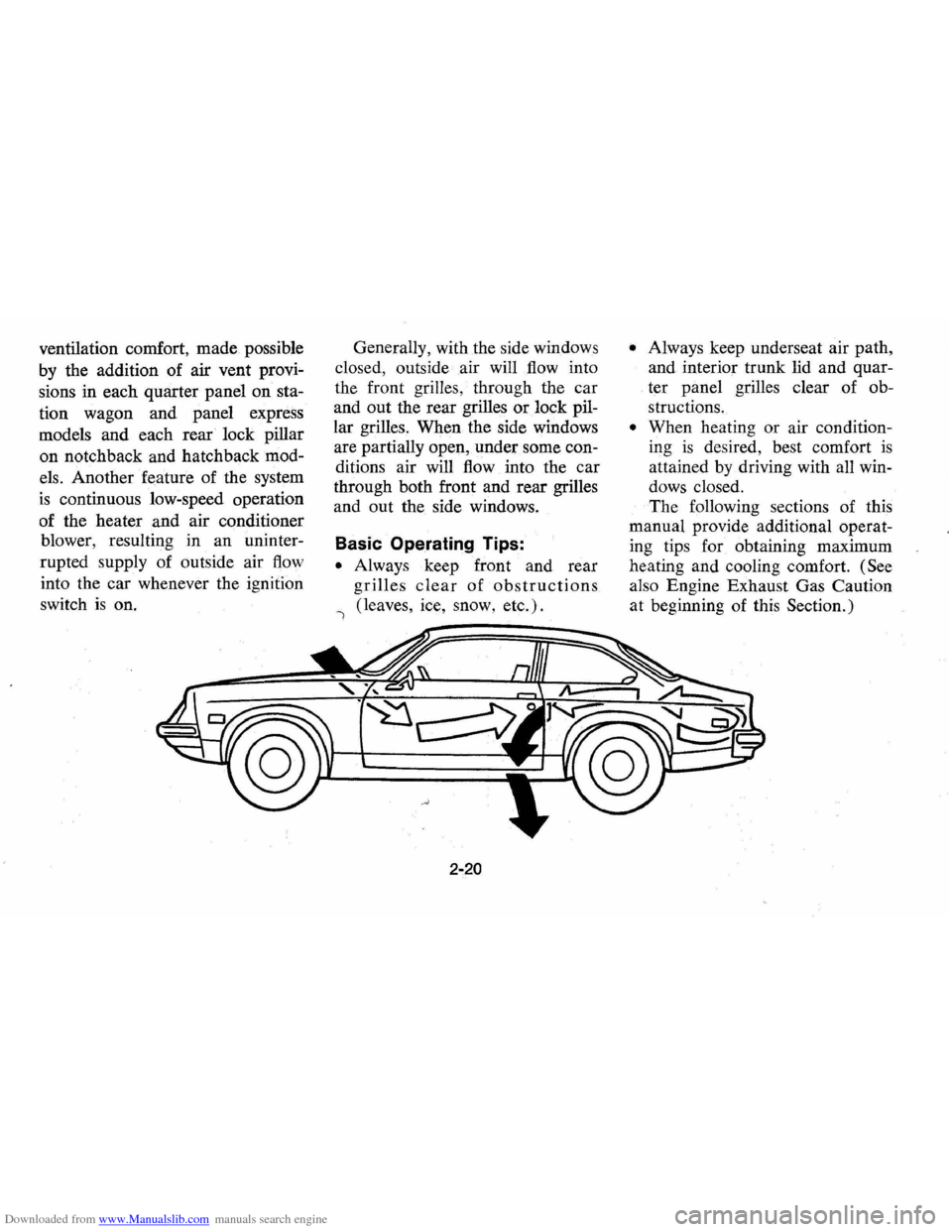
is on. Generally,
with the side windows
closed, outside· air will
flow into
the front grilles, through the car
and out the rear grilles
or lock pil
lar grilles. When the side windows
are partially open, under some con
ditions air will
flow into the car
through both front and rear grilles
and out the side windows.
Basic Operating Tips:
• Always keep front and rear
grilles clear of obstructions
, (leaves, ice, snow, etc.).
2-20
• Always keep underseat air path,
and interior trunk lid and quar
ter panel grilles clear of ob
structions.
• When heating or air condition
ing
is desired, best comfort is
attained by driving with all win
dows closed.
The following sections of this
manual provide additional operat
ing tips for obtaining maximum
heating and cooling comfort.
(See
also Engine Exhaust Gas Caution
at beginning of this Section.)
Page 58 of 87
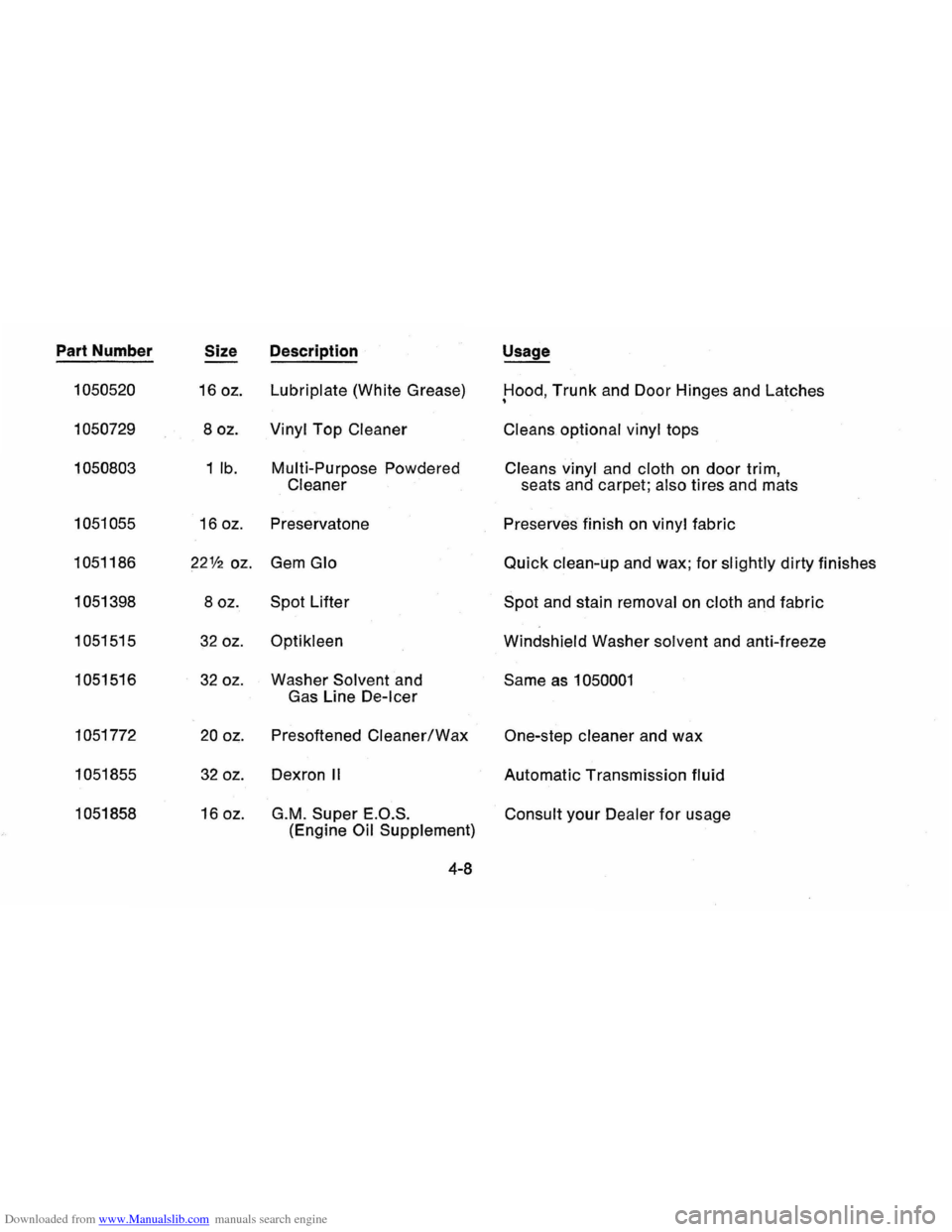
Downloaded from www.Manualslib.com manuals search engine Part Number Size Description Usage
1050520
16 oz. Lubriplate (White Grease) Hood, Trunk and Door Hinges and Latches •
1050729 8 oz. Vinyl Top Cleaner Cleans optional vinyl tops
1050803 1
lb. Multi-Purpose
Powdered
Cleans vinyl and cloth on door trim, Cleaner seats and carpet; also tires and mats
1051055 16 oz.
Preservatone Preserves finish on vinyl fabric
1051186
22112 oz. Gem Glo Quick clean-up and wax; for slightly dirty finishes
1051398 8 oz. Spot Lifter
Spot and stain
removal on cloth and fabric
1051515
32 oz. Optikleen Windshield Washer solvent and anti-freeze
1051516
32 oz. Washer Solvent and
Same as 1050001 Gas Line De-Icer
1051772 20 oz. Presoftened Cleaner/Wax One-step cleaner and wax
1051855
32 oz. Dexron II Automatic Transmission fluid
1051858 16 oz. G.M. Super E.O.S.
(Engine Oil Supplement) Consult your Dealer for usage
4-8
Page 70 of 87
Downloaded from www.Manualslib.com manuals search engine Hood Latche$
Every 6 months or 7,500 miles,
whichever occurs first, lubricate
hood latch assembly and hood
hinge assembly
as follows:
1. Wipe off any accumulation of
dirt or contamination on latch
parts.
2 . Apply Lubriplate or equivalent
to latch pilot bolts and latch
locking plate.
.
3. Apply light engine oil to all pivot
points in release mechanism,
as
well as primary and secondary
latch mechanisms.
4. Lubricate hood hinges.
5. Make hood hinge and latch
mechanism functional check
to
assure the assembly is working
correctly .
Accelerator Linkage
Lubricate with engine oil every
15,000 miles.
Hinges
The following points should be
checked and lubricated every 6
months or
7,500 miles, whichever
occurs first:
hingeS on all doors,
fuel filler door, trunk lid, door lock
striker and door
jamb switches. '
5-12
Air Conditioning
Have your Authorized Dealer
check your Air Conditioning
sys
tem at some time during the winter
months to be sure there has been
no loss in cooling output. During
the summer , see your Authorized
Dealer immediately if you suspect
the system
is not performing as it
should.
NOTE: Your car's air condition
ing system will not operate below
ambient temperature of
300 F
( -1 0 C) , regardless of control
position.
Page 80 of 87
Downloaded from www.Manualslib.com manuals search engine Air Cleaner
Your car receives its power from
a mixture of gasoline and air. The
air
is taken in to the system through
the air cleaner
so it's important to
replace the air cleaner at required
intervals. A dirty air cleaner re
duces engine efficiency.
Properly Tuned Engine
Overall tuning (a check on tim
ing, spark plugs, emission control
devices, etc.) can improve your
car's gas mileage. You just can't
expect an
"out-of-tune" engine to
give you good gas mileage and
cleaner air.
Excess Weight
Fuel economy is related to the
work the engine must do. The
heavier the load, the more power it
takes. Keep excess weight to a
minimum by removing any per
sonal effects or luggage from the
car or trunk when they are not
needed.
Tire Inflation
Underinfiation not only causes
needless wear of the tires, but can
also waste gasoline. It's a good
idea to check tire pressures
regularly.
Wheel Alignment
Incorrect "toe in" or "toe out" can
have the effect
of dragging your
front tires sideways and may cause
premature tire wear.
It takes power
to carry this extra load and that
takes gas from your tank.
Catalytic Converter
The catalytic converter IS an
emission control device added to
5-22
the exhaust system to reduce hy
drocarbon and carbon monoxide
pollutants from the exhaust gas
stream.
The converter contains
beads which are coated with a cata
lytic material containing platinum
and palladium.
Use of the catalytic converter
has the advantage of allowing the
engine to be re-tuned for improved
fuel economy and driveability.
The catalytic converter requires
the use
of unleaded fuel only.
Unleaded gasoline is used to re
duce combustion chamber deposits,
corrosion and
to prevent lead con
tamination of the catalyst that
would render it ineffective.
The use
of leaded fuel will cause the cata
lytic converter to
become ineffec
tive as an emission control device.