wheel CHEVROLET VEGA 1976 1.G Owners Manual
[x] Cancel search | Manufacturer: CHEVROLET, Model Year: 1976, Model line: VEGA, Model: CHEVROLET VEGA 1976 1.GPages: 87, PDF Size: 32.36 MB
Page 16 of 87
Downloaded from www.Manualslib.com manuals search engine Operation Foreign Countries • In
Your car is designed to operate
on unleaded fuel of approximately
91 research octane number.
If you plan to operate your car
outside the Continental limits of
the United
States or Canada, there
is a possibility that the best fuels
available in some countries are so
low in octane rating that excessive
knocking and serious engine
dam
age may result from their use. Also ,
if leaded fuels are used in vehicles
designed for unleaded fuels, it may result
in the deactivation of the
catalytic converter, if the vehicle
is
so equipped, and possibly other
related problems.
The use of leaded
fuel in a vehicle designed
for un
leaded fuel will require different
maintenance intervals.
To obtain in
formation on the octane rating and
availability of non-leaded fuels
available in the countries in which
you plan to travel, and a mainte
nance schedule to be used when
operating on leaded fuel, write to
Chevrolet Motor Division,
Service
Department, Detroit, Michigan
48202, (or in Canada write to
General Motors of Canada Limited,
Owner Relations Department,
Oshawa, Ontario LlJ 5Z6), giving:
1-11
• The vehicle identification num
ber (on plate on instrument
panel ahead of the steering wheel
and visible through the wind
shield,
or from registration slip
or title),.
• The country or countries in which
you plan to travel.
It is recommended that you not
operate your car in any country not
having fuels meeting the require
ments of your car's engine
as these
may cause engine damage for which
Chevrolet
is not responsible under
the terms of the Chevrolet New
Vehicle Warranty or Emission
Control Systems Warranty.
Page 18 of 87
Downloaded from www.Manualslib.com manuals search engine STEERING COLUMN CONTROLS
Anti-Theft Steering
Column Lock
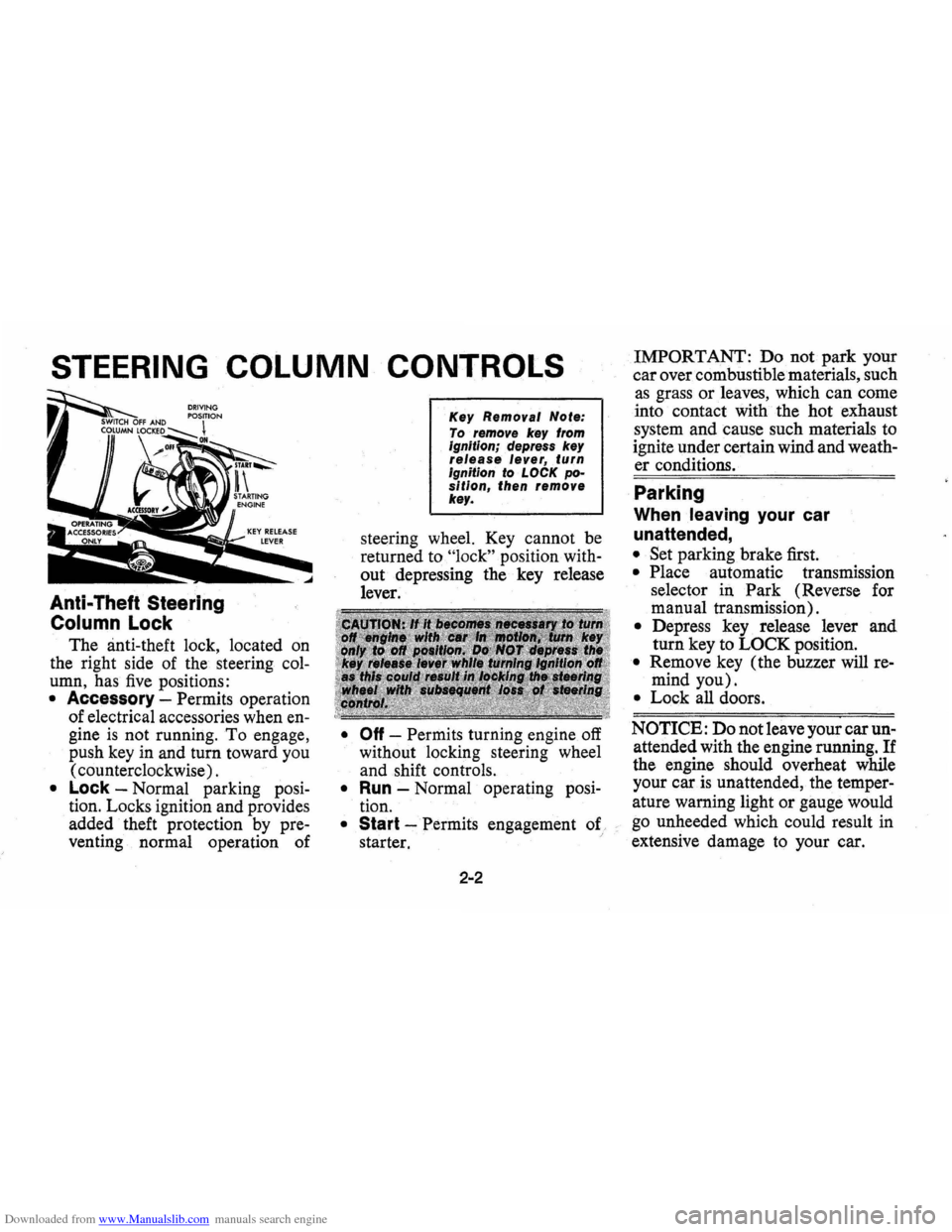
The anti-theft lock, located on
the right side of the steering col
umn, has five positions:
• Accessory -Permits operation
of electrical accessories when
en
gine is not running. To engage,
push
key in and turn toward you
( counterclockwise) .
• Lock -Normal parking posi
tion. Locks ignition and provides
added theft protection
by pre
venting normal operation of
Key Removal Note:
To remove key from ignitionjdepress key release lever, . turn Ignition to LOCK position, then remove key.
steering wheel. Key cannot be
returned to
"lock" position with
out depressing the key release
lever.
• Off -Permits turning engine off
without locking steering wheel
and shift controls.
• Run -Normal operating posi
tion.
• Start -Permits engagement of. :
starter.
2-2
IMPORTANT: Donot park your
car over combustible materials, such
as grass or leaves, which can come
into contact with the hot exhaust
system and cause such materials to
ignite under certain wind and
weath
er conditions.
. Parking
When leaving your car
unattended,
• Set parking brake first.
• Place automatic transmission
selector in
Park (Reverse for
manual transmission).
• Depress key release lever and
turn key to
LOCK position.
• Remove key (the buzzer will re
mind you).
• Lock all doors.
NOTICE: Do not leave your car un
attended with the engine running. If
the engine should overheat while
your
caris unattended, the temper
ature warning light or gauge would
go unheeded which could result in
extensive damage to your car.
Page 24 of 87
Downloaded from www.Manualslib.com manuals search engine is reduced below 5 MPH.
The shift speeds chart indicates
the speeds at which each upshift of
the transmission should be
per
formed to produce the best com
promise between vehicle perform
anceand fuel economy.
Turn Signals and Lane
Change Feature
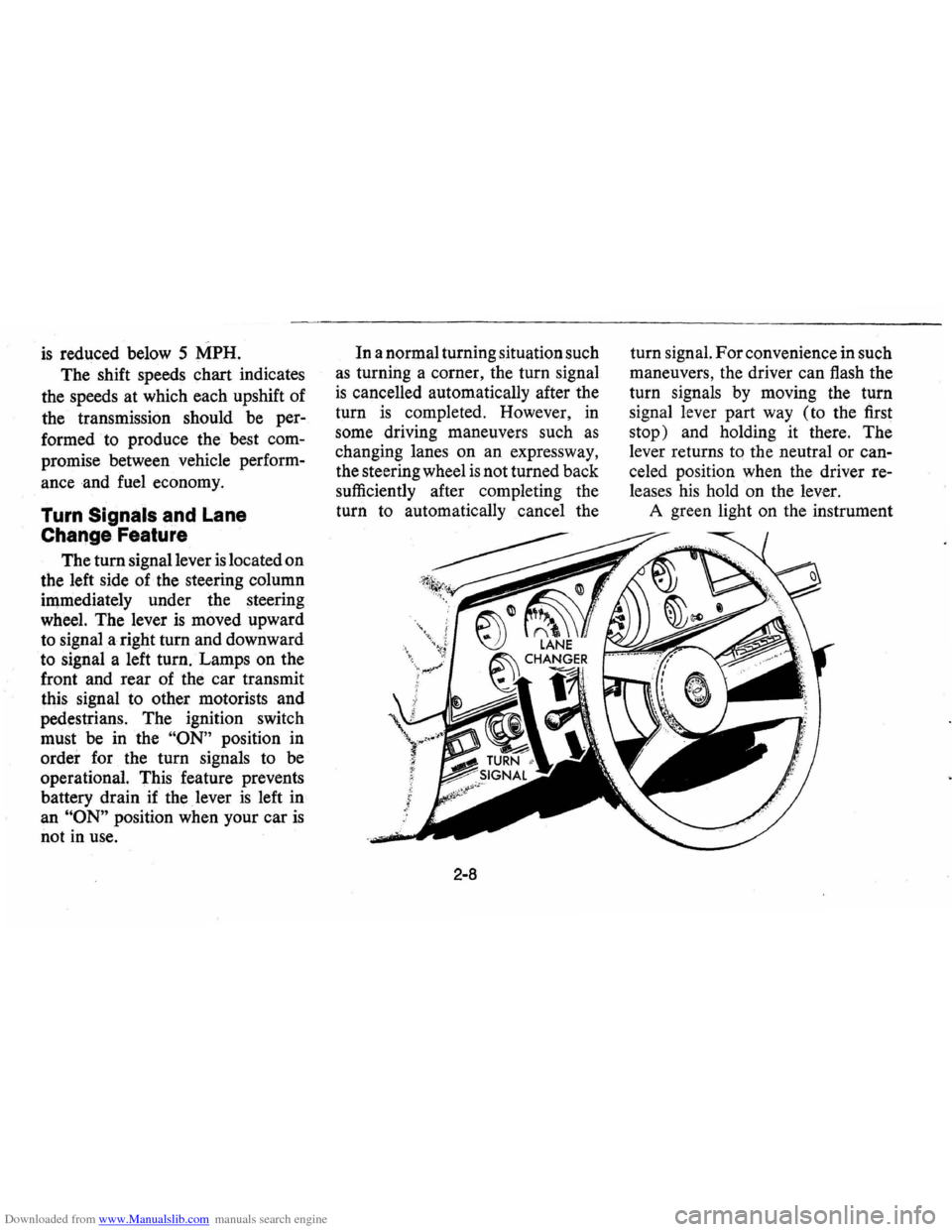
The tum signal lever is located on
the left side of the steering column
iIllmediately under the steering
wheel. The lever
is moved upward
to signal a right turn and downward
to signal a left tum. Lamps on the
front and rear of the car transmit
this signal to other motorists and
pedestrians. The ignition switch
must be in the
"ON" position in
order for the tum signals to be
operational. This feature prevents
battery drain if the lever
is left in
an
"ON" position when your car is
not in use. In
a normal turning situation such
as turning a comer, the tum signal
is cancelled automatically after the
tum
is completed. However, in
some driving maneuvers such
as
changing lanes on an expressway,
the steering wheel
is not turned back
sufficiently after completing the
tum to automatically cancel the
2-8
tum signal. For convenience in such
maneuvers, the driver can flash the
tum signals
by moving the tum
signal lever part way (to the first
stop) and holding it there . The
lever returns
tq the neutral or can
celed position when the driver re
leases his hold on the lever.
A green light on the instrument
Page 25 of 87
Downloaded from www.Manualslib.com manuals search engine cluster flashes to indicate proper
operation of the front and rear turn
signal lamps.
If the indicator lamp
remains on and does not flash,
check for a defective lamp bulb.
If
the indicator fails to light when the
lever
is moved, check the fuse and
indicator bulb.
NOTE: For operation of hazard
flasher, see page 3-1, in
Section "In
Case of Emergency."
Horn
The horn on your car is actuated
by firmly pressing on the pad in the
center of the steering wheel.
As a good motorist,
~se of the
horn should be kept at a minimum.
However, acquaint yourself
as soon
as possible with this function of
your car, should it ever become
necessary to give a warning to a
pedestrian
or another motorist.
Power Steering
If the steering system power as
sist fails due to some malfunction,
or because the engine has stalled,
the vehicle can still be steered.
However, much greater effort
is re
quired, particularly in sharp turns.
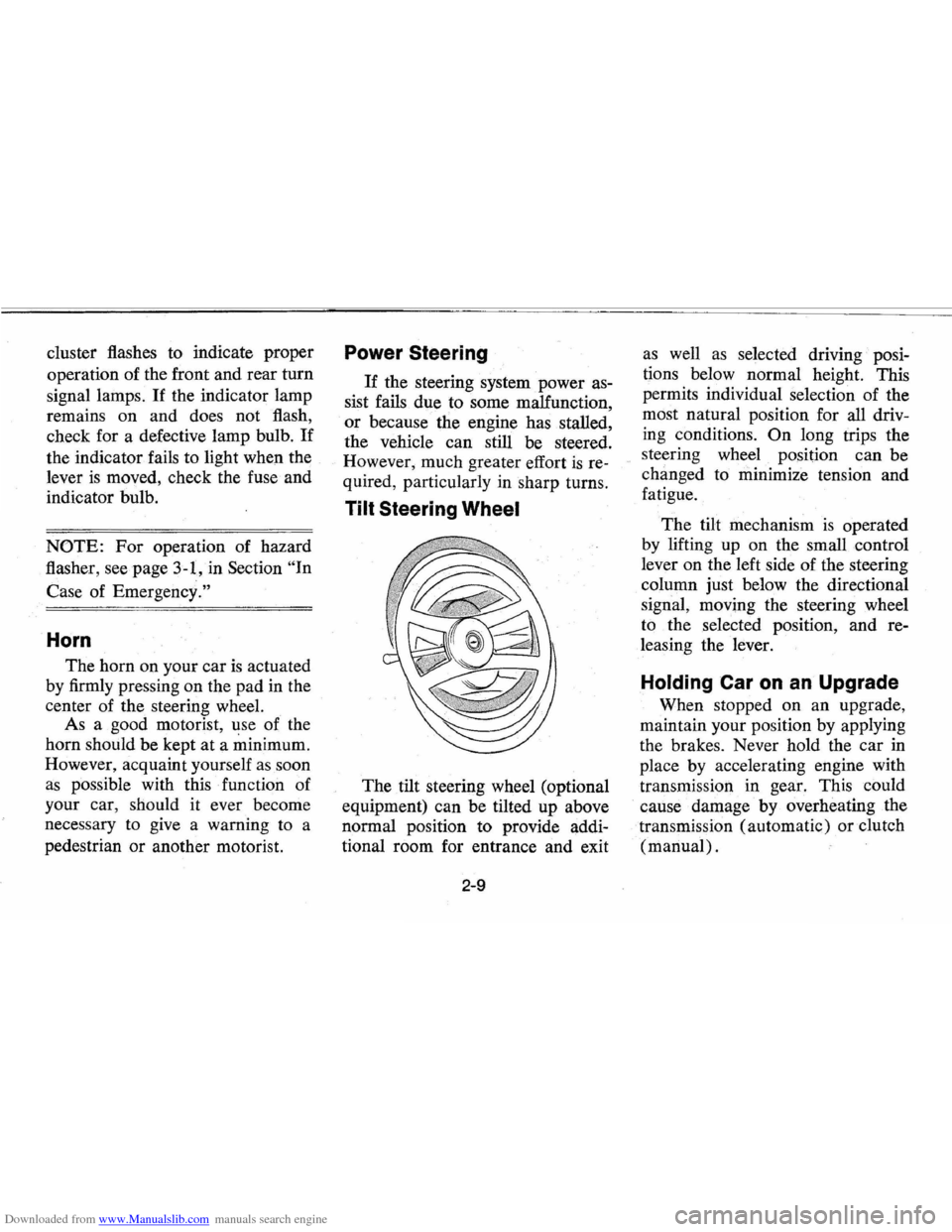
Tilt Steering Wheel
The tilt steering wheel (optional
equipment) can be tilted up above
normal position to provide addi
tional room for entrance and exit
2-9
as well as selected driving· posi
tions below normal height. This
permits individual selection of the
most natural position for
all driv
ing conditions.
On long trips the
steering wheel position can be
changed to minimize tension and
fatigue.
The tilt mechanism
is operated
by lifting up on the small control
lever on the left side of the steering
column just below the directional
signal, moving the steering wheel
to the selected position, and re
leasing the lever.
Holding Car on an Upgrade
When stopped on an upgrade,
maintain your position by applying
the brakes. Never hold the car
in
place by accelerating engine with
transmission in gear. This could
cause damage by overheating
the
. transmission (automatic) or clutch
(manual) .
Page 27 of 87
Downloaded from www.Manualslib.com manuals search engine Parking Brake
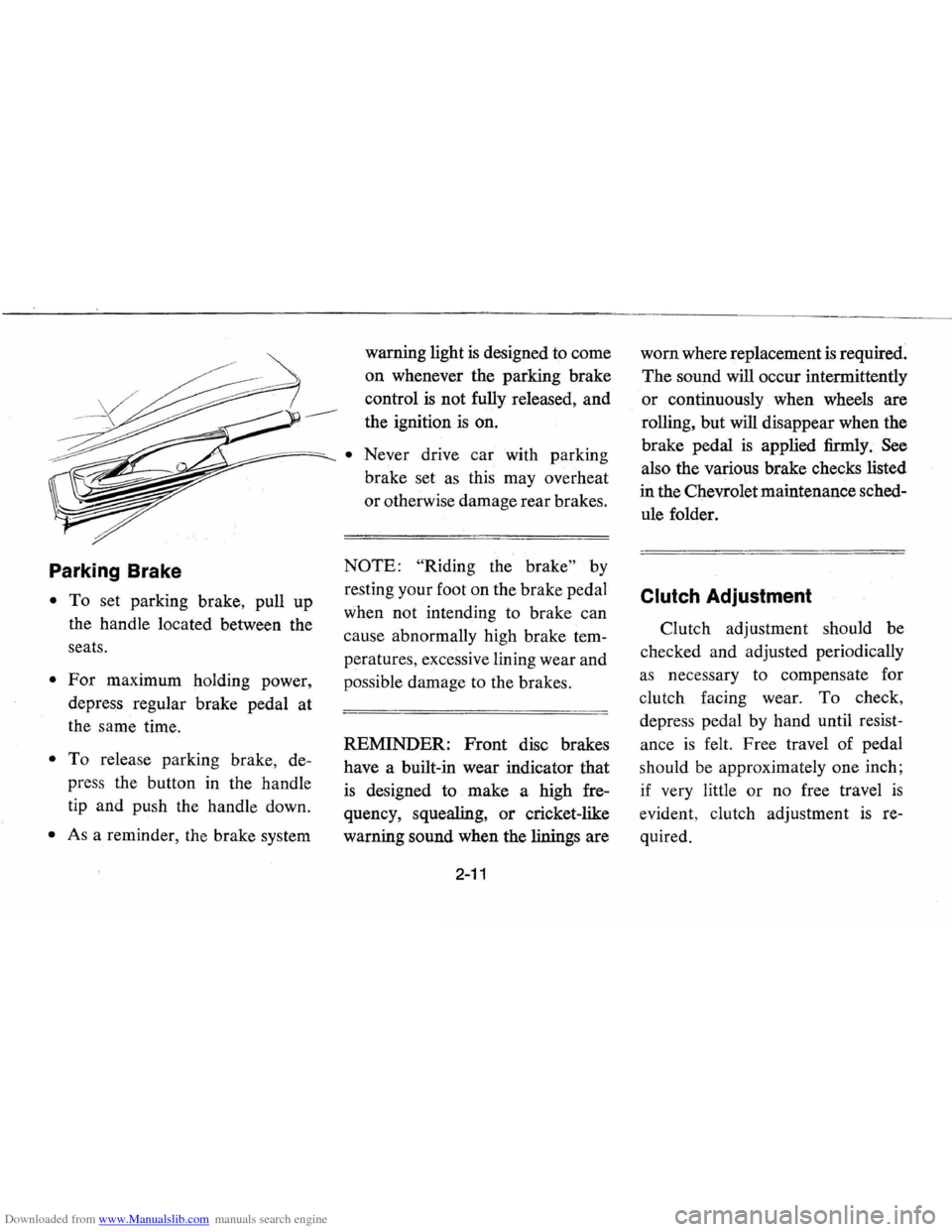
• To set parking brake, pull up
the handle located between the
seats.
• For maximum holding power,
depress regular brake pedal at
the same time.
• To release parking brake, de
press the button in the handle
tip and push the handle down.
• As a reminder, the brake system warning
light
is designed to come
on whenever the parking brake
control
is not fully released, and
the ignition ·
is on.
• Never drive car with parking
brake set
as this may overheat
or otherwise damage rear brakes.
NOTE: "Riding the brake" by
resting your foot on the brake pedal
when not intending to brake can
cause abnormally high brake tem
peratures, excessive lining wear and
possible damage to the brakes.
REMINDER:
Front disc brakes
have a built-in wear indicator that
is designed to make a high fre
quency, squealing,
or cricket-like
warning sound when the linings are
2-11
worn where replacement is required.
The sound will occur intermittently
or continuously when wheels are
rolling, but will disappear when the
brake pedal
is applied firmly. See
also the various brake checks listed
in the Chevrolet maintenance sched
ule folder.
Clutch Adjustment
Clutch adjustment should be
checked and adjusted periodically
as necessary to compensate for
clutch facing wear.
To check,
depress pedal by hand until resist
ance
is felt. Free travel of pedal
should be approximately one inch;
if very little
or no free travel is
evident , clutch adjustment is re
quired.
Page 43 of 87
Downloaded from www.Manualslib.com manuals search engine OTHER CONTROLS AND FEATURES
Positraction Rear Axle
The optional Positraction axle
can provide additional traction
on
snow, ice, mud, sand, gravel, etc.
Normally, the
Positraction unit
functions as a standard axle. How
ever, when either drive wheel en
counters a slippery enough surface,
the
Positraction can continue to
provide driving forc'e to the wheel
having the greater traction, instead
of merely spinning the wheel which
has the least traction.
Rear Compartment-Sedan
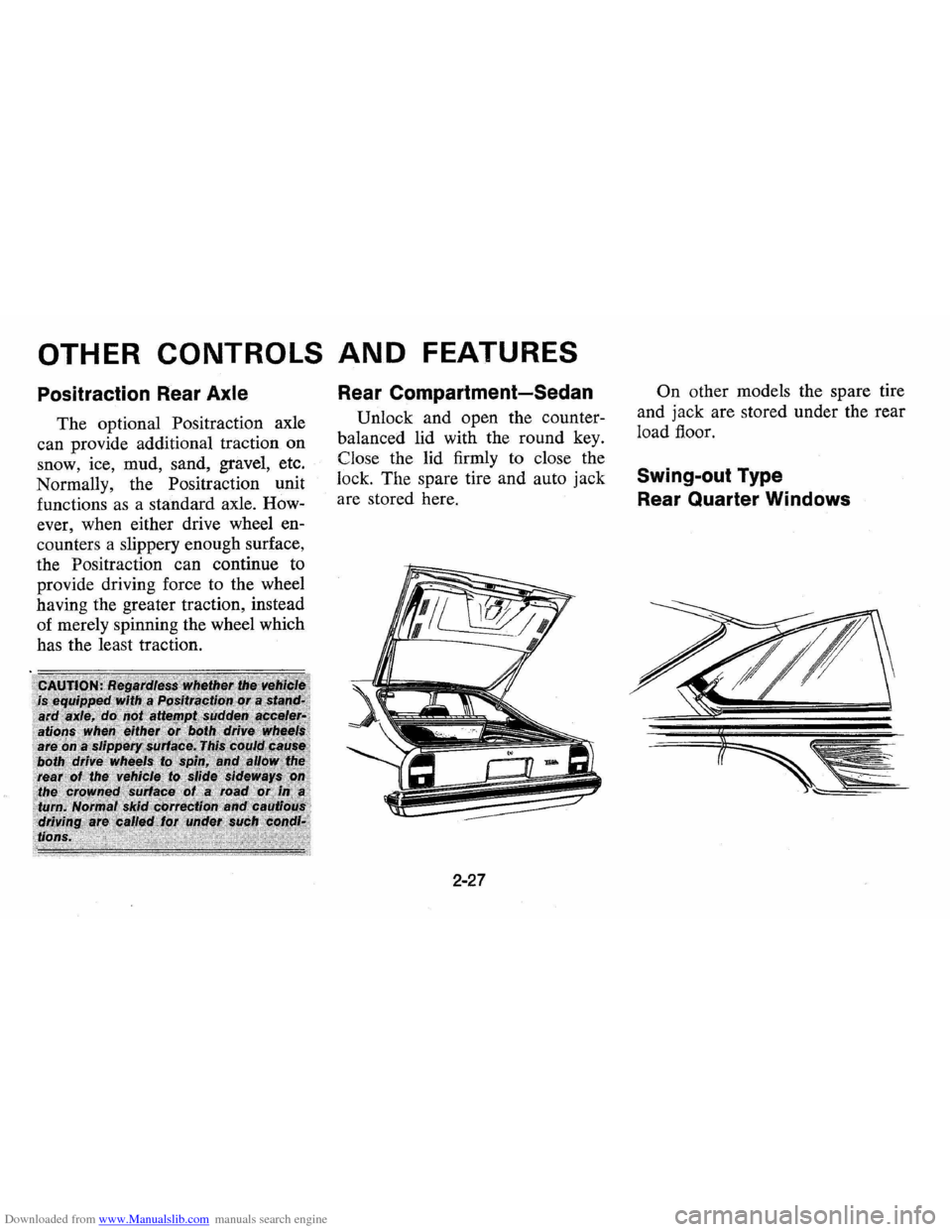
Unlock and open the counter
balanced lid with the round key.
Close the lid firmly to close the
lock. The spare tire and auto jack
are stored here.
2-27
On other models the spare tire
and jack are stored under the rear
load floor.
Swing-out Type
Rear Quarter Windows
Page 46 of 87
Downloaded from www.Manualslib.com manuals search engine In Case of Emergency
Four Way Hazard
Warning
Flasher
• Use the warning flasher to warn
other drivers any time your
ve
hicle becomes a traffic hazard,
day or night.
• A void stopping on the roadway
if possible.
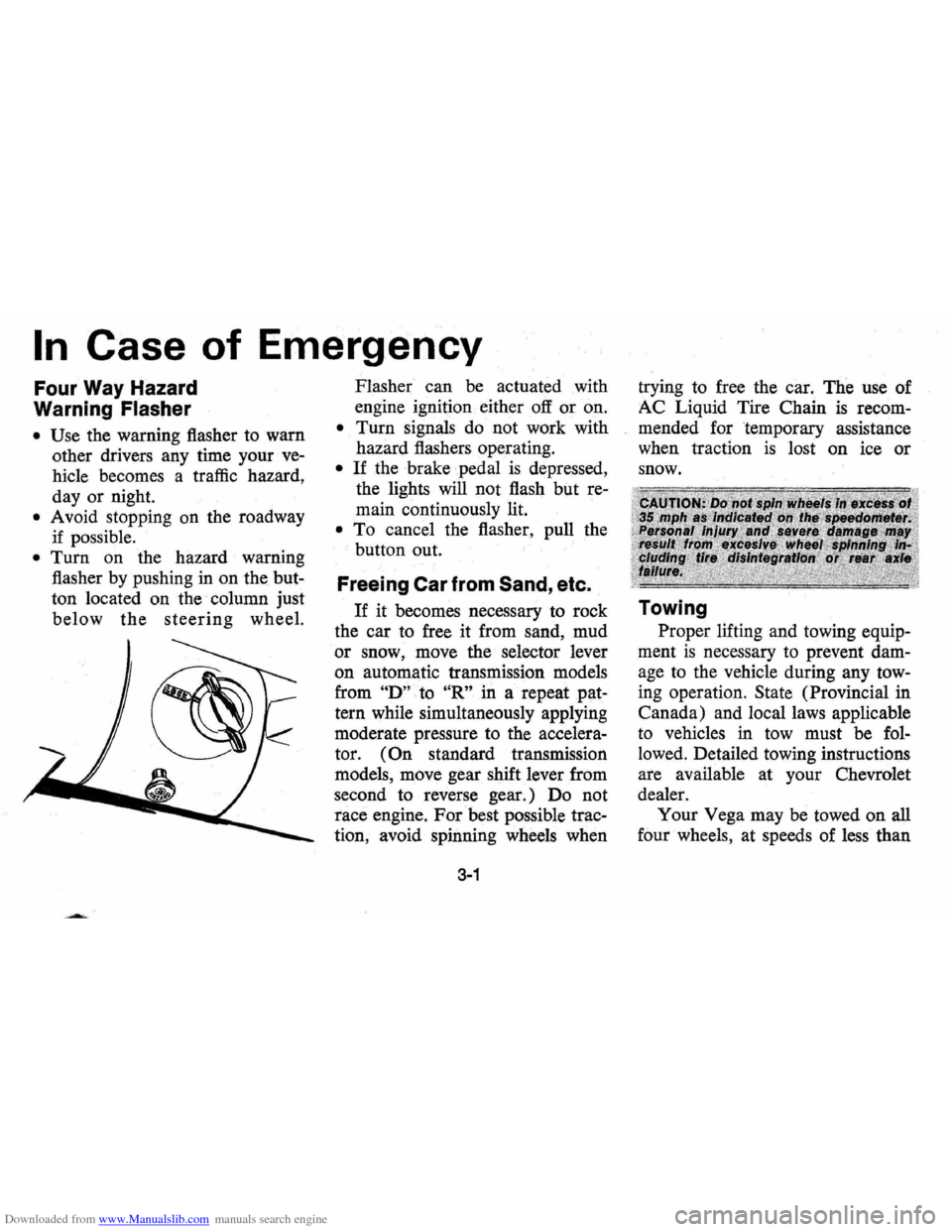
• Turn on the hazard warning
flasher by pushing
in on the but
ton located on the column just
below the steering wheel. Flasher
can
be actuated with
engine ignition either
off or on.
• Turn signals do not work with
hazard flashers operating.
• If the brake pedal is depressed,
the lights will not flash but
re
main continuously lit.
• To cancel the flasher, pull the
button out.
Freeing Car from Sand, etc.
If it becomes necessary to rock
the car to free it from sand, mud
or snow, move the selector lever
on automatic transmission models
from
"D" to "R" in a repeat pat
tern while simultaneously applying
moderate pressure
to the accelera
tor.
(On standard transmission
models, move gear shift lever from
second to reverse gear.) Do not
race engine. For best possible trac
tion, avoid· spinning wheels when
3-1
trying to free the car. The use of
AC Liquid Tire Chain
is recom
mended for temporary assistance
when traction
is lost on ice or
snow.
Towing
Proper lifting and towing equip
ment
is necessary to prevent dam
age to the vehicle during any tow
ing operation. State (Provincial in
Canada) and local laws applicable
to vehicles in tow must be
fol
lowed. Detailed towing instructions
are available at your Chevrolet
dealer. Your Vega may be towed on
all
four wheels, at speeds of less · than
Page 49 of 87
Downloaded from www.Manualslib.com manuals search engine 4. Attach the remammg jumper Engine Coolant
cable FIRST to the negative ter
minal (black color,
"-" or "N")
of the OTHER vehicle's battery,
(regardless of which vehicle has
the discharged
battery) and
THEN to the negative terminal
of the battery in THIS
car-thus
taking advantage of the flame
arrestor feature on the battery in
THIS car, should a spark occur.
5. Start engine in the vehicle that is
providing the jump start (if it
was not running). Let run a few
minutes, then start the engine in Jacking Instructions
the car that has the discharged
battery.
6. Reverse the above sequence
EXACTL Y when removing the
jumper cables, taking care to re
move the cable from
[he negative
terminal of the battery in THIS
car
as the FIRST step.
3-4
Preparation
• Park on level surface and set
parking brake firmly.
• Set automatic transmission in
park (manual transmission in
reverse).
• Activate hazard warning flasher.
Instructions
1. After removing spare wheel
and tire, jack, jack base, and
jack handle (wheel nut
wrench), proceed with chang
ing the wheel
as follows:
2. Remove hub cap or wheel
cover with flat end of wheel
nut wrench and loosen, but do
not remove nuts, by turning
counterclockwise.
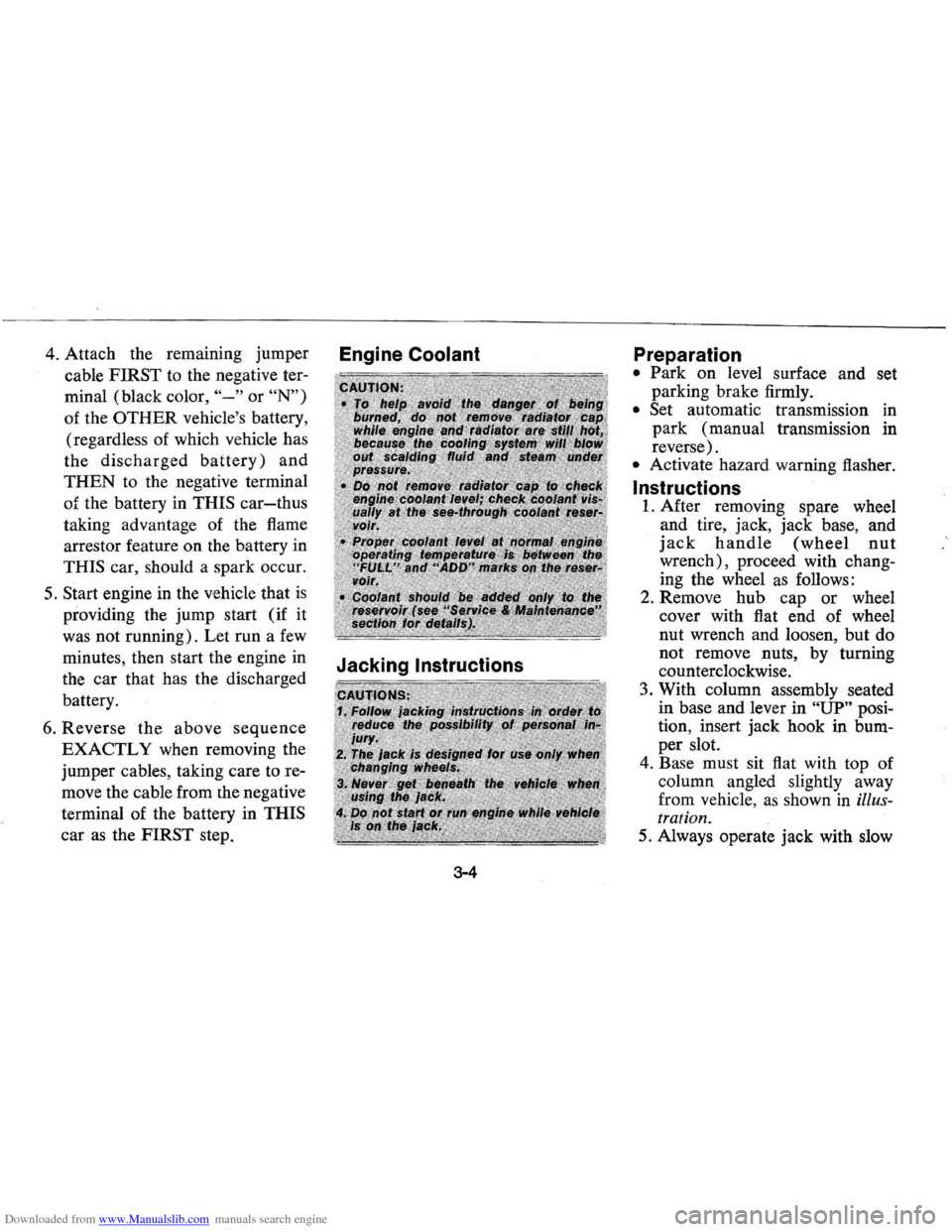
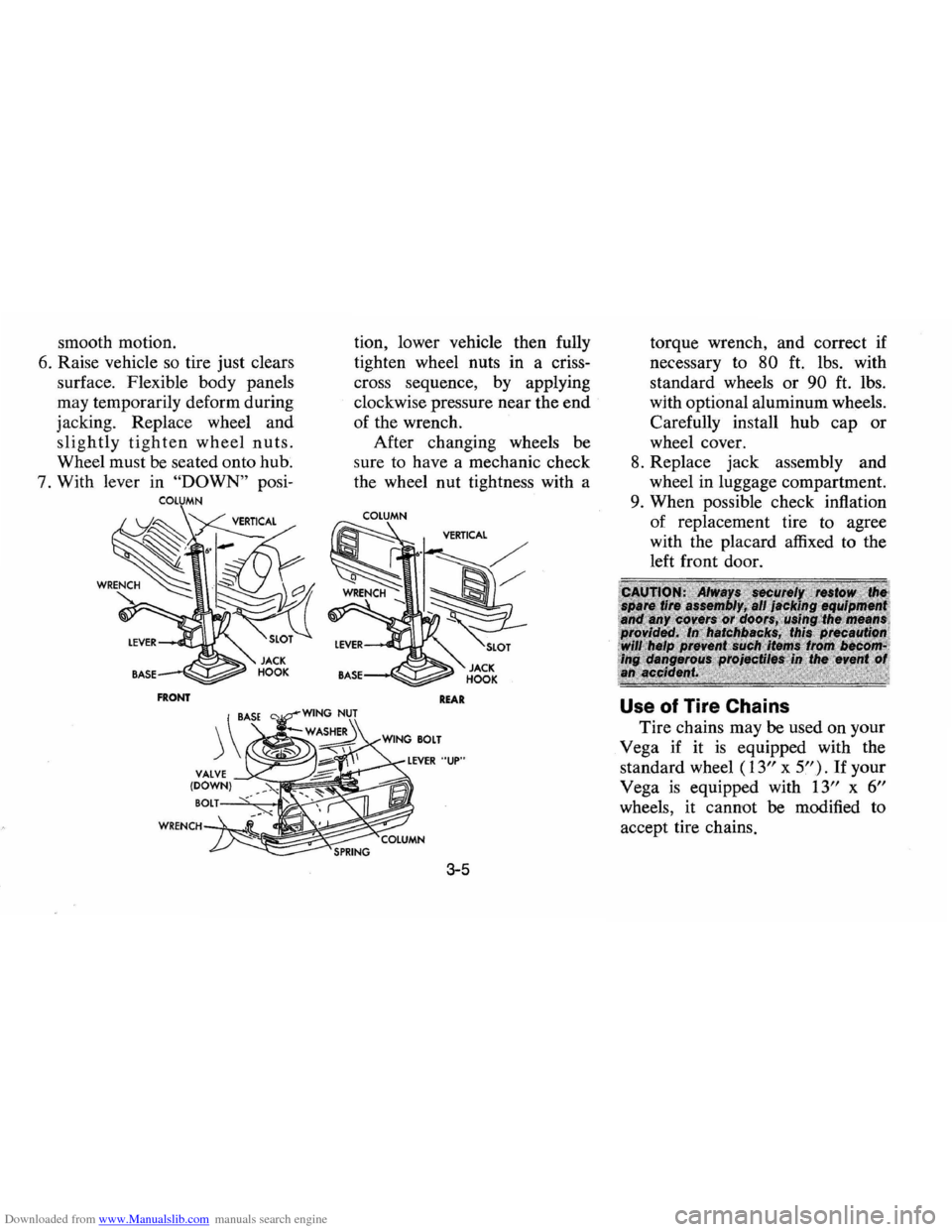
3. With column assembly seated
in base and lever in
"UP" posi
tion, insert jack hook in bum
per slot.
4. Base must sit flat with top of
column angled slightly away
from vehicle,
as shown in illus
tration.
5. Always operate jack with slow
Page 50 of 87
Downloaded from www.Manualslib.com manuals search engine smooth motion.
6. Raise vehicle so tire just clears
surface. Flexible body panels
may temporarily deform during
jacking. Replace wheel and
slightly tighten wheel nuts.
Wheel must be seated onto hub.
7. With lever in
"DOWN" posi
COLUMN
FRONT
tion, lower vehicle then fully
tighten wheel nuts in a criss
cross sequence, by applying
clockwise pressure near the
end
of the wrench.
After changing wheels
be
sure to have a mechanic check
the wheel nut tightness with a
COLUMN
REAR
3-5
torque wrench, and correct if
necessary to
80 ft. lbs. with
standard wheels
or 90 ft. lbs.
with optional aluminum wheels.
Carefully install
hub cap or
wheel cover.
8. Replace jack assembly and
wheel in luggage compartment.
9. When possible check inflation
of replacement tire to agree
with the placard affixed to the
left front door.
Use of Tire Chains
Tire chains may be used on your
Vega if it
is equipped with the
standard wheel
(13" x 5"). If your
Vega
is equipped with 13" x 6"
wheels, it cannot be modified to
accept tire chains.
Page 69 of 87
Downloaded from www.Manualslib.com manuals search engine Front Wheel Bearings
Every 30,000 miles-clean and
repack with a high melting point
wheel bearing lubricant.
Use wheel
bearing lubricant GM
Part No.
1051344 or equivalent. This
is a
premium high melting point lubri
cant. When replacement
is neces
sary specify Delco parts.
Brakes
Brake linings should be periodi
cally inspected for wear by a quali
fied technician. The frequency of
this inspection depends upon driv
ing conditions such
as traffic or
terrain, and also· the driving tech
niques of individual owners. Your
Chevrolet Dealer
is best qualified
to advise you as to how often this
inspection should be performed.
When replacement
is required,
specify GM and Delco parts.
REMINDER: The front disc
brakes have a built-in wear indica
tor that
is designed to make a high
frequency, squealing or cricket-like
warning sound when the linings are
worn to where replacement
is re
quired. The sound will occur inter
mittently or continuously when
wheels are rolling, but will dis
appear when the brake pedal
is
firmly applied. Also see the brake
checks listed in the Maintenance
Schedule folder.
5-11
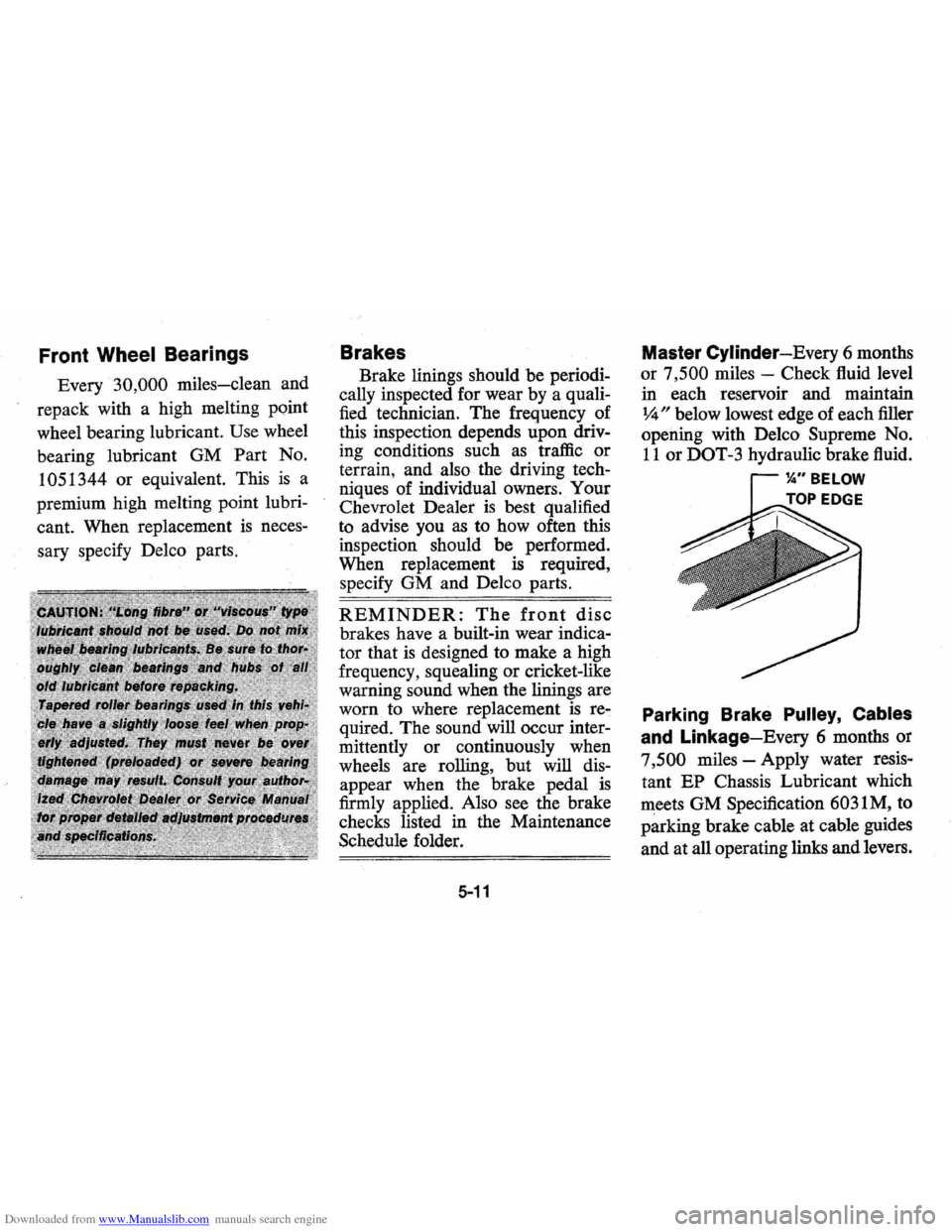
Master Cylinder-Every 6 months
or
7,500 miles -Check fluid level
in each reservoir and maintain
~ /I below lowest edge of e.ach filler
opening with Delco
Supreme No.
11 or DOT -3 hydraulic brake fluid.
~" BELOW
TOP EDGE
Parking Brake Pulley, Cables
and Linkage-Every 6 months or
7
,500 miles -Apply water resis
tant EP Chassis Lubricant which
meets GM Specification
6031M, to
parking brake cable at cable guides
and at all operating links and levers.