engine CHEVROLET VENTURE 2003 1.G Owners Manual
[x] Cancel search | Manufacturer: CHEVROLET, Model Year: 2003, Model line: VENTURE, Model: CHEVROLET VENTURE 2003 1.GPages: 486, PDF Size: 3.3 MB
Page 444 of 486

Part B: Owner Checks and Services
Listed in this part are owner checks and services
which should be performed at the intervals speci®ed to
help ensure the safety, dependability and emission
control performance of your vehicle.
Be sure any necessary repairs are completed at once.
Whenever any ¯uids or lubricants are added to your
vehicle, make sure they are the proper ones, as shown
in Part D.
At Each Fuel Fill
It is important for you or a service station attendant to
perform these underhood checks at each fuel ®ll.
Engine Oil Level Check
Check the engine oil level and add the proper oil if
necessary. SeeEngine Oil on page 5-13for further
details.
Engine Coolant Level Check
Check the engine coolant level and add DEX-COOLž
coolant mixture if necessary. SeeEngine Coolant
on page 5-23for further details.
Windshield Washer Fluid Level Check
Check the windshield washer ¯uid level in the windshield
washer tank and add the proper ¯uid if necessary.
See
Windshield Washer Fluid on page 5-38for further
details.
At Least Once a Month
Tire In¯ation Check
Visually inspect your tires and make sure tires are
in¯ated to the correct pressures. Don't forget to check
your spare tire. See
Tires on page 5-60for further
details.
Cassette Tape Player Service
Clean cassette tape player. Cleaning should be done
every 50 hours of tape play. SeeAudio System(s)
on page 3-61for further details.
6-10
Page 446 of 486
At Least Once a Year
Key Lock Cylinders Service
Lubricate the key lock cylinders with the lubricant
speci®ed in Part D.
Body Lubrication Service
Lubricate all key lock cylinders, hood latch assemblies,
secondary latches, pivots, spring anchor and release
pawl, hood and door hinges, rear folding seats, fuel door
hinge, liftgate hinges, power sliding door cable and
sliding door track(s). Part D tells you what to use. More
frequent lubrication may be required when exposed
to a corrosive environment.
Starter Switch Check
{CAUTION:
When you are doing this inspection, the
vehicle could move suddenly. If the vehicle
moves, you or others could be injured.
1. Before you start, be sure you have enough room
around the vehicle.
2. Firmly apply both the parking brake and the regular
brake. See
Parking Brake on page 2-38if
necessary.
Do not use the accelerator pedal, and be ready to
turn off the engine immediately if it starts.
3. Try to start the engine in each gear. The starter
should work only in PARK (P) or NEUTRAL (N).
If the starter works in any other position, your
vehicle needs service.
6-12
Page 447 of 486
Automatic Transaxle Shift Lock Control
System Check
{CAUTION:
When you are doing this inspection, the
vehicle could move suddenly. If the vehicle
moves, you or others could be injured.
1. Before you start, be sure you have enough room
around the vehicle. It should be parked on a level
surface.2. Firmly apply the parking brake. See
Parking Brake
on page 2-38if necessary.
Be ready to apply the regular brake immediately if
the vehicle begins to move.
3. With the engine off, turn the key to the RUN
position, but don't start the engine. Without applying
the regular brake, try to move the shift lever out
of PARK (P) with normal effort. If the shift lever
moves out of PARK (P), your vehicle needs service.
Ignition Transaxle Lock Check
While parked, and with the parking brake set, try to turn
the ignition key to LOCK in each shift lever position.
·The key should turn to LOCK only when the
shift lever is in PARK (P).
·The key should come out only in LOCK.
6-13
Page 448 of 486
Parking Brake and Automatic Transaxle
Park (P) Mechanism Check
{CAUTION:
When you are doing this check, your vehicle
could begin to move. You or others could be
injured and property could be damaged. Make
sure there is room in front of your vehicle in
case it begins to roll. Be ready to apply the
regular brake at once should the vehicle begin
to move.Park on a fairly steep hill, with the vehicle facing
downhill. Keeping your foot on the regular brake, set the
parking brake.
·To check the parking brake's holding ability: With
the engine running and transaxle in NEUTRAL (N),
slowly remove foot pressure from the regular
brake pedal. Do this until the vehicle is held by the
parking brake only.
·To check the PARK (P) mechanism's holding ability:
With the engine running, shift to PARK (P). Then
release the parking brake followed by the regular
brake.
Underbody Flushing Service
At least every spring, use plain water to ¯ush any
corrosive materials from the underbody. Take care to
clean thoroughly any areas where mud and other debris
can collect.
6-14
Page 449 of 486

Part C: Periodic
MaintenanceInspections
Listed in this part are inspections and services which
should be performed at least twice a year (for instance,
each spring and fall).
You should let your dealer's
service department do these jobs. Make sure any
necessary repairs are completed at once.
Proper procedures to perform these services may be
found in a service manual. SeeService Publications
Ordering Information on page 7-10.
Steering, Suspension and Front
Drive Axle Boot and Seal Inspection
Inspect the front and rear suspension and steering
system for damaged, loose or missing parts, signs of
wear or lack of lubrication. Inspect the power steering
lines and hoses for proper hook-up, binding, leaks,
cracks, cha®ng, etc. Clean and then inspect the drive
axle boot seals for damage, tears or leakage. Replace
seals if necessary.
Exhaust System Inspection
Inspect the complete exhaust system. Inspect the body
near the exhaust system. Look for broken, damaged,
missing or out-of-position parts as well as open seams,
holes, loose connections or other conditions which
could cause a heat build-up in the ¯oor pan or could let
exhaust fumes into the vehicle. See
Engine Exhaust
on page 2-42.
6-15
Page 450 of 486

Fuel System Inspection
Inspect the complete fuel system for damage or leaks.
Engine Cooling System Inspection
Inspect the hoses and have them replaced if they
are cracked, swollen or deteriorated. Inspect all pipes,
®ttings and clamps; replace as needed. Clean the
outside of the radiator and air conditioning condenser.
To help ensure proper operation, a pressure test of
the cooling system and pressure cap is recommended
at least once a year.
Throttle System Inspection
Inspect the throttle system for interference or binding,
and for damaged or missing parts. Replace parts
as needed. Replace any components that have high
effort or excessive wear. Do not lubricate accelerator
and cruise control cables.
All-Wheel Drive Inspection
Inspect the transfer case (power transfer unit) and
carrier assembly-differential (rear drive module) every
12 months or at engine oil change intervals, check rear
differential and transfer case and add lubricant when
necessary. A ¯uid loss could indicate a problem; check
and have it repaired, if needed. Check vent hoses at
transfer case and differential for kinks and proper
installation.
Brake System Inspection
Inspect the complete system. Inspect brake lines and
hoses for proper hook-up, binding, leaks, cracks,
cha®ng, etc. Inspect disc brake pads for wear and rotors
for surface condition. Also inspect drum brake linings
for wear and cracks. Inspect other brake parts, including
drums, wheel cylinders, calipers, parking brake, etc.
Check parking brake adjustment. You may need to have
your brakes inspected more often if your driving
habits or conditions result in frequent braking.
6-16
Page 451 of 486
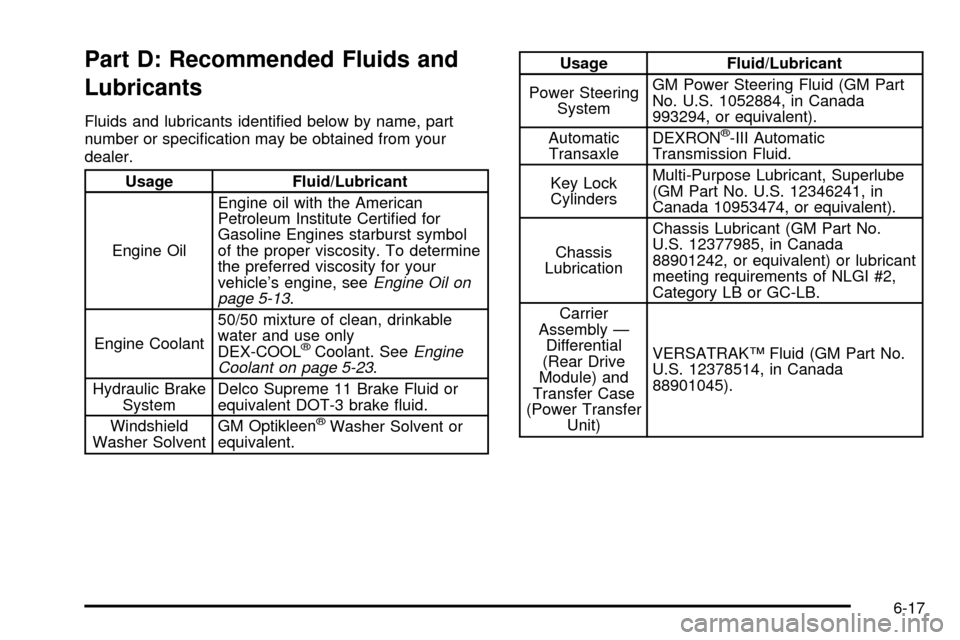
Part D: Recommended Fluids and
Lubricants
Fluids and lubricants identi®ed below by name, part
number or speci®cation may be obtained from your
dealer.
Usage Fluid/Lubricant
Engine OilEngine oil with the American
Petroleum Institute Certi®ed for
Gasoline Engines starburst symbol
of the proper viscosity. To determine
the preferred viscosity for your
vehicle's engine, see
Engine Oil on
page 5-13.
Engine Coolant50/50 mixture of clean, drinkable
water and use only
DEX-COOL
žCoolant. SeeEngine
Coolant on page 5-23.
Hydraulic Brake
SystemDelco Supreme 11 Brake Fluid or
equivalent DOT-3 brake ¯uid.
Windshield
Washer SolventGM Optikleen
žWasher Solvent or
equivalent.
Usage Fluid/Lubricant
Power Steering
SystemGM Power Steering Fluid (GM Part
No. U.S. 1052884, in Canada
993294, or equivalent).
Automatic
TransaxleDEXRON
ž-III Automatic
Transmission Fluid.
Key Lock
CylindersMulti-Purpose Lubricant, Superlube
(GM Part No. U.S. 12346241, in
Canada 10953474, or equivalent).
Chassis
LubricationChassis Lubricant (GM Part No.
U.S. 12377985, in Canada
88901242, or equivalent) or lubricant
meeting requirements of NLGI #2,
Category LB or GC-LB.
Carrier
Assembly Ð
Differential
(Rear Drive
Module) and
Transfer Case
(Power Transfer
Unit)VERSATRAKŸ Fluid (GM Part No.
U.S. 12378514, in Canada
88901045).
6-17
Page 466 of 486

Reporting Safety Defects to the
Canadian Government
If you live in Canada, and you believe that your vehicle
has a safety defect, you should immediately notify
Transport Canada, in addition to notifying General
Motors of Canada Limited. You may write to:
Transport Canada
330 Sparks Street
Tower C
Ottawa, Ontario K1A 0N5
Reporting Safety Defects to
General Motors
In addition to notifying NHTSA (or Transport Canada) in
a situation like this, we certainly hope you'll notify us.
Please call us at 1-800-222-1020, or write:
Chevrolet Motor Division
Chevrolet Customer Assistance Center
P.O. Box 33170
Detroit, MI 48232-5170
In Canada, please call us at 1-800-263-3777 (English)
or 1-800-263-7854 (French). Or, write:
General Motors of Canada Limited
Customer Communication Centre, 163-005
1908 Colonel Sam Drive
Oshawa, Ontario L1H 8P7
Service Publications Ordering
Information
Service Manuals
Service Manuals have the diagnosis and repair
information on engines, transmission, axle, suspension,
brakes, electrical, steering, body, etc.
RETAIL SELL PRICE: $120.00
Transmission, Transaxle, Transfer
Case Unit Repair Manual
This manual provides information on unit repair service
procedures, adjustments, and speci®cations for GM
transmissions, transaxles, and transfer cases.
RETAIL SELL PRICE: $50.00
Service Bulletins
Service Bulletins give technical service information
needed to knowledgeably service General Motors cars
and trucks. Each bulletin contains instructions to
assist in the diagnosis and service of your vehicle.
In Canada, information pertaining to Product Service
Bulletins can be obtained by contacting your General
Motors dealer or by calling 1-800-GM-DRIVE
(1-800-463-7483).
7-10
Page 469 of 486

A
Accessory In¯ator...........................................5-68
Accessory Power Outlets.................................3-24
Adding Washer Fluid.......................................5-39
Additional Program Information........................... 7-9
Additives, Fuel................................................. 5-6
Add-On Electrical Equipment............................5-96
Adjusting the Bucket Seats...............................1-16
Adjusting the Captain's Chairs
(Second Row).............................................1-22
Adjusting the Speakers
(Balance/Fade)....................3-64, 3-67, 3-74, 3-84
Adjusting the Split Bench Seats
(Second Row)............................................... 1-9
Air Bag Systems.............................................1-93
How Does an Air Bag Restrain?....................1-99
Servicing Your Air Bag-Equipped Vehicle.......1-102
What Makes an Air Bag In¯ate?....................1-99
What Will You See After an Air
Bag In¯ates?.........................................1-100
When Should an Air Bag In¯ate?...................1-98
Where Are the Air Bags?..............................1-96
Air Bag .........................................................3-40
Readiness Light..........................................3-40
Air Cleaner/Filter, Engine.................................5-18
All-Wheel Drive Disable Warning Message..........3-57
All-Wheel Drive......................................5-50, 5-86
All-Wheel-Drive (AWD) System.........................4-10AM-FM Radio.................................................3-62
AM .............................................................3-104
Antenna, Fixed Mast......................................3-105
Anti-lock Brake System (ABS)............................ 4-6
Anti-Lock Brake, System Warning Light..............3-42
Appearance Care............................................5-87
Care of Safety Belts and Built-in Child
Restraint Harness.....................................5-90
Chemical Paint Spotting...............................5-93
Cleaning the Inside of Your Vehicle................5-87
Cleaning the Outside of Your Vehicle..............5-90
Finish Damage............................................5-93
Sheet Metal Damage...................................5-93
Underbody Maintenance...............................5-93
Vehicle Care/Appearance Materials................5-94
Weatherstrips..............................................5-90
Arming and Disarming the Content
Theft-Deterrent System.................................2-68
Arming Con®rmation........................................2-28
Arming with the Power Lock Switch...................2-27
Arming with the Remote Keyless Entry
Transmitter.................................................2-28
Arming with Your Key......................................2-28
Audio Speakers..............................................3-94
Audio System(s).............................................3-61
AM-FM Radio.............................................3-62
Care of Your Cassette Tape Player...............3-104
Care of Your CD and DVD Player................3-105
Care of Your CDs and DVDs.......................3-105
1
Page 471 of 486

C
California Fuel.................................................. 5-5
Canada ± Customer Assistance.......................... 7-4
Canadian Owners................................................ ii
Canadian Roadside Assistance........................... 7-7
Canceling the Sliding Door
Security Lock..............................................2-16
Capacities and Speci®cations..........................5-103
Captain Chairs, Rear.......................................1-22
Carbon Monoxide...................4-26, 4-36, 2-22, 2-42
Care of.........................................................5-90
Safety Belts and Built-in Child
Restraint Harness.....................................5-90
Your Cassette Tape Player..........................3-104
Your CD and DVD Player...........................3-105
Your CDs and DVDs..................................3-105
Cargo Lamp...................................................3-20
Carrier Assembly-Differential
(Rear Drive Module)....................................5-51
Cassette Tape Messages.................................3-79
Cassette Tape Player Service...........................6-10
CD Adapter Kits.............................................3-79
Center Passenger Position, Safety Belts.....1-45, 1-47
Chains, Tires..................................................5-67
Change Engine Oil Message............................3-54
Charging System Indicator Message..................3-52
Checking Coolant............................................5-24Checking Engine Oil........................................5-14
Checking Things Under the Hood......................5-10
Checking Your Restraint Systems....................1-103
Check...........................................................3-45
Engine Light...............................................3-45
Chemical Paint Spotting...................................5-93
Child Restraints..............................................1-82
Built-In Child Restraint..................................1-82
Child Restraint Systems...............................1-61
Infants and Young Children...........................1-58
Lower Anchorages and Top Tethers for
Children (LATCH System)..........................1-69
Older Children.............................................1-55
Securing a Child Restraint Designed
for the LATCH System..............................1-71
Securing a Child Restraint in a Center
Seat Position...................................1-75, 1-77
Securing a Child Restraint in a Rear
Outside Seat Position...............................1-71
Securing a Child Restraint in the Right
Front Seat Position...................................1-79
Top Strap Anchor Location............................1-67
Top Strap...................................................1-66
Where to Put the Restraint...........................1-65
Cleaning Aluminum Wheels..............................5-92
Cleaning Built-In Child Restraint Pad.................5-90
Cleaning Exterior Lamps/Lenses.......................5-91
Cleaning Fabric/Carpet....................................5-88
3