air conditioning CHEVROLET VOLT 2011 User Guide
[x] Cancel search | Manufacturer: CHEVROLET, Model Year: 2011, Model line: VOLT, Model: CHEVROLET VOLT 2011Pages: 516, PDF Size: 6.61 MB
Page 297 of 516
Black plate (5,1)Chevrolet Volt Owner Manual - 2011
Climate Controls 8-5
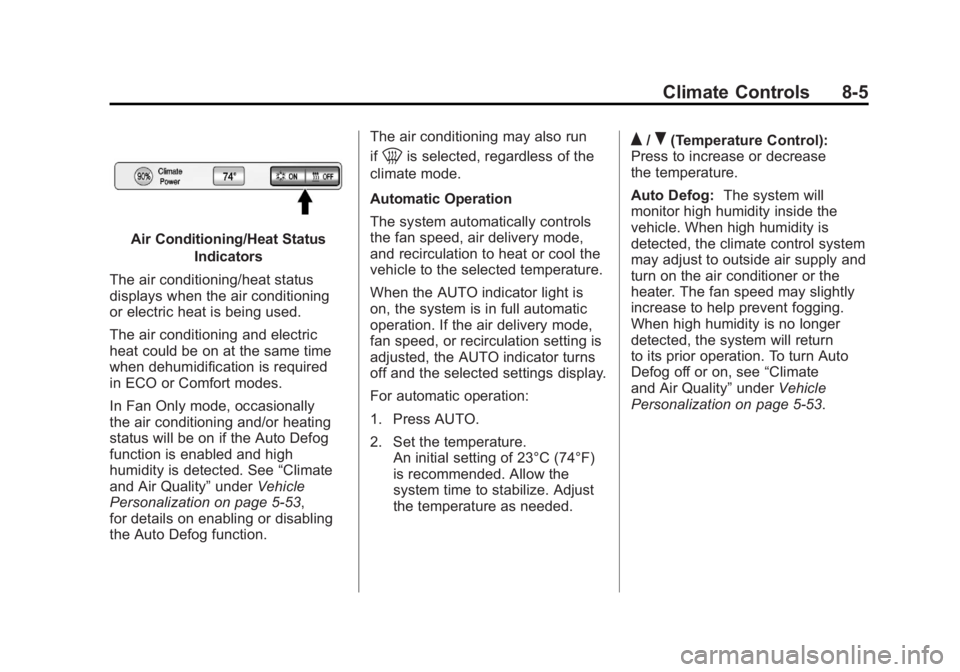
Air Conditioning/Heat StatusIndicators
The air conditioning/heat status
displays when the air conditioning
or electric heat is being used.
The air conditioning and electric
heat could be on at the same time
when dehumidification is required
in ECO or Comfort modes.
In Fan Only mode, occasionally
the air conditioning and/or heating
status will be on if the Auto Defog
function is enabled and high
humidity is detected. See “Climate
and Air Quality” underVehicle
Personalization on page 5‑53,
for details on enabling or disabling
the Auto Defog function. The air conditioning may also run
if
0is selected, regardless of the
climate mode.
Automatic Operation
The system automatically controls
the fan speed, air delivery mode,
and recirculation to heat or cool the
vehicle to the selected temperature.
When the AUTO indicator light is
on, the system is in full automatic
operation. If the air delivery mode,
fan speed, or recirculation setting is
adjusted, the AUTO indicator turns
off and the selected settings display.
For automatic operation:
1. Press AUTO.
2. Set the temperature. An initial setting of 23°C (74°F)
is recommended. Allow the
system time to stabilize. Adjust
the temperature as needed.Q/R(Temperature Control):
Press to increase or decrease
the temperature.
Auto Defog: The system will
monitor high humidity inside the
vehicle. When high humidity is
detected, the climate control system
may adjust to outside air supply and
turn on the air conditioner or the
heater. The fan speed may slightly
increase to help prevent fogging.
When high humidity is no longer
detected, the system will return
to its prior operation. To turn Auto
Defog off or on, see “Climate
and Air Quality” underVehicle
Personalization on page 5‑53.
Page 298 of 516
Black plate (6,1)Chevrolet Volt Owner Manual - 2011
8-6 Climate Controls
Manual Operation
A(Fan Control):Press the
fan control buttons or the touch
screen fan control, to increase or
decrease the fan speed. The fan
speed setting displays. Pressing
either button cancels automatic
fan control and the fan can be
controlled manually. Press AUTO
to return to automatic operation.
Press the fan down button
repeatedly to turn off the fan
and the climate control system.
If the fan is manually turned off
while in ECO or Comfort mode,
the display will automatically change
to Fan Only mode. When the fan is
turned back on either by manually
increasing fan speed or pressing
the AUTO button, the climate
mode will revert back to ECO
or Comfort mode. Air Delivery Mode Control:
Press CLIMATE to select the
Climate touch screen. Press the
air delivery mode touch screen
button to change the direction of
the airflow. The selected air delivery
mode button is lit. Pressing any
of the air delivery buttons cancels
automatic air delivery control and
the direction of the airflow can be
controlled manually. Press AUTO
to return to automatic operation.
To change the current mode,
select one of the following:
Y(Vent):
Air is directed to the
instrument panel outlets.
\(Bi-Level): Air is divided
between the instrument panel
outlets and the floor outlets.
[(Floor): Air is directed to the
floor outlets.
-(Defog): Air is directed to the
windshield and floor outlets. Clears
the windows of fog or moisture.
0(Defrost): Air is directed to
the windshield. The windshield is
cleared of fog or frost more quickly.
Selecting
0will disable automatic
control and the AUTO button
indicator will not be lit.
Selecting
0again will return to the
previous climate settings.
For best results, clear all snow and
ice from the windshield before
defrosting.
If
0is selected in Fan Only or
ECO mode, air conditioning or
electric heat may turn on and have
a noticeable effect on vehicle
electric range and fuel economy.
Page 300 of 516
Black plate (8,1)Chevrolet Volt Owner Manual - 2011
8-8 Climate Controls
Rear Window Defogger
=(Rear Window Defogger):
Press to turn the rear window
defogger on or off.
The rear window defogger
turns off automatically after about
five minutes. If turned on again,
it runs for about five minutes
before turning off. The defogger
can also be turned off by turning
the vehicle off.
For vehicles with heated outside
rearview mirrors, they turn on when
the rear window defogger button
is on and help to clear fog or frost
from the surface of the mirror.
See Heated Mirrors on page 2‑16. Notice:
Do not try to clear frost
or other material from the inside
of the front windshield and rear
window with a razor blade or
anything else that is sharp.
This may damage the rear
window defogger grid and affect
the radio's ability to pick up
stations clearly. The repairs
wouldn't be covered by the
vehicle warranty.
Remote Start: For vehicles with
this feature, the climate control
system may be started by using
the Remote Keyless Entry (RKE)
transmitter. The climate control
system will default to an appropriate
heating or cooling mode.
See Remote Start on page 2‑8.
The rear window defogger turns on
if it is cold outside.
Compressor
The vehicle has an electric powered
air conditioning compressor.
This allows for continuous air
conditioning and/or high voltage
battery cooling operation, without
running the engine.
The compressor operating speed
is not tied to the engine speed, so
some noise may be heard from the
compressor, especially when air
conditioning use is high and the
engine has turned off. This is
normal.
Page 305 of 516
Black plate (3,1)Chevrolet Volt Owner Manual - 2011
Driving and Operating 9-3
Drive Mode and PRNDL Selection
Use Normal Mode when possible.
Sport Mode provides more
responsive acceleration than
Normal Mode but can reduce
efficiency.
Use Mountain Mode prior to
climbing long, steep grades in
mountainous areas. Be sure to
engage Mountain Mode before
starting to climb. Mountain Mode
reduces electric range and power
but may be needed to maintain
speeds above 96 km/h (60 mph)
when climbing grades of 5% or
greater.
Use L (Low) in heavy stop‐and‐go
traffic or when traveling downhill.
L (Low) requires less brake
pedal application and provides
a controlled, efficient way to
slow the vehicle down.Climate Setting
Using the heat and air conditioning
systems decreases the energy
available for electric driving.
Optimal energy efficiency is
achieved with the heat, air
conditioning, and fan turned off.
Less energy is used at low fan
speeds. When using the fan:
.Fan Only is the most energy
efficient climate setting as long
as
0is not selected.
.ECO is for moderate air
conditioning and heater
operation and is the next
most energy efficient setting as
long as
0is not selected.
.Comfort provides the most
comfort but is the least energy
efficient.
Use the auto heated seat feature
instead of climate settings. Heating
the seat uses less energy than
heating the vehicle interior. Use remote start to heat or cool the
interior when the vehicle is plugged
in to maximize the electric range by
utilizing electricity from the electrical
outlet.
In hot weather, avoid parking in
direct sunlight or use sunshades
inside the vehicle.
Turn off the front and rear window
defog/defrost when they are no
longer needed.
Avoid driving with the windows open
at highway speeds.
Vehicle Charging/Maintenance
Charging
Keep the vehicle plugged in, even
when fully charged, to keep the
battery temperature ready for the
next drive. This is important when
outside temperatures are extremely
hot or cold.
Page 385 of 516
Black plate (19,1)Chevrolet Volt Owner Manual - 2011
Vehicle Care 10-19
Cooling System
(High Voltage Battery)
During vehicle operation and
also during charging, the high
voltage battery cells in the
vehicle are kept within a normal
operating temperature range.
If the temperature rises above this
temperature, the battery cooling
system turns on the air conditioning
compressor and cools the coolant
until the correct temperature is
reached. If the temperature falls
below this temperature, a high
voltage heater, located in the
battery, heats the coolant until the
correct temperature is reached.
What to Use
The high voltage battery coolant
reservoir in the vehicle is filled
with a 50/50 mixture of DEX-COOL
engine coolant and deionized water.
If using this mixture, nothing else
needs to be added.
Checking Coolant
The vehicle must be on a level
surface when checking the coolant
level.
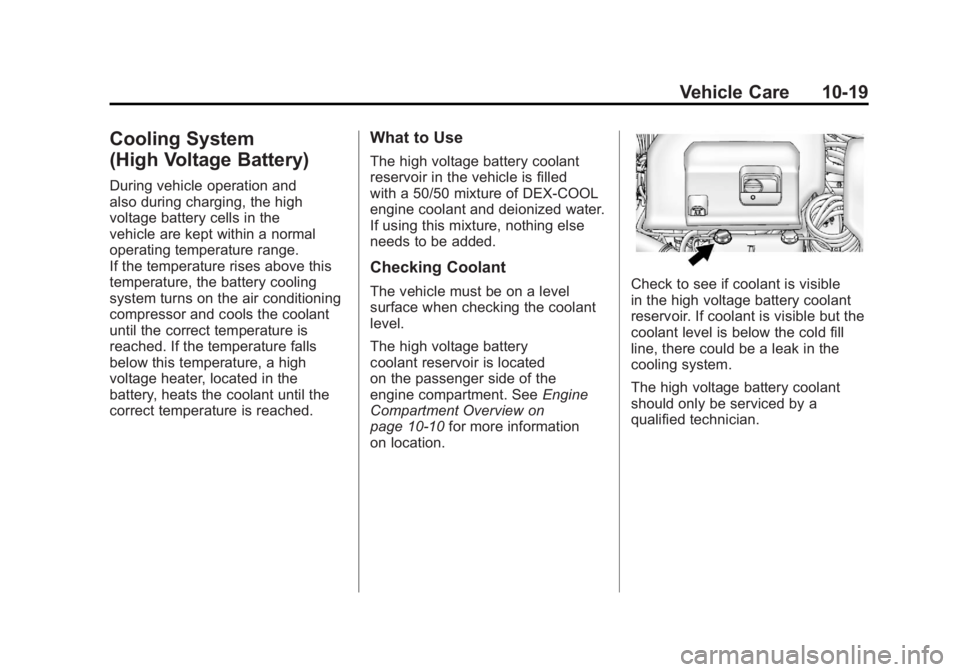
The high voltage battery
coolant reservoir is located
on the passenger side of the
engine compartment. SeeEngine
Compartment Overview on
page 10‑10 for more information
on location.Check to see if coolant is visible
in the high voltage battery coolant
reservoir. If coolant is visible but the
coolant level is below the cold fill
line, there could be a leak in the
cooling system.
The high voltage battery coolant
should only be serviced by a
qualified technician.
Page 405 of 516

Black plate (39,1)Chevrolet Volt Owner Manual - 2011
Vehicle Care 10-39
Engine Compartment Fuse Block
A fuse puller is located in the engine
compartment fuse block.
The vehicle may not be equipped
with all of the fuses, relays, and
features shown. Mini Fuses Usage
1 Engine Control
Module
–Switched
Power
2 Emissions
3 Not Used Mini Fuses Usage
4 Ignition
Coils/Injectors
5 Empty
6a Empty
6b Rear Defogger
(Lower Grid)
7 Empty
8 Empty
9 Heated Mirrors
10 Air Conditioning
Control Module
11 Traction
Power Inverter
Module
–Battery
12 Cabin Heater Pump
and Valve
13 Empty
14 Empty
Page 407 of 516

Black plate (41,1)Chevrolet Volt Owner Manual - 2011
Vehicle Care 10-41
Mini Fuses Usage53 Traction
Power Inverter
Module
–Run/Crank
54 Run/Crank for Air
Conditioning Control
Module/Instrument
Cluster/Passenger
Airbag Display/
Accessory Power
Module
J‐Case Fuses Usage
16 Empty
18 Empty
19 Power
Window
–Front
20 Empty
21 Antilock Brake
System Electronic
Control Unit J‐Case
Fuses Usage
23 Charge Port Door
27 Empty
28 Empty
29 Empty
30 Antilock Brake
System Motor
42 Cooling Fan –Right
43 Front Wipers
44 Charger
45 Empty
48 Cooling Fan –Left
Mini Relays Usage 3 Powertrain
4 Rear Defog (Lower
Grid)/Heated Mirrors
7 Empty Mini Relays Usage
9 Empty
11 Empty
12 Empty
13 Empty
14 Run/Crank
Micro
Relays Usage
1 Empty
2 Empty
6 Empty
8 Empty
10 Empty
Ultra Micro Relays Usage
5 Charge Port Door
Page 408 of 516

Black plate (42,1)Chevrolet Volt Owner Manual - 2011
10-42 Vehicle Care
Instrument Panel Fuse
Block (Left Side)
The instrument panel fuse block
is on the driver side end of the
instrument panel. To access the
fuses, open the fuse panel door
by pulling out.
To reinstall the door, insert the
bottom tab first, then push the
door back into its original location.
Instrument Panel Fuse Block
A fuse puller is located in the engine
compartment fuse block.
The vehicle may not be equipped
with all of the fuses, relays, and
features shown. Fuses Usage
F1 Power Outlet
–Top
of IP Storage Bin
F2 Radio
F3 Instrument Cluster
F4 Infotainment Display Fuses Usage
F5 Heating, Ventilation
& Air Conditioning/
Integrated Center
Stack Switches
F6 Airbag (Sensing
Diagnostic Module/
Passenger Sensing
Module)
F7 Data Link
Connector 1/Data
Link Connector 2
Page 417 of 516
Black plate (51,1)Chevrolet Volt Owner Manual - 2011
Vehicle Care 10-51
(B) Tire Width:The three‐digit
number indicates the tire section
width in millimeters from
sidewall to sidewall.
(C) Aspect Ratio
:A two‐digit
number that indicates the tire
height‐to‐width measurements.
For example, if the tire size
aspect ratio is 60, as shown in
item C of the illustration, it would
mean that the tire's sidewall is
60 percent as high as it is wide.
(D) Construction Code
:A
letter code is used to indicate
the type of ply construction in
the tire. The letter R means
radial ply construction; the
letter D means diagonal or
bias ply construction; and the
letter B means belted‐bias ply
construction.
(E) Rim Diameter
:Diameter of
the wheel in inches. (F) Service Description
:These
characters represent the load
index and speed rating of the
tire. The load index represents
the load carrying capacity a tire
is certified to carry. The speed
rating is the maximum speed a
tire is certified to carry a load.
Tire Terminology and
Definitions
Air Pressure:The amount
of air inside the tire pressing
outward on each square
inch of the tire. Air pressure is
expressed in kPa (kilopascal)
or psi (pounds per square inch).
Accessory Weight
:The
combined weight of optional
accessories. Some examples
of optional accessories are,
automatic electric drive unit,
power steering, power brakes,
power windows, power seats,
and air conditioning. Aspect Ratio
:The relationship
of a tire's height to its width.
Belt
:A rubber coated layer of
cords that is located between
the plies and the tread. Cords
may be made from steel or other
reinforcing materials.
Bead
:The tire bead contains
steel wires wrapped by steel
cords that hold the tire onto
the rim.
Bias Ply Tire
:A pneumatic
tire in which the plies are laid
at alternate angles less than
90 degrees to the centerline
of the tread.
Cold Tire Pressure
:The
amount of air pressure in a tire,
measured in kPa (kilopascal)
or psi (pounds per square inch)
before a tire has built up heat
from driving. See Tire Pressure
on page 10‑54.
Page 467 of 516
Black plate (5,1)Chevrolet Volt Owner Manual - 2011
Service and Maintenance 11-5
Your dealer has trained service
technicians who will perform
this work and reset the system.
If the engine oil life system is
reset accidentally, service the
vehicle within 5 000 km/3,000 mi
since the last service. Reset the
oil life system whenever the oil is
changed.
Every 80 000 km/50,000 mi
.Engine air cleaner filter
replacement.
.Evaporative control system
inspection. Check all fuel and
vapor lines and hoses for proper
hook‐up, routing, and condition.
Check that the purge valve,
if the vehicle has one, works
properly. Replace as needed. An Emission Control Service.
The U.S. Environmental
Protection Agency or the
California Air Resources Board
has determined that the failure
to perform this maintenance
item will not nullify the emission
warranty or limit recall liability
prior to the completion of
the vehicle's useful life.
We, however, urge that all
recommended maintenance
services be performed at the
indicated intervals and the
maintenance be recorded.
Every 160 000 km/100,000 mi
.Spark plug replacement.
An Emission Control Service. Every 240 000 km/150,000 mi or
every 5 years, whichever occurs
first
.Engine cooling system drain,
flush, and refill (or every five
years, whichever occurs first).
See
Cooling System (Engine) on
page 10‑18 orCooling System
(High Voltage Battery) on
page 10‑19 orCooling System
(Power Electronics and Charger
Modules) on page 10‑20.
An Emission Control Service.
Every 240 000 km/150,000 mi or
every 10 years, whichever occurs
first
.Engine drive belt inspection
for fraying, excessive cracks,
or obvious damage. Replace,
if needed.
Every 10 Years
.Air conditioning system flush
and refill and desiccant
replacement.