height CHEVROLET VOLT 2011 User Guide
[x] Cancel search | Manufacturer: CHEVROLET, Model Year: 2011, Model line: VOLT, Model: CHEVROLET VOLT 2011Pages: 516, PDF Size: 6.61 MB
Page 399 of 516

Black plate (33,1)Chevrolet Volt Owner Manual - 2011
Vehicle Care 10-33
4. At the wall, measure fromthe ground upward (A) to
the recorded distance from
Step 3 and mark it.
5. Draw or tape a horizontal line (B) on the wall the width of the
vehicle at the height of the
mark in Step 4.
Notice: Do not cover a headlamp
to improve beam cut-off when
aiming. Covering a headlamp may
cause excessive heat build-up
which may cause damage to
the headlamp. 6. Turn on the low-beam
headlamps and place a
piece of cardboard or something
equivalent in front of the
headlamp not being adjusted.
This allows only the beam of
light from the headlamp being
adjusted to be seen on the flat
surface.
7. Locate the vertical headlamp
aiming screws, which are under
the hood near each headlamp
assembly. 8. Turn the vertical aiming screw
until the headlamp beam
is aimed to the horizontal
tape line. Turn it clockwise or
counterclockwise to raise or
lower the angle of the beam.
9. Make sure that the light from theheadlamp is positioned at the
bottom edge of the horizontal
tape line. The lamp on the
left (A) shows the correct
headlamp aim. The lamp
on the right (B) shows the
incorrect headlamp aim.
10. Repeat Steps 7 through 9 for the opposite headlamp.
Page 415 of 516
Black plate (49,1)Chevrolet Volt Owner Manual - 2011
Vehicle Care 10-49
Winter Tires
Consider installing winter tires
on the vehicle if frequent driving
on snow or ice covered roads is
expected. All season tires provide
good overall performance on most
surfaces, but they may not offer
the traction or the same level of
performance as winter tires on
snow or ice covered roads.
Winter tires, in general, are
designed for increased traction
on snow and ice covered roads.
With winter tires, there may be
decreased dry road traction,
increased road noise, and shorter
tread life. After changing to winter
tires, be alert for changes in
vehicle handling and braking.See your dealer for details
regarding winter tire availability
and proper tire selection. Also, see
Buying New Tires on page 10‑63.
If using snow tires:
.Use tires of the same brand and
tread type on all four wheel
positions.
.Use only radial ply tires of the
same size, load range, and
speed rating as the original
equipment tires.
Winter tires with the same speed
rating as the original equipment tires
may not be available for H, V, W, Y,
and ZR speed rated tires. If winter
tires with a lower speed rating are
chosen, never exceed the tire's
maximum speed capability.
Tire Sidewall Labeling
Useful information about a
tire is molded into its sidewall.
The examples show a typical
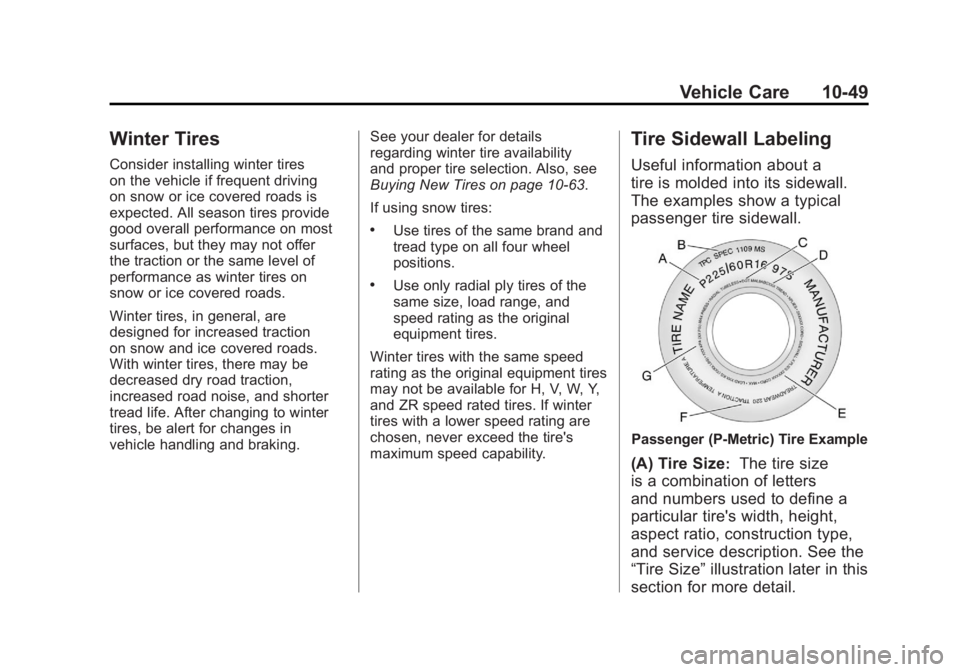
passenger tire sidewall.
Passenger (P‐Metric) Tire Example
(A) Tire Size:The tire size
is a combination of letters
and numbers used to define a
particular tire's width, height,
aspect ratio, construction type,
and service description. See the
“Tire Size” illustration later in this
section for more detail.
Page 417 of 516
Black plate (51,1)Chevrolet Volt Owner Manual - 2011
Vehicle Care 10-51
(B) Tire Width:The three‐digit
number indicates the tire section
width in millimeters from
sidewall to sidewall.
(C) Aspect Ratio
:A two‐digit
number that indicates the tire
height‐to‐width measurements.
For example, if the tire size
aspect ratio is 60, as shown in
item C of the illustration, it would
mean that the tire's sidewall is
60 percent as high as it is wide.
(D) Construction Code
:A
letter code is used to indicate
the type of ply construction in
the tire. The letter R means
radial ply construction; the
letter D means diagonal or
bias ply construction; and the
letter B means belted‐bias ply
construction.
(E) Rim Diameter
:Diameter of
the wheel in inches. (F) Service Description
:These
characters represent the load
index and speed rating of the
tire. The load index represents
the load carrying capacity a tire
is certified to carry. The speed
rating is the maximum speed a
tire is certified to carry a load.
Tire Terminology and
Definitions
Air Pressure:The amount
of air inside the tire pressing
outward on each square
inch of the tire. Air pressure is
expressed in kPa (kilopascal)
or psi (pounds per square inch).
Accessory Weight
:The
combined weight of optional
accessories. Some examples
of optional accessories are,
automatic electric drive unit,
power steering, power brakes,
power windows, power seats,
and air conditioning. Aspect Ratio
:The relationship
of a tire's height to its width.
Belt
:A rubber coated layer of
cords that is located between
the plies and the tread. Cords
may be made from steel or other
reinforcing materials.
Bead
:The tire bead contains
steel wires wrapped by steel
cords that hold the tire onto
the rim.
Bias Ply Tire
:A pneumatic
tire in which the plies are laid
at alternate angles less than
90 degrees to the centerline
of the tread.
Cold Tire Pressure
:The
amount of air pressure in a tire,
measured in kPa (kilopascal)
or psi (pounds per square inch)
before a tire has built up heat
from driving. See Tire Pressure
on page 10‑54.
Page 434 of 516

Black plate (68,1)Chevrolet Volt Owner Manual - 2011
10-68 Vehicle Care
Replace wheels, wheel bolts,
wheel nuts, or Tire Pressure Monitor
System (TPMS) sensors with new
GM original equipment parts.
{WARNING
Using the wrong replacement
wheels, wheel bolts, or wheel
nuts can be dangerous. It could
affect the braking and handling
of the vehicle. Tires can lose air,
and cause loss of control, causing
a crash. Always use the correct
wheel, wheel bolts, and wheel
nuts for replacement.
Notice: The wrong wheel
can also cause problems with
bearing life, brake cooling,
speedometer or odometer
calibration, headlamp aim,
bumper height, vehicle ground
clearance, and tire clearance
to the body and chassis.
{WARNING
Rust or dirt on a wheel,
or on the parts to which it is
fastened, can make wheel
nuts become loose after a
time. The wheel could come
off and cause a crash. When
changing a wheel, remove
any rust or dirt from places
where the wheel attaches to
the vehicle. In an emergency,
a cloth or a paper towel can
be used, however, use a
scraper or wire brush to
remove all rust or dirt.
{WARNING
Never use oil or grease on studs
or the threads of the wheel nuts.
The wheel nuts might come loose
and the wheel could fall off,
causing a crash.
{WARNING
Incorrect wheel nuts or improperly
tightened wheel nuts can cause
the wheel to become loose and
even come off. This could lead
to a crash. Be sure to use the
correct wheel nuts. If you have
to replace them, be sure to get
new GM original equipment
wheel nuts.
Notice: Improperly tightened
wheel nuts can lead to brake
pulsation and rotor damage.
To avoid expensive brake repairs,
evenly tighten the wheel nuts in
the proper sequence and to the
proper torque specification.
Page 451 of 516
Black plate (85,1)Chevrolet Volt Owner Manual - 2011
Vehicle Care 10-85
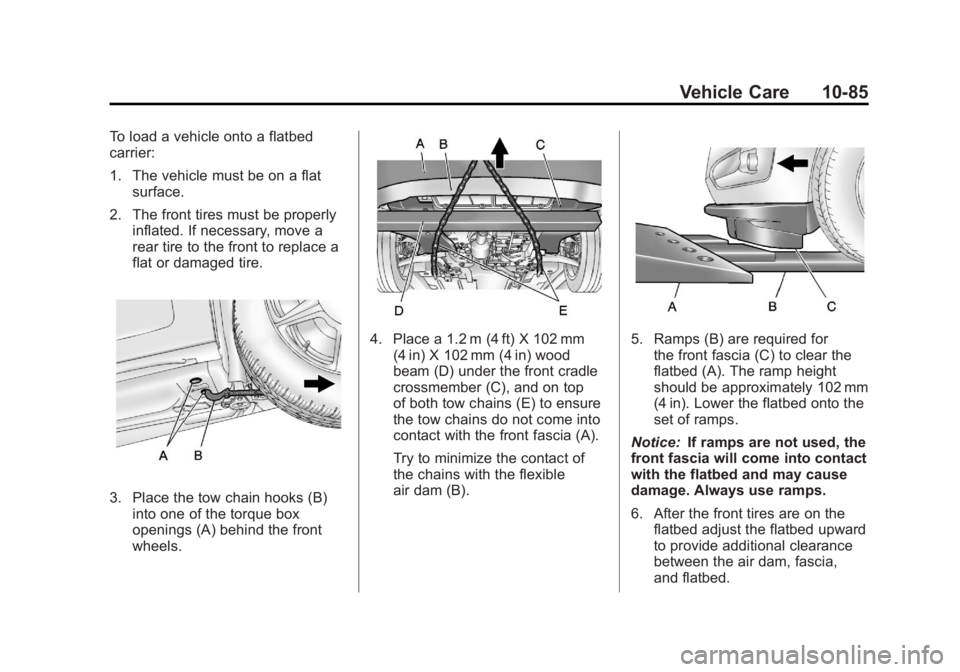
To load a vehicle onto a flatbed
carrier:
1. The vehicle must be on a flatsurface.
2. The front tires must be properly inflated. If necessary, move a
rear tire to the front to replace a
flat or damaged tire.
3. Place the tow chain hooks (B)
into one of the torque box
openings (A) behind the front
wheels.
4. Place a 1.2 m (4 ft) X 102 mm(4 in) X 102 mm (4 in) wood
beam (D) under the front cradle
crossmember (C), and on top
of both tow chains (E) to ensure
the tow chains do not come into
contact with the front fascia (A).
Try to minimize the contact of
the chains with the flexible
air dam (B).5. Ramps (B) are required forthe front fascia (C) to clear the
flatbed (A). The ramp height
should be approximately 102 mm
(4 in). Lower the flatbed onto the
set of ramps.
Notice: If ramps are not used, the
front fascia will come into contact
with the flatbed and may cause
damage. Always use ramps.
6. After the front tires are on the flatbed adjust the flatbed upward
to provide additional clearance
between the air dam, fascia,
and flatbed.
Page 496 of 516
Black plate (20,1)Chevrolet Volt Owner Manual - 2011
13-20 Customer Information
DISCLAIMER OF WARRANTY
THE DATABASE IS PROVIDED
ON AN“AS IS” AND“WITH ALL
FAULTS BASIS” AND DENSO AND
TANA (AND THEIR LICENSORS
AND SUPPLIERS) EXPRESSLY
DISCLAIM ALL OTHER
WARRANTIES, EXPRESS
OR IMPLIED, INCLUDING
BUT NOT LIMITED TO, THE
IMPLIED WARRANTIES
OF NON-INFRINGEMENT,
MERCHANTABILITY,
SATISFACTORY QUALITY,
ACCURACY, TITLE AND FITNESS
FOR A PARTICULAR PURPOSE.
NO ORAL OR WRITTEN ADVICE
OR INFORMATION PROVIDED BY
DENSO OR TANA (OR ANY OF
THEIR LICENSORS, AGENTS,
EMPLOYEES OR THIRD PARTY
PROVIDERS) SHALL CREATE
A WARRANTY, AND YOU ARE
NOT ENTITLED TO RELY
ON ANY SUCH ADVICE
OR INFORMATION. THIS DISCLAIMER OF
WARRANTIES IS AN ESSENTIAL
CONDITION OF THIS
AGREEMENT.
LIMITATION OF LIABILITY
IN NO EVENT SHALL DENSO OR
TANA (OR THEIR LICENSORS OR
SUPPLIERS) BE LIABLE FOR ANY
INCIDENTAL, CONSEQUENTIAL,
SPECIAL, INDIRECT OR
EXEMPLARY DAMAGES ARISING
OUT OF THIS AGREEMENT OR
YOUR USE OF THE DATABASE,
INCLUDING, WITHOUT
LIMITATION, LOST PROFITS OR
COSTS OF COVER, LOSS OF USE
OR BUSINESS INTERRUPTION
OR THE LIKE, REGARDLESS
OF WHETHER THE PARTY WAS
ADVISED OF THE POSSIBILITY
OF SUCH DAMAGES.
IN NO EVENT WILL THE TOTAL
LIABILITY OF DENSO OR TANA
(OR THEIR LICENSORS OR
SUPPLIERS) EXCEED THE
AMOUNTS PAID BY YOU
FOR THE DATABASE.WARNINGS
The DATABASE comprises facts
and information from government
and other sources reflecting
circumstances in existence before
you received the DATABASE, which
may contain errors and omissions.
Accordingly, the DATABASE may
contain inaccurate or incomplete
information due to the passage
of time, changing circumstances,
and due to the nature of the
sources used. The DATABASE
does not include or reflect
information relating to, among
other things, neighborhood safety;
law enforcement; emergency
assistance; construction work; road
or lane closures; vehicle or speed
restrictions; road slope or grade;
bridge height, weight or other limits;
road or traffic conditions; special
events; traffic congestion; or
travel time.