instrument panel CHEVROLET VOLT 2011 User Guide
[x] Cancel search | Manufacturer: CHEVROLET, Model Year: 2011, Model line: VOLT, Model: CHEVROLET VOLT 2011Pages: 516, PDF Size: 6.61 MB
Page 43 of 516
Black plate (7,1)Chevrolet Volt Owner Manual - 2011
Keys, Doors and Windows 2-7
Starting the Vehicle with a Low
Transmitter Battery
If the transmitter battery is weak,
the DIC may display NO REMOTE
DETECTED when you try to
start the vehicle. The REPLACE
BATTERY IN REMOTE KEY
message may also be displayed
at this time.
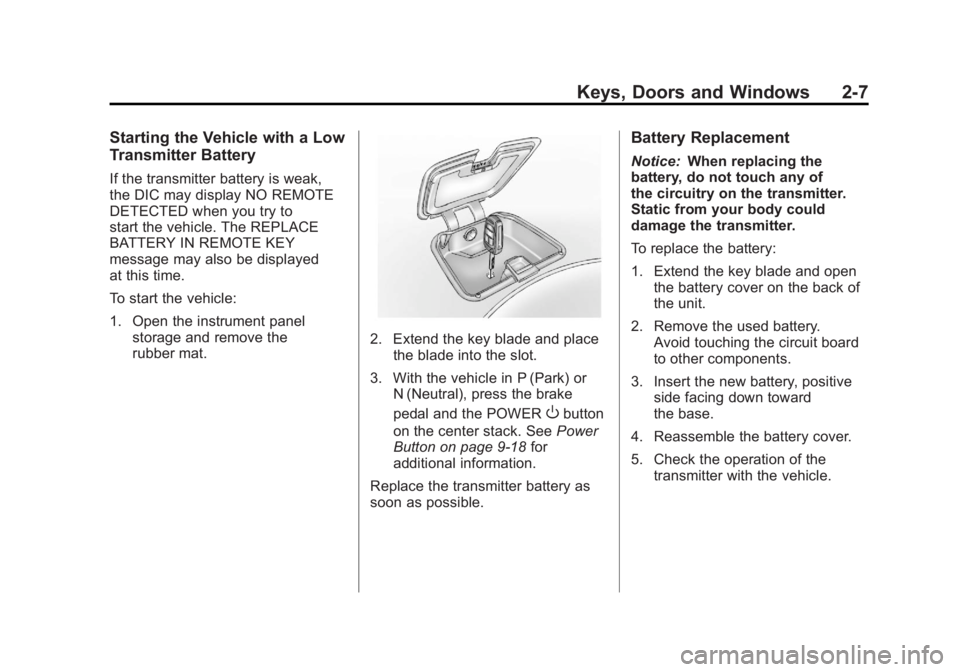
To start the vehicle:
1. Open the instrument panelstorage and remove the
rubber mat.
2. Extend the key blade and placethe blade into the slot.
3. With the vehicle in P (Park) or N (Neutral), press the brake
pedal and the POWER
Obutton
on the center stack. See Power
Button on page 9‑18 for
additional information.
Replace the transmitter battery as
soon as possible.
Battery Replacement
Notice: When replacing the
battery, do not touch any of
the circuitry on the transmitter.
Static from your body could
damage the transmitter.
To replace the battery:
1. Extend the key blade and open the battery cover on the back of
the unit.
2. Remove the used battery. Avoid touching the circuit board
to other components.
3. Insert the new battery, positive side facing down toward
the base.
4. Reassemble the battery cover.
5. Check the operation of the transmitter with the vehicle.
Page 48 of 516
Black plate (12,1)Chevrolet Volt Owner Manual - 2011
2-12 Keys, Doors and Windows
Safety Locks
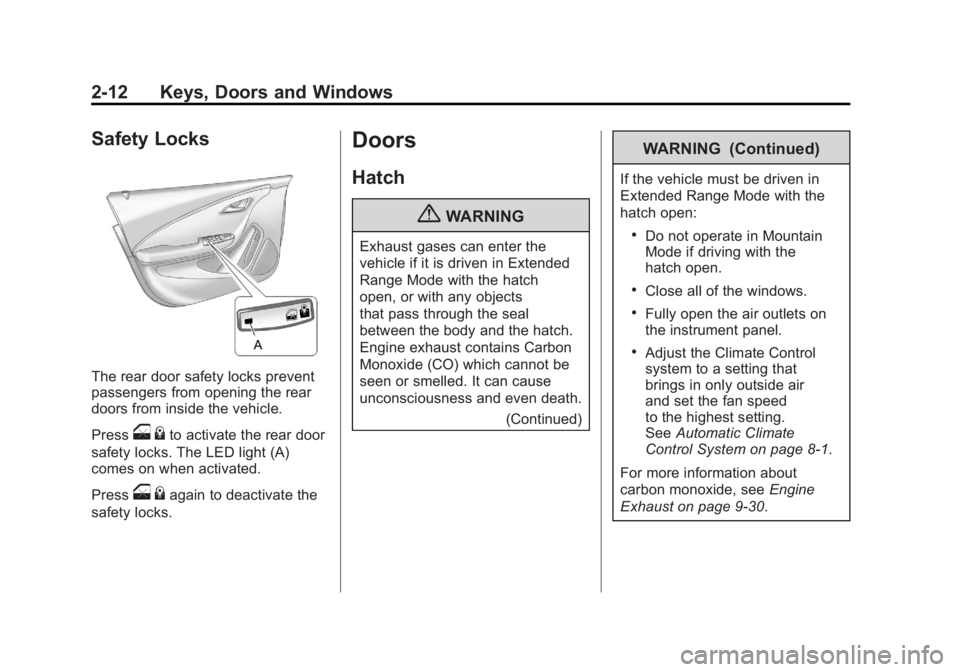
The rear door safety locks prevent
passengers from opening the rear
doors from inside the vehicle.
Press
o{to activate the rear door
safety locks. The LED light (A)
comes on when activated.
Press
o {again to deactivate the
safety locks.
Doors
Hatch
{WARNING
Exhaust gases can enter the
vehicle if it is driven in Extended
Range Mode with the hatch
open, or with any objects
that pass through the seal
between the body and the hatch.
Engine exhaust contains Carbon
Monoxide (CO) which cannot be
seen or smelled. It can cause
unconsciousness and even death.
(Continued)
WARNING (Continued)
If the vehicle must be driven in
Extended Range Mode with the
hatch open:
.Do not operate in Mountain
Mode if driving with the
hatch open.
.Close all of the windows.
.Fully open the air outlets on
the instrument panel.
.Adjust the Climate Control
system to a setting that
brings in only outside air
and set the fan speed
to the highest setting.
SeeAutomatic Climate
Control System on page 8‑1.
For more information about
carbon monoxide, see Engine
Exhaust on page 9‑30.
Page 68 of 516
Black plate (12,1)Chevrolet Volt Owner Manual - 2011
3-12 Seats and Restraints
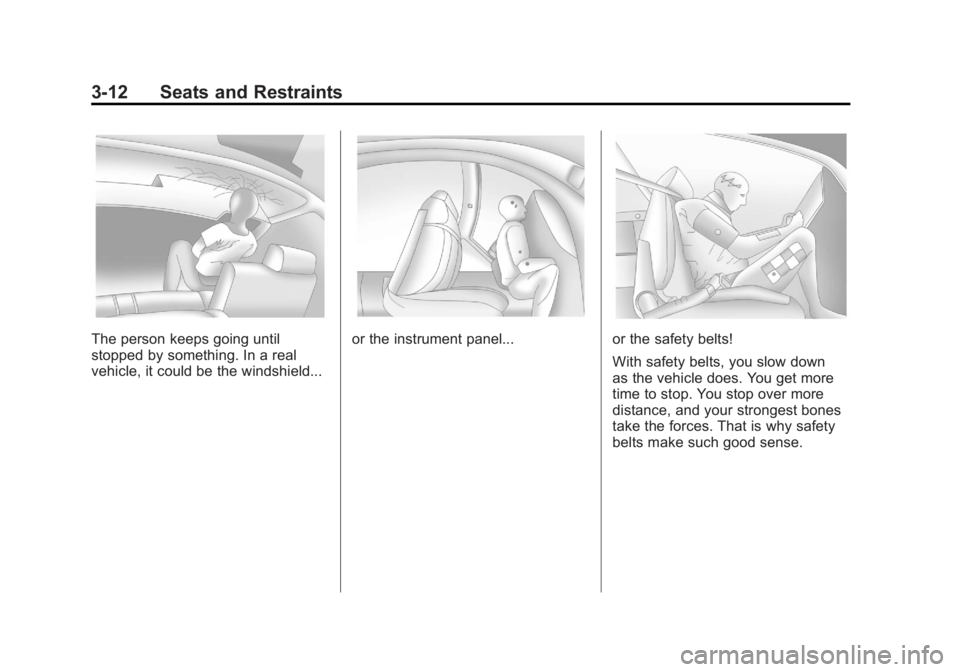
The person keeps going until
stopped by something. In a real
vehicle, it could be the windshield...or the instrument panel...or the safety belts!
With safety belts, you slow down
as the vehicle does. You get more
time to stop. You stop over more
distance, and your strongest bones
take the forces. That is why safety
belts make such good sense.
Page 81 of 516
Black plate (25,1)Chevrolet Volt Owner Manual - 2011
Seats and Restraints 3-25
Airbag System
The vehicle has the following
airbags:
.A frontal airbag for the driver.
.A frontal airbag for the right front
passenger.
.A knee airbag for the driver.
.A knee airbag for the front
passenger.
.A seat-mounted side impact
airbag for the driver.
.A seat-mounted side impact
airbag for the right front
passenger.
.A roof-rail airbag for the driver
and the passenger seated
directly behind the driver.
.A roof-rail airbag for the
right front passenger and the
passenger seated directly
behind the right front passenger.All of the airbags in the vehicle will
have the word AIRBAG embossed
in the trim or on an attached label
near the deployment opening.
For frontal airbags, the word
AIRBAG will appear on the middle
part of the steering wheel for the
driver and on the instrument panel
for the right front passenger.
With knee airbags, the word
AIRBAG will appear on the lower
portion of the instrument panel.
With seat-mounted side impact
airbags, the word AIRBAG will
appear on the side of the seatback
closest to the door.
With roof-rail airbags, the word
AIRBAG will appear along the
headliner or trim.
Airbags are designed to supplement
the protection provided by safety
belts. Even though today's airbags
are also designed to help reduce
the risk of injury from the force of an
inflating bag, all airbags must inflate
very quickly to do their job. Here are the most important things
to know about the airbag system:
{WARNING
You can be severely injured or
killed in a crash if you are not
wearing a safety belt
—even if
the vehicle has airbags. Airbags
are designed to work with safety
belts, but do not replace them.
Also, airbags are not designed to
deploy in every crash. In some
crashes safety belts are the only
restraint. See When Should an
Airbag Inflate? on page 3‑28.
Wearing a safety belt during a
crash helps reduce your chance
of hitting things inside the vehicle
or being ejected from it. Airbags
are “supplemental restraints” to
the safety belts. Everyone in the
vehicle should wear a safety belt
properly —whether or not there is
an airbag for that person.
Page 83 of 516
Black plate (27,1)Chevrolet Volt Owner Manual - 2011
Seats and Restraints 3-27
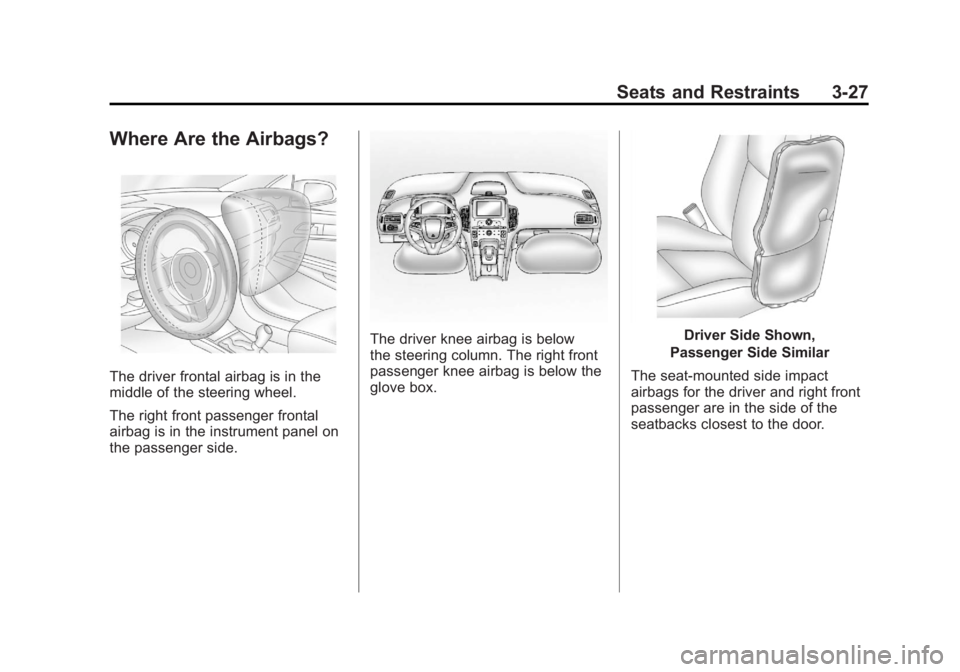
Where Are the Airbags?
The driver frontal airbag is in the
middle of the steering wheel.
The right front passenger frontal
airbag is in the instrument panel on
the passenger side.
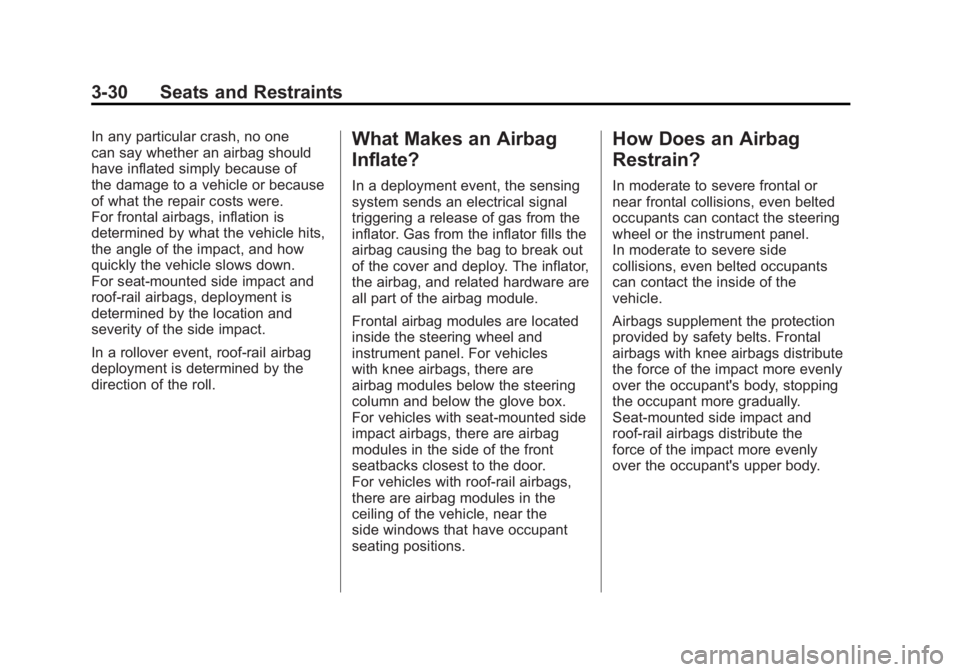
The driver knee airbag is below
the steering column. The right front
passenger knee airbag is below the
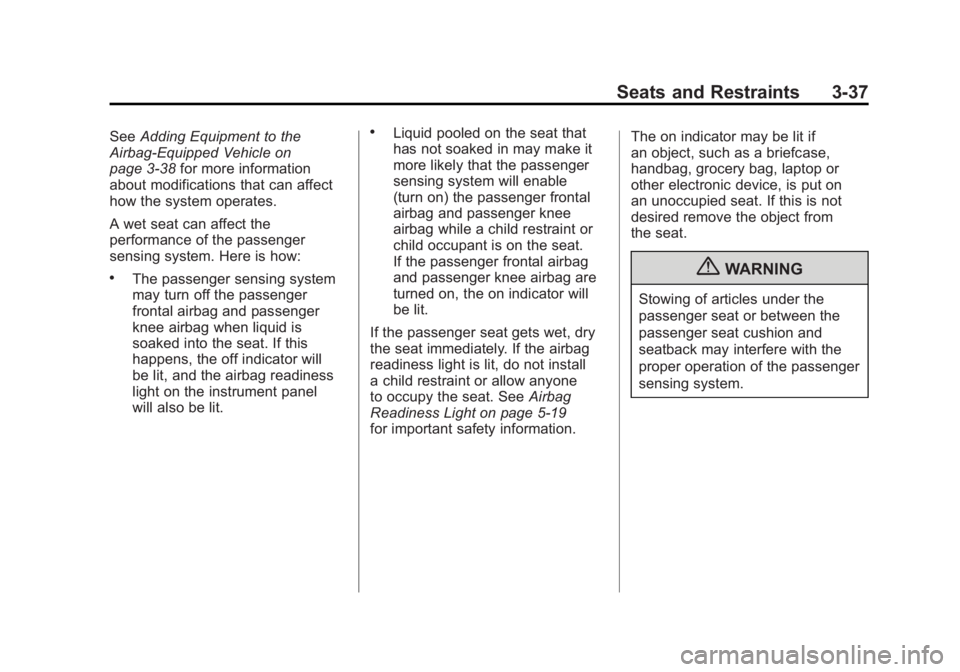
glove box.Driver Side Shown,
Passenger Side Similar
The seat-mounted side impact
airbags for the driver and right front
passenger are in the side of the
seatbacks closest to the door.
Page 86 of 516
Black plate (30,1)Chevrolet Volt Owner Manual - 2011
3-30 Seats and Restraints
In any particular crash, no one
can say whether an airbag should
have inflated simply because of
the damage to a vehicle or because
of what the repair costs were.
For frontal airbags, inflation is
determined by what the vehicle hits,
the angle of the impact, and how
quickly the vehicle slows down.
For seat-mounted side impact and
roof-rail airbags, deployment is
determined by the location and
severity of the side impact.
In a rollover event, roof‐rail airbag
deployment is determined by the
direction of the roll.What Makes an Airbag
Inflate?
In a deployment event, the sensing
system sends an electrical signal
triggering a release of gas from the
inflator. Gas from the inflator fills the
airbag causing the bag to break out
of the cover and deploy. The inflator,
the airbag, and related hardware are
all part of the airbag module.
Frontal airbag modules are located
inside the steering wheel and
instrument panel. For vehicles
with knee airbags, there are
airbag modules below the steering
column and below the glove box.
For vehicles with seat-mounted side
impact airbags, there are airbag
modules in the side of the front
seatbacks closest to the door.
For vehicles with roof-rail airbags,
there are airbag modules in the
ceiling of the vehicle, near the
side windows that have occupant
seating positions.
How Does an Airbag
Restrain?
In moderate to severe frontal or
near frontal collisions, even belted
occupants can contact the steering
wheel or the instrument panel.
In moderate to severe side
collisions, even belted occupants
can contact the inside of the
vehicle.
Airbags supplement the protection
provided by safety belts. Frontal
airbags with knee airbags distribute
the force of the impact more evenly
over the occupant's body, stopping
the occupant more gradually.
Seat-mounted side impact and
roof-rail airbags distribute the
force of the impact more evenly
over the occupant's upper body.
Page 93 of 516
Black plate (37,1)Chevrolet Volt Owner Manual - 2011
Seats and Restraints 3-37
SeeAdding Equipment to the
Airbag-Equipped Vehicle on
page 3‑38 for more information
about modifications that can affect
how the system operates.
A wet seat can affect the
performance of the passenger
sensing system. Here is how:
.The passenger sensing system
may turn off the passenger
frontal airbag and passenger
knee airbag when liquid is
soaked into the seat. If this
happens, the off indicator will
be lit, and the airbag readiness
light on the instrument panel
will also be lit.
.Liquid pooled on the seat that
has not soaked in may make it
more likely that the passenger
sensing system will enable
(turn on) the passenger frontal
airbag and passenger knee
airbag while a child restraint or
child occupant is on the seat.
If the passenger frontal airbag
and passenger knee airbag are
turned on, the on indicator will
be lit.
If the passenger seat gets wet, dry
the seat immediately. If the airbag
readiness light is lit, do not install
a child restraint or allow anyone
to occupy the seat. See Airbag
Readiness Light on page 5‑19
for important safety information. The on indicator may be lit if
an object, such as a briefcase,
handbag, grocery bag, laptop or
other electronic device, is put on
an unoccupied seat. If this is not
desired remove the object from
the seat.
{WARNING
Stowing of articles under the
passenger seat or between the
passenger seat cushion and
seatback may interfere with the
proper operation of the passenger
sensing system.
Page 94 of 516
Black plate (38,1)Chevrolet Volt Owner Manual - 2011
3-38 Seats and Restraints
Servicing the
Airbag-Equipped Vehicle
Airbags affect how the vehicle
should be serviced. There are
parts of the airbag system in
several places around the vehicle.
Your dealer and the service manual
have information about servicing
the vehicle and the airbag system.
To purchase a service manual,
seeService Publications Ordering
Information on page 13‑12.
{WARNING
For up to 10 seconds after the
vehicle is turned off and the
12‐volt battery is disconnected,
an airbag can still inflate during
improper service. You can be
injured if you are close to an
airbag when it inflates. Avoid
yellow connectors. They are
probably part of the airbag
system. Be sure to follow proper
service procedures, and make
sure the person performing work
for you is qualified to do so.
Adding Equipment to the
Airbag-Equipped Vehicle
Q: Is there anything I might add
to or change about the vehicle
that could keep the airbags
from working properly?
A: Yes. If you add things that
change the vehicle's frame,
bumper system, height, front end
or side sheet metal, they may
keep the airbag system from
working properly. Changing or
moving any parts of the front
seats, safety belts, the airbag
sensing and diagnostic module,
steering wheel, instrument
panel, roof-rail airbag modules,
ceiling headliner or pillar garnish
trim, overhead console, front
sensors, side impact sensors,
rollover sensor module, or airbag
wiring can affect the operation of
the airbag system.
Page 119 of 516
Black plate (1,1)Chevrolet Volt Owner Manual - 2011
Storage 4-1
Storage
Storage Compartments
Instrument Panel Storage . . . . 4-1
Glove Box . . . . . . . . . . . . . . . . . . . . 4-1
Floor Console Storage . . . . . . . . 4-1
Umbrella Storage . . . . . . . . . . . . . 4-2
Additional Storage Features
Cargo Cover . . . . . . . . . . . . . . . . . . 4-2
Storage
Compartments
Instrument Panel Storage
There is a storage compartment
on top of the instrument panel that
includes an auxiliary power outlet.
Inside is a transmitter slot for the
Remote Keyless Entry (RKE)
transmitter. SeeRemote Keyless
Entry (RKE) System Operation on
page 2‑3.
Glove Box
Open the glove box by lifting up on
the lever.
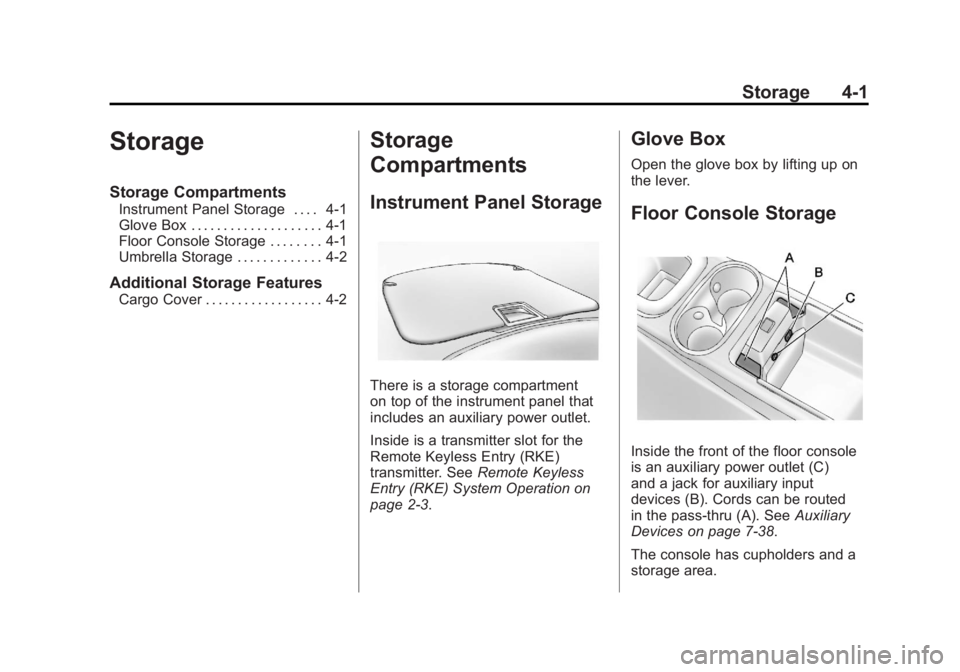
Floor Console Storage
Inside the front of the floor console
is an auxiliary power outlet (C)
and a jack for auxiliary input
devices (B). Cords can be routed
in the pass‐thru (A). See Auxiliary
Devices on page 7‑38.
The console has cupholders and a
storage area.
Page 121 of 516
Black plate (1,1)Chevrolet Volt Owner Manual - 2011
Instruments and Controls 5-1
Instruments and
Controls
Instrument Panel Overview
Instrument Panel Overview . . . . 5-4
Controls
Steering Wheel Adjustment . . . 5-6
Steering Wheel Controls . . . . . . 5-6
Horn . . . . . . . . . . . . . . . . . . . . . . . . . . 5-7
Windshield Wiper/Washer . . . . . 5-7
Power Outlets . . . . . . . . . . . . . . . . . 5-8
Warning Lights, Gauges, and
Indicators
Warning Lights, Gauges, andIndicators . . . . . . . . . . . . . . . . . . . . 5-9
Instrument Cluster . . . . . . . . . . . . 5-9
Speedometer . . . . . . . . . . . . . . . . 5-15
Odometer . . . . . . . . . . . . . . . . . . . . 5-15
Trip Odometer . . . . . . . . . . . . . . . 5-15
Compass . . . . . . . . . . . . . . . . . . . . 5-16 Battery Gauge (High
Voltage) . . . . . . . . . . . . . . . . . . . . 5-16
Fuel Gauge . . . . . . . . . . . . . . . . . . 5-16
Driver Efficiency Gauge . . . . . . 5-17
Total Vehicle Range . . . . . . . . . 5-17
Safety Belt Reminders . . . . . . . 5-18
Airbag Readiness Light . . . . . . 5-19
Passenger Airbag Status Indicator . . . . . . . . . . . . . . . . . . . . 5-20
Charging System Light (12-Volt Battery) . . . . . . . . . . . . 5-21
Malfunction Indicator Lamp . . . . . . . . . . . . . 5-21
Brake System Warning Light . . . . . . . . . . . . . . . . . . . . . . . 5-24
Electric Parking Brake Light . . . . . . . . . . . . . . . . . . . . . . . 5-25
Service Electric Parking Brake Light . . . . . . . . . . . . . . . . . . . . . . . 5-25
Antilock Brake System (ABS) Warning Light . . . . . . . . . . . . . . 5-26
Sport Mode Light . . . . . . . . . . . . 5-26
Mountain Mode Light . . . . . . . . 5-26 Traction Control System
(TCS)/StabiliTrak
®Light . . . . 5-27
Engine Coolant Temperature Warning Light . . . . . . . . . . . . . . 5-27
Tire Pressure Light . . . . . . . . . . 5-27
Engine Oil Pressure Light . . . . 5-28
Low Fuel Warning Light . . . . . . 5-28
Security Light . . . . . . . . . . . . . . . . 5-29
High-Beam On Light . . . . . . . . . 5-29
Lamps On Reminder . . . . . . . . . 5-29
Cruise Control Light . . . . . . . . . 5-29
Door, Hood, or Hatch Open
Light . . . . . . . . . . . . . . . . . . . . . . . 5-30
Information Displays
Center Stack Display . . . . . . . . 5-31
Power Flows . . . . . . . . . . . . . . . . . 5-31
Charging . . . . . . . . . . . . . . . . . . . . . 5-33
Energy Information . . . . . . . . . . 5-41
Clock . . . . . . . . . . . . . . . . . . . . . . . . 5-42
Driver InformationCenter (DIC) . . . . . . . . . . . . . . . 5-43