instrument cluster CHEVROLET VOLT 2011 Owner's Guide
[x] Cancel search | Manufacturer: CHEVROLET, Model Year: 2011, Model line: VOLT, Model: CHEVROLET VOLT 2011Pages: 516, PDF Size: 6.61 MB
Page 323 of 516
Black plate (21,1)Chevrolet Volt Owner Manual - 2011
Driving and Operating 9-21
The Remote Keyless Entry (RKE)
transmitter must be in the vehicle.
Press the brake pedal and push
and release the POWER
Obutton.
If the RKE transmitter is not in the
vehicle or something is interfering
with the transmitter, a message
displays in the Driver Information
Center (DIC). See Key and Lock
Messages on page 5‑48.
If the vehicle will not start due
to a low RKE transmitter battery,
the vehicle can still be driven.
See “Starting the Vehicle with
a Low Transmitter Battery” in
Remote Keyless Entry (RKE)
System Operation on page 2‑3.
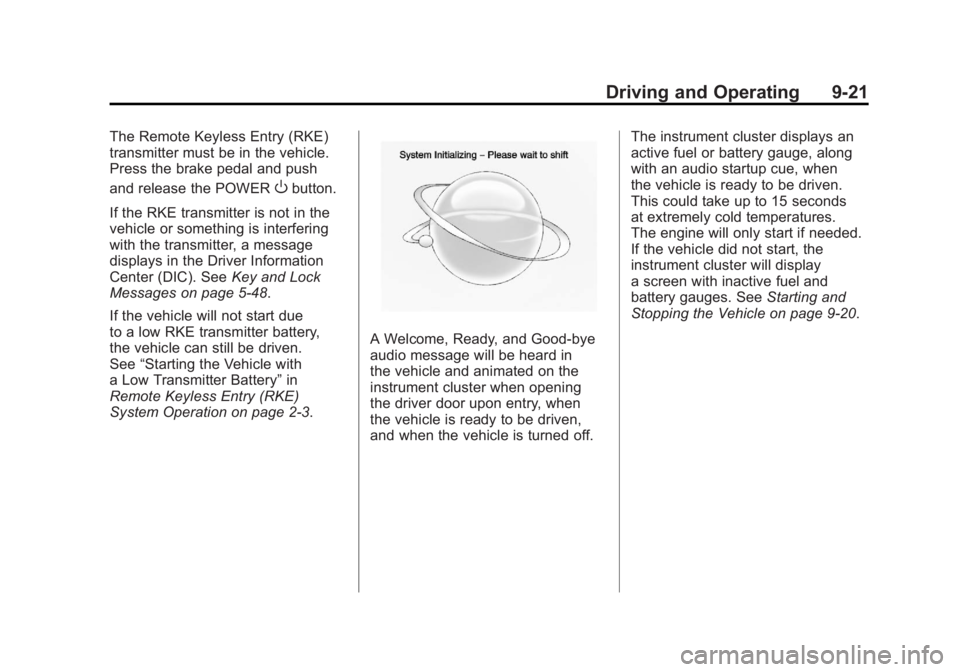
A Welcome, Ready, and Good‐bye
audio message will be heard in
the vehicle and animated on the
instrument cluster when opening
the driver door upon entry, when
the vehicle is ready to be driven,
and when the vehicle is turned off. The instrument cluster displays an
active fuel or battery gauge, along
with an audio startup cue, when
the vehicle is ready to be driven.
This could take up to 15 seconds
at extremely cold temperatures.
The engine will only start if needed.
If the vehicle did not start, the
instrument cluster will display
a screen with inactive fuel and
battery gauges. See
Starting and
Stopping the Vehicle on page 9‑20.
Page 341 of 516
Black plate (39,1)Chevrolet Volt Owner Manual - 2011
Driving and Operating 9-39
Electronic Stability
Control (ESC)
The vehicle has an Electronic
Stability Control system called
StabiliTrak. It is an advanced
computer‐controlled system that
assists with directional control of the
vehicle in difficult driving conditions.
StabiliTrak comes on automatically
whenever the vehicle is started and
cannot be turned off.
The system may be heard or felt
while it is working, but this is
normal.StabiliTrak activates when the
computer senses a difference
between the intended path and
the direction the vehicle is actually
traveling. StabiliTrak selectively
applies braking pressure to help
steer the vehicle in the intended
direction.
When the vehicle is started
and begins to move, the system
performs several diagnostic checks
to ensure there are no problems.
The system may be heard or
felt while it is working. This is
normal and does not mean there
is a problem with the vehicle.
The system should initialize
before the vehicle reaches 32 km/h
(20 mph). In some cases, it may
take approximately 3.2 km (2 mi) of
driving before the system initializes.
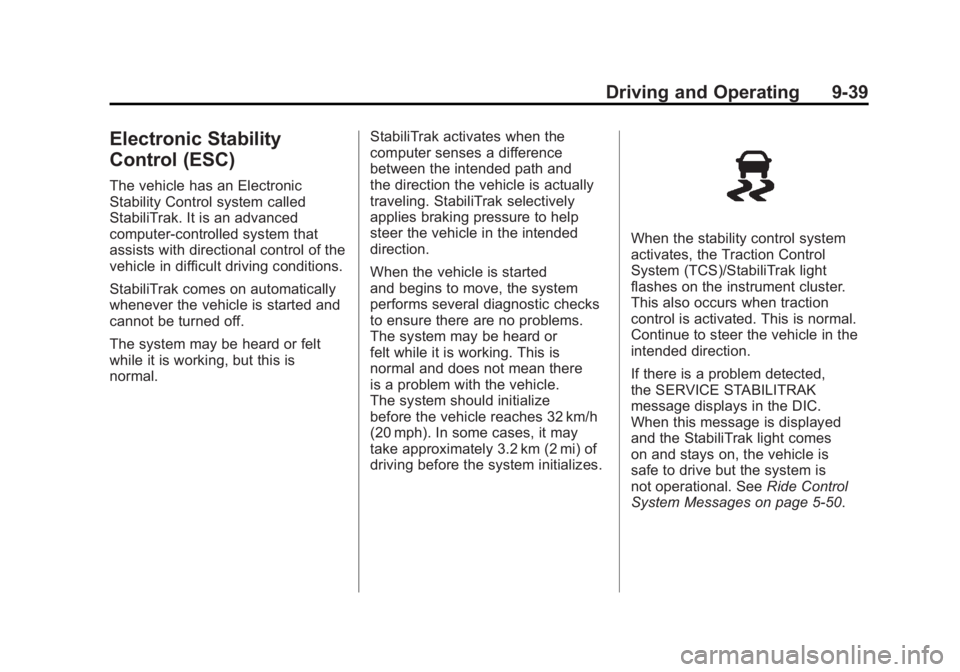
When the stability control system
activates, the Traction Control
System (TCS)/StabiliTrak light
flashes on the instrument cluster.
This also occurs when traction
control is activated. This is normal.
Continue to steer the vehicle in the
intended direction.
If there is a problem detected,
the SERVICE STABILITRAK
message displays in the DIC.
When this message is displayed
and the StabiliTrak light comes
on and stays on, the vehicle is
safe to drive but the system is
not operational. See
Ride Control
System Messages on page 5‑50.
Page 343 of 516
Black plate (41,1)Chevrolet Volt Owner Manual - 2011
Driving and Operating 9-41
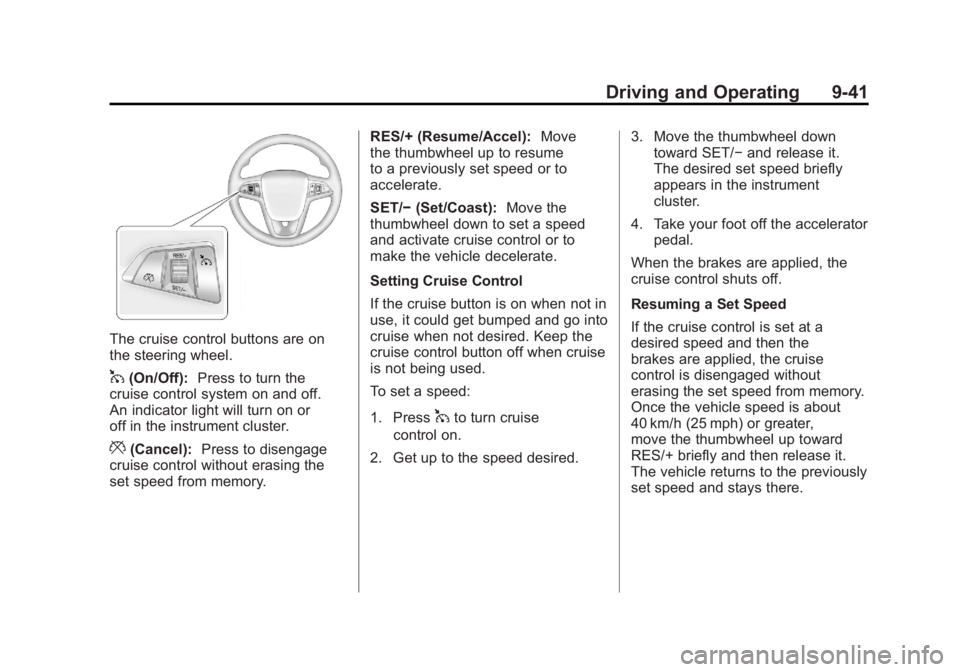
The cruise control buttons are on
the steering wheel.
1(On/Off):Press to turn the
cruise control system on and off.
An indicator light will turn on or
off in the instrument cluster.
*(Cancel): Press to disengage
cruise control without erasing the
set speed from memory. RES/+ (Resume/Accel):
Move
the thumbwheel up to resume
to a previously set speed or to
accelerate.
SET/− (Set/Coast): Move the
thumbwheel down to set a speed
and activate cruise control or to
make the vehicle decelerate.
Setting Cruise Control
If the cruise button is on when not in
use, it could get bumped and go into
cruise when not desired. Keep the
cruise control button off when cruise
is not being used.
To set a speed:
1. Press
1to turn cruise
control on.
2. Get up to the speed desired. 3. Move the thumbwheel down
toward SET/− and release it.
The desired set speed briefly
appears in the instrument
cluster.
4. Take your foot off the accelerator pedal.
When the brakes are applied, the
cruise control shuts off.
Resuming a Set Speed
If the cruise control is set at a
desired speed and then the
brakes are applied, the cruise
control is disengaged without
erasing the set speed from memory.
Once the vehicle speed is about
40 km/h (25 mph) or greater,
move the thumbwheel up toward
RES/+ briefly and then release it.
The vehicle returns to the previously
set speed and stays there.
Page 407 of 516

Black plate (41,1)Chevrolet Volt Owner Manual - 2011
Vehicle Care 10-41
Mini Fuses Usage53 Traction
Power Inverter
Module
–Run/Crank
54 Run/Crank for Air
Conditioning Control
Module/Instrument
Cluster/Passenger
Airbag Display/
Accessory Power
Module
J‐Case Fuses Usage
16 Empty
18 Empty
19 Power
Window
–Front
20 Empty
21 Antilock Brake
System Electronic
Control Unit J‐Case
Fuses Usage
23 Charge Port Door
27 Empty
28 Empty
29 Empty
30 Antilock Brake
System Motor
42 Cooling Fan –Right
43 Front Wipers
44 Charger
45 Empty
48 Cooling Fan –Left
Mini Relays Usage 3 Powertrain
4 Rear Defog (Lower
Grid)/Heated Mirrors
7 Empty Mini Relays Usage
9 Empty
11 Empty
12 Empty
13 Empty
14 Run/Crank
Micro
Relays Usage
1 Empty
2 Empty
6 Empty
8 Empty
10 Empty
Ultra Micro Relays Usage
5 Charge Port Door
Page 408 of 516

Black plate (42,1)Chevrolet Volt Owner Manual - 2011
10-42 Vehicle Care
Instrument Panel Fuse
Block (Left Side)
The instrument panel fuse block
is on the driver side end of the
instrument panel. To access the
fuses, open the fuse panel door
by pulling out.
To reinstall the door, insert the
bottom tab first, then push the
door back into its original location.
Instrument Panel Fuse Block
A fuse puller is located in the engine
compartment fuse block.
The vehicle may not be equipped
with all of the fuses, relays, and
features shown. Fuses Usage
F1 Power Outlet
–Top
of IP Storage Bin
F2 Radio
F3 Instrument Cluster
F4 Infotainment Display Fuses Usage
F5 Heating, Ventilation
& Air Conditioning/
Integrated Center
Stack Switches
F6 Airbag (Sensing
Diagnostic Module/
Passenger Sensing
Module)
F7 Data Link
Connector 1/Data
Link Connector 2
Page 423 of 516
Black plate (57,1)Chevrolet Volt Owner Manual - 2011
Vehicle Care 10-57
Tire Pressure Monitor
Operation
This vehicle may have a Tire
Pressure Monitor System (TPMS).
The TPMS is designed to warn
the driver when a low tire pressure
condition exists. TPMS sensors
are mounted onto each tire and
wheel assembly. The TPMS sensors
monitor the air pressure in the
tires and transmit the tire pressure
readings to a receiver located in
the vehicle.
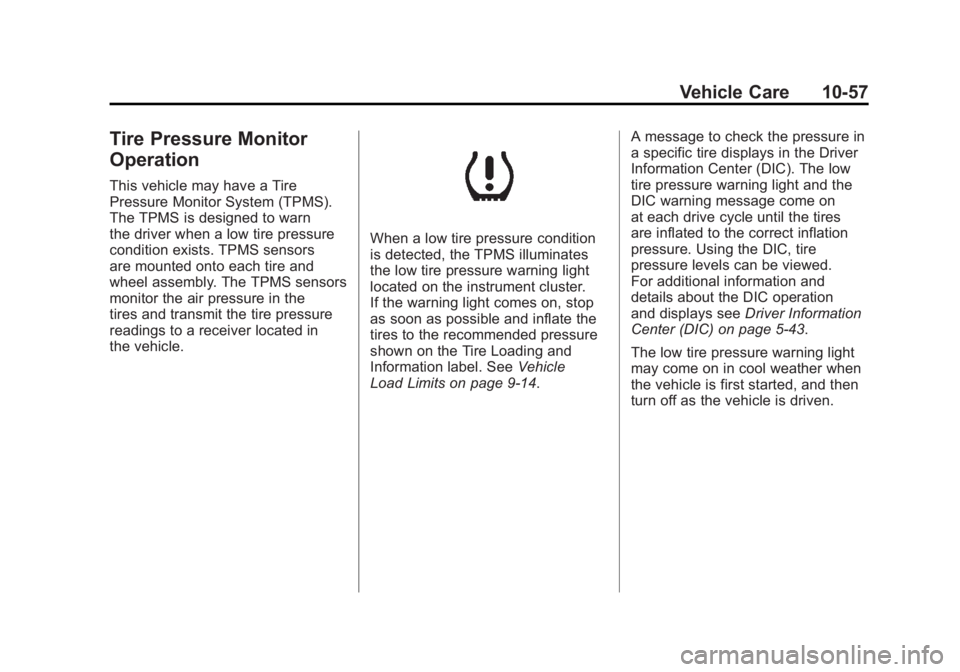
When a low tire pressure condition
is detected, the TPMS illuminates
the low tire pressure warning light
located on the instrument cluster.
If the warning light comes on, stop
as soon as possible and inflate the
tires to the recommended pressure
shown on the Tire Loading and
Information label. SeeVehicle
Load Limits on page 9‑14. A message to check the pressure in
a specific tire displays in the Driver
Information Center (DIC). The low
tire pressure warning light and the
DIC warning message come on
at each drive cycle until the tires
are inflated to the correct inflation
pressure. Using the DIC, tire
pressure levels can be viewed.
For additional information and
details about the DIC operation
and displays see
Driver Information
Center (DIC) on page 5‑43.
The low tire pressure warning light
may come on in cool weather when
the vehicle is first started, and then
turn off as the vehicle is driven.
Page 447 of 516
Black plate (81,1)Chevrolet Volt Owner Manual - 2011
Vehicle Care 10-81
6. Check that the jumper cablesdo not have loose or missing
insulation or a shock could
result and the vehicles could
be damaged.
Before connecting the jumper
cables, here are some basic
things to know. Positive (+)
jumper cable goes to positive (+)
battery terminal or a remote
positive (+) terminal if available.
Negative (−) jumper cable goes
to negative (−) battery terminal
or a remote negative (−) terminal
if available. Do not connect
positive (+) to negative (−) or
there will be a short that may
damage the battery and other
parts of the vehicle. Notice:
If the jumper cables
are connected or removed in
the wrong order, electrical
shorting may occur and damage
the vehicle. The repairs would
not be covered by the vehicle
warranty. Always connect and
remove the jumper cables in the
correct order, making sure that
the cables do not touch each
other or other metal.
Connecting the Jumper Cables
1. Connect the red positive (+) jumper cable to the remote
positive (+) terminal (A) of your
Volt. Do not let the other end
of the cable touch metal.
2. Connect the other end of the red positive (+) jumper cable to the
positive (+) terminal of the other
vehicle. 3. Connect the black negative (−)
jumper cable to the negative (−)
battery terminal of the other
vehicle battery. Do not let the
other end touch anything until
the next step.
4. Connect the other end of the black negative (−) jumper cable
to the remote negative (−)
terminal of your Volt.
5. Push the POWER
Obutton
to start. This will wake up the
electronics on the Volt. After the
instrument cluster initializes,
the Volt will use power from
the high voltage battery to
charge the 12‐volt battery.
The jumper cables can then
be disconnected. If the Volt
does not start, call your dealer
or Roadside Assistance.
See Roadside Assistance
Program on page 13‑6.
Page 506 of 516
Black plate (2,1)Chevrolet Volt Owner Manual - 2011
i-2 INDEX
Brake System Warning Light . . . 5-24
Brakes . . . . . . . . . . . . . . . . . . . . . . . . 10-25Antilock . . . . . . . . . . . . . . . . . . . . . . . 9-33
Fluid . . . . . . . . . . . . . . . . . . . . . . . . 10-26
Regenerative Braking . . . . . . . . . 9-37
System Messages . . . . . . . . . . . . 5-46
Braking . . . . . . . . . . . . . . . . . . . . . . . . . 9-5
Break-In, New Vehicle . . . . . . . . . 9-18
Bulb Replacement . . . . . . . . . . . . 10-37
Back-up Lamps . . . . . . . . . . . . . 10-35
Halogen Bulbs . . . . . . . . . . . . . . 10-34
Headlamp Aiming . . . . . . . . . . . 10-32
Headlamps . . . . . . . . . . . . . . . . . 10-34
License Plate Lamps . . . . . . . 10-36
Buying New Tires . . . . . . . . . . . . . 10-63
C
Calibration . . . . . . . . . . . . . . . . . . . . . 5-16
California Fuel Requirements . . . . . . . . . . . 9-58
Perchlorate MaterialsRequirements . . . . . . . . . . . . . . . 10-3
Warning . . . . . . . . . . . . . . . . . . . . . . 10-3 Camera, Rear Vision . . . . . . . . . . 9-46
Canadian Vehicle Owners . . . . . . . . iii
Capacities and
Specifications . . . . . . . . . . . . . . . . 12-2
Carbon Monoxide Engine Exhaust . . . . . . . . . . . . . . . 9-30
Hatch . . . . . . . . . . . . . . . . . . . . . . . . . 2-12
Winter Driving . . . . . . . . . . . . . . . . 9-11
Cargo Cover . . . . . . . . . . . . . . . . . . . . . . . . . . 4-2
Cautions, Danger, and
Warnings . . . . . . . . . . . . . . . . . . . . . . . . iv
CD/DVD Player . . . . . . . . . . . . . . . . 7-18
Chains, Tire . . . . . . . . . . . . . . . . . . 10-69
Charge Cord . . . . . . . . . . . . . . . . . . . 9-54
Charging . . . . . . . . . . . . . . . . . . . . . . 5-33 Delay Override . . . . . . . . . . . . . . . 9-52
Electrical Requirements . . . . . . 9-56
Plug-In . . . . . . . . . . . . . . . . . . . . . . . 9-49
Charging Status Screens . . . . . . 9-52
Charging System Light . . . . . . . . 5-21
Check Engine Light . . . . . . . . . . . . . . . . . . 5-21 Child Restraints
Infants and Young
Children . . . . . . . . . . . . . . . . . . . . . 3-43
Lower Anchors and Tethers for Children . . . . . . . . . 3-49
Older Children . . . . . . . . . . . . . . . . 3-41
Securing . . . . . . . . . . . . . . . . 3-57, 3-60
Systems . . . . . . . . . . . . . . . . . . . . . . 3-45
Cleaning Exterior Care . . . . . . . . . . . . . . . 10-89
Interior Care . . . . . . . . . . . . . . . . 10-93
Climate Control Systems Automatic . . . . . . . . . . . . . . . . . . . . . . 8-1
Clock . . . . . . . . . . . . . . . . . . . . . . . . . . 5-42
Cluster, Instrument . . . . . . . . . . . . . 5-9
Collision Damage Repair . . . . . 13-10
Compass . . . . . . . . . . . . . . . . . . . . . . 5-16
Compressor Kit, Tire Sealant . . . . . . . . . . . . . . . . . . . . . . 10-71
Configure Menu . . . . . . . . . . . . . . . 7-66
Control of a Vehicle . . . . . . . . . . . . . 9-5
Convex Mirrors . . . . . . . . . . . . . . . . 2-15
Page 510 of 516
Black plate (6,1)Chevrolet Volt Owner Manual - 2011
i-6 INDEX
I
Immobilizer . . . . . . . . . . . . . . . . . . . . 2-14
Infants and Young Children,Restraints . . . . . . . . . . . . . . . . . . . . 3-43
Information Energy . . . . . . . . . . . . . . . . . . . . . . . 5-41
Open Source . . . . . . . . . . . . . . . 13-24
Infotainment . . . . . . . . . . . . . . . . . . . . 7-2
Instrument Cluster . . . . . . . . . . . . . . 5-9
Instrument Panel Storage Area . . . . . . . . . . . . . . . . . . 4-1
Introduction . . . . . . . . . . . . . . . . . . . . . . . iii
J
Jump Starting . . . . . . . . . . . . . . . . . 10-79
K
Key and Lock Messages . . . . . . . 5-48
Keyless Entry Remote (RKE) System . . . . . . . . 2-3
Keys . . . . . . . . . . . . . . . . . . . . . . . . . . . . 2-2
L
Labeling, Tire Sidewall . . . . . . . . 10-49
Lamp Messages . . . . . . . . . . . . . . . 5-49
Lamps Daytime Running (DRL) . . . . . . . 6-3
Dome . . . . . . . . . . . . . . . . . . . . . . . . . . 6-5
Exterior Controls . . . . . . . . . . . . . . . 6-1
License Plate . . . . . . . . . . . . . . . 10-36
Malfunction Indicator . . . . . . . . . 5-21
On Reminder . . . . . . . . . . . . . . . . . 5-29
Reading . . . . . . . . . . . . . . . . . . . . . . . 6-5
Lap-Shoulder Belt . . . . . . . . . . . . . 3-19
LATCH System Replacing Parts after aCrash . . . . . . . . . . . . . . . . . . . . . . . 3-57
LATCH, Lower Anchors and
Tethers for Children . . . . . . . . . . 3-49
Lifting the Vehicle, Tires . . . . . . . 10-5
Lighting Entry . . . . . . . . . . . . . . . . . . . . . . . . . . 6-5
Exit . . . . . . . . . . . . . . . . . . . . . . . . . . . . 6-6
Illumination Control . . . . . . . . . . . . 6-5 Lights
Airbag Readiness . . . . . . . . . . . . . 5-19
Antilock Brake System
(ABS) Warning . . . . . . . . . . . . . . 5-26
Brake System Warning . . . . . . . 5-24
Charging System . . . . . . . . . . . . . 5-21
Cruise Control . . . . . . . . . . . . . . . . 5-29
Electric Parking Brake . . . . . . . . 5-25
Engine Coolant Temperature Warning . . . . . . . 5-27
Engine Oil Pressure . . . . . . . . . . 5-28
Flash-to-Pass . . . . . . . . . . . . . . . . . . 6-2
High-Beam On . . . . . . . . . . . . . . . . 5-29
High/Low Beam Changer . . . . . . 6-2
Hood, Door, Hatch Open . . . . . 5-30
Low Fuel Warning . . . . . . . . . . . . 5-28
Mountain Mode . . . . . . . . . . . . . . . 5-26
Safety Belt Reminders . . . . . . . . 5-18
Security . . . . . . . . . . . . . . . . . . . . . . 5-29
Service Electric Parking Brake . . . . . . . . . . . . . . . . . . . . . . . 5-25
Sport Mode . . . . . . . . . . . . . . . . . . . 5-26
Tire Pressure . . . . . . . . . . . . . . . . . 5-27
Traction Control System (TCS)/StabiliTrak
®. . . . . . . . . . 5-27