brake CHEVROLET VOLT 2011 Repair Manual
[x] Cancel search | Manufacturer: CHEVROLET, Model Year: 2011, Model line: VOLT, Model: CHEVROLET VOLT 2011Pages: 516, PDF Size: 6.61 MB
Page 417 of 516

Black plate (51,1)Chevrolet Volt Owner Manual - 2011
Vehicle Care 10-51
(B) Tire Width:The three‐digit
number indicates the tire section
width in millimeters from
sidewall to sidewall.
(C) Aspect Ratio
:A two‐digit
number that indicates the tire
height‐to‐width measurements.
For example, if the tire size
aspect ratio is 60, as shown in
item C of the illustration, it would
mean that the tire's sidewall is
60 percent as high as it is wide.
(D) Construction Code
:A
letter code is used to indicate
the type of ply construction in
the tire. The letter R means
radial ply construction; the
letter D means diagonal or
bias ply construction; and the
letter B means belted‐bias ply
construction.
(E) Rim Diameter
:Diameter of
the wheel in inches. (F) Service Description
:These
characters represent the load
index and speed rating of the
tire. The load index represents
the load carrying capacity a tire
is certified to carry. The speed
rating is the maximum speed a
tire is certified to carry a load.
Tire Terminology and
Definitions
Air Pressure:The amount
of air inside the tire pressing
outward on each square
inch of the tire. Air pressure is
expressed in kPa (kilopascal)
or psi (pounds per square inch).
Accessory Weight
:The
combined weight of optional
accessories. Some examples
of optional accessories are,
automatic electric drive unit,
power steering, power brakes,
power windows, power seats,
and air conditioning. Aspect Ratio
:The relationship
of a tire's height to its width.
Belt
:A rubber coated layer of
cords that is located between
the plies and the tread. Cords
may be made from steel or other
reinforcing materials.
Bead
:The tire bead contains
steel wires wrapped by steel
cords that hold the tire onto
the rim.
Bias Ply Tire
:A pneumatic
tire in which the plies are laid
at alternate angles less than
90 degrees to the centerline
of the tread.
Cold Tire Pressure
:The
amount of air pressure in a tire,
measured in kPa (kilopascal)
or psi (pounds per square inch)
before a tire has built up heat
from driving. See Tire Pressure
on page 10‑54.
Page 426 of 516
Black plate (60,1)Chevrolet Volt Owner Manual - 2011
10-60 Vehicle Care
There are two minutes to match
the first tire/wheel position, and
five minutes overall to match all
four tire/wheel positions. If it takes
longer, the matching process stops
and must be restarted.
Follow the TPMS sensor matching
process:
1. Set the parking brake.
2. Put the vehicle in ON/RUN andplace the vehicle in P (Park).
3. If the DIC display is minimized, press the SELECT knob to
maximize it.
4. Use the SELECT knob to scroll to the Tire Pressure display
screen.
5. Press and hold the SELECT knob for five seconds to begin
the sensor matching process.
A message displays confirming
to begin the process. 6. Use the SELECT knob to
select YES with the highlighted
selection, and press the
SELECT knob again to
confirm the selection.
The horn sounds twice to signal
the receiver is in relearn mode
and the TIRE LEARNING
ACTIVE message displays
on the DIC screen.
7. Start with the driver side front tire.
8. Place the relearn tool against the tire sidewall, near the valve
stem. Then press the button
to activate the TPMS sensor.
A horn chirp confirms that the
sensor identification code has
been matched to this tire and
wheel position. 9. Proceed to the passenger
side front tire, and repeat the
procedure in Step 8.
10. Proceed to the passenger side rear tire, and repeat the
procedure in Step 8.
11. Proceed to the driver side rear tire, and repeat the procedure
in Step 8. The horn sounds two
times to indicate the sensor
identification code has been
matched to the driver side
rear tire, and the TPMS sensor
matching process is no longer
active. The TIRE LEARNING
ACTIVE message on the DIC
display screen goes off.
12. Turn the vehicle off.
13. Set all four tires to the recommended air pressure
level as indicated on the Tire
and Loading Information label.
Page 430 of 516
Black plate (64,1)Chevrolet Volt Owner Manual - 2011
10-64 Vehicle Care
GM's exclusive TPC Spec
system considers over a dozen
critical specifications that impact
the overall performance of the
vehicle, including brake system
performance, ride and handling,
traction control, and tire pressure
monitoring performance. GM's TPC
Spec number is molded onto the
tire's sidewall near the tire size.
If the tires have an all‐season
tread design, the TPC spec number
will be followed by MS, for mud
and snow. SeeTire Sidewall
Labeling on page 10‑49 for
additional information.
GM recommends replacing all the
tires at the same time. Uniform
tread depth on all tires will help
to maintain the performance of
the vehicle. Braking and handling
performance may be adversely
affected if all the tires are not
replaced at the same time.
See Tire Inspection on page 10‑61
and Tire Rotation on page 10‑61 for
information on proper tire rotation.{WARNING
Tires could explode during
improper service. Attempting to
mount or dismount a tire could
cause injury or death. Only your
dealer or authorized tire service
center should mount or dismount
the tires.
{WARNING
Mixing tires of different sizes,
brands, or types may cause
loss of control of the vehicle,
resulting in a crash or other
vehicle damage. Use the
correct size, brand, and type
of tire on all wheels.
{WARNING
Using bias-ply tires on the
vehicle may cause the wheel
rim flanges to develop cracks
after many miles of driving.
A tire and/or wheel could fail
suddenly and cause a crash.
Use only radial-ply tires with
the wheels on the vehicle.
If the vehicle tires must be replaced
with a tire that does not have a TPC
Spec number, make sure they are
the same size, load range, speed
rating, and construction (radial) as
the original tires.
Vehicles that have a tire pressure
monitoring system could give an
inaccurate low‐pressure warning
if non‐TPC Spec rated tires are
installed. See Tire Pressure Monitor
System on page 10‑55.
Page 431 of 516
Black plate (65,1)Chevrolet Volt Owner Manual - 2011
Vehicle Care 10-65
The Tire and Loading Information
Label indicates the original
equipment tires on the vehicle.
SeeVehicle Load Limits on
page 9‑14, for the label location
and more information about the
Tire and Loading Information label.
Different Size Tires and
Wheels
If wheels or tires are installed that
are a different size than the original
equipment wheels and tires, vehicle
performance, including its braking,
ride and handling characteristics,
stability, and resistance to rollover
may be affected. If the vehicle has
electronic systems such as antilock
brakes, rollover airbags, traction
control, and electronic stability
control, the performance of these
systems can also be affected.
{WARNING
If different sized wheels are used,
there may not be an acceptable
level of performance and safety
if tires not recommended for
those wheels are selected.
This increases the chance
of a crash and serious injury.
Only use GM specific wheel
and tire systems developed
for the vehicle, and have them
properly installed by a GM
certified technician.
See Buying New Tires on
page 10‑63 andAccessories
and Modifications on page 10‑4
for additional information.
Uniform Tire Quality
Grading
Quality grades can be found
where applicable on the tire
sidewall between tread shoulder
and maximum section width.
For example:
Treadwear 200 Traction AA
Temperature A
The following information relates
to the system developed by the
United States National Highway
Traffic Safety Administration
(NHTSA), which grades tires
by treadwear, traction, and
temperature performance.
This applies only to vehicles
sold in the United States.
Page 434 of 516

Black plate (68,1)Chevrolet Volt Owner Manual - 2011
10-68 Vehicle Care
Replace wheels, wheel bolts,
wheel nuts, or Tire Pressure Monitor
System (TPMS) sensors with new
GM original equipment parts.
{WARNING
Using the wrong replacement
wheels, wheel bolts, or wheel
nuts can be dangerous. It could
affect the braking and handling
of the vehicle. Tires can lose air,
and cause loss of control, causing
a crash. Always use the correct
wheel, wheel bolts, and wheel
nuts for replacement.
Notice: The wrong wheel
can also cause problems with
bearing life, brake cooling,
speedometer or odometer
calibration, headlamp aim,
bumper height, vehicle ground
clearance, and tire clearance
to the body and chassis.
{WARNING
Rust or dirt on a wheel,
or on the parts to which it is
fastened, can make wheel
nuts become loose after a
time. The wheel could come
off and cause a crash. When
changing a wheel, remove
any rust or dirt from places
where the wheel attaches to
the vehicle. In an emergency,
a cloth or a paper towel can
be used, however, use a
scraper or wire brush to
remove all rust or dirt.
{WARNING
Never use oil or grease on studs
or the threads of the wheel nuts.
The wheel nuts might come loose
and the wheel could fall off,
causing a crash.
{WARNING
Incorrect wheel nuts or improperly
tightened wheel nuts can cause
the wheel to become loose and
even come off. This could lead
to a crash. Be sure to use the
correct wheel nuts. If you have
to replace them, be sure to get
new GM original equipment
wheel nuts.
Notice: Improperly tightened
wheel nuts can lead to brake
pulsation and rotor damage.
To avoid expensive brake repairs,
evenly tighten the wheel nuts in
the proper sequence and to the
proper torque specification.
Page 435 of 516
Black plate (69,1)Chevrolet Volt Owner Manual - 2011
Vehicle Care 10-69
Used Replacement Wheels
{WARNING
Replacing a wheel with a used
one is dangerous. How it has
been used or how far it has been
driven may be unknown. It could
fail suddenly and cause a crash.
When replacing wheels, use a
new GM original equipment
wheel.
Tire Chains
{WARNING
Do not use tire chains. There is
not enough clearance. Tire chains
used on a vehicle without the
proper amount of clearance can
cause damage to the brakes,
suspension or other vehicle(Continued)
WARNING (Continued)
parts. The area damaged by
the tire chains could cause
loss of control and a crash.
Use another type of traction
device only if its manufacturer
recommends it for the vehicle's
tire size combination and
road conditions. Follow that
manufacturer's instructions.
To avoid vehicle damage, drive
slow and readjust or remove the
traction device if it contacts the
vehicle. Do not spin the wheels.
If traction devices are used,
install them on the front tires.
If a Tire Goes Flat
This vehicle has a tire sealant and
compressor kit. SeeTire Sealant
and Compressor Kit on page 10‑71.
There is no spare tire, no tire
changing equipment, and no
place to store a tire.
To properly lift this vehicle, see
Lifting the Vehicle on page 10‑5.
It is unusual for a tire to blowout
while driving, especially if the
tires are maintained properly.
See Tires on page 10‑48.
If air goes out of a tire, it is much
more likely to leak out slowly.
Page 436 of 516
Black plate (70,1)Chevrolet Volt Owner Manual - 2011
10-70 Vehicle Care
But if there ever is a blowout, here
are a few tips about what to expect
and what to do:
If a front tire fails, the flat tire will
create a drag that pulls the vehicle
toward that side. Take your foot
off the accelerator pedal and grip
the steering wheel firmly. Steer to
maintain lane position, and then
gently brake to a stop, well off
the road, if possible.
A rear blowout, particularly on a
curve, acts much like a skid and
may require the same correction
as used in a skid. Stop pressing
the accelerator pedal and steer to
straighten the vehicle. It may be
very bumpy and noisy. Gently
brake to a stop, well off the road,
if possible.{WARNING
Driving on a flat tire will cause
permanent damage to the tire.
Re-inflating a tire after it has
been driven on while severely
underinflated or flat may cause
a blowout and a serious crash.
Never attempt to re-inflate a tire
that has been driven on while
severely underinflated or flat.
Have your dealer or an authorized
tire service center repair or
replace the flat tire as soon
as possible.
If a tire goes flat, avoid further tire
and wheel damage by driving slowly
to a level place and stopping, well
off the road, if possible.
1. Turn on the hazard warning flashers. See Hazard Warning
Flashers on page 6‑4.
2. Set the parking brake firmly. 3. Put the shift lever in P (Park).
See Shifting Into Park on
page 9‑22.
4. Turn off the engine.
5. Inspect the flat tire.
If the tire has been separated from
the wheel, has damaged sidewalls,
or has a puncture larger than
6 mm (¼ in), the tire is too severely
damaged for the tire sealant and
compressor kit to be effective.
See Roadside Assistance Program
on page 13‑6.
If the tire has a puncture less
than 6 mm (¼ in) in the tread area
of the tire, see Tire Sealant and
Compressor Kit on page 10‑71.
Page 446 of 516
Black plate (80,1)Chevrolet Volt Owner Manual - 2011
10-80 Vehicle Care
Jump Starting the Volt
If the Volt won't start, the 12‐volt
battery may be run down. To jump
start the Volt use the underhood
remote positive (+) and negative (−)
terminals.
1. The other vehicle used to jumpstart the Volt must have a 12‐volt
battery with a negative ground
system.
Notice: Only use a vehicle
that has a 12-volt system with
a negative ground for jump
starting. If the other vehicle does
not have a 12-volt system with a
negative ground, both vehicles
can be damaged.
2. Park both vehicles close enough so that the jumper cables can
reach both vehicles' positive (+)
and negative (−) terminals.
The vehicles must not touch
each other. It could cause an
unwanted ground connection
that could damage both vehicles'
electrical systems. Put both vehicles in P (Park) for
an automatic transmission or
electric drive unit. For a manual
transmission, place the vehicle
in N (Neutral) and set the
parking brake.
Notice: If the radio or other
accessories are left on during
the jump starting procedure, they
could be damaged. The repairs
would not be covered by the
warranty. Always turn off the
radio and other accessories
when jump starting the vehicle.
3. Turn off the ignition on the other vehicle. Turn off the radio,
all lamps, and accessories that
are not needed in both vehicles.
Unplug accessories from the
cigarette lighter or the accessory
power outlets. This avoids
sparks and helps save both
batteries and accessories.
4. Locate the positive (+) and negative (−) terminals on the
other vehicle.
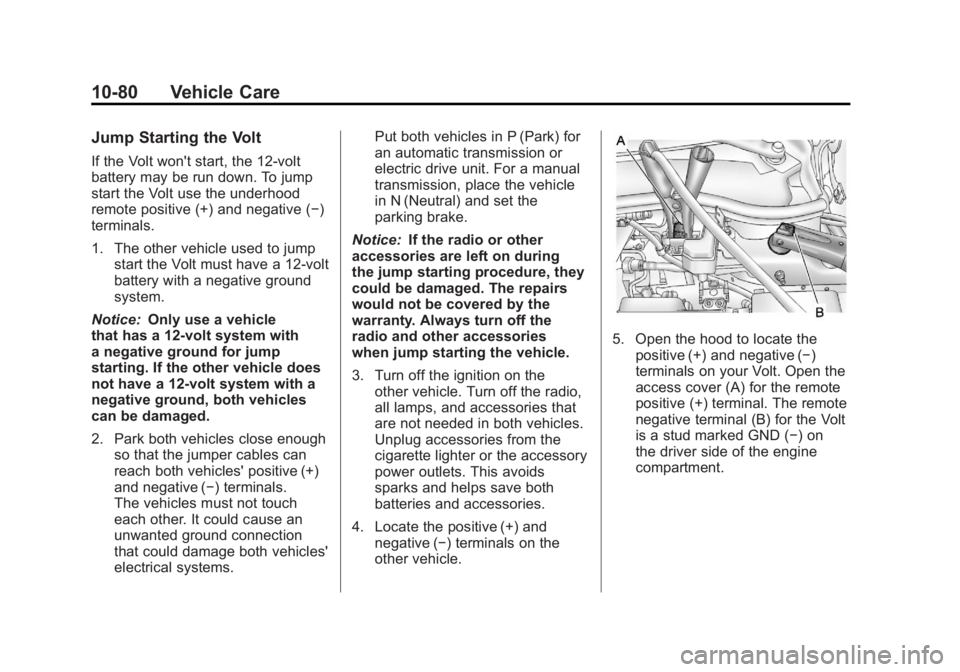
5. Open the hood to locate thepositive (+) and negative (−)
terminals on your Volt. Open the
access cover (A) for the remote
positive (+) terminal. The remote
negative terminal (B) for the Volt
is a stud marked GND (−) on
the driver side of the engine
compartment.
Page 448 of 516
Black plate (82,1)Chevrolet Volt Owner Manual - 2011
10-82 Vehicle Care
Disconnecting the Jumper Cables
1. Disconnect the blacknegative (−) jumper cable
from the Volt. Do not let the
other end of the cable touch
anything until after the next step.
2. Disconnect the black negative (−) jumper cable
from the other vehicle with
the good battery.
3. Disconnect the red positive (+) jumper cable from the other
vehicle. Do not let the other
end of the cable touch anything
until after the next step.
4. Disconnect the red positive (+) jumper cable from the Volt.
5. Return the positive (+) and negative (−) terminal covers
to their original positions.Jump Starting Another Vehicle
When using the Volt to jump
start another vehicle with a
run‐down battery, jumper cables
are connected directly to the
positive (+) and negative (−)
terminals on the 12‐volt battery in
the rear cargo area. Do not use the
remote terminals under the hood.
This could cause a fuse to overload
in the Volt.
1. Check the other vehicle. It must
have a 12‐volt battery with a
negative ground system.
Notice: Only use a vehicle
that has a 12-volt system with
a negative ground for jump
starting. If the other vehicle does
not have a 12-volt system with a
negative ground, both vehicles
can be damaged.
2. Park both vehicles close enough so that the jumper cables can
reach both vehicles' positive (+)
and negative (−) terminals.
The vehicles must not touch
each other. It could cause an unwanted ground connection
that could damage both vehicles'
electrical systems.
Put both vehicles in P (Park) for
an automatic transmission or
electric drive unit. For a manual
transmission, place the vehicle
in N (Neutral) and set the
parking brake.
Notice: If the radio or other
accessories are left on during
the jump starting procedure, they
could be damaged. The repairs
would not be covered by the
warranty. Always turn off the
radio and other accessories
when jump starting the vehicle.
3. Turn off both vehicles. Turn off the radio, all lamps,
and accessories that are not
needed in both vehicles. Unplug
accessories from the cigarette
lighter or the accessory power
outlets. This avoids sparks and
helps save both batteries and
accessories.
Page 454 of 516
Black plate (88,1)Chevrolet Volt Owner Manual - 2011
10-88 Vehicle Care
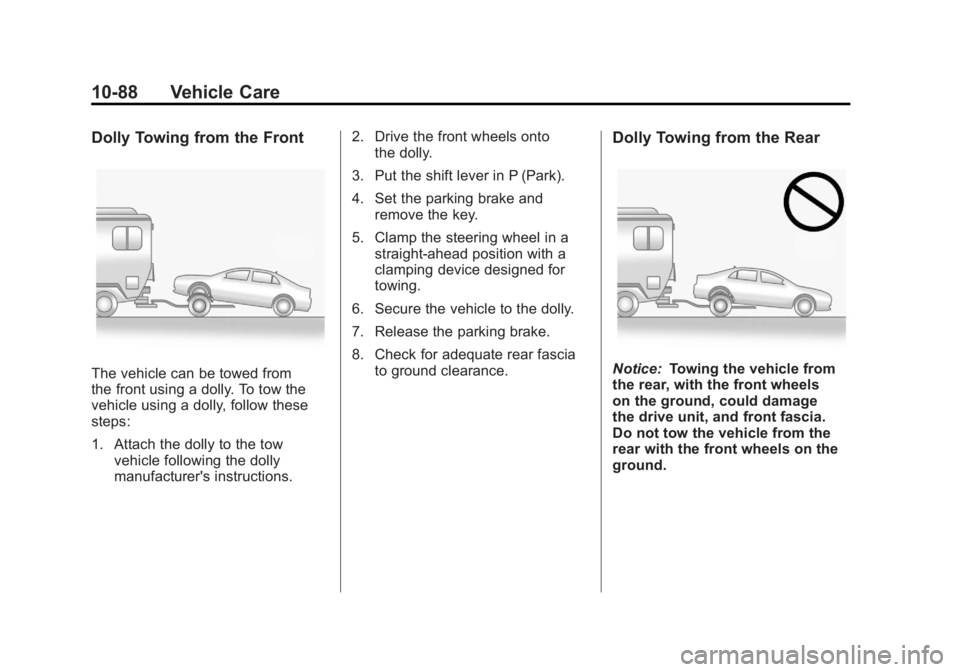
Dolly Towing from the Front
The vehicle can be towed from
the front using a dolly. To tow the
vehicle using a dolly, follow these
steps:
1. Attach the dolly to the towvehicle following the dolly
manufacturer's instructions. 2. Drive the front wheels onto
the dolly.
3. Put the shift lever in P (Park).
4. Set the parking brake and remove the key.
5. Clamp the steering wheel in a straight-ahead position with a
clamping device designed for
towing.
6. Secure the vehicle to the dolly.
7. Release the parking brake.
8. Check for adequate rear fascia to ground clearance.
Dolly Towing from the Rear
Notice: Towing the vehicle from
the rear, with the front wheels
on the ground, could damage
the drive unit, and front fascia.
Do not tow the vehicle from the
rear with the front wheels on the
ground.