brake CHEVROLET VOLT 2011 Workshop Manual
[x] Cancel search | Manufacturer: CHEVROLET, Model Year: 2011, Model line: VOLT, Model: CHEVROLET VOLT 2011Pages: 516, PDF Size: 6.61 MB
Page 371 of 516

Black plate (5,1)Chevrolet Volt Owner Manual - 2011
Vehicle Care 10-5
Lifting the Vehicle
This vehicle can be lifted with a
hoist or a service jack. Do not use
any other type of jack to lift the
vehicle.
Lifting the Vehicle with a Hoist
This vehicle can be lifted with
a hoist at the four locations,
as illustrated.
Notice:Lifting the vehicle
improperly can damage the
vehicle and result in costly
repairs not covered by the
warranty.
The front lifting points can be
accessed from either side of the
vehicle, behind the front tires.
The rear lifting points can be
accessed from either side of the
vehicle, in front of the rear tires. Lifting the Vehicle with a
Service Jack
{WARNING
Lifting a vehicle can cause
an injury. The vehicle can slip
off the jack and roll over you or
other people. You and they could
be badly injured. Find a level
place to lift your vehicle. To help
prevent the vehicle from moving:
1. Set the parking brake firmly.
2. Put the shift lever in P (Park).
3. Turn off the vehicle.
To be even more certain the
vehicle will not move, put blocks
in front of and behind the wheels.
Page 377 of 516
Black plate (11,1)Chevrolet Volt Owner Manual - 2011
Vehicle Care 10-11
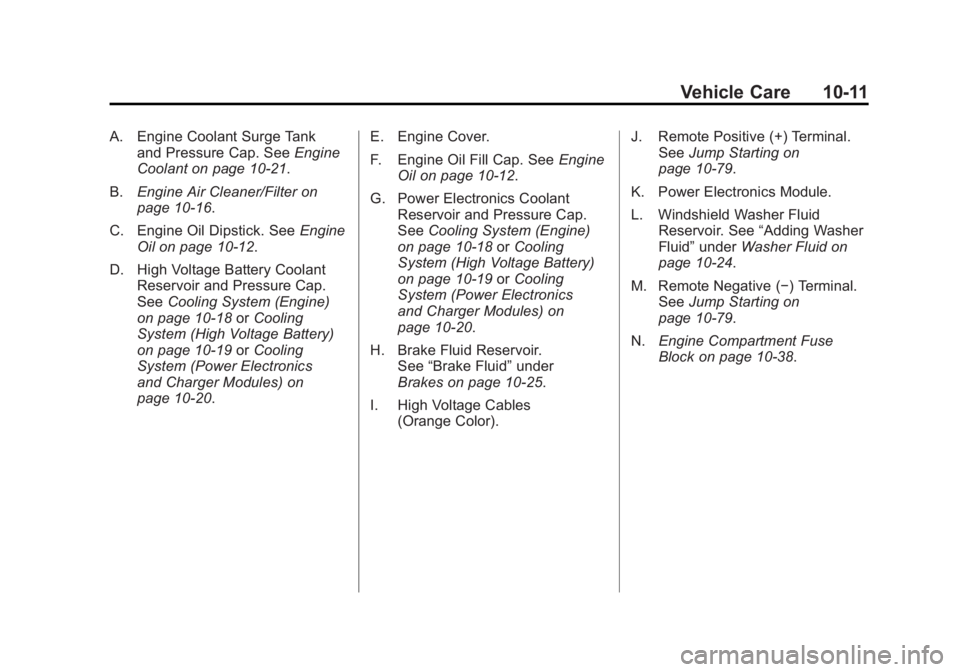
A. Engine Coolant Surge Tankand Pressure Cap. See Engine
Coolant on page 10‑21.
B. Engine Air Cleaner/Filter on
page 10‑16.
C. Engine Oil Dipstick. See Engine
Oil on page 10‑12.
D. High Voltage Battery Coolant Reservoir and Pressure Cap.
See Cooling System (Engine)
on page 10‑18 orCooling
System (High Voltage Battery)
on page 10‑19 orCooling
System (Power Electronics
and Charger Modules) on
page 10‑20. E. Engine Cover.
F. Engine Oil Fill Cap. See
Engine
Oil on page 10‑12.
G. Power Electronics Coolant Reservoir and Pressure Cap.
See Cooling System (Engine)
on page 10‑18 orCooling
System (High Voltage Battery)
on page 10‑19 orCooling
System (Power Electronics
and Charger Modules) on
page 10‑20.
H. Brake Fluid Reservoir. See “Brake Fluid” under
Brakes on page 10‑25.
I. High Voltage Cables (Orange Color). J. Remote Positive (+) Terminal.
See Jump Starting on
page 10‑79.
K. Power Electronics Module.
L. Windshield Washer Fluid Reservoir. See “Adding Washer
Fluid” under Washer Fluid on
page 10‑24.
M. Remote Negative (−) Terminal. See Jump Starting on
page 10‑79.
N. Engine Compartment Fuse
Block on page 10‑38.
Page 391 of 516
Black plate (25,1)Chevrolet Volt Owner Manual - 2011
Vehicle Care 10-25
Brakes
This vehicle has disc brakes.
Disc brake pads have built-in wear
indicators that make a high-pitched
warning sound when the brake pads
are worn and new pads are needed.
The sound can come and go or be
heard all the time the vehicle is
moving, except when applying
the brake pedal firmly.
{WARNING
The brake wear warning sound
means that soon the brakes will
not work well. That could lead to
a crash. When the brake wear
warning sound is heard, have
the vehicle serviced.
Notice: Continuing to drive with
worn-out brake pads could result
in costly brake repair. Some driving conditions or climates
can cause a brake squeal when
the brakes are first applied or
lightly applied. This does not mean
something is wrong with the brakes.
Properly torqued wheel nuts are
necessary to help prevent brake
pulsation. When tires are rotated,
inspect brake pads for wear and
evenly tighten wheel nuts in
the proper sequence to torque
specifications in
Capacities and
Specifications on page 12‑2.
Brake linings should always be
replaced as complete axle sets.
Brake Pedal Travel
See your dealer if the brake pedal
does not return to normal height,
or if there is a rapid increase
in pedal travel. This could be
a sign that brake service might
be required.
Brake Adjustment
Every time the brakes are applied,
with or without the vehicle moving,
the brakes adjust for wear.
Replacing Brake System Parts
The braking system on a vehicle is
complex. Its many parts have to be
of top quality and work well together
if the vehicle is to have really good
braking. The vehicle was designed
and tested with top-quality brake
parts. When parts of the braking
system are replaced, be sure to get
new, approved replacement parts.
If this is not done, the brakes might
not work properly. For example,
installing disc brake pads that are
wrong for the vehicle, can change
the balance between the front
and rear brakes —for the worse.
The braking performance expected
can change in many other ways if
the wrong replacement brake parts
are installed.
Page 392 of 516
Black plate (26,1)Chevrolet Volt Owner Manual - 2011
10-26 Vehicle Care
Brake Fluid
The brake master cylinder reservoir
is filled with DOT 3 brake fluid as
indicated on the reservoir cap.
SeeEngine Compartment Overview
on page 10‑10 for the location of the
reservoir. There are only two reasons why
the brake fluid level in the reservoir
might go down:
.The brake fluid level goes down
because of normal brake lining
wear. When new linings are
installed, the fluid level goes
back up.
.A fluid leak in the brake
hydraulic system can also
cause a low fluid level. Have
the brake hydraulic system fixed,
since a leak means that sooner
or later the brakes will not
work well.
Do not top off the brake fluid.
Adding fluid does not correct a
leak. If fluid is added when the
linings are worn, there will be too
much fluid when new brake linings
are installed. Add or remove brake
fluid, as necessary, only when work
is done on the brake hydraulic
system.
{WARNING
If too much brake fluid is added,
it can spill on the engine
and burn, if the engine is hot
enough. You or others could be
burned, and the vehicle could be
damaged. Add brake fluid only
when work is done on the brake
hydraulic system.
When the brake fluid falls to a low
level, the brake warning light comes
on. See Brake System Warning
Light on page 5‑24.
Page 393 of 516
Black plate (27,1)Chevrolet Volt Owner Manual - 2011
Vehicle Care 10-27
Checking Brake Fluid
Check brake fluid by looking at the
brake fluid reservoir. SeeEngine
Compartment Overview on
page 10‑10.
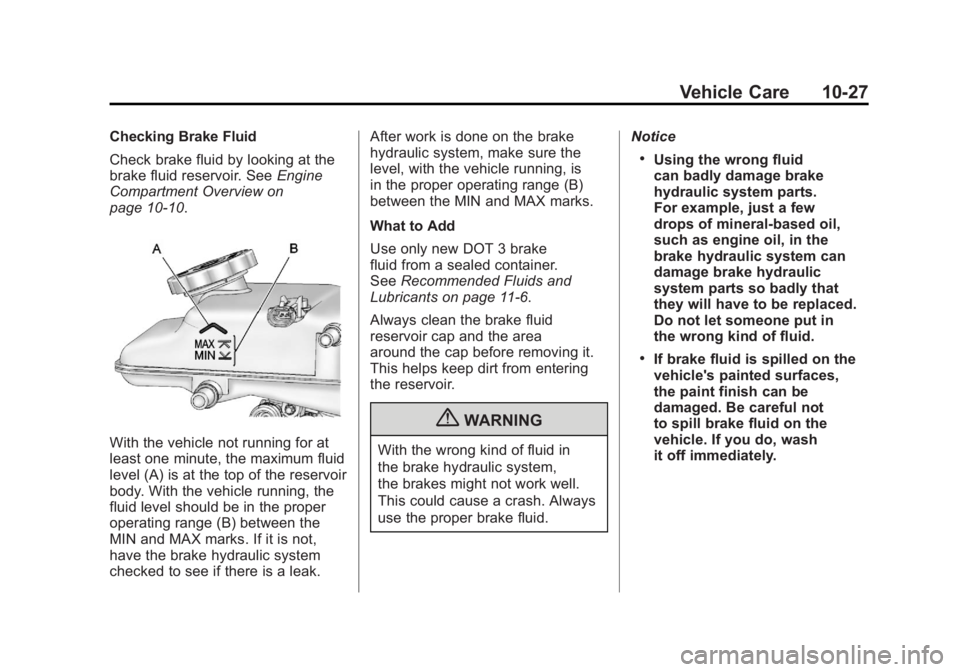
With the vehicle not running for at
least one minute, the maximum fluid
level (A) is at the top of the reservoir
body. With the vehicle running, the
fluid level should be in the proper
operating range (B) between the
MIN and MAX marks. If it is not,
have the brake hydraulic system
checked to see if there is a leak. After work is done on the brake
hydraulic system, make sure the
level, with the vehicle running, is
in the proper operating range (B)
between the MIN and MAX marks.
What to Add
Use only new DOT 3 brake
fluid from a sealed container.
See
Recommended Fluids and
Lubricants on page 11‑6.
Always clean the brake fluid
reservoir cap and the area
around the cap before removing it.
This helps keep dirt from entering
the reservoir.
{WARNING
With the wrong kind of fluid in
the brake hydraulic system,
the brakes might not work well.
This could cause a crash. Always
use the proper brake fluid. Notice
.Using the wrong fluid
can badly damage brake
hydraulic system parts.
For example, just a few
drops of mineral-based oil,
such as engine oil, in the
brake hydraulic system can
damage brake hydraulic
system parts so badly that
they will have to be replaced.
Do not let someone put in
the wrong kind of fluid.
.If brake fluid is spilled on the
vehicle's painted surfaces,
the paint finish can be
damaged. Be careful not
to spill brake fluid on the
vehicle. If you do, wash
it off immediately.
Page 395 of 516
Black plate (29,1)Chevrolet Volt Owner Manual - 2011
Vehicle Care 10-29
Extended Storage
Remove the 12‐volt battery black,
negative (−) cable from the battery
to keep the 12‐volt battery from
running down or use a battery
trickle charger.
In addition, to avoid potential
damage to the high voltage battery,
perform the following recommended
steps:
.Store the high voltage battery
with 1/2 charge or less.
.Always store the vehicle in an
environment between−10°C
(14°F) and 30°C (86°F).
.Vehicle storage at extreme
temperatures can cause damage
to the high voltage battery.
Remember to reconnect the 12‐volt
battery when ready to drive the
vehicle.
Propulsion System Start
Check
{WARNING
When you are doing this
inspection, the vehicle could
move suddenly. If the vehicle
moves, you or others could be
injured.
1. Before starting this check, be sure there is enough room
around the vehicle. 2. Firmly apply both the electric
parking brake and the regular
brake. See Electric Parking
Brake on page 9‑35.
Do not use the accelerator
pedal, and be ready to turn
off the propulsion system
immediately if it starts.
3. Try to start the propulsion system in each gear. The vehicle
should start only in P (Park) or
N (Neutral). If the vehicle starts
in any other position, contact
your dealer for service.
Page 396 of 516
Black plate (30,1)Chevrolet Volt Owner Manual - 2011
10-30 Vehicle Care
Electrical Drive Unit Shift
Lock Control Function
Check
{WARNING
When you are doing this
inspection, the vehicle could
move suddenly. If the vehicle
moves, you or others could be
injured.
1. Before starting this check, be sure there is enough room
around the vehicle. It should
be parked on a level surface. 2. Firmly apply the parking brake.
See Electric Parking Brake on
page 9‑35.
Be ready to apply the regular
brake immediately if the vehicle
begins to move.
3. With the vehicle off and the brake not applied, push the
power button to ON/RUN without
starting the vehicle. See Power
Button on page 9‑18. Without
applying the regular brake, try
to move the shift lever out of
P (Park) with normal effort. If the
shift lever moves out of P (Park),
contact your dealer for service.
Park Brake and P (Park)
Mechanism Check
{WARNING
When you are doing this check,
the vehicle could begin to move.
You or others could be injured
and property could be damaged.
Make sure there is room in front
of the vehicle in case it begins to
roll. Be ready to apply the regular
brake at once should the vehicle
begin to move.
Page 397 of 516
Black plate (31,1)Chevrolet Volt Owner Manual - 2011
Vehicle Care 10-31
Park on a fairly steep hill, with the
vehicle facing downhill. Keeping
your foot on the regular brake,
set the electric parking brake.
.To check the electric parking
brake's holding ability: With the
propulsion system active and the
electric drive unit in N (Neutral),
slowly remove foot pressure
from the regular brake pedal.
Do this until the vehicle is
held by the electric parking
brake only.
.To check the P (Park)
mechanism's holding ability:
With the propulsion system
active, shift to P (Park).
Then release the electric
parking brake followed by
the regular brake.
Contact your dealer if service is
required.
Wiper Blade Replacement
Windshield wiper blades should be
inspected for wear and cracking.
See Scheduled Maintenance on
page 11‑2 for more information.
Replacement blades come in
different types and are removed
in different ways. For proper type
and length, see Maintenance
Replacement Parts on page 11‑7.
Notice: Allowing the wiper blade
arm to touch the windshield
when no wiper blade is installed
could damage the windshield.
Any damage that occurs would
not be covered by your warranty.
Do not allow the wiper blade arm
to touch the windshield.
To replace the windshield wiper
blade:
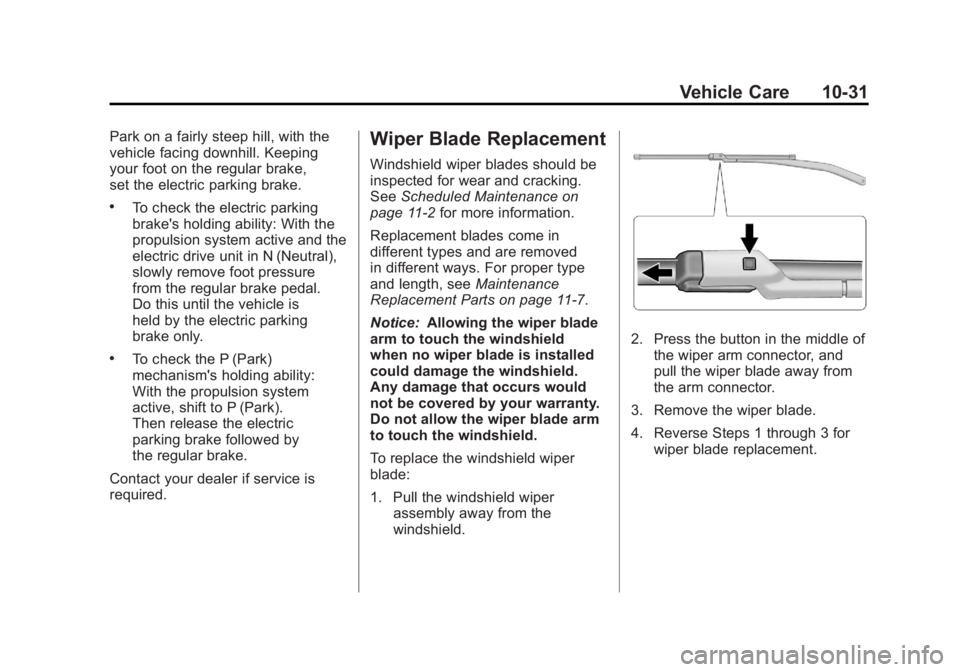
1. Pull the windshield wiper
assembly away from the
windshield.
2. Press the button in the middle ofthe wiper arm connector, and
pull the wiper blade away from
the arm connector.
3. Remove the wiper blade.
4. Reverse Steps 1 through 3 for wiper blade replacement.
Page 407 of 516

Black plate (41,1)Chevrolet Volt Owner Manual - 2011
Vehicle Care 10-41
Mini Fuses Usage53 Traction
Power Inverter
Module
–Run/Crank
54 Run/Crank for Air
Conditioning Control
Module/Instrument
Cluster/Passenger
Airbag Display/
Accessory Power
Module
J‐Case Fuses Usage
16 Empty
18 Empty
19 Power
Window
–Front
20 Empty
21 Antilock Brake
System Electronic
Control Unit J‐Case
Fuses Usage
23 Charge Port Door
27 Empty
28 Empty
29 Empty
30 Antilock Brake
System Motor
42 Cooling Fan –Right
43 Front Wipers
44 Charger
45 Empty
48 Cooling Fan –Left
Mini Relays Usage 3 Powertrain
4 Rear Defog (Lower
Grid)/Heated Mirrors
7 Empty Mini Relays Usage
9 Empty
11 Empty
12 Empty
13 Empty
14 Run/Crank
Micro
Relays Usage
1 Empty
2 Empty
6 Empty
8 Empty
10 Empty
Ultra Micro Relays Usage
5 Charge Port Door
Page 413 of 516

Black plate (47,1)Chevrolet Volt Owner Manual - 2011
Vehicle Care 10-47
FusesUsage
F10 Regulated Voltage
Control/Ultrasonic
Front and Rear
Parking Assist
(If Equipped)
F11 Horn
F12 Rear Power
Windows
F13 Electric Parking
Brake
F14 Rear Defog
(Upper Grid) Fuses
Usage
F15 Empty
F16 Hatch Release
F17 Empty
F18 Empty
Relays Usage
R1 Rear Defog
(Upper Grid)
R2 Hatch Release
R3 Empty Relays
Usage
R4 Empty
R5 Empty
R6 Empty
R7 Empty
R8 Horn
Diodes Usage DIODE Empty