battery CHEVROLET VOLT 2011 Manual PDF
[x] Cancel search | Manufacturer: CHEVROLET, Model Year: 2011, Model line: VOLT, Model: CHEVROLET VOLT 2011Pages: 516, PDF Size: 6.61 MB
Page 446 of 516
Black plate (80,1)Chevrolet Volt Owner Manual - 2011
10-80 Vehicle Care
Jump Starting the Volt
If the Volt won't start, the 12‐volt
battery may be run down. To jump
start the Volt use the underhood
remote positive (+) and negative (−)
terminals.
1. The other vehicle used to jumpstart the Volt must have a 12‐volt
battery with a negative ground
system.
Notice: Only use a vehicle
that has a 12-volt system with
a negative ground for jump
starting. If the other vehicle does
not have a 12-volt system with a
negative ground, both vehicles
can be damaged.
2. Park both vehicles close enough so that the jumper cables can
reach both vehicles' positive (+)
and negative (−) terminals.
The vehicles must not touch
each other. It could cause an
unwanted ground connection
that could damage both vehicles'
electrical systems. Put both vehicles in P (Park) for
an automatic transmission or
electric drive unit. For a manual
transmission, place the vehicle
in N (Neutral) and set the
parking brake.
Notice: If the radio or other
accessories are left on during
the jump starting procedure, they
could be damaged. The repairs
would not be covered by the
warranty. Always turn off the
radio and other accessories
when jump starting the vehicle.
3. Turn off the ignition on the other vehicle. Turn off the radio,
all lamps, and accessories that
are not needed in both vehicles.
Unplug accessories from the
cigarette lighter or the accessory
power outlets. This avoids
sparks and helps save both
batteries and accessories.
4. Locate the positive (+) and negative (−) terminals on the
other vehicle.
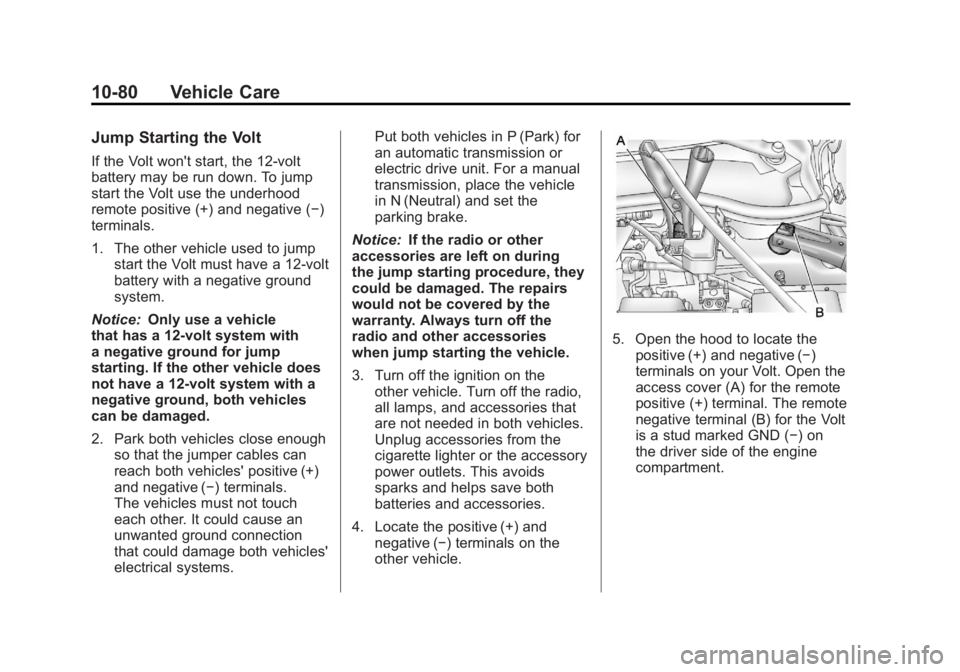
5. Open the hood to locate thepositive (+) and negative (−)
terminals on your Volt. Open the
access cover (A) for the remote
positive (+) terminal. The remote
negative terminal (B) for the Volt
is a stud marked GND (−) on
the driver side of the engine
compartment.
Page 447 of 516
Black plate (81,1)Chevrolet Volt Owner Manual - 2011
Vehicle Care 10-81
6. Check that the jumper cablesdo not have loose or missing
insulation or a shock could
result and the vehicles could
be damaged.
Before connecting the jumper
cables, here are some basic
things to know. Positive (+)
jumper cable goes to positive (+)
battery terminal or a remote
positive (+) terminal if available.
Negative (−) jumper cable goes
to negative (−) battery terminal
or a remote negative (−) terminal
if available. Do not connect
positive (+) to negative (−) or
there will be a short that may
damage the battery and other
parts of the vehicle. Notice:
If the jumper cables
are connected or removed in
the wrong order, electrical
shorting may occur and damage
the vehicle. The repairs would
not be covered by the vehicle
warranty. Always connect and
remove the jumper cables in the
correct order, making sure that
the cables do not touch each
other or other metal.
Connecting the Jumper Cables
1. Connect the red positive (+) jumper cable to the remote
positive (+) terminal (A) of your
Volt. Do not let the other end
of the cable touch metal.
2. Connect the other end of the red positive (+) jumper cable to the
positive (+) terminal of the other
vehicle. 3. Connect the black negative (−)
jumper cable to the negative (−)
battery terminal of the other
vehicle battery. Do not let the
other end touch anything until
the next step.
4. Connect the other end of the black negative (−) jumper cable
to the remote negative (−)
terminal of your Volt.
5. Push the POWER
Obutton
to start. This will wake up the
electronics on the Volt. After the
instrument cluster initializes,
the Volt will use power from
the high voltage battery to
charge the 12‐volt battery.
The jumper cables can then
be disconnected. If the Volt
does not start, call your dealer
or Roadside Assistance.
See Roadside Assistance
Program on page 13‑6.
Page 448 of 516
Black plate (82,1)Chevrolet Volt Owner Manual - 2011
10-82 Vehicle Care
Disconnecting the Jumper Cables
1. Disconnect the blacknegative (−) jumper cable
from the Volt. Do not let the
other end of the cable touch
anything until after the next step.
2. Disconnect the black negative (−) jumper cable
from the other vehicle with
the good battery.
3. Disconnect the red positive (+) jumper cable from the other
vehicle. Do not let the other
end of the cable touch anything
until after the next step.
4. Disconnect the red positive (+) jumper cable from the Volt.
5. Return the positive (+) and negative (−) terminal covers
to their original positions.Jump Starting Another Vehicle
When using the Volt to jump
start another vehicle with a
run‐down battery, jumper cables
are connected directly to the
positive (+) and negative (−)
terminals on the 12‐volt battery in
the rear cargo area. Do not use the
remote terminals under the hood.
This could cause a fuse to overload
in the Volt.
1. Check the other vehicle. It must
have a 12‐volt battery with a
negative ground system.
Notice: Only use a vehicle
that has a 12-volt system with
a negative ground for jump
starting. If the other vehicle does
not have a 12-volt system with a
negative ground, both vehicles
can be damaged.
2. Park both vehicles close enough so that the jumper cables can
reach both vehicles' positive (+)
and negative (−) terminals.
The vehicles must not touch
each other. It could cause an unwanted ground connection
that could damage both vehicles'
electrical systems.
Put both vehicles in P (Park) for
an automatic transmission or
electric drive unit. For a manual
transmission, place the vehicle
in N (Neutral) and set the
parking brake.
Notice: If the radio or other
accessories are left on during
the jump starting procedure, they
could be damaged. The repairs
would not be covered by the
warranty. Always turn off the
radio and other accessories
when jump starting the vehicle.
3. Turn off both vehicles. Turn off the radio, all lamps,
and accessories that are not
needed in both vehicles. Unplug
accessories from the cigarette
lighter or the accessory power
outlets. This avoids sparks and
helps save both batteries and
accessories.
Page 449 of 516
Black plate (83,1)Chevrolet Volt Owner Manual - 2011
Vehicle Care 10-83
4. Locate the positive (+) andnegative (−) terminals on the
vehicle with the run‐down
battery.
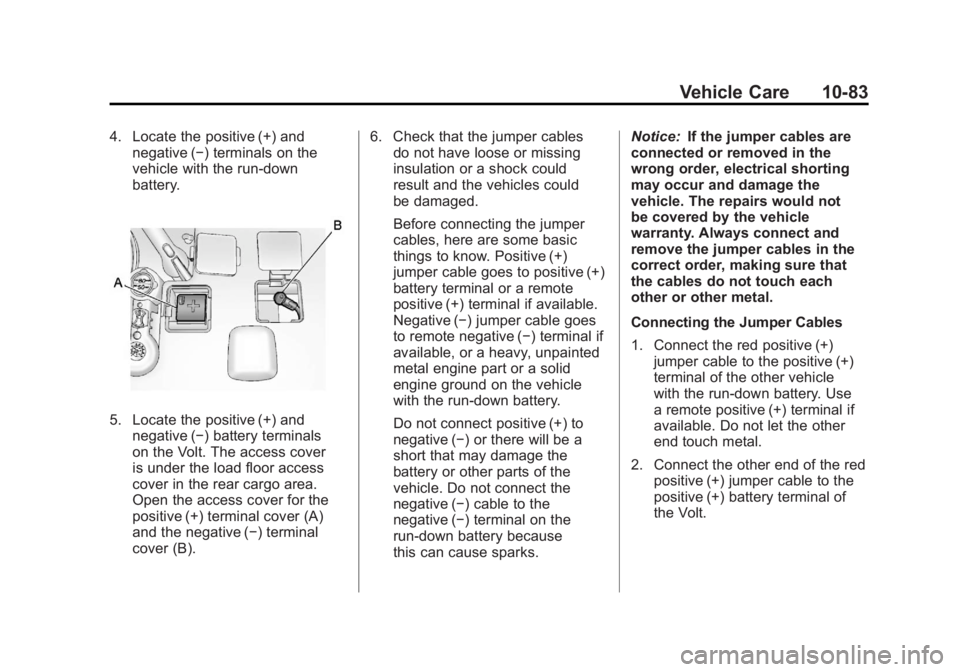
5. Locate the positive (+) and
negative (−) battery terminals
on the Volt. The access cover
is under the load floor access
cover in the rear cargo area.
Open the access cover for the
positive (+) terminal cover (A)
and the negative (−) terminal
cover (B). 6. Check that the jumper cables
do not have loose or missing
insulation or a shock could
result and the vehicles could
be damaged.
Before connecting the jumper
cables, here are some basic
things to know. Positive (+)
jumper cable goes to positive (+)
battery terminal or a remote
positive (+) terminal if available.
Negative (−) jumper cable goes
to remote negative (−) terminal if
available, or a heavy, unpainted
metal engine part or a solid
engine ground on the vehicle
with the run‐down battery.
Do not connect positive (+) to
negative (−) or there will be a
short that may damage the
battery or other parts of the
vehicle. Do not connect the
negative (−) cable to the
negative (−) terminal on the
run‐down battery because
this can cause sparks. Notice:
If the jumper cables are
connected or removed in the
wrong order, electrical shorting
may occur and damage the
vehicle. The repairs would not
be covered by the vehicle
warranty. Always connect and
remove the jumper cables in the
correct order, making sure that
the cables do not touch each
other or other metal.
Connecting the Jumper Cables
1. Connect the red positive (+) jumper cable to the positive (+)
terminal of the other vehicle
with the run‐down battery. Use
a remote positive (+) terminal if
available. Do not let the other
end touch metal.
2. Connect the other end of the red positive (+) jumper cable to the
positive (+) battery terminal of
the Volt.
Page 450 of 516
Black plate (84,1)Chevrolet Volt Owner Manual - 2011
10-84 Vehicle Care
3. Connect the black negative (−)jumper cable to the negative (−)
battery terminal of the Volt.
Do not let the other end touch
anything until the next step.
4. Make the final connection to a heavy, unpainted metal engine
part or to the remote negative (−)
terminal on the other vehicle
with the run‐down battery.
5. Press the POWER
Obutton
to start the Volt. This will wake
up the electronics on the Volt.
The engine will only start if it is
needed.
6. Try to start the other vehicle that had the run‐down battery.
If it will not start after a few tries,
it probably needs service. Disconnecting the Jumper Cables
1. Disconnect the black
negative (−) jumper cable
from the other vehicle that had
the run‐down battery. Do not let
the other end of the cable touch
anything until after the next step.
2. Disconnect the black negative (−) jumper cable
from the Volt.
3. Disconnect the red positive (+) jumper cable from the Volt.
Do not let the other end of the
cable touch anything until after
the next step.
4. Disconnect the red positive (+) jumper cable from the other
vehicle.
5. Return the positive (+) and negative (−) terminal covers
to their original positions.
Towing
Towing the Vehicle
Notice: Incorrectly towing
a disabled vehicle may
cause damage to the vehicle.
The disabled vehicle should be
towed on a flatbed car carrier.
Use care when there is low
ground clearance and/or
special equipment.
Attempting to pull the vehicle
onto a flatbed without following
the proper steps could damage
the vehicle.
Consult your dealer or a
professional towing service if the
disabled vehicle must be towed.
See Roadside Assistance Program
on page 13‑6.
Page 464 of 516
Black plate (2,1)Chevrolet Volt Owner Manual - 2011
11-2 Service and Maintenance
{WARNING
Performing maintenance work can
be dangerous. Some jobs can
cause serious injury. Perform
maintenance work only if you
have the required know-how and
the proper tools and equipment.
If in doubt, see your dealer to
have a qualified technician do
the work. SeeDoing Your Own
Service Work on page 10‑8.
At your dealer, you can be
certain that you will receive the
highest level of service available.
Your dealer has specially trained
service technicians, uses genuine
replacement parts, as well as,
up‐to‐date tools and equipment
to ensure fast and accurate
diagnostics. The proper replacement parts,
fluids, and lubricants to use are
listed in
Recommended Fluids
and Lubricants on page 11‑6 and
Maintenance Replacement Parts on
page 11‑7. We recommend the use
of genuine parts from your dealer.
Rotation of New Tires
To maintain ride, handling, and
performance of the vehicle, it is
important that the first rotation
service for new tires be performed.
Tires should be rotated every
12 000 km/7,500 mi. See Tire
Rotation on page 10‑61.
Scheduled
Maintenance
Required Services
Every Month
.Engine oil level check.
See Engine Oil on page 10‑12.
.Engine, power electronics,
and high voltage battery
pack coolant level checks.
SeeCooling System (Engine) on
page 10‑18 orCooling System
(High Voltage Battery) on
page 10‑19 orCooling System
(Power Electronics and Charger
Modules) on page 10‑20 for
more information.
.Fluids visual leak check. A leak
in any system must be repaired
and the fluid level checked.
Page 466 of 516
Black plate (4,1)Chevrolet Volt Owner Manual - 2011
11-4 Service and Maintenance
.Exhaust system and nearby heat
shields inspection for loose or
damaged components.
.SeePropulsion System Start
Check on page 10‑29.
.See Electrical Drive Unit Shift
Lock Control Function Check on
page 10‑30.
.See Park Brake and P (Park)
Mechanism Check on
page 10‑30.
.Cooling systems check.
See Cooling System (Engine) on
page 10‑18 orCooling System
(High Voltage Battery) on
page 10‑19 orCooling System
(Power Electronics and Charger
Modules) on page 10‑20.
.Accelerator pedal check for
damage, high effort, or binding.
Replace if needed.
.Check the sealant expiration
date printed on the instruction
label of the tire sealant and
compressor kit. See Tire
Sealant and Compressor
Kit on page 10‑71.
.Hood/Decklid/Liftgate Support
Gas Strut Service: Visually
inspect gas strut, if equipped, for
signs of wear, cracks, or other
damage. Check the hold open
ability of the gas strut. Contact
your dealer if service is required. Every 24 Months or When the
Change Engine Oil Soon Message
Displays
.Every 24 months or when the
CHANGE ENGINE OIL SOON
message displays, change the
engine oil and filter as soon
as possible, within the next
1 000 km/600 mi. The engine oil
and filter must be changed at
least once every 24 months.
After each oil and filter change,
the oil life system must be reset.
See
Engine Oil Life System on
page 10‑15. More frequent
changes may be required when
the vehicle is exposed to a
corrosive environment, such as
areas of high humidity, along an
ocean coast, and/or areas that
apply road salt during winter.
Page 467 of 516
Black plate (5,1)Chevrolet Volt Owner Manual - 2011
Service and Maintenance 11-5
Your dealer has trained service
technicians who will perform
this work and reset the system.
If the engine oil life system is
reset accidentally, service the
vehicle within 5 000 km/3,000 mi
since the last service. Reset the
oil life system whenever the oil is
changed.
Every 80 000 km/50,000 mi
.Engine air cleaner filter
replacement.
.Evaporative control system
inspection. Check all fuel and
vapor lines and hoses for proper
hook‐up, routing, and condition.
Check that the purge valve,
if the vehicle has one, works
properly. Replace as needed. An Emission Control Service.
The U.S. Environmental
Protection Agency or the
California Air Resources Board
has determined that the failure
to perform this maintenance
item will not nullify the emission
warranty or limit recall liability
prior to the completion of
the vehicle's useful life.
We, however, urge that all
recommended maintenance
services be performed at the
indicated intervals and the
maintenance be recorded.
Every 160 000 km/100,000 mi
.Spark plug replacement.
An Emission Control Service. Every 240 000 km/150,000 mi or
every 5 years, whichever occurs
first
.Engine cooling system drain,
flush, and refill (or every five
years, whichever occurs first).
See
Cooling System (Engine) on
page 10‑18 orCooling System
(High Voltage Battery) on
page 10‑19 orCooling System
(Power Electronics and Charger
Modules) on page 10‑20.
An Emission Control Service.
Every 240 000 km/150,000 mi or
every 10 years, whichever occurs
first
.Engine drive belt inspection
for fraying, excessive cracks,
or obvious damage. Replace,
if needed.
Every 10 Years
.Air conditioning system flush
and refill and desiccant
replacement.
Page 468 of 516
Black plate (6,1)Chevrolet Volt Owner Manual - 2011
11-6 Service and Maintenance
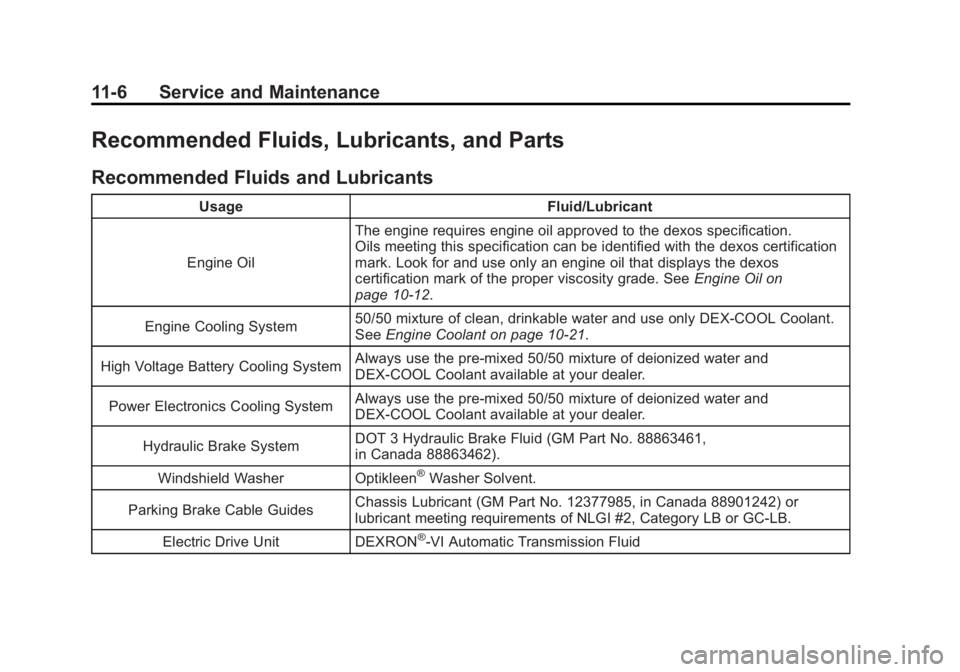
Recommended Fluids, Lubricants, and Parts
Recommended Fluids and Lubricants
UsageFluid/Lubricant
Engine Oil The engine requires engine oil approved to the dexos specification.
Oils meeting this specification can be identified with the dexos certification
mark. Look for and use only an engine oil that displays the dexos
certification mark of the proper viscosity grade. See
Engine Oil on
page 10‑12.
Engine Cooling System 50/50 mixture of clean, drinkable water and use only DEX-COOL Coolant.
See
Engine Coolant on page 10‑21.
High Voltage Battery Cooling System Always use the pre‐mixed 50/50 mixture of deionized water and
DEX-COOL Coolant available at your dealer.
Power Electronics Cooling System Always use the pre‐mixed 50/50 mixture of deionized water and
DEX-COOL Coolant available at your dealer.
Hydraulic Brake System DOT 3 Hydraulic Brake Fluid (GM Part No. 88863461,
in Canada 88863462).
Windshield Washer Optikleen
®Washer Solvent.
Parking Brake Cable Guides Chassis Lubricant (GM Part No. 12377985, in Canada 88901242) or
lubricant meeting requirements of NLGI #2, Category LB or GC‐LB.
Electric Drive Unit DEXRON
®-VI Automatic Transmission Fluid
Page 474 of 516

Black plate (2,1)Chevrolet Volt Owner Manual - 2011
12-2 Technical Data
Vehicle Data
Capacities and Specifications
The following approximate capacities are given in metric and English conversions. Refer toRecommended Fluids
and Lubricants on page 11‑6 for more information.
Application Capacities
Metric English
Air Conditioning Refrigerant R134a For the air conditioning system refrigerant charge
amount, see the refrigerant label under the hood. See your dealer for more information.
Cooling Systems Engine 6.3 L 6.7 qt
High Voltage Battery 6.0 L 6.3 qt
Power Electronics 3.0 L 3.2 qt
Engine Oil with Filter 3.5 L 3.7 qt
Fuel Tank 35.2 L 9.3 gal
Electric Drive Unit 8.45 L 8.93 qt
Wheel Nut Torque 140 Y100 lb ft
All capacities are approximate. When adding, be sure to fill to the approximate level, as recommended in this
manual.