towing CHRYSLER ASPEN 2009 2.G User Guide
[x] Cancel search | Manufacturer: CHRYSLER, Model Year: 2009, Model line: ASPEN, Model: CHRYSLER ASPEN 2009 2.GPages: 481, PDF Size: 9.28 MB
Page 283 of 481
NOTE:Towing the vehicle, coasting, or driving for any
other reason with the shift lever in NEUTRAL can result
in severe transmission damage. Refer to ªRecreational
Towingº in Section 5 and ªTowing a Disabled Vehicleº in
Section 6 of this manual.
DRIVE
For most city and highway driving.
2 (Second)
For driving slowly in heavy city traffic or on mountain
roads where more precise speed control is desirable. Use
it also when climbing long grades, and for engine brak-
ing when descending moderately steep grades. To pre-
vent excessive engine speed, do not exceed 45 mph (72
km/h) in this range.1 (First)
For driving up very steep hills and for engine braking at
low speeds (25 mph {40 km/h} or less) when going
downhill. To prevent excessive engine speed do not
exceed 25 mph (40 km/h) in this range.
Overdrive Operation
The automatic transmission contains an electronically
controlled fourth and fifth (if equipped) speed (OVER-
DRIVE). The transmission will automatically shift from
DRIVE to OVERDRIVE if the following conditions are
present:
²the transmission selector is in DRIVE;
²the engine coolant has reached normal operating tem-
perature;
STARTING AND OPERATING 281
5
Page 284 of 481
²vehicle speed is above approximately 30 mph (48
km/h);
²the TOW/HAUL switch has not been activated;
²transmission has reached normal operating
temperature.
NOTE:If the vehicle is started in extremely cold tem-
peratures, the transmission may not shift into OVER-
DRIVE and will automatically select the most desirable
gear for operation at this temperature. Normal operation
will resume when the transmission fluid temperature has
risen to a suitable level. Refer also to the Note under
torque converter clutch, later in this section.
If the transmission temperature gets extremely hot, the
transmission will automatically select the most desirable
gear for operation at this temperature. If the transmission
temperature becomes hot enough, the ªTransmission
Temperature Indicator Lightº may illuminate and thetransmission may downshift out of OVERDRIVE until
the transmission cools down. After cooldown, the trans-
mission will resume normal operation.
The transmission will downshift from OVERDRIVE to
DRIVE if the accelerator pedal is fully depressed at
vehicle speeds above approximately 35 mph (56 km/h).
When To Use TOW/HAUL Mode
When driving in hilly areas, towing a trailer, carrying a
heavy load, etc., and frequent transmission shifting oc-
curs, press the TOW/HAUL button. This will improve
performance and reduce the potential for transmission
overheating or failure due to excessive shifting. When
operating in TOW/HAUL mode, 5th gear (if equipped) is
disabled and 2-3 and 3-4 shift patterns are modified.
Shifts into OVERDRIVE (4th gear) are allowed during
steady cruise (for improved fuel economy) and automatic
closed-throttle downshifts to 3rd gear (for improved
braking) will occur during steady braking.
282 STARTING AND OPERATING
Page 288 of 481
NOTE:The transfer case NEUTRAL position is to be
used for recreational towing only. Refer to ªRecreational
Towingº in this section for specific procedures on shifting
into and out of NEUTRAL.
Transfer Case Position Indicator Lights
Transfer case position indicator lights are located on the
instrument cluster. If there are no indicator lights on or
flashing, the transfer case position is four-wheel drive
(4WD) and indicates the current and desired transfer case
selection (4WD,4WD LOCK).
The ªSVC 4WD Warning Lightº monitors the electric
shift 4WD system. If this light remains on after engine
start up or illuminates during driving, it means that the
4WD system is not functioning properly and that service
is required. See your authorized dealer for service.
WARNING!
Always engage the parking brake when powering
down the vehicle if the(SVC 4WD Warning Lightº is
illuminated. Not engaging the parking brake may
allow the vehicle to roll, which may cause personal
injury.
NOTE:Do not attempt to make a shift while only the
front or rear wheels are spinning. The NV 244 Generation
II transfer case is not equipped with a synchronizer and
therefore the front and rear driveshaft speeds must be
equal for the shift to take place. Shifting while only the
front or rear wheels are spinning can cause damage to the
transfer case.
286 STARTING AND OPERATING
Page 290 of 481
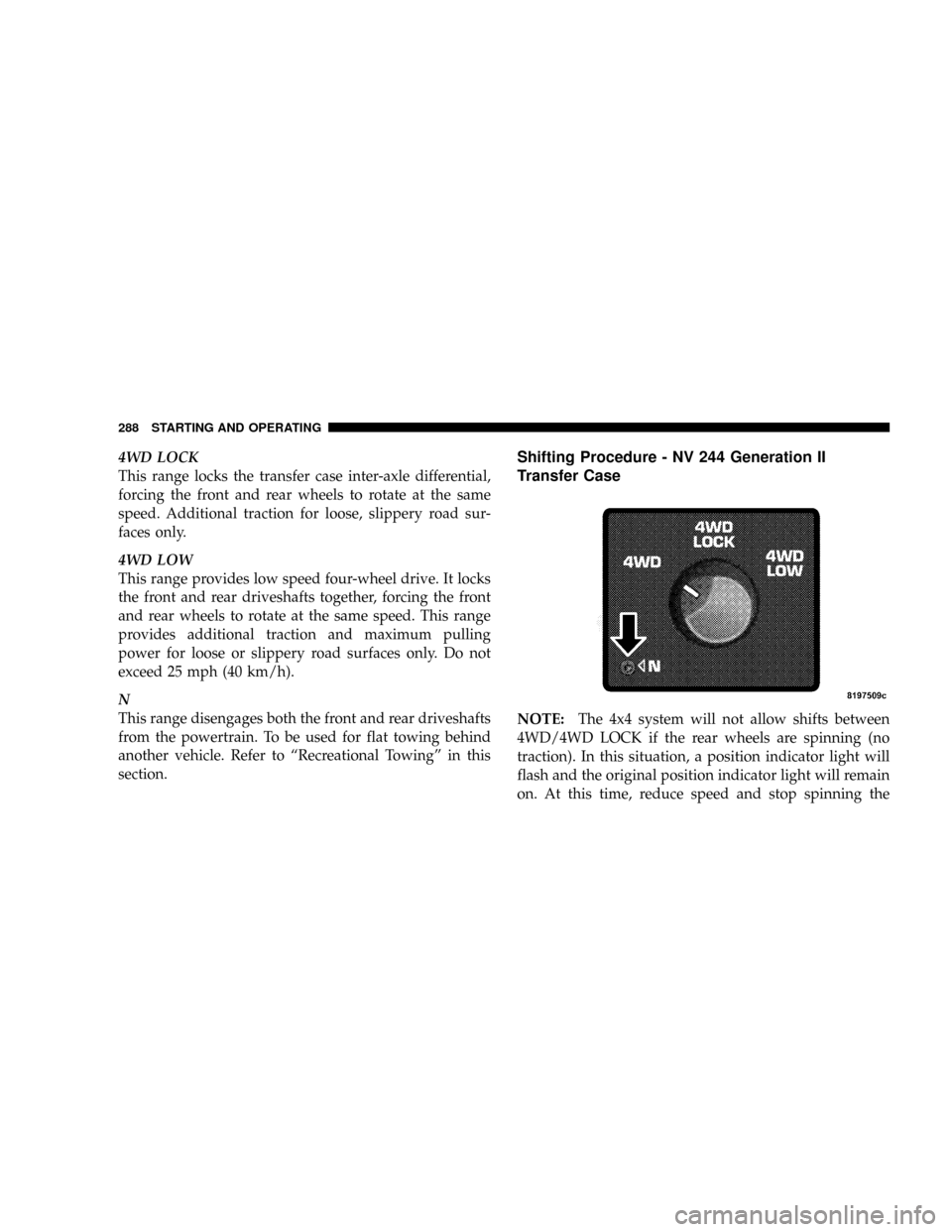
4WD LOCK
This range locks the transfer case inter-axle differential,
forcing the front and rear wheels to rotate at the same
speed. Additional traction for loose, slippery road sur-
faces only.
4WD LOW
This range provides low speed four-wheel drive. It locks
the front and rear driveshafts together, forcing the front
and rear wheels to rotate at the same speed. This range
provides additional traction and maximum pulling
power for loose or slippery road surfaces only. Do not
exceed 25 mph (40 km/h).
N
This range disengages both the front and rear driveshafts
from the powertrain. To be used for flat towing behind
another vehicle. Refer to ªRecreational Towingº in this
section.Shifting Procedure - NV 244 Generation II
Transfer Case
NOTE:The 4x4 system will not allow shifts between
4WD/4WD LOCK if the rear wheels are spinning (no
traction). In this situation, a position indicator light will
flash and the original position indicator light will remain
on. At this time, reduce speed and stop spinning the
288 STARTING AND OPERATING
Page 308 of 481
NOTE:When the vehicle is in 4WD LOW, a feature of
the ESP system remains active whether the ESP is on or
off. This feature functions similar to a limited slip differ-
ential and controls the wheel spin across an axle. If one
wheel on an axle is spinning faster than the other, the
system will apply the brake of the spinning wheel and
allow more engine torque to be applied to the wheel that
is not spinning.
WARNING!
In the Partial Off mode, the engine torque reduction
and stability features are desensitized. Therefore, the
enhanced vehicle stability offered by ESP is
unavailable.
Trailer Sway Control (TSC)
TSC uses sensors in the vehicle to recognize a swaying
trailer and will take the appropriate actions to attempt to
stop the sway. The system will reduce engine power andapply individual brakes that will counter act the sway of
the trailer. TSC will become active automatically once the
swaying trailer is recognized. No driver action is re-
quired. TSC cannot stop all trailers from swaying. Al-
ways use caution when towing a trailer and follow the
tongue weight recommendations. For additional infor-
mation on towing a trailer with your vehicle, refer to
9Trailer Towing9in Section 5.
ESP/BAS Warning Light and ESP/TCS Indicator
Light
The malfunction indicator for the ESP is combined with
the BAS indicator. The yellow ESP/BAS Warning Light
and the yellow ESP/TCS Indicator Light in the instru-
ment cluster both come on when the ignition switch is
turned to the ON position. They should both go out with
the engine running. If the ESP/BAS Warning Light comes
on continuously with the engine running, a malfunction
has been detected in either the ESP or BAS system, or
both. If this light remains on after several ignition cycles,
306 STARTING AND OPERATING
Page 315 of 481
NOTE:Under a maximum loaded vehicle condition,
gross axle weight ratings (GAWRs) for the front and rear
axles must not be exceeded. For further information on
GAWRs, vehicle loading, and trailer towing, refer to
ªVehicle Loadingº in this section.
To determine the maximum loading conditions of your
vehicle, locate the statement ªThe combined weight of
occupants and cargo should never exceed XXX kg or XXX
lbs.º on the Tire and Loading Information placard. The
combined weight of occupants, cargo/luggage and
trailer tongue weight (if applicable) should never exceed
the weight referenced here.
Steps for Determining Correct Load Limit
1. Locate the statement ªThe combined weight of occu-
pants and cargo should never exceed XXX kg or XXX lbsº
on your vehicle's placard.2. Determine the combined weight of the driver and
passengers that will be riding in your vehicle.
3. Subtract the combined weight of the driver and pas-
sengers from XXX kg or XXX lbs.
4. The resulting figure equals the available amount of
cargo and luggage load capacity. For example, if ªXXXº
amount equals 1,400 lbs (635 kg) and there will be five
150 lb (68 kg) passengers in your vehicle, the amount of
available cargo and luggage load capacity is 650 lbs (295
kg) (since 5 x 150 = 750, and 1400 ± 750 = 650 lbs [295 kg]).
5. Determine the combined weight of luggage and cargo
being loaded on the vehicle. That weight may not safely
exceed the available cargo and luggage load capacity
calculated in Step 4.
STARTING AND OPERATING 313
5
Page 316 of 481
6. If your vehicle will be towing a trailer, load from your
trailer will be transferred to your vehicle. Consult this
manual to determine how this reduces the available
cargo and luggage load capacity of your vehicle.
NOTE:The following table shows examples on how to
calculate total load, cargo/luggage, and towing capaci-
ties of your vehicle with varying seating configurationsand number and size of occupants. This table is for
illustration purposes only and may not be accurate for
the seating and load carry capacity of your vehicle.
NOTE:For the following example, the combined weight
of occupants and cargo should never exceed 865 lbs (392
kg).
314 STARTING AND OPERATING
Page 351 of 481
WARNING!
Do not load your vehicle any heavier than the GVWR
or the maximum front and rear GAWR. If you do,
parts on your vehicle can break, or it can change the
way your vehicle handles. This could cause you to
lose control. Also, overloading can shorten the life of
your vehicle.
TRAILER TOWING
In this section you will find safety tips and information
on limits to the type of towing you can reasonably do
with your vehicle. Before towing a trailer carefully re-
view this information to tow your load as efficiently and
safely as possible.
To maintain warranty coverage, follow the requirements
and recommendations in this manual concerning ve-
hicles used for trailer towing.
Common Towing Definitions
The following trailer towing related definitions will assist
you in understanding the following information:
Gross Vehicle Weight Rating (GVWR)
The GVWR is the total allowable weight of your vehicle.
This includes driver, passengers, cargo and tongue
weight. The total load must be limited so that you do not
exceed the GVWR.
Gross Trailer Weight (GTW)
The GTW is the weight of the trailer plus the weight of all
cargo, consumables and equipment (permanent or tem-
porary) loaded in or on the trailer in its9loaded and
ready for operation9condition. The recommended way to
measure GTW is to put your fully loaded trailer on a
vehicle scale. The entire weight of the trailer must be
supported by the scale.
STARTING AND OPERATING 349
5
Page 353 of 481
Weight-Distributing Hitch
A weight-distributing hitch works by applying leverage
through spring (load) bars. They are typically used for
heavier loads, to distribute trailer tongue weight to the
tow vehicle's front axle and the trailer axle(s). When used
in accordance with the manufacturers' directions, it pro-
vides for a more level ride, offering more consistent
steering and brake control thereby enhancing towing
safety. The addition of a friction/hydraulic sway control
also dampens sway caused by traffic and crosswinds and
contributes positively to tow vehicle and trailer stability.
Trailer sway control and a weight distributing (load
equalizing) hitch are recommended for heavier tongue
weights and may be required depending on vehicle and
trailer configuration/loading to comply with Gross Axle
Weight Rating (GAWR) requirements.WARNING!
An improperly adjusted weight-distributing hitch
may reduce handling, stability, and braking perfor-
mance, and could result in an accident.
Weight-Distributing Systems may not be compatible
with surge brake couplers. Consult with your hitch
and trailer manufacturer or a reputable recreational
vehicle dealer for additional information.
STARTING AND OPERATING 351
5
Page 355 of 481
Trailer Hitch Classification
The rear bumper is intended to tow trailers up to 2,000
lbs (907 kg) without added equipment or alterations to
the standard equipment. Your vehicle may be factory
equipped for safe towing of trailers weighing over 2,000
lbs (907 kg) with the optional Trailer Tow Prep Package.
See your authorized dealer for package content.
The following chart provides the industry standard for
the maximum trailer weight a given trailer hitch class can
tow and should be used to assist you in selecting the
correct trailer hitch for your intended towing condition.
Refer to ªTrailer Towing Weights (Maximum Trailer
Weight Ratings)º for the website address that contains
the necessary information for your specific drivetrain.
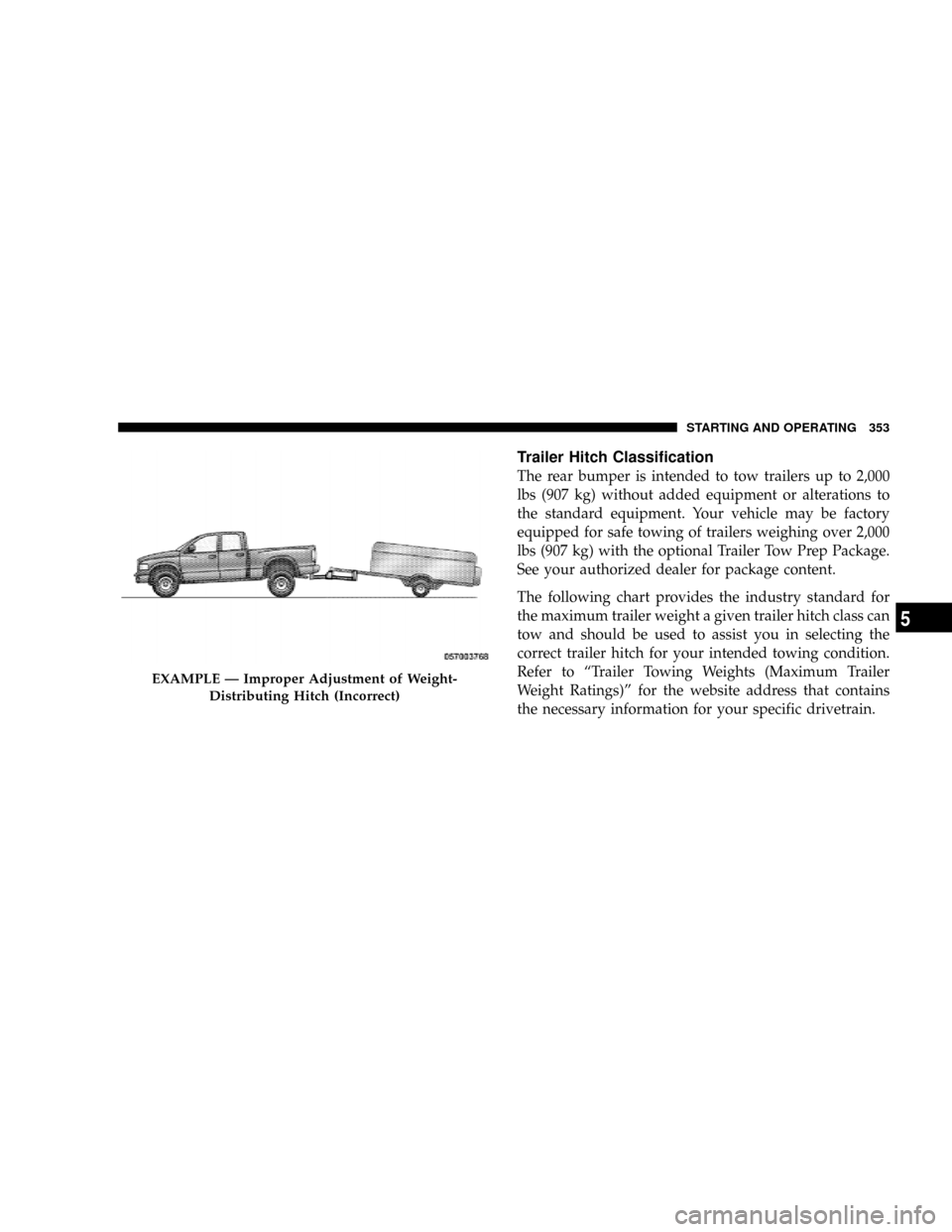
EXAMPLE Ð Improper Adjustment of Weight-
Distributing Hitch (Incorrect)
STARTING AND OPERATING 353
5