ignition CHRYSLER ASPEN 2009 2.G Owner's Manual
[x] Cancel search | Manufacturer: CHRYSLER, Model Year: 2009, Model line: ASPEN, Model: CHRYSLER ASPEN 2009 2.GPages: 481, PDF Size: 9.28 MB
Page 50 of 481
How To Use The Automatic Locking Mode
1. Buckle the combination lap/shoulder belt.
2. Grasp the shoulder portion and pull downward until
the entire belt is extracted.
3. Allow the belt to retract. As the belt retracts, you will
hear a clicking sound. This indicates the safety belt is
now in the automatic locking mode.
How To Disengage The Automatic Locking Mode
Disconnect the combination lap/shoulder belt and allow
it to retract completely to disengage the automatic lock-
ing mode and activate the vehicle sensitive (emergency)
locking mode.
Rear 60/40 Seat Third Row Center Three Point
Belt Ð If Equipped
The center three point seat belt for the third row rear seat
may be disconnected to allow the 60% seatback to easily
fold down. The keyed buckle latch plate (small latch plate
at the end of the belt) can be detached from the keyed
seat belt buckle (buckle without a red release button)
located on the left inboard side of the third row bench
seat. Insert the ignition key into the center white slot on
the keyed buckle. The small latchplate can be removed
when the key is pressed into the buckle. Allow the
retractor to take up the surplus webbing, and insert the
latch plates into the slots in the headliner for storage
while the 60% seatback is folded down.
48 THINGS TO KNOW BEFORE STARTING YOUR VEHICLE
Page 54 of 481
The Enhanced Warning System (BeltAlertt) can be en-
abled or disabled by your authorized dealer or by
following these steps:
NOTE:The following steps must occur within the first
60 seconds of the ignition switch being turned to the ON
or START position. The manufacturer does not recom-
mend deactivating the Enhanced Warning System
(BeltAlertt).
1. Turn the ignition switch to the OFF position and
buckle the driver's seat belt.DO NOTstart the engine or
press the TRIP RESET button.
2. Turn the ignition switch to the ON position and wait
for the seat belt Warning Light to turn off. If during this
time, the seat belt becomes unbuckled or the engine is
cranked or started, programming will be cancelled.
3. Unbuckle and then re-buckle the driver's seat belt
three times within 10 seconds, ending with the seat beltbuckled. A chime will sound immediately (once the
feature has toggled). If during this time the ignition
switch is turned out of the ON position or the timer
expires, programming mode will be cancelled.
4. Programming mode will be cancelled after the feature
has toggled with the seat belt still buckled or if the
ignition switch is turned to the LOCK position or 10
seconds after the feature has toggled.
The Enhanced Warning System (BeltAlertt) can be reac-
tivated by repeating this procedure.
NOTE:Although the Enhanced Warning System
(BeltAlertt) has been deactivated, the Seat Belt Warning
Light will continue to illuminate while the driver's seat
belt remains unbuckled.
52 THINGS TO KNOW BEFORE STARTING YOUR VEHICLE
Page 60 of 481
How the Airbag System Works
²
TheOccupant Restraint Controller (ORC)determines
if a frontal collision is severe enough to require the
airbags to inflate. The front airbag inflators are de-
signed to provide different rates of airbag inflation
from direction provided by the ORC. The ORC will
detect a roll over when equipped with side airbags.
The ORC also monitors the readiness of the electronic
parts of the system whenever the ignition switch is in
the START or RUN positions. These include all of the
items listed above except the steering wheel and
column, and knee bolsters. If the key is in the OFF
position, in the ACC position, or not in the ignition,
the airbags are not ªonº and will not inflate.
During a moderate-to-severe rear impact the ORC may
deploy the seat belt pretensioners alone.Also, the ORC turns on the AIRBAG warning
light in the instrument cluster for 2.5 to 8
seconds for a self-check when the ignition is
first turned on. After the self-check, the AIR-
BAG warning light will turn off. If the ORC detects a
malfunction in any part of the system, it turns on the
AIRBAG warning light either momentarily or continu-
ously. A single chime will sound if the light comes on
again after initial start up.
WARNING!
Ignoring the AIRBAG warning light in your instru-
ment panel could mean you won't have the airbags to
protect you in a collision. If the light does not come
on, stays on after you start the vehicle, or if it comes
on as you drive, have the airbag system checked right
away.
58 THINGS TO KNOW BEFORE STARTING YOUR VEHICLE
Page 64 of 481
NOTE:Perchlorate Material ± special handling may ap-
ply. See www.dtsc.ca.gov/hazardouswaste/perchlorate.
Enhanced Accident Response System
If the airbags deploy after an impact and the electrical
system remains functional, vehicles equipped with
power door locks will unlock automatically, the engine
will shut off and the hazard lights will turn on. In
addition, approximately five seconds after the vehicle has
stopped moving, the interior lights will light until the
ignition switch is turned OFF.
Airbag Light
You will want to have the airbags ready to
inflate for your protection in an impact. While
the airbag system is designed to be mainte-
nance free, if any of the following occurs, have
an authorized dealer service the system promptly:
²The airbag light does not come on or flickers during
the 2.5 to 8 seconds when the ignition switch is first
turned ON.
²The light remains on or flickers after the 2.5 to 8
seconds interval.
²The light flickers or comes on and remains on while
driving.
NOTE:If the speedometer, tachometer or any engine
related gauges are not working, the airbag control mod-
ule may also be disabled. The airbags may not be ready
to inflate for your protection. Promptly check the fuse
block for blown fuses. Refer to ªFuse Blockº in Section 7.
See your authorized dealer if the fuse is good.
62 THINGS TO KNOW BEFORE STARTING YOUR VEHICLE
Page 66 of 481
particular driver, vehicle, or crash, will be treated confi-
dentially. Confidential data will not be disclosed by the
manufacturer to any third party except when:
1. Used for research purposes, such as to match data
with a particular crash record in an aggregate database,
provided confidentiality of personal data is thereafter
preserved
2. Used in defense of litigation involving a the manufac-
turer's product
3. Requested by police under a legal warrant
4. Otherwise required by law
Data parameters that may be recorded:
²Diagnostic trouble code(s) and warning light status for
electronically-controlled safety systems, including the
airbag system
²Airbag disable light status (if equipped)
²9Time9of airbag deployment (in terms of ignition
cycles and vehicle mileage)
²Airbag deployment level (if applicable)
²Impact acceleration and angle
²Seat belt status
²Brake status (service and parking brakes)
²Accelerator status (including vehicle speed)
²Engine control status (including engine speed)
²Transmission gear selection
²Cruise control status
²Traction/stability control status
²Tire pressure monitoring system (TPMS) status (if
equipped)
64 THINGS TO KNOW BEFORE STARTING YOUR VEHICLE
Page 78 of 481
mispositioned parts. Open seams or loose connections
could permit exhaust fumes to seep into the passenger
compartment. In addition, inspect the exhaust system
each time the vehicle is raised for lubrication or oil
change. Replace or adjust as required.
Safety Checks You Should Make Inside The
Vehicle
Heater Defroster Ducts
Inspect the heater defroster ducts for proper operation.
Check for proper airflow through all defroster ducts. If
there are any question regarding the operation of your
heater defroster ducts, have the system checked by an
authorized dealer.
Seat Belts
Inspect the belt system periodically, checking for cuts,
frays and loose parts. Damaged parts must be replaced
immediately. Do not disassemble or modify the system.Seat belt assemblies must be replaced after an accident if
they have been damaged (bent retractor, torn webbing,
etc.) or if the front airbags have deployed. If there is any
question regarding belt or retractor condition, replace the
belt.
Airbag Light
The Airbag light should come on and remain on for six to
eight seconds as a bulb check when the ignition switch is
first turned ON. If the light is not lit during starting, see
your authorized dealer. If the light stays on, flickers or
comes on while driving, have the system checked by an
authorized dealer. If there is a problem with the airbag
light, the seat belt light will flash.
76 THINGS TO KNOW BEFORE STARTING YOUR VEHICLE
Page 89 of 481
WARNING!
Vehicles and other objects seen in the right side
convex mirror will look smaller and farther away
than they really are. Relying too much on your right
side mirror could cause you to collide with another
vehicle or other object. Use your inside mirror when
judging the size or distance of a vehicle seen in the
right side mirror.
Automatic Dimming Driver's Outside Mirror Ð If
Equipped
This mirror will automatically adjust for annoying light
glare from vehicles behind you. This feature is controlled
by the inside mirror and can be turned off by pressing the
button at the base of the inside mirror.
Heated Mirrors Ð If Equipped
Heated mirrors are automatically activated when you
depress the rear window defroster switch located on the
instrument panel. The light will illuminate to indicate
that the heating elements are on. Turning off the rear
window defroster or the ignition will deactivate the
heated mirrors.
UNDERSTANDING THE FEATURES OF YOUR VEHICLE 87
3
Page 102 of 481
Call Continuation
Call continuation is the progression of a phone call on the
UConnecttsystem after the vehicle ignition key has been
switched to OFF. Call continuation functionality avail-
able on the vehicle can be any one of three types:
²After the ignition key is switched to OFF, a call can
continue on the UConnecttsystem either until the call
ends, or until the vehicle battery condition dictates
cessation of the call on the UConnecttsystem and
transfer of the call to the mobile phone.
²After the ignition key is switched to OFF, a call can
continue on the UConnecttsystem for a certain dura-
tion, after which the call is automatically transferred
from the UConnecttsystem to the mobile phone.
²An active call is automatically transferred to the
mobile phone after the ignition key is switched to OFF.
UConnectTSystem Features
Language Selection
To change the language that the UConnecttsystem is
using:
²Press the PHONE button to begin.
²After the9Ready9prompt and the following beep, say
the name of the language you wish to switch to
English, Espanol, or Francais.
²Continue to follow the system prompts to complete
language selection.
After selecting one of the languages, all prompts and
voice commands will be in that language.
NOTE:After every UConnecttlanguage change opera-
tion, only the language-specific 32-name phonebook is
usable. The paired phone name is not language-specific
and usable across all languages.
100 UNDERSTANDING THE FEATURES OF YOUR VEHICLE
Page 111 of 481
²low-to-medium vehicle speed,
²low road noise,
²smooth road surface,
²fully closed windows,
²dry weather conditions, and
²operation from the driver's seat.
²Performance, such as audio clarity, echo, and loudness
to a large degree rely on the phone and network, and
not the UConnecttsystem.
²Echo at the far end can sometimes be reduced by
lowering the in-vehicle audio volume.
²In a convertible vehicle, system performance may be
compromised with the convertible top down.
BluetoothtCommunication Link
Cellular phones have been found to lose connection to
the UConnecttsystem. When this happens, the connec-
tion can generally be re-established by switching the
phone off/on. Your cell phone is recommended to remain
in BluetoothtON mode.
Power-Up
After switching the ignition key from OFF to either ON
or ACC position, or after a language change, you must
wait at least five seconds prior to using the system.
UNDERSTANDING THE FEATURES OF YOUR VEHICLE 109
3
Page 125 of 481
Four-Way Passenger's Power Seat Ð If Equipped
The front passenger's power seat switches are located on
the right side of the passenger seat lower side trim. The
bottom switch controls forward/rearward adjustment.
The top switch controls the seatback recline adjustment.
NOTE:The four-way seat does not have an up/down
adjustment.
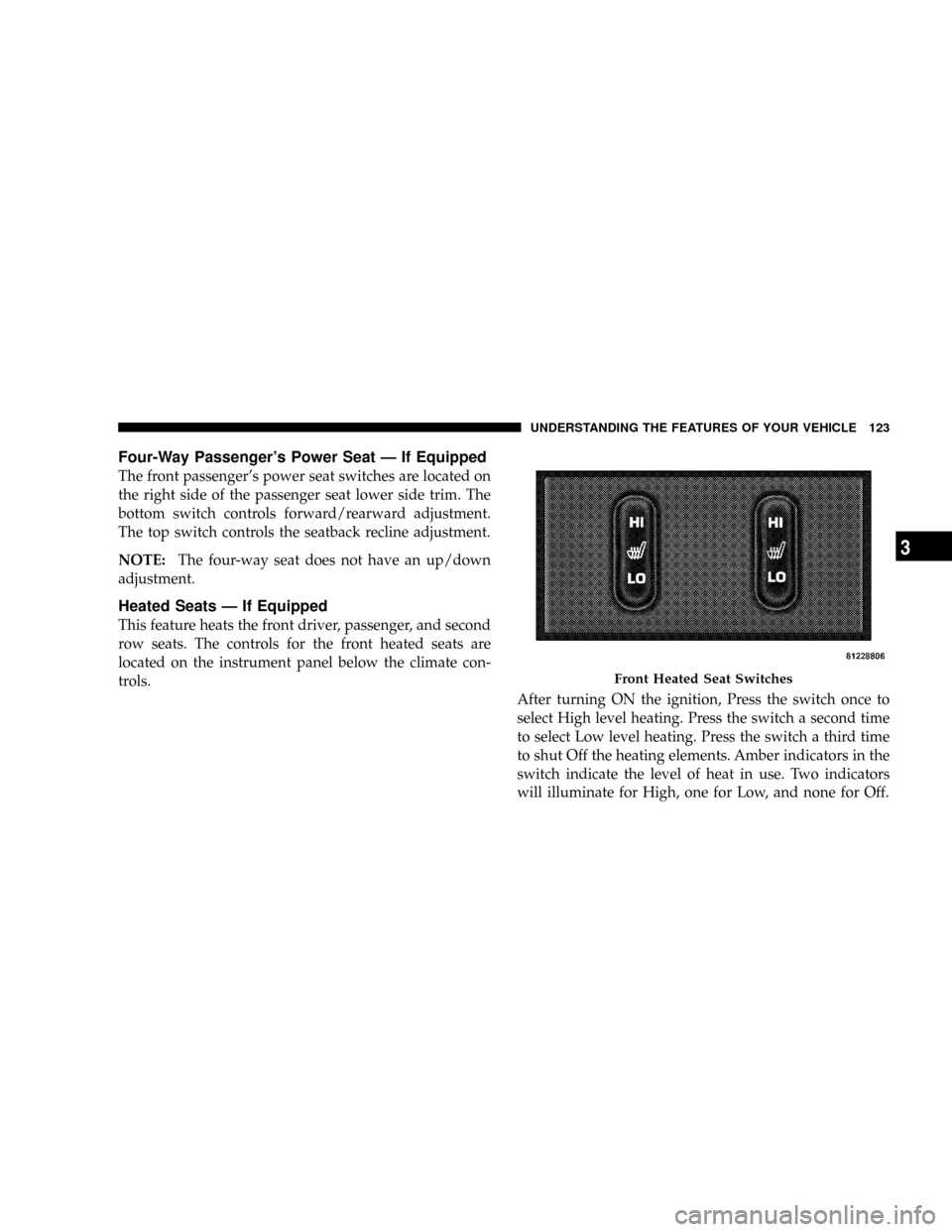
Heated Seats Ð If Equipped
This feature heats the front driver, passenger, and second
row seats. The controls for the front heated seats are
located on the instrument panel below the climate con-
trols.
After turning ON the ignition, Press the switch once to
select High level heating. Press the switch a second time
to select Low level heating. Press the switch a third time
to shut Off the heating elements. Amber indicators in the
switch indicate the level of heat in use. Two indicators
will illuminate for High, one for Low, and none for Off.
Front Heated Seat Switches
UNDERSTANDING THE FEATURES OF YOUR VEHICLE 123
3