warning CHRYSLER CONCORDE 2004 2.G Owner's Manual
[x] Cancel search | Manufacturer: CHRYSLER, Model Year: 2004, Model line: CONCORDE, Model: CHRYSLER CONCORDE 2004 2.GPages: 273, PDF Size: 6 MB
Page 48 of 273
3. Attach the tether strap hook (A) of the child restraint to
the anchor (B) and remove slack in the tether strap
according to the child restraint manufacturer’s instruc-
tions.
WARNING!
An incorrectly anchored tether strap could lead to
increased head motion and possible injury to the
child. Use only the anchor positions directly behind
the child seat to secure a child restraint top tether
strap.
Transporting Pets
Airbags deploying in the front seat could harm your pet.
An unrestrained pet will be thrown about and possibly
injured, or injure a passenger during panic braking or in
a collision.
Pets should be restrained in the rear seat in pet harnesses
or pet carriers that are secured by seat belts.
ENGINE BREAK-IN RECOMMENDATIONS
The engine in your new vehicle does not require a long
break-in period.
Drive moderately during the first 300 miles (500 km).
After the initial 60 miles (100 km), speeds up to 50 or 55
mph (80 or 90 km/h) are desirable.
While cruising, brief full-throttle acceleration, within the
limits of local traffic laws, contributes to a good break-in.
Wide open throttle acceleration in low gear can be
detrimental and should be avoided.
The crankcase oil installed in the engine at the factory is
a high quality energy conserving type lubricant. Oil
changes should be consistent with expected climate con-
ditions under which vehicle operations will occur. The
recommended viscosity and quality grades are in Section
7 of this manual.
Do not use non-detergent or straight mineral oils.
A new engine may consume some oil during its first few
thousand miles of operation. This is a normal part of the
break-in and not an indication of a problem.
48 THINGS TO KNOW BEFORE STARTING YOUR VEHICLE
Page 49 of 273
SAFETY TIPS
Exhaust Gas
WARNING!
Exhaust gases can injure or kill. They contain carbon
monoxide (CO) which is colorless and odorless.
Breathing it can make you unconscious and can
eventually poison you. To avoid breathing (CO)
follow the safety tips below.
•Do not run the engine in a closed garage or in confined
areas any longer than needed to move your vehicle in
or out of the area.
•If it is necessary to sit in a parked vehicle with the
engine running, adjust your heating or cooling con-
trols to force outside air into the vehicle. Set the blower
at high speed.
•To avoid drawing exhaust gases into the vehicle, close
the trunk while driving. However, if for some reason itmust remain open, close all windows. Adjust the
heating or cooling system to force outside air into the
vehicle. Set the blower at high speed.
Safety Checks You Should Make Inside the
Vehicle
Seat Belts
Inspect the belt system periodically, checking for cuts,
frays and loose parts. Damaged parts must be replaced
immediately. Do not disassemble or modify the system.
Safety belt assemblies must be replaced after an accident
if they have been damaged (bent retractor, torn webbing,
etc.). If there is any question regarding belt or retractor
condition, replace the belt.
Airbag Light
The light should come on and remain on for 6 to
8 seconds as a bulb check when the ignition
switch is first turned ON. If the bulb is not lit
during starting, have it replaced. If the light stays on or
comes on while driving, have the system checked by an
authorized dealer.
THINGS TO KNOW BEFORE STARTING YOUR VEHICLE 49
2
Page 58 of 273
WARNING!
Vehicles and other objects seen in the right side
convex mirror will look smaller and farther away
than they really are. Relying too much on your right
side mirror could cause you to collide with another
vehicle or other object. Use your inside mirror when
judging the size or distance of a vehicle seen in this
convex mirror.
Mirror Tilt in Reverse
This feature will tilt the driver’s exterior mirror down-
ward to improve visibility of the rear wheel area when
the vehicle is placed in reverse. Once reverse is disen-
gaged, the driver’s exterior mirror will return to it’s
original position.This feature can be turned on or off by performing the
following procedure:
1. Press and hold the Set button.
2. Move the horizontal seat switch forward.
3. Release the Set button and the horizontal seat switch.
On vehicles equipped with an EVIC (Electronic Vehicle
Information Center), these functions can be selected at
the EVIC using the Customer Programmable Features for
details.Illuminated Vanity Mirrors
An illuminated vanity mirror is on each sun visor. To use
the mirror, rotate the sun visor down and swing the
mirror cover upward. The lamps turn on automatically.
Closing the mirror cover turns off the lamps.
58 UNDERSTANDING THE FEATURES OF YOUR VEHICLE
Page 59 of 273
SEATS
Power Seats
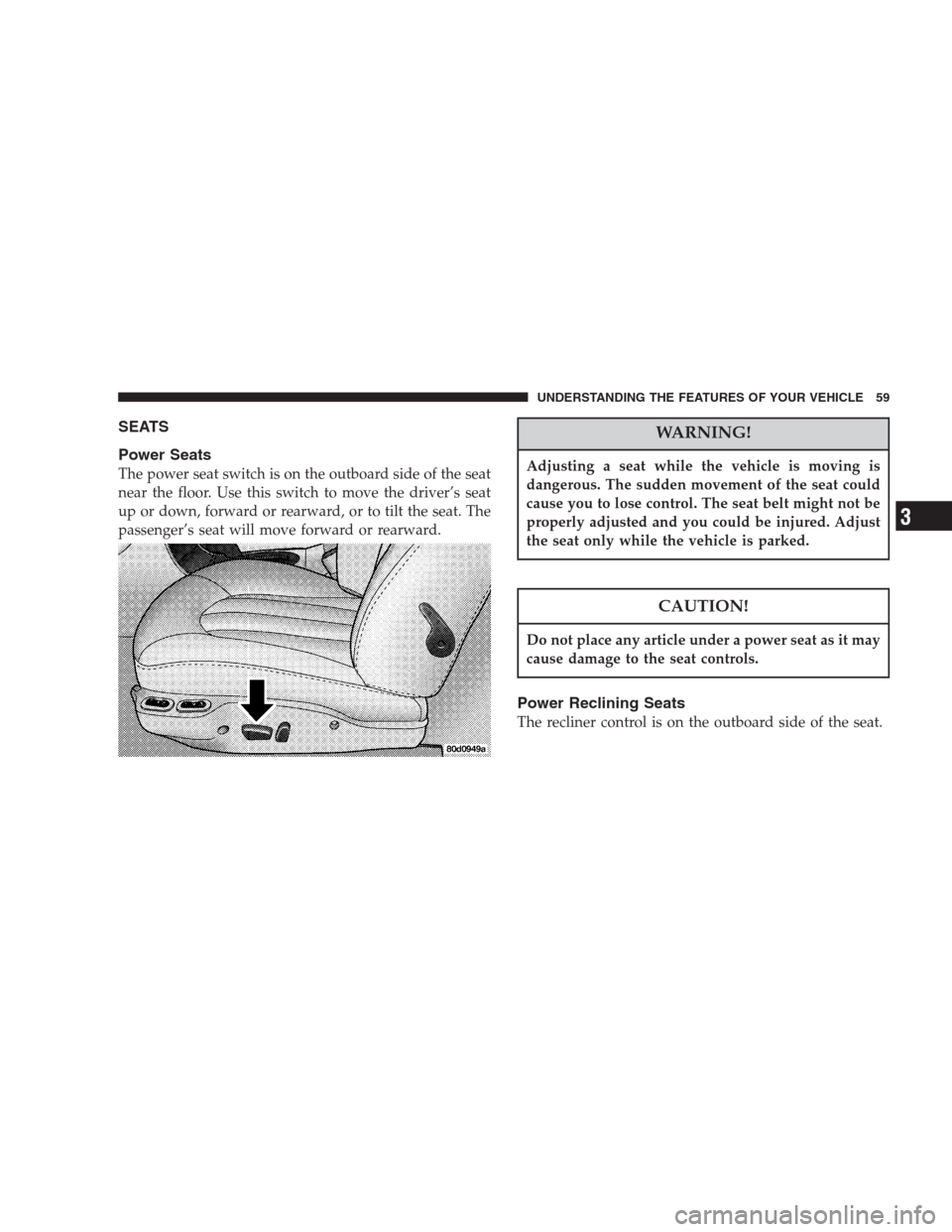
The power seat switch is on the outboard side of the seat
near the floor. Use this switch to move the driver’s seat
up or down, forward or rearward, or to tilt the seat. The
passenger’s seat will move forward or rearward.
WARNING!
Adjusting a seat while the vehicle is moving is
dangerous. The sudden movement of the seat could
cause you to lose control. The seat belt might not be
properly adjusted and you could be injured. Adjust
the seat only while the vehicle is parked.
CAUTION!
Do not place any article under a power seat as it may
cause damage to the seat controls.
Power Reclining Seats
The recliner control is on the outboard side of the seat.
UNDERSTANDING THE FEATURES OF YOUR VEHICLE 59
3
Page 60 of 273
WARNING!
Do not ride with the seatback reclined so that the
shoulder belt is no longer resting against your chest.
In a collision you could slide under the seat belt and
be seriously or even fatally injured. Use the recliner
only when the vehicle is parked.
Driver’s Seat Glide –To – Exit Feature
This feature provides ease of entry and exit for the driver
by moving the driver’s seat approximately 2–1/8 inches
(55mm) rearward on exit and the same distance forward
after entry, provided that the seat is not in the full
rearward position.
After entry, the seat will return to its previously set
position after one of the following occurs:
•The ignition switch is turned on
•The seatbelt is fastened (the seat moves when the seat
belt webbing is pulled out.)During exit, the seat will move rearward from the set
position when the key is removed from the ignition
providing that the seat is not in the full rearward
position.
This feature can be turned on or off by performing the
following procedure.
1. Press and hold the Set button.
2. Move the horizontal seat switch rearward.
3. Release the Set button and the horizontal seat switch.
NOTE:The glide feature is only available on the
driver’s seat.
NOTE:On vehicles equipped with an EVIC (Electronic
Vehicle Information Center), these functions can be se-
lected at the EVIC using the Customer Programmable
Features. Refer to EVIC-Customer Programmable Fea-
tures for details.
60 UNDERSTANDING THE FEATURES OF YOUR VEHICLE
Page 65 of 273
WARNING!
If the hood is not fully latched, it could fly up when
the vehicle is moving and block your forward vision.
You could have a collision. Be sure all hood latches
are fully latched before driving.
INTERIOR LIGHTS
To Turn The Interior Lights On:
Rotate the Dimmer Control upward to the second detent.
Rotate the switch downward to turn the interior lights
off.
NOTE:The interior lights have a “fade to off” feature.
When the lights are turned off, they gradually “fade” off.
Battery Saver Feature—Interior Lights
The interior courtesy lights come on when a door is open
or left ajar. To prevent battery drain, if you leave a door
open or ajar these lights will turn off after 15 minutes.
After you close the door, the interior courtesy lights will
again function in the normal matter.
NOTE:The map lights or reading lights that are manu-
ally switched on will not turn off automatically.
Instrument Panel Lighting
The brightness of the instrument panel lighting can be
regulated by rotating the dimmer switch.
Daytime Brightness Feature
Certain instrument panel components can be illuminated
at full brightness during the daytime. These are the
Odometer, Transmission Range Indicator, Radio, Climate
Controls, and the Overhead Travel Information Center.
This can be helpful when driving with your headlights
UNDERSTANDING THE FEATURES OF YOUR VEHICLE 65
3
Page 70 of 273
If the button is pushed and held while in the OFF
position, the wiper will operate for several wipes then
turn off.
If the button is pushed while in the OFF position, the
wipers will cycle twice.
NOTE:The Automatic Headlight System will turn on
the headlights if it detects that the windshield wipers
have been in operation for more than 10 seconds.
WARNING!
Sudden loss of visibility through the windshield
could lead to an accident. You might not see other
vehicles or other obstacles. To avoid sudden icing of
the windshield during freezing weather, warm the
windshield with the defroster before and during
windshield washer use.
Speed Sensitive Intermittent Wipers System
Use the intermittent feature of this system when weather
conditions make a single wiping cycle, with a variable
pause between cycles, desirable.
For maximum delay between cycles, turn the control
knob into the upper end of the delay range. The delay
interval decreases as you turn the knob until it enters the
LO continual speed position. The delay can be regulated
from a maximum of about 18 seconds between cycles, to
a cycle every 1/2 second.
NOTE:Vehicle speed is monitored to calculate wiper
delay intervals. The delay between cycles is shortened
when the vehicle is moving above 10 mph (16 km/h) and
lengthened below 10 mph (16 km/h).
70 UNDERSTANDING THE FEATURES OF YOUR VEHICLE
Page 71 of 273
TILT STEERING COLUMN
To tilt the column, pull the small lever below the turn
signal control toward you and move the wheel up or
down, as desired. Release the lever to lock the wheel
firmly in place.WARNING!
Tilting the steering column while the vehicle is
moving is dangerous. Without a stable steering col-
umn, you could lose control of the vehicle and have
an accident. Adjust the column only while the ve-
hicle is stopped. Be sure it is locked before driving.
UNDERSTANDING THE FEATURES OF YOUR VEHICLE 71
3
Page 73 of 273
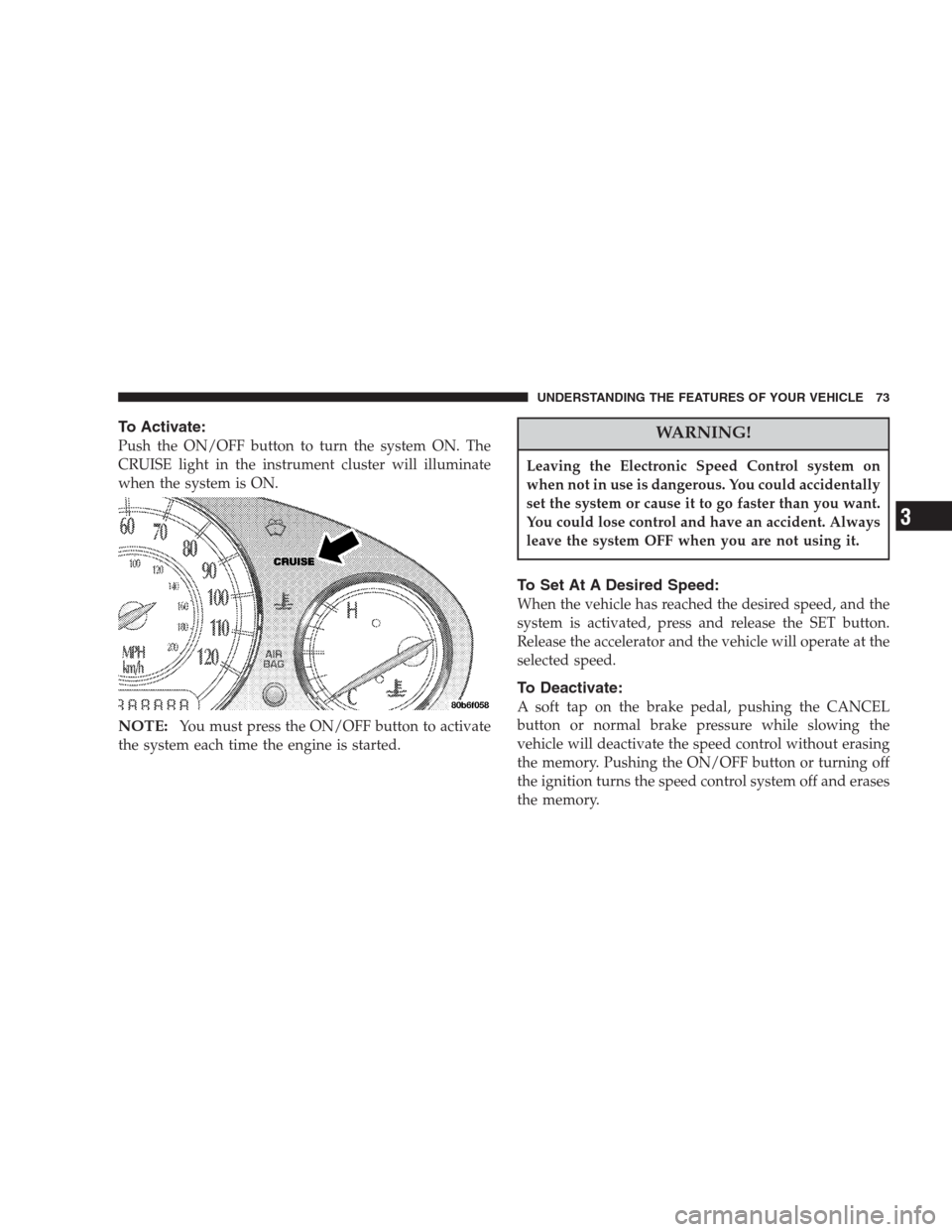
To Activate:
Push the ON/OFF button to turn the system ON. The
CRUISE light in the instrument cluster will illuminate
when the system is ON.
NOTE:You must press the ON/OFF button to activate
the system each time the engine is started.
WARNING!
Leaving the Electronic Speed Control system on
when not in use is dangerous. You could accidentally
set the system or cause it to go faster than you want.
You could lose control and have an accident. Always
leave the system OFF when you are not using it.
To Set At A Desired Speed:
When the vehicle has reached the desired speed, and the
system is activated, press and release the SET button.
Release the accelerator and the vehicle will operate at the
selected speed.
To Deactivate:
A soft tap on the brake pedal, pushing the CANCEL
button or normal brake pressure while slowing the
vehicle will deactivate the speed control without erasing
the memory. Pushing the ON/OFF button or turning off
the ignition turns the speed control system off and erases
the memory.
UNDERSTANDING THE FEATURES OF YOUR VEHICLE 73
3
Page 74 of 273
To Resume Speed:
To resume a previously set speed, push and release the
ACCEL/RESUME button. Resume can be used at any
speed above 25 mph (40 km/h).
To Vary The Speed Setting:
When the speed control is engaged, speed can be in-
creased by pressing and holding the ACCEL/RESUME
button. When the button is released, a new set speed will
be established.
Tapping the ACCEL/RESUME button once will result in
a 2 mph (3 km/h) speed increase. Each time the button is
tapped, speed will increase. For example, tapping the
button three times will increase speed by 6 mph (10
km/h), etc.
To decrease speed while speed control is engaged, press
and hold the COAST button. Release the button when the
desired speed is reached, and the new speed will be set.
Tapping the COAST button once will result ina1mph
speed decrease. Each time the button is tapped, speed
will decrease. For example, tapping the button 3 times
will decrease the speed by 3 mph (5 km/h), etc.
To Accelerate For Passing:
Depress the accelerator as you would normally. When the
pedal is released, the vehicle will return to the set speed.
WARNING!
Speed Control can be dangerous where the system
can’t maintain a constant speed. Your vehicle could
go too fast for the conditions, and you could lose
control. An accident could be the result. Don’t use
Speed Control in heavy traffic or on roads that are
winding, icy, snow-covered, or slippery.
Using Speed Control On Hills
Your vehicle is equipped with Interactive Speed Control.
This feature operates when traveling up or down hills
with the Speed Control engaged and the driver’s foot off
of the accelerator.
When Climbing A Hill
If vehicle speed drops 3 mph (5 km/h) below the Speed
Control SET speed, the transmission will downshift to
third gear. Under severe conditions the transmission may
74 UNDERSTANDING THE FEATURES OF YOUR VEHICLE