spark CHRYSLER CROSSFIRE 2007 1.G Owners Manual
[x] Cancel search | Manufacturer: CHRYSLER, Model Year: 2007, Model line: CROSSFIRE, Model: CHRYSLER CROSSFIRE 2007 1.GPages: 299, PDF Size: 8.26 MB
Page 186 of 299
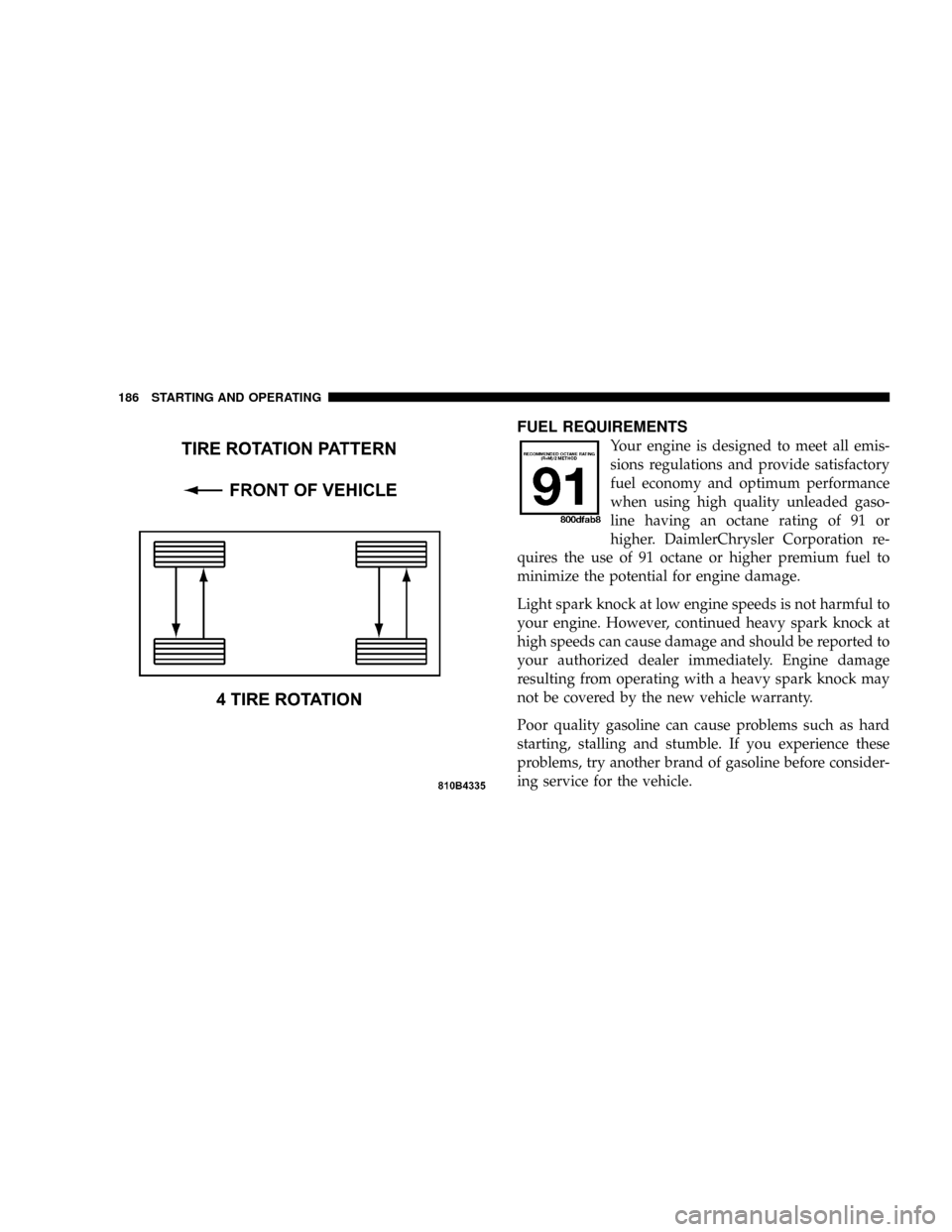
FUEL REQUIREMENTS
Your engine is designed to meet all emis-
sions regulations and provide satisfactory
fuel economy and optimum performance
when using high quality unleaded gaso-
line having an octane rating of 91 or
higher. DaimlerChrysler Corporation re-
quires the use of 91 octane or higher premium fuel to
minimize the potential for engine damage.
Light spark knock at low engine speeds is not harmful to
your engine. However, continued heavy spark knock at
high speeds can cause damage and should be reported to
your authorized dealer immediately. Engine damage
resulting from operating with a heavy spark knock may
not be covered by the new vehicle warranty.
Poor quality gasoline can cause problems such as hard
starting, stalling and stumble. If you experience these
problems, try another brand of gasoline before consider-
ing service for the vehicle.
186 STARTING AND OPERATING
Page 188 of 299

MMT in Gasoline
MMT is a manganese containing metallic additive that is
blended into some gasolines to increase the octane num-
ber. Gasolines blended with MMT offer no performance
advantage beyond gasolines of the same octane number
without MMT. Gasolines blended with MMT have shown
to reduce spark plug life and reduce emission system
performance in some vehicles. DaimlerChrysler Corpo-
ration recommends using gasolines without MMT. Since
the MMT content of gasoline may not be indicated on the
pump, you should ask your gasoline retailer whether or
not his/her gasoline contains MMT.
MMT is prohibited in both Federal and California refor-
mulated gasolines.
In Canada, MMT can be used at levels higher than those
allowed in the United States. For this reason, it is even
more important to look for gasolines without MMT in
Canada.
Materials Added to Fuel
All gasoline sold in the United States is required to
contain effective detergent additives. Use of additional
detergents or other additives is not needed under normal
conditions and would result in unnecessary cost. There-
fore, you should not have to add anything to the fuel.
Sulfur in Gasoline
If you live in the Northeast United States, your vehicle
may have been designed to meet California low emission
standards with cleaner burning California reformulated
gasoline with low sulfur. If such fuels are not available in
states adopting California emission standards, your ve-
hicle will operate satisfactorily on fuels meeting Federal
specifications, but emission control system performance
may be adversely affected.
Gasoline sold outside of California is permitted to have
higher sulfur levels, which may affect the performance of
the vehicle's catalytic converter. This may cause the
CHECK ENGINE light to illuminate. DaimlerChrysler
Corporation recommends that you try a different brand
188 STARTING AND OPERATING
Page 203 of 299
JUMP-STARTING THE BATTERY
WARNING!
Take care to avoid the radiator cooling fan whenever
the hood is raised. It can start any time the ignition
switch is on. You can be hurt by the fan.
CAUTION!
Do not try to push or tow your vehicle to get it
started. Your vehicle cannot be started this way.
Pushing with another vehicle may damage the trans-
mission or the rear of your vehicle. If your vehicle
has a discharged (dead) battery, booster cables may
be used to obtain a start from another vehicle. This
type of start can be dangerous if done improperly, so
follow the procedure carefully.
WARNING!
Battery fluid is a corrosive acid solution; do not allow
battery fluid to contact eyes, skin or clothing. Don't
lean over battery when attaching clamps or allow the
clamps to touch each other. If acid splashes in eyes or
on skin, flush contaminated area immediately with
large quantities of water.
A battery generates hydrogen gas that is flammable
and explosive. Keep flame or spark away from the
vent holes. Do not use a booster battery or any other
booster source with an output that exceeds 12 volts.
WHAT TO DO IN EMERGENCIES 203
6
Page 229 of 299
Drive Belts - Check Condition and Tension
At the distance shown in the maintenance schedules,
check all drive belts for condition and proper tension.
Improper belt tension can cause belt slippage and failure.
Inspect the drive belts for evidence of cuts, cracks, or
glazing and replace them if there is any sign of damage
which could result in belt failure. If adjustment is re-
quired, adjust the belts according to the specifications
and procedures shown in the Service Manual.
Special tools are required to properly measure tension
and to restore belt tension to factory specifications. Also,
check belt routing to make sure there is no interference
between the belts and other engine components.
Spark Plugs
Spark plugs must fire properly to assure engine perfor-
mance and emission control. New plugs should be in-
stalled at the distance specified in the appropriate main-
tenance chart. The entire set should be replaced if there is
any malfunction due to a faulty spark plug. Check the
specifications section for the proper type of spark plug
for use in your vehicle.
Engine Air Cleaner Filter
Under normal driving conditions, replace the air filter at
each interval called out by FSS.
WARNING!
The air cleaner can provide a measure of protection
in the case of engine backfire. Do not remove the air
cleaner unless such removal is necessary for repair or
maintenance. Make sure that no one is near the
engine compartment before starting the vehicle with
the air cleaner removed. Failure to do so can result in
serious personal injury.
Engine Fuel Filter
A plugged fuel filter can cause hard starting or limit the
speed at which a vehicle can be driven. Should an
excessive amount of dirt accumulate in the fuel tank,
frequent filter replacement may be necessary. See your
authorized dealer for service.
MAINTAINING YOUR VEHICLE 229
7
Page 231 of 299
In unusual situations involving grossly malfunctioning
engine operation, a scorching odor may suggest severe
and abnormal catalyst overheating. If this occurs, stop
the vehicle, turn off the engine and allow it to cool.
Service, including a tune up to DaimlerChrysler Corpo-
ration's specifications, should be obtained immediately.
To minimize the possibility of catalyst damage:
²Do not shut off the engine or interrupt the ignition
when the transmission is in gear and the vehicle is in
motion.
²Do not try to start the engine by pushing or towing the
vehicle.
²Do not idle the engine with any spark plug wires
disconnected for a prolonged period.
Ignition Wiring System
The ignition cables should be kept clean and properly
connected. Terminals should be fully seated. Cracked,
damaged, or faulty cables should be replaced.
Crankcase Emission Control System
Proper operation of this system depends on freedom
from sticking or plugging due to deposits.
Check ventilation hose for indication of damage or
plugging deposits. Replace if necessary.
Maintenance-Free Battery
The top of the maintenance-free battery is permanently
sealed. You will never have to add water, nor is periodic
maintenance required.
MAINTAINING YOUR VEHICLE 231
7
Page 232 of 299
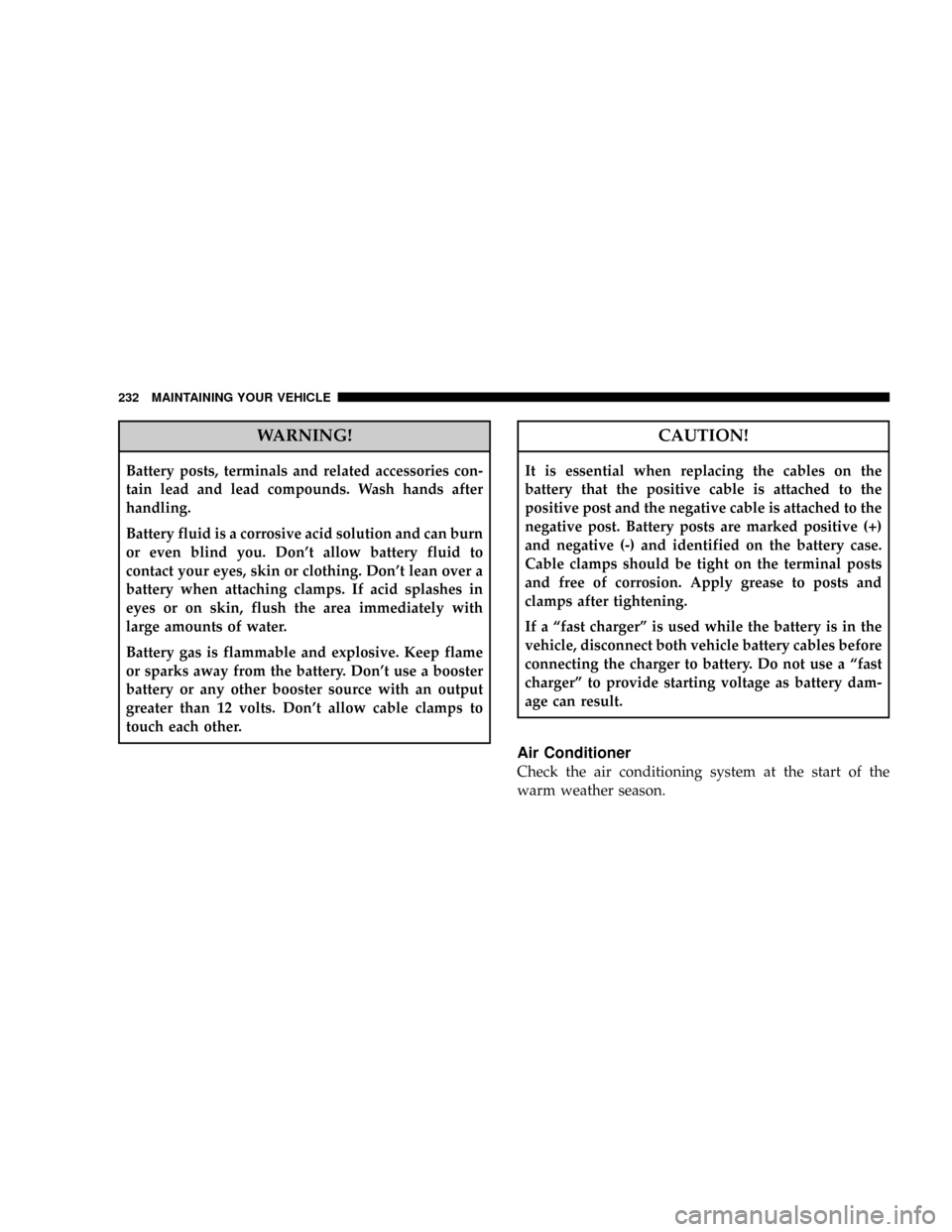
WARNING!
Battery posts, terminals and related accessories con-
tain lead and lead compounds. Wash hands after
handling.
Battery fluid is a corrosive acid solution and can burn
or even blind you. Don't allow battery fluid to
contact your eyes, skin or clothing. Don't lean over a
battery when attaching clamps. If acid splashes in
eyes or on skin, flush the area immediately with
large amounts of water.
Battery gas is flammable and explosive. Keep flame
or sparks away from the battery. Don't use a booster
battery or any other booster source with an output
greater than 12 volts. Don't allow cable clamps to
touch each other.
CAUTION!
It is essential when replacing the cables on the
battery that the positive cable is attached to the
positive post and the negative cable is attached to the
negative post. Battery posts are marked positive (+)
and negative (-) and identified on the battery case.
Cable clamps should be tight on the terminal posts
and free of corrosion. Apply grease to posts and
clamps after tightening.
If a ªfast chargerº is used while the battery is in the
vehicle, disconnect both vehicle battery cables before
connecting the charger to battery. Do not use a ªfast
chargerº to provide starting voltage as battery dam-
age can result.
Air Conditioner
Check the air conditioning system at the start of the
warm weather season.
232 MAINTAINING YOUR VEHICLE
Page 265 of 299
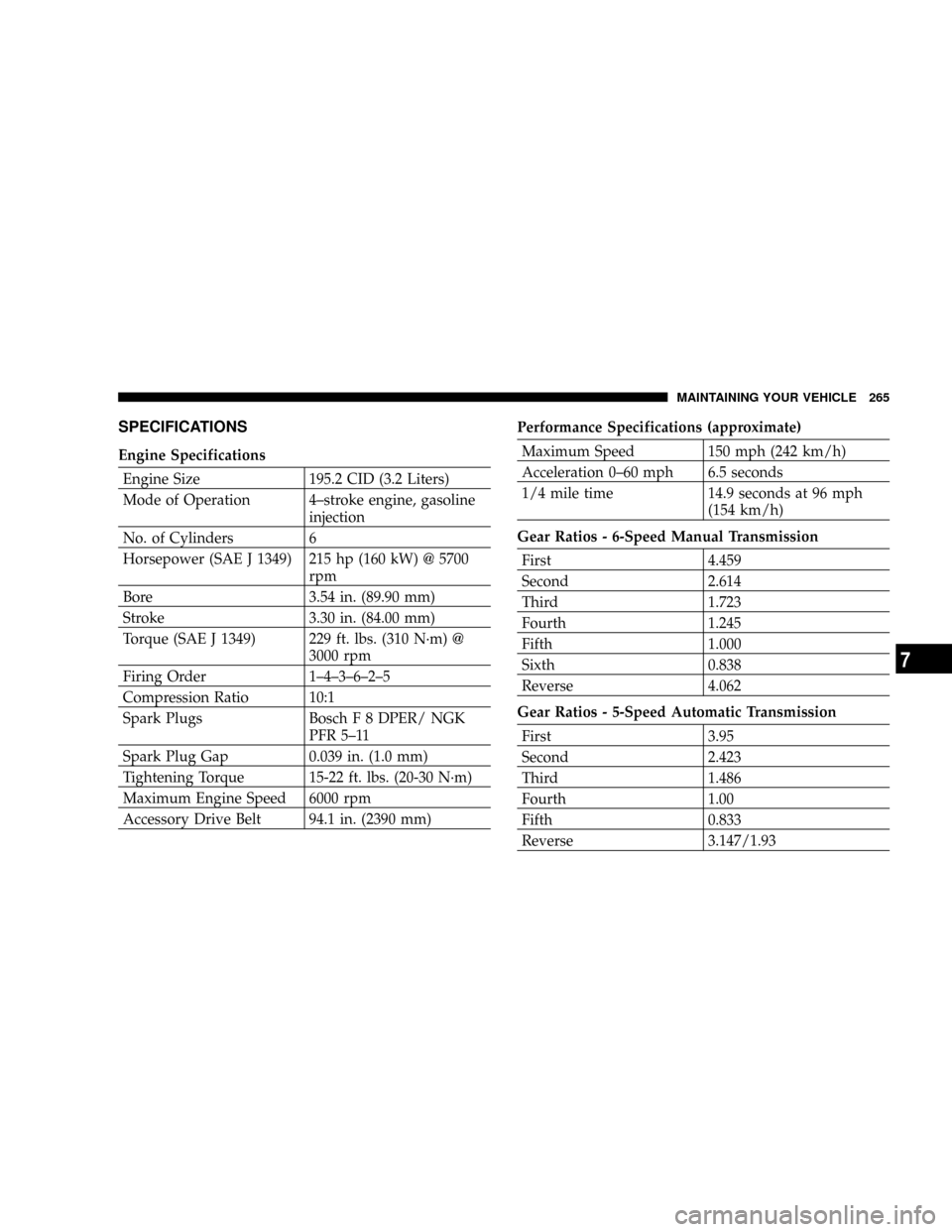
SPECIFICATIONS
Engine Specifications
Engine Size 195.2 CID (3.2 Liters)
Mode of Operation 4±stroke engine, gasoline
injection
No. of Cylinders 6
Horsepower (SAE J 1349) 215 hp (160 kW) @ 5700
rpm
Bore 3.54 in. (89.90 mm)
Stroke 3.30 in. (84.00 mm)
Torque (SAE J 1349) 229 ft. lbs. (310 N´m) @
3000 rpm
Firing Order 1±4±3±6±2±5
Compression Ratio 10:1
Spark Plugs Bosch F 8 DPER/ NGK
PFR 5±11
Spark Plug Gap 0.039 in. (1.0 mm)
Tightening Torque 15-22 ft. lbs. (20-30 N´m)
Maximum Engine Speed 6000 rpm
Accessory Drive Belt 94.1 in. (2390 mm)Performance Specifications (approximate)
Maximum Speed 150 mph (242 km/h)
Acceleration 0±60 mph 6.5 seconds
1/4 mile time 14.9 seconds at 96 mph
(154 km/h)
Gear Ratios - 6-Speed Manual Transmission
First 4.459
Second 2.614
Third 1.723
Fourth 1.245
Fifth 1.000
Sixth 0.838
Reverse 4.062
Gear Ratios - 5-Speed Automatic Transmission
First 3.95
Second 2.423
Third 1.486
Fourth 1.00
Fifth 0.833
Reverse 3.147/1.93
MAINTAINING YOUR VEHICLE 265
7
Page 268 of 299
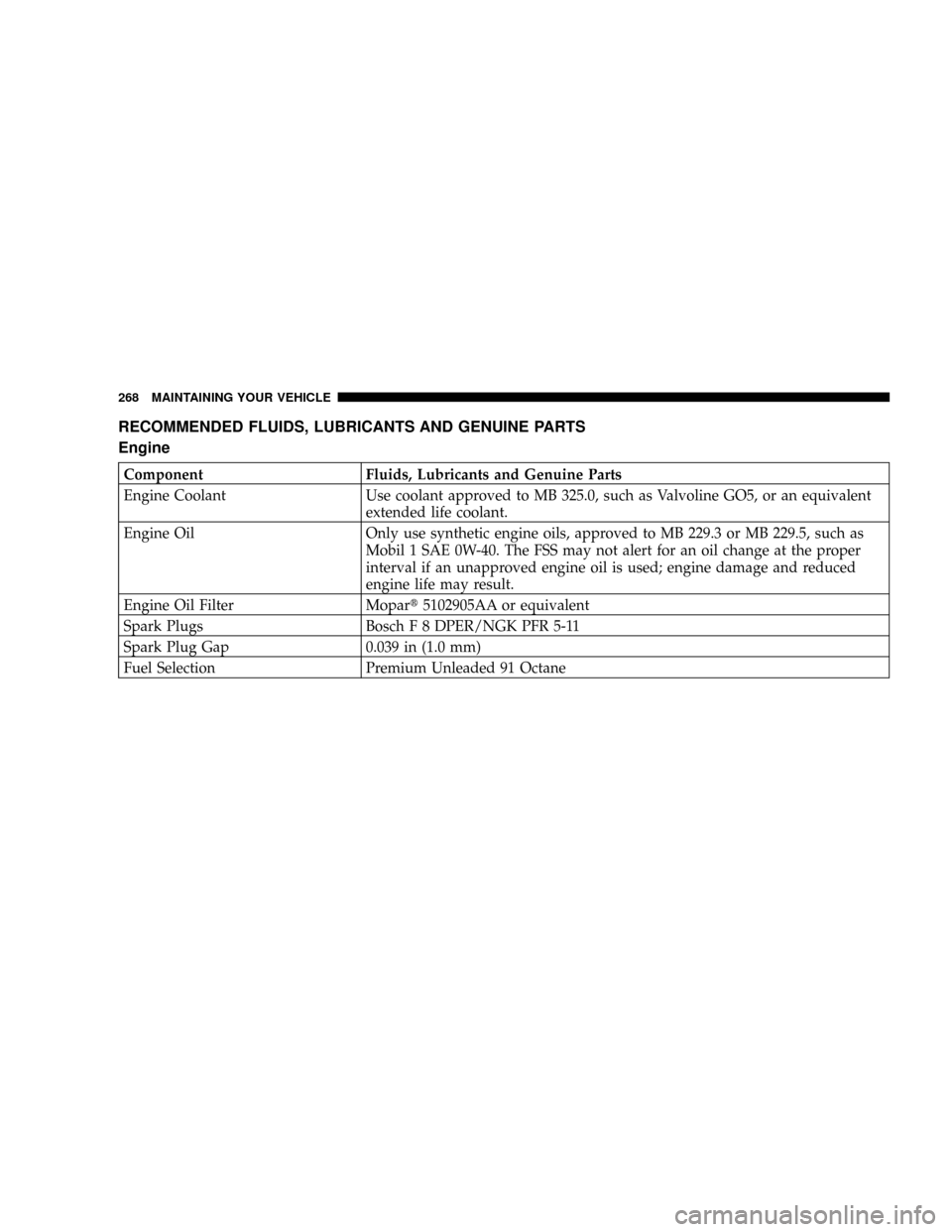
RECOMMENDED FLUIDS, LUBRICANTS AND GENUINE PARTS
Engine
Component Fluids, Lubricants and Genuine Parts
Engine Coolant Use coolant approved to MB 325.0, such as Valvoline GO5, or an equivalent
extended life coolant.
Engine Oil Only use synthetic engine oils, approved to MB 229.3 or MB 229.5, such as
Mobil 1 SAE 0W-40. The FSS may not alert for an oil change at the proper
interval if an unapproved engine oil is used; engine damage and reduced
engine life may result.
Engine Oil Filter Mopart5102905AA or equivalent
Spark Plugs Bosch F 8 DPER/NGK PFR 5-11
Spark Plug Gap 0.039 in (1.0 mm)
Fuel Selection Premium Unleaded 91 Octane
268 MAINTAINING YOUR VEHICLE
Page 279 of 299
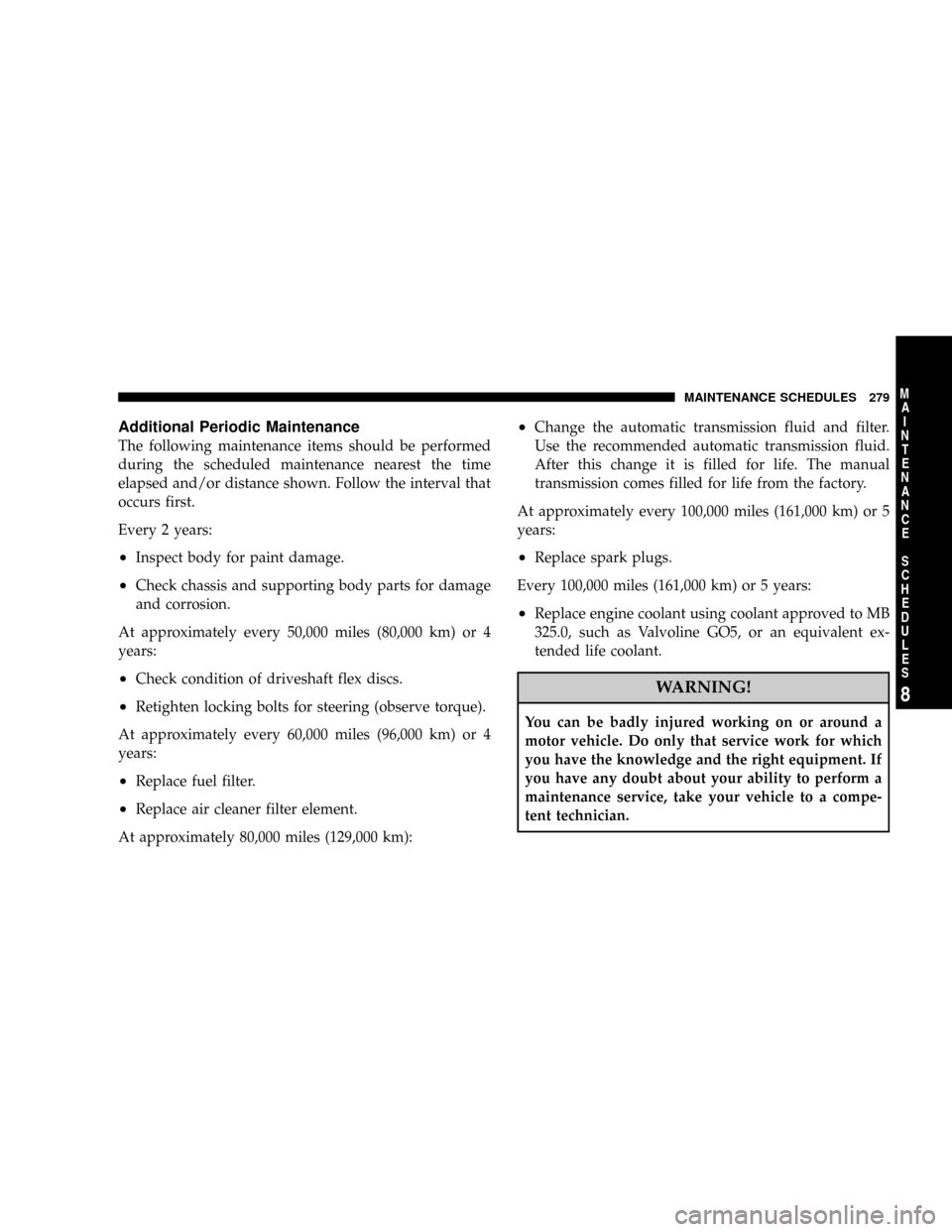
Additional Periodic Maintenance
The following maintenance items should be performed
during the scheduled maintenance nearest the time
elapsed and/or distance shown. Follow the interval that
occurs first.
Every 2 years:
²Inspect body for paint damage.
²Check chassis and supporting body parts for damage
and corrosion.
At approximately every 50,000 miles (80,000 km) or 4
years:
²Check condition of driveshaft flex discs.
²Retighten locking bolts for steering (observe torque).
At approximately every 60,000 miles (96,000 km) or 4
years:
²Replace fuel filter.
²Replace air cleaner filter element.
At approximately 80,000 miles (129,000 km):
²Change the automatic transmission fluid and filter.
Use the recommended automatic transmission fluid.
After this change it is filled for life. The manual
transmission comes filled for life from the factory.
At approximately every 100,000 miles (161,000 km) or 5
years:
²Replace spark plugs.
Every 100,000 miles (161,000 km) or 5 years:
²Replace engine coolant using coolant approved to MB
325.0, such as Valvoline GO5, or an equivalent ex-
tended life coolant.
WARNING!
You can be badly injured working on or around a
motor vehicle. Do only that service work for which
you have the knowledge and the right equipment. If
you have any doubt about your ability to perform a
maintenance service, take your vehicle to a compe-
tent technician.
MAINTENANCE SCHEDULES 279
8
M
A
I
N
T
E
N
A
N
C
E
S
C
H
E
D
U
L
E
S
Page 293 of 299
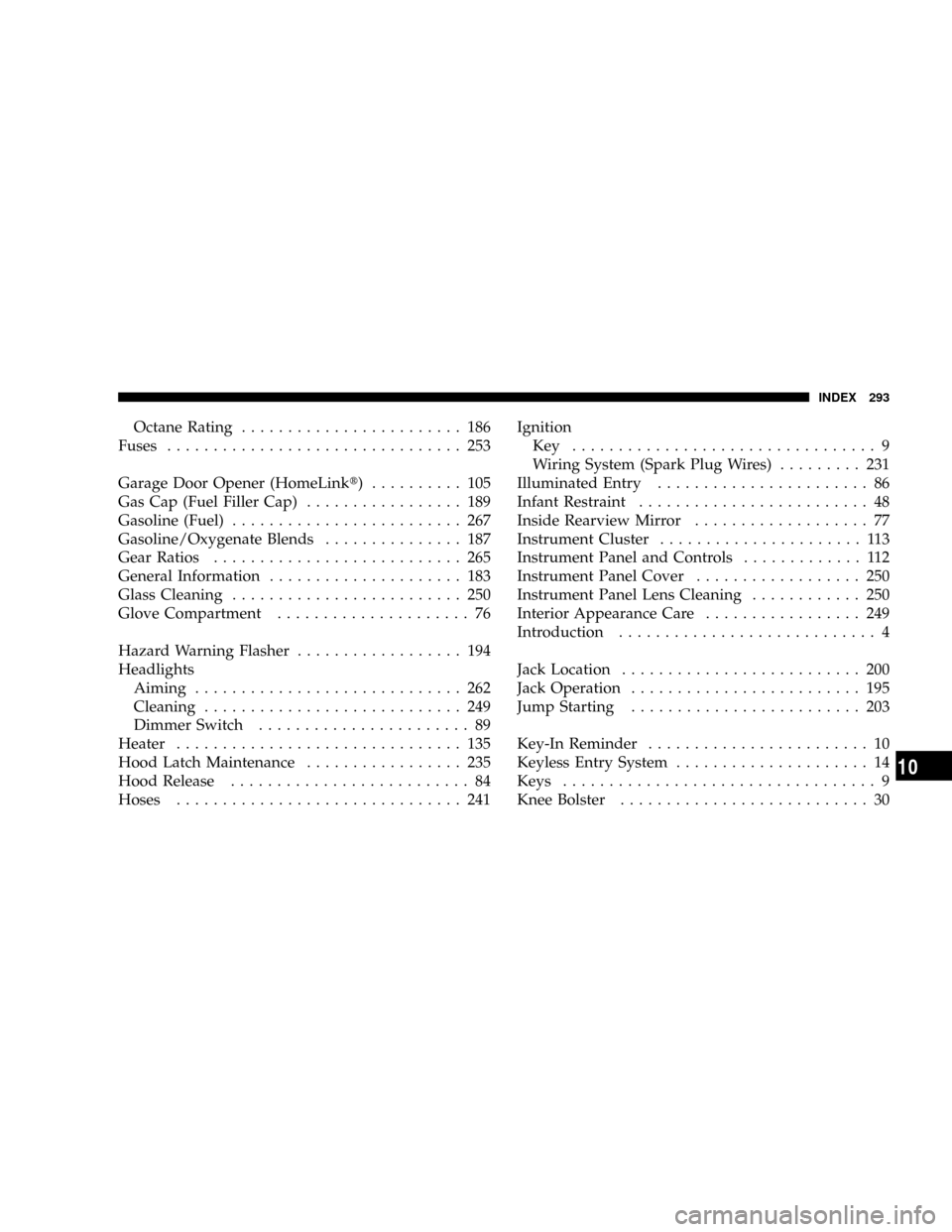
Octane Rating........................ 186
Fuses................................ 253
Garage Door Opener (HomeLinkt) .......... 105
Gas Cap (Fuel Filler Cap)................. 189
Gasoline (Fuel)......................... 267
Gasoline/Oxygenate Blends............... 187
Gear Ratios........................... 265
General Information..................... 183
Glass Cleaning......................... 250
Glove Compartment..................... 76
Hazard Warning Flasher.................. 194
Headlights
Aiming............................. 262
Cleaning............................ 249
Dimmer Switch....................... 89
Heater............................... 135
Hood Latch Maintenance................. 235
Hood Release.......................... 84
Hoses............................... 241Ignition
Key ................................. 9
Wiring System (Spark Plug Wires)......... 231
Illuminated Entry....................... 86
Infant Restraint......................... 48
Inside Rearview Mirror................... 77
Instrument Cluster...................... 113
Instrument Panel and Controls............. 112
Instrument Panel Cover.................. 250
Instrument Panel Lens Cleaning............ 250
Interior Appearance Care................. 249
Introduction............................ 4
Jack Location.......................... 200
Jack Operation......................... 195
Jump Starting......................... 203
Key-In Reminder........................ 10
Keyless Entry System..................... 14
Keys.................................. 9
Knee Bolster........................... 30
INDEX 293
10