lock CHRYSLER CROSSFIRE 2008 1.G User Guide
[x] Cancel search | Manufacturer: CHRYSLER, Model Year: 2008, Model line: CROSSFIRE, Model: CHRYSLER CROSSFIRE 2008 1.GPages: 358, PDF Size: 4.7 MB
Page 20 of 358
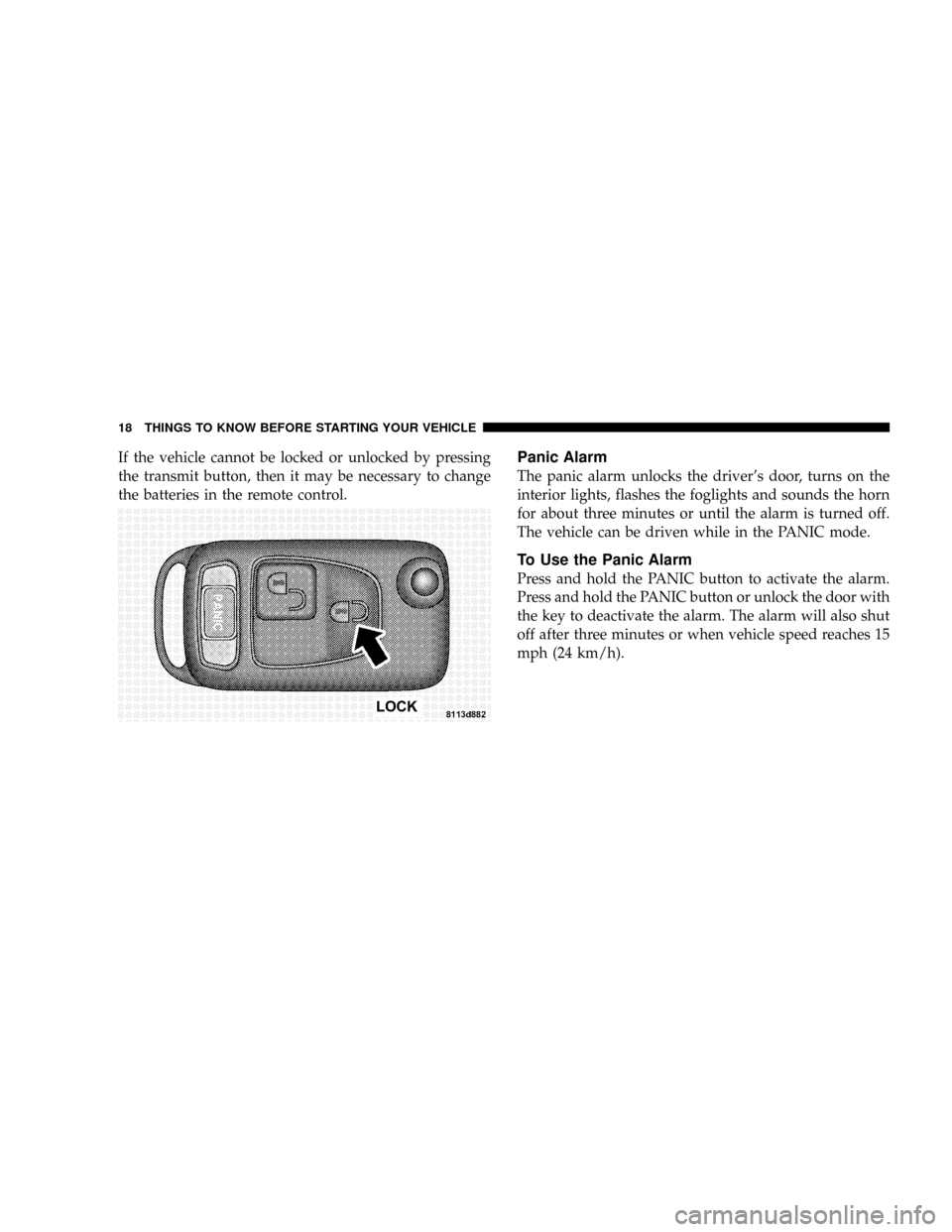
If the vehicle cannot be locked or unlocked by pressing
the transmit button, then it may be necessary to change
the batteries in the remote control.Panic Alarm
The panic alarm unlocks the driver's door, turns on the
interior lights, flashes the foglights and sounds the horn
for about three minutes or until the alarm is turned off.
The vehicle can be driven while in the PANIC mode.
To Use the Panic Alarm
Press and hold the PANIC button to activate the alarm.
Press and hold the PANIC button or unlock the door with
the key to deactivate the alarm. The alarm will also shut
off after three minutes or when vehicle speed reaches 15
mph (24 km/h).
18 THINGS TO KNOW BEFORE STARTING YOUR VEHICLE
Page 23 of 358
NOTE:Only replace the batteries in pairs.
The system may have to be re-synchronized if the trans-
mitter is without voltage for several minutes. To synchro-
nize, aim the transmitter eye at the vehicle and briefly
press either the LOCK or the UNLOCK button twice.
Within approximately 30 seconds, insert the key in the
ignition and turn it to the ON/RUN position. The remote
control should once again be operational.
SECURITY ALARM SYSTEM
The Security Alarm system monitors the doors, rear
liftgate/decklid, hood, and ignition for unauthorized
operation. The Security Alarm system is automatically
armed or disarmed with the remote control or any of
your vehicle's keys by locking or unlocking the vehicle.
The antitheft alarm is armed within approximately 10
seconds after locking the vehicle. A blinking light in the
tow away alarm switch indicates that the alarm is armed.
Once the Security Alarm system has been armed, theexterior vehicle lights will flash and an alarm will sound
when a door, the rear liftgate/decklid, the hood, or glove
compartment is opened, or if someone attempts to raise
the vehicle for towing. The Security Alarm will flash the
exterior lamps for approximately three minutes and
sound an audible alarm for 30 seconds. The Security
Alarm will stay on even if the activating element is
immediately closed.
Tow-Away Alarm
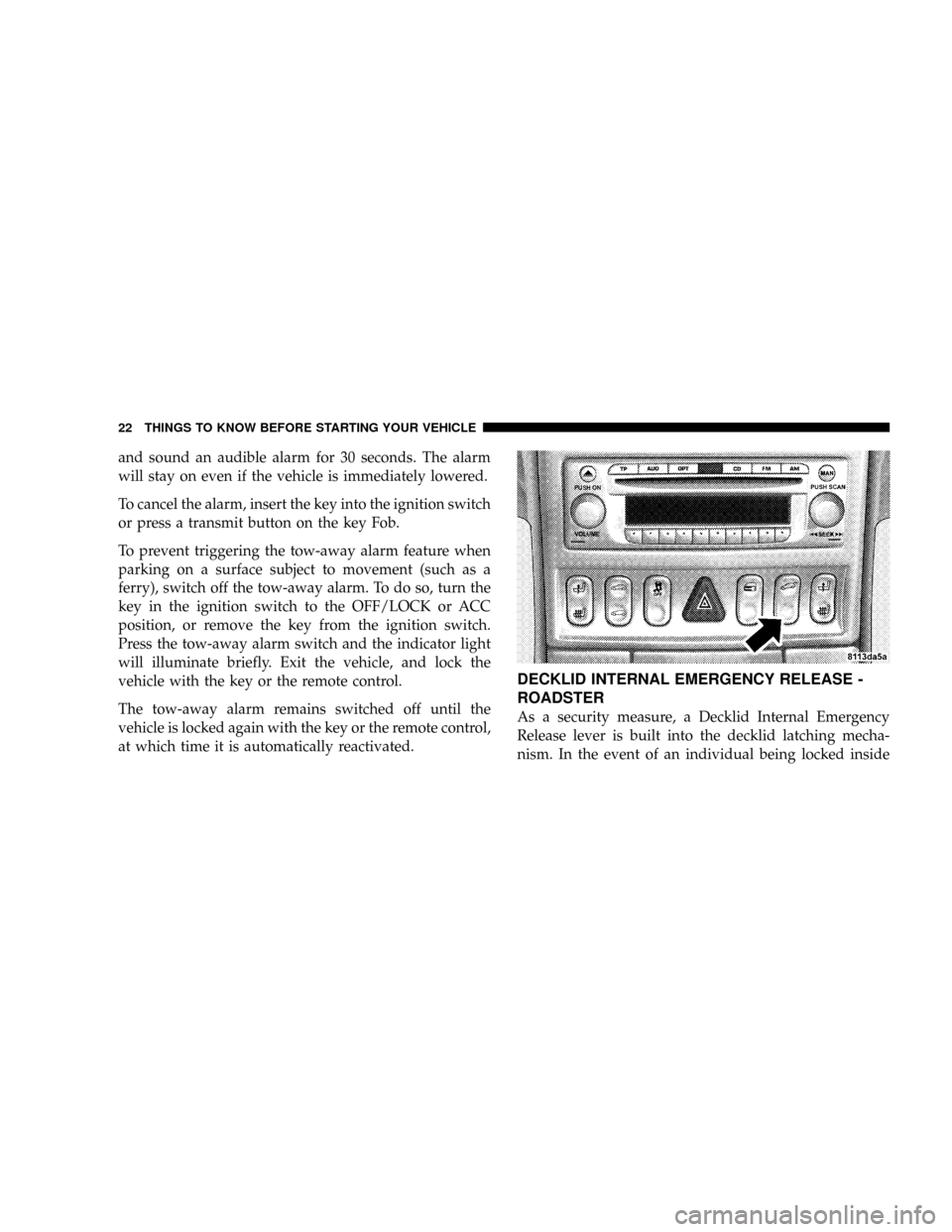
The tow-away alarm switch is located on the console. To
deactivate for towing or jacking up the vehicle, press and
release the upper portion of the switch. Press and release
the upper portion to activate it again.
After the alarm system has been armed, the exterior
vehicle lights will flash and an alarm will sound when
someone attempts to raise the vehicle. The alarm will
flash the exterior lamps for approximately three minutes
THINGS TO KNOW BEFORE STARTING YOUR VEHICLE 21
2
Page 24 of 358
and sound an audible alarm for 30 seconds. The alarm
will stay on even if the vehicle is immediately lowered.
To cancel the alarm, insert the key into the ignition switch
or press a transmit button on the key Fob.
To prevent triggering the tow-away alarm feature when
parking on a surface subject to movement (such as a
ferry), switch off the tow-away alarm. To do so, turn the
key in the ignition switch to the OFF/LOCK or ACC
position, or remove the key from the ignition switch.
Press the tow-away alarm switch and the indicator light
will illuminate briefly. Exit the vehicle, and lock the
vehicle with the key or the remote control.
The tow-away alarm remains switched off until the
vehicle is locked again with the key or the remote control,
at which time it is automatically reactivated.
DECKLID INTERNAL EMERGENCY RELEASE -
ROADSTER
As a security measure, a Decklid Internal Emergency
Release lever is built into the decklid latching mecha-
nism. In the event of an individual being locked inside
22 THINGS TO KNOW BEFORE STARTING YOUR VEHICLE
Page 27 of 358
WARNING!
When leaving the vehicle, always remove the key
from the ignition switch, and lock the vehicle. Do not
leave children unattended in the vehicle, or with
access to an unlocked vehicle. Unsupervised use of
vehicle equipment can cause serious personal injury.
Power Window Operation With The Convertible
Top Switch (Roadster Only)
The power windows can also be operated by using the
convertible top switch.
To operate, turn the key in the ignition switch to the
ON/RUN position. Press down on the rear of the con-
vertible top switch twice to open the windows.
Press down on the front of the convertible top switch
twice to close the windows.
REAR LIFTGATE/DECKLID RELEASE
You can open the rear liftgate/decklid by using the
handle located on the liftgate/decklid just above the rear
license plate pocket.
WARNING!
Do not allow children to have access to the rear cargo
area by climbing into the rear cargo area from out-
side. Always close the liftgate/decklid when your
vehicle is unattended. Once in the cargo area, young
children may have difficulty leaving the vehicle. If
trapped in the cargo area, children can die from
suffocation or heat stroke.
THINGS TO KNOW BEFORE STARTING YOUR VEHICLE 25
2
Page 29 of 358
and they reduce the risk of injury caused by striking the
inside of the vehicle.Everyonein a motor vehicle needs
to be buckled up all the time.
Lap/Shoulder Belts
Each seating position is equipped with a combined
lap/shoulder belt system.
The belt webbing retractor will lock only during very
sudden stops or impacts. This feature allows the shoulder
part of the belt to move freely with you under normal
conditions. In a collision, the belt locks and reduces the
risk of your striking the inside of the vehicle or being
thrown out. The seat belts are also equipped with emer-
gency tensioning retractors. These tensioning retractors
are located in each belt's inertia reel and become opera-
tionally ready with the key in the ignition switch turnedto the ACC or ON/RUN positions. The emergency
tensioning retractors are designed to activate during
frontal and rear impacts. They remove slack from the
belts in such a way that the seat belts fit more snugly
against the body, restricting its forward movement as
much as possible.
In cases of other frontal impacts, roll overs, certain side
impacts, rear collisions or other accidents without suffi-
cient frontal or rear impact forces, the emergency tension-
ing retractors will not be activated. The driver and
passenger will then be protected by the fastened seat
belts and inertia reel in the usual manner.
THINGS TO KNOW BEFORE STARTING YOUR VEHICLE 27
2
Page 34 of 358
WARNING!
Seat belt systems must always be replaced after an
impact severe enough to fire the emergency locking
retractors. If there is any question about the condi-
tion of your seat belt system, take the vehicle to an
authorized dealer for an inspection.
WARNING!
A frayed or torn belt could rip apart in a collision and
leave you with no protection. Inspect the belt system
periodically, checking for cuts, frays, or loose parts.
Damaged parts must be replaced immediately. Do not
disassemble or modify the system. Seat belt assem-
blies must be replaced after an accident if they have
been damaged (bent retractor, torn webbing, etc.)
Seat Belts and Pregnant Women
We recommend that pregnant women use the seat belts
throughout their pregnancy. Keeping the mother safe is
the best way to keep the baby safe.
Pregnant women should wear the lap part of the belt
across the thighs and as snug across the hips as possible.
Keep the belt low so that it does not come across the
abdomen. That way the strong bones of the hips will take
the force if there is a collision.
Seat Belt Extender
If a seat belt is too short even when fully extended, an
authorized dealer can provide you with a seat belt
extender. This extender should be used only if the
existing belt is not long enough. When it is not required,
remove the extender and store it.
32 THINGS TO KNOW BEFORE STARTING YOUR VEHICLE
Page 36 of 358
These airbags inflate in higher speed frontal impacts.
They work with the instrument panel inflatable knee
blockers and the seat belts to provide improved protec-
tion for the driver and passenger.
The vehicle is also equipped with side airbags, located in
the driver and passenger doors. Side airbags also work
with seat belts to improve occupant protection.
NOTE:The front driver airbag is certified to the Federal
regulations that allow less forceful deployment. The front
driver airbag has a multi stage inflator design. This may
allow the airbag to have different rates of inflation that
are based on collision severity and occupant size. Also,
the front passenger airbag is certified to the Federal
regulations that define Occupant Classification (Refer to
ªOccupant Classification Systemº in this section). Their
covers are also labeled SRS/AIRBAG.WARNING!
²Do not put anything on or around the front airbag
covers or attempt to manually open them. You may
damage the airbags and you could be injured
because the airbags are not there to protect you.
These protective covers are designed to open only
when the airbags are inflated.
²Do not place objects between you and the side
airbags; the performance could be adversely af-
fected and/or objects could be pushed into you,
causing serious injury.
²Do not attach cup holders or any other objects on
or around the door. The inflating side airbag could
drive objects into occupants, causing serious
injury.
34 THINGS TO KNOW BEFORE STARTING YOUR VEHICLE
Page 39 of 358
WARNING!
²Relying on the airbags alone could lead to more
severe injuries in a collision. The airbags work
with your seat belt to restrain you properly. In
some collisions the airbags won't deploy at all.
Always wear your seat belts even though you have
airbags.
²Being too close to the steering wheel or instrument
panel during airbag deployment could cause seri-
ous injury.
²Airbags need room to inflate. Sit back, comfort-
ably extending your arms to reach the steering
wheel or instrument panel.
²The side airbags also need room to inflate. Do not
lean against the door. Sit upright in the center of
the seat.
Airbag System Components
The airbag system consists of the following:
²Occupant Restraint Controller
²Airbag Warning Light
²Driver and passenger frontal airbag/inflator units
²Driver and passenger side airbag/inflator units
²Driver and Passenger Inflatable Knee Blocker
²Driver and Front Passenger Seat Belt Pretensioners
²Side impact sensors
²Front Passenger Seat Occupant Classification System
(OCS)
How the Front Airbag System Works
²
TheOccupant Restraint Controller (ORC)determines
if a frontal collision is severe enough to require the
THINGS TO KNOW BEFORE STARTING YOUR VEHICLE 37
2
Page 41 of 358
WARNING!
Do not put anything on or around the airbag covers
or attempt to manually open them. You may damage
the airbags and you could be injured because the
airbags are not there to protect you. These protective
covers are designed to open only when the airbags
are inflated.
²TheDriver and Passenger Airbag/Inflator Unitsare
located in the center of the steering wheel and the right
side of the instrument panel. When the ORC detects a
collision requiring the airbags, it signals the inflator
units. A large quantity of nontoxic gas is generated to
inflate the front airbags. Different airbag inflation rates
may be possible based on collision severity and occu-
pant size. The steering wheel hub trim cover and theupper right side of the instrument panel separate and
fold out of the way as the bags inflate to their full size.
The bags fully inflate in about 50±70 milliseconds. This
is about half of the time it takes to blink your eyes. The
bags then quickly deflate while helping to restrain the
driver and front passenger. The driver 's front airbag
gas is vented through vent holes in the sides of the
airbag. The passenger 's front airbag gas is vented
through vent holes in the sides of the airbag. In this
way the airbags do not interfere with your control of
the vehicle.
²The Knee Blocker Airbag helps protect the knees and
working with the seat belts, position you for the best
interaction with the airbags.
THINGS TO KNOW BEFORE STARTING YOUR VEHICLE 39
2
Page 49 of 358
OCM to ensure that the resultant bladder pressure in-
crease due to applied lap belt tension does not cause a
small occupant to be classified as a larger occupant
How the Bladder Mat and Pressure Sensor Works
The Bladder Mat and Pressure Sensor are located beneath
the seat cushion foam. The pressure sensor sends a signal
to the OCM. The passenger seat assembly contains criti-
cal components that affect the passenger airbag deploy-
ment. Correctly functioning passenger seat components
are critical for the Occupant Classification System (OCS)
to properly classify the passenger and calculate the
proper airbag deployment. Do not make any modifica-
tions to the passenger seat components, assembly, or to
the seat cover.
How the Driver/Passenger Inflatable Knee
Blockers Works
When the ORC and the impact sensors detect a collision
requiring the Driver/Passenger Inflatable Knee Blockers,it signals the inflator unit. A quantity of nontoxic gas is
generated to inflate the Driver/Passenger Inflatable Knee
Blockers. The Driver/Passenger Inflatable Knee Blockers
inflates rearward towards the driver 's knees to help
protect the knees and position you for the best interaction
with the front airbag. The Driver/Passenger Inflatable
Knee Blockers fully inflates in about 50 milliseconds, this
is only about half of the time it takes you to blink your
eyes. It then quickly deflates while helping to protect the
driver 's knees.
The Knee Impact Blockers help protect the knees and
position the occupant.
Passenger Front Airbag On/Off Switch
The ON/OFF switch is located at the right end of the
instrument panel and is accessible by opening the pas-
senger door.
THINGS TO KNOW BEFORE STARTING YOUR VEHICLE 47
2