air condition CHRYSLER PACIFICA 2004 1.G Owner's Manual
[x] Cancel search | Manufacturer: CHRYSLER, Model Year: 2004, Model line: PACIFICA, Model: CHRYSLER PACIFICA 2004 1.GPages: 361, PDF Size: 5.21 MB
Page 277 of 361
Also check belt routing to make sure there is no interfer-
ence between the belts and other engine components.
Spark Plugs
Spark plugs must fire properly to assure engine perfor-
mance and emission control. New plugs should be in-
stalled at the specified mileage. The entire set should be
replaced if there is any malfunction due to a faulty spark
plug. Malfunctioning spark plugs can damage the cata-
lytic converter. For proper type of replacement spark
plugs, refer to the ªVehicle Emission Control Informa-
tionº label in the engine compartment.
Engine Air Cleaner Filter
Under normal driving conditions, replace the air filter at
the intervals shown on Schedule ªAº. If, however, you
drive the vehicle frequently under dusty or severe con-
ditions, the filter element should be inspected periodi-
cally and replaced if necessary at the intervals shown on
Schedule ªBº.
WARNING!
The air cleaner can provide a measure of protection
in the case of engine backfire. Do not remove the air
cleaner unless such removal is necessary for repair or
maintenance. Make sure that no one is near the
engine compartment before starting the vehicle with
the air cleaner removed. Failure to do so can result in
serious personal injury.
Fuel Filter
A plugged fuel filter can cause stalling, limit the speed at
which a vehicle can be driven or cause hard starting.
Should an excessive amount of dirt accumulate in the
fuel tank, filter replacement may be necessary. See your
local dealer for service.
MAINTAINING YOUR VEHICLE 277
7
Page 281 of 361
Air Conditioner
For best possible performance, your air conditioner
should be checked and serviced by an Authorized Dealer
at the start of each warm season. This service should
include cleaning of the condenser fins and a system
performance check. Drive belt tension should also be
checked at this time.WARNING!
²Use only refrigerants approved by the manufac-
ture for your air conditioning system. Some un-
approved refrigerants are flammable and can ex-
plode, injuring you. Other unapproved
refrigerants can cause the system to fail, requiring
costly repairs.
²Never add air conditioning refrigerant to correct a
non-cooling problem unless pressure gauges are
connected to the system by a certified technician.
Lack of cooling could be due to a restriction and
adding refrigerant may cause a dangerous pres-
sure rise and you could be injured.
MAINTAINING YOUR VEHICLE 281
7
Page 282 of 361

Refrigerant Recovery And Recycling
The air conditioning system of your vehicle contains
R-134a, a refrigerant that does not deplete the ozone layer
in the upper atmosphere. The manufacture recommends
that air conditioning service be done by facilities using
refrigerant recycling and recovery equipment that meets
SAE standard J1991.
A/C Air Filter
The filter access door is located under the instrument
panel on the passenger side. To replace the filter slide the
lock toward the rear of the vehicle (unlock position).
Remove the access door and pull the filter downward.
When installing a new filter, ensure its proper orienta-
tion. Align the black arrow on the bottom of the filter
frame with the direction of airflow (away from the
blower motor and towards the center of the car).Refer to the ªMaintenance Schedulesº section of this
manual for the recommended air conditioning filter
replacement intervals.
Power Steering Ð Fluid Check
Checking the power steering fluid level at a defined
service interval is not required. The fluid should only be
checked if a leak is suspected, abnormal noises are
apparent, and/or the system is not functioning as antici-
pated. Coordinate inspection efforts through a certified
DaimlerChrysler Dealership.9
282 MAINTAINING YOUR VEHICLE
Page 298 of 361

²Police, taxi, limousine, commercial type operation, or
trailer towing where the vehicle driven regularly for
more than 45 minutes of continuous operation.
NOTE:Refer to Section 8 of this manual for Mainte-
nance Schedules.
If the transmission is disassembled for any reason, the
fluid and filter should be changed.
Special Additives
Do not add any fluid additives to the transmission. The
only exception to this policy is the use of special dyes to
aid in detecting fluid leaks. The use of transmission
sealers should be avoided as they may adversely affect
seals.
All Wheel Drive (AWD) Ð If Equipped
Under normal operating conditions, periodic fluid level
checks and lubricant changes for the Power Transfer
Unit, Overrunning Clutch and Rear Carrier, are not
required. However when the vehicle is serviced for other
reasons, the exterior surface of these components should
be inspected for evidence of fluid leaks. Confirmed leaks
should be repaired as soon as possible.
Power Transfer Unit
The fill plug is located on the side of the power transfer
unit housing. The fluid should be maintained at a level
even with the bottom of the fill plug hole when the
vehicle is parked on a level surface. If it becomes neces-
sary to add or replace the fluid, use only the manufac-
turers recommended fluid, refer to Recommended Flu-
ids, Lubricants and Genuine Parts for correct fluid type.
298 MAINTAINING YOUR VEHICLE
Page 300 of 361

Front And Rear Wheel Bearings
Front and rear wheel bearings are permanently sealed.
No regular maintenance is required for these compo-
nents.
Appearance Care and Protection from Corrosion
Protection of Body and Paint from Corrosion
Vehicle body care requirements vary according to geo-
graphic locations and usage. Chemicals that make roads
passable in snow and ice, and those that are sprayed on
trees and road surfaces during other seasons, are highly
corrosive to the metal in your vehicle. Outside parking,
which exposes your vehicle to airborne contaminants,
road surfaces on which the vehicle is operated, extreme
hot or cold weather and other extreme conditions will
have an adverse effect on paint, metal trim, and under-
body protection.The following maintenance recommendations will enable
you to obtain maximum benefit from the corrosion
resistance built into your vehicle.
What Causes Corrosion?
Corrosion is the result of deterioration or removal of
paint and protective coatings from your vehicle.
The most common causes are:
²Road salt, dirt and moisture accumulation.
²Stone and gravel impact.
²Insects, tree sap and tar.
²Salt in the air near seacoast localities.
²Atmospheric fallout/industrial pollutants.
300 MAINTAINING YOUR VEHICLE
Page 306 of 361

VEHICLE STORAGE
If you are leaving your vehicle dormant for more than 21
days you may want to take steps to protect your battery.
You may:
²Disconnect the negative cable from the battery.
²Anytime you store your vehicle, or keep it out of
service (i.e. vacation) for two weeks or more, run the
air conditioning system at idle for about five minutes
in the fresh air and high blower setting. This will
insure adequate system lubrication to minimize the
possibility of compressor damage when the system is
started again.
REPLACEMENT LIGHT BULBS
LIGHT BULBS Ð Interior Bulb Number
Center & Rear Reading Lights............... 578
Front Door Courtesy Light.................. 578
Liftgate Light(s).......................... 578
Overhead Console Reading Lights...........212±2
Visor Vanity Lights.....................V26377
NOTE:For lighted switches, see your dealer for replace-
ment instructions.
All of the interior bulbs are glass wedge base or glass
cartridge types. Aluminum base bulbs are not approved
and should not be used for replacement.
306 MAINTAINING YOUR VEHICLE
Page 316 of 361

EMISSION CONTROL SYSTEM MAINTENANCE
The ªScheduledº maintenance services, listed inbold
typemust be done at the times or mileages specified to
assure the continued proper functioning of the emission
control system. These, and all other maintenance services
included in this manual, should be done to provide best
vehicle performance and reliability. More frequent main-
tenance may be needed for vehicles in severe operating
conditions such as dusty areas and very short trip
driving.
Inspection and service also should be done any time a
malfunction is suspected.
NOTE:Maintenance, replacement, or repair of the emis-
sion control devices and systems on your vehicle may be
performed by any automotive repair establishment or
individual using any automotive part which has been
certified pursuant to U.S. EPA or, in the State of Califor-
nia, California Air Resources Board regulations.
MAINTENANCE SCHEDULES
There are two maintenance schedules that show the
requiredservice for your vehicle.
First is ScheduleªBº. It is for vehicles that are operated
under the conditions that are listed below and at the
beginning of the schedule.
²Day or night temperatures are below 32É F (0É C).
²Stop and go driving.
²Extensive engine idling.
²Driving in dusty conditions.
²Short trips of less than 10 miles (16 km).
²More than 50% of your driving is at sustained high
speeds during hot weather, above 90É F (32É C).
²Trailer towing.L
316 MAINTENANCE SCHEDULES
8
M
A
I
N
T
E
N
A
N
C
E
S
C
H
E
D
U
L
E
S
Page 320 of 361
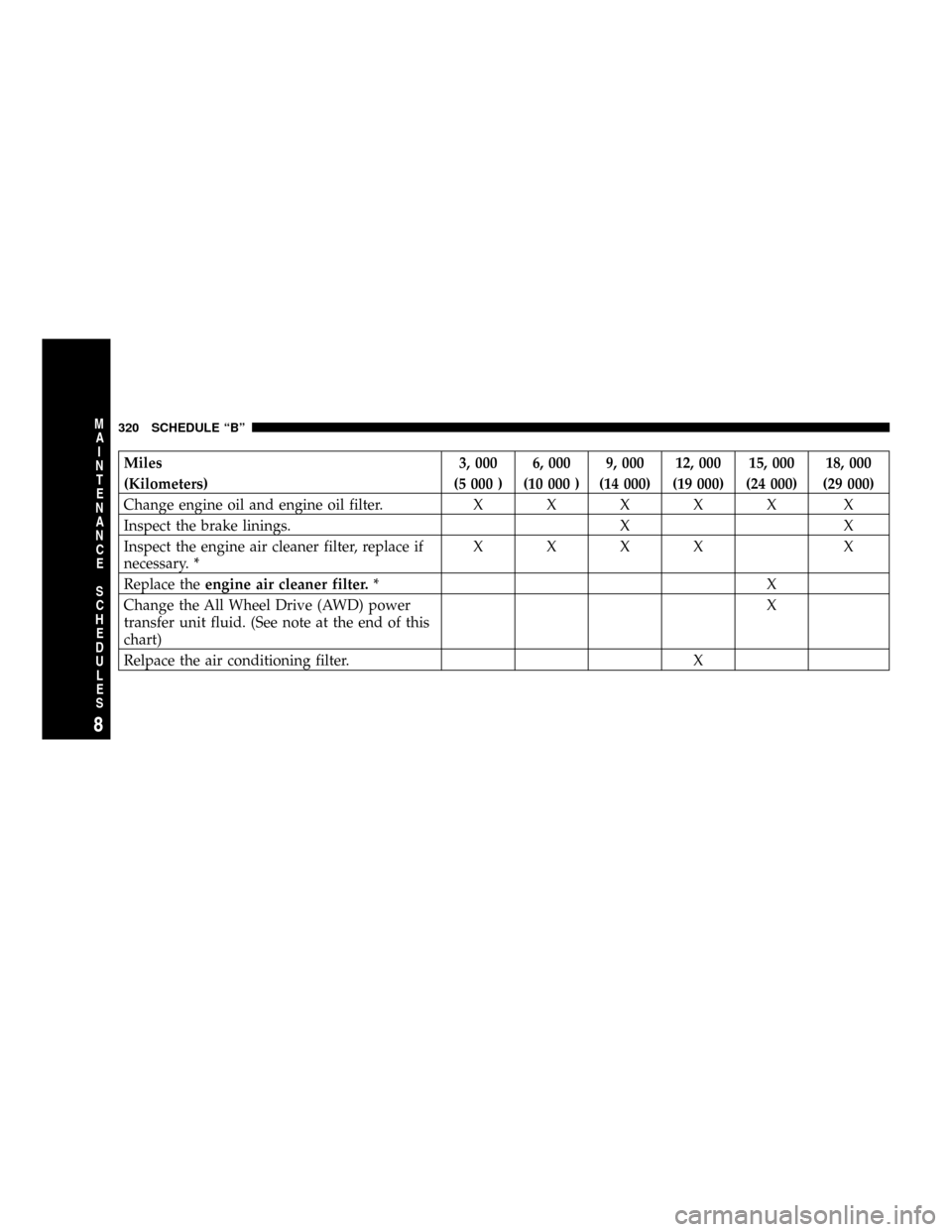
Miles 3, 000 6, 000 9, 000 12, 000 15, 000 18, 000
(Kilometers) (5 000 ) (10 000 ) (14 000) (19 000) (24 000) (29 000)
Change engine oil and engine oil filter.XXXXX X
Inspect the brake linings. X X
Inspect the engine air cleaner filter, replace if
necessary. *XXXX X
Replace theengine air cleaner filter.*X
Change the All Wheel Drive (AWD) power
transfer unit fluid. (See note at the end of this
chart)X
Relpace the air conditioning filter. X
320 SCHEDULE ªBº
8
M
A
I
N
T
E
N
A
N
C
E
S
C
H
E
D
U
L
E
S
Page 321 of 361
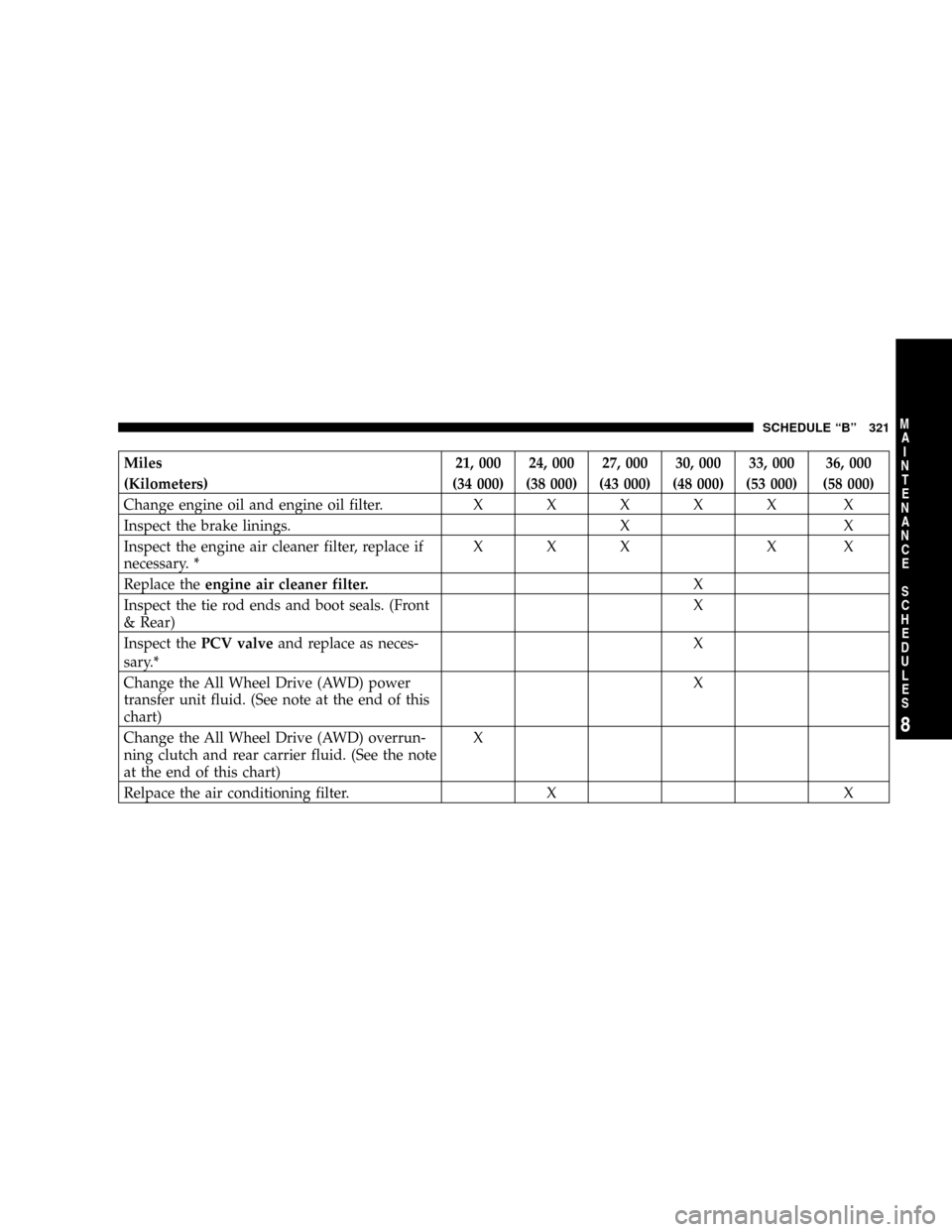
Miles 21, 000 24, 000 27, 000 30, 000 33, 000 36, 000
(Kilometers) (34 000) (38 000) (43 000) (48 000) (53 000) (58 000)
Change engine oil and engine oil filter.XXXXX X
Inspect the brake linings. X X
Inspect the engine air cleaner filter, replace if
necessary. *XXX X X
Replace theengine air cleaner filter.X
Inspect the tie rod ends and boot seals. (Front
& Rear)X
Inspect thePCV valveand replace as neces-
sary.*X
Change the All Wheel Drive (AWD) power
transfer unit fluid. (See note at the end of this
chart)X
Change the All Wheel Drive (AWD) overrun-
ning clutch and rear carrier fluid. (See the note
at the end of this chart)X
Relpace the air conditioning filter. X X
SCHEDULE ªBº 321
8
M
A
I
N
T
E
N
A
N
C
E
S
C
H
E
D
U
L
E
S
Page 322 of 361
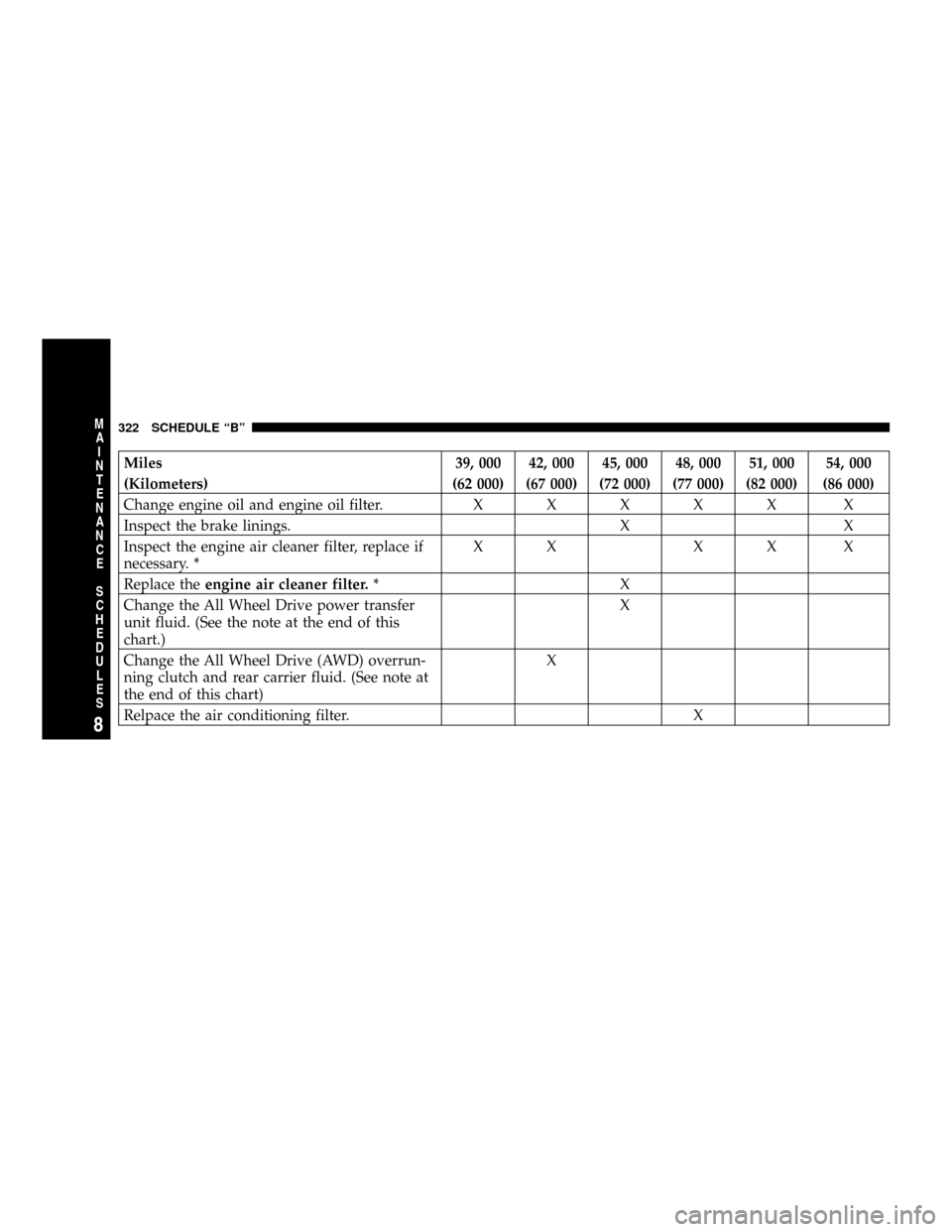
Miles 39, 000 42, 000 45, 000 48, 000 51, 000 54, 000
(Kilometers) (62 000) (67 000) (72 000) (77 000) (82 000) (86 000)
Change engine oil and engine oil filter.XXXXX X
Inspect the brake linings. X X
Inspect the engine air cleaner filter, replace if
necessary. *XX XX X
Replace theengine air cleaner filter.*X
Change the All Wheel Drive power transfer
unit fluid. (See the note at the end of this
chart.)X
Change the All Wheel Drive (AWD) overrun-
ning clutch and rear carrier fluid. (See note at
the end of this chart)X
Relpace the air conditioning filter. X
322 SCHEDULE ªBº
8
M
A
I
N
T
E
N
A
N
C
E
S
C
H
E
D
U
L
E
S