battery CHRYSLER VOYAGER 1996 Service Manual
[x] Cancel search | Manufacturer: CHRYSLER, Model Year: 1996, Model line: VOYAGER, Model: CHRYSLER VOYAGER 1996Pages: 1938, PDF Size: 55.84 MB
Page 769 of 1938

8W-45 BODY CONTROL MODULE
Component Page
A/C Heater Control..................8W-45-5, 6
Ash Receiver Lamp....................8W-45-5
Automatic Day/Night Mirror.............8W-45-8
Back-Up Switch.......................8W-45-9
Battery.............................8W-45-9
Body Control Module . .8W-45-2, 3, 4, 5, 6, 7, 8, 9, 10
BS02...............................8W-45-9
BS10...............................8W-45-8
BS30...............................8W-45-9
Clockspring..........................8W-45-3
Combination Flasher/DRL Module........8W-45-5
Controller Anti-Lock Brake..............8W-45-6
CS03...............................8W-45-8
Data Link Connector...................8W-45-3
Door Lock Relay......................8W-45-7
Door Unlock Relay....................8W-45-7
Driver Door Ajar Switch................8W-45-7
Driver Door Arm/Disarm Switch..........8W-45-8
Driver Door Lock Switch..............8W-45-6, 8
Driver Door Unlock Relay...............8W-45-7
Driver Power Mirror..................8W-45-10
Driver Power Window Switch............8W-45-6
Engine Coolant Temperature Sensor.......8W-45-9
Engine Oil Pressure Switch..............8W-45-7
ES01...............................8W-45-9
ES02...............................8W-45-9
Front Cigar Lighter/Power Outlet.........8W-45-5
Front Reading Lamps/Switch............8W-45-8
Front Wiper Switch....................8W-45-4
Fuel Tank Module...................8W-45-7, 9
Fuse 1 (JB)..........................8W-45-3
Fuse 2 (JB)..........................8W-45-2
Fuse 3 (JB)..........................8W-45-3
Fuse 6 (JB)..........................8W-45-2
Fuse 19 (PDC)........................8W-45-4
Fuse 22 (PDC)........................8W-45-3
Fuse 28 (PDC)........................8W-45-2
G100...............................8W-45-9
G103...............................8W-45-9
G300............................8W-45-2, 10
G302...............................8W-45-9
Glove Box Lamp......................8W-45-8
Headlamp Dimmer Switch..............8W-45-5
Headlamp Switch...............8W-45-2, 3, 4, 5
Hood Ajar Switch.....................8W-45-7
Horn Relay..........................8W-45-3
HVAC Control........................8W-45-6
Ignition Switch.....................8W-45-2, 5
Instrument Cluster....................8W-45-5
Junction Block...........8W-45-2, 3, 4, 5, 6, 7, 10
Key-In Halo Lamp....................8W-45-10Component Page
Left Mid Reading Lamp................8W-45-8
Left Rear Door Ajar Switch..............8W-45-8
Left Rear Reading Lamp................8W-45-8
Left Visor/Vanity Mirror Lamps..........8W-45-8
Liftgate Ajar Switch...................8W-45-7
Liftgate Arm/Disarm Switch.............8W-45-6
LJ01 B17..........................8W-45-4, 6
Low Beam Relay......................8W-45-5
Low Coolant Level Switch...............8W-45-9
Low Washer Fluid Switch...............8W-45-3
Memory Seat/Mirror Module...........8W-45-2, 6
Message Center.....................8W-45-5, 6
Park Lamp Relay.....................8W-45-3
Passenger Door Ajar Switch.............8W-45-7
Passenger Door Arm/Disarm Switch.......8W-45-8
Passenger Door Lock Switch...........8W-45-6, 8
Passenger Power Mirror...............8W-45-10
Passenger Power Window Switch.........8W-45-6
Power Distribution Center...........8W-45-2, 3, 4
Power Folding Mirror Switch...........8W-45-10
Power Mirror Fold Relay...............8W-45-10
Power Mirror Switch...................8W-45-5
Power Mirror Unfold Relay.............8W-45-10
Powertrain Control Module..............8W-45-9
PS01...............................8W-45-3
PS02...............................8W-45-3
PTC 3 (JB)..........................8W-45-7
Radio.............................8W-45-4, 5
Rear Blower Front Control Switch........8W-45-5
Rear Blower Rear Control Switch.........8W-45-6
Rear Washer Motor....................8W-45-4
Rear Wiper Motor.....................8W-45-4
Remote Keyless Entry Module...........8W-45-6
Right Mid Reading Lamp...............8W-45-8
Right Rear Door Ajar Switch.............8W-45-8
Right Rear Reading Lamp...............8W-45-8
Right Visor/Vanity Mirror Lamps.........8W-45-8
Seat Belt Switch......................8W-45-7
Traction Control Switch.................8W-45-5
Universal Garage Door Opener...........8W-45-6
Wiper Module........................8W-45-3
Wiper On Relay.......................8W-45-4
NS/GS8W - 45 BODY CONTROL MODULE 8W - 45 - 1
Page 777 of 1938

3
57
G18
20
PK/BK
C1
MODULE TANK
FUEL
2
2
BACK-UP
SWITCH
BS02
10B33 E120
VT/BK20L1
SIGNAL SENSORLEVELFUEL BACK-UP
LAMP
FEED
G302
5
GROUND
1
Z1
16
BK
L1
20
VT/BK
VT/BK18L1
G4
18
DB
C146FUEL
LEVEL
SENSOR
SIGNAL SENSESWITCHLEVEL COOLANT
1
SWITCH
LEVEL
COOLANT
LOW
2B33
E120
PK/BK20 G18
(DIESEL)2
Z1
20
BK
ES02
ES01
BK16Z1
BATTERY
Z0
2
BK
G103 G100
BK6 Z0
Z1
10
BK
27SPEED
CONTROL
LAMP
DRIVER
C1
LB/RD20 V38
56
(DIESEL) MODULE
CONTROL
POWERTRAIN
3 60
G58
20
BK/YL
C1
SIGNAL SENSOR TEMPERATURECOOLANT
3
COOLANT
TEMPERATURE
SENSOR
(DIESEL)DRIVERLAMP CONTROLSPEED75
K159
20
VT/RD
C1
SIGNAL SENSORSPEED ENGINE
2
59ENGINE
DISABLE
SIGNAL
C1
OR/BK20 G55
72
ENGINE
SPEED
SENSOR
SIGNAL
BODY
CONTROL
MODULE
SIGNAL SENSORSPEED VEHICLE
43VEHICLE
SPEED
SENSOR
SIGNAL
C1
WT/OR18 G7
42
G7
18
WT/OR
BS30
G4
18
DB
ENGINE
2B13
AW4
3B13
AW4
1B13
AW4
Z1
14
BK
(DIESEL)
SIGNAL DISABLEENGINE
BACK-UP
LAMP
FEEDENGINE
COOLANT
TEMPERATURE
SIGNAL
SIGNAL ENGINE
(8W-51-5)
(8W-70-2)
(8W-15-13) (8W-15-3)
(8W-15-3)
(8W-20-3) (8W-30-36)
(8W-30-36) (8W-30-36)
NS/GS8W-45 BODY CONTROL MODULE 8W - 45 - 9
GS004509J988W-3
Page 943 of 1938

CENTER - C6 DISTRIBUTIONPOWER
K51 20DB/YL ASD RELAY CONTROL A/C COMPRESSOR CLUTCH RELAY CONTROL C13 20DB/ORGROUND Z1 20BKFUSED IGNITION "C" (7.5A) A142 18DG/OR
10 61 5LT. GREEN
A14 18RD/WT K51 18DB/YL C13 18DB/OR F87 18WT/BK A142 18DG/OR K90 18TN K31 18BR C3 18DB/BK F87 18BK/WT
109 8 7 6 5 4 3 2 1 CAV FUSED B(+) ASD RELAY CONTROL A/C COMPRESSOR CLUTCH RELAY CONTROL FUSED IGNITION SWITCH OUTPUT (RUN/START) ASD RELAY OUTPUT ENGINE STARTER MOTOR RELAY CONTROL FUEL PUMP RELAY CONTROL A/C COMPRESSOR CLUTCH RELAY OUTPUT FUSED IGNITION "C" (7.5A)
- FUNCTION
- CIRCUIT
* EXCEPT BUILT-UP-EXPORT
** BUILT-UP-EXPORT
DIESEL
GAS 1
3
7
8 FUSED IGNITION SWITCH OUTPUT (RUN) F23 18DB/YL**
CENTER - C5 DISTRIBUTIONPOWER
FUSED IGNITION SWITCH OUTPUT (ST-RUN) 2
F14 18LG/YL**
HIGH BEAM RELAY OUTPUT L34 20RD/OR 10 61 5LT. GRAY
F23 20DB/YL* L9 18BK/WT L43 18VT
V14 18RD/VT L34 20RD/OR V16 20WT
V4 12RD/YL V3 12BR/WT F14 20LG/YL* L33 20RD
109 8 7 6 5 4 3 1 CAV FUSED IGNITION SWITCH OUTPUT (RUN) FUSED HAZARD FLASHER FEED (DEDICATED) LOW BEAM RELAY OUTPUT
WIPER ON RELAY DRIVER HIGH BEAM RELAY OUTPUT WIPER HIGH/LOW RELAY DRIVER
WIPER HIGH/LOW RELAY OUTPUT (HIGH) WIPER HIGH/LOW RELAY OUTPUT (LOW) FUSED IGNITION SWITCH OUTPUT (ST-RUN) HIGH BEAM RELAY OUTPUT CIRCUIT
FUNCTION
CENTER - C4 DISTRIBUTIONPOWER
1 4
3 BLACK
6
A10 12RD/DG A2 12PK/BK A1 12RD Z1 18BK A22 12BK/OR
6 5 4
3 2 1 CAV FUSED LINK TO ABS PUMP MOTOR RELAY
BATTERY FEED TO IGNITION SWITCH FUSED B (+) GROUND IGNITION SWITCH RUN ONLY FEED
- CIRCUIT
- FUNCTION
NS/GS8W-80 CONNECTOR PIN-OUTS 8W - 80 - 67
NSGS8067J988W-3
Page 1025 of 1938

8W-95 SPLICE LOCATIONS
INDEX
page page
DESCRIPTION AND OPERATION
INTRODUCTION......................... 1SPLICE LOCATION INDEX.................. 1
SPLICE LOCATIONS (RHD)................ 15
DESCRIPTION AND OPERATION
INTRODUCTION
This section provides illustrations identifying the
general location of the splices in this vehicle. A spliceindex is provided. Use the wiring diagrams in each
section for splice number identification. Refer to the
index for the proper splice number.
SPLICE LOCATION INDEX
Splice Number Location Fig.
BS01 Near Split for Tail Lamps 12
BS02 Near Fuel Tank T/O 12
BS03 Near Instrument Panel T/O 9
BS05 Near Instrument Panel T/O 9
BS05 (2.5L) Near MSA Controller T/O N/S
BS06 Near Instrument Panel T/O 9
BS06 (2.5L) Near MSA Controller T/O N/S
BS08 Near Instrument Panel T/O 9
BS16 Near Right Park Lamp T/O 1
BS17 Near Split for Tail Lamps 12
BS19 Near Horn T/O 1
BS30 (2.5L) Near Generator T/O 5
BS31 Near Left Headlamp Leveling
Motor T/O1
BS31 (2.5L) In BCM T/O 5
BS32 (2.5L) In BCM T/O N/S
BS33 (2.5L) In BCM T/O N/S
BS34 (2.5L) In BCM T/O N/S
BS40 (2.5L) In Engine Harness T/O 5
BS41 (2.5L) In Engine Harness T/O N/S
CS01 Above Right Rear Door 11
CS02 Above Right Rear Door 11
CS03 Right B-Pillar 11
CS04 Right B-Pillar 11
DS01 Near LT Power WDO T/O 10
ES01 In TCM T/O 7
ES01 (2.5L) Near Battery Positive Terminal
T/ON/SSplice Number Location Fig.
ES02 (2.0L) Near Camshaft Position
Sensor T/O3
ES02 (2.4L) Near Fuel Rail T/O 4
ES02 (2.5L) Near Engine Speed Sensor
T/O5
ES02
(3.3L,3.8L)Near Transmission T/O 6
ES03 (2.0L) Near Distributor Coil T/O 2
ES03 (2.4L) Near PDC T/O 4
ES03
(3.3L,3.8L)Near Body Ground T/O 7
ES05 (2.4L) Near Knock Sensor T/O 4
ES05 (2.5L) In Fuel Injection Pump T/O 5
ES05
(3.3L,3.8L)Near Transmission T/O 6
ES06 (2.5L) Near Needle Movement
Sensor T/O5
ES06
(3.3L,3.8L)Near Transmission T/O N/S
ES07 (2.0L) Near Engine Ground T/O 2
ES07 (2.5L) Near Battery Negative
Terminal T/ON/S
ES07 (2.4L) Near Body Ground T/O 4, 7
ES07
(3.3L,3.8L)Near Battery Negative
Terminal T/O6
ES08
(3.3L,3.8L)Near Transmission T/O 6
ES09 (2.0L) In Battery Positive Terminal
T/O7
ES09 (2.4L) Near Battery Positive Terminal 4
NS/GS8W - 95 SPLICE LOCATIONS 8W - 95 - 1
Page 1026 of 1938

Splice Number Location Fig.
ES09 (2.5L) In Battery Positive Terminal
T/ON/S
ES09
(3.3L,3.8L)In Battery Positive Terminal
T/O7
ES10 Near Knock Sensor T/O 6
ES10
(3.3L,3.8L)Near Transmission T/O 7
ES11 (2.0L) Near Battery Positive Terminal
T/O7
ES11 (2.4L) Near Battery Negative
Terminal T/O4
ES11 (2.5L) In Generator T/O N/S
ES11
(3.3L,3.8L)Near Battery Negative
Terminal7
ES12 (2.4L) Near Throttle Body T/O 4
ES12 (2.5L) Near Battery Negative
Terminal T/ON/S
ES12
(3.3L,3.8L)Near Battery Positive Terminal
T/O7
ES13 (2.4L) Near Generator T/O 4
ES13
(3.3L,3.8L)Near Battery Negative
Terminal T/O7
ES14 (2.4L) Near Generator T/O 4,7
ES14
(3.3L,3.8L)Near Battery Negative
Terminal T/O7
ES17 (2.0L) Near Camshaft Position
Sensor T/O3
ES17 (2.4L) Near Engine Ground T/O 4
ES17
(3.3L,3.8L)Near Battery Negative
Terminal T/O7
ES18 (2.0L) Near Camshaft Position
Sensor T/O3
ES18 (2.4L) Near Engine Ground T/O 4
ES18
(3.3L,3.8L)Near Engine Ground T/O 7Splice Number Location Fig.
ES21 (2.0L) Near Body Ground T/O N/S
ES21 (2.4L) Near Engine Ground T/O 4
ES21
(3.3L,3.8L)Near A/C Clutch T/O 6
ES23 (2.0L) Near Radiator Fan T/O N/S
ES23 (2.4L) Near Radiator Fan T/O 4
ES23
(3.3L,3.8L)Near Engine ground T/O 7
ES24 (2.4L) Near Transmission T/O 4
ES24
(3.3L,3.8L)Near Transmission T/O 7
ES26 (2.5L) In Battery Positive Terminal
T/ON/S
ES28 (2.5L) In Battery Positive Terminal
T/ON/S
ES29 (2.5L) Near Glow Plug Relay T/O N/S
ES30 (2.5L) Near Fuel Heater T/O 5
ES31 (2.5L) Near Fuel Heater T/O 5
ES37 (2.5L) Near Oil Pressure Switch T/O 5
ES40 (2.5L) Near Fuel Injection Pump T/O 5
ES99 (2.0L) Near Knock Sensor T/O 2
FS01 (2.4L) Near ECT Sensor T/O N/S
FS01
(3.3L,3.8L)Near Injector #5 T/O N/S
FS02 (2.4L) Near Inj #2 T/O N/S
FS02
(3.3L,3.8L)Between Inj's 4 and 6 N/S
FS03 (2.4L) Between Inj #2 and #3 N/S
PS01 Near Steering Column T/O 8
PS02 Near Steering Column T/O 8
RFS01 Near Radiator Fan #2 N/S
RFS02 Near Radiator Fan #1 N/S
8W - 95 - 2 8W - 95 SPLICE LOCATIONSNS/GS
DESCRIPTION AND OPERATION (Continued)
Page 1039 of 1938
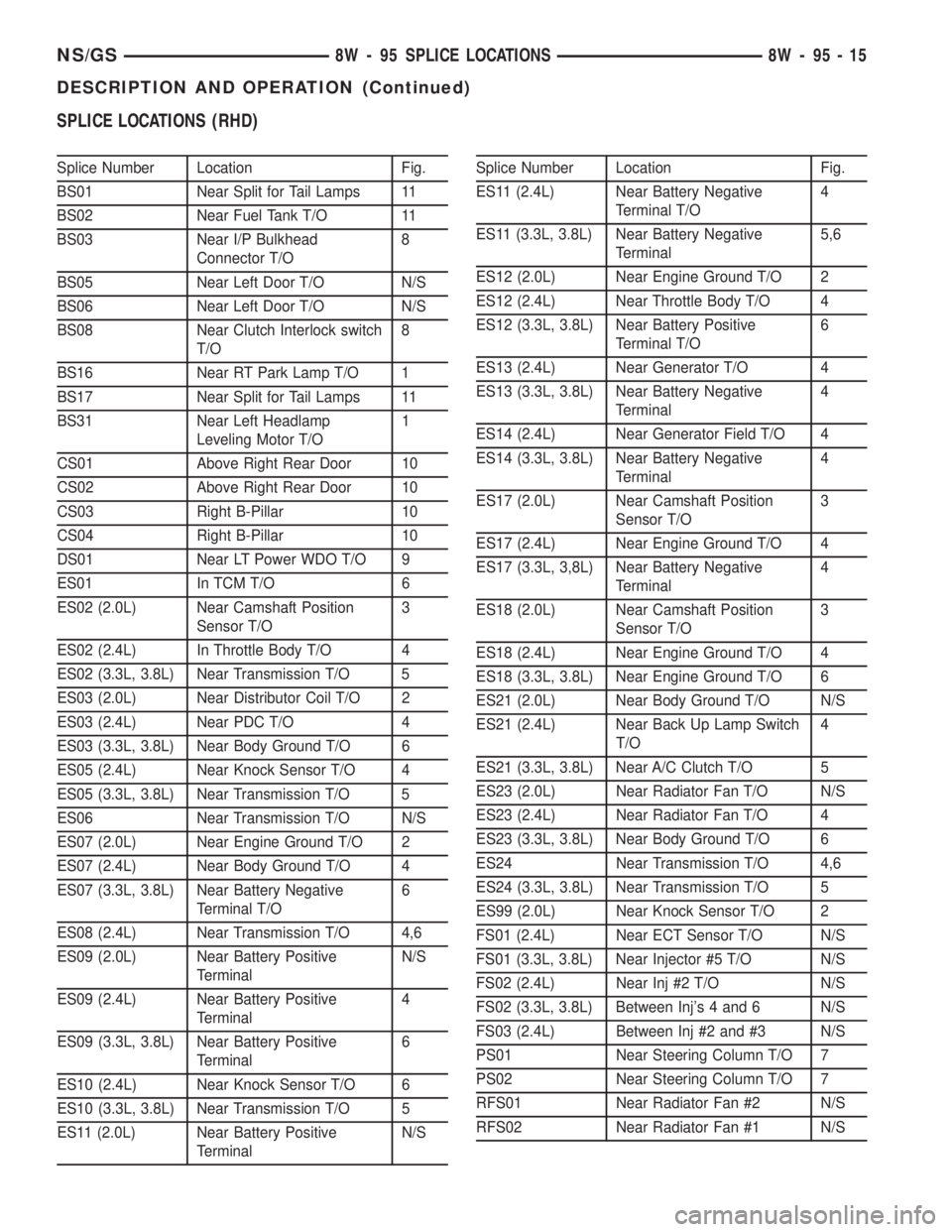
SPLICE LOCATIONS (RHD)
Splice Number Location Fig.
BS01 Near Split for Tail Lamps 11
BS02 Near Fuel Tank T/O 11
BS03 Near I/P Bulkhead
Connector T/O8
BS05 Near Left Door T/O N/S
BS06 Near Left Door T/O N/S
BS08 Near Clutch Interlock switch
T/O8
BS16 Near RT Park Lamp T/O 1
BS17 Near Split for Tail Lamps 11
BS31 Near Left Headlamp
Leveling Motor T/O1
CS01 Above Right Rear Door 10
CS02 Above Right Rear Door 10
CS03 Right B-Pillar 10
CS04 Right B-Pillar 10
DS01 Near LT Power WDO T/O 9
ES01 In TCM T/O 6
ES02 (2.0L) Near Camshaft Position
Sensor T/O3
ES02 (2.4L) In Throttle Body T/O 4
ES02 (3.3L, 3.8L) Near Transmission T/O 5
ES03 (2.0L) Near Distributor Coil T/O 2
ES03 (2.4L) Near PDC T/O 4
ES03 (3.3L, 3.8L) Near Body Ground T/O 6
ES05 (2.4L) Near Knock Sensor T/O 4
ES05 (3.3L, 3.8L) Near Transmission T/O 5
ES06 Near Transmission T/O N/S
ES07 (2.0L) Near Engine Ground T/O 2
ES07 (2.4L) Near Body Ground T/O 4
ES07 (3.3L, 3.8L) Near Battery Negative
Terminal T/O6
ES08 (2.4L) Near Transmission T/O 4,6
ES09 (2.0L) Near Battery Positive
TerminalN/S
ES09 (2.4L) Near Battery Positive
Terminal4
ES09 (3.3L, 3.8L) Near Battery Positive
Terminal6
ES10 (2.4L) Near Knock Sensor T/O 6
ES10 (3.3L, 3.8L) Near Transmission T/O 5
ES11 (2.0L) Near Battery Positive
TerminalN/SSplice Number Location Fig.
ES11 (2.4L) Near Battery Negative
Terminal T/O4
ES11 (3.3L, 3.8L) Near Battery Negative
Terminal5,6
ES12 (2.0L) Near Engine Ground T/O 2
ES12 (2.4L) Near Throttle Body T/O 4
ES12 (3.3L, 3.8L) Near Battery Positive
Terminal T/O6
ES13 (2.4L) Near Generator T/O 4
ES13 (3.3L, 3.8L) Near Battery Negative
Terminal4
ES14 (2.4L) Near Generator Field T/O 4
ES14 (3.3L, 3.8L) Near Battery Negative
Terminal4
ES17 (2.0L) Near Camshaft Position
Sensor T/O3
ES17 (2.4L) Near Engine Ground T/O 4
ES17 (3.3L, 3,8L) Near Battery Negative
Terminal4
ES18 (2.0L) Near Camshaft Position
Sensor T/O3
ES18 (2.4L) Near Engine Ground T/O 4
ES18 (3.3L, 3.8L) Near Engine Ground T/O 6
ES21 (2.0L) Near Body Ground T/O N/S
ES21 (2.4L) Near Back Up Lamp Switch
T/O4
ES21 (3.3L, 3.8L) Near A/C Clutch T/O 5
ES23 (2.0L) Near Radiator Fan T/O N/S
ES23 (2.4L) Near Radiator Fan T/O 4
ES23 (3.3L, 3.8L) Near Body Ground T/O 6
ES24 Near Transmission T/O 4,6
ES24 (3.3L, 3.8L) Near Transmission T/O 5
ES99 (2.0L) Near Knock Sensor T/O 2
FS01 (2.4L) Near ECT Sensor T/O N/S
FS01 (3.3L, 3.8L) Near Injector #5 T/O N/S
FS02 (2.4L) Near Inj #2 T/O N/S
FS02 (3.3L, 3.8L) Between Inj's 4 and 6 N/S
FS03 (2.4L) Between Inj #2 and #3 N/S
PS01 Near Steering Column T/O 7
PS02 Near Steering Column T/O 7
RFS01 Near Radiator Fan #2 N/S
RFS02 Near Radiator Fan #1 N/S
NS/GS8W - 95 SPLICE LOCATIONS 8W - 95 - 15
DESCRIPTION AND OPERATION (Continued)
Page 1055 of 1938
CAUTION: Be sure that the tapped holes maintain
the original centerline.
Heli-Coil tools and inserts are readily available
from automotive parts jobbers.
HYDROSTATIC LOCKED ENGINE
When an engine is suspected to be hydrostatically
locked, regardless of what caused the problem, these
steps should be used.
CAUTION: Do Not Use Starter Motor To Rotate
Engine, severe damage may occur.
(1) Inspect air cleaner, induction system and
intake manifold to insure system is dry and clear of
foreign material.
(2) Remove negative battery cable.
(3) Place a shop towel around the spark plugs
when removing them from the engine. This will catch
any fluid that may possibly be in the cylinder under
pressure.
(4) With all spark plugs removed, rotate engine
crankshaft using a breaker bar and socket.
(5) Identify the fluid in the cylinder(s) (i.e., cool-
ant, fuel, oil or other).
(6) Make sure all fluid has been removed from the
cylinders. Inspect engine for damage (i.e., Connecting
Rods, Pistons, Valves etc.)
(7) Repair engine or components as necessary to
prevent this problem from occurring again.
CAUTION: Squirt approximately 1 teaspoon of oil
into cylinders, rotate engine to lubricate the cylin-
der walls to prevent damage on restart.
(8) Install new spark plugs.
(9) Drain engine oil and remove oil filter.
(10) Fill engine with specified amount of approved
oil and install new oil filter.
(11) Connect negative battery cable.
(12) Start engine and check for any leaks.
ENGINE OIL
Checking Oil Level
To assure proper engine lubrication, the engine oil
must be maintained at the correct level. Check the
oil level at regular intervals, such as every fuel stop.
The best time to check the oil level is about 5 min-
utes after a fully warmed-up engine is shut off, or
before starting the vehicle after it has sat overnight.
Checking the oil while the vehicle is on level
ground, will improve the accuracy of the oil level
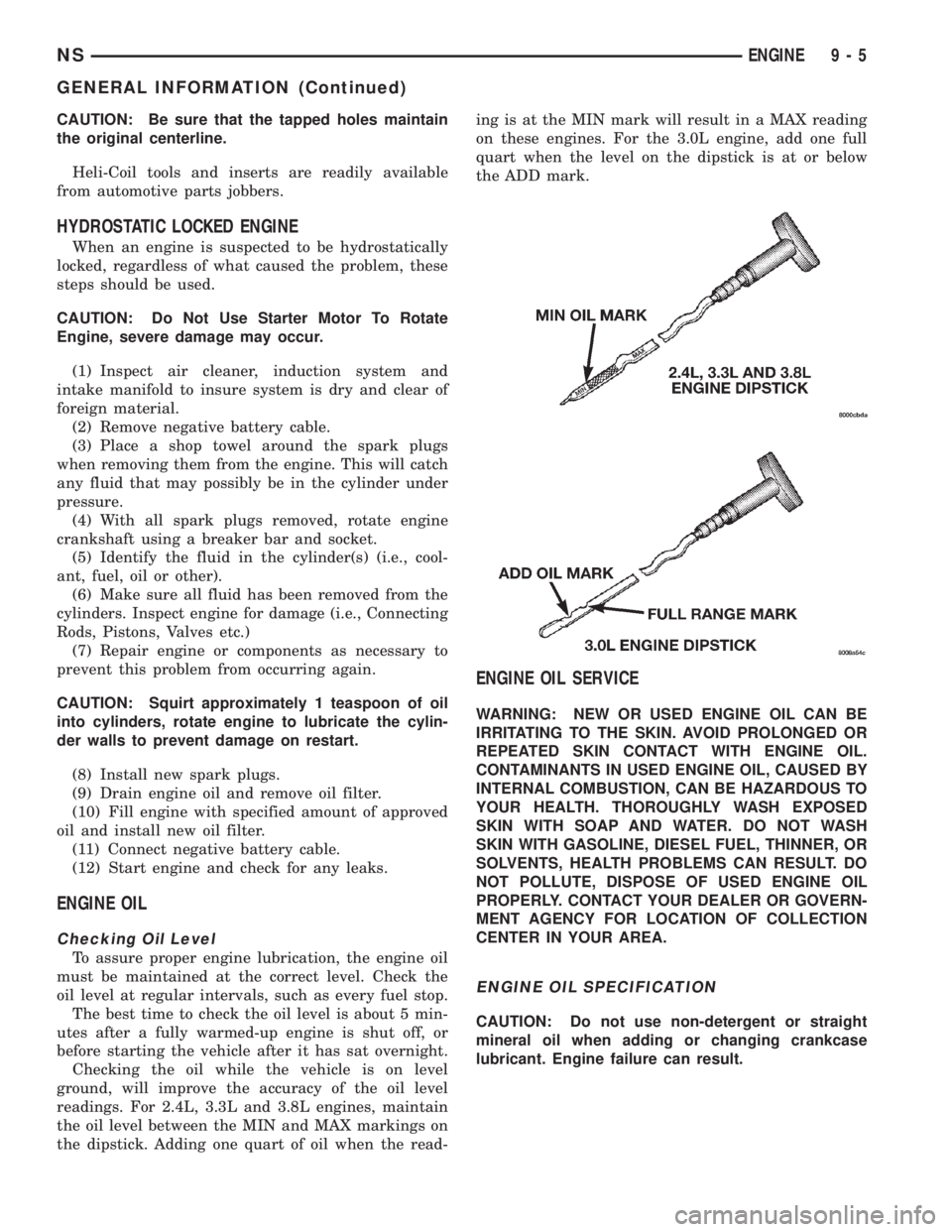
readings. For 2.4L, 3.3L and 3.8L engines, maintain
the oil level between the MIN and MAX markings on
the dipstick. Adding one quart of oil when the read-ing is at the MIN mark will result in a MAX reading
on these engines. For the 3.0L engine, add one full
quart when the level on the dipstick is at or below
the ADD mark.
ENGINE OIL SERVICE
WARNING: NEW OR USED ENGINE OIL CAN BE
IRRITATING TO THE SKIN. AVOID PROLONGED OR
REPEATED SKIN CONTACT WITH ENGINE OIL.
CONTAMINANTS IN USED ENGINE OIL, CAUSED BY
INTERNAL COMBUSTION, CAN BE HAZARDOUS TO
YOUR HEALTH. THOROUGHLY WASH EXPOSED
SKIN WITH SOAP AND WATER. DO NOT WASH
SKIN WITH GASOLINE, DIESEL FUEL, THINNER, OR
SOLVENTS, HEALTH PROBLEMS CAN RESULT. DO
NOT POLLUTE, DISPOSE OF USED ENGINE OIL
PROPERLY. CONTACT YOUR DEALER OR GOVERN-
MENT AGENCY FOR LOCATION OF COLLECTION
CENTER IN YOUR AREA.
ENGINE OIL SPECIFICATION
CAUTION: Do not use non-detergent or straight
mineral oil when adding or changing crankcase
lubricant. Engine failure can result.
NSENGINE 9 - 5
GENERAL INFORMATION (Continued)
Page 1057 of 1938
ENGINE DIAGNOSIS
INDEX
page page
DIAGNOSIS AND TESTING
CYLINDER COMBUSTION
PRESSURE LEAKAGE TEST.............. 8
CYLINDER COMPRESSION PRESSURE TEST . . 7
ENGINE DIAGNOSISÐMECHANICAL......... 12
ENGINE DIAGNOSISÐPERFORMANCE...... 10GENERAL INFORMATION.................. 7
INSPECTION
(ENGINE OIL LEAKS IN GENERAL)......... 8
INTAKE MANIFOLD LEAKAGE DIAGNOSIS..... 7
LASH ADJUSTER (TAPPET)
NOISE DIAGNOSIS...................... 8
DIAGNOSIS AND TESTING
GENERAL INFORMATION
Engine diagnosis is helpful in determining the
causes of malfunctions.
These malfunctions may be classified as either
mechanical (e.g., a strange noise), or performance
(e.g., engine idles rough and stalls).
Refer to the Service DiagnosisÐMechanical Chart
and the Service DiagnosisÐPerformance Chart, for
possible causes and corrections of malfunctions. Refer
to Group 14, Fuel System, for the fuel system diag-
nosis.
Additional tests and diagnostic procedures may be
necessary for specific engine malfunctions that can-
not be isolated with the Service Diagnosis charts.
Information concerning additional tests and diagno-
sis is provided within the following:
²Cylinder Compression Pressure Test
²Cylinder Combustion Pressure Leakage Test
²Engine Cylinder Head Gasket Failure Diagnosis
²Intake Manifold Leakage Diagnosis
INTAKE MANIFOLD LEAKAGE DIAGNOSIS
An intake manifold air leak is characterized by
lower than normal manifold vacuum. Also, one or
more cylinders may not be functioning.
WARNING: USE EXTREME CAUTION WHEN THE
ENGINE IS OPERATING. DO NOT STAND IN A
DIRECT LINE WITH THE FAN. DO NOT PUT YOUR
HANDS NEAR THE PULLEYS, BELTS OR THE FAN.
DO NOT WEAR LOOSE CLOTHING.
(1) Start the engine.
(2) Spray a small stream of water (Spray Bottle) at
the suspected leak area.
(3) If a change in RPM'S, the area of the suspected
leak has been found.
(4) Repair as required.
CYLINDER COMPRESSION PRESSURE TEST
The results of a cylinder compression pressure test
can be utilized to diagnose several engine malfunc-
tions.
Ensure the battery is completely charged and the
engine starter motor is in good operating condition.
Otherwise the indicated compression pressures may
not be valid for diagnosis purposes.
(1) Check engine oil level and add oil if necessary.
(2) Drive the vehicle until engine reaches normal
operating temperature. Select a route free from traf-
fic and other forms of congestion, observe all traffic
laws, and accelerate through the gears several times
briskly.
(3) Remove all spark plugs from engine. As spark
plugs are being removed, check electrodes for abnor-
mal firing indicators fouled, hot, oily, etc. Record cyl-
inder number of spark plug for future reference.
(4) Disconnect coil wire from distributor and
secure to good ground to prevent a spark from start-
ing a fire (Conventional Ignition System). For Direct
Ignition System DIS disconnect the coil connector.
(5) Be sure throttle blade is fully open during the
compression check.
(6) Insert compression gage adaptor into the #1
spark plug hole in cylinder head. Crank engine until
maximum pressure is reached on gage. Record this
pressure as #1 cylinder pressure.
(7) Repeat the previous step for all remaining cyl-
inders.
(8) Compression should not be less than (689kPa)
100 psi and not vary more than 25 percent from cyl-
inder to cylinder.
(9) If one or more cylinders have abnormally low
compression pressures, repeat the compression test.
(10) If the same cylinder or cylinders repeat an
abnormally low reading on the second compression
test, it could indicate the existence of a problem in
the cylinder in question.The recommended com-
pression pressures are to be used only as a
guide to diagnosing engine problems. An engine
should not be disassembled to determine the
NSENGINE 9 - 7
Page 1059 of 1938
(2) Add an oil soluble dye (use as recommended by
manufacturer). Start the engine and let idle for
approximately 15 minutes. Check the oil dipstick to
make sure the dye is thoroughly mixed as indicated
with a bright yellow color under a black light.
(3) Using a black light, inspect the entire engine
for fluorescent dye, particularly at the suspected area
of oil leak. If the oil leak is found and identified,
repair per service manual instructions.
(4) If dye is not observed, drive the vehicle at var-
ious speeds for approximately 24km (15 miles), and
repeat inspection.
(5)If the oil leak source is not positively
identified at this time, proceed with the air leak
detection test method as follows:
(6) Disconnect the fresh air hose (makeup air) at
the cylinder head cover and plug or cap the nipple on
the cover.
(7) Remove the PCV valve hose from the cylinder
head cover. Cap or plug the PCV valve nipple on the
cover.
(8) Attach an air hose with pressure gauge and
regulator to the dipstick tube.
CAUTION: Do not subject the engine assembly to
more than 20.6 kpa (3 PSI) of test pressure.
(9) Gradually apply air pressure from 1 psi to 2.5
psi maximum while applying soapy water at the sus-
pected source. Adjust the regulator to the suitable
test pressure that provide the best bubbles which
will pinpoint the leak source. If the oil leak is
detected and identified, repair per service manual
procedures.
(10) If the leakage occurs at the rear oil seal area,
refer to the section, Inspection for Rear Seal Area
Leak.
(11) If no leaks are detected, turn off the air sup-
ply and remove the air hose and all plugs and caps.
Install the PCV valve and breather cap hose. Proceed
to next step.
(12) Clean the oil off the suspect oil leak area
using a suitable solvent. Drive the vehicle at various
speeds approximately 24 km (15 miles). Inspect the
engine for signs of an oil leak by using a black light.INSPECTION FOR REAR SEAL AREA LEAKS
Since it is sometimes difficult to determine the
source of an oil leak in the rear seal area of the
engine, a more involved inspection is necessary. The
following steps should be followed to help pinpoint
the source of the leak.
If the leakage occurs at the crankshaft rear oil seal
area:
(1) Disconnect the battery.
(2) Raise the vehicle.
(3) Remove torque converter or clutch housing
cover and inspect rear of block for evidence of oil.
Use a black light to check for the oil leak. If a leak is
present in this area remove transmission for further
inspection.
(a) Circular spray pattern generally indicates
seal leakage or crankshaft damage.
(b) Where leakage tends to run straight down,
possible causes are a porous block, oil galley cup
plug, bedplate to cylinder block mating surfaces
and seal bore. See proper repair procedures for
these items.
(4) If no leaks are detected, pressurized the crank-
case as outlined in the, Inspection (Engine oil Leaks
in general)
CAUTION: Do not exceed 20.6 kPa (3 psi).
(5) If the leak is not detected, very slowly turn the
crankshaft and watch for leakage. If a leak is
detected between the crankshaft and seal while
slowly turning the crankshaft, it is possible the
crankshaft seal surface is damaged. The seal area on
the crankshaft could have minor nicks or scratches
that can be polished out with emery cloth.
CAUTION: Use extreme caution when crankshaft
polishing is necessary to remove minor nicks and
scratches. The crankshaft seal flange is especially
machined to complement the function of the rear oil
seal.
(6) For bubbles that remain steady with shaft
rotation, no further inspection can be done until dis-
assembled.
(7) After the oil leak root cause and appropriate
corrective action have been identified. Refer to Rear
Crankshaft Seals, for proper replacement procedures.
NSENGINE 9 - 9
DIAGNOSIS AND TESTING (Continued)
Page 1060 of 1938
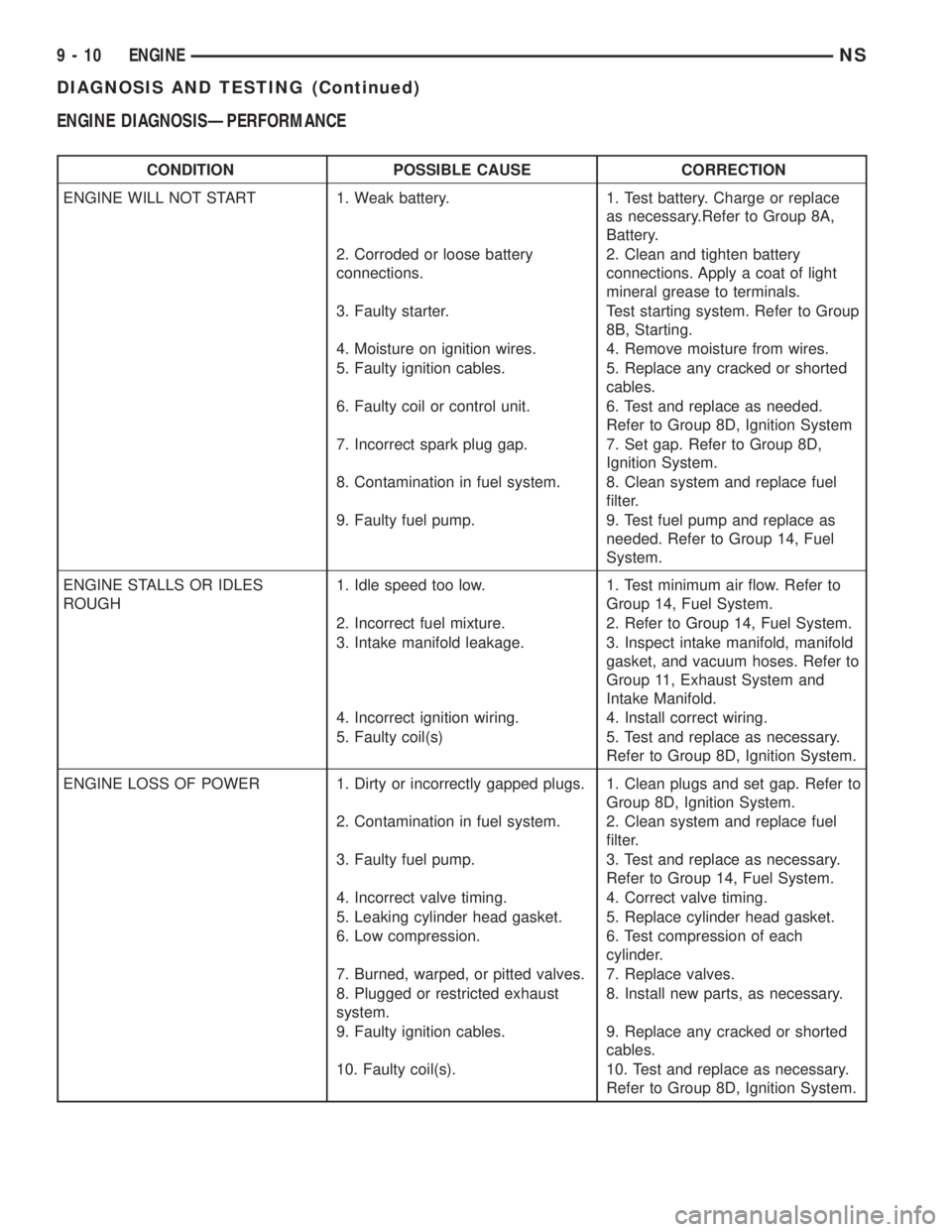
ENGINE DIAGNOSISÐPERFORMANCE
CONDITION POSSIBLE CAUSE CORRECTION
ENGINE WILL NOT START 1. Weak battery. 1. Test battery. Charge or replace
as necessary.Refer to Group 8A,
Battery.
2. Corroded or loose battery
connections.2. Clean and tighten battery
connections. Apply a coat of light
mineral grease to terminals.
3. Faulty starter. Test starting system. Refer to Group
8B, Starting.
4. Moisture on ignition wires. 4. Remove moisture from wires.
5. Faulty ignition cables. 5. Replace any cracked or shorted
cables.
6. Faulty coil or control unit. 6. Test and replace as needed.
Refer to Group 8D, Ignition System
7. Incorrect spark plug gap. 7. Set gap. Refer to Group 8D,
Ignition System.
8. Contamination in fuel system. 8. Clean system and replace fuel
filter.
9. Faulty fuel pump. 9. Test fuel pump and replace as
needed. Refer to Group 14, Fuel
System.
ENGINE STALLS OR IDLES
ROUGH1. Idle speed too low. 1. Test minimum air flow. Refer to
Group 14, Fuel System.
2. Incorrect fuel mixture. 2. Refer to Group 14, Fuel System.
3. Intake manifold leakage. 3. Inspect intake manifold, manifold
gasket, and vacuum hoses. Refer to
Group 11, Exhaust System and
Intake Manifold.
4. Incorrect ignition wiring. 4. Install correct wiring.
5. Faulty coil(s) 5. Test and replace as necessary.
Refer to Group 8D, Ignition System.
ENGINE LOSS OF POWER 1. Dirty or incorrectly gapped plugs. 1. Clean plugs and set gap. Refer to
Group 8D, Ignition System.
2. Contamination in fuel system. 2. Clean system and replace fuel
filter.
3. Faulty fuel pump. 3. Test and replace as necessary.
Refer to Group 14, Fuel System.
4. Incorrect valve timing. 4. Correct valve timing.
5. Leaking cylinder head gasket. 5. Replace cylinder head gasket.
6. Low compression. 6. Test compression of each
cylinder.
7. Burned, warped, or pitted valves. 7. Replace valves.
8. Plugged or restricted exhaust
system.8. Install new parts, as necessary.
9. Faulty ignition cables. 9. Replace any cracked or shorted
cables.
10. Faulty coil(s). 10. Test and replace as necessary.
Refer to Group 8D, Ignition System.
9 - 10 ENGINENS
DIAGNOSIS AND TESTING (Continued)