ABS CHRYSLER VOYAGER 1996 User Guide
[x] Cancel search | Manufacturer: CHRYSLER, Model Year: 1996, Model line: VOYAGER, Model: CHRYSLER VOYAGER 1996Pages: 1938, PDF Size: 55.84 MB
Page 76 of 1938
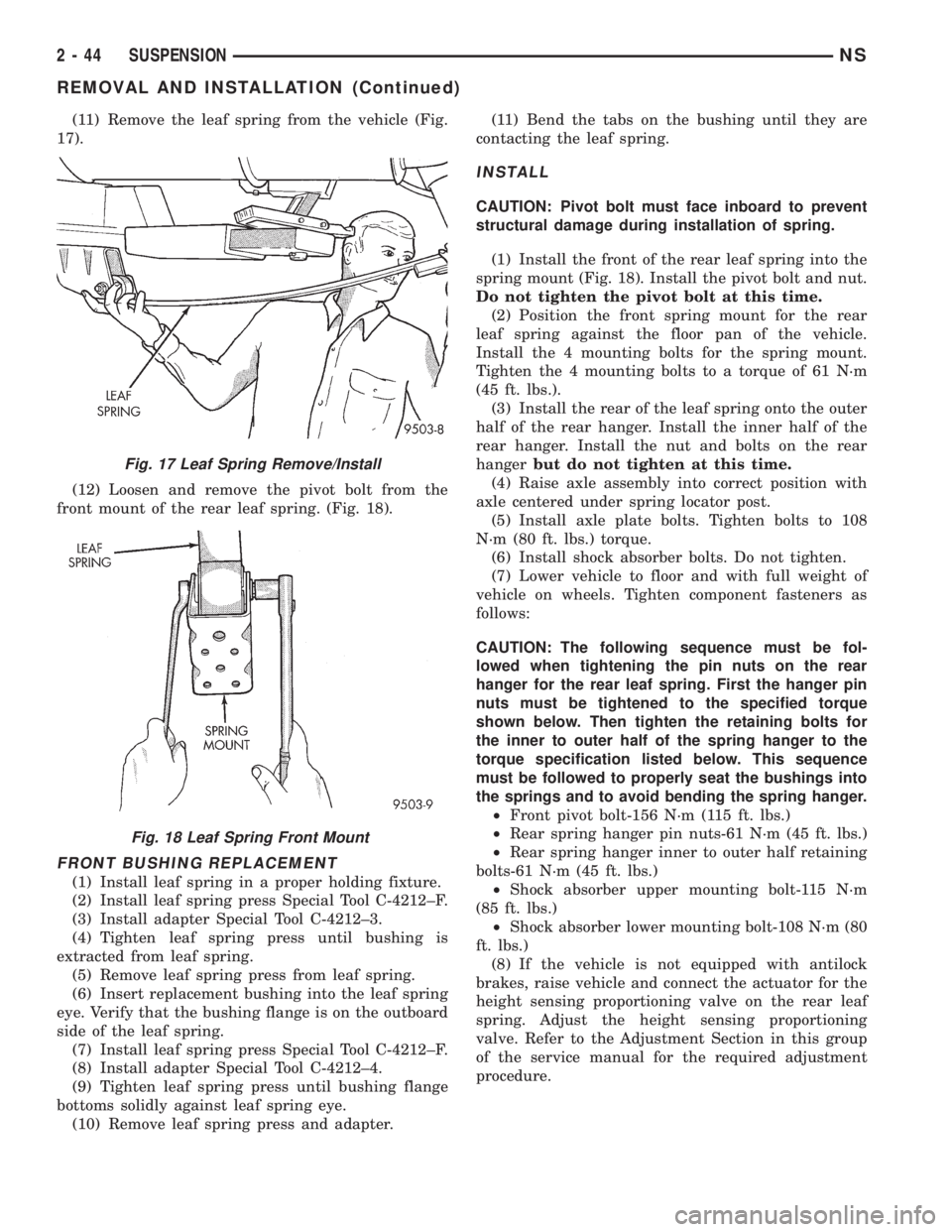
(11) Remove the leaf spring from the vehicle (Fig.
17).
(12) Loosen and remove the pivot bolt from the
front mount of the rear leaf spring. (Fig. 18).
FRONT BUSHING REPLACEMENT
(1) Install leaf spring in a proper holding fixture.
(2) Install leaf spring press Special Tool C-4212±F.
(3) Install adapter Special Tool C-4212±3.
(4) Tighten leaf spring press until bushing is
extracted from leaf spring.
(5) Remove leaf spring press from leaf spring.
(6) Insert replacement bushing into the leaf spring
eye. Verify that the bushing flange is on the outboard
side of the leaf spring.
(7) Install leaf spring press Special Tool C-4212±F.
(8) Install adapter Special Tool C-4212±4.
(9) Tighten leaf spring press until bushing flange
bottoms solidly against leaf spring eye.
(10) Remove leaf spring press and adapter.(11) Bend the tabs on the bushing until they are
contacting the leaf spring.
INSTALL
CAUTION: Pivot bolt must face inboard to prevent
structural damage during installation of spring.
(1) Install the front of the rear leaf spring into the
spring mount (Fig. 18). Install the pivot bolt and nut.
Do not tighten the pivot bolt at this time.
(2) Position the front spring mount for the rear
leaf spring against the floor pan of the vehicle.
Install the 4 mounting bolts for the spring mount.
Tighten the 4 mounting bolts to a torque of 61 N´m
(45 ft. lbs.).
(3) Install the rear of the leaf spring onto the outer
half of the rear hanger. Install the inner half of the
rear hanger. Install the nut and bolts on the rear
hangerbut do not tighten at this time.
(4) Raise axle assembly into correct position with
axle centered under spring locator post.
(5) Install axle plate bolts. Tighten bolts to 108
N´m (80 ft. lbs.) torque.
(6) Install shock absorber bolts. Do not tighten.
(7) Lower vehicle to floor and with full weight of
vehicle on wheels. Tighten component fasteners as
follows:
CAUTION: The following sequence must be fol-
lowed when tightening the pin nuts on the rear
hanger for the rear leaf spring. First the hanger pin
nuts must be tightened to the specified torque
shown below. Then tighten the retaining bolts for
the inner to outer half of the spring hanger to the
torque specification listed below. This sequence
must be followed to properly seat the bushings into
the springs and to avoid bending the spring hanger.
²Front pivot bolt-156 N´m (115 ft. lbs.)
²Rear spring hanger pin nuts-61 N´m (45 ft. lbs.)
²Rear spring hanger inner to outer half retaining
bolts-61 N´m (45 ft. lbs.)
²Shock absorber upper mounting bolt-115 N´m
(85 ft. lbs.)
²Shock absorber lower mounting bolt-108 N´m (80
ft. lbs.)
(8) If the vehicle is not equipped with antilock
brakes, raise vehicle and connect the actuator for the
height sensing proportioning valve on the rear leaf
spring. Adjust the height sensing proportioning
valve. Refer to the Adjustment Section in this group
of the service manual for the required adjustment
procedure.
Fig. 17 Leaf Spring Remove/Install
Fig. 18 Leaf Spring Front Mount
2 - 44 SUSPENSIONNS
REMOVAL AND INSTALLATION (Continued)
Page 77 of 1938

SHOCK ABSORBER
REMOVE/INSTALL
(1) Raise vehicle. Vehicle is to be raised and sup-
ported on jackstands or on a frame contact type
hoist. See Hoisting in the Lubrication And Mainte-
nance section of this service manual.
(2) Support the rear axle of the vehicle using 2
jackstands positioned at the outer ends of the axle.
NOTE: If the shock absorber lower mounting bolt
deflects upward during removal, raise axle by
adjusting the support jack. If the lower shock
absorber bolt deflects downward during removal,
lower the axle by adjusting the support jack.
(3) Remove the shock absorber lower mounting
bolt.
(4) While holding shock absorber, remove the
shock absorber upper mounting bolt.
(5) To install the shock absorber use the reverse
sequence of its removal.
(6) Lower the vehicle to the ground so the full
weight of the vehicle is supported by the suspension.
(7) Tighten the upper and lower shock absorber
mounting bolt to their specified torques.
REAR TRACK BAR
REMOVE
(1) Remove the nut and bolt mounting the track
bar to the rear axle (Fig. 19).
(2) Remove the nut and bolt attaching the track
bar to the track bar mount on the body of the vehicle.
Remove the track bar from the track bar mount.
INSTALL
(1) Install the track bar first into the body mount
for the track bar (Fig. 20). Install the track bar boltwith the head of the bolt facing toward the rear of
the vehicle (Fig. 21). Do not tighten.
(2) Install the track bar into its mounting bracket
on the rear axle (Fig. 19). Install the track bar bolt
with the head of the bolt facing toward the rear of
the vehicle. Do not tighten.
(3) Lower the vehicle to the ground until the full
weight of the vehicle is supported by the wheels.
Tighten both track bar attaching bolts to a torque of
95 N´m (70 ft. lbs.).
TRACK BAR MOUNT
REMOVE
(1) Remove the track bar from the track bar
mount.
(2) Remove the three bolts attaching the track bar
mount to the body (Fig. 22).
Fig. 19 Track Bar Mounting To Axle
Fig. 20 Track Bar Installation
Fig. 21 Track Bar Bolt Installation
NSSUSPENSION 2 - 45
REMOVAL AND INSTALLATION (Continued)
Page 79 of 1938
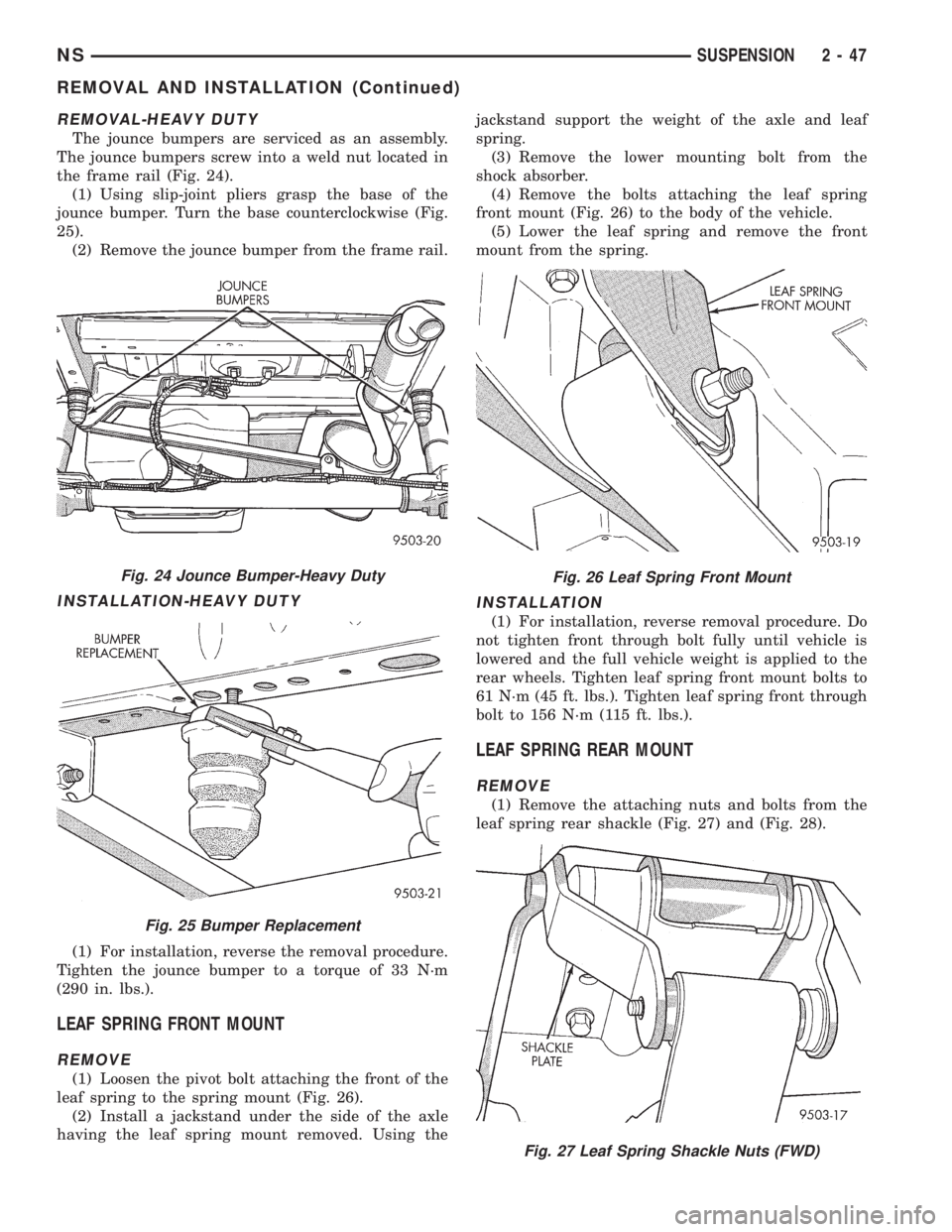
REMOVAL-HEAVY DUTY
The jounce bumpers are serviced as an assembly.
The jounce bumpers screw into a weld nut located in
the frame rail (Fig. 24).
(1) Using slip-joint pliers grasp the base of the
jounce bumper. Turn the base counterclockwise (Fig.
25).
(2) Remove the jounce bumper from the frame rail.
INSTALLATION-HEAVY DUTY
(1) For installation, reverse the removal procedure.
Tighten the jounce bumper to a torque of 33 N´m
(290 in. lbs.).
LEAF SPRING FRONT MOUNT
REMOVE
(1) Loosen the pivot bolt attaching the front of the
leaf spring to the spring mount (Fig. 26).
(2) Install a jackstand under the side of the axle
having the leaf spring mount removed. Using thejackstand support the weight of the axle and leaf
spring.
(3) Remove the lower mounting bolt from the
shock absorber.
(4) Remove the bolts attaching the leaf spring
front mount (Fig. 26) to the body of the vehicle.
(5) Lower the leaf spring and remove the front
mount from the spring.
INSTALLATION
(1) For installation, reverse removal procedure. Do
not tighten front through bolt fully until vehicle is
lowered and the full vehicle weight is applied to the
rear wheels. Tighten leaf spring front mount bolts to
61 N´m (45 ft. lbs.). Tighten leaf spring front through
bolt to 156 N´m (115 ft. lbs.).
LEAF SPRING REAR MOUNT
REMOVE
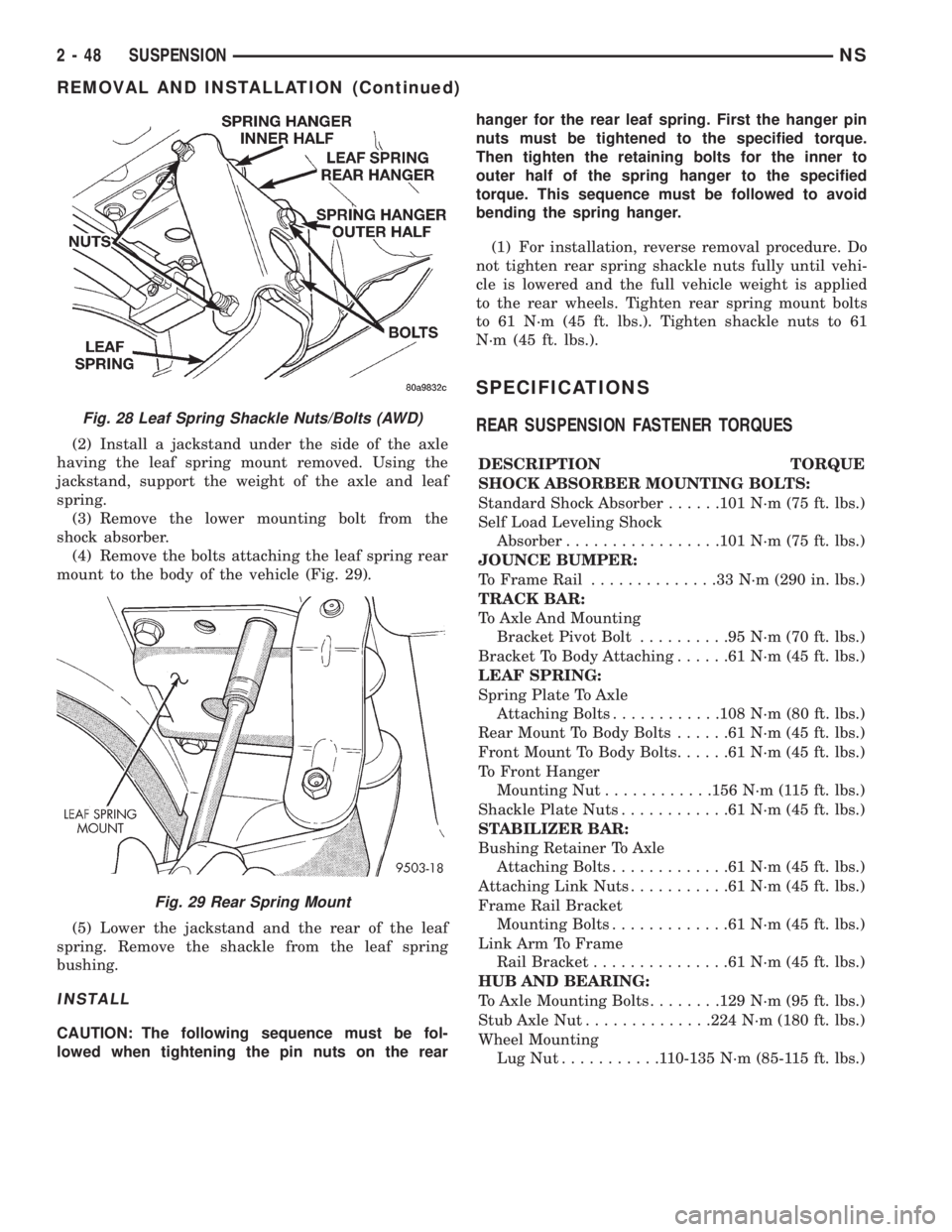
(1) Remove the attaching nuts and bolts from the
leaf spring rear shackle (Fig. 27) and (Fig. 28).
Fig. 24 Jounce Bumper-Heavy Duty
Fig. 25 Bumper Replacement
Fig. 26 Leaf Spring Front Mount
Fig. 27 Leaf Spring Shackle Nuts (FWD)
NSSUSPENSION 2 - 47
REMOVAL AND INSTALLATION (Continued)
Page 80 of 1938
(2) Install a jackstand under the side of the axle
having the leaf spring mount removed. Using the
jackstand, support the weight of the axle and leaf
spring.
(3) Remove the lower mounting bolt from the
shock absorber.
(4) Remove the bolts attaching the leaf spring rear
mount to the body of the vehicle (Fig. 29).
(5) Lower the jackstand and the rear of the leaf
spring. Remove the shackle from the leaf spring
bushing.
INSTALL
CAUTION: The following sequence must be fol-
lowed when tightening the pin nuts on the rearhanger for the rear leaf spring. First the hanger pin
nuts must be tightened to the specified torque.
Then tighten the retaining bolts for the inner to
outer half of the spring hanger to the specified
torque. This sequence must be followed to avoid
bending the spring hanger.
(1) For installation, reverse removal procedure. Do
not tighten rear spring shackle nuts fully until vehi-
cle is lowered and the full vehicle weight is applied
to the rear wheels. Tighten rear spring mount bolts
to 61 N´m (45 ft. lbs.). Tighten shackle nuts to 61
N´m (45 ft. lbs.).
SPECIFICATIONS
REAR SUSPENSION FASTENER TORQUES
DESCRIPTION TORQUE
SHOCK ABSORBER MOUNTING BOLTS:
Standard Shock Absorber......101 N´m (75 ft. lbs.)
Self Load Leveling Shock
Absorber.................101 N´m (75 ft. lbs.)
JOUNCE BUMPER:
To Frame Rail..............33N´m(290 in. lbs.)
TRACK BAR:
To Axle And Mounting
Bracket Pivot Bolt..........95N´m(70ft.lbs.)
Bracket To Body Attaching......61N´m(45ft.lbs.)
LEAF SPRING:
Spring Plate To Axle
Attaching Bolts............108 N´m (80 ft. lbs.)
Rear Mount To Body Bolts......61N´m(45ft.lbs.)
Front Mount To Body Bolts......61N´m(45ft.lbs.)
To Front Hanger
Mounting Nut............156 N´m (115 ft. lbs.)
Shackle Plate Nuts............61N´m(45ft.lbs.)
STABILIZER BAR:
Bushing Retainer To Axle
Attaching Bolts.............61N´m(45ft.lbs.)
Attaching Link Nuts...........61N´m(45ft.lbs.)
Frame Rail Bracket
Mounting Bolts.............61N´m(45ft.lbs.)
Link Arm To Frame
Rail Bracket...............61N´m(45ft.lbs.)
HUB AND BEARING:
To Axle Mounting Bolts........129 N´m (95 ft. lbs.)
Stub Axle Nut..............224 N´m (180 ft. lbs.)
Wheel Mounting
LugNut...........110-135 N´m (85-115 ft. lbs.)
Fig. 28 Leaf Spring Shackle Nuts/Bolts (AWD)
Fig. 29 Rear Spring Mount
2 - 48 SUSPENSIONNS
REMOVAL AND INSTALLATION (Continued)
Page 85 of 1938
BASE BRAKE SYSTEM
INDEX
page page
DESCRIPTION AND OPERATION
CHASSIS TUBES AND HOSES.............. 7
FRONT DISC BRAKE SYSTEM.............. 4
HUB/BEARING REAR WHEEL............... 9
MASTER CYLINDER...................... 7
PARKING BRAKE SYSTEM OPERATION....... 5
POWER BRAKE VACUUM BOOSTER
OPERATION........................... 8
PROPORTIONING VALVES................. 5
REAR DISC BRAKES...................... 5
REAR DRUM BRAKES..................... 5
RED BRAKE WARNING LAMP OPERATION..... 8
STOP LAMP SWITCH...................... 9
DIAGNOSIS AND TESTING
ADJUSTER REAR DRUM BRAKE
(AUTOMATIC)......................... 14
BRAKE FLUID CONTAMINATION............ 19
BRAKE ROTOR......................... 14
BRAKE SYSTEM BASIC DIAGNOSIS GUIDE.... 9
BRAKE SYSTEM DIAGNOSIS CHARTS....... 10
PROPORTIONING VALVES................ 16
RED BRAKE WARNING LAMP TEST......... 19
STOP LAMP SWITCH TEST PROCEDURE..... 19
TRACTION CONTROL LAMP TEST.......... 19
SERVICE PROCEDURES
BLEEDING BASE BRAKE
HYDRAULIC SYSTEM................... 20
BRAKE DRUM MACHINING................ 24
BRAKE TUBE REPAIR PROCEDURE......... 24
MASTER CYLINDER BLEEDING
PROCEDURE......................... 22
MASTER CYLINDER FLUID LEVEL CHECK.... 20
PARK BRAKE AUTO ADJUSTER
MECHANISM RELEASE................. 26
ROTOR MACHINING (FRONT/REAR)......... 22
REMOVAL AND INSTALLATION
BRAKE SUPPORT PLATE (REAR DRUM
BRAKES)............................ 37
FRONT DISC BRAKE CALIPER............. 27
FRONT DISC BRAKE PADS................ 30
FRONT PARK BRAKE CABLE.............. 65
HUB/BEARING.......................... 40
HYDRAULIC BRAKE TUBES AND HOSES..... 58
INTERMEDIATE PARK BRAKE CABLE....... 66
JUNCTION BLOCK....................... 55
LEFT REAR PARK BRAKE CABLE........... 67
MASTER CYLINDER..................... 44
PARK BRAKE PEDAL MECHANISM.......... 58PARK BRAKE SHOES (WITH REAR DISC
BRAKES)............................ 60
PROPORTIONING VALVE (W/ABS BRAKES) . . . 56
PROPORTIONING VALVE
(W/O ABS BRAKES).................... 57
REAR BRAKE DRUM..................... 33
REAR BRAKE WHEEL CYLINDER........... 39
REAR DISC BRAKE CALIPER.............. 28
REAR DISC BRAKE SHOES................ 31
REAR DRUM BRAKE SHOES............... 34
RIGHT REAR PARK BRAKE CABLE......... 66
STOP LAMP SWITCH..................... 69
VACUUM BOOSTER 2.4 LITER ENGINE...... 47
VACUUM BOOSTER 3.0 LITER ENGINE...... 49
VACUUM BOOSTER 3.3/3.8 LITER ENGINE.... 52
WHEEL AND TIRE INSTALLATION........... 27
DISASSEMBLY AND ASSEMBLY
FRONT DISC BRAKE CALIPER............. 71
MASTER CYLINDER BRAKE FLUID LEVEL
SWITCH............................. 71
MASTER CYLINDER FLUID RESERVOIR
FILL TUBE............................ 71
MASTER CYLINDER FLUID RESERVOIR...... 70
MASTER CYLINDER TO POWER BRAKE
BOOSTER VACUUM SEAL............... 69
WHEEL CYLINDER REAR DRUM BRAKE...... 76
CLEANING AND INSPECTION
BRAKE HOSE AND BRAKE LINES
INSPECTION.......................... 78
FRONT DISC BRAKE PAD LINING
INSPECTION.......................... 76
REAR DISC BRAKES..................... 76
REAR DRUM BRAKE SHOE LINING
INSPECTION.......................... 77
REAR DRUM BRAKE WHEEL CYLINDER...... 78
REAR WHEEL HUB AND BEARING
ASSEMBLY........................... 78
ADJUSTMENTS
PARK BRAKE CABLE ADJUSTMENT......... 81
PARK BRAKE SHOES (WITH REAR DISC
BRAKES)............................ 79
PROPORTIONING VALVE
(HEIGHT SENSING).................... 81
REAR DRUM BRAKE SHOE ADJUSTMENT.... 79
STOP LAMP SWITCH..................... 78
SPECIFICATIONS
BRAKE ACTUATION SYSTEM.............. 83
BRAKE FASTENER TORQUE
SPECIFICATIONS...................... 83
NSBRAKES 5 - 3
Page 87 of 1938
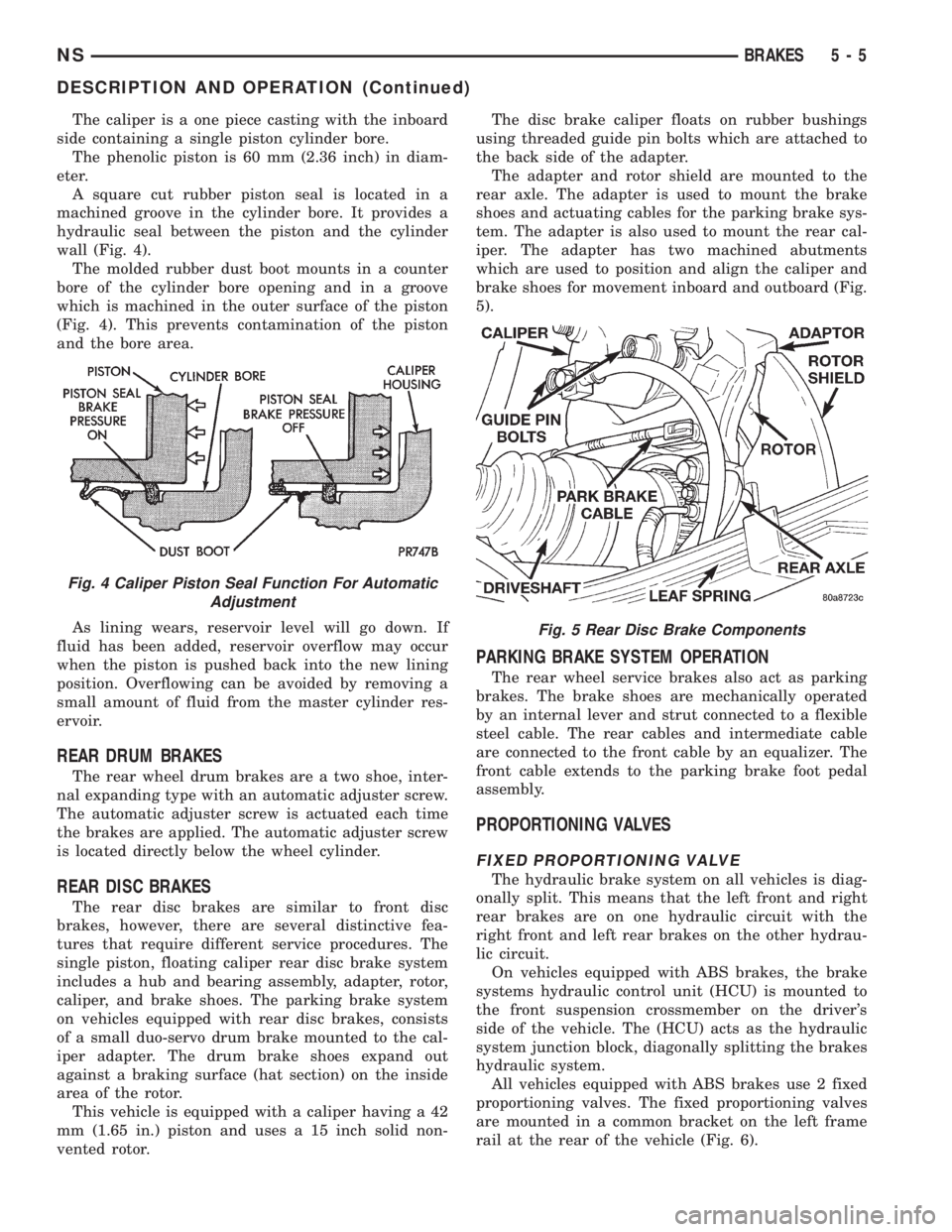
The caliper is a one piece casting with the inboard
side containing a single piston cylinder bore.
The phenolic piston is 60 mm (2.36 inch) in diam-
eter.
A square cut rubber piston seal is located in a
machined groove in the cylinder bore. It provides a
hydraulic seal between the piston and the cylinder
wall (Fig. 4).
The molded rubber dust boot mounts in a counter
bore of the cylinder bore opening and in a groove
which is machined in the outer surface of the piston
(Fig. 4). This prevents contamination of the piston
and the bore area.
As lining wears, reservoir level will go down. If
fluid has been added, reservoir overflow may occur
when the piston is pushed back into the new lining
position. Overflowing can be avoided by removing a
small amount of fluid from the master cylinder res-
ervoir.
REAR DRUM BRAKES
The rear wheel drum brakes are a two shoe, inter-
nal expanding type with an automatic adjuster screw.
The automatic adjuster screw is actuated each time
the brakes are applied. The automatic adjuster screw
is located directly below the wheel cylinder.
REAR DISC BRAKES
The rear disc brakes are similar to front disc
brakes, however, there are several distinctive fea-
tures that require different service procedures. The
single piston, floating caliper rear disc brake system
includes a hub and bearing assembly, adapter, rotor,
caliper, and brake shoes. The parking brake system
on vehicles equipped with rear disc brakes, consists
of a small duo-servo drum brake mounted to the cal-
iper adapter. The drum brake shoes expand out
against a braking surface (hat section) on the inside
area of the rotor.
This vehicle is equipped with a caliper having a 42
mm (1.65 in.) piston and uses a 15 inch solid non-
vented rotor.The disc brake caliper floats on rubber bushings
using threaded guide pin bolts which are attached to
the back side of the adapter.
The adapter and rotor shield are mounted to the
rear axle. The adapter is used to mount the brake
shoes and actuating cables for the parking brake sys-
tem. The adapter is also used to mount the rear cal-
iper. The adapter has two machined abutments
which are used to position and align the caliper and
brake shoes for movement inboard and outboard (Fig.
5).
PARKING BRAKE SYSTEM OPERATION
The rear wheel service brakes also act as parking
brakes. The brake shoes are mechanically operated
by an internal lever and strut connected to a flexible
steel cable. The rear cables and intermediate cable
are connected to the front cable by an equalizer. The
front cable extends to the parking brake foot pedal
assembly.
PROPORTIONING VALVES
FIXED PROPORTIONING VALVE
The hydraulic brake system on all vehicles is diag-
onally split. This means that the left front and right
rear brakes are on one hydraulic circuit with the
right front and left rear brakes on the other hydrau-
lic circuit.
On vehicles equipped with ABS brakes, the brake
systems hydraulic control unit (HCU) is mounted to
the front suspension crossmember on the driver's
side of the vehicle. The (HCU) acts as the hydraulic
system junction block, diagonally splitting the brakes
hydraulic system.
All vehicles equipped with ABS brakes use 2 fixed
proportioning valves. The fixed proportioning valves
are mounted in a common bracket on the left frame
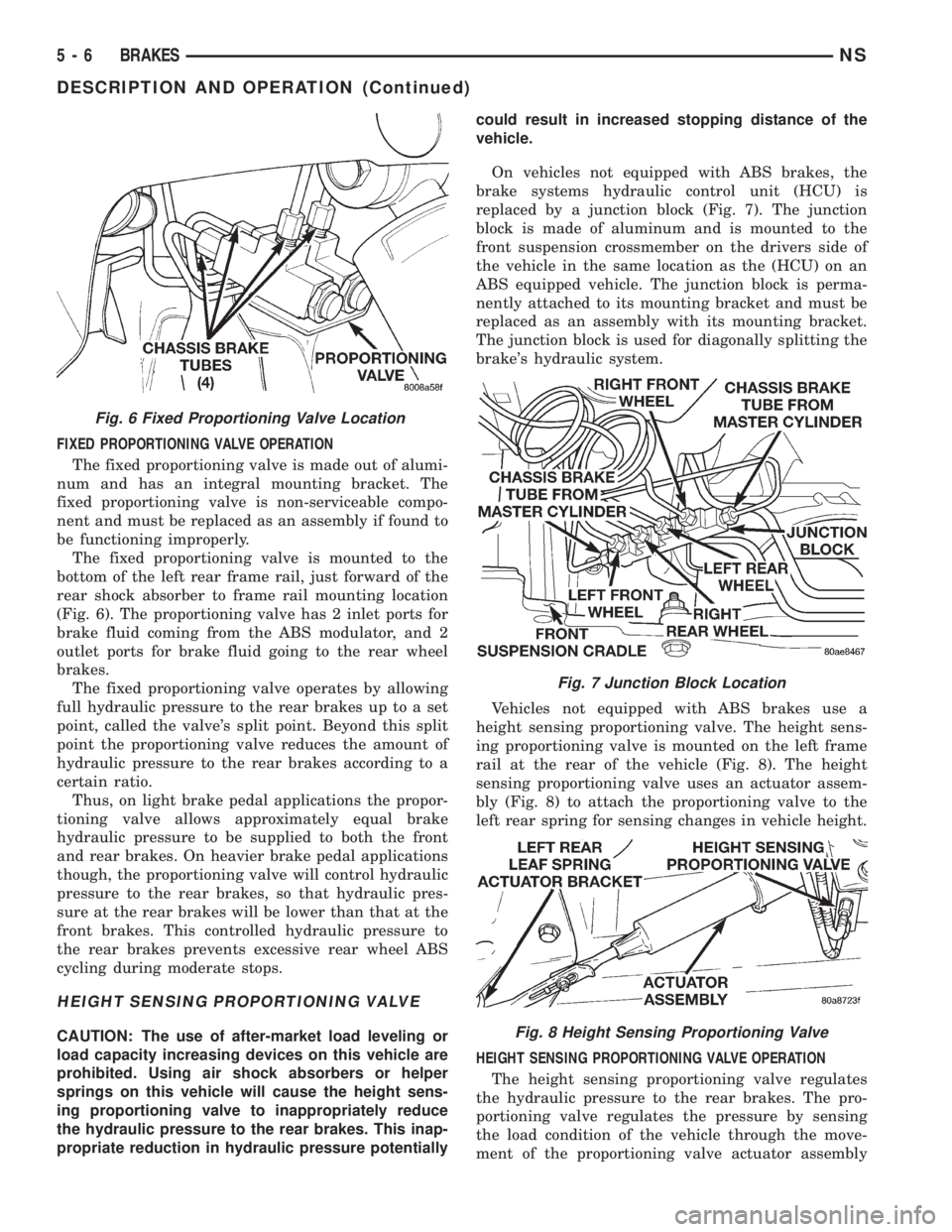
rail at the rear of the vehicle (Fig. 6).
Fig. 4 Caliper Piston Seal Function For Automatic
Adjustment
Fig. 5 Rear Disc Brake Components
NSBRAKES 5 - 5
DESCRIPTION AND OPERATION (Continued)
Page 88 of 1938
FIXED PROPORTIONING VALVE OPERATION
The fixed proportioning valve is made out of alumi-
num and has an integral mounting bracket. The
fixed proportioning valve is non-serviceable compo-
nent and must be replaced as an assembly if found to
be functioning improperly.
The fixed proportioning valve is mounted to the
bottom of the left rear frame rail, just forward of the
rear shock absorber to frame rail mounting location
(Fig. 6). The proportioning valve has 2 inlet ports for
brake fluid coming from the ABS modulator, and 2
outlet ports for brake fluid going to the rear wheel
brakes.
The fixed proportioning valve operates by allowing
full hydraulic pressure to the rear brakes up to a set
point, called the valve's split point. Beyond this split
point the proportioning valve reduces the amount of
hydraulic pressure to the rear brakes according to a
certain ratio.
Thus, on light brake pedal applications the propor-
tioning valve allows approximately equal brake
hydraulic pressure to be supplied to both the front
and rear brakes. On heavier brake pedal applications
though, the proportioning valve will control hydraulic
pressure to the rear brakes, so that hydraulic pres-
sure at the rear brakes will be lower than that at the
front brakes. This controlled hydraulic pressure to
the rear brakes prevents excessive rear wheel ABS
cycling during moderate stops.
HEIGHT SENSING PROPORTIONING VALVE
CAUTION: The use of after-market load leveling or
load capacity increasing devices on this vehicle are
prohibited. Using air shock absorbers or helper
springs on this vehicle will cause the height sens-
ing proportioning valve to inappropriately reduce
the hydraulic pressure to the rear brakes. This inap-
propriate reduction in hydraulic pressure potentiallycould result in increased stopping distance of the
vehicle.
On vehicles not equipped with ABS brakes, the
brake systems hydraulic control unit (HCU) is
replaced by a junction block (Fig. 7). The junction
block is made of aluminum and is mounted to the
front suspension crossmember on the drivers side of
the vehicle in the same location as the (HCU) on an
ABS equipped vehicle. The junction block is perma-
nently attached to its mounting bracket and must be
replaced as an assembly with its mounting bracket.
The junction block is used for diagonally splitting the
brake's hydraulic system.
Vehicles not equipped with ABS brakes use a
height sensing proportioning valve. The height sens-
ing proportioning valve is mounted on the left frame
rail at the rear of the vehicle (Fig. 8). The height
sensing proportioning valve uses an actuator assem-
bly (Fig. 8) to attach the proportioning valve to the
left rear spring for sensing changes in vehicle height.
HEIGHT SENSING PROPORTIONING VALVE OPERATION
The height sensing proportioning valve regulates
the hydraulic pressure to the rear brakes. The pro-
portioning valve regulates the pressure by sensing
the load condition of the vehicle through the move-
ment of the proportioning valve actuator assembly
Fig. 6 Fixed Proportioning Valve Location
Fig. 7 Junction Block Location
Fig. 8 Height Sensing Proportioning Valve
5 - 6 BRAKESNS
DESCRIPTION AND OPERATION (Continued)
Page 98 of 1938
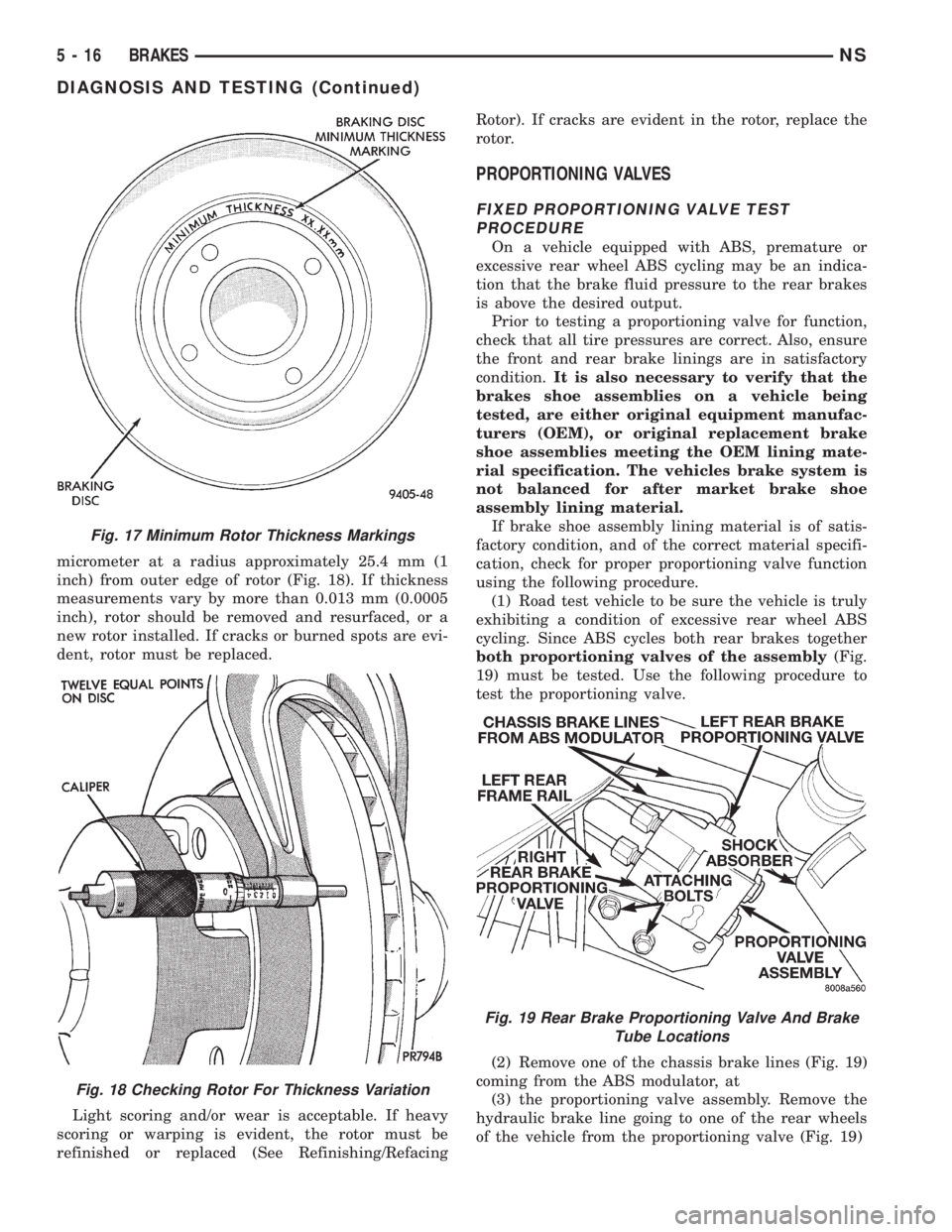
micrometer at a radius approximately 25.4 mm (1
inch) from outer edge of rotor (Fig. 18). If thickness
measurements vary by more than 0.013 mm (0.0005
inch), rotor should be removed and resurfaced, or a
new rotor installed. If cracks or burned spots are evi-
dent, rotor must be replaced.
Light scoring and/or wear is acceptable. If heavy
scoring or warping is evident, the rotor must be
refinished or replaced (See Refinishing/RefacingRotor). If cracks are evident in the rotor, replace the
rotor.
PROPORTIONING VALVES
FIXED PROPORTIONING VALVE TEST
PROCEDURE
On a vehicle equipped with ABS, premature or
excessive rear wheel ABS cycling may be an indica-
tion that the brake fluid pressure to the rear brakes
is above the desired output.
Prior to testing a proportioning valve for function,
check that all tire pressures are correct. Also, ensure
the front and rear brake linings are in satisfactory
condition.It is also necessary to verify that the
brakes shoe assemblies on a vehicle being
tested, are either original equipment manufac-
turers (OEM), or original replacement brake
shoe assemblies meeting the OEM lining mate-
rial specification. The vehicles brake system is
not balanced for after market brake shoe
assembly lining material.
If brake shoe assembly lining material is of satis-
factory condition, and of the correct material specifi-
cation, check for proper proportioning valve function
using the following procedure.
(1) Road test vehicle to be sure the vehicle is truly
exhibiting a condition of excessive rear wheel ABS
cycling. Since ABS cycles both rear brakes together
both proportioning valves of the assembly(Fig.
19) must be tested. Use the following procedure to
test the proportioning valve.
(2) Remove one of the chassis brake lines (Fig. 19)
coming from the ABS modulator, at
(3) the proportioning valve assembly. Remove the
hydraulic brake line going to one of the rear wheels
of the vehicle from the proportioning valve (Fig. 19)
Fig. 17 Minimum Rotor Thickness Markings
Fig. 18 Checking Rotor For Thickness Variation
Fig. 19 Rear Brake Proportioning Valve And Brake
Tube Locations
5 - 16 BRAKESNS
DIAGNOSIS AND TESTING (Continued)
Page 99 of 1938
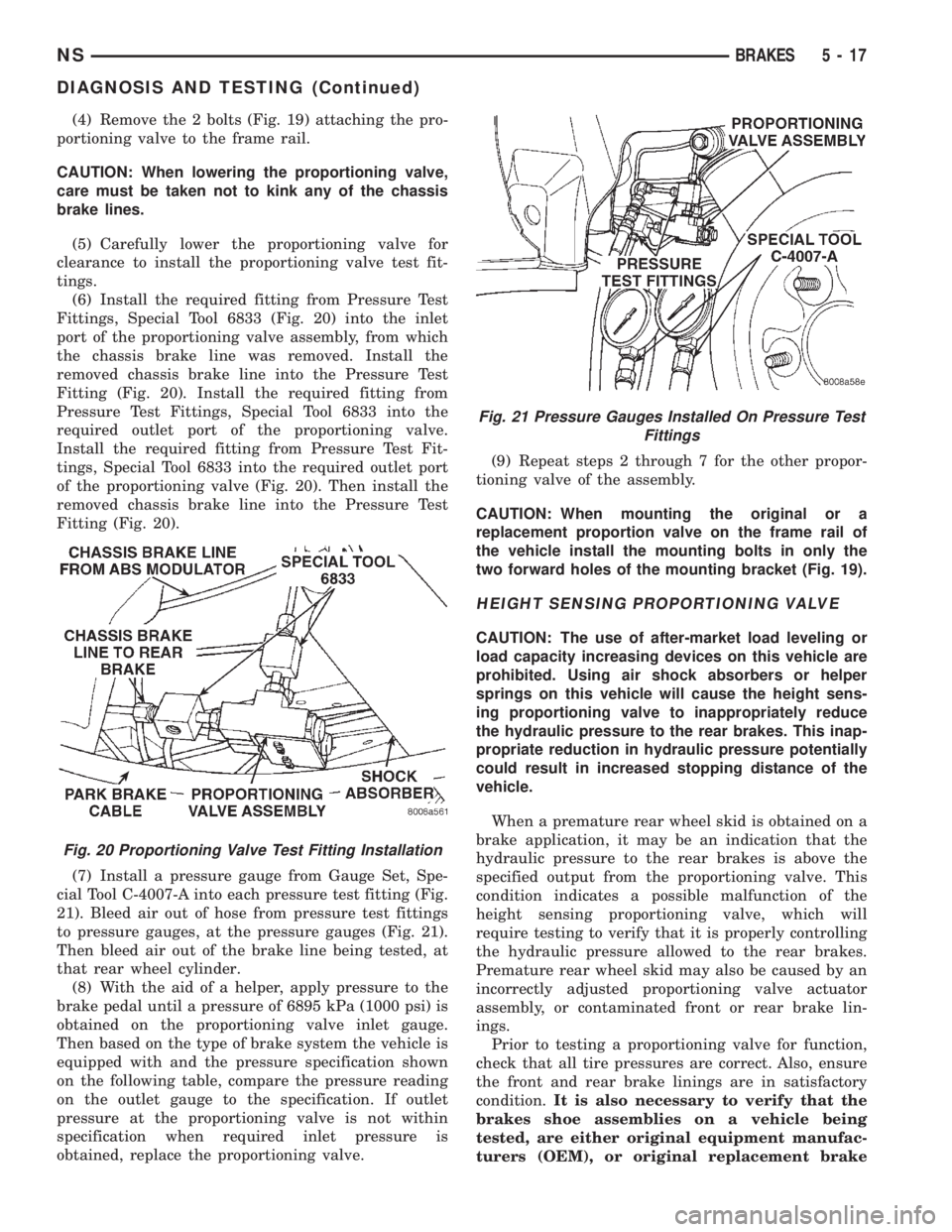
(4) Remove the 2 bolts (Fig. 19) attaching the pro-
portioning valve to the frame rail.
CAUTION: When lowering the proportioning valve,
care must be taken not to kink any of the chassis
brake lines.
(5) Carefully lower the proportioning valve for
clearance to install the proportioning valve test fit-
tings.
(6) Install the required fitting from Pressure Test
Fittings, Special Tool 6833 (Fig. 20) into the inlet
port of the proportioning valve assembly, from which
the chassis brake line was removed. Install the
removed chassis brake line into the Pressure Test
Fitting (Fig. 20). Install the required fitting from
Pressure Test Fittings, Special Tool 6833 into the
required outlet port of the proportioning valve.
Install the required fitting from Pressure Test Fit-
tings, Special Tool 6833 into the required outlet port
of the proportioning valve (Fig. 20). Then install the
removed chassis brake line into the Pressure Test
Fitting (Fig. 20).
(7) Install a pressure gauge from Gauge Set, Spe-
cial Tool C-4007-A into each pressure test fitting (Fig.
21). Bleed air out of hose from pressure test fittings
to pressure gauges, at the pressure gauges (Fig. 21).
Then bleed air out of the brake line being tested, at
that rear wheel cylinder.
(8) With the aid of a helper, apply pressure to the
brake pedal until a pressure of 6895 kPa (1000 psi) is
obtained on the proportioning valve inlet gauge.
Then based on the type of brake system the vehicle is
equipped with and the pressure specification shown
on the following table, compare the pressure reading
on the outlet gauge to the specification. If outlet
pressure at the proportioning valve is not within
specification when required inlet pressure is
obtained, replace the proportioning valve.(9) Repeat steps 2 through 7 for the other propor-
tioning valve of the assembly.
CAUTION: When mounting the original or a
replacement proportion valve on the frame rail of
the vehicle install the mounting bolts in only the
two forward holes of the mounting bracket (Fig. 19).
HEIGHT SENSING PROPORTIONING VALVE
CAUTION: The use of after-market load leveling or
load capacity increasing devices on this vehicle are
prohibited. Using air shock absorbers or helper
springs on this vehicle will cause the height sens-
ing proportioning valve to inappropriately reduce
the hydraulic pressure to the rear brakes. This inap-
propriate reduction in hydraulic pressure potentially
could result in increased stopping distance of the
vehicle.
When a premature rear wheel skid is obtained on a
brake application, it may be an indication that the
hydraulic pressure to the rear brakes is above the
specified output from the proportioning valve. This
condition indicates a possible malfunction of the
height sensing proportioning valve, which will
require testing to verify that it is properly controlling
the hydraulic pressure allowed to the rear brakes.
Premature rear wheel skid may also be caused by an
incorrectly adjusted proportioning valve actuator
assembly, or contaminated front or rear brake lin-
ings.
Prior to testing a proportioning valve for function,
check that all tire pressures are correct. Also, ensure
the front and rear brake linings are in satisfactory
condition.It is also necessary to verify that the
brakes shoe assemblies on a vehicle being
tested, are either original equipment manufac-
turers (OEM), or original replacement brake
Fig. 20 Proportioning Valve Test Fitting Installation
Fig. 21 Pressure Gauges Installed On Pressure Test
Fittings
NSBRAKES 5 - 17
DIAGNOSIS AND TESTING (Continued)
Page 104 of 1938
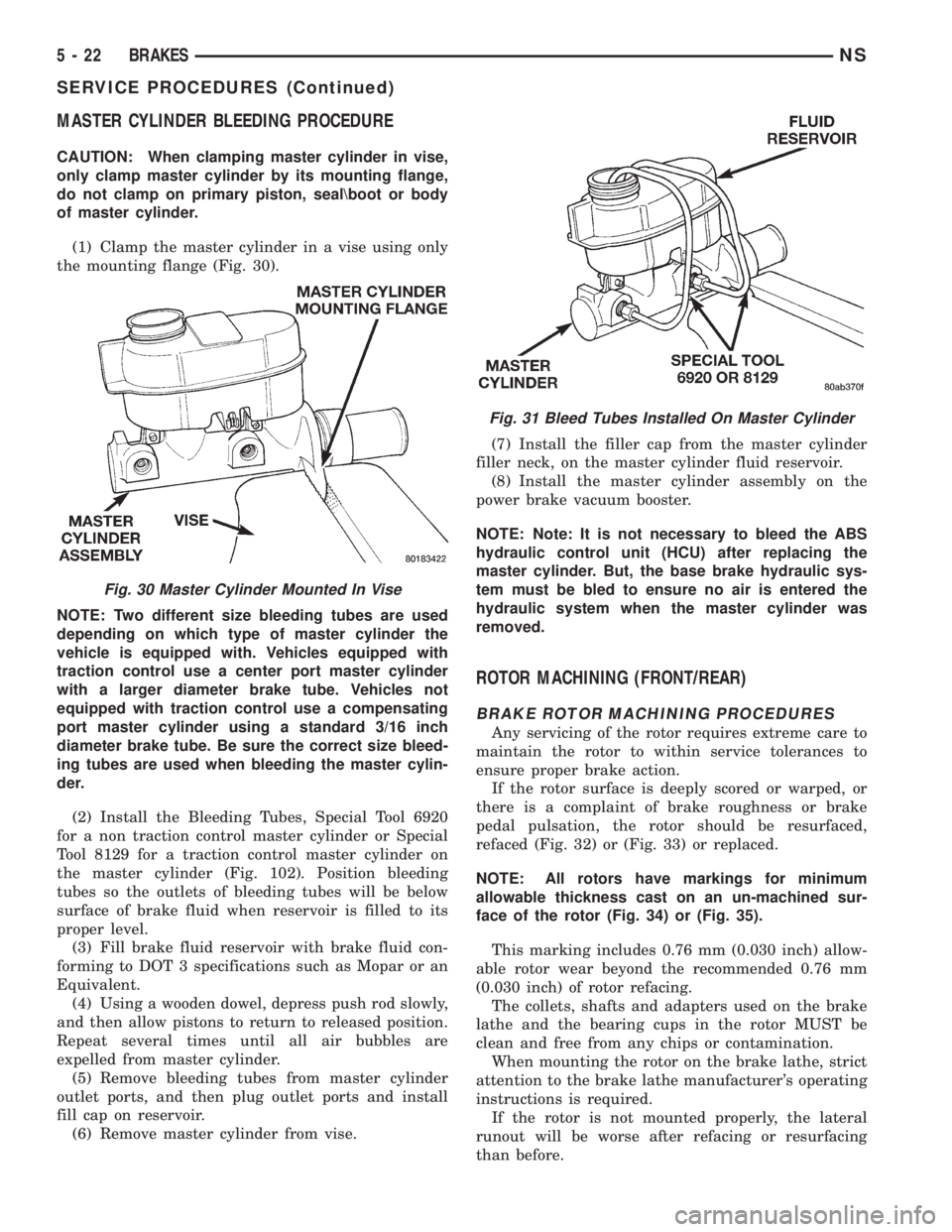
MASTER CYLINDER BLEEDING PROCEDURE
CAUTION: When clamping master cylinder in vise,
only clamp master cylinder by its mounting flange,
do not clamp on primary piston, seal\boot or body
of master cylinder.
(1) Clamp the master cylinder in a vise using only
the mounting flange (Fig. 30).
NOTE: Two different size bleeding tubes are used
depending on which type of master cylinder the
vehicle is equipped with. Vehicles equipped with
traction control use a center port master cylinder
with a larger diameter brake tube. Vehicles not
equipped with traction control use a compensating
port master cylinder using a standard 3/16 inch
diameter brake tube. Be sure the correct size bleed-
ing tubes are used when bleeding the master cylin-
der.
(2) Install the Bleeding Tubes, Special Tool 6920
for a non traction control master cylinder or Special
Tool 8129 for a traction control master cylinder on
the master cylinder (Fig. 102). Position bleeding
tubes so the outlets of bleeding tubes will be below
surface of brake fluid when reservoir is filled to its
proper level.
(3) Fill brake fluid reservoir with brake fluid con-
forming to DOT 3 specifications such as Mopar or an
Equivalent.
(4) Using a wooden dowel, depress push rod slowly,
and then allow pistons to return to released position.
Repeat several times until all air bubbles are
expelled from master cylinder.
(5) Remove bleeding tubes from master cylinder
outlet ports, and then plug outlet ports and install
fill cap on reservoir.
(6) Remove master cylinder from vise.(7) Install the filler cap from the master cylinder
filler neck, on the master cylinder fluid reservoir.
(8) Install the master cylinder assembly on the
power brake vacuum booster.
NOTE: Note: It is not necessary to bleed the ABS
hydraulic control unit (HCU) after replacing the
master cylinder. But, the base brake hydraulic sys-
tem must be bled to ensure no air is entered the
hydraulic system when the master cylinder was
removed.
ROTOR MACHINING (FRONT/REAR)
BRAKE ROTOR MACHINING PROCEDURES
Any servicing of the rotor requires extreme care to
maintain the rotor to within service tolerances to
ensure proper brake action.
If the rotor surface is deeply scored or warped, or
there is a complaint of brake roughness or brake
pedal pulsation, the rotor should be resurfaced,
refaced (Fig. 32) or (Fig. 33) or replaced.
NOTE: All rotors have markings for minimum
allowable thickness cast on an un-machined sur-
face of the rotor (Fig. 34) or (Fig. 35).
This marking includes 0.76 mm (0.030 inch) allow-
able rotor wear beyond the recommended 0.76 mm
(0.030 inch) of rotor refacing.
The collets, shafts and adapters used on the brake
lathe and the bearing cups in the rotor MUST be
clean and free from any chips or contamination.
When mounting the rotor on the brake lathe, strict
attention to the brake lathe manufacturer's operating
instructions is required.
If the rotor is not mounted properly, the lateral
runout will be worse after refacing or resurfacing
than before.
Fig. 30 Master Cylinder Mounted In Vise
Fig. 31 Bleed Tubes Installed On Master Cylinder
5 - 22 BRAKESNS
SERVICE PROCEDURES (Continued)