ABS CHRYSLER VOYAGER 1996 Owner's Manual
[x] Cancel search | Manufacturer: CHRYSLER, Model Year: 1996, Model line: VOYAGER, Model: CHRYSLER VOYAGER 1996Pages: 1938, PDF Size: 55.84 MB
Page 106 of 1938
BRAKE DRUM MACHINING
Measure the runout and diameter of the rear brake
using only accurate measuring equipment. There
should be no variation in the drum diameter greater
than 0.090 mm (0.004 inch). Drum runout should not
exceed 0.15 mm (0.006 inch) out of round. If the
drum runout or diameter variation exceed these val-
ues the drum should be refaced. For best results in
eliminating the irregularities that cause brake rough-
ness and surge, the amount of material removed dur-
ing a single cut should be limited to 0.13 mm (0.005
inch). When the entire braking surface has been
cleaned. A final cut of 0.0254 mm (0.001 inch) will
assure a good drum surface providing the equipment
used is capable of the precision required for resurfac-
ing brake drums. Deeper cuts are permissible for the
sole purpose of removing deep score marks.Do not
reface more than 1.52 mm (0.060 inch) over the
standard drum diameter.
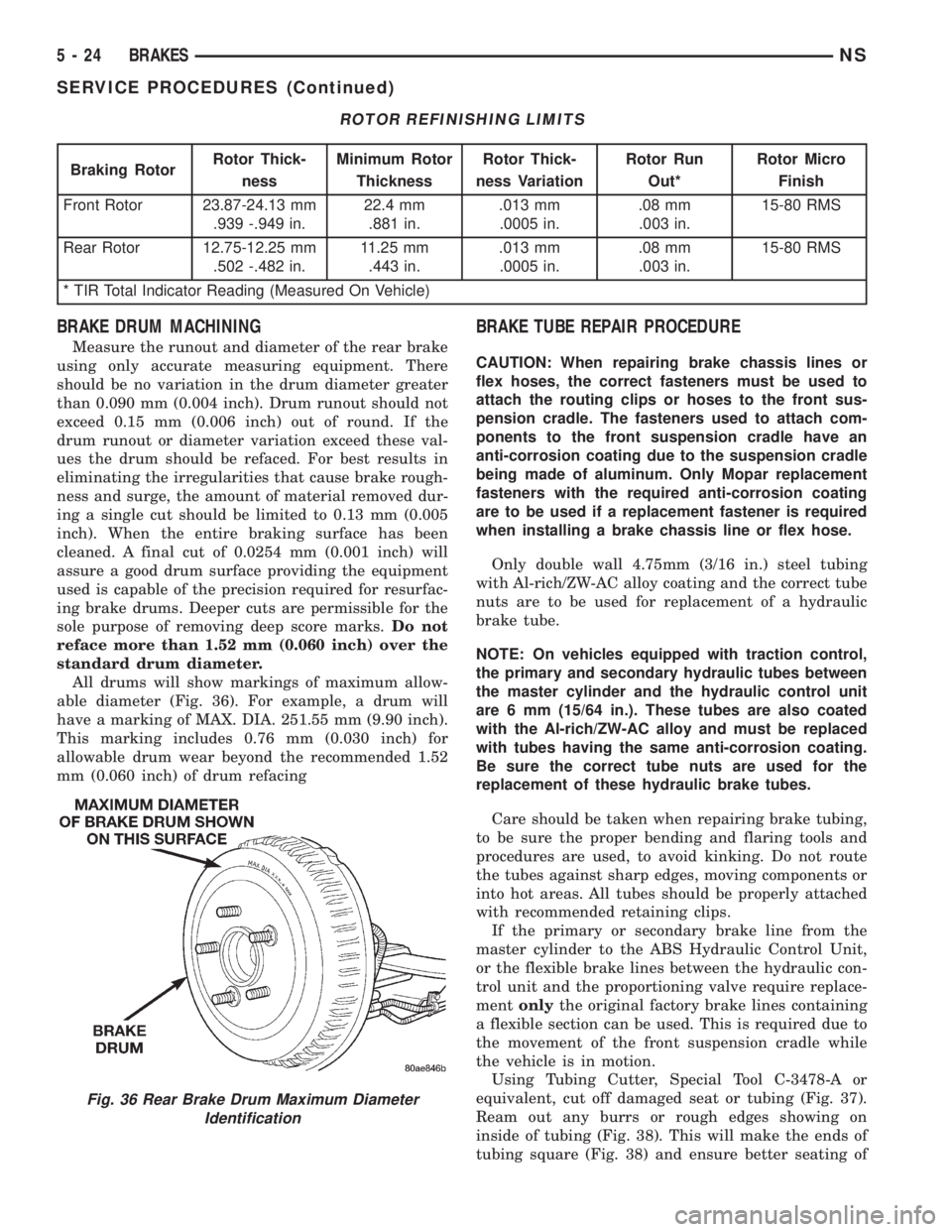
All drums will show markings of maximum allow-
able diameter (Fig. 36). For example, a drum will
have a marking of MAX. DIA. 251.55 mm (9.90 inch).
This marking includes 0.76 mm (0.030 inch) for
allowable drum wear beyond the recommended 1.52
mm (0.060 inch) of drum refacing
BRAKE TUBE REPAIR PROCEDURE
CAUTION: When repairing brake chassis lines or
flex hoses, the correct fasteners must be used to
attach the routing clips or hoses to the front sus-
pension cradle. The fasteners used to attach com-
ponents to the front suspension cradle have an
anti-corrosion coating due to the suspension cradle
being made of aluminum. Only Mopar replacement
fasteners with the required anti-corrosion coating
are to be used if a replacement fastener is required
when installing a brake chassis line or flex hose.
Only double wall 4.75mm (3/16 in.) steel tubing
with Al-rich/ZW-AC alloy coating and the correct tube
nuts are to be used for replacement of a hydraulic
brake tube.
NOTE: On vehicles equipped with traction control,
the primary and secondary hydraulic tubes between
the master cylinder and the hydraulic control unit
are 6 mm (15/64 in.). These tubes are also coated
with the Al-rich/ZW-AC alloy and must be replaced
with tubes having the same anti-corrosion coating.
Be sure the correct tube nuts are used for the
replacement of these hydraulic brake tubes.
Care should be taken when repairing brake tubing,
to be sure the proper bending and flaring tools and
procedures are used, to avoid kinking. Do not route
the tubes against sharp edges, moving components or
into hot areas. All tubes should be properly attached
with recommended retaining clips.
If the primary or secondary brake line from the
master cylinder to the ABS Hydraulic Control Unit,
or the flexible brake lines between the hydraulic con-
trol unit and the proportioning valve require replace-
mentonlythe original factory brake lines containing
a flexible section can be used. This is required due to
the movement of the front suspension cradle while
the vehicle is in motion.
Using Tubing Cutter, Special Tool C-3478-A or
equivalent, cut off damaged seat or tubing (Fig. 37).
Ream out any burrs or rough edges showing on
inside of tubing (Fig. 38). This will make the ends of
tubing square (Fig. 38) and ensure better seating of
ROTOR REFINISHING LIMITS
Braking RotorRotor Thick-
nessMinimum Rotor
ThicknessRotor Thick-
ness VariationRotor Run
Out*Rotor Micro
Finish
Front Rotor 23.87-24.13 mm
.939 -.949 in.22.4 mm
.881 in..013 mm
.0005 in..08 mm
.003 in.15-80 RMS
Rear Rotor 12.75-12.25 mm
.502 -.482 in.11.25 mm
.443 in..013 mm
.0005 in..08 mm
.003 in.15-80 RMS
* TIR Total Indicator Reading (Measured On Vehicle)
Fig. 36 Rear Brake Drum Maximum Diameter
Identification
5 - 24 BRAKESNS
SERVICE PROCEDURES (Continued)
Page 119 of 1938
CAUTION: When installing the tension clip on the
automatic adjuster, it must be located on only the
threaded area of the adjuster assembly (Fig. 66). If
it is located on a non-threaded area of the adjuster,
the function of the automatic adjuster will be
affected.
(7) Install the tension clip (Fig. 66) attaching the
upper return spring to the automatic adjuster assem-
bly.
(8) Install the brake shoe to brake shoe lower
return springs on the brake shoes (Fig. 64) and (Fig.
65).
(9) Install automatic adjustment lever on the lead-
ing brake shoe of the rear brake assembly (Fig. 63).
(10) Install the actuating spring on the automatic
adjustment lever and leading brake shoe assembly
(Fig. 62).
(11) Verify that the automatic adjuster lever has
positive contact with the star wheel on the automatic
adjuster assembly.
(12) When all components of both rear brake
assemblies are correctly and fully installed, remove
the locking pliers from the front park brake cable.
(13) Adjust brake shoes assemblies so as not to
interfere with brake drum installation.
(14) Install the rear brake drums on the hubs.
(15) Adjust rear brake shoes per Adjusting Rear
Brakes procedure in the service adjustments section
of the service manual.
(16) Install the wheel and tire assembly.
(17) Push the park brake pedal to the floor once
and release pedal. This will automatically remove the
slack from and correctly adjust the park brake
cables.
(18) Tighten the wheel mounting stud nuts in
proper sequence until all nuts are torqued to half
specification. Then repeat the tightening sequence to
the full specified torque of 130 N´m (95 ft. lbs.).
(19) Road test vehicle. The automatic adjuster will
continue the brake adjustment during the road test
of the vehicle.
BRAKE SUPPORT PLATE (REAR DRUM BRAKES)
REMOVE
(1) Raise vehicle on jackstands or centered on a
frame contact type hoist. See Hoisting in the Lubri-
cation and Maintenance section of this service man-
ual for required lifting procedure.
(2) Remove wheel and tire.
(3) Remove brake drum from hub/bearing.
(4) Remove brake shoes from brake support plate.
Refer to Rear Brake Shoe Removal in the removal
and installation section in this group of the service
manual for the required procedure.(5) Disconnect the park brake cable from the park
brake actuation lever.
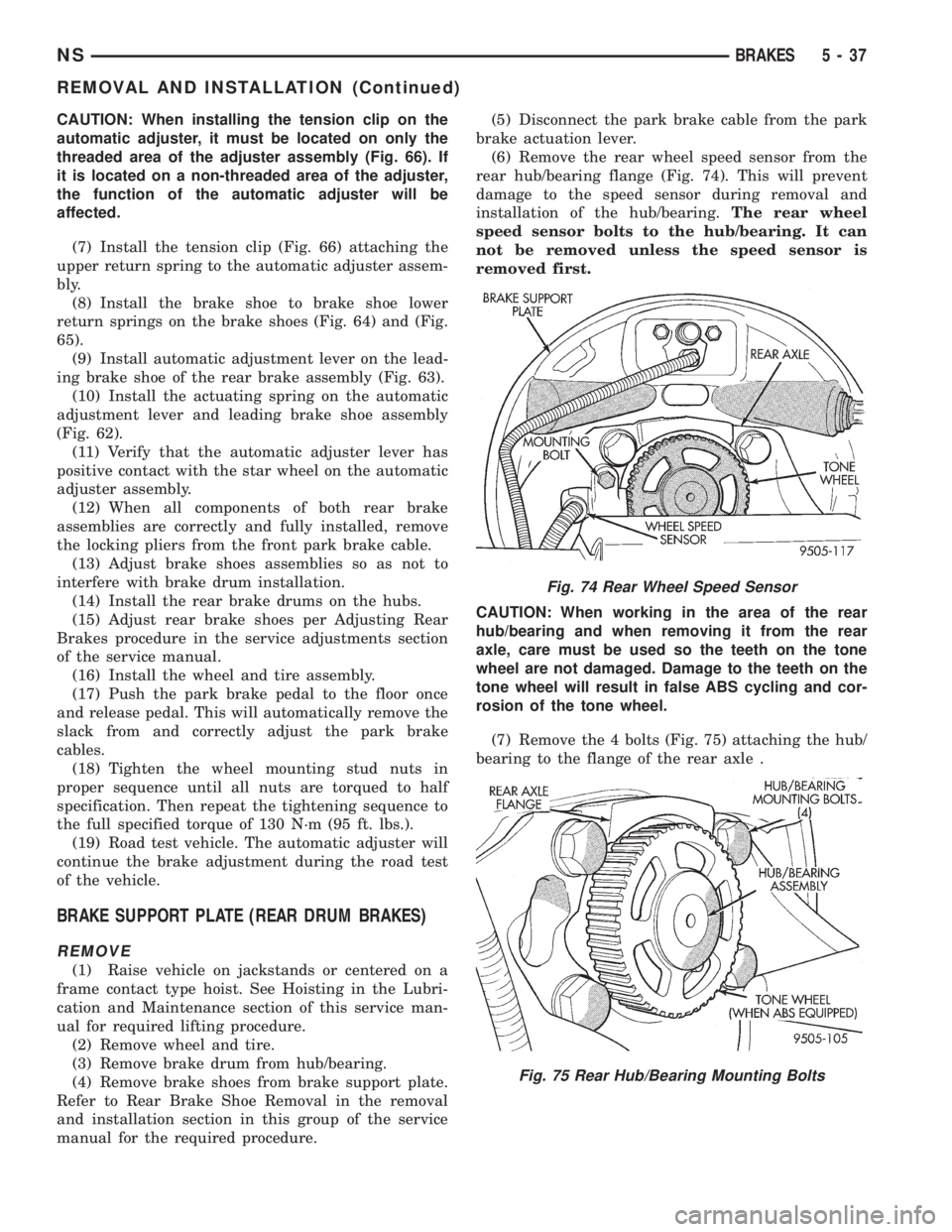
(6) Remove the rear wheel speed sensor from the
rear hub/bearing flange (Fig. 74). This will prevent
damage to the speed sensor during removal and
installation of the hub/bearing.The rear wheel
speed sensor bolts to the hub/bearing. It can
not be removed unless the speed sensor is
removed first.
CAUTION: When working in the area of the rear
hub/bearing and when removing it from the rear
axle, care must be used so the teeth on the tone
wheel are not damaged. Damage to the teeth on the
tone wheel will result in false ABS cycling and cor-
rosion of the tone wheel.
(7) Remove the 4 bolts (Fig. 75) attaching the hub/
bearing to the flange of the rear axle .
Fig. 74 Rear Wheel Speed Sensor
Fig. 75 Rear Hub/Bearing Mounting Bolts
NSBRAKES 5 - 37
REMOVAL AND INSTALLATION (Continued)
Page 122 of 1938

(3) Remove the rear wheel cylinder attaching bolts
(Fig. 81). Then pull wheel cylinder assembly off the
brake support plate.
INSTALL
(1) Apply MopartGasket In-A-Tube or equivalent
sealant around wheel cylinder mounting surface in
brake support plate.
(2) Install wheel cylinder onto brake support, and
tighten the wheel cylinder to brake support plate
attaching bolts (Fig. 81) to 8 N´m (75 in. lbs.).
(3) Attach hydraulic brake tube to wheel cylinder,
(Fig. 81) and tighten tube to wheel cylinder fitting to
16 N´m (142 in. lbs.).
(4) Install brake shoes on support plate.
(5) Install rear brake drum onto rear hub. Install
rear wheel and tire assembly, tighten wheel stud
nuts to 129 N´m (95 ft. lbs.).
(6) Adjust the rear brakes, (See Adjusting Service
Brakes) in Service Adjustments section in this group
of the service manual.
(7) Bleed the entire brake system. See (Bleeding
Brake System) in Service Adjustments section in this
group of the service manual.
HUB/BEARING
FRONT WHEEL DRIVE
REMOVE
(1) Raise vehicle on jackstands or centered on a
frame contact type hoist. See Hoisting in the Lubri-
cation and Maintenance section of this service man-
ual for required lifting procedure.
(2) Remove wheel and tire.
(3) Remove brake drum from hub/bearing.
(4) Remove rear wheel speed sensor from rear hub/
bearing (Fig. 82). This will prevent damage to the
speed sensor during removal and installation of the
hub/bearing.The rear wheel speed sensor bolts
to the hub/bearing. It can not be removed
unless the speed sensor is removed first.
CAUTION: When working in the area of the rear
hub/bearing and when removing it from the rear
axle, care must be used so the teeth on the tone
wheel are not damaged. Damage to the teeth on the
tone wheel will result in false ABS cycling and cor-
rosion of the tone wheel.
(5) Remove the 4 bolts (Fig. 83) attaching the hub/
bearing to the rear axle.
CAUTION: Corrosion may occur between the hub/
bearing and the axle. If this occurs the hub/bearing
will be difficult to remove from the axle. If the hub/
bearing will not come out of the axle by pulling onit by hand, do not pound on the hub/bearing to
remove it from the axle. Pounding on the hub/bear-
ing to remove it from the axle will damage the hub/
bearing. This damage will result in noise or failure
of the bearing.
(6) If hub/bearing cannot be removed from the axle
by hand, use Remover Special Tool 8214 (Fig. 84) and
following procedure to press the hub/bearing out of
the axle.
(a) Place Special Tool 8214-1 over tone wheel
and against cast flange of hub/bearing (Fig. 84)
(b) Put a dab of grease in the bolt pilot hole on
the back of Special Tool 8214-1.
(c) Insert Special Tool 8214-2 into the hole in the
bottom of the end casting on the axle (Fig. 84).
Special Tool 8214-2 should be against and sup-
ported by the axle plate (Fig. 84) when pressing
the wheel bearing out of the axle.If Special Tool
8214-2 will not fit into the hole in the end
casting, file or grind the flashing from the
hole until tool fits properly.
Fig. 82 Rear Wheel Speed Sensor
Fig. 83 Rear Hub/Bearing Mounting Bolts
5 - 40 BRAKESNS
REMOVAL AND INSTALLATION (Continued)
Page 128 of 1938
NOTE: Two different size bleeding tubes are used
depending on which type of master cylinder the
vehicle is equipped with. Vehicles equipped with
traction control use a center port master cylinder
with a larger diameter brake tube. Vehicles not
equipped with traction control use a compensating
port master cylinder using a standard 3/16 inch
diameter brake tube. Be sure the correct size bleed-
ing tubes are used when bleeding the master cylin-
der.
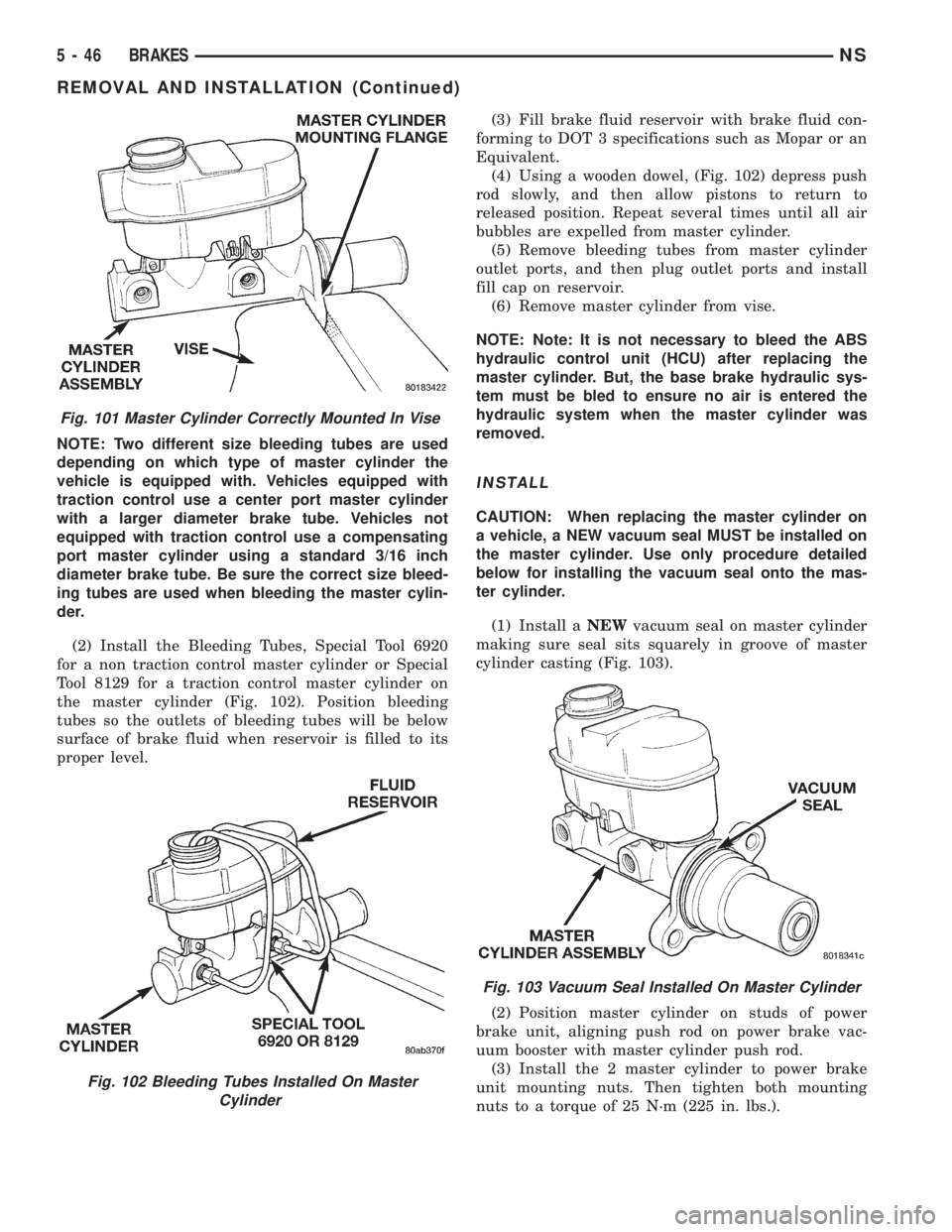
(2) Install the Bleeding Tubes, Special Tool 6920
for a non traction control master cylinder or Special
Tool 8129 for a traction control master cylinder on
the master cylinder (Fig. 102). Position bleeding
tubes so the outlets of bleeding tubes will be below
surface of brake fluid when reservoir is filled to its
proper level.(3) Fill brake fluid reservoir with brake fluid con-
forming to DOT 3 specifications such as Mopar or an
Equivalent.
(4) Using a wooden dowel, (Fig. 102) depress push
rod slowly, and then allow pistons to return to
released position. Repeat several times until all air
bubbles are expelled from master cylinder.
(5) Remove bleeding tubes from master cylinder
outlet ports, and then plug outlet ports and install
fill cap on reservoir.
(6) Remove master cylinder from vise.
NOTE: Note: It is not necessary to bleed the ABS
hydraulic control unit (HCU) after replacing the
master cylinder. But, the base brake hydraulic sys-
tem must be bled to ensure no air is entered the
hydraulic system when the master cylinder was
removed.
INSTALL
CAUTION: When replacing the master cylinder on
a vehicle, a NEW vacuum seal MUST be installed on
the master cylinder. Use only procedure detailed
below for installing the vacuum seal onto the mas-
ter cylinder.
(1) Install aNEWvacuum seal on master cylinder
making sure seal sits squarely in groove of master
cylinder casting (Fig. 103).
(2) Position master cylinder on studs of power
brake unit, aligning push rod on power brake vac-
uum booster with master cylinder push rod.
(3) Install the 2 master cylinder to power brake
unit mounting nuts. Then tighten both mounting
nuts to a torque of 25 N´m (225 in. lbs.).
Fig. 101 Master Cylinder Correctly Mounted In Vise
Fig. 102 Bleeding Tubes Installed On Master
Cylinder
Fig. 103 Vacuum Seal Installed On Master Cylinder
5 - 46 BRAKESNS
REMOVAL AND INSTALLATION (Continued)
Page 129 of 1938

CAUTION: When installing the primary and second-
ary brake tubes on master cylinder, be sure brake
tubes do not contact any other components within
the vehicle and that there is slack in the flexible
sections of the tubes. This is required due to the
movement between the ABS hydraulic control mod-
ule (HCU) and the master cylinder, when the vehicle
is in motion.
(4) Connect the primary and secondary brake
tubes to master cylinder primary and secondary
ports (Fig. 99). Brake tubes must be held securely
when tightened to control orientation of flex section.
Then fully tighten the tube nuts to a torque of 17
N´m (145 in. lbs.).
(5) Install the vehicle wiring harness connector, on
the brake fluid level sensor in the master cylinder
brake fluid reservoir (Fig. 98).
(6) Install filler tube into the master cylinder fluid
reservoir (Fig. 97).
VACUUM BOOSTER 2.4 LITER ENGINE
REMOVE
CAUTION: Reserve vacuum in the vacuum booster
must be pumped down (removed) before removing
master cylinder from vacuum booster. This is nec-
essary to prevent the vacuum booster from sucking
in any contamination as the master cylinder is
removed. This can be done simply by pumping the
brake pedal, with the vehicle's engine not running,
until a firm feeling brake pedal is achieved.
(1) With engine not running, pump brake pedal
until a firm pedal is achieved (4-5 strokes).
(2) Remove both battery cables from battery.
(3) Remove the battery thermal guard and the bat-
tery from the battery tray.
(4) Remove the air inlet resonator and hoses as an
assembly from the throttle body and air cleaner
housing (Fig. 104)
(5) If vehicle is equipped with speed control,
unplug wiring harness connector from the speed con-
trol servo. Then disconnect vacuum lines from the
speed control servo and vacuum reservoir on battery
tray.
(6) Remove bolt attaching the speed control servo
bracket to the battery tray. Slide the bracket forward
to unhook it from the battery tray and remove.
(7) Remove the 2 bolts and the nut (Fig. 105)
attaching the battery tray to the body.
(8) Remove wiring harness connector from brake
fluid level sensor in master cylinder fluid reservoir
(Fig. 106).
(9) Clean the area where the master cylinder
assembly attaches to the power brake booster. Useonly a solvent such as Mopar Brake Parts Cleaner or
an equivalent.
(10) Remove clip attaching drain hose for wiper
module to brake tube at master cylinder. Remove
Fig. 104 Air Inlet Resonator
Fig. 105 Battery Tray Mounting Locations
Fig. 106 Fluid Level Sensor Electrical Connection
NSBRAKES 5 - 47
REMOVAL AND INSTALLATION (Continued)
Page 138 of 1938
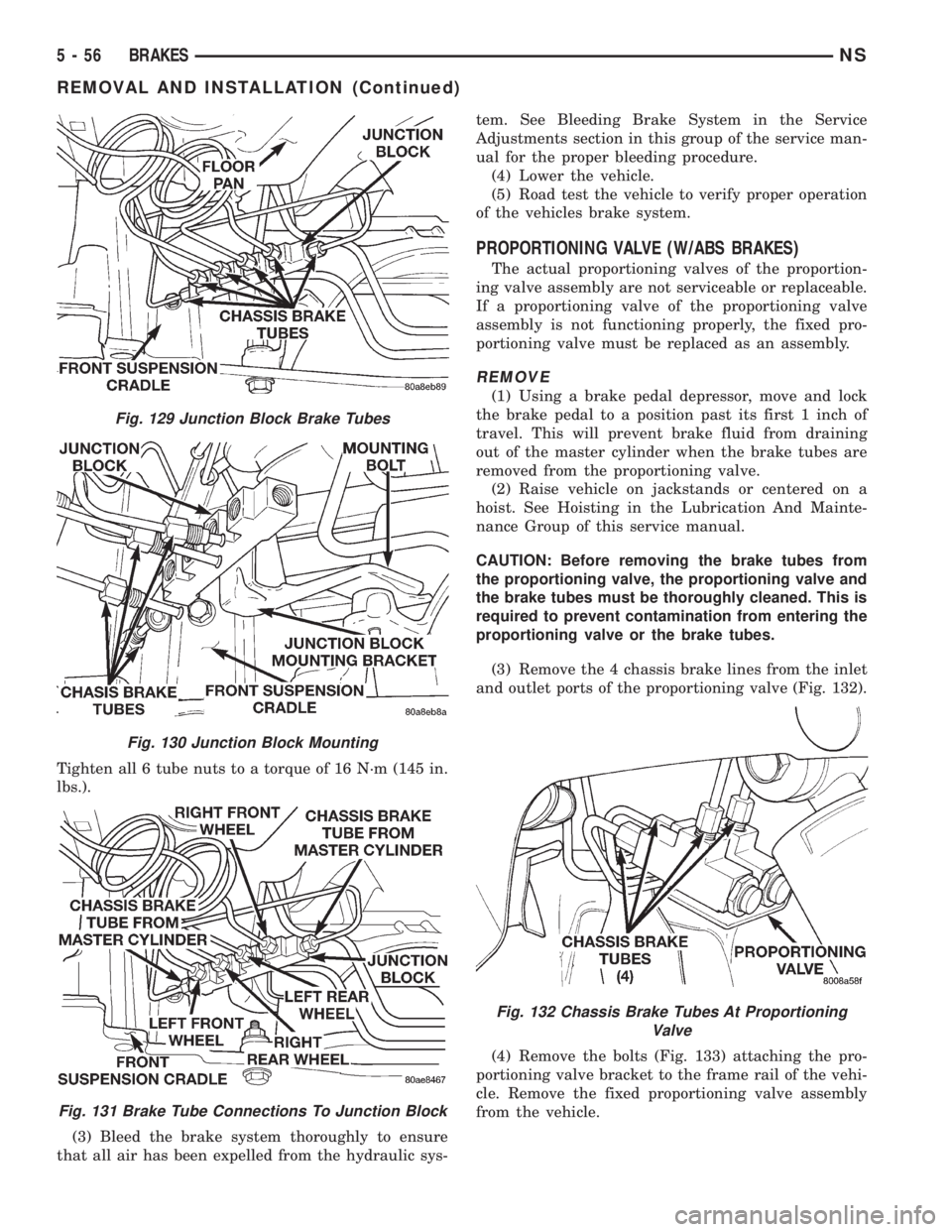
Tighten all 6 tube nuts to a torque of 16 N´m (145 in.
lbs.).
(3) Bleed the brake system thoroughly to ensure
that all air has been expelled from the hydraulic sys-tem. See Bleeding Brake System in the Service
Adjustments section in this group of the service man-
ual for the proper bleeding procedure.
(4) Lower the vehicle.
(5) Road test the vehicle to verify proper operation
of the vehicles brake system.
PROPORTIONING VALVE (W/ABS BRAKES)
The actual proportioning valves of the proportion-
ing valve assembly are not serviceable or replaceable.
If a proportioning valve of the proportioning valve
assembly is not functioning properly, the fixed pro-
portioning valve must be replaced as an assembly.
REMOVE
(1) Using a brake pedal depressor, move and lock
the brake pedal to a position past its first 1 inch of
travel. This will prevent brake fluid from draining
out of the master cylinder when the brake tubes are
removed from the proportioning valve.
(2) Raise vehicle on jackstands or centered on a
hoist. See Hoisting in the Lubrication And Mainte-
nance Group of this service manual.
CAUTION: Before removing the brake tubes from
the proportioning valve, the proportioning valve and
the brake tubes must be thoroughly cleaned. This is
required to prevent contamination from entering the
proportioning valve or the brake tubes.
(3) Remove the 4 chassis brake lines from the inlet
and outlet ports of the proportioning valve (Fig. 132).
(4) Remove the bolts (Fig. 133) attaching the pro-
portioning valve bracket to the frame rail of the vehi-
cle. Remove the fixed proportioning valve assembly
from the vehicle.
Fig. 129 Junction Block Brake Tubes
Fig. 130 Junction Block Mounting
Fig. 131 Brake Tube Connections To Junction Block
Fig. 132 Chassis Brake Tubes At Proportioning
Valve
5 - 56 BRAKESNS
REMOVAL AND INSTALLATION (Continued)
Page 139 of 1938
INSTALL
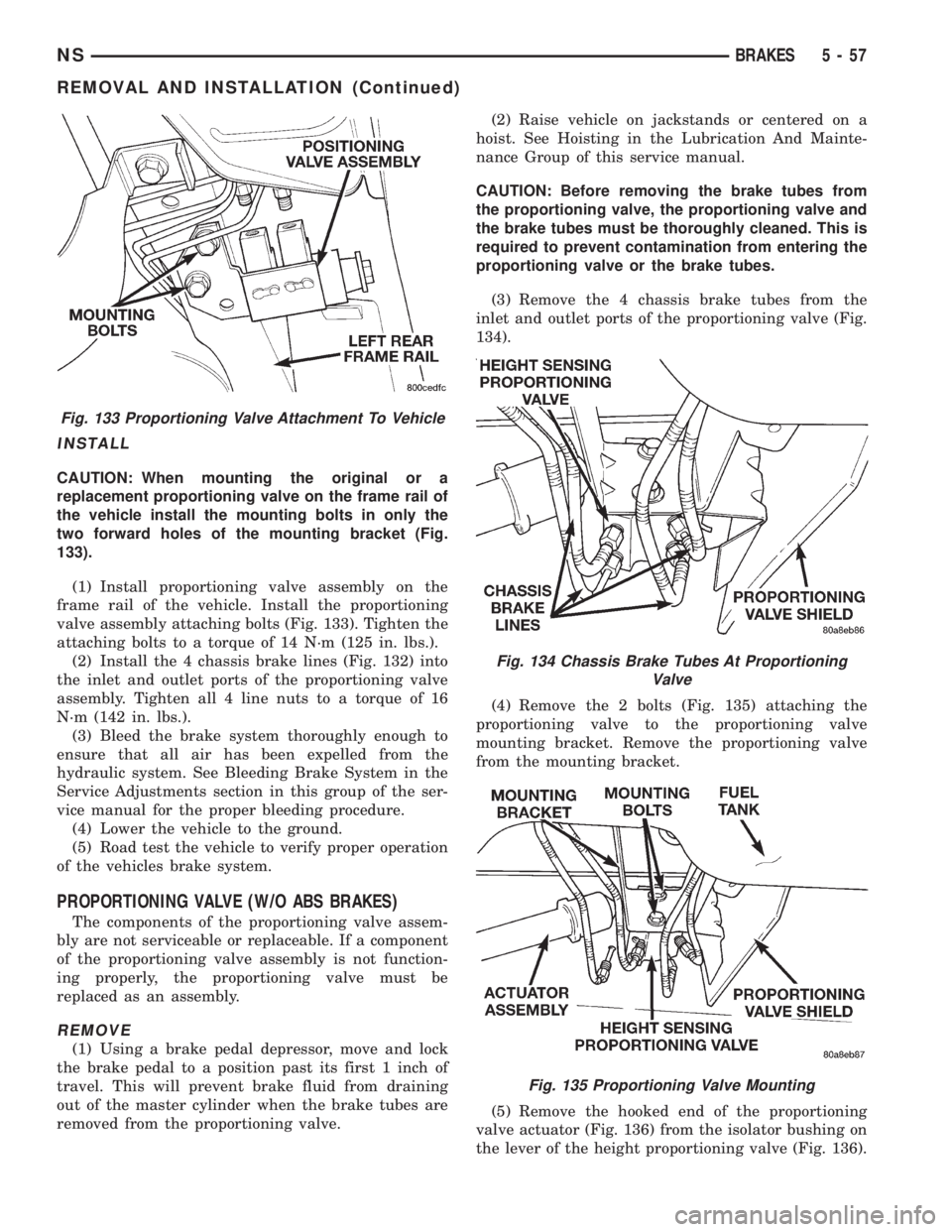
CAUTION: When mounting the original or a
replacement proportioning valve on the frame rail of
the vehicle install the mounting bolts in only the
two forward holes of the mounting bracket (Fig.
133).
(1) Install proportioning valve assembly on the
frame rail of the vehicle. Install the proportioning
valve assembly attaching bolts (Fig. 133). Tighten the
attaching bolts to a torque of 14 N´m (125 in. lbs.).
(2) Install the 4 chassis brake lines (Fig. 132) into
the inlet and outlet ports of the proportioning valve
assembly. Tighten all 4 line nuts to a torque of 16
N´m (142 in. lbs.).
(3) Bleed the brake system thoroughly enough to
ensure that all air has been expelled from the
hydraulic system. See Bleeding Brake System in the
Service Adjustments section in this group of the ser-
vice manual for the proper bleeding procedure.
(4) Lower the vehicle to the ground.
(5) Road test the vehicle to verify proper operation
of the vehicles brake system.
PROPORTIONING VALVE (W/O ABS BRAKES)
The components of the proportioning valve assem-
bly are not serviceable or replaceable. If a component
of the proportioning valve assembly is not function-
ing properly, the proportioning valve must be
replaced as an assembly.
REMOVE
(1) Using a brake pedal depressor, move and lock
the brake pedal to a position past its first 1 inch of
travel. This will prevent brake fluid from draining
out of the master cylinder when the brake tubes are
removed from the proportioning valve.(2) Raise vehicle on jackstands or centered on a
hoist. See Hoisting in the Lubrication And Mainte-
nance Group of this service manual.
CAUTION: Before removing the brake tubes from
the proportioning valve, the proportioning valve and
the brake tubes must be thoroughly cleaned. This is
required to prevent contamination from entering the
proportioning valve or the brake tubes.
(3) Remove the 4 chassis brake tubes from the
inlet and outlet ports of the proportioning valve (Fig.
134).
(4) Remove the 2 bolts (Fig. 135) attaching the
proportioning valve to the proportioning valve
mounting bracket. Remove the proportioning valve
from the mounting bracket.
(5) Remove the hooked end of the proportioning
valve actuator (Fig. 136) from the isolator bushing on
the lever of the height proportioning valve (Fig. 136).
Fig. 133 Proportioning Valve Attachment To Vehicle
Fig. 134 Chassis Brake Tubes At Proportioning
Valve
Fig. 135 Proportioning Valve Mounting
NSBRAKES 5 - 57
REMOVAL AND INSTALLATION (Continued)
Page 140 of 1938
INSTALL
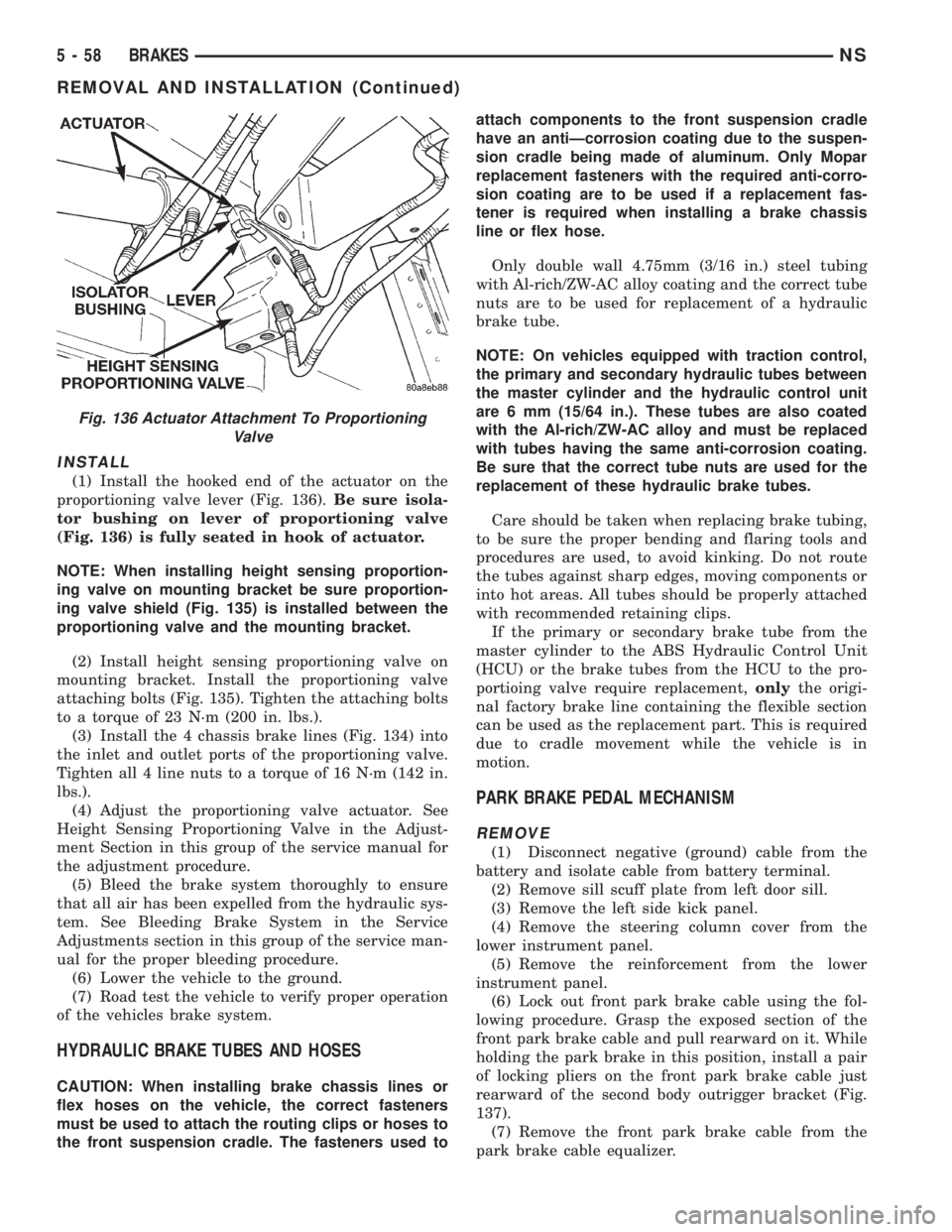
(1) Install the hooked end of the actuator on the
proportioning valve lever (Fig. 136).Be sure isola-
tor bushing on lever of proportioning valve
(Fig. 136) is fully seated in hook of actuator.
NOTE: When installing height sensing proportion-
ing valve on mounting bracket be sure proportion-
ing valve shield (Fig. 135) is installed between the
proportioning valve and the mounting bracket.
(2) Install height sensing proportioning valve on
mounting bracket. Install the proportioning valve
attaching bolts (Fig. 135). Tighten the attaching bolts
to a torque of 23 N´m (200 in. lbs.).
(3) Install the 4 chassis brake lines (Fig. 134) into
the inlet and outlet ports of the proportioning valve.
Tighten all 4 line nuts to a torque of 16 N´m (142 in.
lbs.).
(4) Adjust the proportioning valve actuator. See
Height Sensing Proportioning Valve in the Adjust-
ment Section in this group of the service manual for
the adjustment procedure.
(5) Bleed the brake system thoroughly to ensure
that all air has been expelled from the hydraulic sys-
tem. See Bleeding Brake System in the Service
Adjustments section in this group of the service man-
ual for the proper bleeding procedure.
(6) Lower the vehicle to the ground.
(7) Road test the vehicle to verify proper operation
of the vehicles brake system.
HYDRAULIC BRAKE TUBES AND HOSES
CAUTION: When installing brake chassis lines or
flex hoses on the vehicle, the correct fasteners
must be used to attach the routing clips or hoses to
the front suspension cradle. The fasteners used toattach components to the front suspension cradle
have an antiÐcorrosion coating due to the suspen-
sion cradle being made of aluminum. Only Mopar
replacement fasteners with the required anti-corro-
sion coating are to be used if a replacement fas-
tener is required when installing a brake chassis
line or flex hose.
Only double wall 4.75mm (3/16 in.) steel tubing
with Al-rich/ZW-AC alloy coating and the correct tube
nuts are to be used for replacement of a hydraulic
brake tube.
NOTE: On vehicles equipped with traction control,
the primary and secondary hydraulic tubes between
the master cylinder and the hydraulic control unit
are 6 mm (15/64 in.). These tubes are also coated
with the Al-rich/ZW-AC alloy and must be replaced
with tubes having the same anti-corrosion coating.
Be sure that the correct tube nuts are used for the
replacement of these hydraulic brake tubes.
Care should be taken when replacing brake tubing,
to be sure the proper bending and flaring tools and
procedures are used, to avoid kinking. Do not route
the tubes against sharp edges, moving components or
into hot areas. All tubes should be properly attached
with recommended retaining clips.
If the primary or secondary brake tube from the
master cylinder to the ABS Hydraulic Control Unit
(HCU) or the brake tubes from the HCU to the pro-
portioing valve require replacement,onlythe origi-
nal factory brake line containing the flexible section
can be used as the replacement part. This is required
due to cradle movement while the vehicle is in
motion.
PARK BRAKE PEDAL MECHANISM
REMOVE
(1) Disconnect negative (ground) cable from the
battery and isolate cable from battery terminal.
(2) Remove sill scuff plate from left door sill.
(3) Remove the left side kick panel.
(4) Remove the steering column cover from the
lower instrument panel.
(5) Remove the reinforcement from the lower
instrument panel.
(6) Lock out front park brake cable using the fol-
lowing procedure. Grasp the exposed section of the
front park brake cable and pull rearward on it. While
holding the park brake in this position, install a pair
of locking pliers on the front park brake cable just
rearward of the second body outrigger bracket (Fig.
137).
(7) Remove the front park brake cable from the
park brake cable equalizer.
Fig. 136 Actuator Attachment To Proportioning
Valve
5 - 58 BRAKESNS
REMOVAL AND INSTALLATION (Continued)
Page 143 of 1938
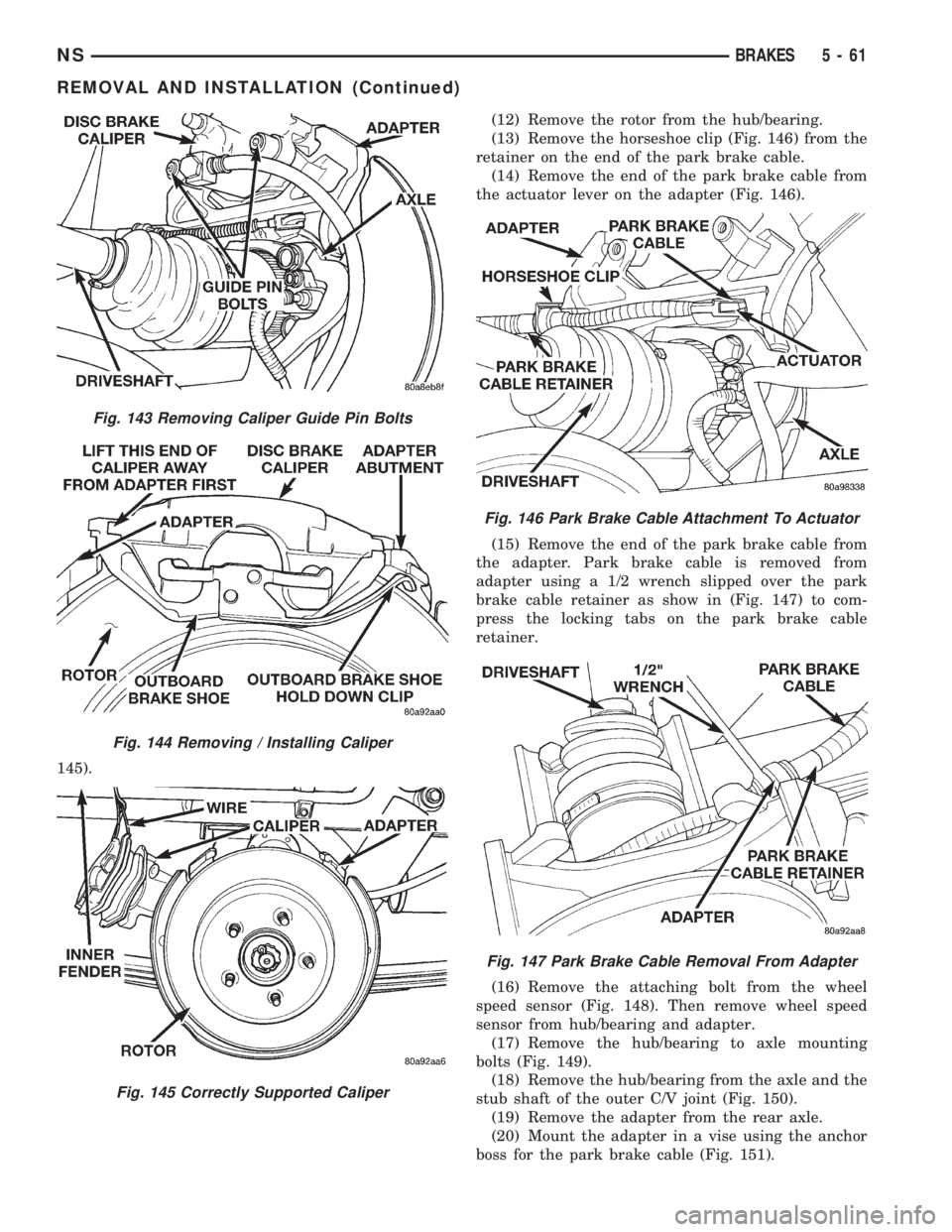
145).(12) Remove the rotor from the hub/bearing.
(13) Remove the horseshoe clip (Fig. 146) from the
retainer on the end of the park brake cable.
(14) Remove the end of the park brake cable from
the actuator lever on the adapter (Fig. 146).
(15) Remove the end of the park brake cable from
the adapter. Park brake cable is removed from
adapter using a 1/2 wrench slipped over the park
brake cable retainer as show in (Fig. 147) to com-
press the locking tabs on the park brake cable
retainer.
(16) Remove the attaching bolt from the wheel
speed sensor (Fig. 148). Then remove wheel speed
sensor from hub/bearing and adapter.
(17) Remove the hub/bearing to axle mounting
bolts (Fig. 149).
(18) Remove the hub/bearing from the axle and the
stub shaft of the outer C/V joint (Fig. 150).
(19) Remove the adapter from the rear axle.
(20) Mount the adapter in a vise using the anchor
boss for the park brake cable (Fig. 151).
Fig. 143 Removing Caliper Guide Pin Bolts
Fig. 144 Removing / Installing Caliper
Fig. 145 Correctly Supported Caliper
Fig. 146 Park Brake Cable Attachment To Actuator
Fig. 147 Park Brake Cable Removal From Adapter
NSBRAKES 5 - 61
REMOVAL AND INSTALLATION (Continued)
Page 146 of 1938
NOTE: When the hold down pin is installed, the
long part of the hold down pin is to be positioned
strait up and down. This will ensure that the hold
down pin is correctly engaged with the adapter.
(6) Install the hold down spring and pin (Fig. 153)
on the leading park brake shoe.
(7) Install the lower return spring (Fig. 152) on
the leading and trailing park brake shoes.When
installing the hold down spring it is to be
installed behind the park brake shoes (Fig.
152).
(8) Install the 4 mounting bolts for the adapter
and hub/bearing into the bolt holes in the axle.
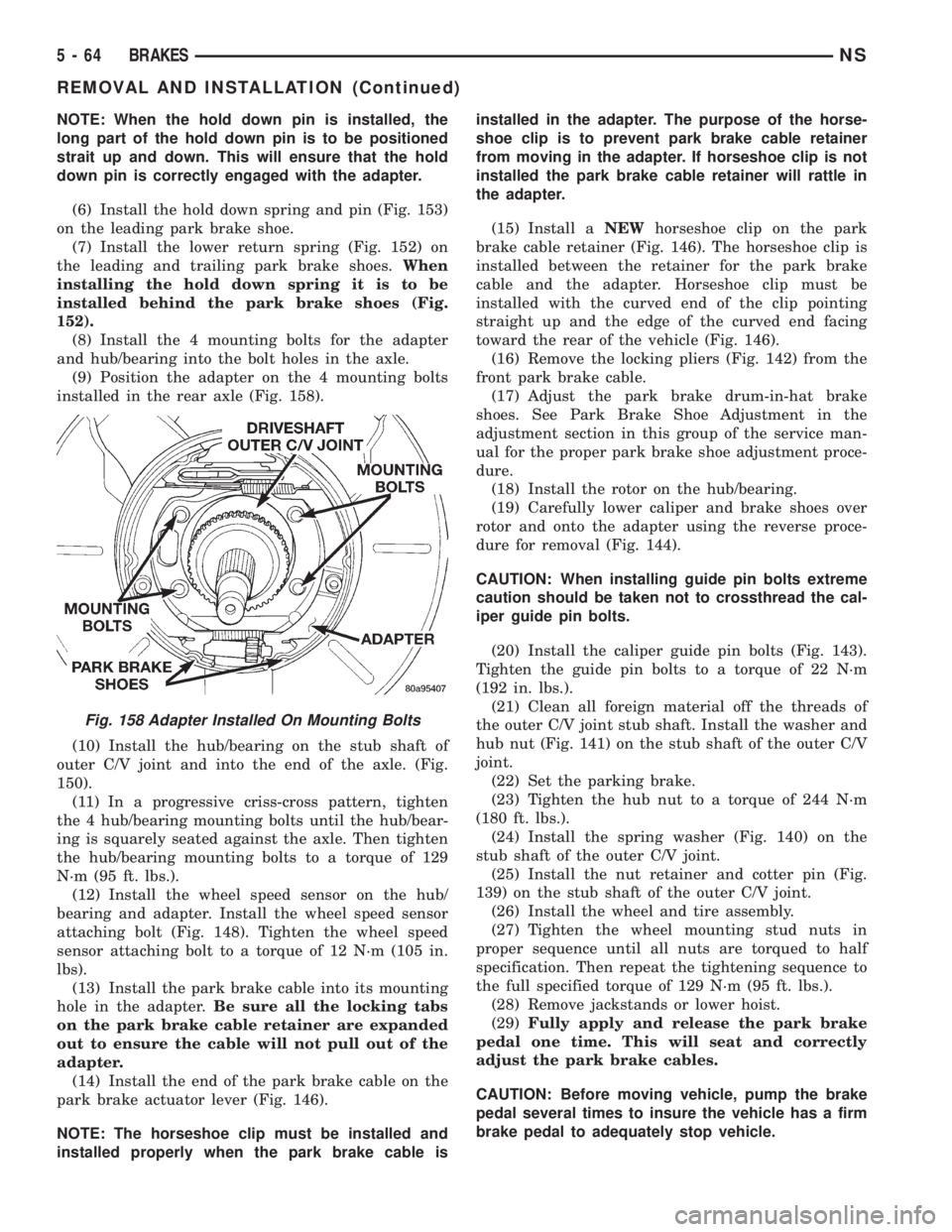
(9) Position the adapter on the 4 mounting bolts
installed in the rear axle (Fig. 158).
(10) Install the hub/bearing on the stub shaft of
outer C/V joint and into the end of the axle. (Fig.
150).
(11) In a progressive criss-cross pattern, tighten
the 4 hub/bearing mounting bolts until the hub/bear-
ing is squarely seated against the axle. Then tighten
the hub/bearing mounting bolts to a torque of 129
N´m (95 ft. lbs.).
(12) Install the wheel speed sensor on the hub/
bearing and adapter. Install the wheel speed sensor
attaching bolt (Fig. 148). Tighten the wheel speed
sensor attaching bolt to a torque of 12 N´m (105 in.
lbs).
(13) Install the park brake cable into its mounting
hole in the adapter.Be sure all the locking tabs
on the park brake cable retainer are expanded
out to ensure the cable will not pull out of the
adapter.
(14) Install the end of the park brake cable on the
park brake actuator lever (Fig. 146).
NOTE: The horseshoe clip must be installed and
installed properly when the park brake cable isinstalled in the adapter. The purpose of the horse-
shoe clip is to prevent park brake cable retainer
from moving in the adapter. If horseshoe clip is not
installed the park brake cable retainer will rattle in
the adapter.
(15) Install aNEWhorseshoe clip on the park
brake cable retainer (Fig. 146). The horseshoe clip is
installed between the retainer for the park brake
cable and the adapter. Horseshoe clip must be
installed with the curved end of the clip pointing
straight up and the edge of the curved end facing
toward the rear of the vehicle (Fig. 146).
(16) Remove the locking pliers (Fig. 142) from the
front park brake cable.
(17) Adjust the park brake drum-in-hat brake
shoes. See Park Brake Shoe Adjustment in the
adjustment section in this group of the service man-
ual for the proper park brake shoe adjustment proce-
dure.
(18) Install the rotor on the hub/bearing.
(19) Carefully lower caliper and brake shoes over
rotor and onto the adapter using the reverse proce-
dure for removal (Fig. 144).
CAUTION: When installing guide pin bolts extreme
caution should be taken not to crossthread the cal-
iper guide pin bolts.
(20) Install the caliper guide pin bolts (Fig. 143).
Tighten the guide pin bolts to a torque of 22 N´m
(192 in. lbs.).
(21) Clean all foreign material off the threads of
the outer C/V joint stub shaft. Install the washer and
hub nut (Fig. 141) on the stub shaft of the outer C/V
joint.
(22) Set the parking brake.
(23) Tighten the hub nut to a torque of 244 N´m
(180 ft. lbs.).
(24) Install the spring washer (Fig. 140) on the
stub shaft of the outer C/V joint.
(25) Install the nut retainer and cotter pin (Fig.
139) on the stub shaft of the outer C/V joint.
(26) Install the wheel and tire assembly.
(27) Tighten the wheel mounting stud nuts in
proper sequence until all nuts are torqued to half
specification. Then repeat the tightening sequence to
the full specified torque of 129 N´m (95 ft. lbs.).
(28) Remove jackstands or lower hoist.
(29)Fully apply and release the park brake
pedal one time. This will seat and correctly
adjust the park brake cables.
CAUTION: Before moving vehicle, pump the brake
pedal several times to insure the vehicle has a firm
brake pedal to adequately stop vehicle.
Fig. 158 Adapter Installed On Mounting Bolts
5 - 64 BRAKESNS
REMOVAL AND INSTALLATION (Continued)