fuel CHRYSLER VOYAGER 1996 User Guide
[x] Cancel search | Manufacturer: CHRYSLER, Model Year: 1996, Model line: VOYAGER, Model: CHRYSLER VOYAGER 1996Pages: 1938, PDF Size: 55.84 MB
Page 36 of 1938
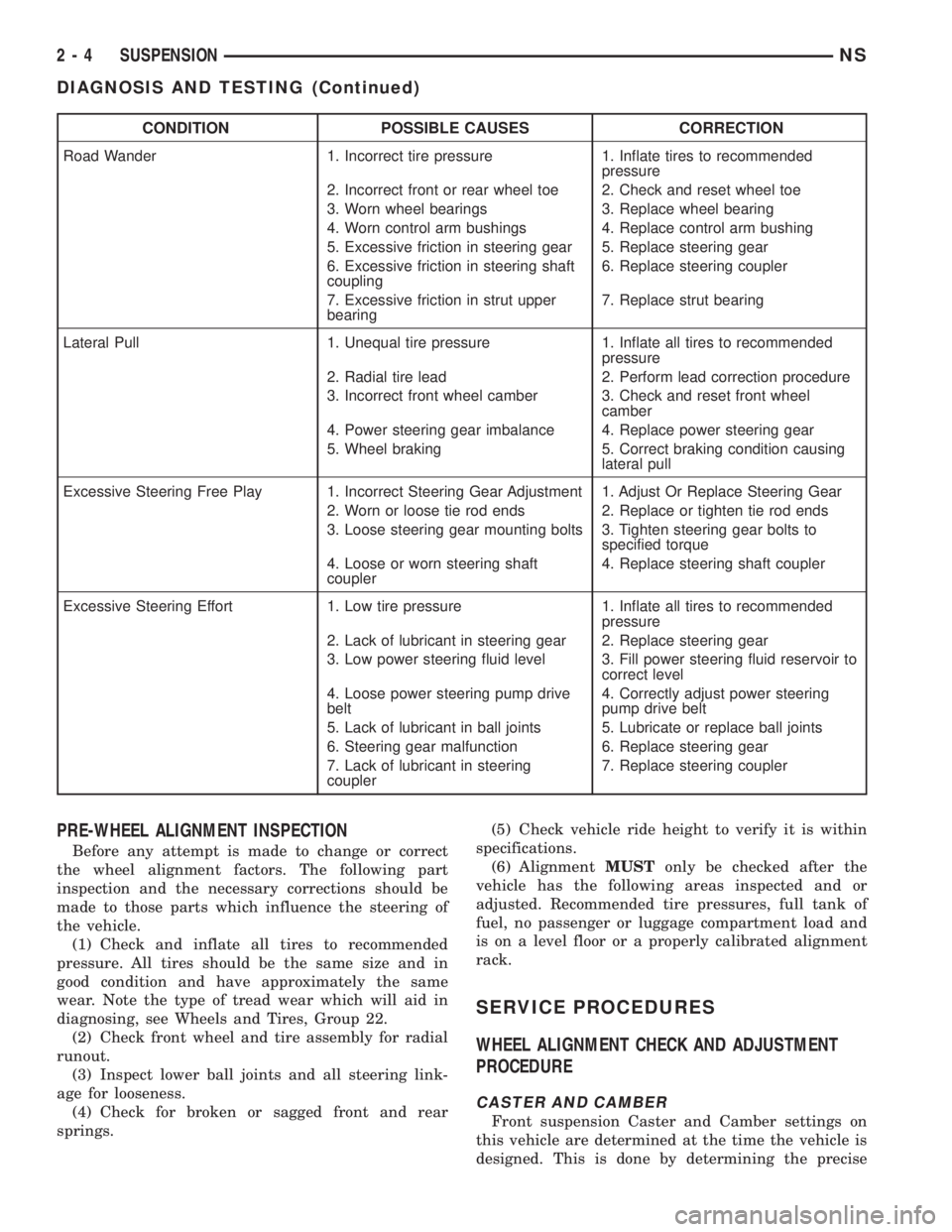
CONDITION POSSIBLE CAUSES CORRECTION
Road Wander 1. Incorrect tire pressure 1. Inflate tires to recommended
pressure
2. Incorrect front or rear wheel toe 2. Check and reset wheel toe
3. Worn wheel bearings 3. Replace wheel bearing
4. Worn control arm bushings 4. Replace control arm bushing
5. Excessive friction in steering gear 5. Replace steering gear
6. Excessive friction in steering shaft
coupling6. Replace steering coupler
7. Excessive friction in strut upper
bearing7. Replace strut bearing
Lateral Pull 1. Unequal tire pressure 1. Inflate all tires to recommended
pressure
2. Radial tire lead 2. Perform lead correction procedure
3. Incorrect front wheel camber 3. Check and reset front wheel
camber
4. Power steering gear imbalance 4. Replace power steering gear
5. Wheel braking 5. Correct braking condition causing
lateral pull
Excessive Steering Free Play 1. Incorrect Steering Gear Adjustment 1. Adjust Or Replace Steering Gear
2. Worn or loose tie rod ends 2. Replace or tighten tie rod ends
3. Loose steering gear mounting bolts 3. Tighten steering gear bolts to
specified torque
4. Loose or worn steering shaft
coupler4. Replace steering shaft coupler
Excessive Steering Effort 1. Low tire pressure 1. Inflate all tires to recommended
pressure
2. Lack of lubricant in steering gear 2. Replace steering gear
3. Low power steering fluid level 3. Fill power steering fluid reservoir to
correct level
4. Loose power steering pump drive
belt4. Correctly adjust power steering
pump drive belt
5. Lack of lubricant in ball joints 5. Lubricate or replace ball joints
6. Steering gear malfunction 6. Replace steering gear
7. Lack of lubricant in steering
coupler7. Replace steering coupler
PRE-WHEEL ALIGNMENT INSPECTION
Before any attempt is made to change or correct
the wheel alignment factors. The following part
inspection and the necessary corrections should be
made to those parts which influence the steering of
the vehicle.
(1) Check and inflate all tires to recommended
pressure. All tires should be the same size and in
good condition and have approximately the same
wear. Note the type of tread wear which will aid in
diagnosing, see Wheels and Tires, Group 22.
(2) Check front wheel and tire assembly for radial
runout.
(3) Inspect lower ball joints and all steering link-
age for looseness.
(4) Check for broken or sagged front and rear
springs.(5) Check vehicle ride height to verify it is within
specifications.
(6) AlignmentMUSTonly be checked after the
vehicle has the following areas inspected and or
adjusted. Recommended tire pressures, full tank of
fuel, no passenger or luggage compartment load and
is on a level floor or a properly calibrated alignment
rack.
SERVICE PROCEDURES
WHEEL ALIGNMENT CHECK AND ADJUSTMENT
PROCEDURE
CASTER AND CAMBER
Front suspension Caster and Camber settings on
this vehicle are determined at the time the vehicle is
designed. This is done by determining the precise
2 - 4 SUSPENSIONNS
DIAGNOSIS AND TESTING (Continued)
Page 40 of 1938
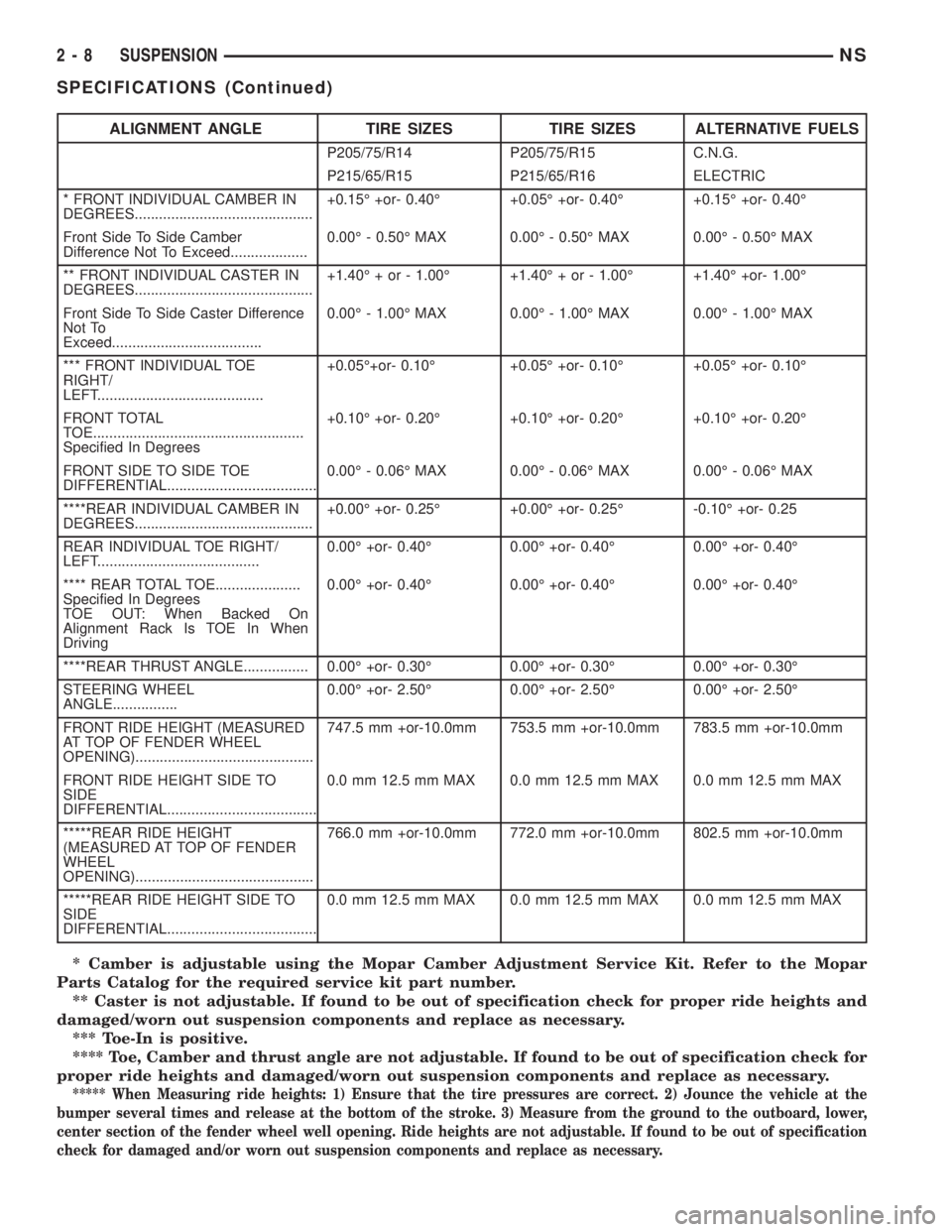
* Camber is adjustable using the Mopar Camber Adjustment Service Kit. Refer to the Mopar
Parts Catalog for the required service kit part number.
** Caster is not adjustable. If found to be out of specification check for proper ride heights and
damaged/worn out suspension components and replace as necessary.
*** Toe-In is positive.
**** Toe, Camber and thrust angle are not adjustable. If found to be out of specification check for
proper ride heights and damaged/worn out suspension components and replace as necessary.
***** When Measuring ride heights: 1) Ensure that the tire pressures are correct. 2) Jounce the vehicle at the
bumper several times and release at the bottom of the stroke. 3) Measure from the ground to the outboard, lower,
center section of the fender wheel well opening. Ride heights are not adjustable. If found to be out of specification
check for damaged and/or worn out suspension components and replace as necessary.
ALIGNMENT ANGLE TIRE SIZES TIRE SIZES ALTERNATIVE FUELS
P205/75/R14 P205/75/R15 C.N.G.
P215/65/R15 P215/65/R16 ELECTRIC
* FRONT INDIVIDUAL CAMBER IN
DEGREES............................................+0.15É +or- 0.40É +0.05É +or- 0.40É +0.15É +or- 0.40É
Front Side To Side Camber
Difference Not To Exceed...................0.00É - 0.50É MAX 0.00É - 0.50É MAX 0.00É - 0.50É MAX
** FRONT INDIVIDUAL CASTER IN
DEGREES............................................+1.40É + or - 1.00É +1.40É + or - 1.00É +1.40É +or- 1.00É
Front Side To Side Caster Difference
Not To
Exceed.....................................0.00É - 1.00É MAX 0.00É - 1.00É MAX 0.00É - 1.00É MAX
*** FRONT INDIVIDUAL TOE
RIGHT/
LEFT.........................................+0.05É+or- 0.10É +0.05É +or- 0.10É +0.05É +or- 0.10É
FRONT TOTAL
TOE....................................................
Specified In Degrees+0.10É +or- 0.20É +0.10É +or- 0.20É +0.10É +or- 0.20É
FRONT SIDE TO SIDE TOE
DIFFERENTIAL.....................................0.00É - 0.06É MAX 0.00É - 0.06É MAX 0.00É - 0.06É MAX
****REAR INDIVIDUAL CAMBER IN
DEGREES............................................+0.00É +or- 0.25É +0.00É +or- 0.25É -0.10É +or- 0.25
REAR INDIVIDUAL TOE RIGHT/
LEFT........................................0.00É +or- 0.40É 0.00É +or- 0.40É 0.00É +or- 0.40É
**** REAR TOTAL TOE.....................
Specified In Degrees
TOE OUT: When Backed On
Alignment Rack Is TOE In When
Driving0.00É +or- 0.40É 0.00É +or- 0.40É 0.00É +or- 0.40É
****REAR THRUST ANGLE................ 0.00É +or- 0.30É 0.00É +or- 0.30É 0.00É +or- 0.30É
STEERING WHEEL
ANGLE................0.00É +or- 2.50É 0.00É +or- 2.50É 0.00É +or- 2.50É
FRONT RIDE HEIGHT (MEASURED
AT TOP OF FENDER WHEEL
OPENING)............................................747.5 mm +or-10.0mm 753.5 mm +or-10.0mm 783.5 mm +or-10.0mm
FRONT RIDE HEIGHT SIDE TO
SIDE
DIFFERENTIAL.....................................0.0 mm 12.5 mm MAX 0.0 mm 12.5 mm MAX 0.0 mm 12.5 mm MAX
*****REAR RIDE HEIGHT
(MEASURED AT TOP OF FENDER
WHEEL
OPENING)............................................766.0 mm +or-10.0mm 772.0 mm +or-10.0mm 802.5 mm +or-10.0mm
*****REAR RIDE HEIGHT SIDE TO
SIDE
DIFFERENTIAL.....................................0.0 mm 12.5 mm MAX 0.0 mm 12.5 mm MAX 0.0 mm 12.5 mm MAX
2 - 8 SUSPENSIONNS
SPECIFICATIONS (Continued)
Page 82 of 1938
ALIGNMENT ANGLE TIRE SIZES TIRE SIZESALTERNATIVE
FUELS
P205/75/R14 P205/75/R15 C.N.G.
P215/65/R15 P215/65/R16 ELECTRIC
* FRONT INDIVIDUAL CAMBER IN
DEGREES............................................+0.15É +or- 0.40É +0.05É +or- 0.40É +0.15É +or- 0.40É
Front Side To Side Camber Difference Not
To Exceed...................0.00É - 0.50É MAX 0.00É - 0.50É MAX 0.00É - 0.50É MAX
** FRONT INDIVIDUAL CASTER IN
DEGREES............................................+1.40É + or - 1.00É +1.40É + or - 1.00É +1.40É +or- 1.00É
Front Side To Side Caster Difference Not To
Exceed.....................................0.00É - 1.00É MAX 0.00É - 1.00É MAX 0.00É - 1.00É MAX
*** FRONT INDIVIDUAL TOE RIGHT/
LEFT.........................................+0.05É+or- 0.10É +0.05É +or- 0.10É +0.05É +or- 0.10É
FRONT TOTAL
TOE....................................................
Specified In Degrees+0.10É +or- 0.20É +0.10É +or- 0.20É +0.10É +or- 0.20É
FRONT SIDE TO SIDE TOE
DIFFERENTIAL.....................................0.00É - 0.06É MAX 0.00É - 0.06É MAX 0.00É - 0.06É MAX
****REAR INDIVIDUAL CAMBER IN
DEGREES............................................+0.00É +or- 0.25É +0.00É +or- 0.25É -0.10É +or- 0.25
REAR INDIVIDUAL TOE RIGHT/
LEFT........................................0.00É +or- 0.40É 0.00É +or- 0.40É 0.00É +or- 0.40É
**** REAR TOTAL TOE.....................
Specified In Degrees
TOE OUT: When Backed On Alignment Rack
Is TOE In When Driving0.00É +or- 0.40É 0.00É +or- 0.40É 0.00É +or- 0.40É
****REAR THRUST ANGLE................ 0.00É +or- 0.30É 0.00É +or- 0.30É 0.00É +or- 0.30É
STEERING WHEEL ANGLE................ 0.00É +or- 2.50É 0.00É +or- 2.50É 0.00É +or- 2.50É
FRONT RIDE HEIGHT (MEASURED AT
TOP OF FENDER WHEEL
OPENING)............................................747.5 mm
+or-10.0mm753.5 mm
+or-10.0mm783.5 mm
+or-10.0mm
FRONT RIDE HEIGHT SIDE TO SIDE
DIFFERENTIAL.....................................0.0 mm 12.5 mm
MAX0.0 mm 12.5 mm
MAX0.0 mm 12.5 mm
MAX
*****REAR RIDE HEIGHT (MEASURED AT
TOP OF FENDER WHEEL
OPENING)............................................766.0 mm
+or-10.0mm772.0 mm
+or-10.0mm802.5 mm
+or-10.0mm
*****REAR RIDE HEIGHT SIDE TO SIDE
DIFFERENTIAL.....................................0.0 mm 12.5 mm
MAX0.0 mm 12.5 mm
MAX0.0 mm 12.5 mm
MAX
2 - 2 SUSPENSIONNS/GS
SPECIFICATIONS (Continued)
Page 171 of 1938
fluid accumulators temporarily store brake fluid that
is decayed from the wheel brakes during an ABS
cycle. This stored brake fluid is then used by the
pump in the HCU to provide build pressure for the
brake hydraulic system.
Additionally on vehicles that are equipped with
only ABS (non-traction control vehicles) there is a
mini brake fluid accumulator on the secondary
hydraulic circuit which protects the master cylinder's
seals during an ABS stop. There is also a noise
damping chamber on the primary hydraulic circuit.
On ABS equipped vehicles with traction control, in
addition to the brake fluid accumulators there are
also two noise damping chambers in the HCU.
HCU PUMP/MOTOR
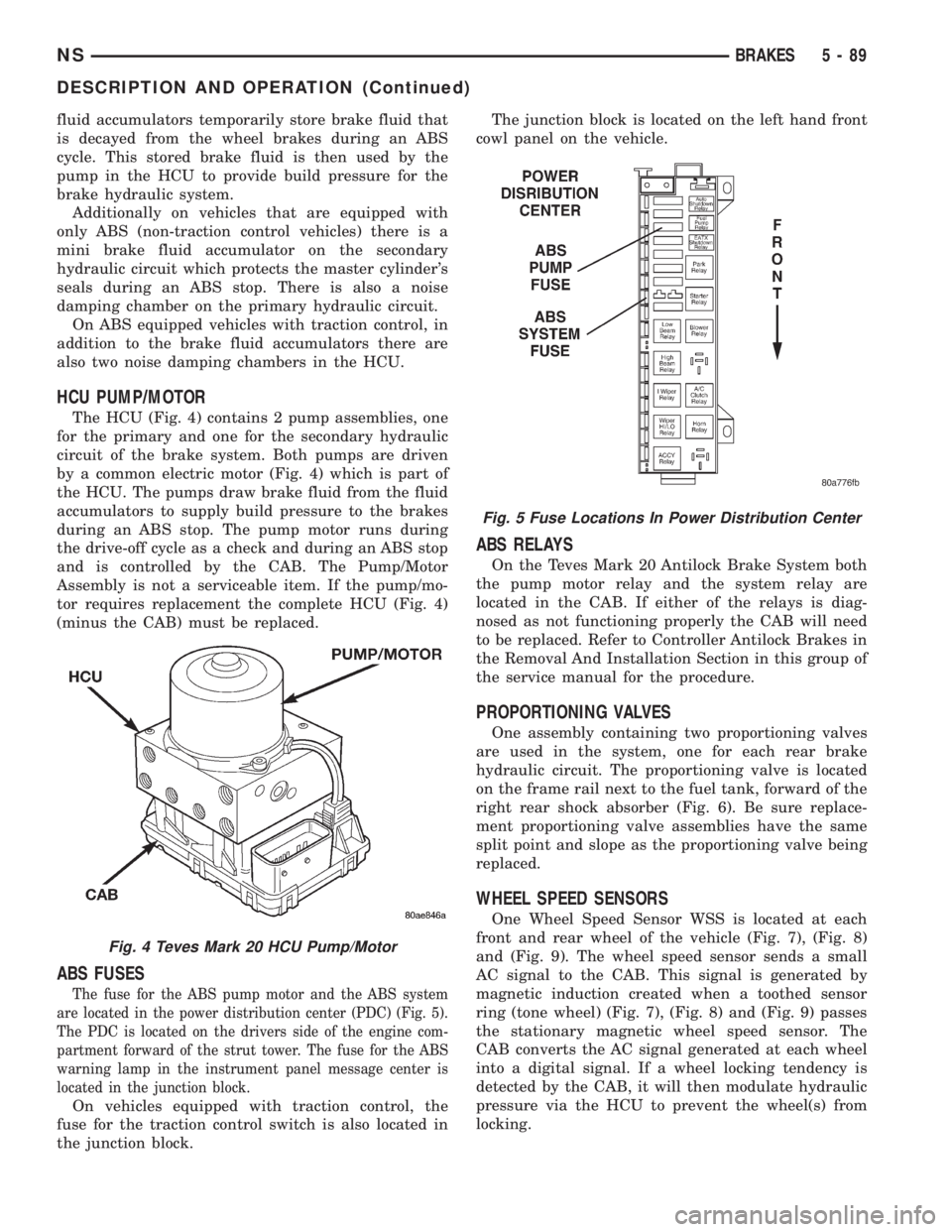
The HCU (Fig. 4) contains 2 pump assemblies, one
for the primary and one for the secondary hydraulic
circuit of the brake system. Both pumps are driven
by a common electric motor (Fig. 4) which is part of
the HCU. The pumps draw brake fluid from the fluid
accumulators to supply build pressure to the brakes
during an ABS stop. The pump motor runs during
the drive-off cycle as a check and during an ABS stop
and is controlled by the CAB. The Pump/Motor
Assembly is not a serviceable item. If the pump/mo-
tor requires replacement the complete HCU (Fig. 4)
(minus the CAB) must be replaced.
ABS FUSES
The fuse for the ABS pump motor and the ABS system
are located in the power distribution center (PDC) (Fig. 5).
The PDC is located on the drivers side of the engine com-
partment forward of the strut tower. The fuse for the ABS
warning lamp in the instrument panel message center is
located in the junction block.
On vehicles equipped with traction control, the
fuse for the traction control switch is also located in
the junction block.The junction block is located on the left hand front
cowl panel on the vehicle.
ABS RELAYS
On the Teves Mark 20 Antilock Brake System both
the pump motor relay and the system relay are
located in the CAB. If either of the relays is diag-
nosed as not functioning properly the CAB will need
to be replaced. Refer to Controller Antilock Brakes in
the Removal And Installation Section in this group of
the service manual for the procedure.
PROPORTIONING VALVES
One assembly containing two proportioning valves
are used in the system, one for each rear brake
hydraulic circuit. The proportioning valve is located
on the frame rail next to the fuel tank, forward of the
right rear shock absorber (Fig. 6). Be sure replace-
ment proportioning valve assemblies have the same
split point and slope as the proportioning valve being
replaced.
WHEEL SPEED SENSORS
One Wheel Speed Sensor WSS is located at each
front and rear wheel of the vehicle (Fig. 7), (Fig. 8)
and (Fig. 9). The wheel speed sensor sends a small
AC signal to the CAB. This signal is generated by
magnetic induction created when a toothed sensor
ring (tone wheel) (Fig. 7), (Fig. 8) and (Fig. 9) passes
the stationary magnetic wheel speed sensor. The
CAB converts the AC signal generated at each wheel
into a digital signal. If a wheel locking tendency is
detected by the CAB, it will then modulate hydraulic
pressure via the HCU to prevent the wheel(s) from
locking.
Fig. 4 Teves Mark 20 HCU Pump/Motor
Fig. 5 Fuse Locations In Power Distribution Center
NSBRAKES 5 - 89
DESCRIPTION AND OPERATION (Continued)
Page 274 of 1938
²Transmission range sensor, or Park/Neutral
Position switch with automatic transmissions
²Clutch Pedal Position Switch with manual
transmissions
²Ignition switch
²Battery
²All related wiring and connections
CAUTION: Before performing any starter tests, the
ignition and fuel systems must be disabled.
²To disable ignition and fuel systems, disconnect
the Automatic Shutdown Relay (ASD). The ASD relay
is located in the in the Power Distribution Center
(PDC). Refer to the PDC cover for the proper relay
location.
STARTER SOLENOID
WARNING: CHECK TO ENSURE THAT THE TRANS-
MISSION IS IN THE PARK POSITION WITH THE
PARKING BRAKE APPLIED
(1) Verify battery condition. Battery must be in
good condition with a full charge before performing
any starter tests. Refer to Battery Tests.
(2) Perform Starter Solenoid test BEFORE per-
forming the starter relay test.
(3) Raise the vehicle.
(4) Perform a visual inspection of the starter/
starter solenoid for corrosion, loose connections or
faulty wiring.
(5) Lower the vehicle.
(6) Locate and remove the starter relay from the
Power Distribution Center (PDC). Refer to the PDC
label for relay identification and location.
(7) Connect a remote starter switch or a jumper
wire between the remote battery positive post and
terminal 87 of the starter relay connector.
(a) If engine cranks, starter/starter solenoid is
good. Go to the Starter Relay Test.
(b) If engine does not or solenoid chatters, check
wiring and connectors from starter relay to starter
solenoid for loose or corroded connections. Particu-
larly at starter terminals.
(c) Repeat test. If engine still fails to crank prop-
erly, trouble is within starter or starter mounted
solenoid, and replace starter.
STARTER RELAY
WARNING: CHECK TO ENSURE THAT THE TRANS-
MISSION IS IN THE PARK POSITION/NEUTRAL
WITH THE PARKING BRAKE APPLIED
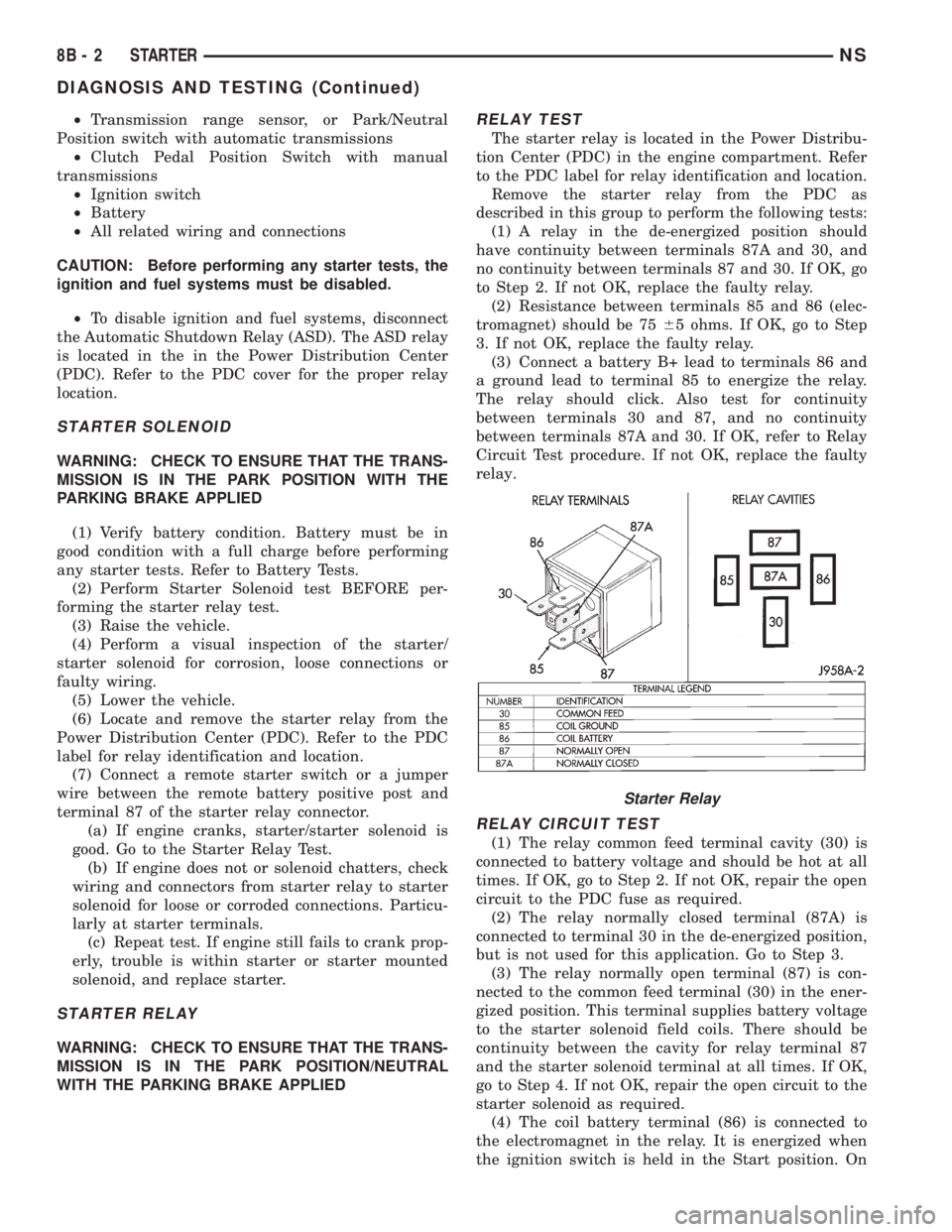
RELAY TEST
The starter relay is located in the Power Distribu-
tion Center (PDC) in the engine compartment. Refer
to the PDC label for relay identification and location.
Remove the starter relay from the PDC as
described in this group to perform the following tests:
(1) A relay in the de-energized position should
have continuity between terminals 87A and 30, and
no continuity between terminals 87 and 30. If OK, go
to Step 2. If not OK, replace the faulty relay.
(2) Resistance between terminals 85 and 86 (elec-
tromagnet) should be 7565 ohms. If OK, go to Step
3. If not OK, replace the faulty relay.
(3) Connect a battery B+ lead to terminals 86 and
a ground lead to terminal 85 to energize the relay.
The relay should click. Also test for continuity
between terminals 30 and 87, and no continuity
between terminals 87A and 30. If OK, refer to Relay
Circuit Test procedure. If not OK, replace the faulty
relay.
RELAY CIRCUIT TEST
(1) The relay common feed terminal cavity (30) is
connected to battery voltage and should be hot at all
times. If OK, go to Step 2. If not OK, repair the open
circuit to the PDC fuse as required.
(2) The relay normally closed terminal (87A) is
connected to terminal 30 in the de-energized position,
but is not used for this application. Go to Step 3.
(3) The relay normally open terminal (87) is con-
nected to the common feed terminal (30) in the ener-
gized position. This terminal supplies battery voltage
to the starter solenoid field coils. There should be
continuity between the cavity for relay terminal 87
and the starter solenoid terminal at all times. If OK,
go to Step 4. If not OK, repair the open circuit to the
starter solenoid as required.
(4) The coil battery terminal (86) is connected to
the electromagnet in the relay. It is energized when
the ignition switch is held in the Start position. On
Starter Relay
8B - 2 STARTERNS
DIAGNOSIS AND TESTING (Continued)
Page 275 of 1938
vehicles with a manual transmission, the clutch
pedal must be fully depressed for this test. Check for
battery voltage at the cavity for relay terminal 86
with the ignition switch in the Start position, and no
voltage when the ignition switch is released to the
On position. If OK, go to Step 5. If not OK with an
automatic transmission, check for an open or short
circuit to the ignition switch and repair, if required.
If the circuit to the ignition switch is OK, see the
Ignition Switch Test procedure in this group. If not
OK with a manual transmission, check the circuit
between the relay and the clutch pedal position
switch for an open or a short. If the circuit is OK, see
the Clutch Pedal Position Switch Test procedure in
this group.
(5) The coil ground terminal (85) is connected to
the electromagnet in the relay. On vehicles with an
automatic transmission, it is grounded through the
park/neutral position switch only when the gearshift
selector lever is in the Park or Neutral positions. On
vehicles with a manual transmission, it is grounded
at all times. Check for continuity to ground at the
cavity for relay terminal 85. If not OK with an auto-
matic transmission, check for an open or short circuit
to the park/neutral position switch and repair, if
required. If the circuit is OK, see the Park/Neutral
Position Switch Test procedure in this group. If not
OK with a manual transmission, repair the circuit to
ground as required.
SAFETY SWITCHES
For diagnostics,
²Clutch Pedal Position Switch, refer to Group 6,
Clutch.
²Park/Neutral Position Switch, refer to Group 21,
Transaxle
IGNITION SWITCH
After testing starter solenoid and relay, test igni-
tion switch and wiring. Refer to Group 8D, Ignition
Systems or Group 8W, Wiring Diagrams. Check all
wiring for opens or shorts, and all connectors for
being loose or corroded.
BATTERY
Refer to Group 8A, Battery for proper procedures.
ALL RELATED WIRING AND CONNECTORS
Refer to Group 8W, Wiring Diagrams,
FEED CIRCUIT RESISTANCE TEST
Before proceeding with this operation, review Diag-
nostic Preparation and Starter Feed Circuit Tests.
The following operation will require a voltmeter,
accurate to 1/10 of a volt.
CAUTION: Before performing any starter tests, the
ignition and fuel systems must be disabled.
(1) To disable the ignition and fuel systems, dis-
connect the Automatic Shutdown Relay (ASD). The
ASD relay is located in the Power Distribution Cen-
ter (PDC). Refer to the PDC cover for proper relay
location.
(2) With all wiring harnesses and components
properly connected, perform the following:
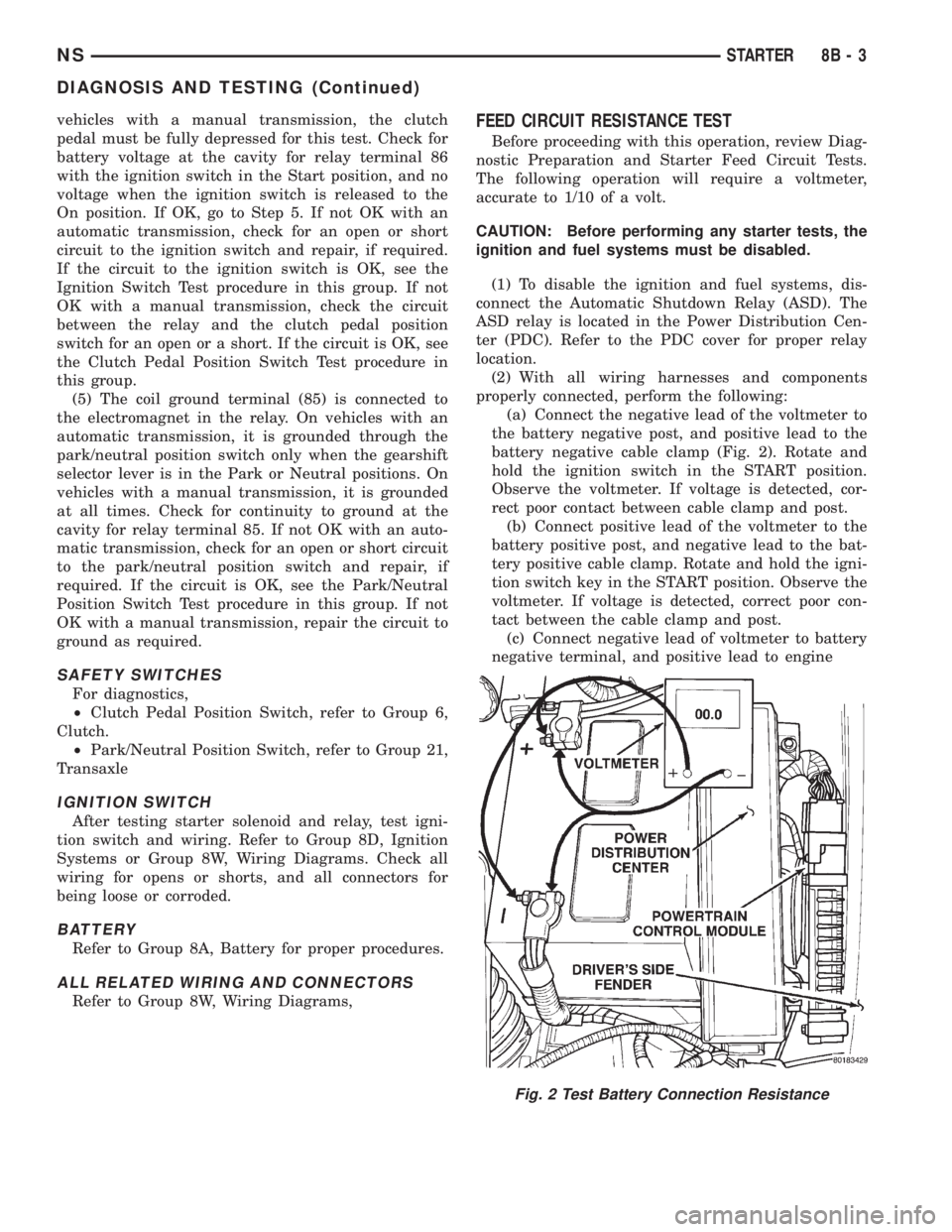
(a) Connect the negative lead of the voltmeter to
the battery negative post, and positive lead to the
battery negative cable clamp (Fig. 2). Rotate and
hold the ignition switch in the START position.
Observe the voltmeter. If voltage is detected, cor-
rect poor contact between cable clamp and post.
(b) Connect positive lead of the voltmeter to the
battery positive post, and negative lead to the bat-
tery positive cable clamp. Rotate and hold the igni-
tion switch key in the START position. Observe the
voltmeter. If voltage is detected, correct poor con-
tact between the cable clamp and post.
(c) Connect negative lead of voltmeter to battery
negative terminal, and positive lead to engine
Fig. 2 Test Battery Connection Resistance
NSSTARTER 8B - 3
DIAGNOSIS AND TESTING (Continued)
Page 277 of 1938
CAUTION: Before performing any starter tests, the
ignition and fuel systems must be disabled.
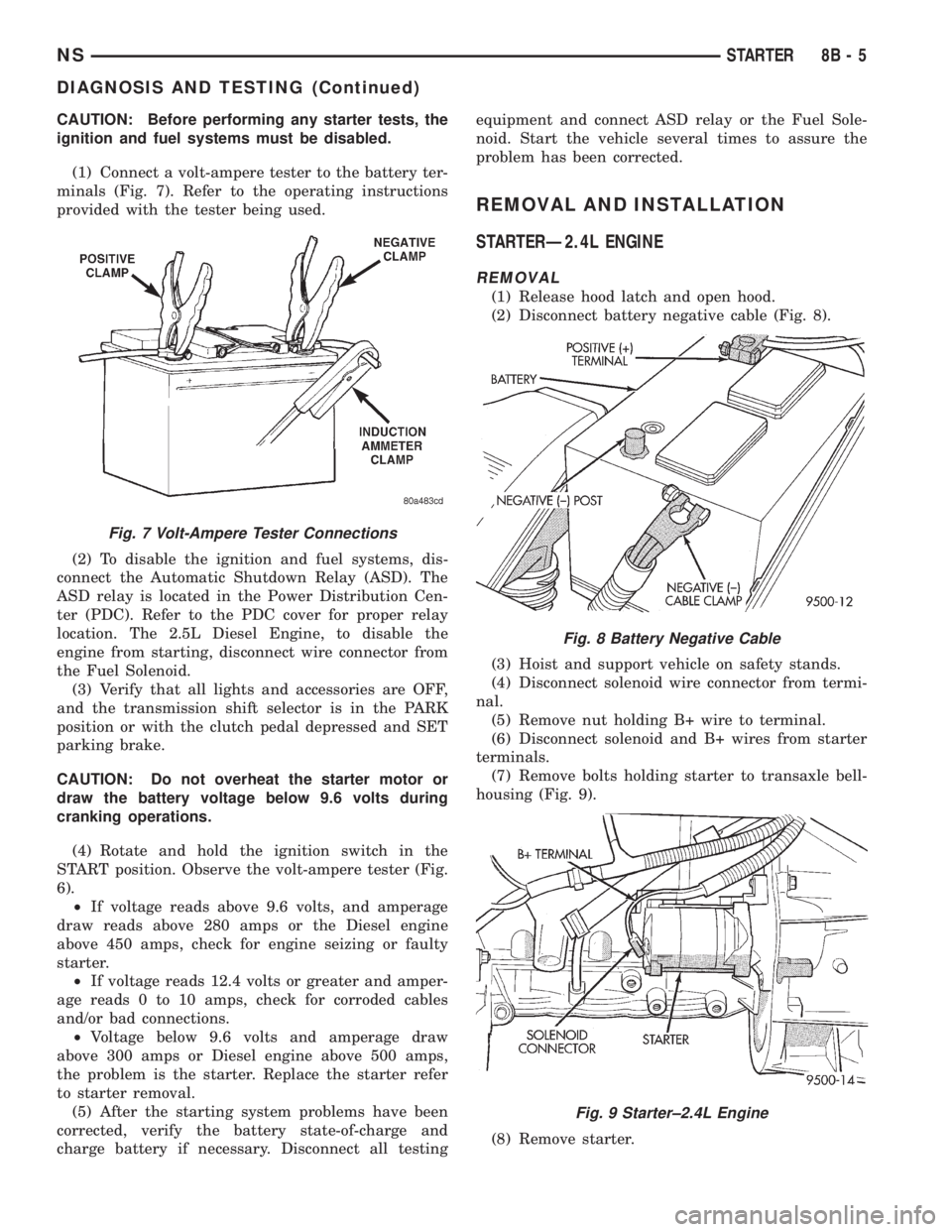
(1) Connect a volt-ampere tester to the battery ter-
minals (Fig. 7). Refer to the operating instructions
provided with the tester being used.
(2) To disable the ignition and fuel systems, dis-
connect the Automatic Shutdown Relay (ASD). The
ASD relay is located in the Power Distribution Cen-
ter (PDC). Refer to the PDC cover for proper relay
location. The 2.5L Diesel Engine, to disable the
engine from starting, disconnect wire connector from
the Fuel Solenoid.
(3) Verify that all lights and accessories are OFF,
and the transmission shift selector is in the PARK
position or with the clutch pedal depressed and SET
parking brake.
CAUTION: Do not overheat the starter motor or
draw the battery voltage below 9.6 volts during
cranking operations.
(4) Rotate and hold the ignition switch in the
START position. Observe the volt-ampere tester (Fig.
6).
²If voltage reads above 9.6 volts, and amperage
draw reads above 280 amps or the Diesel engine
above 450 amps, check for engine seizing or faulty
starter.
²If voltage reads 12.4 volts or greater and amper-
age reads 0 to 10 amps, check for corroded cables
and/or bad connections.
²Voltage below 9.6 volts and amperage draw
above 300 amps or Diesel engine above 500 amps,
the problem is the starter. Replace the starter refer
to starter removal.
(5) After the starting system problems have been
corrected, verify the battery state-of-charge and
charge battery if necessary. Disconnect all testingequipment and connect ASD relay or the Fuel Sole-
noid. Start the vehicle several times to assure the
problem has been corrected.
REMOVAL AND INSTALLATION
STARTERÐ2.4L ENGINE
REMOVAL
(1) Release hood latch and open hood.
(2) Disconnect battery negative cable (Fig. 8).
(3) Hoist and support vehicle on safety stands.
(4) Disconnect solenoid wire connector from termi-
nal.
(5) Remove nut holding B+ wire to terminal.
(6) Disconnect solenoid and B+ wires from starter
terminals.
(7) Remove bolts holding starter to transaxle bell-
housing (Fig. 9).
(8) Remove starter.
Fig. 7 Volt-Ampere Tester Connections
Fig. 8 Battery Negative Cable
Fig. 9 Starter±2.4L Engine
NSSTARTER 8B - 5
DIAGNOSIS AND TESTING (Continued)
Page 300 of 1938
²available manifold vacuum
²barometric pressure
²engine coolant temperature
²engine RPM
²intake air temperature (2.4L only)
²throttle position
The PCM also regulates the fuel injection system.
Refer to the Fuel Injection sections of Group 14.
IGNITION SYSTEM
NOTE: The 2.4, 3.0 and 3.3/3.8L engines use a fixed
ignition timing system. Basic ignition timing is not
adjustable. All spark advance is determined by the
Powertrain Control Module (PCM).
The distributorless ignition system used on 2.4 and
3.3/3.8L engines is refered to as the Direct Ignition
System (DIS). The system's three main components
are the coil pack, crankshaft position sensor, and
camshaft position sensor. The crankshaft position
sensor and camshaft position sensor are hall effect
devices.
The 3.0L engine uses a distributor, crankshaft sen-
sor and ignition coil. The system's main components
are the distributor, distributor pickup, camshaft sig-
nal, crankshaft signal and ignition coil.
SPARK PLUGSÐ2.4/3.0L
All engines use resistor spark plugs. They have
resistance values ranging from 6,000 to 20,000 ohms
when checked with at least a 1000 volt spark plug
tester.Do not use an ohm meter to check the resis-
tance of the spark plugs. This will give an inac-
curate reading.
Remove the spark plugs and examine them for
burned electrodes and fouled, cracked or broken por-
celain insulators. Keep plugs arranged in the order
in which they were removed from the engine. An iso-
lated plug displaying an abnormal condition indicates
that a problem exists in the corresponding cylinder.
Replace spark plugs at the intervals recommended in
Group O - Lubrication and Maintenance.
Spark plugs that have low mileage may be cleaned
and reused if not otherwise defective, carbon or oil
fouled. Refer to the Spark Plug Condition section of
this group. After cleaning, file the center electrode
flat with a small flat point file or jewelers file. Adjust
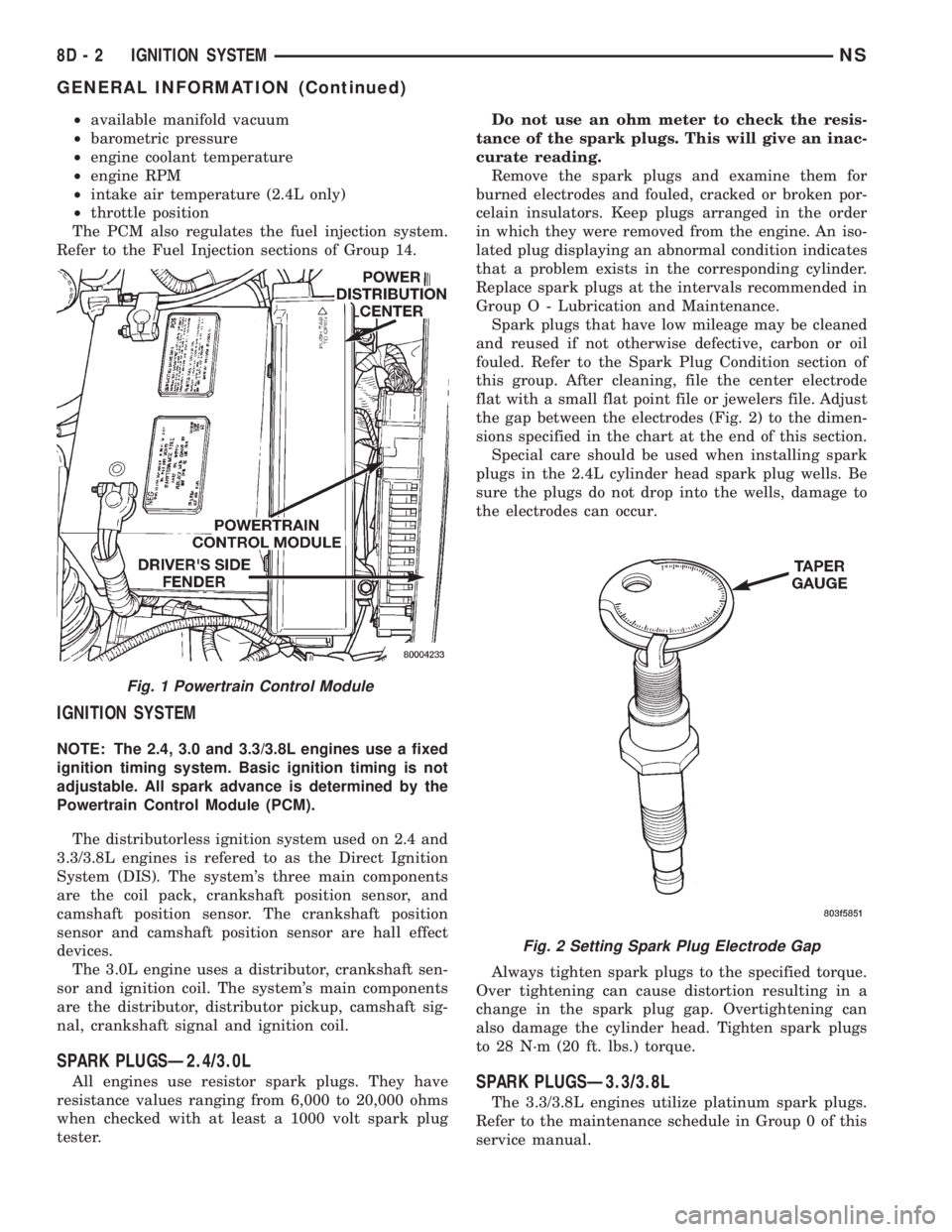
the gap between the electrodes (Fig. 2) to the dimen-
sions specified in the chart at the end of this section.
Special care should be used when installing spark
plugs in the 2.4L cylinder head spark plug wells. Be
sure the plugs do not drop into the wells, damage to
the electrodes can occur.
Always tighten spark plugs to the specified torque.
Over tightening can cause distortion resulting in a
change in the spark plug gap. Overtightening can
also damage the cylinder head. Tighten spark plugs
to 28 N´m (20 ft. lbs.) torque.SPARK PLUGSÐ3.3/3.8L
The 3.3/3.8L engines utilize platinum spark plugs.
Refer to the maintenance schedule in Group 0 of this
service manual.
Fig. 1 Powertrain Control Module
Fig. 2 Setting Spark Plug Electrode Gap
8D - 2 IGNITION SYSTEMNS
GENERAL INFORMATION (Continued)
Page 302 of 1938
Clean Spark Plug cables with a cloth moistened
with a non-flammable solvent. Wipe the cables dry.
Check for brittle or cracked insulation.
SPARK PLUG CABLESÐ3.3/3.8L
The spark plug cables and spark plug boots are
made from high temperature silicone materials. The
spark plug boots utilize metal heat shields for ther-
mal protection from the exhaust manifold. The heat
shields slide over the spark plug boots. The notches
on the heat shields ensure the spark plug boot and
shield twist together during spark plug boot removal.
They also identify proper heat shield installation on
the boot for service.Refer to 3.3/3.8L Spark Plug
Cable removal and installation.All spark plug
cable leads are properly identified with cylinder num-
bers. The inside of the spark plug boot is coated with
a special high temperature silicone grease for greater
sealing and to minimize boot bonding to the spark
plug insulator. The convoluted tubing on the rear
plug cables are made of a high temperature plastic
material. Under normal driving conditions, the spark
plug cables have a recommended service life of a
100,000 miles. The spark plugs have a recommended
service life of 75,000 miles for severe driving condi-
tions per schedule B in this manual.
The spark plug heat shield can be reused if an
ignition cable is replaced due to failure. Never reuse
heat shield's that have heat shield anti-twist, side or
spark plug attachment tabs bent or missing. Ensure
that the heat shield is properly attached to the spark
plug to avoid RFI problems. The bottom of the spark
plug heat shield must make contact with the spark
plug hex.
The front ignition cables must not make contact
with the oil dip stick tube and #5 cable must not
touch the coil mounting bolt to avoid abrasion/dielec-
tric failures.
IGNITION COIL
WARNING: THE DIRECT IGNITION SYSTEM GEN-
ERATES APPROXIMATELY 40,000 VOLTS. PER-
SONAL INJURY COULD RESULT FROM CONTACT
WITH THIS SYSTEM.
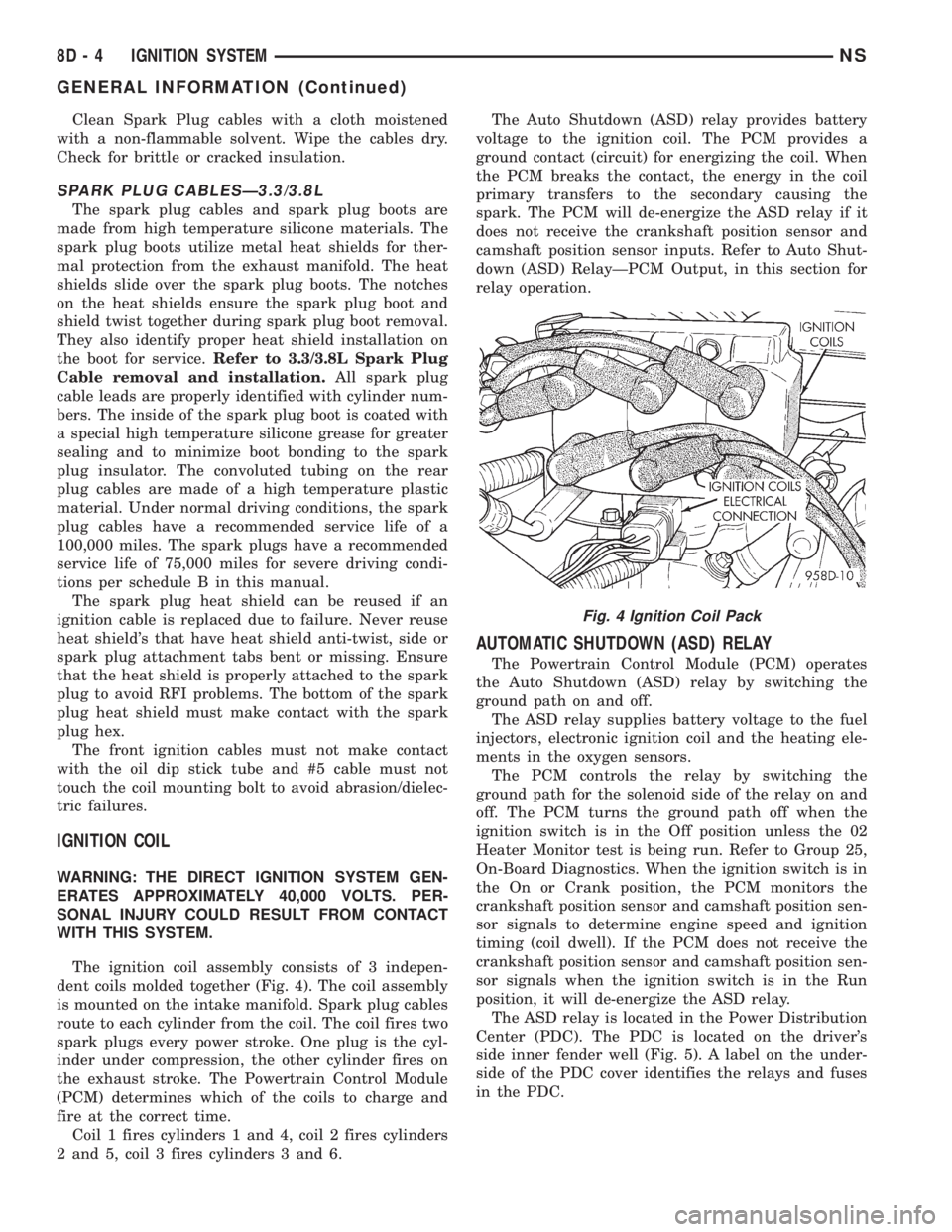
The ignition coil assembly consists of 3 indepen-
dent coils molded together (Fig. 4). The coil assembly
is mounted on the intake manifold. Spark plug cables
route to each cylinder from the coil. The coil fires two
spark plugs every power stroke. One plug is the cyl-
inder under compression, the other cylinder fires on
the exhaust stroke. The Powertrain Control Module
(PCM) determines which of the coils to charge and
fire at the correct time.
Coil 1 fires cylinders 1 and 4, coil 2 fires cylinders
2 and 5, coil 3 fires cylinders 3 and 6.The Auto Shutdown (ASD) relay provides battery
voltage to the ignition coil. The PCM provides a
ground contact (circuit) for energizing the coil. When
the PCM breaks the contact, the energy in the coil
primary transfers to the secondary causing the
spark. The PCM will de-energize the ASD relay if it
does not receive the crankshaft position sensor and
camshaft position sensor inputs. Refer to Auto Shut-
down (ASD) RelayÐPCM Output, in this section for
relay operation.
AUTOMATIC SHUTDOWN (ASD) RELAY
The Powertrain Control Module (PCM) operates
the Auto Shutdown (ASD) relay by switching the
ground path on and off.
The ASD relay supplies battery voltage to the fuel
injectors, electronic ignition coil and the heating ele-
ments in the oxygen sensors.
The PCM controls the relay by switching the
ground path for the solenoid side of the relay on and
off. The PCM turns the ground path off when the
ignition switch is in the Off position unless the 02
Heater Monitor test is being run. Refer to Group 25,
On-Board Diagnostics. When the ignition switch is in
the On or Crank position, the PCM monitors the
crankshaft position sensor and camshaft position sen-
sor signals to determine engine speed and ignition
timing (coil dwell). If the PCM does not receive the
crankshaft position sensor and camshaft position sen-
sor signals when the ignition switch is in the Run
position, it will de-energize the ASD relay.
The ASD relay is located in the Power Distribution
Center (PDC). The PDC is located on the driver's
side inner fender well (Fig. 5). A label on the under-
side of the PDC cover identifies the relays and fuses
in the PDC.
Fig. 4 Ignition Coil Pack
8D - 4 IGNITION SYSTEMNS
GENERAL INFORMATION (Continued)
Page 304 of 1938

cylinder 4 crankshaft timing marks follow. One cam-
shaft pulse after the 3 pulses indicates cylinder 5.
The 2 camshaft pulses after cylinder 5 signals cylin-
der 6 (Fig. 10). The PCM can synchronize on cylin-
ders1or4.
When metal aligns with the sensor, voltage goes
low (less than 0.3 volts). When a notch aligns with
the sensor, voltage switches high (5.0 volts). As a
group of notches pass under the sensor, the voltage
switches from low (metal) to high (notch) then back
to low. The number of notches determine the amount
of pulses. If available, an oscilloscope can display the
square wave patterns of each timing event.
Top Dead Center (TDC) does not occur when
notches on the camshaft sprocket pass below the cyl-
inder. TDC occurs after the camshaft pulse (or
pulses) and after the 4 crankshaft pulses associated
with the particular cylinder. The arrows and cylinder
call outs on Figure 4 represent which cylinder the
flat spot and notches identify, they do not indicate
TDC position.
The camshaft position sensor is mounted in the
front of the timing case cover (Fig. 11).
MANIFOLD ABSOLUTE PRESSURE (MAP) SENSOR
The MAP sensor reacts to absolute pressure in the
intake manifold and provides an input voltage to the
Powertrain Control Module (PCM). As engine load
changes, manifold pressure varies. The changes in
engine load cause the MAP sensors resistance to
change. The change in MAP sensor resistance results
in a different input voltage to the PCM.
The input voltage level supplies the PCM with
information relating to ambient barometric pressure
during engine start-up (cranking) and engine load
while its operating. Based on MAP sensor voltage
and inputs from other sensors, the PCM adjusts
spark advance and the air-fuel mixture.
ENGINE COOLANT TEMPERATURE (ECT) SENSOR
The ECT sensor is located next to the thermostat
housing (Fig. 12). The sensor provides an input volt-
age to the Powertrain Control Module (PCM). Thesensor is a variable resistance (thermistor) with a
range of -40ÉF to 265ÉF. As coolant temperature var-
ies, the sensors resistance changes, resulting in a dif-
ferent input voltage to the PCM.
The PCM contains different spark advance sched-
ules for cold and warm engine operation. The sched-
ules reduce engine emission and improve driveability.
When the engine is cold, the PCM will demand
slightly richer air-fuel mixtures and higher idle
speeds until normal operating temperatures are
reached.
The ECT sensor input is also used for cooling fan
control.
Fig. 9 Camshaft Position Sensor
Fig. 10 Camshaft Sprocket
Fig. 11 Camshaft Position Sensor Location
8D - 6 IGNITION SYSTEMNS
GENERAL INFORMATION (Continued)