fuses CHRYSLER VOYAGER 1996 User Guide
[x] Cancel search | Manufacturer: CHRYSLER, Model Year: 1996, Model line: VOYAGER, Model: CHRYSLER VOYAGER 1996Pages: 1938, PDF Size: 55.84 MB
Page 407 of 1938
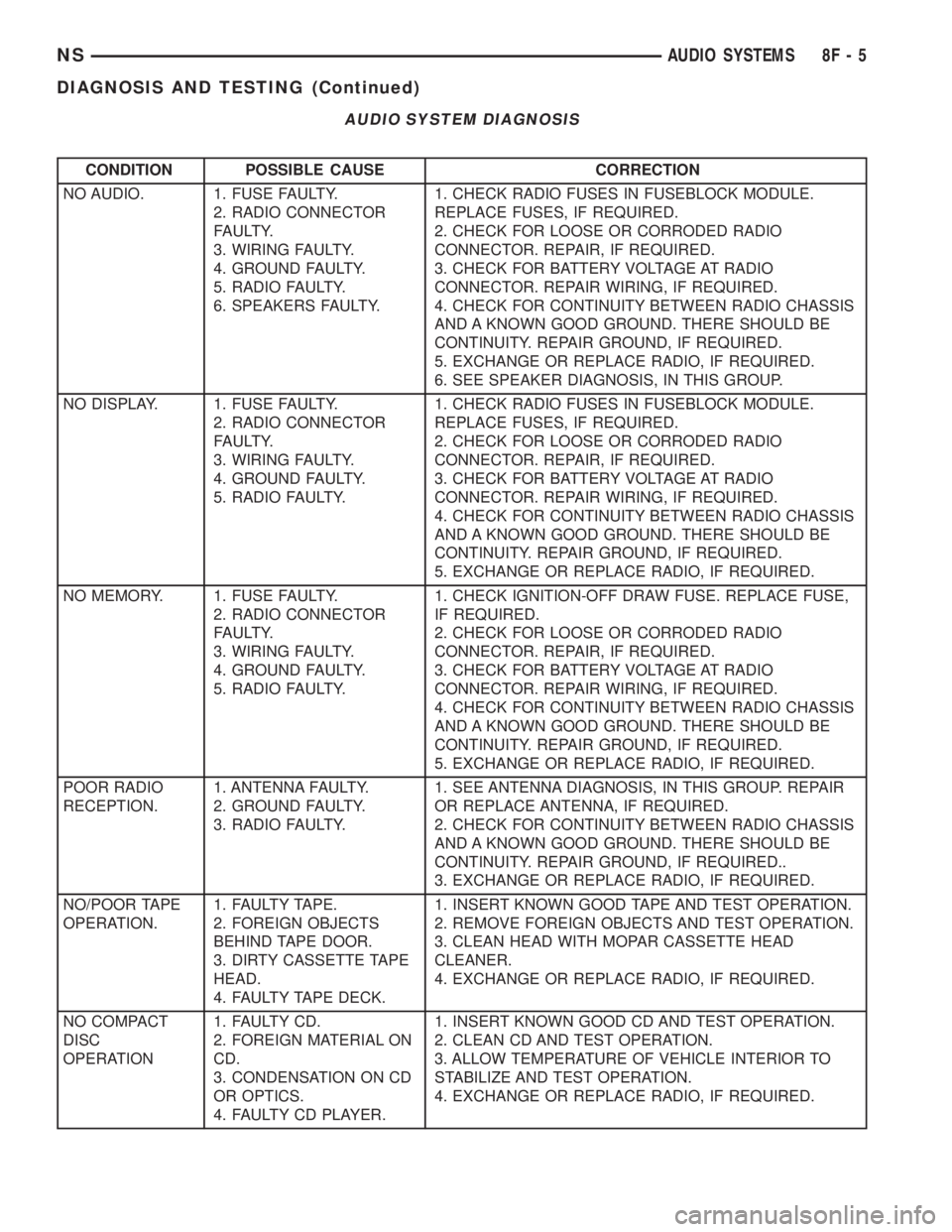
CONDITION POSSIBLE CAUSE CORRECTION
NO AUDIO. 1. FUSE FAULTY.
2. RADIO CONNECTOR
FAULTY.
3. WIRING FAULTY.
4. GROUND FAULTY.
5. RADIO FAULTY.
6. SPEAKERS FAULTY.1. CHECK RADIO FUSES IN FUSEBLOCK MODULE.
REPLACE FUSES, IF REQUIRED.
2. CHECK FOR LOOSE OR CORRODED RADIO
CONNECTOR. REPAIR, IF REQUIRED.
3. CHECK FOR BATTERY VOLTAGE AT RADIO
CONNECTOR. REPAIR WIRING, IF REQUIRED.
4. CHECK FOR CONTINUITY BETWEEN RADIO CHASSIS
AND A KNOWN GOOD GROUND. THERE SHOULD BE
CONTINUITY. REPAIR GROUND, IF REQUIRED.
5. EXCHANGE OR REPLACE RADIO, IF REQUIRED.
6. SEE SPEAKER DIAGNOSIS, IN THIS GROUP.
NO DISPLAY. 1. FUSE FAULTY.
2. RADIO CONNECTOR
FAULTY.
3. WIRING FAULTY.
4. GROUND FAULTY.
5. RADIO FAULTY.1. CHECK RADIO FUSES IN FUSEBLOCK MODULE.
REPLACE FUSES, IF REQUIRED.
2. CHECK FOR LOOSE OR CORRODED RADIO
CONNECTOR. REPAIR, IF REQUIRED.
3. CHECK FOR BATTERY VOLTAGE AT RADIO
CONNECTOR. REPAIR WIRING, IF REQUIRED.
4. CHECK FOR CONTINUITY BETWEEN RADIO CHASSIS
AND A KNOWN GOOD GROUND. THERE SHOULD BE
CONTINUITY. REPAIR GROUND, IF REQUIRED.
5. EXCHANGE OR REPLACE RADIO, IF REQUIRED.
NO MEMORY. 1. FUSE FAULTY.
2. RADIO CONNECTOR
FAULTY.
3. WIRING FAULTY.
4. GROUND FAULTY.
5. RADIO FAULTY.1. CHECK IGNITION-OFF DRAW FUSE. REPLACE FUSE,
IF REQUIRED.
2. CHECK FOR LOOSE OR CORRODED RADIO
CONNECTOR. REPAIR, IF REQUIRED.
3. CHECK FOR BATTERY VOLTAGE AT RADIO
CONNECTOR. REPAIR WIRING, IF REQUIRED.
4. CHECK FOR CONTINUITY BETWEEN RADIO CHASSIS
AND A KNOWN GOOD GROUND. THERE SHOULD BE
CONTINUITY. REPAIR GROUND, IF REQUIRED.
5. EXCHANGE OR REPLACE RADIO, IF REQUIRED.
POOR RADIO
RECEPTION.1. ANTENNA FAULTY.
2. GROUND FAULTY.
3. RADIO FAULTY.1. SEE ANTENNA DIAGNOSIS, IN THIS GROUP. REPAIR
OR REPLACE ANTENNA, IF REQUIRED.
2. CHECK FOR CONTINUITY BETWEEN RADIO CHASSIS
AND A KNOWN GOOD GROUND. THERE SHOULD BE
CONTINUITY. REPAIR GROUND, IF REQUIRED..
3. EXCHANGE OR REPLACE RADIO, IF REQUIRED.
NO/POOR TAPE
OPERATION.1. FAULTY TAPE.
2. FOREIGN OBJECTS
BEHIND TAPE DOOR.
3. DIRTY CASSETTE TAPE
HEAD.
4. FAULTY TAPE DECK.1. INSERT KNOWN GOOD TAPE AND TEST OPERATION.
2. REMOVE FOREIGN OBJECTS AND TEST OPERATION.
3. CLEAN HEAD WITH MOPAR CASSETTE HEAD
CLEANER.
4. EXCHANGE OR REPLACE RADIO, IF REQUIRED.
NO COMPACT
DISC
OPERATION1. FAULTY CD.
2. FOREIGN MATERIAL ON
CD.
3. CONDENSATION ON CD
OR OPTICS.
4. FAULTY CD PLAYER.1. INSERT KNOWN GOOD CD AND TEST OPERATION.
2. CLEAN CD AND TEST OPERATION.
3. ALLOW TEMPERATURE OF VEHICLE INTERIOR TO
STABILIZE AND TEST OPERATION.
4. EXCHANGE OR REPLACE RADIO, IF REQUIRED.
AUDIO SYSTEM DIAGNOSIS
NSAUDIO SYSTEMS 8F - 5
DIAGNOSIS AND TESTING (Continued)
Page 453 of 1938

LAMPS
CONTENTS
page page
BULB APPLICATION...................... 25
EXTERIOR LAMP BULB SERVICE............ 9
EXTERIOR LAMP SERVICE................. 14HEADLAMP ALIGNMENT................... 5
INTERIOR LAMPS........................ 18
LAMP DIAGNOSIS........................ 1
LAMP DIAGNOSIS
INDEX
page page
GENERAL INFORMATION
ELECTRONIC DAYTIME RUNNING LIGHT (DRL).1
GENERAL INFORMATION.................. 1SAFETY PRECAUTIONS................... 1
DIAGNOSIS AND TESTING
DIAGNOSTIC PROCEDURES................ 2
GENERAL INFORMATION
GENERAL INFORMATION
NS vehicles use lighting on the interior and exte-
rior of the vehicle for illuminating and indicating
purposes. Lighting circuits are protected by fuses.
Lighting circuits require an overload protected power
source, on/off device, lamps and body ground to oper-
ate properly. Plastic lamps require a wire in the har-
ness to supply body ground to the lamp socket.
Replace sockets and bulbs that are corroded.
Some of the interior and exterior lighting functions
are governed by the body controller. The headlamp,
dome, and the door ajar switches provide signals to
the body controller. The body controller in turn acti-
vates relay(s) in order to provide either a ground or
feed line to the appropriate lamp(s).
Wire connectors can make intermittent contact or
become corroded. Before coupling wire connectors,
inspect the terminals inside the connector. Male ter-
minals should not be bent or disengaged from the
insulator. Female terminals should not be sprung
open or disengaged from the insulator. Bent and
sprung terminals can be repaired using needle nose
pliers and pick tool. Corroded terminals appear
chalky or green. Corroded terminals should be
replaced to avoid recurrence of the problem symp-
toms.
Begin electrical system failure diagnosis by testing
related fuses in the fuse block and power distribution
center. Verify that bulbs are in good condition andtest continuity of the circuit ground. Refer to Group
8W, Wiring Diagrams, for component location and cir-
cuit information.SAFETY PRECAUTIONS
WARNING: EYE PROTECTION SHOULD BE USED
WHEN SERVICING GLASS COMPONENTS. PER-
SONAL INJURY CAN RESULT.
CAUTION: Do not touch the glass of halogen bulbs
with fingers or other possibly oily surface, reduced
bulb life will result.
Do not use bulbs with higher candle power than
indicated in the Bulb Application table at the end of
this group. Damage to lamp and/or Daytime Run-
ning Lamp Module can result.
Do not use fuses, circuit breakers or relays hav-
ing greater amperage value than indicated on the
fuse panel or in the Owners Manual.
When it is necessary to remove components to ser-
vice another, it should not be necessary to apply
excessive force or bend a component to remove it.
Before damaging a trim component, verify hidden
fasteners or captured edges are not holding the com-
ponent in place.
ELECTRONIC DAYTIME RUNNING LIGHT (DRL)
The Combination Flasher/DRL is a module provid-
ing turn signal, hazard warning, and daytime run-
NSLAMPS 8L - 1
Page 479 of 1938
LAMPS
CONTENTS
page page
BULB APPLICATION..................... 17
HEADLAMP ALIGNMENT.................. 5
LAMP BULB SERVICE.................... 8LAMP DIAGNOSIS....................... 1
LAMP SERVICE........................ 13
LAMP DIAGNOSIS
INDEX
page page
GENERAL INFORMATION
HEADLAMP LEVELING MOTOR............. 2
INTRODUCTION........................ 1SAFETY PRECAUTIONS.................. 1
DIAGNOSIS AND TESTING
DIAGNOSTIC PROCEDURES.............. 2
GENERAL INFORMATION
INTRODUCTION
GS vehicles use lighting on the interior and exte-
rior of the vehicle for illuminating and indicating
purposes. Lighting circuits are protected by fuses.
Lighting circuits require an overload protected power
source, on/off device, lamps and body ground to oper-
ate properly. Plastic lamps require a wire in the har-
ness to supply body ground to the lamp socket.
Replace sockets and bulbs that are corroded.
Some of the interior and exterior lighting functions
are governed by the body controller. The headlamp,
dome, and the door ajar switches provide signals to
the body controller. The body controller in turn acti-
vates relay(s) in order to provide either a ground or
feed line to the appropriate lamp(s).
Wire connectors can make intermittent contact or
become corroded. Before coupling wire connectors,
inspect the terminals inside the connector. Male ter-
minals should not be bent or disengaged from the
insulator. Female terminals should not be sprung
open or disengaged from the insulator. Bent and
sprung terminals can be repaired using needle nose
pliers and pick tool. Corroded terminals appear
chalky or green. Corroded terminals should be
replaced to avoid recurrence of the problem symp-
toms.Begin electrical system failure diagnosis by testing
related fuses in the fuse block and power distribution
center. Verify that bulbs are in good condition and
test continuity of the circuit ground. Refer to Group
8W, Wiring Diagrams, for component location and cir-
cuit information.
SAFETY PRECAUTIONS
WARNING: EYE PROTECTION SHOULD BE USED
WHEN SERVICING GLASS COMPONENTS. PER-
SONAL INJURY CAN RESULT.
CAUTION: Do not touch the glass of halogen bulbs
with fingers or other possibly oily surface, reduced
bulb life will result.
Do not use bulbs with higher candle power than
indicated in the Bulb Application table at the end of
this group. Damage to lamp and/or Daytime Run-
ning Lamp Module can result.
Do not use fuses, circuit breakers or relays hav-
ing greater amperage value than indicated on the
fuse panel or in the Owners Manual.
When it is necessary to remove components to ser-
vice another, it should not be necessary to apply
excessive force or bend a component to remove it.
Before damaging a trim component, verify hidden
fasteners or captured edges are not holding the com-
ponent in place.
NS/GSLAMPS 8L - 1
Page 521 of 1938
determine whether a valid key is in the ignition lock
cylinder.
The Smart Key transponder cannot be repaired
and, if faulty or damaged, it must be replaced.
SMART KEY IMMOBILIZER SYSTEM INDICATOR
LAMP
The Smart Key Immobilizer System (SKIS) indica-
tor lamp gives an indication when the SKIS is faulty
or when the vehicle has been immobilized due to the
use of an invalid ignition key. The lamp is controlled
by the instrument cluster circuitry based upon mes-
sages received from the Smart Key Immobilizer Mod-
ule (SKIM) on the Chrysler Collision Detection (CCD)
data bus.
The SKIM sends messages to the instrument clus-
ter to turn the lamp on for about three seconds when
the ignition switch is turned to the On position as a
bulb test. After completion of the bulb test, the SKIM
sends bus messages to keep the lamp off for a dura-
tion of about one second. Then the SKIM sends mes-
sages to the instrument cluster circuitry to turn the
lamp on or off based upon the results of the SKIS
self-tests. If the SKIS indicator lamp comes on and
stays on after the bulb test, it indicates that the
SKIM has detected a system malfunction and/or that
the SKIS has become inoperative. If the SKIM
detects an invalid key when the ignition switch is
turned to the On position, it sends messages to the
instrument cluster to flash the SKIS indicator lamp.
The SKIM can also send messages to the instru-
ment cluster to flash the lamp and to generate a sin-
gle audible chime tone. These functions serve as an
indication to the customer that the SKIS has been
placed in its ªCustomer Learnº programming mode.
See Smart Key Immobilizer System Transponder Pro-
gramming in this group for more information on the
ªCustomer Learnº programming mode.
The SKIS indicator lamp uses a replaceable incan-
descent bulb and bulb holder on the instrument clus-
ter electronic circuit board. Refer to Group 8E -
Instrument Panel Systems for diagnosis and service
of a faulty SKIS indicator lamp. If the SKIS indicator
lamp comes on and stays on after the bulb test func-
tion, diagnosis of the SKIS should be performed with
a DRB scan tool and the proper Diagnostic Proce-
dures manual.
DIAGNOSIS AND TESTING
SMART KEY IMMOBILIZER SYSTEM
WARNING: ON VEHICLES EQUIPPED WITH AIR-
BAGS, REFER TO GROUP 8M - PASSIVE
RESTRAINT SYSTEMS BEFORE ATTEMPTING ANY
STEERING WHEEL, STEERING COLUMN, OR
INSTRUMENT PANEL COMPONENT DIAGNOSIS OR
SERVICE. FAILURE TO TAKE THE PROPER PRE-
CAUTIONS COULD RESULT IN ACCIDENTAL AIR-
BAG DEPLOYMENT AND POSSIBLE PERSONAL
INJURY.
NOTE: The following tests may not prove conclu-
sive in the diagnosis of this system. The most reli-
able, efficient, and accurate means to diagnose the
Smart Key Immobilizer System involves the use of a
DRB scan tool. Refer to the proper Diagnostic Pro-
cedures manual for the procedures.
The Smart Key Immobilizer System (SKIS) and the
Chrysler Collision Detection (CCD) data bus network
should be diagnosed using a DRB scan tool. The DRB
will allow confirmation that the CCD data bus is
functional, that the Smart Key Immobilizer Module
(SKIM) is placing the proper messages on the CCD
data bus, and that the Powertrain Control Module
(PCM) and the instrument cluster are receiving the
CCD data bus messages. Refer to the proper Diag-
nostic Procedures manual for the procedures. Refer
to 8W-30 - Fuel/Ignition System in Group 8W - Wir-
ing Diagrams for complete circuit descriptions and
diagrams.
(1) Check the fuses in the fuseblock module. If OK,
go to Step 2. If not OK, repair the shorted circuit or
component as required and replace the faulty fuse.
(2) Disconnect and isolate the battery negative
cable. Unplug the wire harness connector at the
SKIM. Check for continuity between the ground cir-
cuit cavity of the SKIM wire harness connector and a
good ground. There should be continuity. If OK, go to
Step 3. If not OK, repair the open circuit to ground
as required.
(3) Connect the battery negative cable. Check for
battery voltage at the fused B(+) circuit cavity of the
SKIM wire harness connector. If OK, go to Step 4. If
not OK, repair the open circuit to the fuse in the
fuseblock module as required.
NS/GSVEHICLE THEFT/SECURITY SYSTEMS 8Q - 3
DESCRIPTION AND OPERATION (Continued)
Page 532 of 1938
two positions of seat and recliner, and the side view
mirrors as chosen by the driver.
The inputs from these switches to the memory
seat/mirror module is a ground level signal.
(1) Adjust the seat, recliner and side view mirrors
to the desired position.
(2)
Press momentarily and release memory switch S.
(3) Press momentarily and release memory switch
1 or 2. Do NOT press any switches for 10 seconds.
(4) To program the second driver's position, follow
the above sequence.
(5) To recall either of the programmed positions
momentarily press and release either memory selec-
tor switch 1 or 2.
DEFINITION OF: MOMENTARILY AND
RELEASE
The memory seat/mirror module has switch input
timing requirements of a minimum press momen-
tarily time of 250 milliseconds followed by a maxi-
mum hold time of 5 seconds, followed by a maximum
release time between steps of 5 seconds that must be
met for proper operation of the system.
SEAT AND RECLINER SWITCHES
The seat and recliner switch assembly is mounted
outboard on the seat side-shield. Press and hold the
desired seat or recliner switch to effect movement.
The Memory Seat/Mirror Module (MSM Module) will
drive a maximum of 2 motors at a time in a given
direction. If conflicting directions are requested, the
priority for response will be as follows:
²Seat Track Rearward
²Seat Front Down
²Seat Rear Down
²Recliner Rearward
²Seat Track Forward
²Seat Front Up
²Seat Rear Up
²Recliner Forward
The inputs from these switches to the MSM Mod-
ule is a current limited battery source fed by the
MSM Module. This protects the MSM Module printed
circuit board traces from acting as fuses. All of these
switch contact inputs to the module are normally
closed to ground, except when actuated.
POSITION SENSING SEAT AND RECLINER
POTENTIOMETERS
A potentiometer is mounted to each seat track and
recliner motor end-bell to provide a sense voltage to
the Memory Seat/Mirror Module that will indicate to
the module where the seat track or recliner is posi-
tioned.
This sense voltage is derived from a 5 volt source
provided by the module to the potentiometer. Thesense voltage is input into the module and stored by
the Memory Seat/Mirror Module.
DIAGNOSIS AND TESTING
MEMORY SELECTOR SWITCHES
To test the memory selector switch:
(1) Remove the memory selector switch. Refer to
removal procedure.
(2) Using an ohmmeter check continuity reading
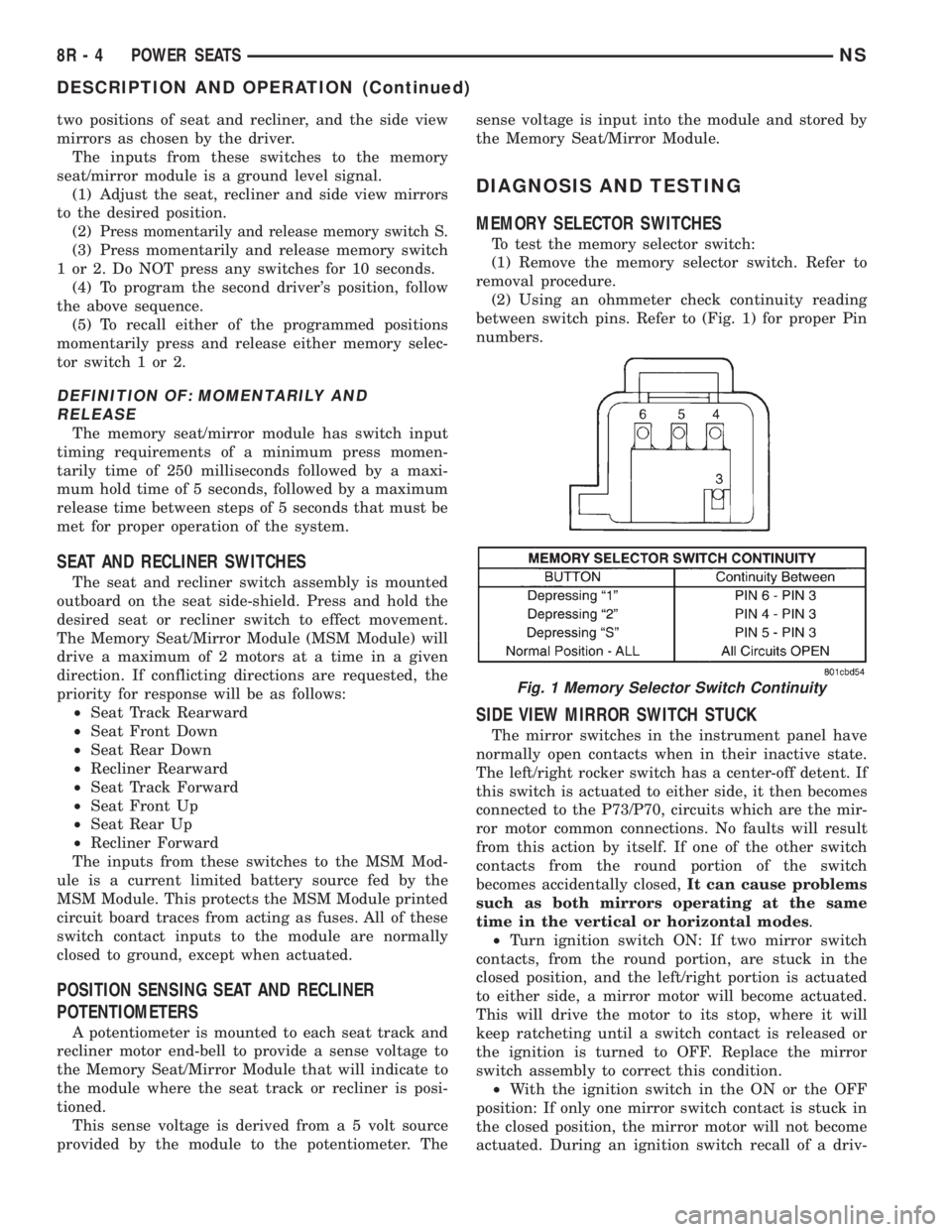
between switch pins. Refer to (Fig. 1) for proper Pin
numbers.
SIDE VIEW MIRROR SWITCH STUCK
The mirror switches in the instrument panel have
normally open contacts when in their inactive state.
The left/right rocker switch has a center-off detent. If
this switch is actuated to either side, it then becomes
connected to the P73/P70, circuits which are the mir-
ror motor common connections. No faults will result
from this action by itself. If one of the other switch
contacts from the round portion of the switch
becomes accidentally closed,It can cause problems
such as both mirrors operating at the same
time in the vertical or horizontal modes.
²Turn ignition switch ON: If two mirror switch
contacts, from the round portion, are stuck in the
closed position, and the left/right portion is actuated
to either side, a mirror motor will become actuated.
This will drive the motor to its stop, where it will
keep ratcheting until a switch contact is released or
the ignition is turned to OFF. Replace the mirror
switch assembly to correct this condition.
²With the ignition switch in the ON or the OFF
position: If only one mirror switch contact is stuck in
the closed position, the mirror motor will not become
actuated. During an ignition switch recall of a driv-
Fig. 1 Memory Selector Switch Continuity
8R - 4 POWER SEATSNS
DESCRIPTION AND OPERATION (Continued)
Page 572 of 1938
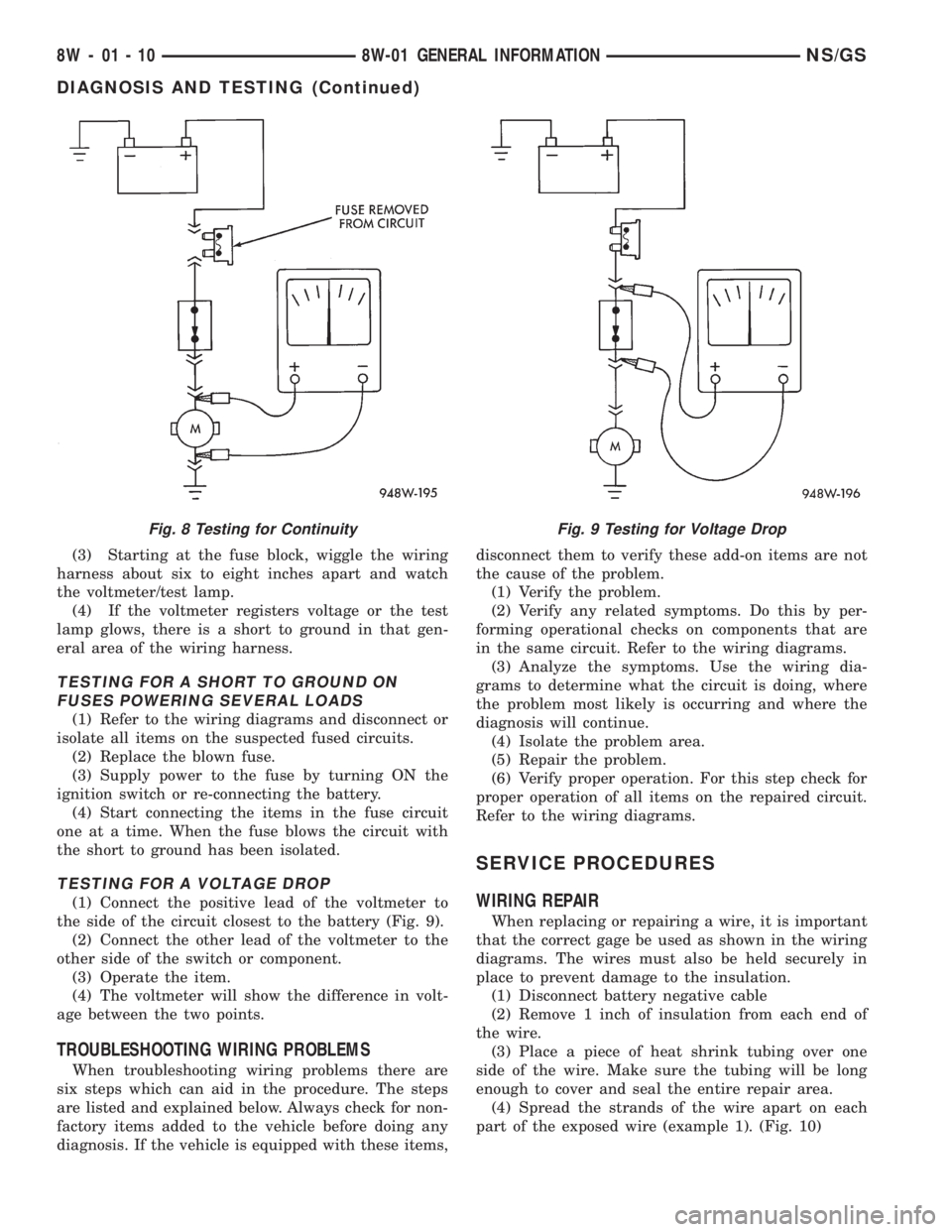
(3) Starting at the fuse block, wiggle the wiring
harness about six to eight inches apart and watch
the voltmeter/test lamp.
(4) If the voltmeter registers voltage or the test
lamp glows, there is a short to ground in that gen-
eral area of the wiring harness.
TESTING FOR A SHORT TO GROUND ON
FUSES POWERING SEVERAL LOADS
(1) Refer to the wiring diagrams and disconnect or
isolate all items on the suspected fused circuits.
(2) Replace the blown fuse.
(3) Supply power to the fuse by turning ON the
ignition switch or re-connecting the battery.
(4) Start connecting the items in the fuse circuit
one at a time. When the fuse blows the circuit with
the short to ground has been isolated.
TESTING FOR A VOLTAGE DROP
(1) Connect the positive lead of the voltmeter to
the side of the circuit closest to the battery (Fig. 9).
(2) Connect the other lead of the voltmeter to the
other side of the switch or component.
(3) Operate the item.
(4) The voltmeter will show the difference in volt-
age between the two points.
TROUBLESHOOTING WIRING PROBLEMS
When troubleshooting wiring problems there are
six steps which can aid in the procedure. The steps
are listed and explained below. Always check for non-
factory items added to the vehicle before doing any
diagnosis. If the vehicle is equipped with these items,disconnect them to verify these add-on items are not
the cause of the problem.
(1) Verify the problem.
(2) Verify any related symptoms. Do this by per-
forming operational checks on components that are
in the same circuit. Refer to the wiring diagrams.
(3) Analyze the symptoms. Use the wiring dia-
grams to determine what the circuit is doing, where
the problem most likely is occurring and where the
diagnosis will continue.
(4) Isolate the problem area.
(5) Repair the problem.
(6) Verify proper operation. For this step check for
proper operation of all items on the repaired circuit.
Refer to the wiring diagrams.
SERVICE PROCEDURES
WIRING REPAIR
When replacing or repairing a wire, it is important
that the correct gage be used as shown in the wiring
diagrams. The wires must also be held securely in
place to prevent damage to the insulation.
(1) Disconnect battery negative cable
(2) Remove 1 inch of insulation from each end of
the wire.
(3) Place a piece of heat shrink tubing over one
side of the wire. Make sure the tubing will be long
enough to cover and seal the entire repair area.
(4) Spread the strands of the wire apart on each
part of the exposed wire (example 1). (Fig. 10)
Fig. 8 Testing for ContinuityFig. 9 Testing for Voltage Drop
8W - 01 - 10 8W-01 GENERAL INFORMATIONNS/GS
DIAGNOSIS AND TESTING (Continued)
Page 578 of 1938

Component Page
Fuel Tank Module...................8W-30, 45
Fuel Temperature Sensor.................8W-30
Fuel Timing Solenoid....................8W-30
Fuses (JB)............................8W-12
Fuses (PDC)...........................8W-10
Fusible Link.....................8W-20, 21, 63
Fusible Link A0........................8W-30
Fusible Link A11.......................8W-10
Fusible Link A54.......................8W-10
Grounds..............................8W-15
Generator.............................8W-20
Glove Box Lamp........................8W-44
Glow Plug Lamp.....................8W-30, 46
Glow Plugs............................8W-30
Glow Plug Relay........................8W-30
Headlamps............................8W-50
Headlamp Dimmer Switch..........8W-10, 46, 50
Headlamp Leveling Motors...............8W-50
Headlamp Switch.......................8W-50
Headlamp Washer......................8W-53
High Beam Indicator....................8W-46
High Beam Relay....................8W-10, 50
Headlamps............................8W-50
Horns................................8W-41
Hood Ajar Switch....................8W-39, 44
Horn Relay.........................8W-39, 41
Horn Switch.....................8W-10, 39, 41
HVAC Control.........................8W-42
Idle Air Control Motor...................8W-30
Ignition Coil Pack.......................8W-30
Ignition Switch.........................8W-10
Instrument Cluster.....................8W-40
Intake Air Temperature Sensor............8W-30
Intake Air Temperature/Manifold Absolute
Pressure Sensor.....................8W-30
Interior Lamps On Switch................8W-44
Junction Block.........................8W-12
Key-In Halo Lamp......................8W-44
Knock Sensor..........................8W-30
Lamp Assemblies.......................8W-51
License Lamp..........................8W-51
Liftgate Ajar Indicator Lamp..............8W-40
Liftgate Ajar Switch...............8W-39, 40, 44
Liftgate Arm/Disarm Switch............8W-39, 61
Liftgate Flood Lamps....................8W-44
Liftgate Lock Motor.....................8W-61
Low Beam Relay.....................8W-10, 50
Low Coolant Level Switch................8W-45
Low Fuel Warning Indicator Lamp..........8W-40
Low Oil Pressure Lamp..................8W-46
Low Washer Fluid Level Indicator Lamp.....8W-40
Low Washer Fluid Switch.................8W-53
Low/Reverse Pressure Switch..............8W-31
Low/Reverse Solenoid....................8W-31Component Page
Manifold Absolute Pressure Sensor.........8W-30
Memory Power Seat Switch...............8W-63
Seat Sensors...........................8W-63
Memory Seat/Mirror Module...........8W-62, 63
Memory Set Switch..................8W-62, 63
Message Center........................8W-46
Mid Reading Lamps.....................8W-44
Mode Door Actuator.....................8W-42
Name Brand Speaker Relay...............8W-47
Needle Movement Sensor.................8W-30
Odometer.............................8W-40
Output Shaft Speed Sensor...............8W-31
Overdrive Pressure Switch................8W-31
Overdrive Solenoid......................8W-31
Overhead Console.......................8W-49
Park Brake Switch...................8W-46, 50
Park Lamp Relay.........8W-10, 12, 44, 50, 51, 54
Park/Turn Signal Lamps.................8W-50
Airbag Squibs..........................8W-43
Power Distribution Center................8W-10
Power Folding Mirror Switch..............8W-62
Power Mirror Fold Relay.................8W-62
Power Mirror Switch....................8W-62
Power Mirror Unfold Relay...............8W-62
Power Seat Circuit Breaker............8W-62, 63
Powertrain Control Module...............8W-30
PTCs (JB).............................8W-12
Radiator Fan Disconnect.................8W-42
Radiator Fan Relays.....................8W-42
Radio................................8W-47
Radio Choke...........................8W-47
Reading Lamps........................8W-44
Rear A/C Heater Unit....................8W-42
Rear Blower Control Switches.............8W-42
Rear Cigar Lighter/Power Outlet...........8W-41
Rear Defogger On Indicator...............8W-42
Rear Dome Lamp.......................8W-44
Rear Fog Lamp.........................8W-51
Rear Fog Lamp Indicator.................8W-51
Rear Washer Motor.....................8W-53
Rear Washer Switch..................8W-42, 53
Rear Window Defogger...................8W-48
Rear Window Defogger Relay..............8W-48
Rear Window Defogger Switch..........8W-42, 48
Rear Wiper Delay On Indicator.........8W-42, 53
Rear Wiper Delay Switch..............8W-42, 53
Rear Wiper Motor.......................8W-53
Rear Wiper On Indicator..............8W-42, 53
Rear Wiper On Switch................8W-42, 53
Recirculate Mode Indicator................8W-42
Recirculate Mode Switch.................8W-42
Recirculation Door Actuator...............8W-42
Remote Keyless Entry Module.............8W-61
Repeater Lamps.....................8W-51, 52
8W - 02 - 2 8W - 02 COMPONENT INDEXNS/GS
Page 583 of 1938

FUSES
FUSE NO. AMPS FUSED CIRCUIT FEED CIRCUIT
110AF23 18DB/YL
F87 18WT/BK F14 18LG/YL
10A
2
3- SPARE
L33 20RD 10A
4
L34 20RD/OR 10A
5
620A
L44 20VT/RD
820A INTERNAL
INTERNAL 20A
9
1115A
A20 12RD/DB 1020A
INTERNAL
F32 18PK/DB 25A
12
SPARE 20A
13
A5 18RD/DB -
14
15*20A
A14 18RD/WT*
16
INTERNAL
F41 20PK/VT
A17 12RD/BK 20A
17
1815A
30A
19
40A
2140A
2240A
2340A
2440A
2540A
2640A
2740A
2810A 20AA22 12BK/OR
A0 6RD
INTERNAL
A0 6RD
A0 6RD
A0 6RD
A0 6RD
A0 6RD
A0 6RD
A0 6RD
A0 6RD
A0 6RD
A0 6RD
A0 6RD
A0 6RD
A0 6RD
A0 6RD
A0 6RD
A0 6RD L9 18BK/WT
A1 12RD
A16 12GY
A10 12RD/DG
A2 12PK/BK
A4 12BK/RD
M1 20PK L43 18VT
715A
A0 6RD A0 6RD A0 6RD A0 6RD A0 6RD INTERNAL L34 20RD/OR
20**INTERNAL
INTERNAL
INTERNAL
INTERNAL
INTERNAL
INTERNAL
* GAS
** DIESEL
F23 20DB/YL
F14 20LG/YL
BUILT-UP-EXPORT
EXCEPT BUILT-UP-EXPORT
NS/GS8W-10 POWER DISTRIBUTION 8W - 10 - 3
GS001003J988W-1
Page 618 of 1938

87
85 86
30
1
JUNCTION BLOCKTOP OF
23456789101112
6
FUSES
789105 4321PTC'S
87A 87A
3086 8587
87A
3086 8587
87
85 86
30
30 86
858787
85 86
30
12
10 112 98
4
5
13
76
1
21 2
1
2
21
DOOR UNLOCK
RELAY RELAYDOOR LOCK COMBINATION FLASHER/
DRL MODULE
RELAY DOOR UNLOCKDRIVER D3
D1D4
D2
COURTESY
LAMP RELAY REAR WINDOW
DEFOGGER RELAY
SPEAKER RELAYNAME BRAND
1
8
15
19
23
30234567
14 13 12 11 10 9
16
20 21 2218 17
29
36 35 34 33 32 31 24 25 26 27 28
28 27 26 25 24
31 32 33 34 35 3629 17 18
22 21 20 16 910111213147 6 5 4 3 2
30 2319 15 81
28 27 26 25 24
31 32 33 34 35 3629 17 18
22 21 20 16 910111213147 6 5 4 3 2
30 2319 15 81
28 27 26 25 24
31 32 33 34 35 3629 17 18
22 21 20 16 910111213147 6 5 4 3 2
30 2319 15 81
C1
C4
C3 C2
87
85 86
30
87A 87
85 86
3087A
FOLD RELAY POWER MIRROR
UNFOLD RELAY POWER MIRROR WASHER
MODULE
P
S31
30
56
87A
87A87A
8W - 12 - 2 8W-12 JUNCTION BLOCKNS/GS
J988W-3GS001202
Page 619 of 1938

FUSES
FUSE NO. AMPS FUSED CIRCUIT FEED CIRCUIT
110A INTERNALL78 20DG/YL
F11 20RD/WT
2
3
L78 20DG/YL
4
5
6INTERNAL
7C16 20LB/YL
8
10
C40 12BR/WT 9
F45 20YL/RD
INTERNAL 11
12
A81 20DG/RD
L7 12BK/YL
L7 12BK/YL
INTERNAL
INTERNAL
A41 12YL
A22 12BK/OR10A
15A
15A
15A
20A
10A
10A
10A
20A
10AINTERNAL L7 12BK/YL
INTERNAL V20 18RD 15AA21 12DB
A22 12BK/OR
-
9A-
- 9A 9A-
-
- 9A-
- - -
- 9
108 7-
6 54- 32- INTERNAL 9A
1
FEED CIRCUIT FUSED CIRCUIT AMPS PTC NO.(POSITIVE TEMPERATURE COEFFICIENT)PTC'S
F21 12TN-
FOG LAMPS F39 18PK/LG
INTERNALA21 12DB
INTERNAL
INTERNAL
INTERNALINTERNAL
INTERNAL
INTERNAL
INTERNAL
INTERNAL
L78 20DG/YL
L78 20DG/YL
F39 18PK/LG
C16 20LB/YL
NS/GS8W-12 JUNCTION BLOCK 8W - 12 - 3
GS001203J988W-3