rear axle CHRYSLER VOYAGER 1996 User Guide
[x] Cancel search | Manufacturer: CHRYSLER, Model Year: 1996, Model line: VOYAGER, Model: CHRYSLER VOYAGER 1996Pages: 1938, PDF Size: 55.84 MB
Page 61 of 1938
(4) Install front brake caliper back over braking
disc and align with caliper mounting holes on steer-
ing knuckle (Fig. 62). Refer to Front Disc Brake Ser-
vice in the Brake Section of this service manual for
caliper installation procedure. Install the caliper
adapter to steering knuckle attaching bolts and
torque to 19 N´m (168 in. lbs.).
(5) Install wheel and tire assembly on vehicle.
Tighten the wheel mounting stud nuts in proper
sequence until all nuts are torqued to half specifica-
tion. Then repeat the tightening sequence to the full
specified torque of 129 N´m (95 ft. lbs.).
(6) Lower vehicle to the ground.
REAR WHEEL MOUNTING STUDS
REMOVE
CAUTION: If a wheel attaching stud needs to be
replaced in the hub and bearing assembly the studs
CAN NOT be hammered out of the hub flange. If astud is removed by hammering it out of the bearing
flange, damage to the hub and bearing assembly
will occur leading to premature hub and bearing
failure.
The following procedure and special tools shown
MUSTbe used when replacing wheel attaching
studs.
The hub and bearing assembly does not require
removal from the rear axle for replacement of the
wheel attaching studs.
(1) Raise vehicle on jackstands or centered on a
frame contact type hoist. See Hoisting in the Lubri-
cation and Maintenance section of this manual, for
the required lifting procedure to be used for this
vehicle.
(2) Remove the rear wheel and tire assembly.
(3) Remove the rear brake drum.
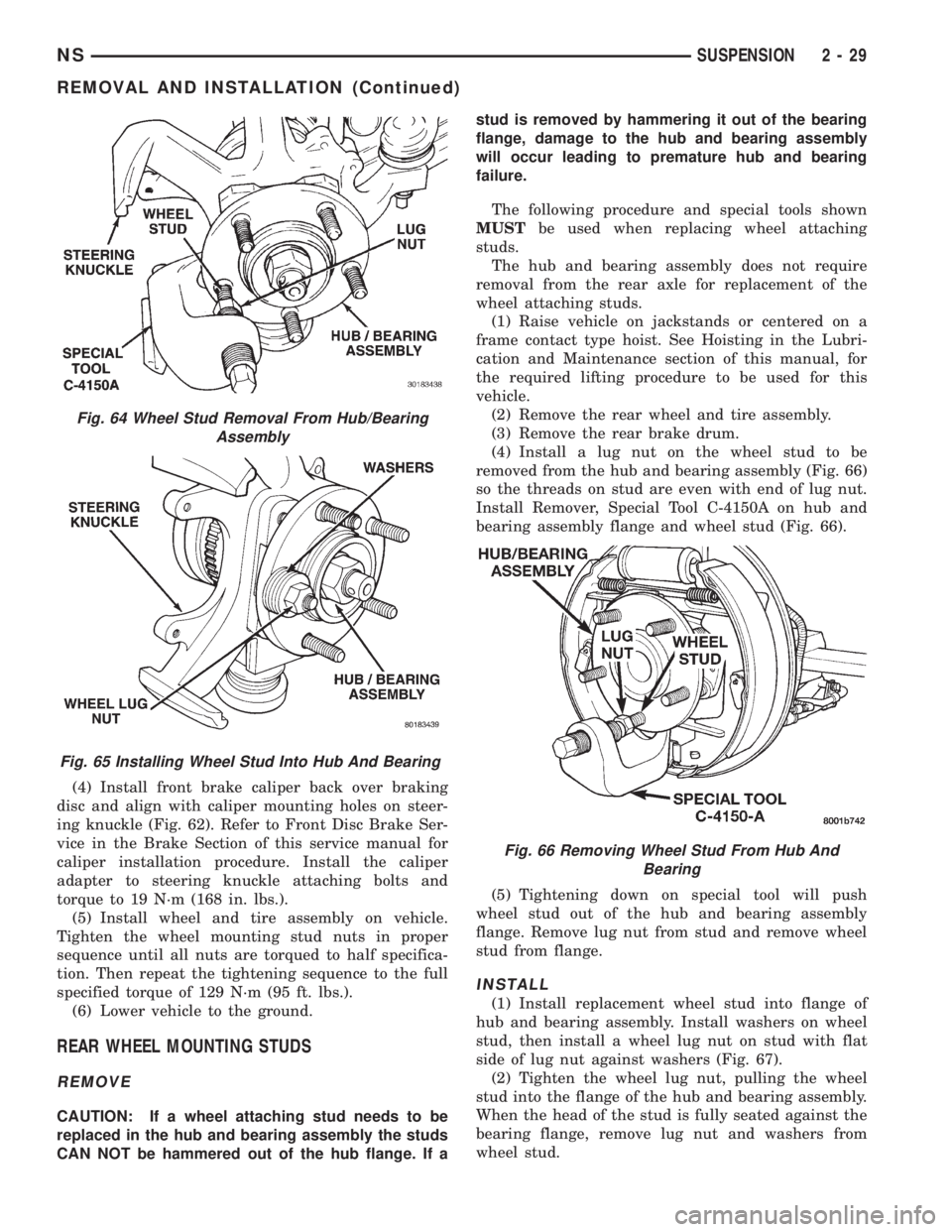
(4) Install a lug nut on the wheel stud to be
removed from the hub and bearing assembly (Fig. 66)
so the threads on stud are even with end of lug nut.
Install Remover, Special Tool C-4150A on hub and
bearing assembly flange and wheel stud (Fig. 66).
(5) Tightening down on special tool will push
wheel stud out of the hub and bearing assembly
flange. Remove lug nut from stud and remove wheel
stud from flange.
INSTALL
(1) Install replacement wheel stud into flange of
hub and bearing assembly. Install washers on wheel
stud, then install a wheel lug nut on stud with flat
side of lug nut against washers (Fig. 67).
(2) Tighten the wheel lug nut, pulling the wheel
stud into the flange of the hub and bearing assembly.
When the head of the stud is fully seated against the
bearing flange, remove lug nut and washers from
wheel stud.
Fig. 64 Wheel Stud Removal From Hub/Bearing
Assembly
Fig. 65 Installing Wheel Stud Into Hub And Bearing
Fig. 66 Removing Wheel Stud From Hub And
Bearing
NSSUSPENSION 2 - 29
REMOVAL AND INSTALLATION (Continued)
Page 68 of 1938
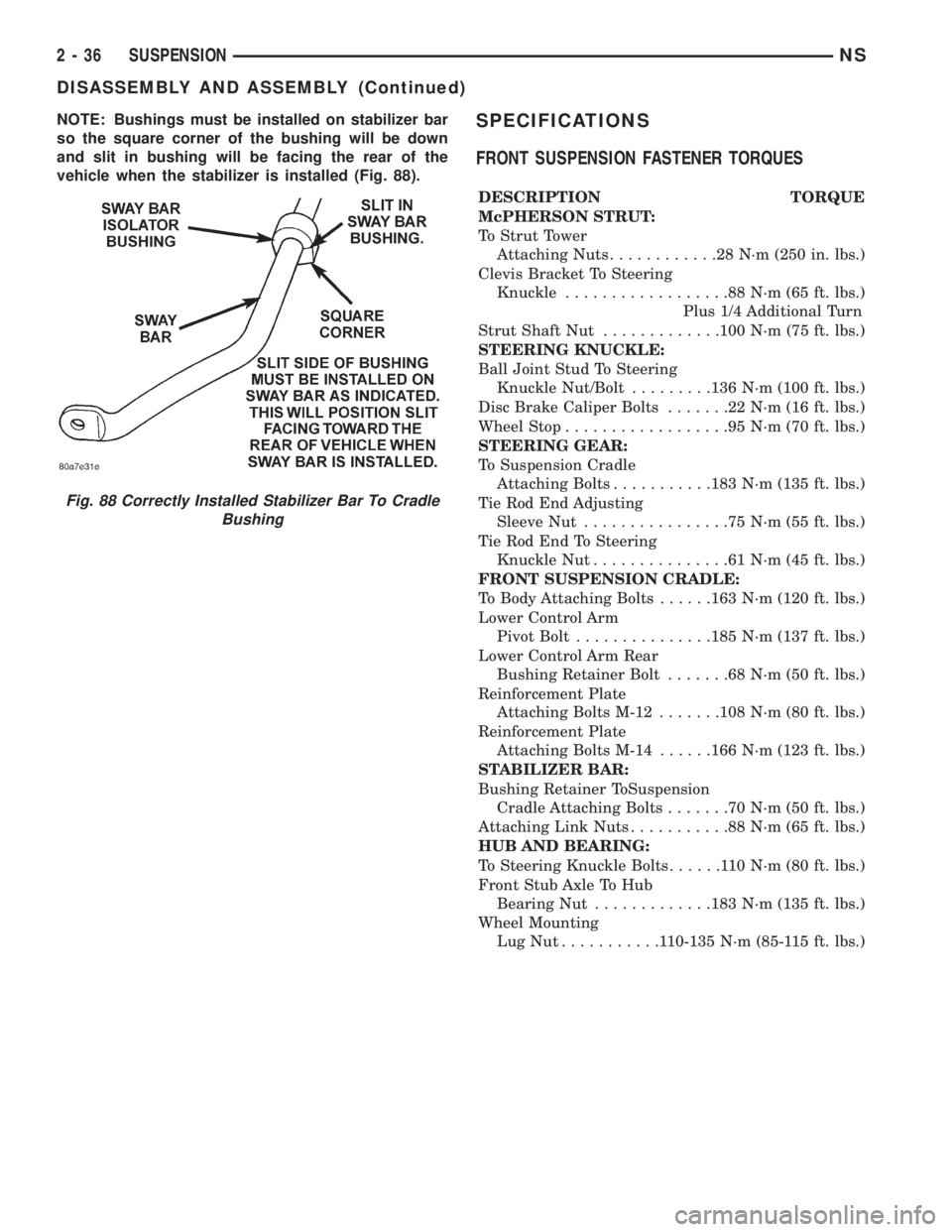
NOTE: Bushings must be installed on stabilizer bar
so the square corner of the bushing will be down
and slit in bushing will be facing the rear of the
vehicle when the stabilizer is installed (Fig. 88).SPECIFICATIONS
FRONT SUSPENSION FASTENER TORQUES
DESCRIPTION TORQUE
McPHERSON STRUT:
To Strut Tower
Attaching Nuts............28N´m(250 in. lbs.)
Clevis Bracket To Steering
Knuckle..................88N´m(65ft.lbs.)
Plus 1/4 Additional Turn
Strut Shaft Nut.............100 N´m (75 ft. lbs.)
STEERING KNUCKLE:
Ball Joint Stud To Steering
Knuckle Nut/Bolt.........136 N´m (100 ft. lbs.)
Disc Brake Caliper Bolts.......22N´m(16ft.lbs.)
Wheel Stop..................95N´m(70ft.lbs.)
STEERING GEAR:
To Suspension Cradle
Attaching Bolts...........183 N´m (135 ft. lbs.)
Tie Rod End Adjusting
Sleeve Nut................75N´m(55ft.lbs.)
Tie Rod End To Steering
Knuckle Nut...............61N´m(45ft.lbs.)
FRONT SUSPENSION CRADLE:
To Body Attaching Bolts......163 N´m (120 ft. lbs.)
Lower Control Arm
Pivot Bolt...............185 N´m (137 ft. lbs.)
Lower Control Arm Rear
Bushing Retainer Bolt.......68N´m(50ft.lbs.)
Reinforcement Plate
Attaching Bolts M-12.......108 N´m (80 ft. lbs.)
Reinforcement Plate
Attaching Bolts M-14......166 N´m (123 ft. lbs.)
STABILIZER BAR:
Bushing Retainer ToSuspension
Cradle Attaching Bolts.......70N´m(50ft.lbs.)
Attaching Link Nuts...........88N´m(65ft.lbs.)
HUB AND BEARING:
To Steering Knuckle Bolts......110N´m(80ft.lbs.)
Front Stub Axle To Hub
Bearing Nut.............183 N´m (135 ft. lbs.)
Wheel Mounting
LugNut...........110-135 N´m (85-115 ft. lbs.)
Fig. 88 Correctly Installed Stabilizer Bar To Cradle
Bushing
2 - 36 SUSPENSIONNS
DISASSEMBLY AND ASSEMBLY (Continued)
Page 70 of 1938
REAR SUSPENSION
INDEX
page page
GENERAL INFORMATION
REAR SUSPENSION..................... 38
DESCRIPTION AND OPERATION
REAR TRACK BAR....................... 39
REAR WHEEL ALIGNMENT................ 39
SHOCK ABSORBERS (REAR LOAD LEVELING) . 40
STABILIZER BAR........................ 39
REMOVAL AND INSTALLATION
JOUNCE BUMPER....................... 46
LEAF SPRING FRONT MOUNT............. 47LEAF SPRING REAR MOUNT.............. 47
REAR SPRINGS (AWD)................... 43
REAR SPRINGS (FWD)................... 40
REAR TRACK BAR....................... 45
SHOCK ABSORBER...................... 45
STABILIZER BAR........................ 46
TRACK BAR MOUNT..................... 45
SPECIFICATIONS
REAR SUSPENSION FASTENER TORQUES . . . 48
GENERAL INFORMATION
REAR SUSPENSION
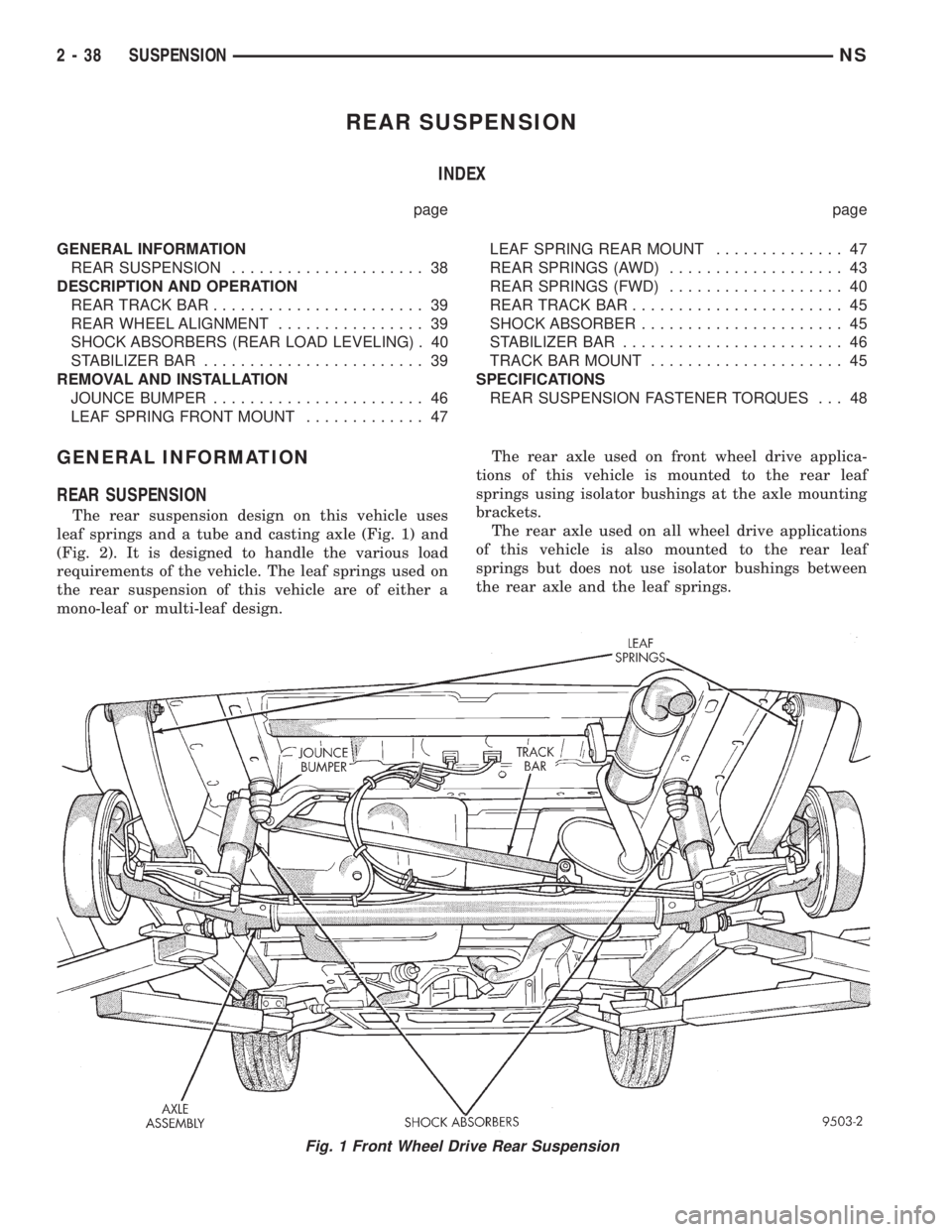
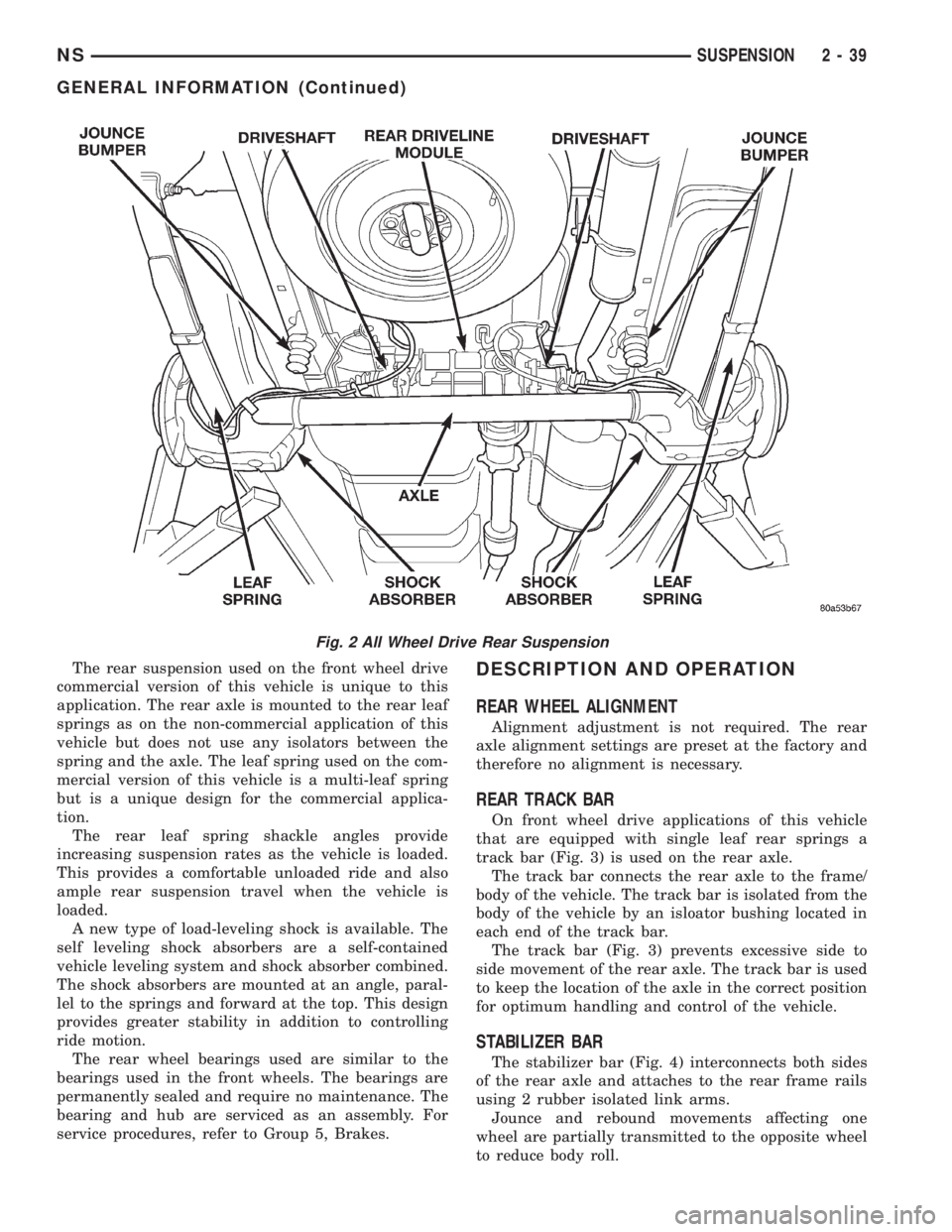
The rear suspension design on this vehicle uses
leaf springs and a tube and casting axle (Fig. 1) and
(Fig. 2). It is designed to handle the various load
requirements of the vehicle. The leaf springs used on
the rear suspension of this vehicle are of either a
mono-leaf or multi-leaf design.The rear axle used on front wheel drive applica-
tions of this vehicle is mounted to the rear leaf
springs using isolator bushings at the axle mounting
brackets.
The rear axle used on all wheel drive applications
of this vehicle is also mounted to the rear leaf
springs but does not use isolator bushings between
the rear axle and the leaf springs.
Fig. 1 Front Wheel Drive Rear Suspension
2 - 38 SUSPENSIONNS
Page 71 of 1938
The rear suspension used on the front wheel drive
commercial version of this vehicle is unique to this
application. The rear axle is mounted to the rear leaf
springs as on the non-commercial application of this
vehicle but does not use any isolators between the
spring and the axle. The leaf spring used on the com-
mercial version of this vehicle is a multi-leaf spring
but is a unique design for the commercial applica-
tion.
The rear leaf spring shackle angles provide
increasing suspension rates as the vehicle is loaded.
This provides a comfortable unloaded ride and also
ample rear suspension travel when the vehicle is
loaded.
A new type of load-leveling shock is available. The
self leveling shock absorbers are a self-contained
vehicle leveling system and shock absorber combined.
The shock absorbers are mounted at an angle, paral-
lel to the springs and forward at the top. This design
provides greater stability in addition to controlling
ride motion.
The rear wheel bearings used are similar to the
bearings used in the front wheels. The bearings are
permanently sealed and require no maintenance. The
bearing and hub are serviced as an assembly. For
service procedures, refer to Group 5, Brakes.DESCRIPTION AND OPERATION
REAR WHEEL ALIGNMENT
Alignment adjustment is not required. The rear
axle alignment settings are preset at the factory and
therefore no alignment is necessary.
REAR TRACK BAR
On front wheel drive applications of this vehicle
that are equipped with single leaf rear springs a
track bar (Fig. 3) is used on the rear axle.
The track bar connects the rear axle to the frame/
body of the vehicle. The track bar is isolated from the
body of the vehicle by an isloator bushing located in
each end of the track bar.
The track bar (Fig. 3) prevents excessive side to
side movement of the rear axle. The track bar is used
to keep the location of the axle in the correct position
for optimum handling and control of the vehicle.
STABILIZER BAR
The stabilizer bar (Fig. 4) interconnects both sides
of the rear axle and attaches to the rear frame rails
using 2 rubber isolated link arms.
Jounce and rebound movements affecting one
wheel are partially transmitted to the opposite wheel
to reduce body roll.
Fig. 2 All Wheel Drive Rear Suspension
NSSUSPENSION 2 - 39
GENERAL INFORMATION (Continued)
Page 72 of 1938
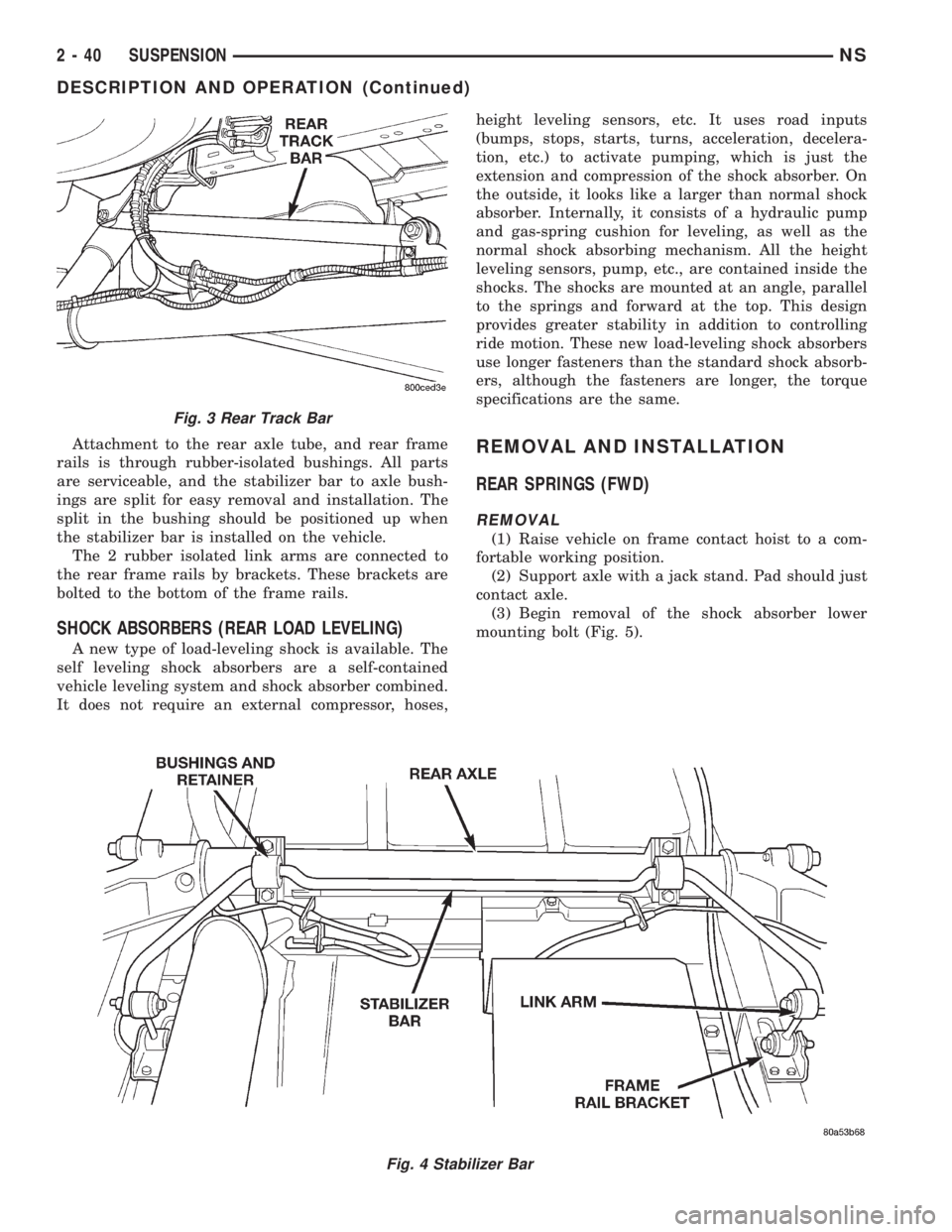
Attachment to the rear axle tube, and rear frame
rails is through rubber-isolated bushings. All parts
are serviceable, and the stabilizer bar to axle bush-
ings are split for easy removal and installation. The
split in the bushing should be positioned up when
the stabilizer bar is installed on the vehicle.
The 2 rubber isolated link arms are connected to
the rear frame rails by brackets. These brackets are
bolted to the bottom of the frame rails.
SHOCK ABSORBERS (REAR LOAD LEVELING)
A new type of load-leveling shock is available. The
self leveling shock absorbers are a self-contained
vehicle leveling system and shock absorber combined.
It does not require an external compressor, hoses,height leveling sensors, etc. It uses road inputs
(bumps, stops, starts, turns, acceleration, decelera-
tion, etc.) to activate pumping, which is just the
extension and compression of the shock absorber. On
the outside, it looks like a larger than normal shock
absorber. Internally, it consists of a hydraulic pump
and gas-spring cushion for leveling, as well as the
normal shock absorbing mechanism. All the height
leveling sensors, pump, etc., are contained inside the
shocks. The shocks are mounted at an angle, parallel
to the springs and forward at the top. This design
provides greater stability in addition to controlling
ride motion. These new load-leveling shock absorbers
use longer fasteners than the standard shock absorb-
ers, although the fasteners are longer, the torque
specifications are the same.
REMOVAL AND INSTALLATION
REAR SPRINGS (FWD)
REMOVAL
(1) Raise vehicle on frame contact hoist to a com-
fortable working position.
(2) Support axle with a jack stand. Pad should just
contact axle.
(3) Begin removal of the shock absorber lower
mounting bolt (Fig. 5).
Fig. 4 Stabilizer Bar
Fig. 3 Rear Track Bar
2 - 40 SUSPENSIONNS
DESCRIPTION AND OPERATION (Continued)
Page 73 of 1938
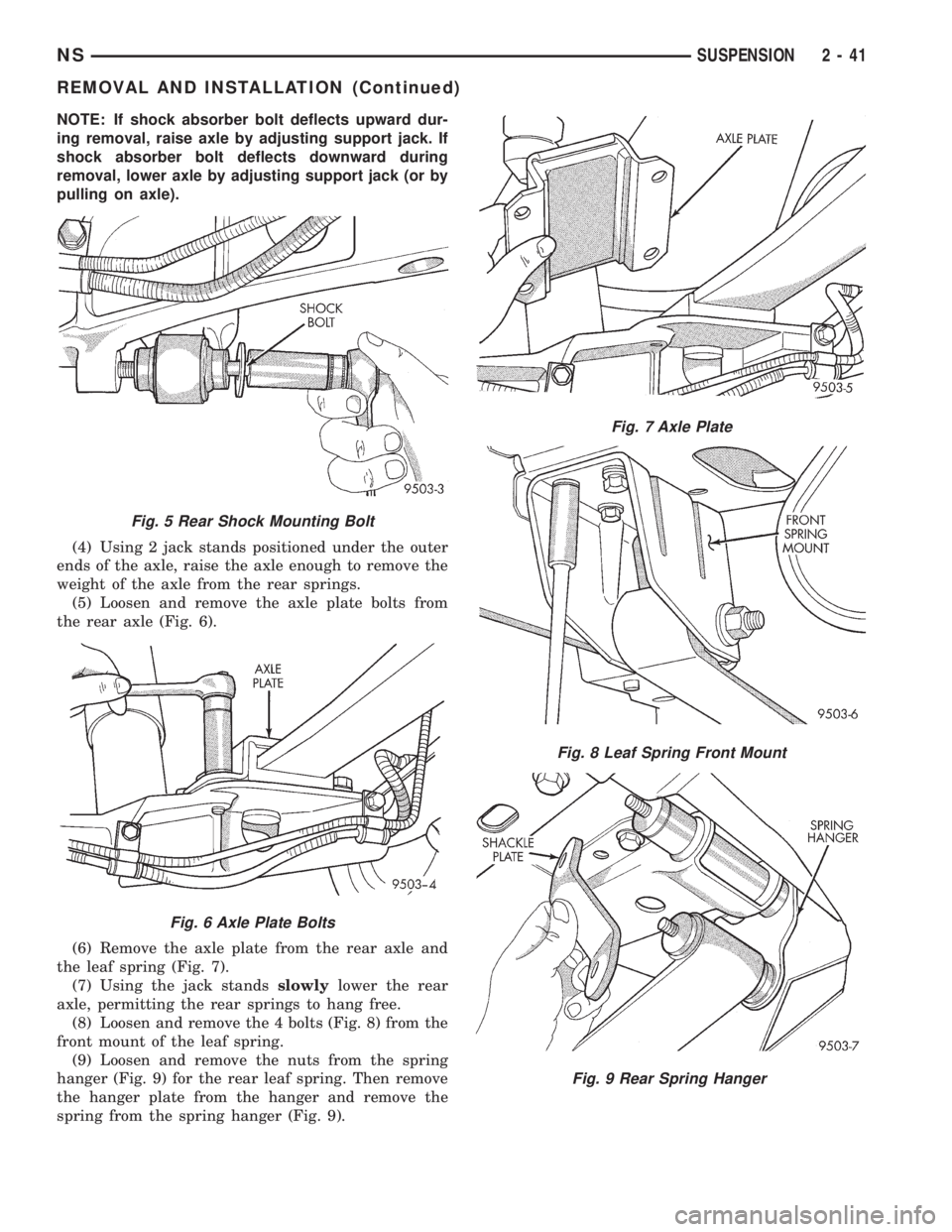
NOTE: If shock absorber bolt deflects upward dur-
ing removal, raise axle by adjusting support jack. If
shock absorber bolt deflects downward during
removal, lower axle by adjusting support jack (or by
pulling on axle).
(4) Using 2 jack stands positioned under the outer
ends of the axle, raise the axle enough to remove the
weight of the axle from the rear springs.
(5) Loosen and remove the axle plate bolts from
the rear axle (Fig. 6).
(6) Remove the axle plate from the rear axle and
the leaf spring (Fig. 7).
(7) Using the jack standsslowlylower the rear
axle, permitting the rear springs to hang free.
(8) Loosen and remove the 4 bolts (Fig. 8) from the
front mount of the leaf spring.
(9) Loosen and remove the nuts from the spring
hanger (Fig. 9) for the rear leaf spring. Then remove
the hanger plate from the hanger and remove the
spring from the spring hanger (Fig. 9).
Fig. 5 Rear Shock Mounting Bolt
Fig. 6 Axle Plate Bolts
Fig. 7 Axle Plate
Fig. 8 Leaf Spring Front Mount
Fig. 9 Rear Spring Hanger
NSSUSPENSION 2 - 41
REMOVAL AND INSTALLATION (Continued)
Page 74 of 1938
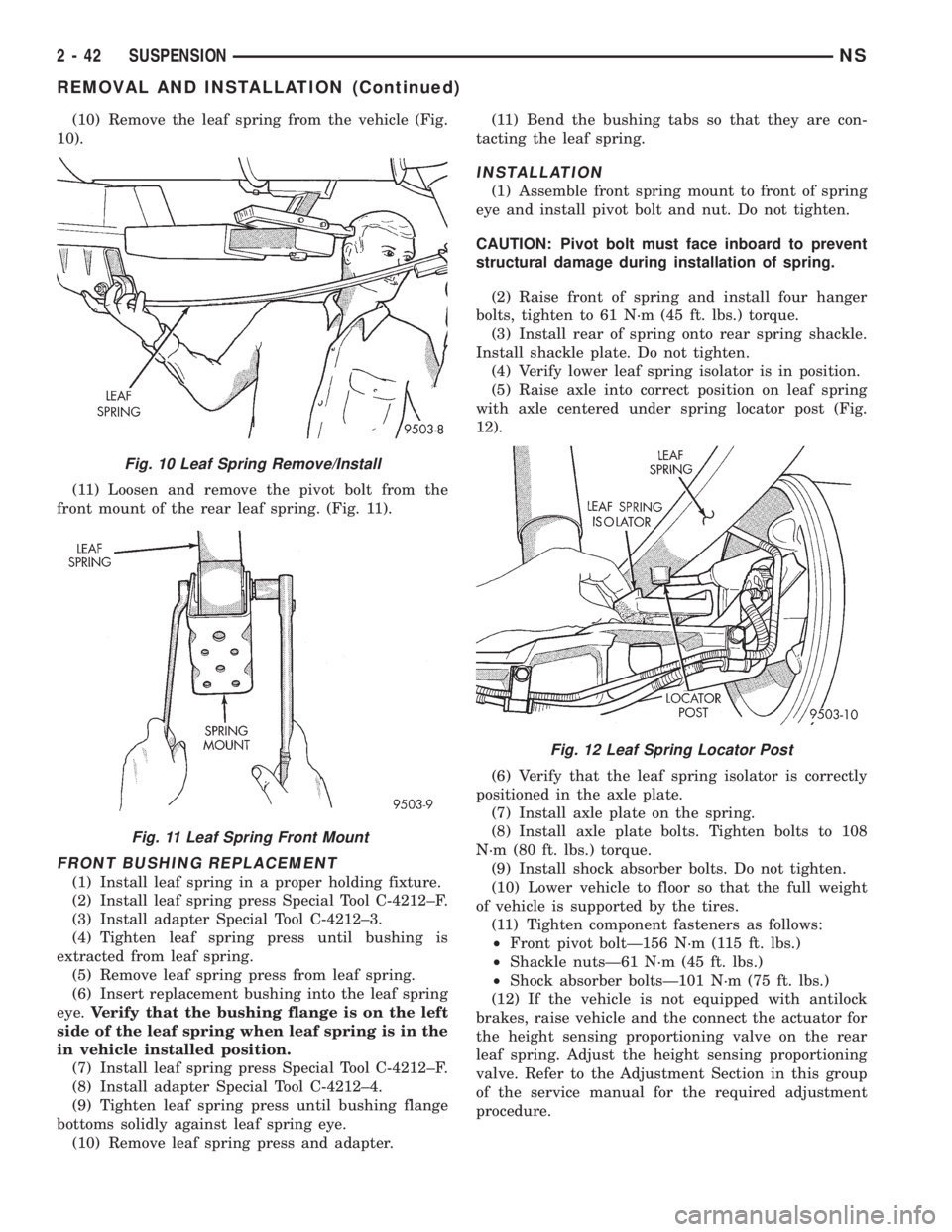
(10) Remove the leaf spring from the vehicle (Fig.
10).
(11) Loosen and remove the pivot bolt from the
front mount of the rear leaf spring. (Fig. 11).
FRONT BUSHING REPLACEMENT
(1) Install leaf spring in a proper holding fixture.
(2) Install leaf spring press Special Tool C-4212±F.
(3) Install adapter Special Tool C-4212±3.
(4) Tighten leaf spring press until bushing is
extracted from leaf spring.
(5) Remove leaf spring press from leaf spring.
(6) Insert replacement bushing into the leaf spring
eye.Verify that the bushing flange is on the left
side of the leaf spring when leaf spring is in the
in vehicle installed position.
(7) Install leaf spring press Special Tool C-4212±F.
(8) Install adapter Special Tool C-4212±4.
(9) Tighten leaf spring press until bushing flange
bottoms solidly against leaf spring eye.
(10) Remove leaf spring press and adapter.(11) Bend the bushing tabs so that they are con-
tacting the leaf spring.
INSTALLATION
(1) Assemble front spring mount to front of spring
eye and install pivot bolt and nut. Do not tighten.
CAUTION: Pivot bolt must face inboard to prevent
structural damage during installation of spring.
(2) Raise front of spring and install four hanger
bolts, tighten to 61 N´m (45 ft. lbs.) torque.
(3) Install rear of spring onto rear spring shackle.
Install shackle plate. Do not tighten.
(4) Verify lower leaf spring isolator is in position.
(5) Raise axle into correct position on leaf spring
with axle centered under spring locator post (Fig.
12).
(6) Verify that the leaf spring isolator is correctly
positioned in the axle plate.
(7) Install axle plate on the spring.
(8) Install axle plate bolts. Tighten bolts to 108
N´m (80 ft. lbs.) torque.
(9) Install shock absorber bolts. Do not tighten.
(10) Lower vehicle to floor so that the full weight
of vehicle is supported by the tires.
(11) Tighten component fasteners as follows:
²Front pivot boltÐ156 N´m (115 ft. lbs.)
²Shackle nutsÐ61 N´m (45 ft. lbs.)
²Shock absorber boltsÐ101 N´m (75 ft. lbs.)
(12) If the vehicle is not equipped with antilock
brakes, raise vehicle and the connect the actuator for
the height sensing proportioning valve on the rear
leaf spring. Adjust the height sensing proportioning
valve. Refer to the Adjustment Section in this group
of the service manual for the required adjustment
procedure.
Fig. 10 Leaf Spring Remove/Install
Fig. 11 Leaf Spring Front Mount
Fig. 12 Leaf Spring Locator Post
2 - 42 SUSPENSIONNS
REMOVAL AND INSTALLATION (Continued)
Page 75 of 1938
REAR SPRINGS (AWD)
REMOVE
(1) Raise vehicle on frame contact hoist to a com-
fortable working position.
(2) Remove the driveshaft from the side of the
vehicle that requires the removal of the leaf spring.
Refer to Group 3 Driveline in this service manual for
the procedure covering the removal of the rear drive-
shafts.
(3) Support axle with a jack stand. Pad should just
contact axle.
NOTE: If shock absorber bolt deflects upward dur-
ing removal, raise axle by adjusting support jack. If
shock absorber bolt deflects downward during
removal, lower axle by adjusting support jack (or by
pulling on axle).
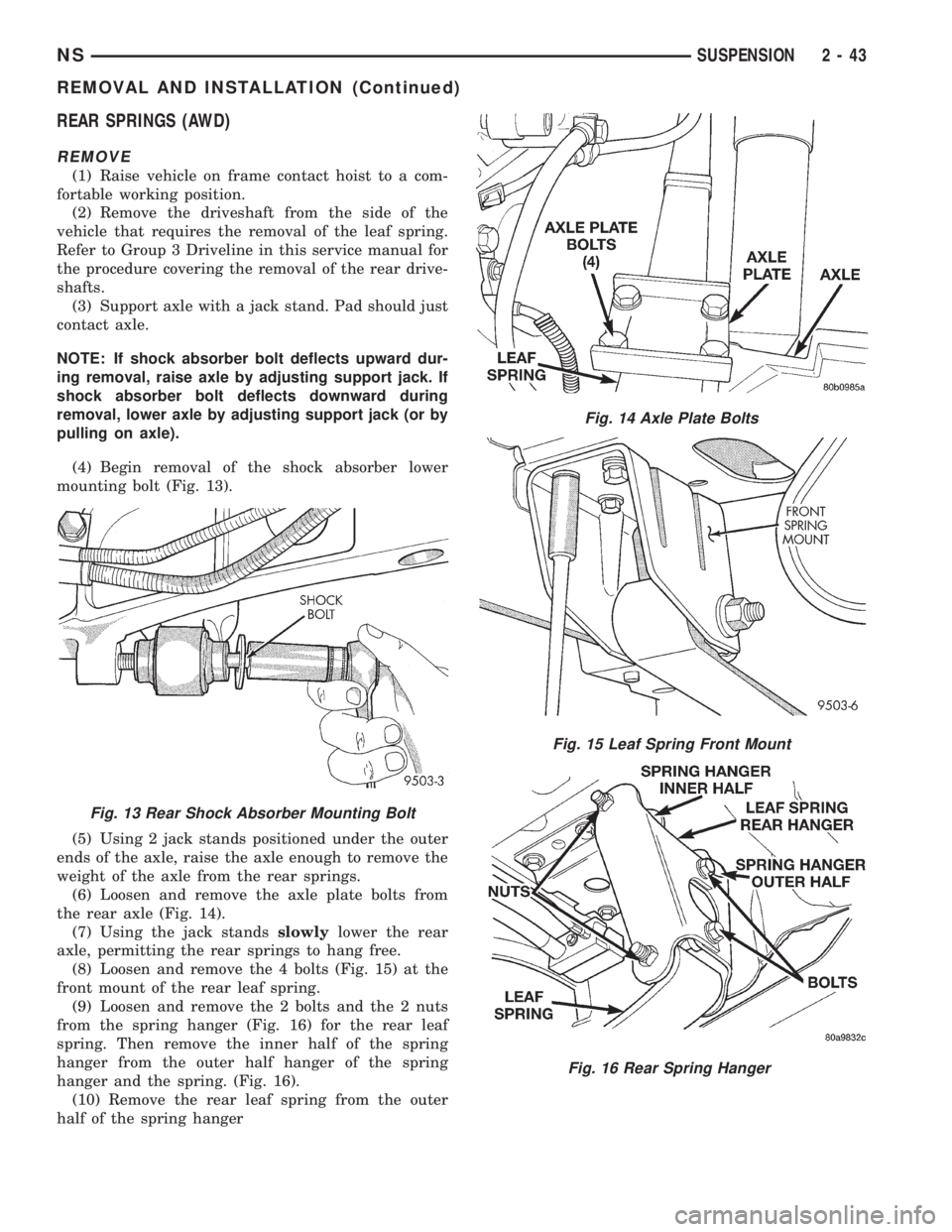
(4) Begin removal of the shock absorber lower
mounting bolt (Fig. 13).
(5) Using 2 jack stands positioned under the outer
ends of the axle, raise the axle enough to remove the
weight of the axle from the rear springs.
(6) Loosen and remove the axle plate bolts from
the rear axle (Fig. 14).
(7) Using the jack standsslowlylower the rear
axle, permitting the rear springs to hang free.
(8) Loosen and remove the 4 bolts (Fig. 15) at the
front mount of the rear leaf spring.
(9) Loosen and remove the 2 bolts and the 2 nuts
from the spring hanger (Fig. 16) for the rear leaf
spring. Then remove the inner half of the spring
hanger from the outer half hanger of the spring
hanger and the spring. (Fig. 16).
(10) Remove the rear leaf spring from the outer
half of the spring hanger
Fig. 13 Rear Shock Absorber Mounting Bolt
Fig. 14 Axle Plate Bolts
Fig. 15 Leaf Spring Front Mount
Fig. 16 Rear Spring Hanger
NSSUSPENSION 2 - 43
REMOVAL AND INSTALLATION (Continued)
Page 76 of 1938
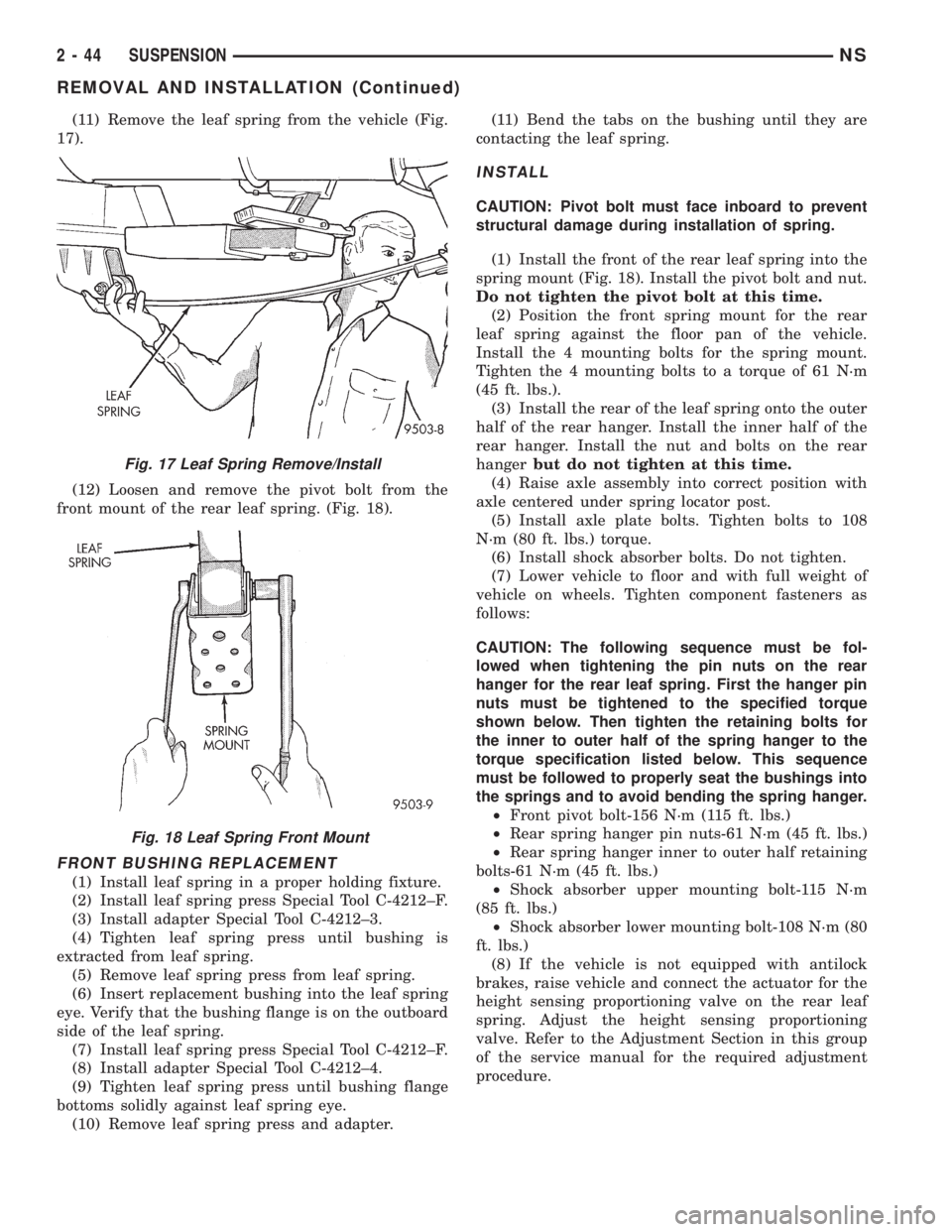
(11) Remove the leaf spring from the vehicle (Fig.
17).
(12) Loosen and remove the pivot bolt from the
front mount of the rear leaf spring. (Fig. 18).
FRONT BUSHING REPLACEMENT
(1) Install leaf spring in a proper holding fixture.
(2) Install leaf spring press Special Tool C-4212±F.
(3) Install adapter Special Tool C-4212±3.
(4) Tighten leaf spring press until bushing is
extracted from leaf spring.
(5) Remove leaf spring press from leaf spring.
(6) Insert replacement bushing into the leaf spring
eye. Verify that the bushing flange is on the outboard
side of the leaf spring.
(7) Install leaf spring press Special Tool C-4212±F.
(8) Install adapter Special Tool C-4212±4.
(9) Tighten leaf spring press until bushing flange
bottoms solidly against leaf spring eye.
(10) Remove leaf spring press and adapter.(11) Bend the tabs on the bushing until they are
contacting the leaf spring.
INSTALL
CAUTION: Pivot bolt must face inboard to prevent
structural damage during installation of spring.
(1) Install the front of the rear leaf spring into the
spring mount (Fig. 18). Install the pivot bolt and nut.
Do not tighten the pivot bolt at this time.
(2) Position the front spring mount for the rear
leaf spring against the floor pan of the vehicle.
Install the 4 mounting bolts for the spring mount.
Tighten the 4 mounting bolts to a torque of 61 N´m
(45 ft. lbs.).
(3) Install the rear of the leaf spring onto the outer
half of the rear hanger. Install the inner half of the
rear hanger. Install the nut and bolts on the rear
hangerbut do not tighten at this time.
(4) Raise axle assembly into correct position with
axle centered under spring locator post.
(5) Install axle plate bolts. Tighten bolts to 108
N´m (80 ft. lbs.) torque.
(6) Install shock absorber bolts. Do not tighten.
(7) Lower vehicle to floor and with full weight of
vehicle on wheels. Tighten component fasteners as
follows:
CAUTION: The following sequence must be fol-
lowed when tightening the pin nuts on the rear
hanger for the rear leaf spring. First the hanger pin
nuts must be tightened to the specified torque
shown below. Then tighten the retaining bolts for
the inner to outer half of the spring hanger to the
torque specification listed below. This sequence
must be followed to properly seat the bushings into
the springs and to avoid bending the spring hanger.
²Front pivot bolt-156 N´m (115 ft. lbs.)
²Rear spring hanger pin nuts-61 N´m (45 ft. lbs.)
²Rear spring hanger inner to outer half retaining
bolts-61 N´m (45 ft. lbs.)
²Shock absorber upper mounting bolt-115 N´m
(85 ft. lbs.)
²Shock absorber lower mounting bolt-108 N´m (80
ft. lbs.)
(8) If the vehicle is not equipped with antilock
brakes, raise vehicle and connect the actuator for the
height sensing proportioning valve on the rear leaf
spring. Adjust the height sensing proportioning
valve. Refer to the Adjustment Section in this group
of the service manual for the required adjustment
procedure.
Fig. 17 Leaf Spring Remove/Install
Fig. 18 Leaf Spring Front Mount
2 - 44 SUSPENSIONNS
REMOVAL AND INSTALLATION (Continued)
Page 77 of 1938

SHOCK ABSORBER
REMOVE/INSTALL
(1) Raise vehicle. Vehicle is to be raised and sup-
ported on jackstands or on a frame contact type
hoist. See Hoisting in the Lubrication And Mainte-
nance section of this service manual.
(2) Support the rear axle of the vehicle using 2
jackstands positioned at the outer ends of the axle.
NOTE: If the shock absorber lower mounting bolt
deflects upward during removal, raise axle by
adjusting the support jack. If the lower shock
absorber bolt deflects downward during removal,
lower the axle by adjusting the support jack.
(3) Remove the shock absorber lower mounting
bolt.
(4) While holding shock absorber, remove the
shock absorber upper mounting bolt.
(5) To install the shock absorber use the reverse
sequence of its removal.
(6) Lower the vehicle to the ground so the full
weight of the vehicle is supported by the suspension.
(7) Tighten the upper and lower shock absorber
mounting bolt to their specified torques.
REAR TRACK BAR
REMOVE
(1) Remove the nut and bolt mounting the track
bar to the rear axle (Fig. 19).
(2) Remove the nut and bolt attaching the track
bar to the track bar mount on the body of the vehicle.
Remove the track bar from the track bar mount.
INSTALL
(1) Install the track bar first into the body mount
for the track bar (Fig. 20). Install the track bar boltwith the head of the bolt facing toward the rear of
the vehicle (Fig. 21). Do not tighten.
(2) Install the track bar into its mounting bracket
on the rear axle (Fig. 19). Install the track bar bolt
with the head of the bolt facing toward the rear of
the vehicle. Do not tighten.
(3) Lower the vehicle to the ground until the full
weight of the vehicle is supported by the wheels.
Tighten both track bar attaching bolts to a torque of
95 N´m (70 ft. lbs.).
TRACK BAR MOUNT
REMOVE
(1) Remove the track bar from the track bar
mount.
(2) Remove the three bolts attaching the track bar
mount to the body (Fig. 22).
Fig. 19 Track Bar Mounting To Axle
Fig. 20 Track Bar Installation
Fig. 21 Track Bar Bolt Installation
NSSUSPENSION 2 - 45
REMOVAL AND INSTALLATION (Continued)