cruise control CHRYSLER VOYAGER 1996 Service Manual
[x] Cancel search | Manufacturer: CHRYSLER, Model Year: 1996, Model line: VOYAGER, Model: CHRYSLER VOYAGER 1996Pages: 1938, PDF Size: 55.84 MB
Page 207 of 1938
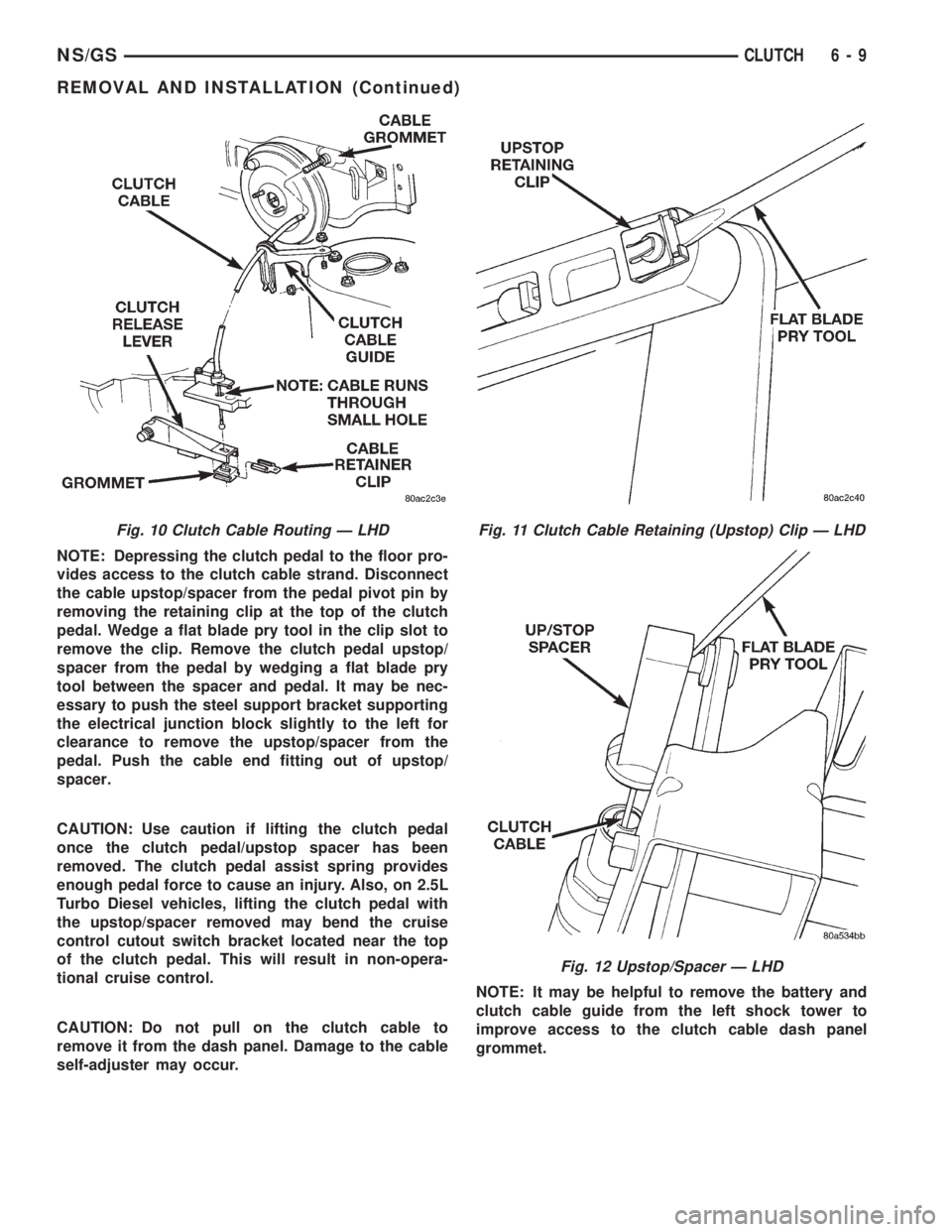
NOTE: Depressing the clutch pedal to the floor pro-
vides access to the clutch cable strand. Disconnect
the cable upstop/spacer from the pedal pivot pin by
removing the retaining clip at the top of the clutch
pedal. Wedge a flat blade pry tool in the clip slot to
remove the clip. Remove the clutch pedal upstop/
spacer from the pedal by wedging a flat blade pry
tool between the spacer and pedal. It may be nec-
essary to push the steel support bracket supporting
the electrical junction block slightly to the left for
clearance to remove the upstop/spacer from the
pedal. Push the cable end fitting out of upstop/
spacer.
CAUTION: Use caution if lifting the clutch pedal
once the clutch pedal/upstop spacer has been
removed. The clutch pedal assist spring provides
enough pedal force to cause an injury. Also, on 2.5L
Turbo Diesel vehicles, lifting the clutch pedal with
the upstop/spacer removed may bend the cruise
control cutout switch bracket located near the top
of the clutch pedal. This will result in non-opera-
tional cruise control.
CAUTION: Do not pull on the clutch cable to
remove it from the dash panel. Damage to the cable
self-adjuster may occur.NOTE: It may be helpful to remove the battery and
clutch cable guide from the left shock tower to
improve access to the clutch cable dash panel
grommet.
Fig. 10 Clutch Cable Routing Ð LHDFig. 11 Clutch Cable Retaining (Upstop) Clip Ð LHD
Fig. 12 Upstop/Spacer Ð LHD
NS/GSCLUTCH 6 - 9
REMOVAL AND INSTALLATION (Continued)
Page 338 of 1938
The instrument cluster is equipped with the follow-
ing warning lamps.
²Lift Gate Ajar
²Low Fuel Level
²Low Windshield Washer Fluid Level
²Cruise
²Battery Voltage
²Fasten Seat Belt
²Door Ajar
DIAGNOSIS AND TESTING
DIAGNOSTIC PROCEDURES
NS vehicle instrument clusters are equipped with a
self diagnostic test feature to help identify electronic
problems. Prior to any test, perform Self Diagnostic
Test. The self diagnostic system monitors the CCD
bus messages. If an electronic problem occurs, a
Diagnostic Trouble Code (DTC) will be displayed in
the odometer window of the cluster.
The following CCD bus messages are continuously
monitored by the diagnostic system:
²Body Control Module
²Powertrain Control Module
²Transmission Control Module, if equipped
HEADLAMP SWITCH
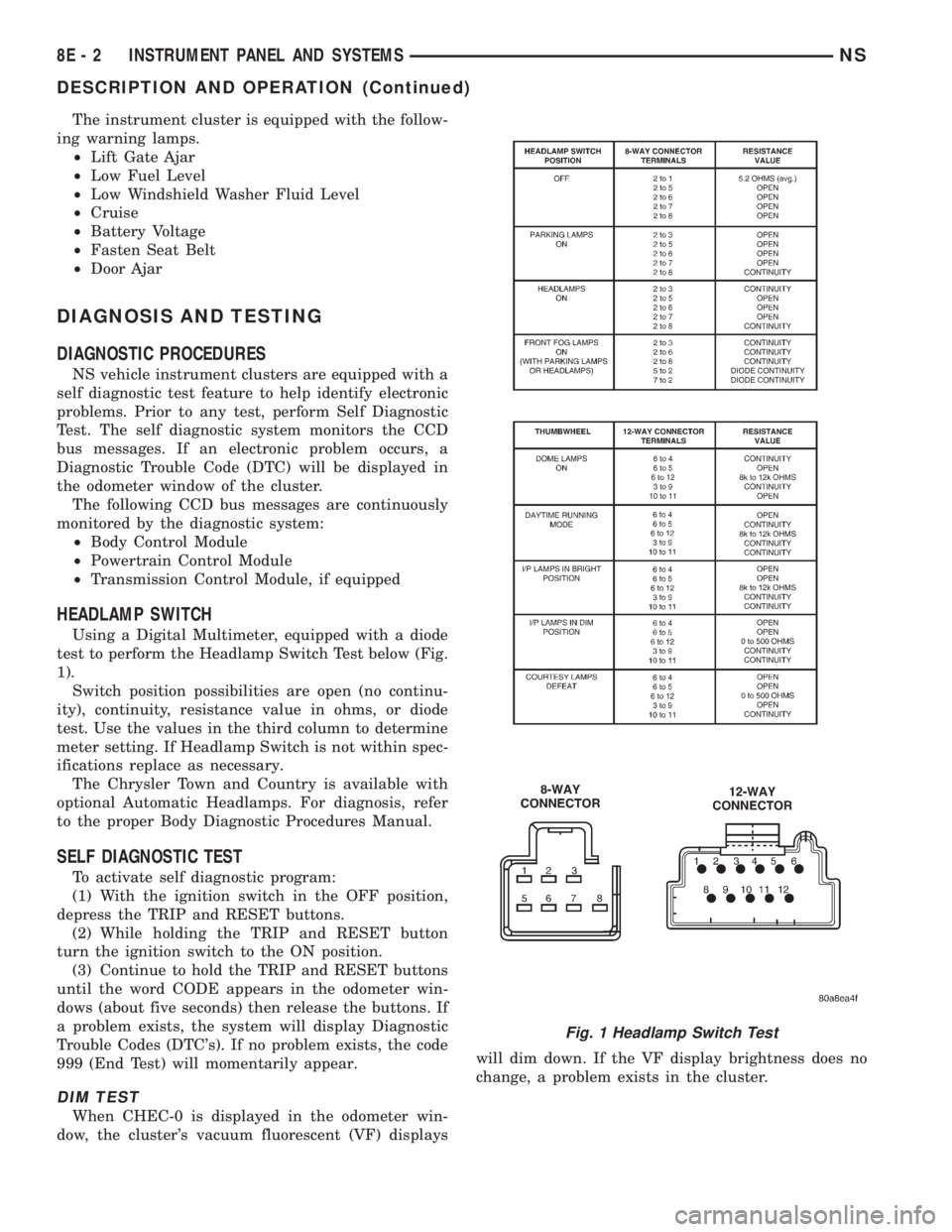
Using a Digital Multimeter, equipped with a diode
test to perform the Headlamp Switch Test below (Fig.
1).
Switch position possibilities are open (no continu-
ity), continuity, resistance value in ohms, or diode
test. Use the values in the third column to determine
meter setting. If Headlamp Switch is not within spec-
ifications replace as necessary.
The Chrysler Town and Country is available with
optional Automatic Headlamps. For diagnosis, refer
to the proper Body Diagnostic Procedures Manual.
SELF DIAGNOSTIC TEST
To activate self diagnostic program:
(1) With the ignition switch in the OFF position,
depress the TRIP and RESET buttons.
(2) While holding the TRIP and RESET button
turn the ignition switch to the ON position.
(3) Continue to hold the TRIP and RESET buttons
until the word CODE appears in the odometer win-
dows (about five seconds) then release the buttons. If
a problem exists, the system will display Diagnostic
Trouble Codes (DTC's). If no problem exists, the code
999 (End Test) will momentarily appear.
DIM TEST
When CHEC-0 is displayed in the odometer win-
dow, the cluster's vacuum fluorescent (VF) displayswill dim down. If the VF display brightness does no
change, a problem exists in the cluster.
Fig. 1 Headlamp Switch Test
8E - 2 INSTRUMENT PANEL AND SYSTEMSNS
DESCRIPTION AND OPERATION (Continued)
Page 419 of 1938

STEP IS NOT DONE A DIAGONSTIC TROUBLE
CODE (DTC) MAY BE SET.
VACUUM RESERVOIR
The reservoir contains a one-way check valve to
trap engine vacuum in the reservoir. When engine
vacuum drops, as in climbing a grade while driving,
the reservoir supplies the vacuum needed to main-
tain proper speed control operation. The vacuum res-
ervoir cannot be repaired and must be replaced if
faulty.
VEHICLE SPEED AND DISTANCE
The 4 speed automatic Transmission Control Mod-
ule (TCM) supplies the speed input to the PCM. The
PCM determines acceleration rates. The speed con-
trol software in the PCM uses vehicle speed and
acceleration to control to the set speed.
Vehicles with a 3 speed automatic or manual trans-
mission have a vehicle speed sensor (VSS) mounted
to an adapter near the transmission output shaft.
The sensor is driven through the adapter by a speed-
ometer pinion gear. The VSS pulse signal is moni-
tored by the PCM to determine vehicle speed and to
maintain speed control set speed. Refer to the appro-
priate Powertrain Diagnostic Procedures manual for
diagnosis and testing of this component. Refer to
group 14, Fuel System for Removal/Installation
DIAGNOSIS AND TESTING
ROAD TEST
Perform a vehicle road test to verify reports of
speed control system malfunction. The road test
should include attention to the speedometer. Speed-
ometer operation should be smooth and without flut-
ter at all speeds.
Flutter in the speedometer indicates a problem
which might cause surging in the speed control sys-
tem. The cause of any speedometer problems should
be corrected before proceeding. Refer to Group 8E,
Instrument Panel and Gauges for speedometer diag-
nosis.
If a road test verifies a surge following a set and
the speedometer operates properly see ªOvershoot/
Undershoot on speed control setº.
If a road test verifies an inoperative system, and
the speedometer operates properly, check for:
²A Diagnostic Trouble Code (DTC). If a DTC
exists, conduct tests per the Powertrain Diagnostic
Procedures service manual.
²A misadjusted brake (stop) lamp switch. This
could also cause an intermittent problem.
²Loose or corroded electrical connections at the
servo. Corrosion should be removed from electricalterminals and a light coating of Mopar Multipurpose
Grease, or equivalent, applied.
²Leaking vacuum reservoir.
²Loose or leaking vacuum hoses or connections.
²Defective one-way vacuum check valve.
²Secure attachment at both ends of the speed
control servo cable.
²Smooth operation of throttle linkage and throttle
body air valve.
²Conduct electrical test at PCM.
²Failed speed control servo. Do the servo vacuum
test.
CAUTION: When test probing for voltage or conti-
nuity at electrical connectors, care must be taken
not to damage connector, terminals or seals. If
these components are damaged, intermittent or
complete system failure may occur.
OVERSHOOT/UNDERSHOOT FOLLOWING SPEED
CONTROL SET
If the operator repeatedly presses and releases the
set button with their foot off of the accelerator (a ªlift
foot setº to begin speed control operation), the vehicle
may accelerate and exceed the desired set speed by
up to 5 MPH (8 km/h) and then decelerate to less
than the desired set speed before finally achieving
the desired set speed.
The Speed Control has an adaptive strategy that
compensates for vehicle-to-vehicle variations in speed
control cable lengths. When the speed control is set
with the vehicle operators foot off of the accelerator
pedal, the speed control thinks there is excessive
speed control cable slack and adapts. If the lift foot
sets are continually used, the speed control over-
shoot/undershoot condition will develop.
To ªunlearnº the overshoot/undershoot condition,
the vehicle operator has to press and release the set
button while maintaining the desired set speed with
the accelerator pedal (not decelerating or accelerat-
ing), and then turn the cruise control switch to the
OFF position (or press the CANCEL button if
equipped) after waiting 10 seconds. This procedure
must be performed approximately 10±15 times to
completely unlearn the overshoot/undershoot condi-
tion.
CHECKING FOR DIAGNOSTIC CODES
When trying to verify a speed control system elec-
tronic malfunction: Connect a DRB scan tool if avail-
able to the data link connector. The connector is
located at left side of the steering column, and at
lower edge of the panel.
(1) A speed control malfunction may occur without
a diagnostic code being indicated.
NSVEHICLE SPEED CONTROL SYSTEM 8H - 3
DESCRIPTION AND OPERATION (Continued)
Page 577 of 1938

8W-02 COMPONENT INDEX
Component Page
2-4 Pressure Switch.....................8W-31
2-4 Solenoid...........................8W-31
A/C Compressor Clutch..................8W-42
A/C Compressor Clutch Relay...........8W-10, 42
A/C Heater Control.....................8W-42
A/C On Indicator.......................8W-42
A/C Pressure Transducer..............8W-30, 42
A/C Switch............................8W-42
A/C Zone Door Actuator..................8W-42
ABS Warning Lamp..................8W-35, 46
Accelerator Pedal Position Sensor..........8W-30
Airbag Control Module...................8W-43
Airbag Indicator Lamp...................8W-43
Airbag Warning Lamp...................8W-46
All Wheel Drive Solenoid.................8W-31
Ambient Air Temperature Sensor...........8W-49
Ash Receiver Lamp.....................8W-44
Automatic Day/Night Mirror..............8W-44
Automatic Shut Down Relay............8W-10, 30
Splice Information......................8W-70
Back-Up Lamp.........................8W-51
Back-Up Switch.....................8W-44, 51
Battery...............................8W-20
Blend Door Actuator.....................8W-42
Body Control Module....................8W-45
Brake Pressure Switch...................8W-46
Brake Warning Lamp....................8W-46
Camshaft Position Sensor................8W-30
Center Dome Lamp.....................8W-44
Center High Mounted Stop Lamp..........8W-51
Cigar/Accessory Relay...................8W-41
Clockspring.......8W-10, 15, 30, 33, 39, 40, 41, 43
Cluster Illumination Lamps...............8W-40
Clutch Interlock Switch...............8W-12, 21
Clutch Interlock Switch Jumper......8W-12, 21, 31
Clutch Switch.......................8W-30, 33
Combination Flasher/DRL Module. . . .8W-50, 51, 52
Combination Relays.....................8W-54
Compass/Mini-Trip Computer..............8W-49
Control Sleeve Sensor....................8W-30
Controller Anti-Lock Brake...............8W-35
Courtesy Lamp Relay...........8W-10, 12, 44, 50
Crank Case Heater......................8W-30
Crankshaft Position Sensor...............8W-30
Cruise Indicator Lamp...................8W-40
Data Link Connector....................8W-30
Diesel Power Relay...................8W-10, 30
Dome Lamp Switch.....................8W-50
Door Ajar Indicator Lamp................8W-40
Door Ajar Switches................8W-39, 40, 44
Door Lock Relay........................8W-61
Speakers..............................8W-47Component Page
Door Unlock Relay......................8W-61
Oxygen Sensors........................8W-30
Door Ajar Switches.............8W-39, 40, 44, 45
Door Arm/Disarm Switches.............8W-39, 61
Door Courtesy Lamps....................8W-44
Door Lock Motors.......................8W-61
Door Lock Switches.....................8W-61
Door Unlock Relays.....................8W-61
Heated Seat Backs......................8W-63
Heated Seat Cushions...................8W-63
Heated Seat Modules....................8W-63
Heated Seat Switches....................8W-63
Power Mirrors.........................8W-62
Power Seat Switches....................8W-63
Power Window Switches..................8W-60
Seat Motors...........................8W-63
Window Motors........................8W-60
Radiator Fans.........................8W-42
Dump Solenoid.........................8W-33
EGR Solenoid..........................8W-30
Electric Wiper De-Icer...................8W-48
Electronic PRNDL Indicator...............8W-40
Engine Coolant Temperature Gauge.........8W-40
Engine Coolant Temperature Lamp.........8W-46
Engine Coolant Temperature Sensor........8W-30
Engine Oil Pressure Switch...............8W-46
Engine Speed Sensor....................8W-30
Engine Starter Motor....................8W-21
Engine Starter Motor Relay............8W-10, 21
Evap Leak Detection Pump...............8W-30
Evap/Purge Solenoid....................8W-30
Evaporator Temperature Sensor............8W-42
Express Down Module...................8W-60
Flexible Fuel Sensor.....................8W-30
Fog Lamps............................8W-50
Fog Lamp Relay........................8W-50
Front Blower Motor.....................8W-42
Front Blower Motor Relay.............8W-10, 42
Front Blower Motor Resistor Block.........8W-42
Front Cigar Lighter/Power Outlet..........8W-41
Front Reading Lamp Defeat Switch.........8W-44
Front Reading Lamps/Switch..............8W-44
Front Washer Motor.....................8W-53
Front Wiper Switch.....................8W-53
Fuel Gauge............................8W-40
Fuel Heater...........................8W-30
Fuel Heater Relay...................8W-10, 30
Fuel Injectors..........................8W-30
Fuel Pump Module......................8W-30
Fuel Pump Relay....................8W-10, 30
Fuel Quantity Actuator..................8W-30
Fuel Shutdown Solenoid..................8W-30
NS/GS8W - 02 COMPONENT INDEX 8W - 02 - 1
Page 729 of 1938

8W-40 INSTRUMENT CLUSTER
Component Page
A/C Heater Control....................8W-40-4
AW4B13............................8W-40-2
Body Control
Module........8W-40-2, 3, 4, 5, 6, 7, 8, 9, 10, 11
BS05........................8W-40-5, 6, 8, 10
BS06........................8W-40-5, 6, 8, 10
BS30...............................8W-40-7
BS40...............................8W-40-7
Clockspring......................8W-40-10, 11
Cluster Illumination Lamps.............8W-40-4
Cruise Indicator Lamp..............8W-40-10, 11
Data Link Connector...................8W-40-9
Door Ajar Indicator Lamp...............8W-40-3
Driver Door Ajar Switch................8W-40-3
Electronic PRNDL Indicator.............8W-40-5
Engine Coolant Temperature Gauge.....8W-40-8, 9
Engine Coolant Temperature Sensor.....8W-40-8, 9
Engine Speed Sensor...................8W-40-7
ES13........................8W-40-5, 6, 8, 10
ES14........................8W-40-5, 6, 8, 10
ES30...............................8W-40-7
Fuel Gauge..........................8W-40-2
Fuel Tank Module.....................8W-40-2
Fuse 2 (JB)..............8W-40-2, 3, 4, 5, 6, 8, 10
Fuse 28 (PDC)........................8W-40-2
G200...............................8W-40-2
G300...............................8W-40-4
G301...............................8W-40-7
G302...............................8W-40-3
G400...............................8W-40-3Component Page
Ignition Switch.....................8W-40-2, 4
Instrument Cluster............8W-40-2, 3, 4, 5, 6,
7, 8, 9, 10, 11
Junction Block...........8W-40-2, 3, 4, 5, 6, 8, 10
Left Rear Door Ajar Switch..............8W-40-3
Left Speed Control Switch...........8W-40-10, 11
Liftgate Ajar Indicator Lamp.............8W-40-3
Liftgate Ajar Switch...................8W-40-3
Low Fuel Warning Indicator Lamp........8W-40-2
Low Washer Fluid Level
Indicator Lamp.................8W-40-10, 11
Low Washer Fluid Switch...........8W-40-10, 11
Memory Seat/Mirror Module.............8W-40-2
Odometer............................8W-40-5
Passenger Door Ajar Switch.............8W-40-3
Power Distribution Center..............8W-40-2
Powertrain Control
Module..............8W-40-5, 6, 7, 8, 9, 10, 11
PS01............8W-40-2, 3, 4, 5, 6, 7, 8, 9, 10, 11
PS02............8W-40-2, 3, 4, 5, 6, 7, 8, 9, 10, 11
Right Rear Door Ajar Switch.............8W-40-3
Right Speed Control Switch..........8W-40-10, 11
Seat Belt Indicator Lamp...............8W-40-4
Seat Belt Switch......................8W-40-4
Speedometer.......................8W-40-6, 7
Tachometer........................8W-40-6, 7
Transmission Control Module..........8W-40-5, 6
Trip Odometer........................8W-40-5
Vehicle Speed Sensor.................8W-40-6, 7
Voltage Indicator Lamp...............8W-40-8, 9
NS/GS8W - 40 INSTRUMENT CLUSTER 8W - 40 - 1
Page 738 of 1938

SENSE WASHER
58C1
SWITCHG29
20
BK/TN
WT20 V37WT20 V37
B
SWITCH FLUID
WASHER
LOW
8B70
E43
21P34
B23
RD/LG20 V37
RIGHT
SPEED
CONTROL
SWITCH
SWITCH CONTROL
SPEED
LEFT
CLOCKSPRING
4
LAMP INDICATOR
LEVEL WASHERLOW
JUNCTION
BLOCK ST-RUN-OFF A81
10A
FUSE
2
CLUSTER INSTRUMENT
10C4
11
(ST-RUN-OFF)IGNITIONFUSEDF11
20
RD/WT
WT/BK20 D2VT/BR20 D1
BODY
CONTROL
MODULE
910
WT/BK20 D2 D1
20
VT/BR
(+)
C23
CCD
BUS
(-)
C234
CCD
BUS
CCD
BUS
(+) (-)BUS CCD
VT/BR18D1WT/BK18 D2
E3672B33
BS06 BS05
B23 P18
1312
BUS CCD
60C2
(-) BUS CCD
59C2
(+)D1
18
VT/BRD2
18
WT/BK
PS01
PS02
POWERTRAIN
CONTROL
MODULE
V37
18
RD/LG
SWITCH
C241
SPEED
CONTROL
SIGNAL LAMP INDICATOR
CRUISE
CRUISE
INDICATOR
CONTROLLAMP INDICATOR
CONTROLLEVELFLUID
LOW
WASHER
FLUID
(EATX) ES14 ES13
(EATX)
B12 B13
A21
PAIR TWISTED
PAIR TWISTED
C2
V37
20
RD/LG
D1
20
VT/BRD2
20
WT/BK
D1
FLUID WASHER
FLUID
SWITCH
SENSE
(8W-53-3)(8W-33-2) (8W-33-2) (8W-12-2) (8W-10-16)
(8W-12-9)
(8W-45-3)(8W-30-4) (8W-30-4) (8W-30-4)
(8W-30-4)
(8W-30-4)
(8W-30-5) (8W-30-4) (8W-30-4)
8W - 40 - 10 8W-40 INSTRUMENT CLUSTER
GASNS/GS
J988W-3GS004010
Page 739 of 1938

SWITCH WASHER
SENSE
58C1
FLUIDG29
20
BK/TN
WT20 V37
B
SWITCH FLUID
WASHER
LOW
21P34
B23
RD/LG20 V37
RIGHT
SPEED
CONTROL
SWITCH
SWITCH CONTROL
SPEED
LEFT
CLOCKSPRING
4
LAMP INDICATOR
LEVEL WASHERLOW
BATT M1
CLUSTER
INSTRUMENT
B(+) FUSED
WT/BK20 D2VT/BR20 D1
BODY
CONTROL
MODULE
910
WT/BK20 D2 D1
20
VT/BR
(+)
C23
CCD
BUS
(-)
C234
CCD
BUS
CCD
BUS
(+) (-)BUS CCD
POWERTRAIN
CONTROL
MODULE
SWITCH 36
SPEED
CONTROL
SIGNAL LAMP INDICATOR
CRUISE
CRUISE
INDICATOR
CONTROLLAMP INDICATOR
CONTROLLEVELFLUID
LOW
WASHER
FLUID
A21
V37
20
RD/LG
ST-RUN-OFF F11
FUSED
IGNITION
(ST-RUN-OFF)
PS02 PS01
PAIR TWISTED
V37
22
WT
DRIVER CONTROLSPEED
LAMP
LB/RD20 V38
LAMP
C156
SPEED
CONTROL
DRIVERLB/RD20 V38
27
TWISTED
PAIR
C2
WASHER
FLUID
SWITCH
SENSE
(8W-53-3)(8W-33-4) (8W-33-4) (8W-10-11)
(8W-45-3)
(8W-45-9)(8W-30-39) (8W-12-9)
(8W-30-31) (8W-30-31)
NS/GS8W-40 INSTRUMENT CLUSTER
DIESEL8W - 40 - 11
GS004011J988W-3
Page 1324 of 1938
THROTTLE BODY....................... 64
THROTTLE POSITION SENSOR............ 65
UPSTREAM OXYGEN SENSOR............. 68
SPECIFICATIONS
TORQUE.............................. 72SPECIAL TOOLS
FUEL................................. 72
GENERAL INFORMATION
INTRODUCTION
All engines used in this section have a sequential
Multi-Port Electronic Fuel Injection system. The MPI
system is computer regulated and provides precise
air/fuel ratios for all driving conditions. The Power-
train Control Module (PCM) operates the fuel injec-
tion system.
The PCM regulates:
²Ignition timing
²Air/fuel ratio
²Emission control devices
²Cooling fan
²Charging system
²Idle speed
²Vehicle speed control
Various sensors provide the inputs necessary for
the PCM to correctly operate these systems. In addi-
tion to the sensors, various switches also provide
inputs to the PCM.
All inputs to the PCM are converted into signals.
The PCM can adapt its programming to meet chang-
ing operating conditions.
Fuel is injected into the intake port above the
intake valve in precise metered amounts through
electrically operated injectors. The PCM fires the
injectors in a specific sequence. Under most operat-
ing conditions, the PCM maintains an air fuel ratio
of 14.7 parts air to 1 part fuel by constantly adjust-
ing injector pulse width. Injector pulse width is the
length of time the injector is open.
The PCM adjusts injector pulse width by opening
and closing the ground path to the injector. Engine
RPM (speed) and manifold absolute pressure (air
density) are the primary inputs that determine injec-
tor pulse width.
MODES OF OPERATION
As input signals to the PCM change, the PCM
adjusts its response to output devices. For example,
the PCM must calculate a different injector pulse
width and ignition timing for idle than it does for
Wide Open Throttle (WOT). There are several differ-
ent modes of operation that determine how the PCM
responds to the various input signals.
There are two different areas of operation, OPEN
LOOP and CLOSED LOOP.
During OPEN LOOP modes the PCM receives
input signals and responds according to preset PCMprogramming. Input from the oxygen (O2S) sensor is
not monitored during OPEN LOOP modes.
During CLOSED LOOP modes the PCM does mon-
itor the O2S sensor input. This input indicates to the
PCM whether or not the calculated injector pulse
width results in the ideal air/fuel ratio of 14.7 parts
air to 1 part fuel. By monitoring the exhaust oxygen
content through the O2S sensor, the PCM can fine
tune the injector pulse width. Fine tuning injector
pulse width allows the PCM to achieve optimum fuel
economy combined with low emissions.
The multi-port fuel injection system has the follow-
ing modes of operation:
²Ignition switch ON (zero RPM)
²Engine start-up
²Engine warm-up
²Cruise (Idle)
²Acceleration
²Deceleration
²Wide Open Throttle
²Ignition switch OFF
The engine start-up (crank), engine warm-up, and
wide open throttle modes are OPEN LOOP modes.
Under most operating conditions, the acceleration,
deceleration, and cruise modes,with the engine at
operating temperatureare CLOSED LOOP modes.
IGNITION SWITCH ON (ZERO RPM) MODE
When the multi-port fuel injection system is acti-
vated by the ignition switch, the following actions
occur:
²The PCM determines atmospheric air pressure
from the MAP sensor input to determine basic fuel
strategy.
²The PCM monitors the coolant temperature sen-
sor and throttle position sensor input. The PCM mod-
ifies fuel strategy based on this input.
When the key is in the ON position and the engine
is not running (zero rpm), the Automatic Shutdown
(ASD) relay and fuel pump relay are not energized.
Therefore battery voltage is not supplied to the fuel
pump, ignition coil, fuel injectors or oxygen sensor
heating element.
ENGINE START-UP MODE
This is an OPEN LOOP mode. The following
actions occur when the starter motor is engaged.
If the PCM receives the camshaft position sensor
and crankshaft position sensor signals, it energizes
the ASD relay and fuel pump relay. These relays sup-
ply battery voltage to the fuel pump, fuel injectors,
14 - 30 FUEL SYSTEMNS
SPECIFICATIONS (Continued)
Page 1325 of 1938
ignition coil, and oxygen sensor heating element. If
the PCM does not receive the camshaft position sen-
sor and crankshaft position sensor signals within
approximately one second, it de-energizes the ASD
relay and fuel pump relay.
The PCM energizes all injectors until it determines
crankshaft position from the camshaft position sen-
sor and crankshaft position sensor signals. The PCM
determines crankshaft position within 1 engine revo-
lution.
After determining crankshaft position, the PCM
begins energizing the injectors in sequence. The PCM
adjusts injector pulse width and controls injector syn-
chronization by turning the individual ground paths
to the injectors On and Off.
When the engine idles within664 RPM of its tar-
get RPM, the PCM compares current MAP sensor
value with the atmospheric pressure value received
during the Ignition Switch On (zero RPM) mode. If
the PCM does not detect a minimum difference
between the two values, it sets a MAP diagnostic
trouble code into memory.
Once the ASD and fuel pump relays have been
energized, the PCM:
²Determines injector pulse width based on engine
coolant temperature, MAP and the number of engine
revolutions since cranking was initiated.
²Monitors the engine coolant temperature sensor,
camshaft position sensor, crankshaft position sensor,
MAP sensor, and throttle position sensor to deter-
mine correct ignition timing.
ENGINE WARM-UP MODE
This is a OPEN LOOP mode. The following inputs
are received by the PCM:
²Engine coolant temperature
²Manifold absolute pressure
²Engine speed (crankshaft position sensor)
²Throttle position
²A/C switch
²Battery voltage
The PCM adjusts injector pulse width and controls
injector synchronization by turning the individual
ground paths to the injectors On and Off.
The PCM adjusts ignition timing and engine idle
speed. Engine idle speed is adjusted through the idle
air control motor.
CRUISE OR IDLE MODE
This is a CLOSED LOOP mode. The PCM recog-
nizes an abrupt increase in throttle position or MAP
pressure as a demand for increased engine output
and vehicle acceleration. The PCM increases injector
pulse width in response to increased fuel demand.
When the engine is at operating temperature this
is a CLOSED LOOP mode. During cruising speed the
following inputs are received by the PCM:²Engine coolant temperature
²Manifold absolute pressure
²Engine speed (crankshaft position sensor)
²Throttle position
²Exhaust gas oxygen content
²A/C control positions
²Battery voltage
The PCM adjusts injector pulse width and controls
injector synchronization by turning the individual
ground paths to the injectors On and Off.
The PCM adjusts engine idle speed and ignition
timing. The PCM adjusts the air/fuel ratio according
to the oxygen content in the exhaust gas.
ACCELERATION MODE
This is a CLOSED LOOP mode. The PCM recog-
nizes an abrupt increase in throttle position or MAP
pressure as a demand for increased engine output
and vehicle acceleration. The PCM increases injector
pulse width in response to increased fuel demand.
DECELERATION MODE
This is a CLOSED LOOP mode. During decelera-
tion the following inputs are received by the PCM:
²Engine coolant temperature
²Manifold absolute pressure
²Engine speed
²Throttle position
²Exhaust gas oxygen content
²A/C control positions
²Battery voltage
The PCM may receive a closed throttle input from
the Throttle Position Sensor (TPS) when it senses an
abrupt decrease in manifold pressure. This indicates
a hard deceleration. The PCM may reduce injector
pulse width or the number of injectors firing per
engine revolution. This helps maintain better control
of the air/fuel mixture (as sensed through the O2S
sensor).
WIDE OPEN THROTTLE (WOT) MODE
This is an OPEN LOOP mode. During WOT oper-
ation, the following inputs are received by the PCM:
²Engine coolant temperature
²Manifold absolute pressure
²Engine speed
²Throttle position
When the PCM senses WOT condition through the
Throttle Position Sensor (TPS) it will:
²De-energize the air conditioning relay. This dis-
ables the air conditioning system.
The exhaust gas oxygen content input is not
accepted by the PCM during WOT operation. The
PCM will adjust injector pulse width to supply a pre-
determined amount of additional fuel.
NSFUEL SYSTEM 14 - 31
GENERAL INFORMATION (Continued)
Page 1931 of 1938
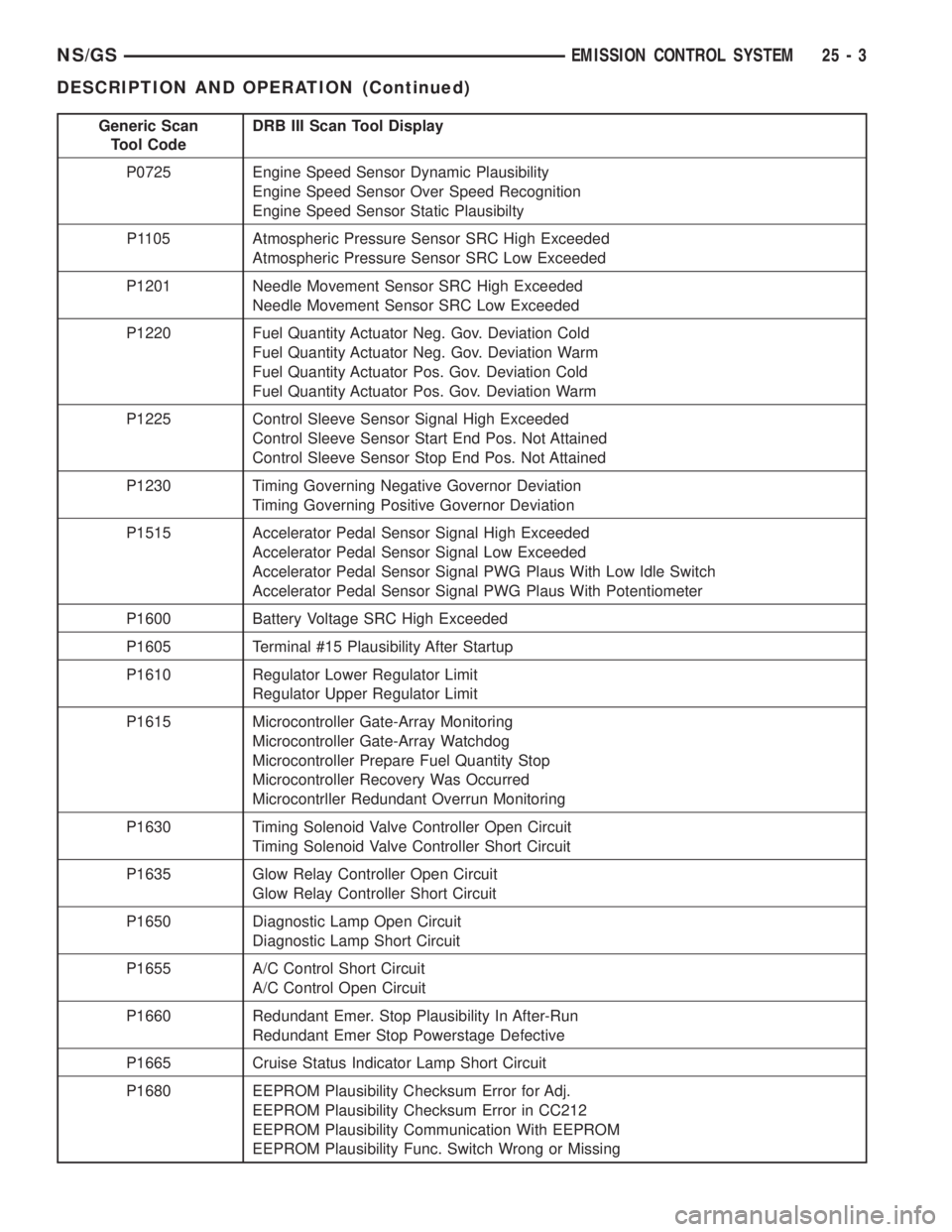
Generic Scan
Tool CodeDRB III Scan Tool Display
P0725 Engine Speed Sensor Dynamic Plausibility
Engine Speed Sensor Over Speed Recognition
Engine Speed Sensor Static Plausibilty
P1105 Atmospheric Pressure Sensor SRC High Exceeded
Atmospheric Pressure Sensor SRC Low Exceeded
P1201 Needle Movement Sensor SRC High Exceeded
Needle Movement Sensor SRC Low Exceeded
P1220 Fuel Quantity Actuator Neg. Gov. Deviation Cold
Fuel Quantity Actuator Neg. Gov. Deviation Warm
Fuel Quantity Actuator Pos. Gov. Deviation Cold
Fuel Quantity Actuator Pos. Gov. Deviation Warm
P1225 Control Sleeve Sensor Signal High Exceeded
Control Sleeve Sensor Start End Pos. Not Attained
Control Sleeve Sensor Stop End Pos. Not Attained
P1230 Timing Governing Negative Governor Deviation
Timing Governing Positive Governor Deviation
P1515 Accelerator Pedal Sensor Signal High Exceeded
Accelerator Pedal Sensor Signal Low Exceeded
Accelerator Pedal Sensor Signal PWG Plaus With Low Idle Switch
Accelerator Pedal Sensor Signal PWG Plaus With Potentiometer
P1600 Battery Voltage SRC High Exceeded
P1605 Terminal #15 Plausibility After Startup
P1610 Regulator Lower Regulator Limit
Regulator Upper Regulator Limit
P1615 Microcontroller Gate-Array Monitoring
Microcontroller Gate-Array Watchdog
Microcontroller Prepare Fuel Quantity Stop
Microcontroller Recovery Was Occurred
Microcontrller Redundant Overrun Monitoring
P1630 Timing Solenoid Valve Controller Open Circuit
Timing Solenoid Valve Controller Short Circuit
P1635 Glow Relay Controller Open Circuit
Glow Relay Controller Short Circuit
P1650 Diagnostic Lamp Open Circuit
Diagnostic Lamp Short Circuit
P1655 A/C Control Short Circuit
A/C Control Open Circuit
P1660 Redundant Emer. Stop Plausibility In After-Run
Redundant Emer Stop Powerstage Defective
P1665 Cruise Status Indicator Lamp Short Circuit
P1680 EEPROM Plausibility Checksum Error for Adj.
EEPROM Plausibility Checksum Error in CC212
EEPROM Plausibility Communication With EEPROM
EEPROM Plausibility Func. Switch Wrong or Missing
NS/GSEMISSION CONTROL SYSTEM 25 - 3
DESCRIPTION AND OPERATION (Continued)