warning CHRYSLER VOYAGER 1996 User Guide
[x] Cancel search | Manufacturer: CHRYSLER, Model Year: 1996, Model line: VOYAGER, Model: CHRYSLER VOYAGER 1996Pages: 1938, PDF Size: 55.84 MB
Page 62 of 1938
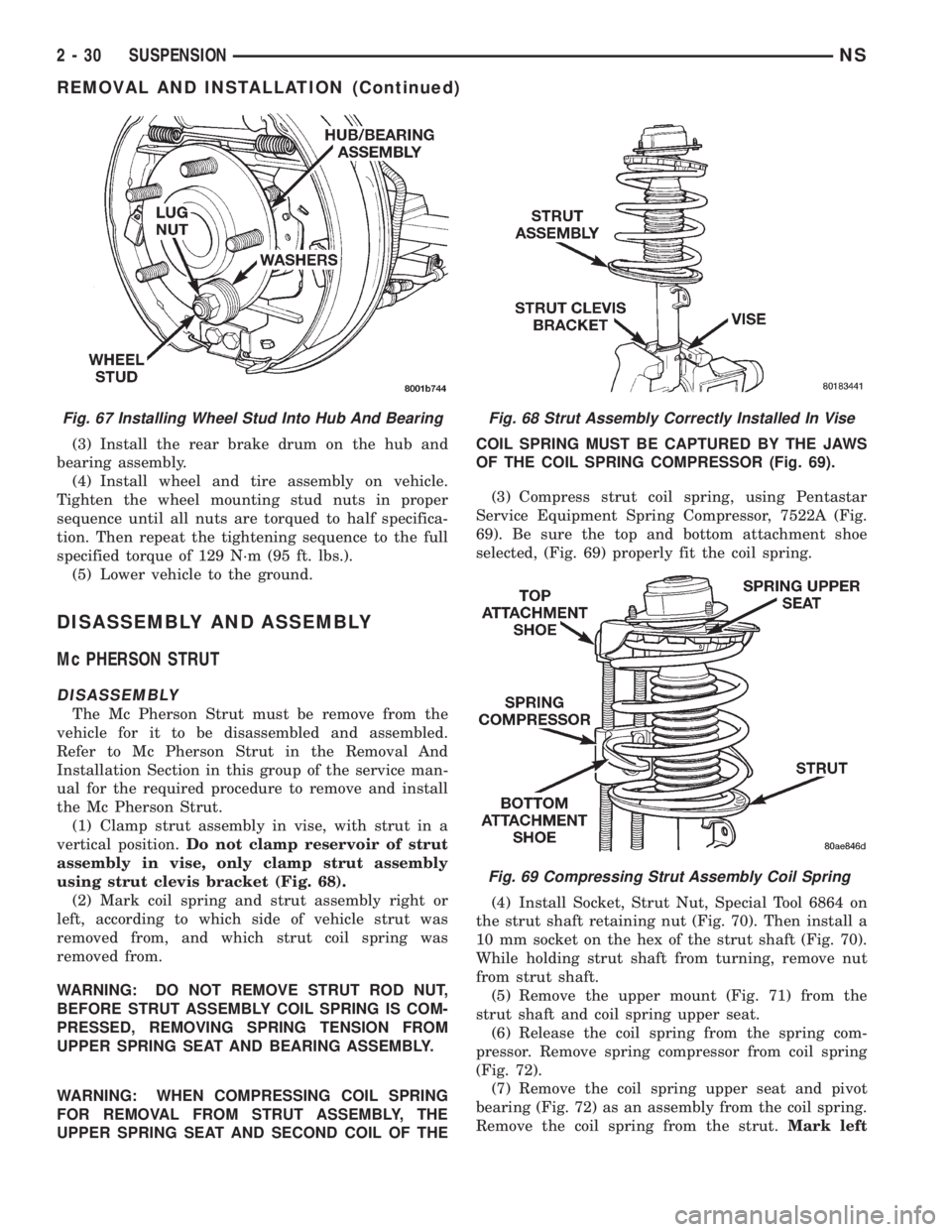
(3) Install the rear brake drum on the hub and
bearing assembly.
(4) Install wheel and tire assembly on vehicle.
Tighten the wheel mounting stud nuts in proper
sequence until all nuts are torqued to half specifica-
tion. Then repeat the tightening sequence to the full
specified torque of 129 N´m (95 ft. lbs.).
(5) Lower vehicle to the ground.
DISASSEMBLY AND ASSEMBLY
Mc PHERSON STRUT
DISASSEMBLY
The Mc Pherson Strut must be remove from the
vehicle for it to be disassembled and assembled.
Refer to Mc Pherson Strut in the Removal And
Installation Section in this group of the service man-
ual for the required procedure to remove and install
the Mc Pherson Strut.
(1) Clamp strut assembly in vise, with strut in a
vertical position.Do not clamp reservoir of strut
assembly in vise, only clamp strut assembly
using strut clevis bracket (Fig. 68).
(2) Mark coil spring and strut assembly right or
left, according to which side of vehicle strut was
removed from, and which strut coil spring was
removed from.
WARNING: DO NOT REMOVE STRUT ROD NUT,
BEFORE STRUT ASSEMBLY COIL SPRING IS COM-
PRESSED, REMOVING SPRING TENSION FROM
UPPER SPRING SEAT AND BEARING ASSEMBLY.
WARNING: WHEN COMPRESSING COIL SPRING
FOR REMOVAL FROM STRUT ASSEMBLY, THE
UPPER SPRING SEAT AND SECOND COIL OF THECOIL SPRING MUST BE CAPTURED BY THE JAWS
OF THE COIL SPRING COMPRESSOR (Fig. 69).
(3) Compress strut coil spring, using Pentastar
Service Equipment Spring Compressor, 7522A (Fig.
69). Be sure the top and bottom attachment shoe
selected, (Fig. 69) properly fit the coil spring.
(4) Install Socket, Strut Nut, Special Tool 6864 on
the strut shaft retaining nut (Fig. 70). Then install a
10 mm socket on the hex of the strut shaft (Fig. 70).
While holding strut shaft from turning, remove nut
from strut shaft.
(5) Remove the upper mount (Fig. 71) from the
strut shaft and coil spring upper seat.
(6) Release the coil spring from the spring com-
pressor. Remove spring compressor from coil spring
(Fig. 72).
(7) Remove the coil spring upper seat and pivot
bearing (Fig. 72) as an assembly from the coil spring.
Remove the coil spring from the strut.Mark left
Fig. 67 Installing Wheel Stud Into Hub And BearingFig. 68 Strut Assembly Correctly Installed In Vise
Fig. 69 Compressing Strut Assembly Coil Spring
2 - 30 SUSPENSIONNS
REMOVAL AND INSTALLATION (Continued)
Page 64 of 1938
²Inspect jounce bumper for cracks and signs of
deterioration.
(13) Replace any components of the strut assembly
found to be worn or defective during the inspection,
before re-assembling the strut.
ASSEMBLY
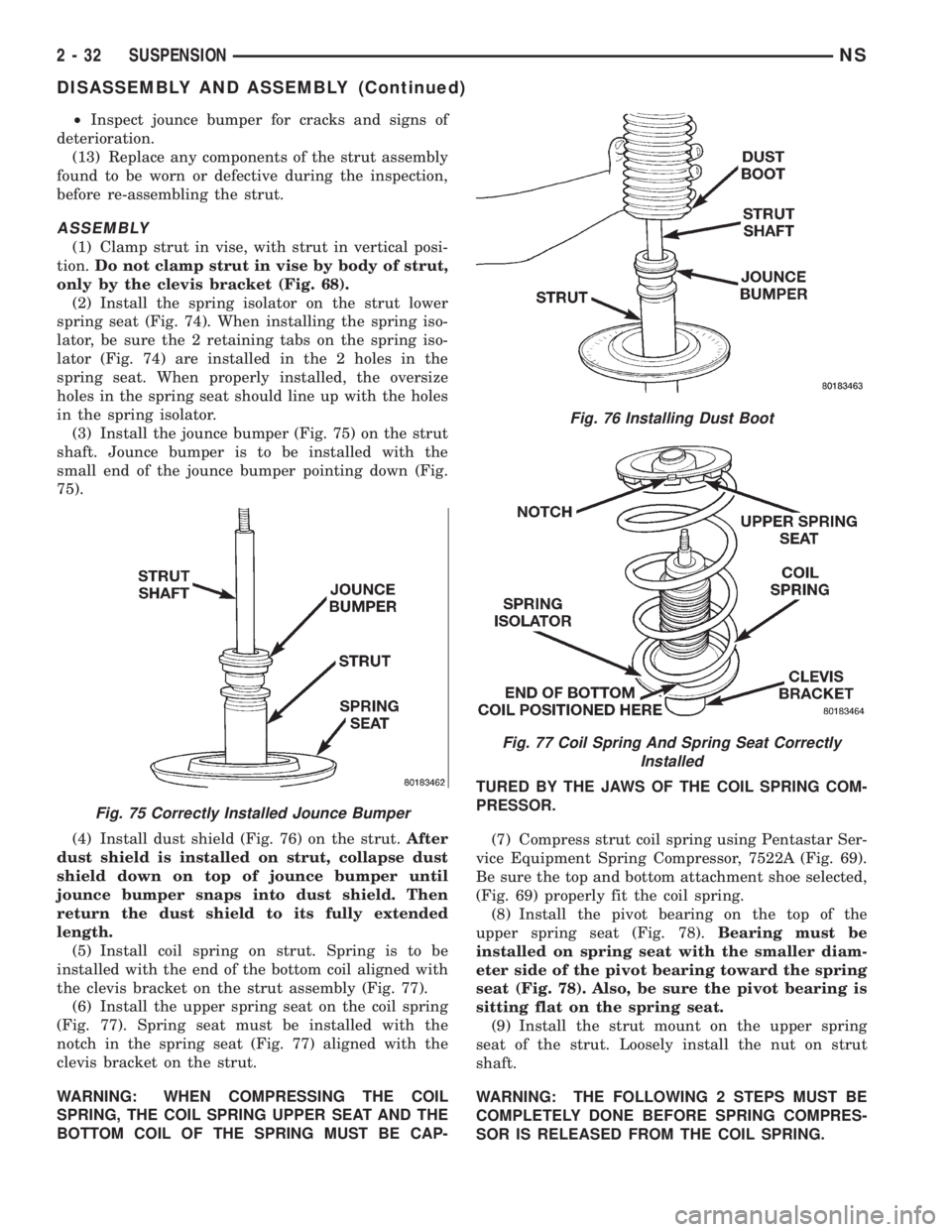
(1) Clamp strut in vise, with strut in vertical posi-
tion.Do not clamp strut in vise by body of strut,
only by the clevis bracket (Fig. 68).
(2) Install the spring isolator on the strut lower
spring seat (Fig. 74). When installing the spring iso-
lator, be sure the 2 retaining tabs on the spring iso-
lator (Fig. 74) are installed in the 2 holes in the
spring seat. When properly installed, the oversize
holes in the spring seat should line up with the holes
in the spring isolator.
(3) Install the jounce bumper (Fig. 75) on the strut
shaft. Jounce bumper is to be installed with the
small end of the jounce bumper pointing down (Fig.
75).
(4) Install dust shield (Fig. 76) on the strut.After
dust shield is installed on strut, collapse dust
shield down on top of jounce bumper until
jounce bumper snaps into dust shield. Then
return the dust shield to its fully extended
length.
(5) Install coil spring on strut. Spring is to be
installed with the end of the bottom coil aligned with
the clevis bracket on the strut assembly (Fig. 77).
(6) Install the upper spring seat on the coil spring
(Fig. 77). Spring seat must be installed with the
notch in the spring seat (Fig. 77) aligned with the
clevis bracket on the strut.
WARNING: WHEN COMPRESSING THE COIL
SPRING, THE COIL SPRING UPPER SEAT AND THE
BOTTOM COIL OF THE SPRING MUST BE CAP-TURED BY THE JAWS OF THE COIL SPRING COM-
PRESSOR.
(7) Compress strut coil spring using Pentastar Ser-
vice Equipment Spring Compressor, 7522A (Fig. 69).
Be sure the top and bottom attachment shoe selected,
(Fig. 69) properly fit the coil spring.
(8) Install the pivot bearing on the top of the
upper spring seat (Fig. 78).Bearing must be
installed on spring seat with the smaller diam-
eter side of the pivot bearing toward the spring
seat (Fig. 78). Also, be sure the pivot bearing is
sitting flat on the spring seat.
(9) Install the strut mount on the upper spring
seat of the strut. Loosely install the nut on strut
shaft.
WARNING: THE FOLLOWING 2 STEPS MUST BE
COMPLETELY DONE BEFORE SPRING COMPRES-
SOR IS RELEASED FROM THE COIL SPRING.
Fig. 75 Correctly Installed Jounce Bumper
Fig. 76 Installing Dust Boot
Fig. 77 Coil Spring And Spring Seat Correctly
Installed
2 - 32 SUSPENSIONNS
DISASSEMBLY AND ASSEMBLY (Continued)
Page 85 of 1938
BASE BRAKE SYSTEM
INDEX
page page
DESCRIPTION AND OPERATION
CHASSIS TUBES AND HOSES.............. 7
FRONT DISC BRAKE SYSTEM.............. 4
HUB/BEARING REAR WHEEL............... 9
MASTER CYLINDER...................... 7
PARKING BRAKE SYSTEM OPERATION....... 5
POWER BRAKE VACUUM BOOSTER
OPERATION........................... 8
PROPORTIONING VALVES................. 5
REAR DISC BRAKES...................... 5
REAR DRUM BRAKES..................... 5
RED BRAKE WARNING LAMP OPERATION..... 8
STOP LAMP SWITCH...................... 9
DIAGNOSIS AND TESTING
ADJUSTER REAR DRUM BRAKE
(AUTOMATIC)......................... 14
BRAKE FLUID CONTAMINATION............ 19
BRAKE ROTOR......................... 14
BRAKE SYSTEM BASIC DIAGNOSIS GUIDE.... 9
BRAKE SYSTEM DIAGNOSIS CHARTS....... 10
PROPORTIONING VALVES................ 16
RED BRAKE WARNING LAMP TEST......... 19
STOP LAMP SWITCH TEST PROCEDURE..... 19
TRACTION CONTROL LAMP TEST.......... 19
SERVICE PROCEDURES
BLEEDING BASE BRAKE
HYDRAULIC SYSTEM................... 20
BRAKE DRUM MACHINING................ 24
BRAKE TUBE REPAIR PROCEDURE......... 24
MASTER CYLINDER BLEEDING
PROCEDURE......................... 22
MASTER CYLINDER FLUID LEVEL CHECK.... 20
PARK BRAKE AUTO ADJUSTER
MECHANISM RELEASE................. 26
ROTOR MACHINING (FRONT/REAR)......... 22
REMOVAL AND INSTALLATION
BRAKE SUPPORT PLATE (REAR DRUM
BRAKES)............................ 37
FRONT DISC BRAKE CALIPER............. 27
FRONT DISC BRAKE PADS................ 30
FRONT PARK BRAKE CABLE.............. 65
HUB/BEARING.......................... 40
HYDRAULIC BRAKE TUBES AND HOSES..... 58
INTERMEDIATE PARK BRAKE CABLE....... 66
JUNCTION BLOCK....................... 55
LEFT REAR PARK BRAKE CABLE........... 67
MASTER CYLINDER..................... 44
PARK BRAKE PEDAL MECHANISM.......... 58PARK BRAKE SHOES (WITH REAR DISC
BRAKES)............................ 60
PROPORTIONING VALVE (W/ABS BRAKES) . . . 56
PROPORTIONING VALVE
(W/O ABS BRAKES).................... 57
REAR BRAKE DRUM..................... 33
REAR BRAKE WHEEL CYLINDER........... 39
REAR DISC BRAKE CALIPER.............. 28
REAR DISC BRAKE SHOES................ 31
REAR DRUM BRAKE SHOES............... 34
RIGHT REAR PARK BRAKE CABLE......... 66
STOP LAMP SWITCH..................... 69
VACUUM BOOSTER 2.4 LITER ENGINE...... 47
VACUUM BOOSTER 3.0 LITER ENGINE...... 49
VACUUM BOOSTER 3.3/3.8 LITER ENGINE.... 52
WHEEL AND TIRE INSTALLATION........... 27
DISASSEMBLY AND ASSEMBLY
FRONT DISC BRAKE CALIPER............. 71
MASTER CYLINDER BRAKE FLUID LEVEL
SWITCH............................. 71
MASTER CYLINDER FLUID RESERVOIR
FILL TUBE............................ 71
MASTER CYLINDER FLUID RESERVOIR...... 70
MASTER CYLINDER TO POWER BRAKE
BOOSTER VACUUM SEAL............... 69
WHEEL CYLINDER REAR DRUM BRAKE...... 76
CLEANING AND INSPECTION
BRAKE HOSE AND BRAKE LINES
INSPECTION.......................... 78
FRONT DISC BRAKE PAD LINING
INSPECTION.......................... 76
REAR DISC BRAKES..................... 76
REAR DRUM BRAKE SHOE LINING
INSPECTION.......................... 77
REAR DRUM BRAKE WHEEL CYLINDER...... 78
REAR WHEEL HUB AND BEARING
ASSEMBLY........................... 78
ADJUSTMENTS
PARK BRAKE CABLE ADJUSTMENT......... 81
PARK BRAKE SHOES (WITH REAR DISC
BRAKES)............................ 79
PROPORTIONING VALVE
(HEIGHT SENSING).................... 81
REAR DRUM BRAKE SHOE ADJUSTMENT.... 79
STOP LAMP SWITCH..................... 78
SPECIFICATIONS
BRAKE ACTUATION SYSTEM.............. 83
BRAKE FASTENER TORQUE
SPECIFICATIONS...................... 83
NSBRAKES 5 - 3
Page 90 of 1938
brakes. The secondary outlet port supplies hydraulic
pressure to the left front and right rear brakes.
POWER BRAKE VACUUM BOOSTER OPERATION
All vehicles use a 270 mm single diaphragm power
brake vacuum booster.
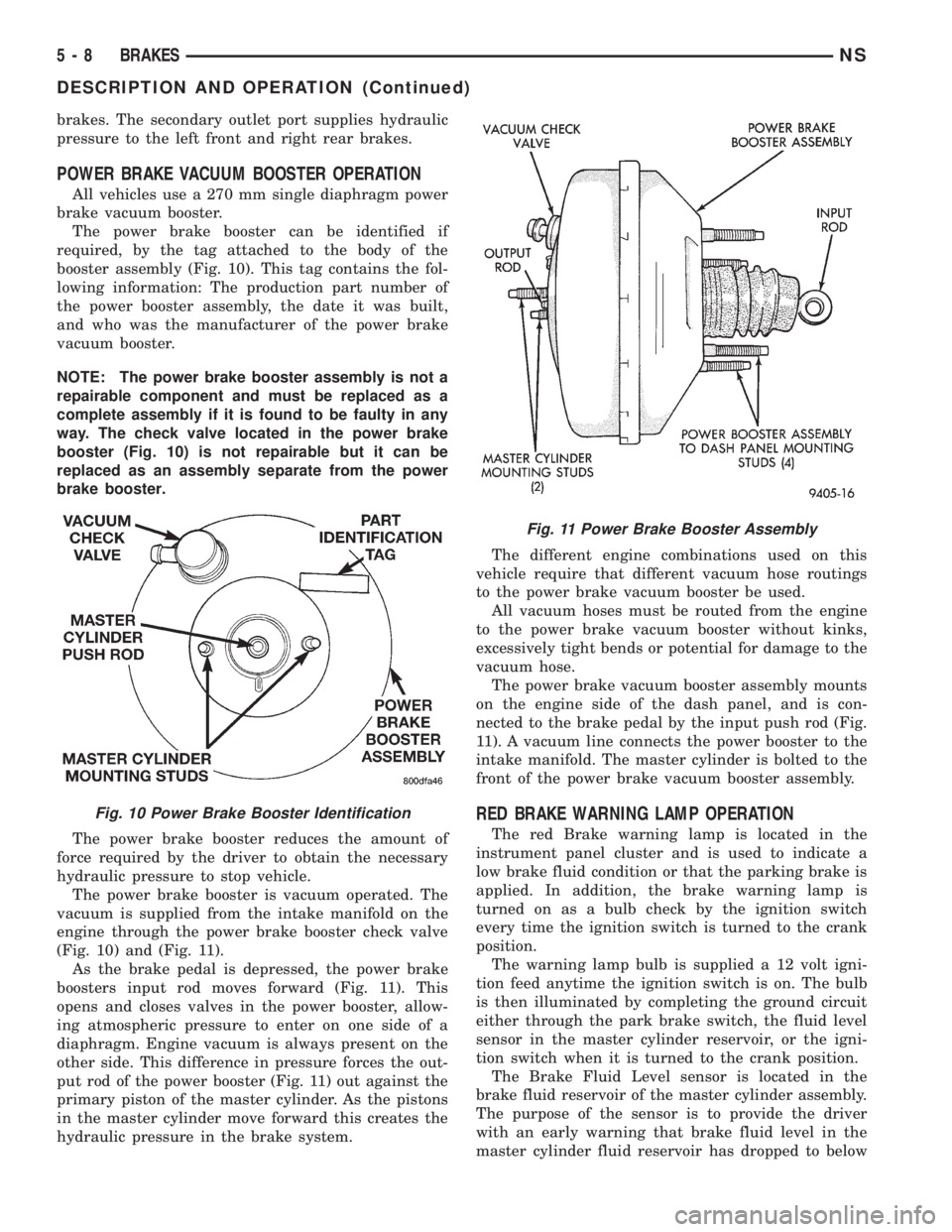
The power brake booster can be identified if
required, by the tag attached to the body of the
booster assembly (Fig. 10). This tag contains the fol-
lowing information: The production part number of
the power booster assembly, the date it was built,
and who was the manufacturer of the power brake
vacuum booster.
NOTE: The power brake booster assembly is not a
repairable component and must be replaced as a
complete assembly if it is found to be faulty in any
way. The check valve located in the power brake
booster (Fig. 10) is not repairable but it can be
replaced as an assembly separate from the power
brake booster.
The power brake booster reduces the amount of
force required by the driver to obtain the necessary
hydraulic pressure to stop vehicle.
The power brake booster is vacuum operated. The
vacuum is supplied from the intake manifold on the
engine through the power brake booster check valve
(Fig. 10) and (Fig. 11).
As the brake pedal is depressed, the power brake
boosters input rod moves forward (Fig. 11). This
opens and closes valves in the power booster, allow-
ing atmospheric pressure to enter on one side of a
diaphragm. Engine vacuum is always present on the
other side. This difference in pressure forces the out-
put rod of the power booster (Fig. 11) out against the
primary piston of the master cylinder. As the pistons
in the master cylinder move forward this creates the
hydraulic pressure in the brake system.The different engine combinations used on this
vehicle require that different vacuum hose routings
to the power brake vacuum booster be used.
All vacuum hoses must be routed from the engine
to the power brake vacuum booster without kinks,
excessively tight bends or potential for damage to the
vacuum hose.
The power brake vacuum booster assembly mounts
on the engine side of the dash panel, and is con-
nected to the brake pedal by the input push rod (Fig.
11). A vacuum line connects the power booster to the
intake manifold. The master cylinder is bolted to the
front of the power brake vacuum booster assembly.
RED BRAKE WARNING LAMP OPERATION
The red Brake warning lamp is located in the
instrument panel cluster and is used to indicate a
low brake fluid condition or that the parking brake is
applied. In addition, the brake warning lamp is
turned on as a bulb check by the ignition switch
every time the ignition switch is turned to the crank
position.
The warning lamp bulb is supplied a 12 volt igni-
tion feed anytime the ignition switch is on. The bulb
is then illuminated by completing the ground circuit
either through the park brake switch, the fluid level
sensor in the master cylinder reservoir, or the igni-
tion switch when it is turned to the crank position.
The Brake Fluid Level sensor is located in the
brake fluid reservoir of the master cylinder assembly.
The purpose of the sensor is to provide the driver
with an early warning that brake fluid level in the
master cylinder fluid reservoir has dropped to below
Fig. 10 Power Brake Booster Identification
Fig. 11 Power Brake Booster Assembly
5 - 8 BRAKESNS
DESCRIPTION AND OPERATION (Continued)
Page 91 of 1938

normal. This may indicate:(1)Abnormal loss of
brake fluid in the master cylinder fluid reservoir
resulting from a leak in the hydraulic system.(2)
Brake shoe linings which have worn to a point
requiring replacement.
As the brake fluid drops below the minimum level,
the brake fluid level sensor closes to ground the
brake warning light circuit. This will turn on the red
brake warning light. At this time, master cylinder
fluid reservoir should be checked and filled to the full
mark with DOT 3 brake fluid.If brake fluid level
has dropped below the add line in the master
cylinder fluid reservoir, the entire brake
hydraulic system should be checked for evi-
dence of a leak.
STOP LAMP SWITCH
The stop lamp switch controls operation of the
vehicles stop lamps. Also, if the vehicle is equippedwith speed control, the stop lamp switch will deacti-
vate speed control when the brake pedal is
depressed.
The stop lamp switch controls operation of the
right and left tail, stop and turn signal lamp and
CHMSL lamp, by supplying battery current to these
lamps.
The stop lamp switch controls the lamp operation
by opening and closing the electrical circuit to the
stop lamps.
HUB/BEARING REAR WHEEL
The rear hub and bearing assembly used on this
vehicle is serviceable only as a complete assembly. No
attempt should be made to disassemble a rear hub
and bearing assembly in an effort to repair it.
The rear hub and bearing assembly is attached to
the rear axle using 4 mounting bolts that are remov-
able from the back of the rear hub/bearing.
DIAGNOSIS AND TESTING
BRAKE SYSTEM BASIC DIAGNOSIS GUIDE
SYMPTOMCHART 1
MISC.
COND.CHART 2
WARNING
LIGHTCHART 3
POWER
BRAKESCHART 4
BRAKE
NOISECHART 5
WHEEL
BRAKES
Brake Warning Light On X NO NO
Excessive Pedal Travel 6 X NO O
Pedal Goes To The Floor 6 X
Stop Light On Without Brakes 3
All Brakes Drag 5
Rear Brakes Drag 2 NO NO
Grabby Brakes O X
Spongy Brake Pedal X NO
Premature Rear Brake Lockup 4 NO NO O
Excessive Pedal Effort 1 O
Rough Engine Idle NO O
Brake Chatter (Rough) NO NO X
Surge During Braking NO NO X
Noise During Braking NO NO X
Rattle Or Clunking Noise NO NO X
Pedal Pulsates During Braking NO NO X
Pull To Right Or Left NO NO X
No: Not A Possible Cause X: Most Likely Cause O: Possible Cause
NSBRAKES 5 - 9
DESCRIPTION AND OPERATION (Continued)
Page 93 of 1938
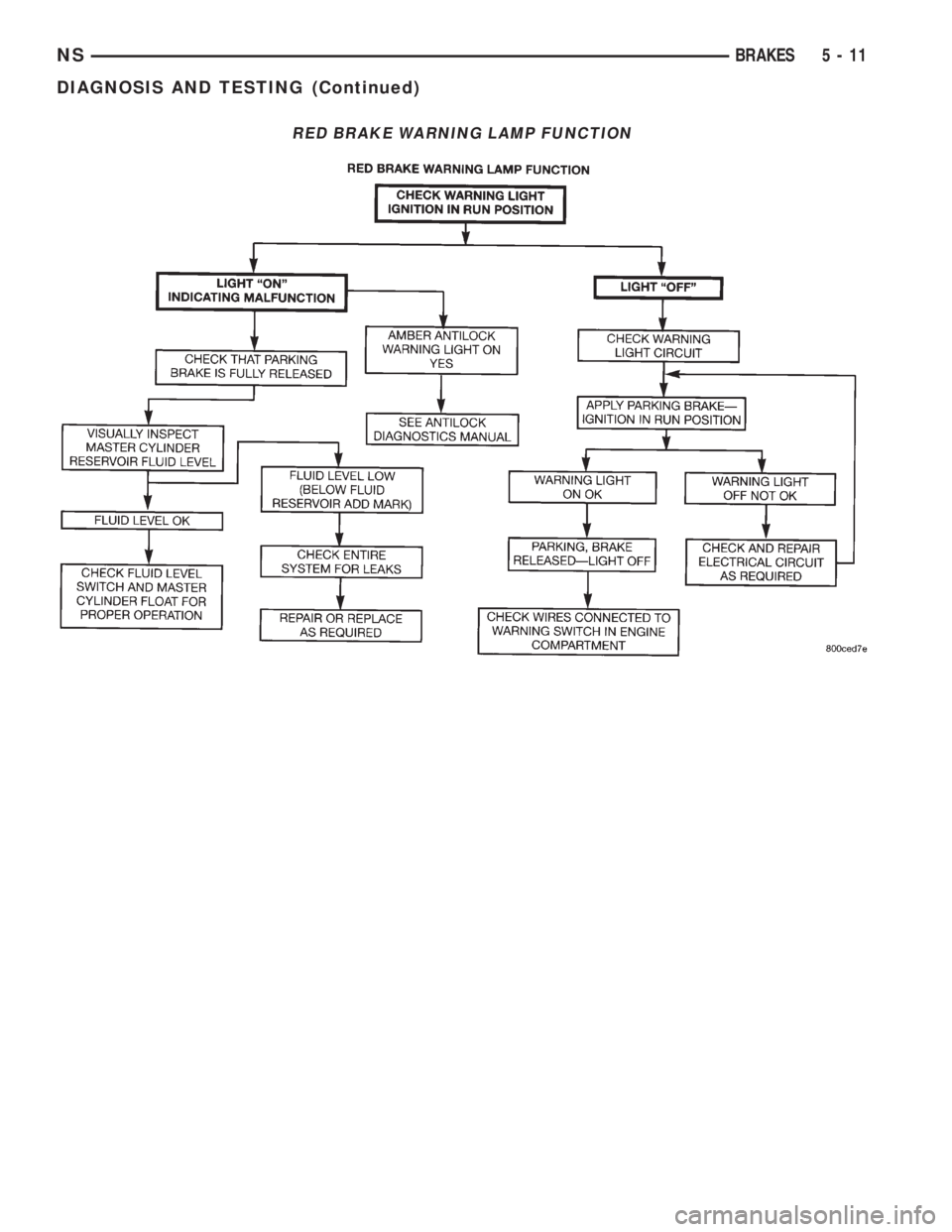
RED BRAKE WARNING LAMP FUNCTION
NSBRAKES 5 - 11
DIAGNOSIS AND TESTING (Continued)
Page 101 of 1938
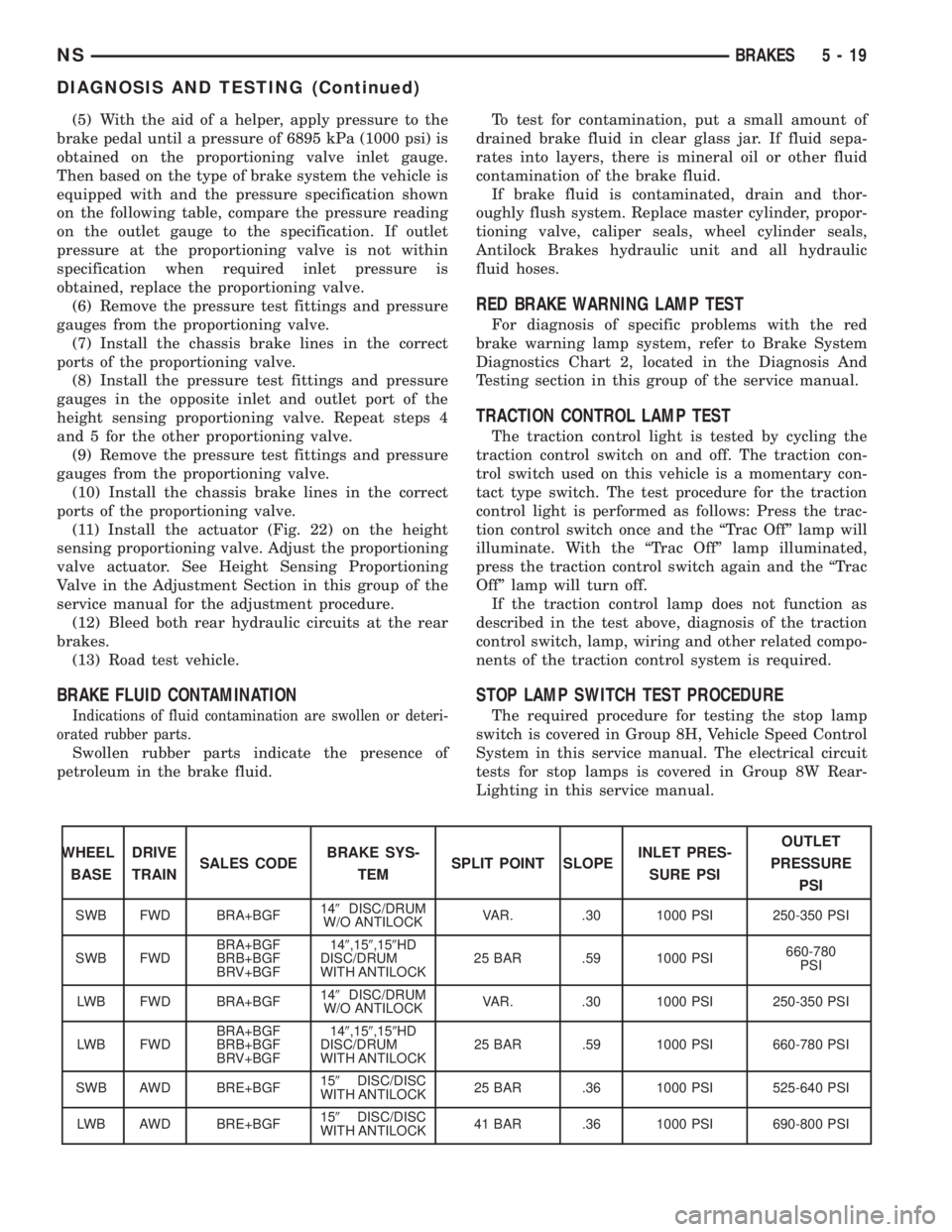
(5) With the aid of a helper, apply pressure to the
brake pedal until a pressure of 6895 kPa (1000 psi) is
obtained on the proportioning valve inlet gauge.
Then based on the type of brake system the vehicle is
equipped with and the pressure specification shown
on the following table, compare the pressure reading
on the outlet gauge to the specification. If outlet
pressure at the proportioning valve is not within
specification when required inlet pressure is
obtained, replace the proportioning valve.
(6) Remove the pressure test fittings and pressure
gauges from the proportioning valve.
(7) Install the chassis brake lines in the correct
ports of the proportioning valve.
(8) Install the pressure test fittings and pressure
gauges in the opposite inlet and outlet port of the
height sensing proportioning valve. Repeat steps 4
and 5 for the other proportioning valve.
(9) Remove the pressure test fittings and pressure
gauges from the proportioning valve.
(10) Install the chassis brake lines in the correct
ports of the proportioning valve.
(11) Install the actuator (Fig. 22) on the height
sensing proportioning valve. Adjust the proportioning
valve actuator. See Height Sensing Proportioning
Valve in the Adjustment Section in this group of the
service manual for the adjustment procedure.
(12) Bleed both rear hydraulic circuits at the rear
brakes.
(13) Road test vehicle.
BRAKE FLUID CONTAMINATION
Indications of fluid contamination are swollen or deteri-
orated rubber parts.
Swollen rubber parts indicate the presence of
petroleum in the brake fluid.To test for contamination, put a small amount of
drained brake fluid in clear glass jar. If fluid sepa-
rates into layers, there is mineral oil or other fluid
contamination of the brake fluid.
If brake fluid is contaminated, drain and thor-
oughly flush system. Replace master cylinder, propor-
tioning valve, caliper seals, wheel cylinder seals,
Antilock Brakes hydraulic unit and all hydraulic
fluid hoses.
RED BRAKE WARNING LAMP TEST
For diagnosis of specific problems with the red
brake warning lamp system, refer to Brake System
Diagnostics Chart 2, located in the Diagnosis And
Testing section in this group of the service manual.
TRACTION CONTROL LAMP TEST
The traction control light is tested by cycling the
traction control switch on and off. The traction con-
trol switch used on this vehicle is a momentary con-
tact type switch. The test procedure for the traction
control light is performed as follows: Press the trac-
tion control switch once and the ªTrac Offº lamp will
illuminate. With the ªTrac Offº lamp illuminated,
press the traction control switch again and the ªTrac
Offº lamp will turn off.
If the traction control lamp does not function as
described in the test above, diagnosis of the traction
control switch, lamp, wiring and other related compo-
nents of the traction control system is required.
STOP LAMP SWITCH TEST PROCEDURE
The required procedure for testing the stop lamp
switch is covered in Group 8H, Vehicle Speed Control
System in this service manual. The electrical circuit
tests for stop lamps is covered in Group 8W Rear-
Lighting in this service manual.
WHEEL
BASEDRIVE
TRAINSALES CODEBRAKE SYS-
TEMSPLIT POINT SLOPEINLET PRES-
SURE PSIOUTLET
PRESSURE
PSI
SWB FWD BRA+BGF149DISC/DRUM
W/O ANTILOCKVAR. .30 1000 PSI 250-350 PSI
SWB FWDBRA+BGF
BRB+BGF
BRV+BGF149,159,159HD
DISC/DRUM
WITH ANTILOCK25 BAR .59 1000 PSI660-780
PSI
LWB FWD BRA+BGF149DISC/DRUM
W/O ANTILOCKVAR. .30 1000 PSI 250-350 PSI
LWB FWDBRA+BGF
BRB+BGF
BRV+BGF149,159,159HD
DISC/DRUM
WITH ANTILOCK25 BAR .59 1000 PSI 660-780 PSI
SWB AWD BRE+BGF159DISC/DISC
WITH ANTILOCK25 BAR .36 1000 PSI 525-640 PSI
LWB AWD BRE+BGF159DISC/DISC
WITH ANTILOCK41 BAR .36 1000 PSI 690-800 PSI
NSBRAKES 5 - 19
DIAGNOSIS AND TESTING (Continued)
Page 109 of 1938
(4) Remove the locking pliers from the front park
brake cable. This will allow the adjuster in the park
brake pedal mechanism to rotate around to its stop.
This will remove the tension from the adjuster and
front park brake cable.
Use the following procedure to reset the auto
adjuster in the park brake pedal mechanism.
(5) Grasp the exposed section of the front park
brake cable and pull rearward on it. While holding
the park brake in this position, install a pair of lock-
ing pliers on the front park brake cable just rearward
of the second body outrigger bracket (Fig. 42).
(6) Install the equalizer on the front park brake
cable.
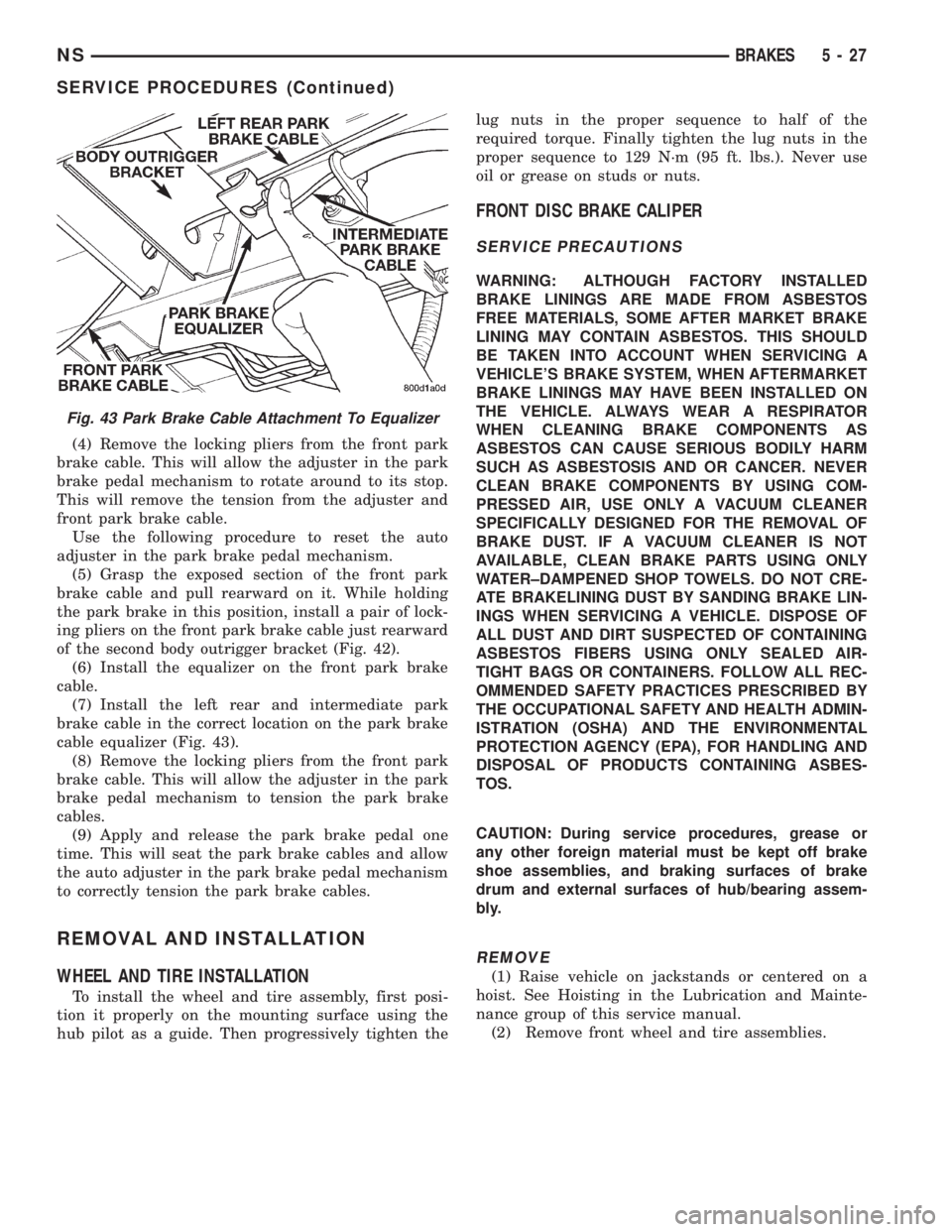
(7) Install the left rear and intermediate park
brake cable in the correct location on the park brake
cable equalizer (Fig. 43).
(8) Remove the locking pliers from the front park
brake cable. This will allow the adjuster in the park
brake pedal mechanism to tension the park brake
cables.
(9) Apply and release the park brake pedal one
time. This will seat the park brake cables and allow
the auto adjuster in the park brake pedal mechanism
to correctly tension the park brake cables.
REMOVAL AND INSTALLATION
WHEEL AND TIRE INSTALLATION
To install the wheel and tire assembly, first posi-
tion it properly on the mounting surface using the
hub pilot as a guide. Then progressively tighten thelug nuts in the proper sequence to half of the
required torque. Finally tighten the lug nuts in the
proper sequence to 129 N´m (95 ft. lbs.). Never use
oil or grease on studs or nuts.
FRONT DISC BRAKE CALIPER
SERVICE PRECAUTIONS
WARNING: ALTHOUGH FACTORY INSTALLED
BRAKE LININGS ARE MADE FROM ASBESTOS
FREE MATERIALS, SOME AFTER MARKET BRAKE
LINING MAY CONTAIN ASBESTOS. THIS SHOULD
BE TAKEN INTO ACCOUNT WHEN SERVICING A
VEHICLE'S BRAKE SYSTEM, WHEN AFTERMARKET
BRAKE LININGS MAY HAVE BEEN INSTALLED ON
THE VEHICLE. ALWAYS WEAR A RESPIRATOR
WHEN CLEANING BRAKE COMPONENTS AS
ASBESTOS CAN CAUSE SERIOUS BODILY HARM
SUCH AS ASBESTOSIS AND OR CANCER. NEVER
CLEAN BRAKE COMPONENTS BY USING COM-
PRESSED AIR, USE ONLY A VACUUM CLEANER
SPECIFICALLY DESIGNED FOR THE REMOVAL OF
BRAKE DUST. IF A VACUUM CLEANER IS NOT
AVAILABLE, CLEAN BRAKE PARTS USING ONLY
WATER±DAMPENED SHOP TOWELS. DO NOT CRE-
ATE BRAKELINING DUST BY SANDING BRAKE LIN-
INGS WHEN SERVICING A VEHICLE. DISPOSE OF
ALL DUST AND DIRT SUSPECTED OF CONTAINING
ASBESTOS FIBERS USING ONLY SEALED AIR-
TIGHT BAGS OR CONTAINERS. FOLLOW ALL REC-
OMMENDED SAFETY PRACTICES PRESCRIBED BY
THE OCCUPATIONAL SAFETY AND HEALTH ADMIN-
ISTRATION (OSHA) AND THE ENVIRONMENTAL
PROTECTION AGENCY (EPA), FOR HANDLING AND
DISPOSAL OF PRODUCTS CONTAINING ASBES-
TOS.
CAUTION: During service procedures, grease or
any other foreign material must be kept off brake
shoe assemblies, and braking surfaces of brake
drum and external surfaces of hub/bearing assem-
bly.
REMOVE
(1) Raise vehicle on jackstands or centered on a
hoist. See Hoisting in the Lubrication and Mainte-
nance group of this service manual.
(2) Remove front wheel and tire assemblies.
Fig. 43 Park Brake Cable Attachment To Equalizer
NSBRAKES 5 - 27
SERVICE PROCEDURES (Continued)
Page 112 of 1938
(9) Road test the vehicle and make several stops to
wear off any foreign material on the brakes and to
seat the brake shoe linings.
FRONT DISC BRAKE PADS
REMOVE
WARNING: ALTHOUGH FACTORY INSTALLED
BRAKE LININGS ARE MADE FROM ASBESTOS
FREE MATERIALS, SOME AFTERMARKET BRAKE
LININGS MAY CONTAIN ASBESTOS. THIS SHOULD
BE TAKEN INTO ACCOUNT WHEN SERVICING A
VEHICLE'S BRAKE SYSTEM, WHEN AFTERMARKET
BRAKE LININGS MAY HAVE BEEN INSTALLED ON
THE VEHICLE. ALWAYS WEAR A RESPIRATOR
WHEN CLEANING BRAKE COMPONENTS AS
ASBESTOS CAN CAUSE SERIOUS BODILY HARM
SUCH AS ASBESTOSIS AND OR CANCER. NEVER
CLEAN BRAKE COMPONENTS BY USING COM-
PRESSED AIR, USE ONLY A VACUUM CLEANER
SPECIFICALLY DESIGNED FOR THE REMOVAL OF
BRAKE DUST. IF A VACUUM CLEANER IS NOT
AVAILABLE, CLEAN BRAKE PARTS USING ONLY
WATER±DAMPENED SHOP TOWELS. DO NOT CRE-
ATE BRAKELINING DUST BY SANDING BRAKE LIN-
INGS WHEN SERVICING A VEHICLE. DISPOSE OF
ALL DUST AND DIRT SUSPECTED OF CONTAINING
ASBESTOS FIBERS USING ONLY SEALED AIR-
TIGHT BAGS OR CONTAINERS. FOLLOW ALL REC-
OMMENDED SAFETY PRACTICES PRESCRIBED BY
THE OCCUPATIONAL SAFETY AND HEALTH ADMIN-
ISTRATION (OSHA) AND THE ENVIRONMENTAL
PROTECTION AGENCY (EPA), FOR HANDLING AND
DISPOSAL OF PRODUCTS CONTAINING ASBES-
TOS.
CAUTION: During service procedures, grease or
any other foreign material must be kept off brake
shoe assemblies, and braking surfaces of brake
drum and external surfaces of hub/bearing assem-
bly.
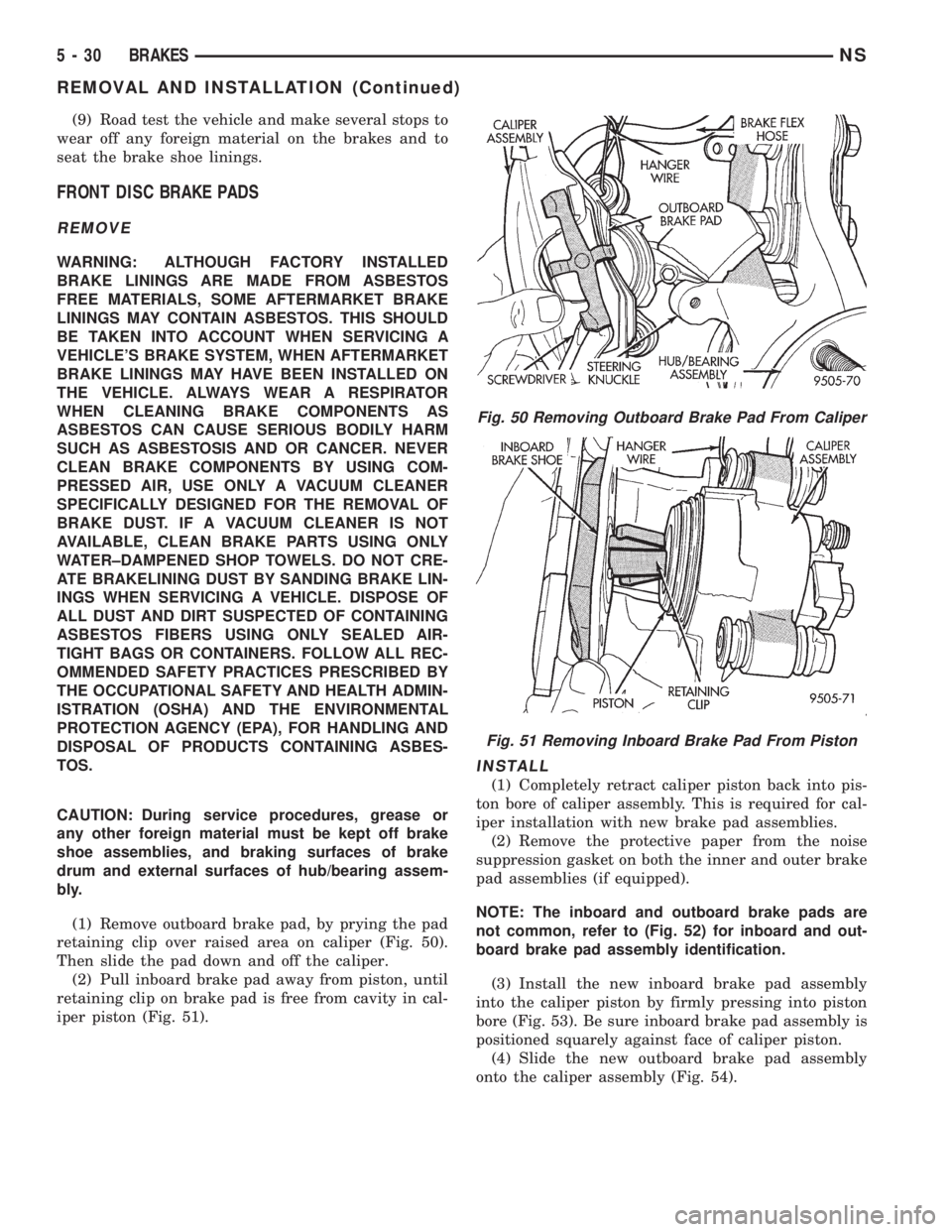
(1) Remove outboard brake pad, by prying the pad
retaining clip over raised area on caliper (Fig. 50).
Then slide the pad down and off the caliper.
(2) Pull inboard brake pad away from piston, until
retaining clip on brake pad is free from cavity in cal-
iper piston (Fig. 51).
INSTALL
(1) Completely retract caliper piston back into pis-
ton bore of caliper assembly. This is required for cal-
iper installation with new brake pad assemblies.
(2) Remove the protective paper from the noise
suppression gasket on both the inner and outer brake
pad assemblies (if equipped).
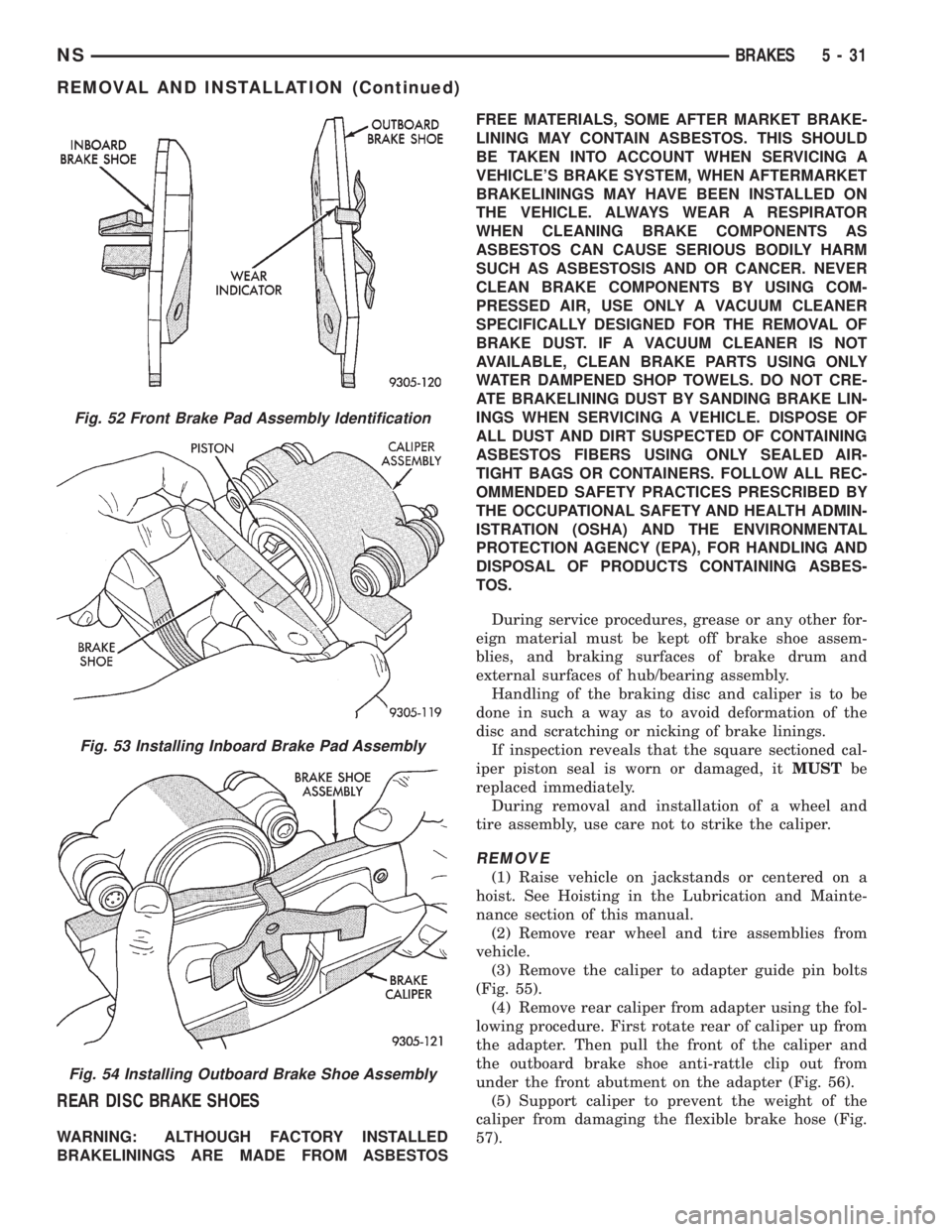
NOTE: The inboard and outboard brake pads are
not common, refer to (Fig. 52) for inboard and out-
board brake pad assembly identification.
(3) Install the new inboard brake pad assembly
into the caliper piston by firmly pressing into piston
bore (Fig. 53). Be sure inboard brake pad assembly is
positioned squarely against face of caliper piston.
(4) Slide the new outboard brake pad assembly
onto the caliper assembly (Fig. 54).
Fig. 50 Removing Outboard Brake Pad From Caliper
Fig. 51 Removing Inboard Brake Pad From Piston
5 - 30 BRAKESNS
REMOVAL AND INSTALLATION (Continued)
Page 113 of 1938
REAR DISC BRAKE SHOES
WARNING: ALTHOUGH FACTORY INSTALLED
BRAKELININGS ARE MADE FROM ASBESTOSFREE MATERIALS, SOME AFTER MARKET BRAKE-
LINING MAY CONTAIN ASBESTOS. THIS SHOULD
BE TAKEN INTO ACCOUNT WHEN SERVICING A
VEHICLE'S BRAKE SYSTEM, WHEN AFTERMARKET
BRAKELININGS MAY HAVE BEEN INSTALLED ON
THE VEHICLE. ALWAYS WEAR A RESPIRATOR
WHEN CLEANING BRAKE COMPONENTS AS
ASBESTOS CAN CAUSE SERIOUS BODILY HARM
SUCH AS ASBESTOSIS AND OR CANCER. NEVER
CLEAN BRAKE COMPONENTS BY USING COM-
PRESSED AIR, USE ONLY A VACUUM CLEANER
SPECIFICALLY DESIGNED FOR THE REMOVAL OF
BRAKE DUST. IF A VACUUM CLEANER IS NOT
AVAILABLE, CLEAN BRAKE PARTS USING ONLY
WATER DAMPENED SHOP TOWELS. DO NOT CRE-
ATE BRAKELINING DUST BY SANDING BRAKE LIN-
INGS WHEN SERVICING A VEHICLE. DISPOSE OF
ALL DUST AND DIRT SUSPECTED OF CONTAINING
ASBESTOS FIBERS USING ONLY SEALED AIR-
TIGHT BAGS OR CONTAINERS. FOLLOW ALL REC-
OMMENDED SAFETY PRACTICES PRESCRIBED BY
THE OCCUPATIONAL SAFETY AND HEALTH ADMIN-
ISTRATION (OSHA) AND THE ENVIRONMENTAL
PROTECTION AGENCY (EPA), FOR HANDLING AND
DISPOSAL OF PRODUCTS CONTAINING ASBES-
TOS.
During service procedures, grease or any other for-
eign material must be kept off brake shoe assem-
blies, and braking surfaces of brake drum and
external surfaces of hub/bearing assembly.
Handling of the braking disc and caliper is to be
done in such a way as to avoid deformation of the
disc and scratching or nicking of brake linings.
If inspection reveals that the square sectioned cal-
iper piston seal is worn or damaged, itMUSTbe
replaced immediately.
During removal and installation of a wheel and
tire assembly, use care not to strike the caliper.
REMOVE
(1) Raise vehicle on jackstands or centered on a
hoist. See Hoisting in the Lubrication and Mainte-
nance section of this manual.
(2) Remove rear wheel and tire assemblies from
vehicle.
(3) Remove the caliper to adapter guide pin bolts
(Fig. 55).
(4) Remove rear caliper from adapter using the fol-
lowing procedure. First rotate rear of caliper up from
the adapter. Then pull the front of the caliper and
the outboard brake shoe anti-rattle clip out from
under the front abutment on the adapter (Fig. 56).
(5) Support caliper to prevent the weight of the
caliper from damaging the flexible brake hose (Fig.
57).
Fig. 52 Front Brake Pad Assembly Identification
Fig. 53 Installing Inboard Brake Pad Assembly
Fig. 54 Installing Outboard Brake Shoe Assembly
NSBRAKES 5 - 31
REMOVAL AND INSTALLATION (Continued)