warning CHRYSLER VOYAGER 1996 Service Manual
[x] Cancel search | Manufacturer: CHRYSLER, Model Year: 1996, Model line: VOYAGER, Model: CHRYSLER VOYAGER 1996Pages: 1938, PDF Size: 55.84 MB
Page 3 of 1938
GROUP TAB LOCATOR
Introduction
0Lubrication and Maintenance
2Suspension
5Brakes
6Clutch
7Cooling System
8ABattery
8BStarting System
8EInstrument Panel and Systems
8HVehicle Speed Control System
8KWiper and Washer Systems
8LLamps
8QVehicle Theft/Security Systems
8UChime Warning/Reminder System
8WWiring Diagrams
9Engine
13Frame and Bumpers
14Fuel SystemÐ2.5L Diesel Engine/2.0L Gas Engine
19Steering
21AÐ598 Manual Transaxle
23Body
24Heating and Air Conditioning
25Emission Control System
Page 10 of 1938
METRIC SYSTEM
WARNING: USE OF AN INCORRECT FASTENER
MAY RESULT IN COMPONENT DAMAGE OR PER-
SONAL INJURY.
Figure art, specifications and torque references in
this Service Manual are identified in metric and SAE
format.
During any maintenance or repair procedures, it is
important to salvage metric fasteners (nuts, bolts,
etc.) for reassembly. If the fastener is not salvage-
able, a fastener of equivalent specification should be
used.
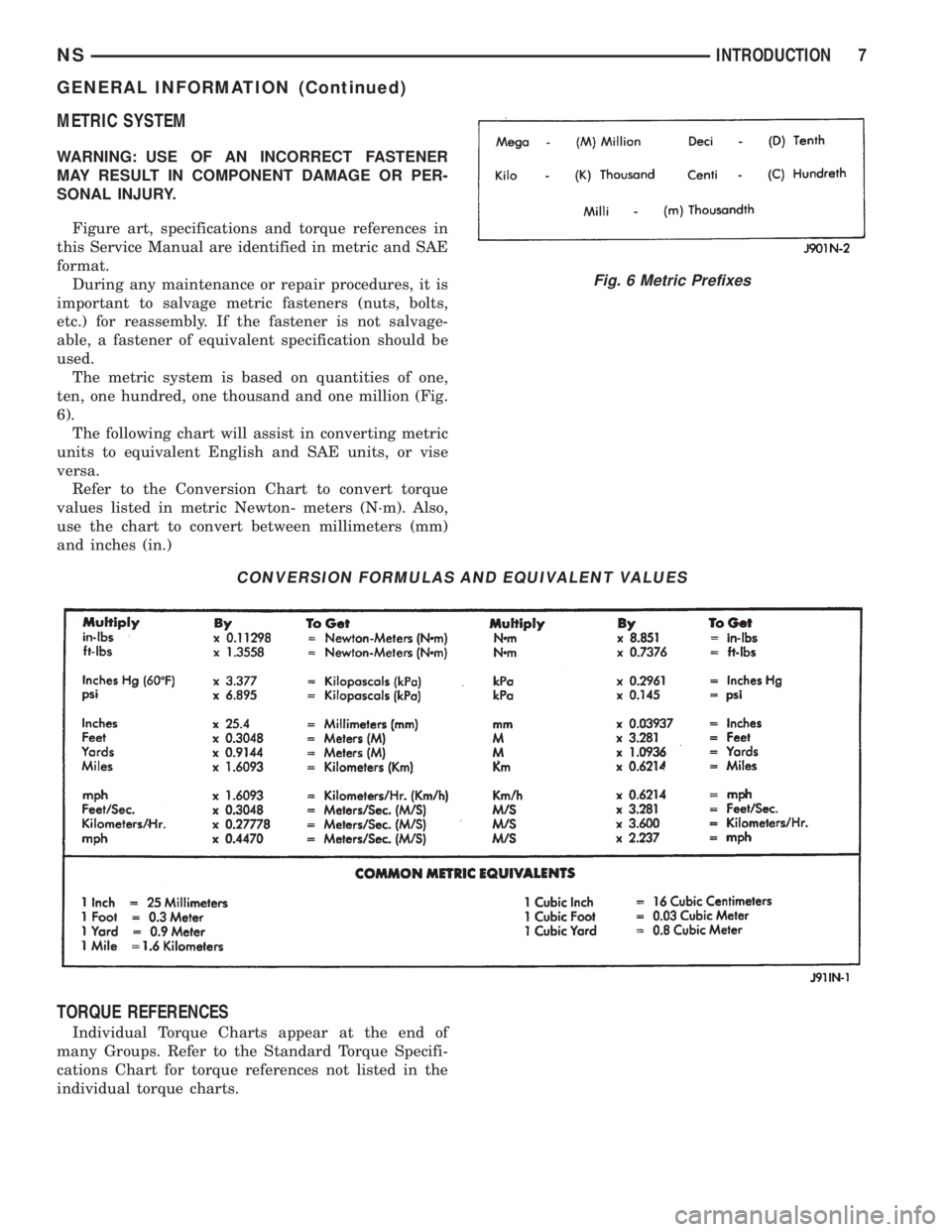
The metric system is based on quantities of one,
ten, one hundred, one thousand and one million (Fig.
6).
The following chart will assist in converting metric
units to equivalent English and SAE units, or vise
versa.
Refer to the Conversion Chart to convert torque
values listed in metric Newton- meters (N´m). Also,
use the chart to convert between millimeters (mm)
and inches (in.)
TORQUE REFERENCES
Individual Torque Charts appear at the end of
many Groups. Refer to the Standard Torque Specifi-
cations Chart for torque references not listed in the
individual torque charts.
Fig. 6 Metric Prefixes
CONVERSION FORMULAS AND EQUIVALENT VALUES
NSINTRODUCTION 7
GENERAL INFORMATION (Continued)
Page 23 of 1938
JUMP STARTING, HOISTING AND TOWING
INDEX
page page
SERVICE PROCEDURES
HOISTING RECOMMENDATIONS............ 9JUMP STARTING PROCEDURE.............. 7
TOWING RECOMMENDATIONS.............. 8
SERVICE PROCEDURES
JUMP STARTING PROCEDURE
WARNING: REVIEW ALL SAFETY PRECAUTIONS
AND WARNINGS IN GROUP 8A, BATTERY/START-
ING/CHARGING SYSTEMS DIAGNOSTICS. DO NOT
JUMP START A FROZEN BATTERY, PERSONAL
INJURY CAN RESULT. DO NOT JUMP START WHEN
MAINTENANCE FREE BATTERY INDICATOR DOT IS
YELLOW OR BRIGHT COLOR. DO NOT JUMP
START A VEHICLE WHEN THE BATTERY FLUID IS
BELOW THE TOP OF LEAD PLATES. DO NOT
ALLOW JUMPER CABLE CLAMPS TO TOUCH
EACH OTHER WHEN CONNECTED TO A BOOSTER
SOURCE. DO NOT USE OPEN FLAME NEAR BAT-
TERY. REMOVE METALLIC JEWELRY WORN ON
HANDS OR WRISTS TO AVOID INJURY BY ACCI-
DENTAL ARCING OF BATTERY CURRENT. WHEN
USING A HIGH OUTPUT BOOSTING DEVICE, DO
NOT ALLOW BATTERY VOLTAGE TO EXCEED 16
VOLTS. REFER TO INSTRUCTIONS PROVIDED
WITH DEVICE BEING USED.
CAUTION: When using another vehicle as a
booster, do not allow vehicles to touch. Electrical
systems can be damaged on either vehicle.
TO JUMP START A DISABLED VEHICLE:
(1) Raise hood on disabled vehicle and visually
inspect engine compartment for:
²Battery cable clamp condition, clean if necessary.
²Frozen battery.
²Yellow or bright color test indicator, if equipped.
²Low battery fluid level.
²Generator drive belt condition and tension.
²Fuel fumes or leakage, correct if necessary.
CAUTION: If the cause of starting problem on dis-
abled vehicle is severe, damage to booster vehicle
charging system can result.
(2) When using another vehicle as a booster
source, park the booster vehicle within cable reach.
Turn off all accessories, set the parking brake, placethe automatic transmission in PARK or the manual
transmission in NEUTRAL and turn the ignition
OFF.
(3) On disabled vehicle, place gear selector in park
or neutral and set park brake. Turn off all accesso-
ries.
(4) Connect jumper cables to booster battery. RED
clamp to positive terminal (+). BLACK clamp to neg-
ative terminal (-). DO NOT allow clamps at opposite
end of cables to touch, electrical arc will result.
Review all warnings in this procedure.
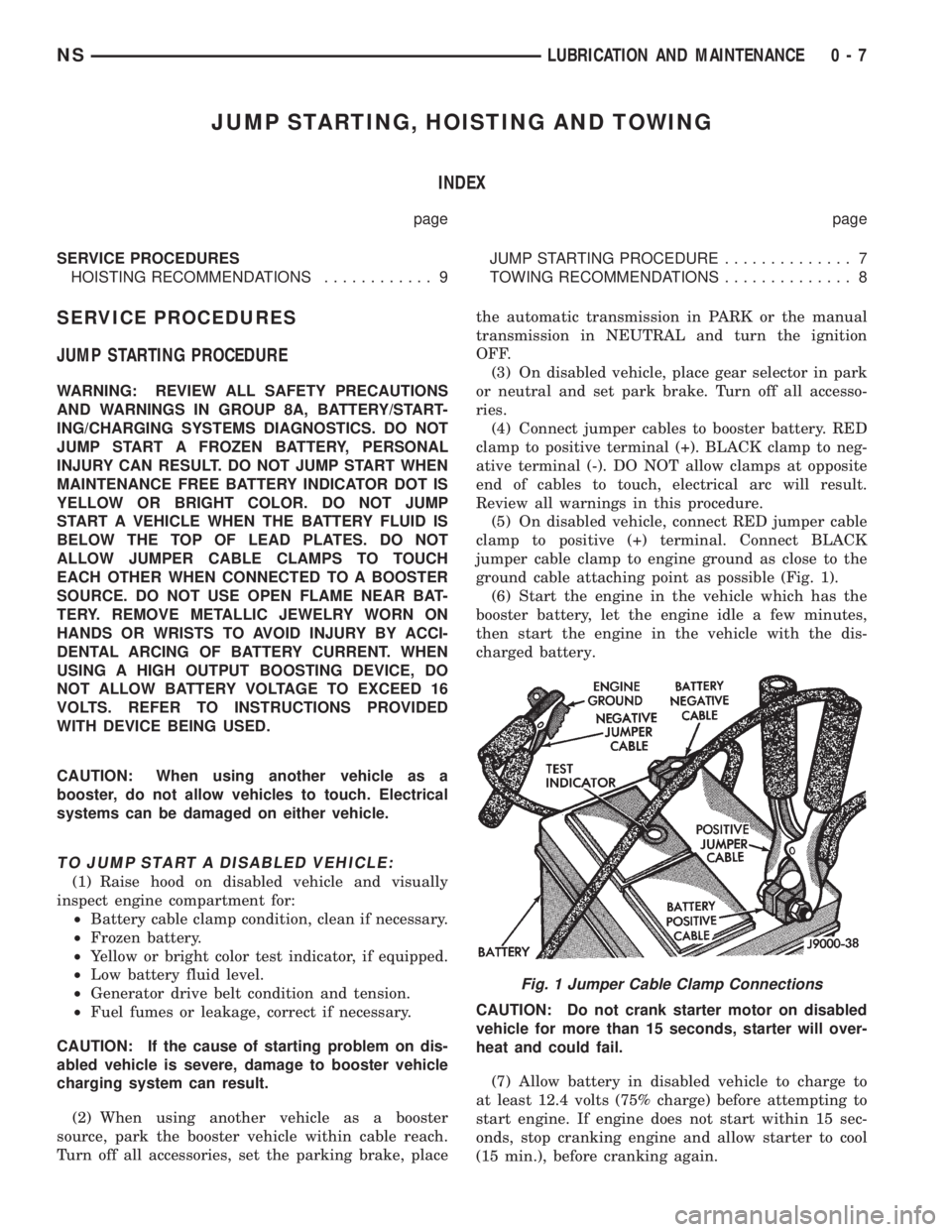
(5) On disabled vehicle, connect RED jumper cable
clamp to positive (+) terminal. Connect BLACK
jumper cable clamp to engine ground as close to the
ground cable attaching point as possible (Fig. 1).
(6) Start the engine in the vehicle which has the
booster battery, let the engine idle a few minutes,
then start the engine in the vehicle with the dis-
charged battery.
CAUTION: Do not crank starter motor on disabled
vehicle for more than 15 seconds, starter will over-
heat and could fail.
(7) Allow battery in disabled vehicle to charge to
at least 12.4 volts (75% charge) before attempting to
start engine. If engine does not start within 15 sec-
onds, stop cranking engine and allow starter to cool
(15 min.), before cranking again.
Fig. 1 Jumper Cable Clamp Connections
NSLUBRICATION AND MAINTENANCE 0 - 7
Page 24 of 1938
DISCONNECT CABLE CLAMPS AS FOLLOWS:
²Disconnect BLACK cable clamp from engine
ground on disabled vehicle.
²When using a Booster vehicle, disconnect
BLACK cable clamp from battery negative terminal.
Disconnect RED cable clamp from battery positive
terminal.
²Disconnect RED cable clamp from battery posi-
tive terminal on disabled vehicle.
TOWING RECOMMENDATIONS
WARNINGS AND CAUTIONS
WARNING: DO NOT ALLOW TOWING ATTACH-
MENT DEVICES TO CONTACT THE FUEL TANK OR
LINES, FUEL LEAK CAN RESULT.
DO NOT LIFT OR TOW VEHICLE BY FRONT OR
REAR BUMPER, OR BUMPER ENERGY ABSORBER
UNITS.
DO NOT GO UNDER A LIFTED VEHICLE IF NOT
SUPPORTED PROPERLY ON SAFETY STANDS.
DO NOT ALLOW PASSENGERS TO RIDE IN A
TOWED VEHICLE.
USE A SAFETY CHAIN THAT IS INDEPENDENT
FROM THE TOWING ATTACHMENT DEVICE.
CAUTION: Do not damage brake lines, exhaust sys-
tem, shock absorbers, sway bars, or any other
under vehicle components when attaching towing
device to vehicle.
Do not attach towing device to front or rear sus-
pension components.
Do not secure vehicle to towing device by the use
of front or rear suspension or steering components.
Remove or secure loose or protruding objects
from a damaged vehicle before towing.
Refer to state and local rules and regulations
before towing a vehicle.
Do not allow weight of towed vehicle to bear on
lower fascia, air dams, or spoilers.
RECOMMENDED TOWING EQUIPMENT
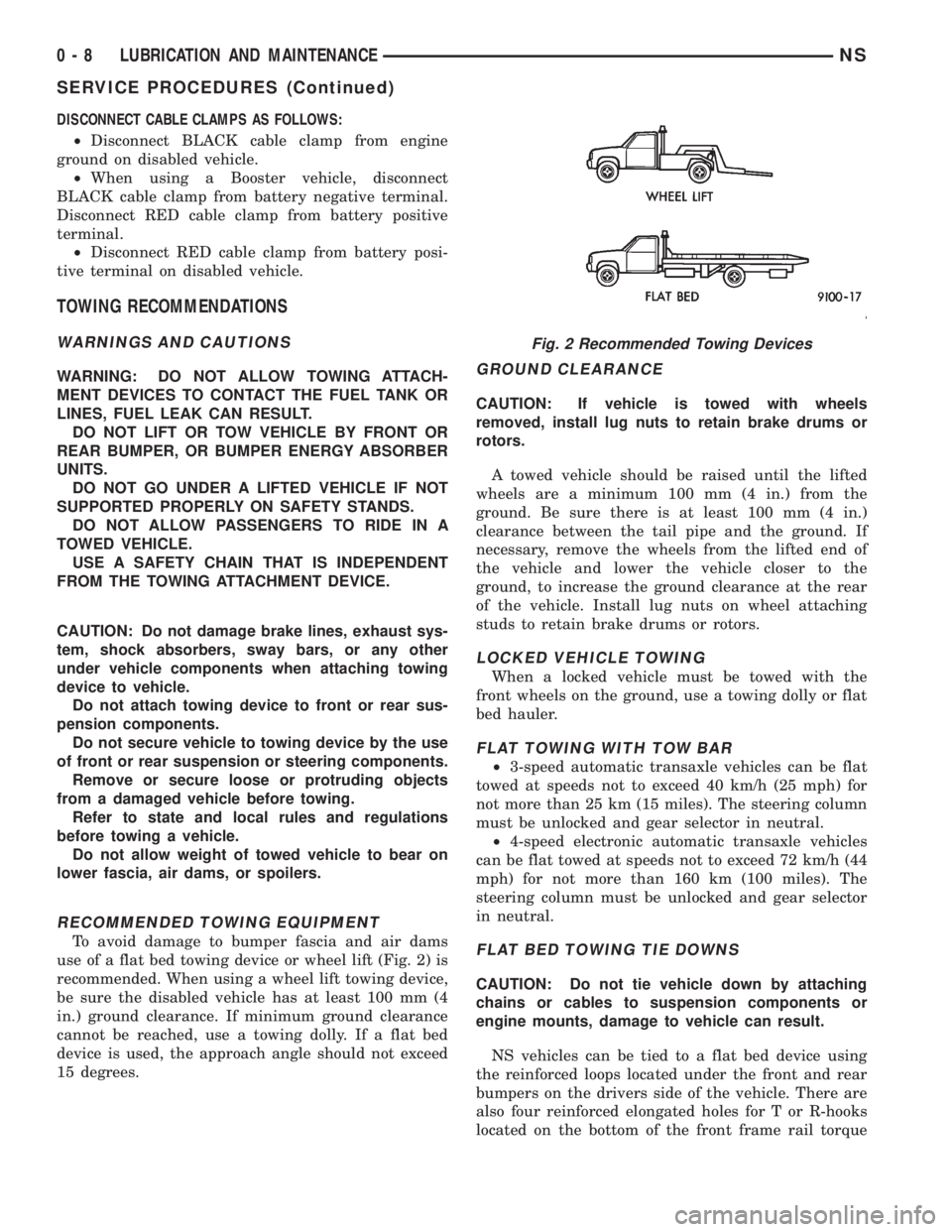
To avoid damage to bumper fascia and air dams
use of a flat bed towing device or wheel lift (Fig. 2) is
recommended. When using a wheel lift towing device,
be sure the disabled vehicle has at least 100 mm (4
in.) ground clearance. If minimum ground clearance
cannot be reached, use a towing dolly. If a flat bed
device is used, the approach angle should not exceed
15 degrees.
GROUND CLEARANCE
CAUTION: If vehicle is towed with wheels
removed, install lug nuts to retain brake drums or
rotors.
A towed vehicle should be raised until the lifted
wheels are a minimum 100 mm (4 in.) from the
ground. Be sure there is at least 100 mm (4 in.)
clearance between the tail pipe and the ground. If
necessary, remove the wheels from the lifted end of
the vehicle and lower the vehicle closer to the
ground, to increase the ground clearance at the rear
of the vehicle. Install lug nuts on wheel attaching
studs to retain brake drums or rotors.
LOCKED VEHICLE TOWING
When a locked vehicle must be towed with the
front wheels on the ground, use a towing dolly or flat
bed hauler.
FLAT TOWING WITH TOW BAR
²3-speed automatic transaxle vehicles can be flat
towed at speeds not to exceed 40 km/h (25 mph) for
not more than 25 km (15 miles). The steering column
must be unlocked and gear selector in neutral.
²4-speed electronic automatic transaxle vehicles
can be flat towed at speeds not to exceed 72 km/h (44
mph) for not more than 160 km (100 miles). The
steering column must be unlocked and gear selector
in neutral.
FLAT BED TOWING TIE DOWNS
CAUTION: Do not tie vehicle down by attaching
chains or cables to suspension components or
engine mounts, damage to vehicle can result.
NS vehicles can be tied to a flat bed device using
the reinforced loops located under the front and rear
bumpers on the drivers side of the vehicle. There are
also four reinforced elongated holes for T or R-hooks
located on the bottom of the front frame rail torque
Fig. 2 Recommended Towing Devices
0 - 8 LUBRICATION AND MAINTENANCENS
SERVICE PROCEDURES (Continued)
Page 25 of 1938
boxes behind the front wheels and forward of the
rear wheels inboard of the rocker panel weld seam.
TOWINGÐFRONT WHEEL LIFT
Chrysler Corporation recommends that a vehicle be
towed with the front end lifted, whenever possible. A
90 cm (36 in.) length of 4x4 wood beam can be placed
between the wheel lift device and the bottom of the
fascia to prevent damage to vehicle during the lifting
operation. The beam can removed after lifting the
front of the vehicle.
TOWINGÐREAR WHEEL LIFT
If a vehicle cannot be towed with the front wheels
lifted, the rear wheels can be lifted provided the fol-
lowing guide lines are observed.
CAUTION: Do not use steering column lock to
secure steering wheel during towing operation.
²On AWD vehicles, all four wheels must be free to
rotate. Use towing dollies at unlifted end of vehicle.
²Unlock steering column and secure steering
wheel in straight ahead position with a clamp device
designed for towing.
²3-speed automatic transaxle vehicles can be flat
towed at speeds not to exceed 40 km/h (25 mph) for
not more than 25 km (15 miles). The steering column
must be unlocked and gear selector in neutral.
²4-speed electronic automatic transaxle vehicles
can be flat towed at speeds not to exceed 72 km/h (44
mph) for not more than 160 km (100 miles). The
steering column must be unlocked and gear selector
in neutral.
HOISTING RECOMMENDATIONS
Refer to Owner's Manual provided with vehicle for
proper emergency jacking procedures.
WARNING: THE HOISTING AND JACK LIFTING
POINTS PROVIDED ARE FOR A COMPLETE VEHI-
CLE. WHEN THE ENGINE OR REAR SUSPENSION
IS REMOVED FROM A VEHICLE, THE CENTER OF
GRAVITY IS ALTERED MAKING SOME HOISTING
CONDITIONS UNSTABLE. PROPERLY SUPPORT ORSECURE VEHICLE TO HOISTING DEVICE WHEN
THESE CONDITIONS EXIST.
CAUTION: Do not position hoisting device on sus-
pension components or front crossmember, dam-
age to vehicle can result.
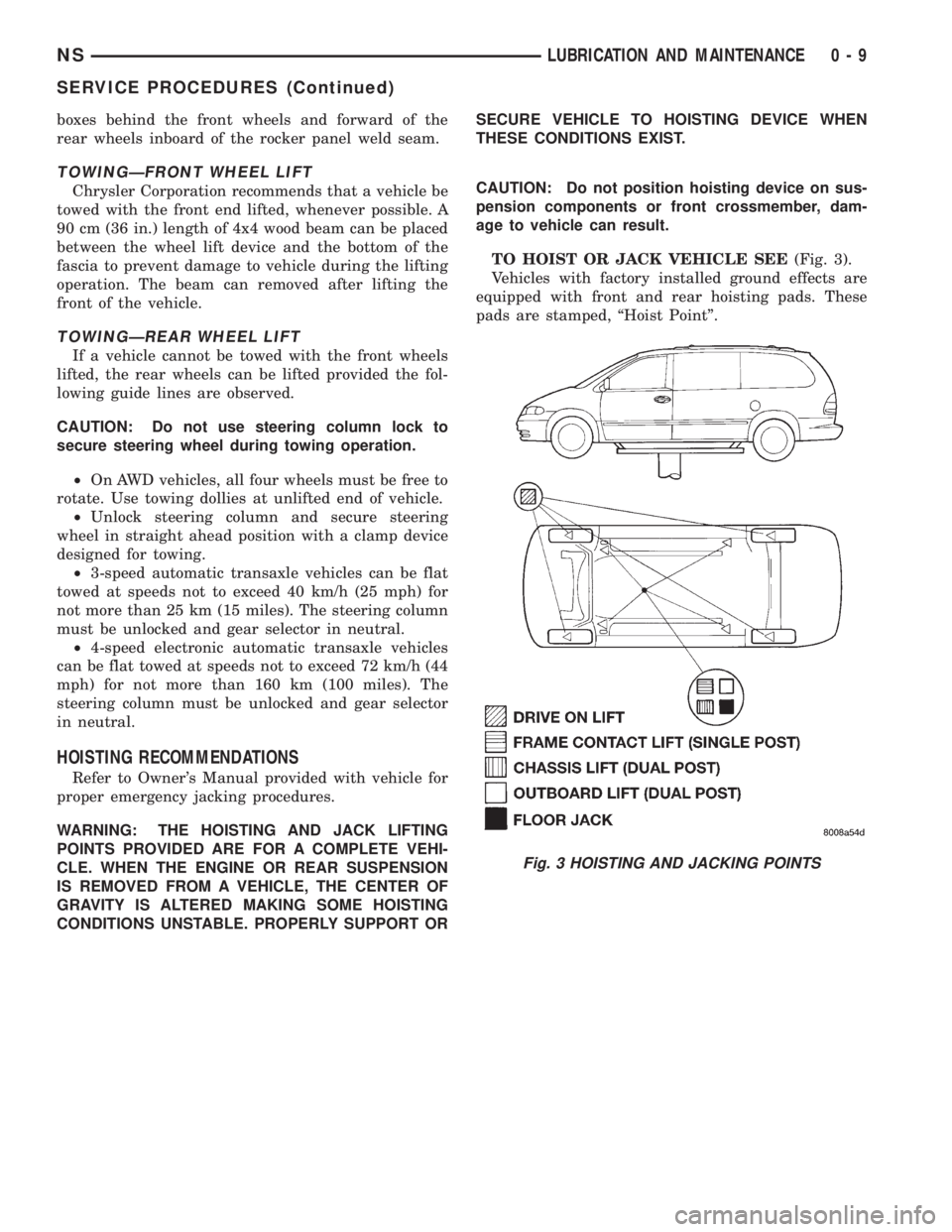
TO HOIST OR JACK VEHICLE SEE(Fig. 3).
Vehicles with factory installed ground effects are
equipped with front and rear hoisting pads. These
pads are stamped, ªHoist Pointº.
Fig. 3 HOISTING AND JACKING POINTS
NSLUBRICATION AND MAINTENANCE 0 - 9
SERVICE PROCEDURES (Continued)
Page 31 of 1938
JUMP STARTING, HOISTING AND TOWING
INDEX
page
SERVICE PROCEDURES
TOWING RECOMMENDATIONS............. 5
SERVICE PROCEDURES
TOWING RECOMMENDATIONS
WARNINGS AND CAUTIONS
WARNING: DO NOT ALLOW TOWING ATTACH-
MENT DEVICES TO CONTACT THE FUEL TANK OR
LINES, FUEL LEAK CAN RESULT.
DO NOT LIFT OR TOW VEHICLE BY FRONT OR
REAR BUMPER, OR BUMPER ENERGY ABSORBER
UNITS.
DO NOT GO UNDER A LIFTED VEHICLE IF NOT
SUPPORTED PROPERLY ON SAFETY STANDS.
DO NOT ALLOW PASSENGERS TO RIDE IN A
TOWED VEHICLE.
USE A SAFETY CHAIN THAT IS INDEPENDENT
FROM THE TOWING ATTACHMENT DEVICE.
CAUTION: Do not damage brake lines, exhaust sys-
tem, shock absorbers, sway bars, or any other
under vehicle components when attaching towing
device to vehicle.
Do not attach towing device to front or rear sus-
pension components.
Do not secure vehicle to towing device by the use
of front or rear suspension or steering components.
Remove or secure loose or protruding objects
from a damaged vehicle before towing.
Refer to state and local rules and regulations
before towing a vehicle.
Do not allow weight of towed vehicle to bear on
lower fascia, air dams, or spoilers.
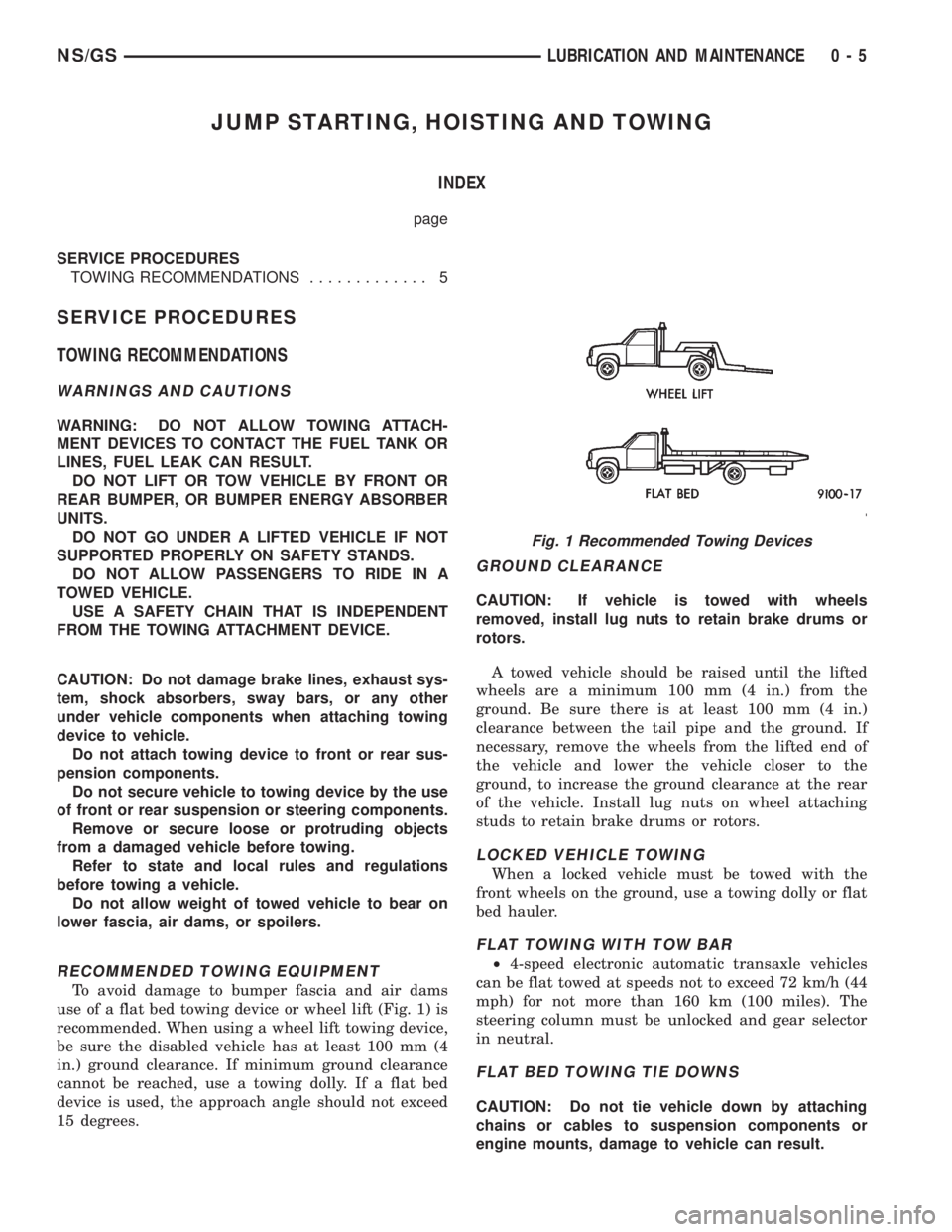
RECOMMENDED TOWING EQUIPMENT
To avoid damage to bumper fascia and air dams
use of a flat bed towing device or wheel lift (Fig. 1) is
recommended. When using a wheel lift towing device,
be sure the disabled vehicle has at least 100 mm (4
in.) ground clearance. If minimum ground clearance
cannot be reached, use a towing dolly. If a flat bed
device is used, the approach angle should not exceed
15 degrees.
GROUND CLEARANCE
CAUTION: If vehicle is towed with wheels
removed, install lug nuts to retain brake drums or
rotors.
A towed vehicle should be raised until the lifted
wheels are a minimum 100 mm (4 in.) from the
ground. Be sure there is at least 100 mm (4 in.)
clearance between the tail pipe and the ground. If
necessary, remove the wheels from the lifted end of
the vehicle and lower the vehicle closer to the
ground, to increase the ground clearance at the rear
of the vehicle. Install lug nuts on wheel attaching
studs to retain brake drums or rotors.
LOCKED VEHICLE TOWING
When a locked vehicle must be towed with the
front wheels on the ground, use a towing dolly or flat
bed hauler.
FLAT TOWING WITH TOW BAR
²4-speed electronic automatic transaxle vehicles
can be flat towed at speeds not to exceed 72 km/h (44
mph) for not more than 160 km (100 miles). The
steering column must be unlocked and gear selector
in neutral.
FLAT BED TOWING TIE DOWNS
CAUTION: Do not tie vehicle down by attaching
chains or cables to suspension components or
engine mounts, damage to vehicle can result.
Fig. 1 Recommended Towing Devices
NS/GSLUBRICATION AND MAINTENANCE 0 - 5
Page 32 of 1938
NS vehicles can be tied to a flat bed device using
the reinforced loops located under the front and rear
bumpers on the drivers side of the vehicle. There are
also four reinforced elongated holes for T or R-hooks
located on the bottom of the front frame rail torque
boxes behind the front wheels and forward of the
rear wheels inboard of the rocker panel weld seam.
TOWINGÐFRONT WHEEL LIFT
Chrysler International recommends that a vehicle
be towed with the front end lifted, whenever possible.
A 90 cm (36 in.) length of 4x4 wood beam can be
placed between the wheel lift device and the bottom
of the fascia to prevent damage to vehicle during the
lifting operation. The beam can removed after lifting
the front of the vehicle.
TOWINGÐREAR WHEEL LIFT
If a vehicle cannot be towed with the front wheels
lifted, the rear wheels can be lifted provided the fol-
lowing guide lines are observed.
CAUTION: Do not use steering column lock to
secure steering wheel during towing operation.
²On AWD vehicles, all four wheels must be free to
rotate. Use towing dollies at unlifted end of vehicle.
²Unlock steering column and secure steering
wheel in straight ahead position with a clamp device
designed for towing.
²4-speed electronic automatic transaxle vehicles
can be flat towed at speeds not to exceed 72 km/h (44
mph) for not more than 160 km (100 miles). The
steering column must be unlocked and gear selector
in neutral.
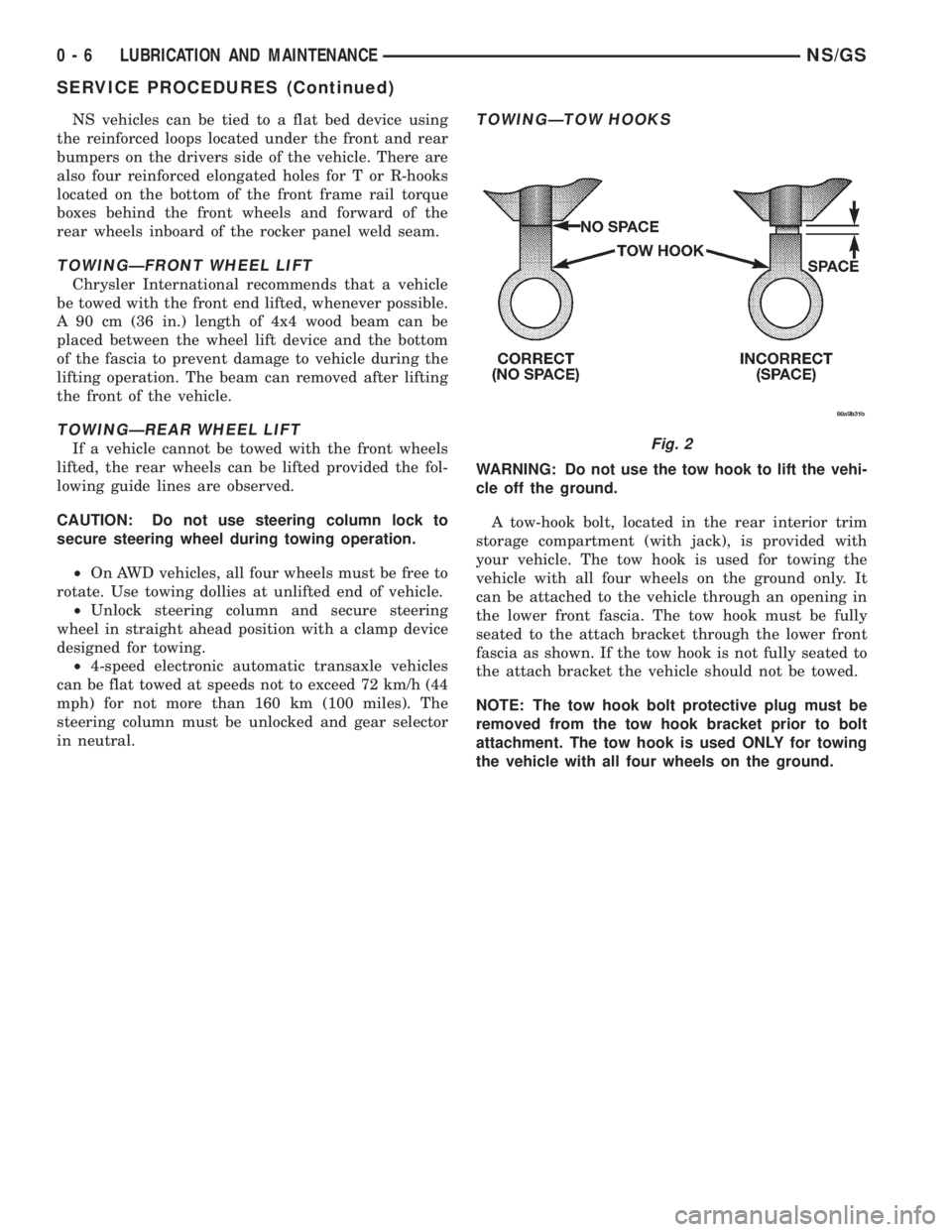
TOWINGÐTOW HOOKS
WARNING: Do not use the tow hook to lift the vehi-
cle off the ground.
A tow-hook bolt, located in the rear interior trim
storage compartment (with jack), is provided with
your vehicle. The tow hook is used for towing the
vehicle with all four wheels on the ground only. It
can be attached to the vehicle through an opening in
the lower front fascia. The tow hook must be fully
seated to the attach bracket through the lower front
fascia as shown. If the tow hook is not fully seated to
the attach bracket the vehicle should not be towed.
NOTE: The tow hook bolt protective plug must be
removed from the tow hook bracket prior to bolt
attachment. The tow hook is used ONLY for towing
the vehicle with all four wheels on the ground.
Fig. 2
0 - 6 LUBRICATION AND MAINTENANCENS/GS
SERVICE PROCEDURES (Continued)
Page 41 of 1938

FRONT SUSPENSION
INDEX
page page
DESCRIPTION AND OPERATION
BALL JOINT............................ 11
COIL SPRING........................... 11
FRONT SUSPENSION DESCRIPTION......... 9
HUB AND BEARING ASSEMBLY............ 10
LOWER CONTROL ARM.................. 10
Mc PHERSON STRUT ASSEMBLY........... 10
STABILIZER BAR ATTACHING LINK.......... 10
STABILIZER BAR........................ 10
STEERING KNUCKLE.................... 10
SUSPENSION CRADLE (CROSSMEMBER)..... 9
WHEEL MOUNTING STUDS................ 11
DIAGNOSIS AND TESTING
BALL JOINT (LOWER).................... 12
HUB AND BEARING ASSEMBLY............ 12
LOWER CONTROL ARM.................. 12
Mc PHERSON STRUT.................... 11
STABILIZER BAR........................ 12
STEERING KNUCKLE.................... 12SERVICE PROCEDURES
SUSPENSION CRADLE THREAD REPAIR
PROCEDURE......................... 12
REMOVAL AND INSTALLATION
BALL JOINT............................ 22
FRONT WHEEL MOUNTING STUDS......... 28
HUB AND BEARING ASSEMBLY............ 25
LOWER CONTROL ARM.................. 19
Mc PHERSON STRUT.................... 13
REAR WHEEL MOUNTING STUDS.......... 29
STABILIZER BAR........................ 23
STEERING KNUCKLE.................... 14
DISASSEMBLY AND ASSEMBLY
BALL JOINT SEAL BOOT.................. 33
LOWER CONTROL ARM FRONT BUSHING.... 34
LOWER CONTROL ARM REAR BUSHING..... 35
Mc PHERSON STRUT.................... 30
STABILIZER BAR BUSHING................ 35
SPECIFICATIONS
FRONT SUSPENSION FASTENER TORQUES . . 36
SPECIAL TOOLS
FRONT SUSPENSION.................... 37
DESCRIPTION AND OPERATION
FRONT SUSPENSION DESCRIPTION
An independent Mc Pherson Strut type front sus-
pension is used on these vehicles. Vertical shock
absorbing Mc Pherson Struts attach to the top of the
steering knuckle and to the front strut tower. This
interconnection between the steering knuckle and the
body of the vehicle, provides for the correct steering
knuckle position. This steering knuckle position pro-
vides for the correct front Caster and Camber set-
tings for the vehicle, at the time the vehicle is
designed.
Lower control arms are attached inboard to the
cast aluminum front suspension cradle and outboard
to the bottom of the steering knuckle. Attachment of
the lower control arm to the steering knuckle is done
through a ball joint in the lower control arm.
During steering maneuvers, the strut and the
steering knuckle (through the ball joint and a pivot
bearing in the strut's upper retainer) turn as an
assembly.
SUSPENSION CRADLE (CROSSMEMBER)
This vehicle uses a one piece cast aluminum cradle
for the front suspension. The cradle is used as theattaching points for the lower control arms, stabilizer
bar and steering gear. The cradle also has the power
steering hoses and the chassis brake tubes attached
to it.
The cradle is mounted to the front frame rails at
four points, two on each side of the vehicle. The cra-
dle is isolated from the body of the vehicle using four
isolators, one located at each mounting bolt location.
WARNING: If a threaded hole in the suspension
cradle needs to be repaired, only use the type of
thread insert and installation procedure specified
for this application.
The threaded holes in the cradle that are
used for attachment of the lower control arm
rear bushing retainer, power steering hose and
chassis brake tubes can be repaired. The repair
is done by the installation of a Heli-Coilt
thread insert which has been specifically devel-
oped for this application. Refer to the Mopar
Parts Catalog for the specified Heli-Coil thread
insert to be used for this application. The pro-
cedure for installing the Heli-Coiltthread
insert is detailed in the Service Procedures sec-
tion in this group of the service manual.
NSSUSPENSION 2 - 9
Page 44 of 1938
STEERING KNUCKLE
The front suspension knuckle is not a repairable
component of the vehicles front suspensionIT MUST
BE REPLACED.If bent, broken or damaged in any
way, do not attempt to straighten or repair the steer-
ing knuckle.
Service replacement of the front hub/bearing
assembly can be done with the front steering knuckle
remaining on the vehicle.
LOWER CONTROL ARM
If damaged, the lower control arm casting is ser-
viced only as a complete component. Inspect lower
control arm for signs of damage from contact with
the ground or road debris. If lower control arm shows
any sign of damage, inspect lower control arm for
distortion.Do not attempt to repair or straighten
a broken or bent lower control arm.
The serviceable components of the lower control
arm are: the ball joint assembly, ball joint assembly
grease seal and control arm bushings. Inspect both
control arm bushings for severe deterioration, and
replace if required. Inspect ball joint per inspection
procedure in this section of the service manual and
replace if required. Service procedures to replace
these components are detailed in the specific compo-
nent removal and installation sections in this group
of the service manual.
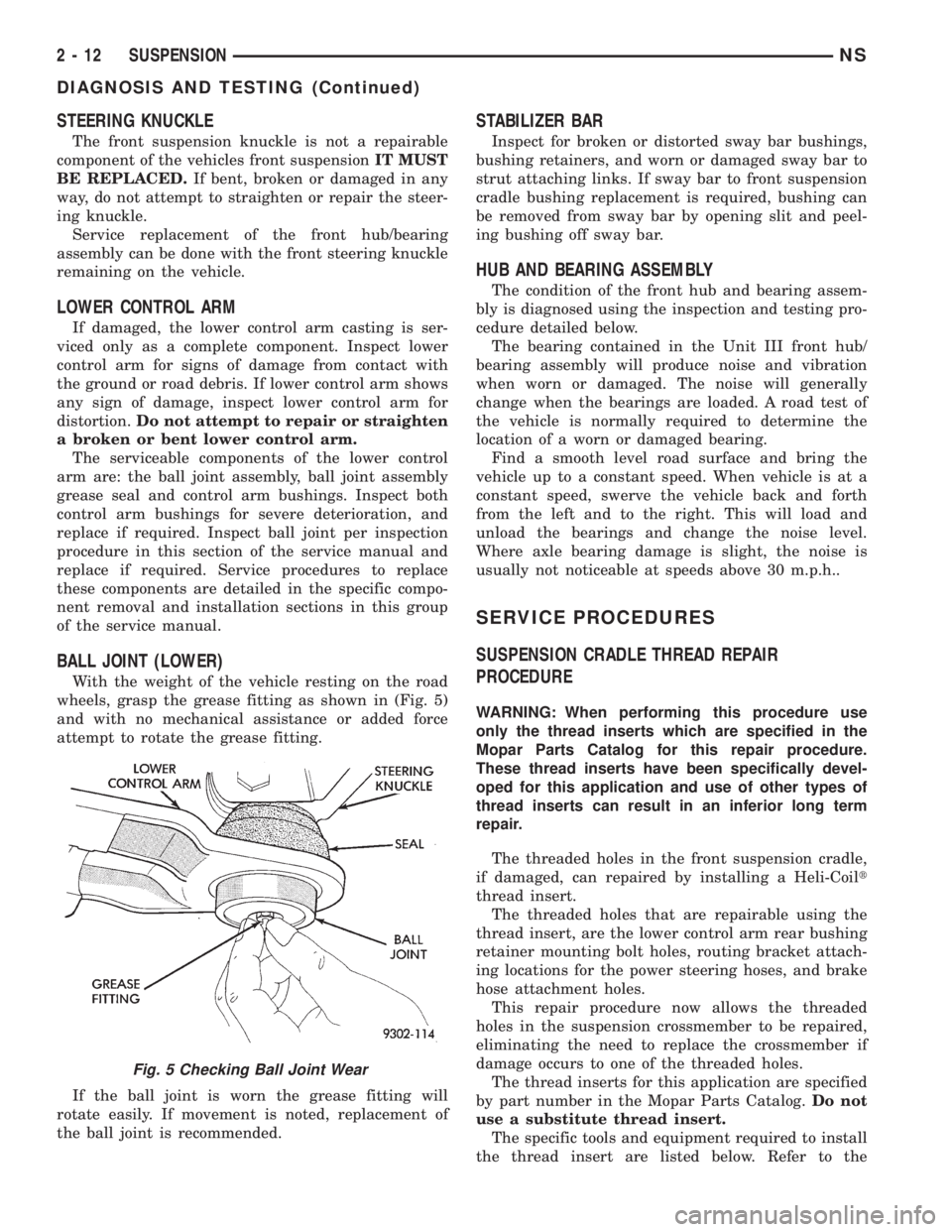
BALL JOINT (LOWER)
With the weight of the vehicle resting on the road
wheels, grasp the grease fitting as shown in (Fig. 5)
and with no mechanical assistance or added force
attempt to rotate the grease fitting.
If the ball joint is worn the grease fitting will
rotate easily. If movement is noted, replacement of
the ball joint is recommended.
STABILIZER BAR
Inspect for broken or distorted sway bar bushings,
bushing retainers, and worn or damaged sway bar to
strut attaching links. If sway bar to front suspension
cradle bushing replacement is required, bushing can
be removed from sway bar by opening slit and peel-
ing bushing off sway bar.
HUB AND BEARING ASSEMBLY
The condition of the front hub and bearing assem-
bly is diagnosed using the inspection and testing pro-
cedure detailed below.
The bearing contained in the Unit III front hub/
bearing assembly will produce noise and vibration
when worn or damaged. The noise will generally
change when the bearings are loaded. A road test of
the vehicle is normally required to determine the
location of a worn or damaged bearing.
Find a smooth level road surface and bring the
vehicle up to a constant speed. When vehicle is at a
constant speed, swerve the vehicle back and forth
from the left and to the right. This will load and
unload the bearings and change the noise level.
Where axle bearing damage is slight, the noise is
usually not noticeable at speeds above 30 m.p.h..
SERVICE PROCEDURES
SUSPENSION CRADLE THREAD REPAIR
PROCEDURE
WARNING: When performing this procedure use
only the thread inserts which are specified in the
Mopar Parts Catalog for this repair procedure.
These thread inserts have been specifically devel-
oped for this application and use of other types of
thread inserts can result in an inferior long term
repair.
The threaded holes in the front suspension cradle,
if damaged, can repaired by installing a Heli-Coilt
thread insert.
The threaded holes that are repairable using the
thread insert, are the lower control arm rear bushing
retainer mounting bolt holes, routing bracket attach-
ing locations for the power steering hoses, and brake
hose attachment holes.
This repair procedure now allows the threaded
holes in the suspension crossmember to be repaired,
eliminating the need to replace the crossmember if
damage occurs to one of the threaded holes.
The thread inserts for this application are specified
by part number in the Mopar Parts Catalog.Do not
use a substitute thread insert.
The specific tools and equipment required to install
the thread insert are listed below. Refer to the
Fig. 5 Checking Ball Joint Wear
2 - 12 SUSPENSIONNS
DIAGNOSIS AND TESTING (Continued)
Page 45 of 1938
instructions included with the thread insert for the
detailed procedure used for the installation of the
thread insert.
NOTE: The thread inserts for this application are
for the repair of M8x1.25 and M10x1.5 threads. Be
sure the correct tools are used for the required
thread insert size.
TOOL REQUIREMENT FOR M8x1.25 Thread
²8.3mm (5/16 in.) Drill Bit
²120É Countersink
²Heli-CoiltTap #4863-8
²Heli-CoiltGage #4624-8
²Heli-CoiltHand Inserting Tool 7751-8
²Needle Nose Pliers ± For Removal Of Thread
Insert Driving Tang
TOOL REQUIREMENT FOR M10x1.5 Thread
²10.5mm (25/64 in.) Drill Bit
²120É Countersink
²Heli-CoiltTap #4863-10
²Heli-CoiltGage #4624-10
²Heli-CoiltHand Inserting Tool 7751-10
²Needle Nose Pliers ± For Removal Of Thread
Insert Driving Tang
REMOVAL AND INSTALLATION
Mc PHERSON STRUT
REMOVAL
WARNING: DO NOT REMOVE THE NUT FROM THE
STRUT ROD WHILE STRUT ASSEMBLY IS
INSTALLED IN VEHICLE, OR BEFORE STRUT
ASSEMBLY SPRING IS COMPRESSED.
(1) Raise vehicle on jack stands or centered on a
frame contact type hoist. See Hoisting in the Lubri-
cation and Maintenance section of this service man-
ual, for the required lifting procedure to be used for
this vehicle.
(2) Remove the wheel and tire assembly from loca-
tion on front of vehicle requiring strut removal.
(3) If both strut assemblies are to be removed,
mark the strut assemblies right or left according to
which side of the vehicle they were removed from.
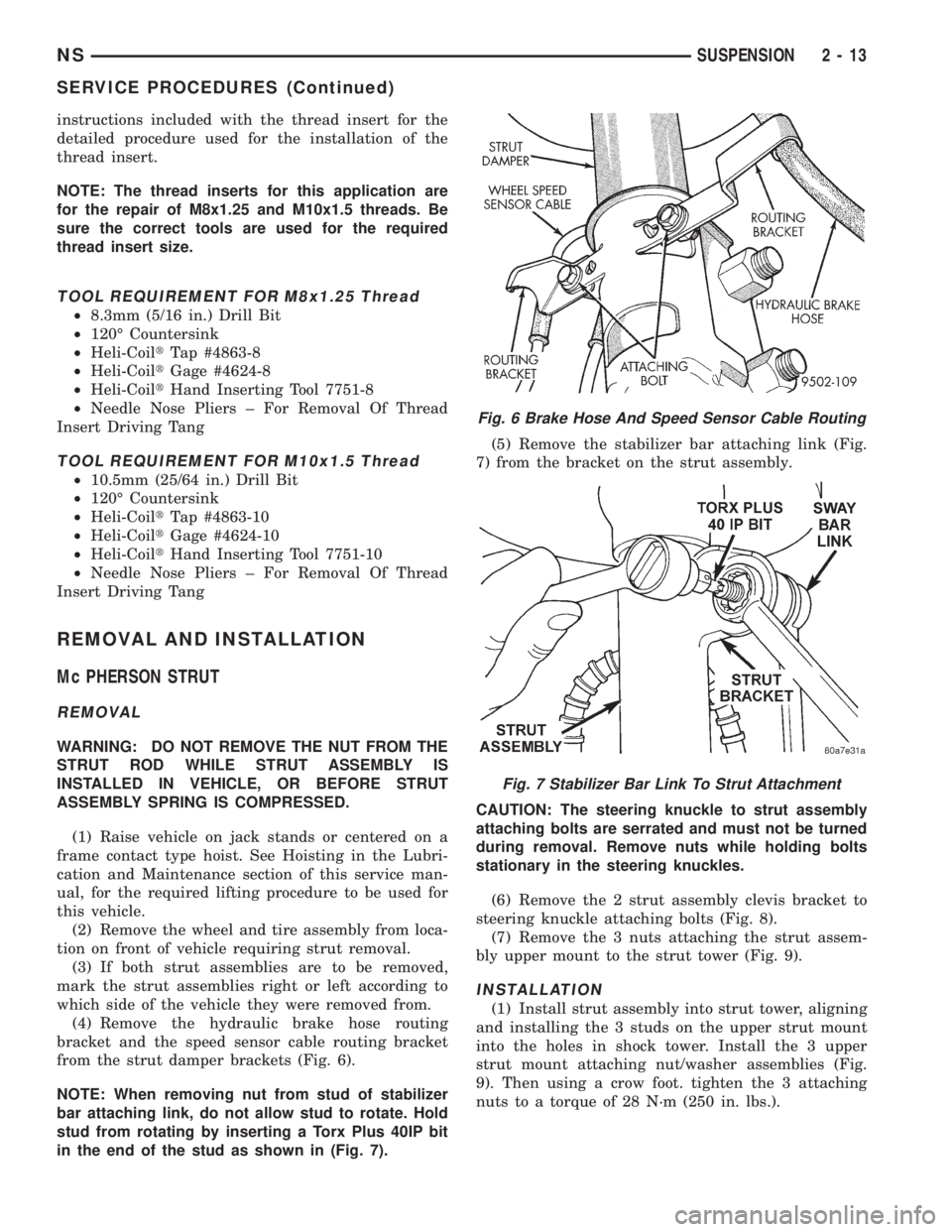
(4) Remove the hydraulic brake hose routing
bracket and the speed sensor cable routing bracket
from the strut damper brackets (Fig. 6).
NOTE: When removing nut from stud of stabilizer
bar attaching link, do not allow stud to rotate. Hold
stud from rotating by inserting a Torx Plus 40IP bit
in the end of the stud as shown in (Fig. 7).(5) Remove the stabilizer bar attaching link (Fig.
7) from the bracket on the strut assembly.
CAUTION: The steering knuckle to strut assembly
attaching bolts are serrated and must not be turned
during removal. Remove nuts while holding bolts
stationary in the steering knuckles.
(6) Remove the 2 strut assembly clevis bracket to
steering knuckle attaching bolts (Fig. 8).
(7) Remove the 3 nuts attaching the strut assem-
bly upper mount to the strut tower (Fig. 9).
INSTALLATION
(1) Install strut assembly into strut tower, aligning
and installing the 3 studs on the upper strut mount
into the holes in shock tower. Install the 3 upper
strut mount attaching nut/washer assemblies (Fig.
9). Then using a crow foot. tighten the 3 attaching
nuts to a torque of 28 N´m (250 in. lbs.).
Fig. 6 Brake Hose And Speed Sensor Cable Routing
Fig. 7 Stabilizer Bar Link To Strut Attachment
NSSUSPENSION 2 - 13
SERVICE PROCEDURES (Continued)