warning light CHRYSLER VOYAGER 1996 Owner's Manual
[x] Cancel search | Manufacturer: CHRYSLER, Model Year: 1996, Model line: VOYAGER, Model: CHRYSLER VOYAGER 1996Pages: 1938, PDF Size: 55.84 MB
Page 527 of 1938
If motor grunts and does not move, verify that reg-
ulator is not binding.
WIRING VOLTAGE TEST
The following wiring test determines whether or
not voltage is continuous through the body harness
to switch.
(1) Remove the master power window switch and
bezel assembly from the driver door. Refer to Group
23, Body for proper procedures.
(2) Disconnect wire connector from back of power
window switch.
(3) Switch ignition ON position.
(4) Connect the clip end of a 12 volt test light to
Pin 13 in door harness connector at the window
switch. Touch the test light probe to Pin 9 and then
to Pin 11.
²If the test light illuminates, the wiring circuit
between the battery and switch is OK.
²If light does not illuminate, check the 40 amp
fuse in the Power Distribution Center or for a broken
wire.
²The power window motors are protected with
Positive Temperature Coefficient (PTC) device that
prevents motor burn out. Check Junction Block.
²Refer to Group 8W, Wiring Diagrams for circuit
information and component locations.
REMOVAL AND INSTALLATION
POWER VENT WINDOW MOTOR
REMOVAL
(1) Disconnect battery negative cable.
(2) Remove D-pillar trim panel.
(3) Disconnect wire connector from power vent
motor.
(4) Remove nut holding crank to vent glass.
(5) Remove bolts holding power vent motor to
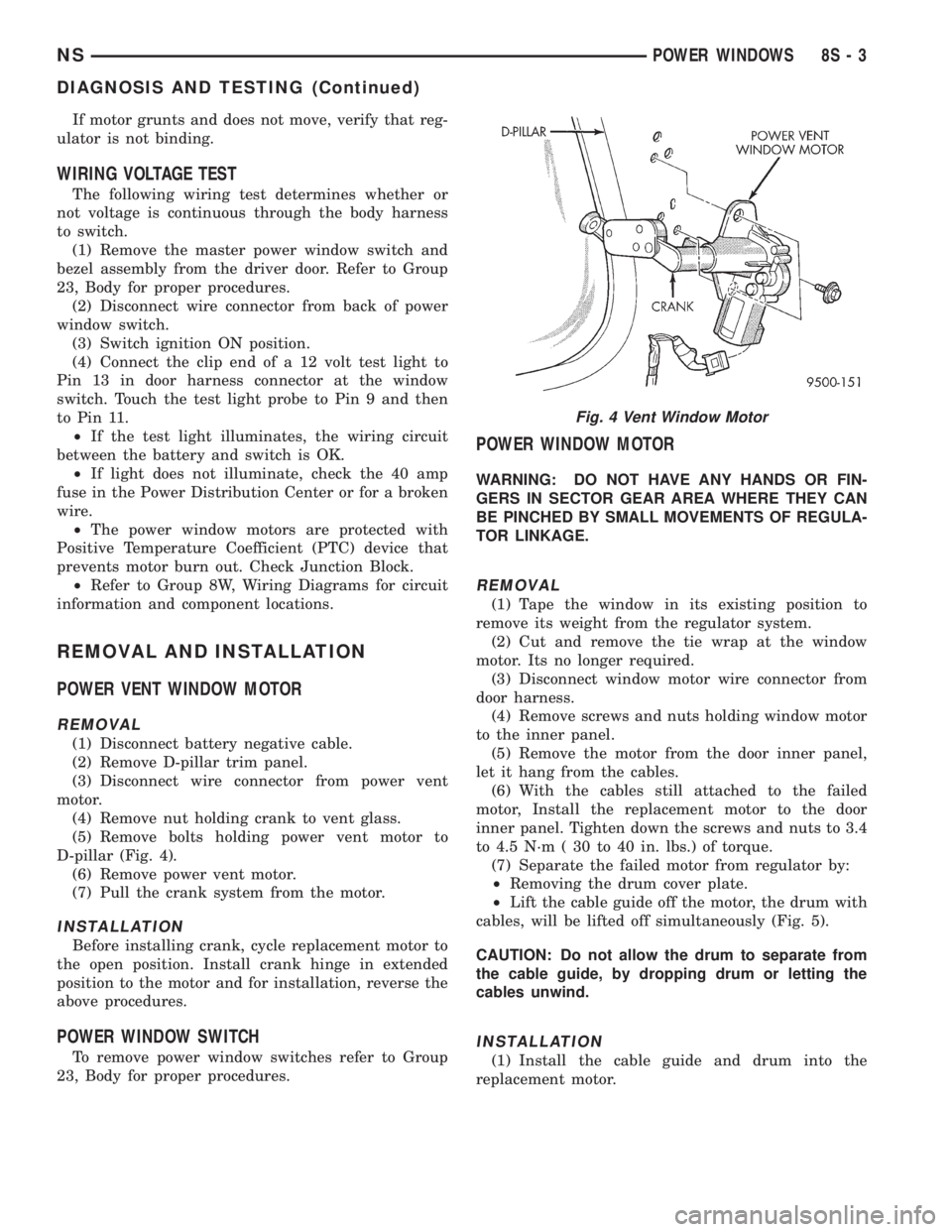
D-pillar (Fig. 4).
(6) Remove power vent motor.
(7) Pull the crank system from the motor.
INSTALLATION
Before installing crank, cycle replacement motor to
the open position. Install crank hinge in extended
position to the motor and for installation, reverse the
above procedures.
POWER WINDOW SWITCH
To remove power window switches refer to Group
23, Body for proper procedures.
POWER WINDOW MOTOR
WARNING: DO NOT HAVE ANY HANDS OR FIN-
GERS IN SECTOR GEAR AREA WHERE THEY CAN
BE PINCHED BY SMALL MOVEMENTS OF REGULA-
TOR LINKAGE.
REMOVAL
(1) Tape the window in its existing position to
remove its weight from the regulator system.
(2) Cut and remove the tie wrap at the window
motor. Its no longer required.
(3) Disconnect window motor wire connector from
door harness.
(4) Remove screws and nuts holding window motor
to the inner panel.
(5) Remove the motor from the door inner panel,
let it hang from the cables.
(6) With the cables still attached to the failed
motor, Install the replacement motor to the door
inner panel. Tighten down the screws and nuts to 3.4
to 4.5 N´m ( 30 to 40 in. lbs.) of torque.
(7) Separate the failed motor from regulator by:
²Removing the drum cover plate.
²Lift the cable guide off the motor, the drum with
cables, will be lifted off simultaneously (Fig. 5).
CAUTION: Do not allow the drum to separate from
the cable guide, by dropping drum or letting the
cables unwind.
INSTALLATION
(1) Install the cable guide and drum into the
replacement motor.
Fig. 4 Vent Window Motor
NSPOWER WINDOWS 8S - 3
DIAGNOSIS AND TESTING (Continued)
Page 544 of 1938

(2) Inspect BCM connectors and wires for proper
connection. If OK, replace BCM for tone condition.
DOME LAMP ON CHIME
The dome lamp on chime will warn the driver that
the dome lamps have been left on.
With the ignition is OFF:
²Driver's door OPEN (door ajar switch is closed to
ground)
²Dome lamps are ON (dome lamp switch is closed
to ground),
The chime will sound continuously until driver's
door is closed, dome lamps tuned OFF or until the
battery protection time out of 15 minutes has
expired. Refer Group 8L, Lamps proper procedures.
Chime rate: 168 to 192 chimes per minute.
ENGINE TEMPERATURE CRITICAL CHIME
The engine temperature critical chime will warn
the driver that the vehicle's engine is overheating.
While monitoring the coolant temperature, the Pow-
ertrain Control Module (PCM) will send on the CCD
bus as engine temperature every 1.376 seconds to the
Body Control Module (BCM). The BCM calculates
engine temperature and determines if a warning
should occur. This feature is functional only with the
Ignition Switch in the Run/Start position.
When the engine temperature reaches 122ÉC
(252ÉF) the BCM will chime one tone and the engine
temperature lamp comes ON. The BCM turns OFF
the lamp when the engine temperature reaches
117ÉC (242ÉF). The BCM will chime continuously
when the engine temperature reaches 125ÉC (257ÉF).
The chime will turn OFF after four minutes or when
the temperature reaches 117ÉC (242ÉF), which ever
occurs first.
EXTERIOR LAMPS ON CHIME
The exterior lamp on chime will warn the driver
that the exterior lights have been left on.
With the ignition switch OFF:
²Driver's door is open (door ajar switch is closed
to ground)
²Parking lamps or headlamps ON (parking lamp
switch is closed to ground)
The chime will sound until lights are turned OFF,
driver's door closed or until the battery protection
time out of 3 minutes has expired.
Refer to Group 8L, Lamps, for proper service pro-
cedures. Chime rate: 168 to 192 chimes per minute.
To test the exterior lamps left on function:
²Turn ignition off
²Remove ignition key
²Turn exterior lamps on with driver's door open.
Chime should sound until lamps are turned off or
driver's door is closed.
KEY-IN IGNITION CHIME
The key-in ignition chime will act as a warning to
the driver that the ignition key has been left in the
ignition switch.
With the ignition switch is in OFF position ONLY:
²Driver's door is open/ajar (door ajar switch is
closed to ground)
²Key is in the ignition switch (key-in ignition
switch is closed to ground)
The chime will sound until one of the above condi-
tions is removed. Chime rate: 168 to 192 chimes per
minute.
To test the key-in ignition function, insert key into
the ignition and open driver's door. Do not turn igni-
tion ON. Chime should sound until key is removed
from ignition or driver's door is closed.
LOW OIL PRESSURE CHIME OPERATION
The low oil pressure chime will warn the driver
that the engine oil pressure is low. The oil pressure
switch, will close to ground during a low oil pressure
condition. The oil pressure lamp will illuminate in
the message center. The body control module will
monitor the oil pressure switch and signal a low oil
pressure condition. A continuous four minute warn-
ing chime will sound and the oil pressure lamp will
come ON when the following conditions are met:
²Ignition on and engine not cranking
²Engine running at 420 to 480 rpm for 10 sec-
onds
²Oil pressure switch closed to ground for (1 sec-
ond minimum, 2 seconds maximum)
Chime rate: 168 to 192 chimes per minute.
SEAT BELT CHIME
The seat belt chime will sound for 4 to 8 seconds,
when the ignition is turned on and the driver's seat
belt is not buckled (seat belt switch is closed to
ground). This is a reminder to the driver to buckle
the seat belt. The seat belt lamp is controlled by the
mechanical instrument cluster. The cluster will also
illuminate the seat belt warning lamp for 6 seconds.
Buckling the driver's seat belt before the time out
has expired will cause the chime to stop immediately.
Chime rate: 38 to 62 chimes per minute.
To test the seat belt warning system, the ignition
switch must be in the OFF position for 1 minute
before starting the test. Turn the ignition switch to
the on position with the driver's seat belt not buck-
led. The seat belt warning lamp should light and the
chime should sound 4 to 8 seconds.
SEAT BELT LAMP
The seat belt lamp in the instrument cluster sig-
nals the vehicle passengers to fasten their seat belts.
The seat belt lamp is illuminated directly by the
8U - 2 CHIME WARNING/REMINDER SYSTEMNS
DIAGNOSIS AND TESTING (Continued)
Page 548 of 1938

FASTEN SEAT BELT LAMP OR TONE
CONTINUES FOR MORE THAN 10 SECONDS
AFTER SEAT BELTS ARE FASTENED AND
DRIVER'S DOOR IS CLOSED.
(1) Check left door ajar switch for no ground when
switch is depressed.
(a) If continuity replace door ajar switch.
(b) If NO continuity replace BCM for tone condi-
tion, or replace mechanical instrument panel for
lamp condition.
(c) Replace BCM for tone condition.
(d) Replace mechanical instrument cluster for
lamp condition.
NO TONE WHEN PARK OR HEADLAMPS ARE
ON AND DRIVER'S DOOR IS OPEN.
(1) Check left door ajar switch for good ground
when driver's door is open. Repair as necessary.
(2) Inspect BCM connectors and wires for proper
connection. If OK, replace BCM for tone condition.
DOME LAMP ON CHIME
The dome lamp on chime will warn the driver that
the dome lamps have been left on.
With the ignition is OFF:
²Driver's door OPEN (door ajar switch is closed to
ground)
²Dome lamps are ON (dome lamp switch is closed
to ground),
The chime will sound continuously until driver's
door is closed, dome lamps tuned OFF or until the
battery protection time out of 15 minutes has
expired. Refer Group 8L, Lamps proper procedures.
Chime rate: 168 to 192 chimes per minute.
ENGINE TEMPERATURE CRITICAL CHIME
The engine temperature critical chime will warn
the driver that the vehicle's engine is overheating.
While monitoring the coolant temperature, the Pow-
ertrain Control Module (PCM) will send on the CCD
bus as engine temperature every 1.376 seconds to the
Body Control Module (BCM). The BCM calculates
engine temperature and determines if a warning
should occur. This feature is functional only with the
Ignition Switch in the Run/Start position. On the
Diesel vehicles, the coolant temperature sensor is
read directly by the BCM.
When the engine temperature reaches 122ÉC
(252ÉF) or the diesel engine 112ÉC (234ÉF), the BCM
will chime one tone and the engine temperature lamp
comes ON. The BCM turns OFF the lamp when the
engine temperature reaches 117ÉC (242ÉF) or the die-
sel engine 108ÉC (226ÉF). The BCM will chime con-
tinuously when the engine temperature reaches
125ÉC (257ÉF) or diesel engine 116ÉC (241ÉF). The
chime will turn OFF after four minutes or when thetemperature reaches 117ÉC (242ÉF) or diesel engine
108ÉC (226ÉF), which ever occurs first.
EXTERIOR LAMPS ON CHIME
The exterior lamp on chime will warn the driver
that the exterior lights have been left on.
With the ignition switch OFF:
²Driver's door is open (door ajar switch is closed
to ground)
²Parking lamps or headlamps ON (parking lamp
switch is closed to ground)
The chime will sound until lights are turned OFF,
driver's door closed or until the battery protection
time out of 3 minutes has expired.
Refer to Group 8L, Lamps, for proper service pro-
cedures. Chime rate: 168 to 192 chimes per minute.
To test the exterior lamps left on function:
²Turn ignition off
²Remove ignition key
²Turn exterior lamps on with driver's door open.
Chime should sound until lamps are turned off or
driver's door is closed.
KEY-IN IGNITION CHIME
The key-in ignition chime will act as a warning to
the driver that the ignition key has been left in the
ignition switch.
With the ignition switch is in OFF position ONLY:
²Driver's door is open/ajar (door ajar switch is
closed to ground)
²Key is in the ignition switch (key-in ignition
switch is closed to ground)
The chime will sound until one of the above condi-
tions is removed. Chime rate: 168 to 192 chimes per
minute.
To test the key-in ignition function, insert key into
the ignition and open driver's door. Do not turn igni-
tion ON. Chime should sound until key is removed
from ignition or driver's door is closed.
LOW OIL PRESSURE CHIME OPERATION
The low oil pressure chime will warn the driver
that the engine oil pressure is low. The oil pressure
switch, will close to ground during a low oil pressure
condition. The oil pressure lamp will illuminate in
the message center. The body control module will
monitor the oil pressure switch and signal a low oil
pressure condition. A continuous four minute warn-
ing chime will sound and the oil pressure lamp will
come ON when the following conditions are met:
²Ignition on and engine not cranking
²Engine running at 420 to 480 rpm for 10 sec-
onds
²Oil pressure switch closed to ground for (1 sec-
ond minimum, 2 seconds maximum)
Chime rate: 168 to 192 chimes per minute.
8U - 2 CHIME WARNING/REMINDER SYSTEMNS/GS
DIAGNOSIS AND TESTING (Continued)
Page 549 of 1938

SEAT BELT CHIME
The seat belt chime will sound for 4 to 8 seconds,
when the ignition is turned on and the driver's seat
belt is not buckled (seat belt switch is closed to
ground). This is a reminder to the driver to buckle
the seat belt. The seat belt lamp is controlled by the
mechanical instrument cluster. The cluster will also
illuminate the seat belt warning lamp for 6 seconds.
Buckling the driver's seat belt before the time out
has expired will cause the chime to stop immediately.
Chime rate: 38 to 62 chimes per minute.
To test the seat belt warning system, the ignition
switch must be in the OFF position for 1 minute
before starting the test. Turn the ignition switch to
the on position with the driver's seat belt not buck-
led. The seat belt warning lamp should light and the
chime should sound 4 to 8 seconds.
SEAT BELT LAMP
The seat belt lamp in the instrument cluster sig-
nals the vehicle passengers to fasten their seat belts.
The seat belt lamp is illuminated directly by the
instrument cluster for 6 seconds after the instrument
cluster receives the message from the Body Control
Module. The seat belt lamp is therefore illuminated
for 6 seconds whenever the ignition switch is moved
to run/start position.
(1) While ignition is off, the seat belt lamp will not
be illuminated.
(2) The ignition power feed status will be updated
every 250 milliseconds or on change.
(3) This lamp will be checked by the instrument
cluster for 6 seconds with every run/start cycle of the
ignition switch.
TURN SIGNAL ON CHIME
The turn signal on chime will warn the driver that
the turn signals have been left on. When the Body
Control Module receives a turn signal input for 1.6
km (1.0 miles), vehicle speed is greater than 24 km/h
(15 mph), the chime will sound continuously until the
turn signal is turned OFF. If vehicle speed drops
below 24 km/h (15 mph) prior to the warning being
activated, the accumulated distance traveled will be
reset. The turn signal chime is not activated whenthe emergency flashers are turned on. This feature
can also be disabled in EEPROM. Chime rate: 38 to
62 chimes per minute.
For the turn signal warning system to operate:
²Must have input from either the right or left
turn signal lamps. Creates a voltage change between
0 and battery voltage.
²The vehicle speed sensor sends a message to the
Powertrain Control Module that vehicle has exceeded
24 km/h (15 mph) for 1.6 km (1.0 miles).
²When the above two conditions are met, the
chime will sound. The chime will stop when no fur-
ther voltage change is detected.
²If hazard warning signals are pulsing, no chime
will sound.
²If speed drops below 24 km/h (15 mph) before
the warning is issued, the warning will not be issued
and the distance counter will be reset.
²If turn signal lamps are not working properly,
the chime will not sound.
²When using the scan tool, refer to the proper
Body Diagnostic Manual for the procedure.
WARNING LAMP ANNOUNCEMENT CHIME
The warning lamp announcement chime will warn
the driver to scan the instrument cluster to observe
which warning lamp is illuminated. Whenever the
volts, low fuel, low washer fluid, coolant level (gas/
diesel), low coolant level, engine temperature high
(diesel only), door ajar or gate ajar lamps are first
illuminated, the chime will sound one tone. The door/
liftgate ajar warning lamp announcement chime
sounds only if the vehicle speed is above 2 m.p.h.
Two seconds after ignition switch is turned ON or
until the seat belt warning chime ends, all warning
announcement chimes will be consolidated into one
warning announcement. This will occur 2 seconds
after the seat belt warning chime ends. If a warning
announcement should occur while another warning
chime in progress (turn signal, low oil pressure or
high speed warnings), no additional chimes will
sound after the chime in progress ends. All associ-
ated lamps will be illuminated, and the active chime
will be the warning announcement.
NS/GSCHIME WARNING/REMINDER SYSTEM 8U - 3
DIAGNOSIS AND TESTING (Continued)
Page 577 of 1938

8W-02 COMPONENT INDEX
Component Page
2-4 Pressure Switch.....................8W-31
2-4 Solenoid...........................8W-31
A/C Compressor Clutch..................8W-42
A/C Compressor Clutch Relay...........8W-10, 42
A/C Heater Control.....................8W-42
A/C On Indicator.......................8W-42
A/C Pressure Transducer..............8W-30, 42
A/C Switch............................8W-42
A/C Zone Door Actuator..................8W-42
ABS Warning Lamp..................8W-35, 46
Accelerator Pedal Position Sensor..........8W-30
Airbag Control Module...................8W-43
Airbag Indicator Lamp...................8W-43
Airbag Warning Lamp...................8W-46
All Wheel Drive Solenoid.................8W-31
Ambient Air Temperature Sensor...........8W-49
Ash Receiver Lamp.....................8W-44
Automatic Day/Night Mirror..............8W-44
Automatic Shut Down Relay............8W-10, 30
Splice Information......................8W-70
Back-Up Lamp.........................8W-51
Back-Up Switch.....................8W-44, 51
Battery...............................8W-20
Blend Door Actuator.....................8W-42
Body Control Module....................8W-45
Brake Pressure Switch...................8W-46
Brake Warning Lamp....................8W-46
Camshaft Position Sensor................8W-30
Center Dome Lamp.....................8W-44
Center High Mounted Stop Lamp..........8W-51
Cigar/Accessory Relay...................8W-41
Clockspring.......8W-10, 15, 30, 33, 39, 40, 41, 43
Cluster Illumination Lamps...............8W-40
Clutch Interlock Switch...............8W-12, 21
Clutch Interlock Switch Jumper......8W-12, 21, 31
Clutch Switch.......................8W-30, 33
Combination Flasher/DRL Module. . . .8W-50, 51, 52
Combination Relays.....................8W-54
Compass/Mini-Trip Computer..............8W-49
Control Sleeve Sensor....................8W-30
Controller Anti-Lock Brake...............8W-35
Courtesy Lamp Relay...........8W-10, 12, 44, 50
Crank Case Heater......................8W-30
Crankshaft Position Sensor...............8W-30
Cruise Indicator Lamp...................8W-40
Data Link Connector....................8W-30
Diesel Power Relay...................8W-10, 30
Dome Lamp Switch.....................8W-50
Door Ajar Indicator Lamp................8W-40
Door Ajar Switches................8W-39, 40, 44
Door Lock Relay........................8W-61
Speakers..............................8W-47Component Page
Door Unlock Relay......................8W-61
Oxygen Sensors........................8W-30
Door Ajar Switches.............8W-39, 40, 44, 45
Door Arm/Disarm Switches.............8W-39, 61
Door Courtesy Lamps....................8W-44
Door Lock Motors.......................8W-61
Door Lock Switches.....................8W-61
Door Unlock Relays.....................8W-61
Heated Seat Backs......................8W-63
Heated Seat Cushions...................8W-63
Heated Seat Modules....................8W-63
Heated Seat Switches....................8W-63
Power Mirrors.........................8W-62
Power Seat Switches....................8W-63
Power Window Switches..................8W-60
Seat Motors...........................8W-63
Window Motors........................8W-60
Radiator Fans.........................8W-42
Dump Solenoid.........................8W-33
EGR Solenoid..........................8W-30
Electric Wiper De-Icer...................8W-48
Electronic PRNDL Indicator...............8W-40
Engine Coolant Temperature Gauge.........8W-40
Engine Coolant Temperature Lamp.........8W-46
Engine Coolant Temperature Sensor........8W-30
Engine Oil Pressure Switch...............8W-46
Engine Speed Sensor....................8W-30
Engine Starter Motor....................8W-21
Engine Starter Motor Relay............8W-10, 21
Evap Leak Detection Pump...............8W-30
Evap/Purge Solenoid....................8W-30
Evaporator Temperature Sensor............8W-42
Express Down Module...................8W-60
Flexible Fuel Sensor.....................8W-30
Fog Lamps............................8W-50
Fog Lamp Relay........................8W-50
Front Blower Motor.....................8W-42
Front Blower Motor Relay.............8W-10, 42
Front Blower Motor Resistor Block.........8W-42
Front Cigar Lighter/Power Outlet..........8W-41
Front Reading Lamp Defeat Switch.........8W-44
Front Reading Lamps/Switch..............8W-44
Front Washer Motor.....................8W-53
Front Wiper Switch.....................8W-53
Fuel Gauge............................8W-40
Fuel Heater...........................8W-30
Fuel Heater Relay...................8W-10, 30
Fuel Injectors..........................8W-30
Fuel Pump Module......................8W-30
Fuel Pump Relay....................8W-10, 30
Fuel Quantity Actuator..................8W-30
Fuel Shutdown Solenoid..................8W-30
NS/GS8W - 02 COMPONENT INDEX 8W - 02 - 1
Page 578 of 1938

Component Page
Fuel Tank Module...................8W-30, 45
Fuel Temperature Sensor.................8W-30
Fuel Timing Solenoid....................8W-30
Fuses (JB)............................8W-12
Fuses (PDC)...........................8W-10
Fusible Link.....................8W-20, 21, 63
Fusible Link A0........................8W-30
Fusible Link A11.......................8W-10
Fusible Link A54.......................8W-10
Grounds..............................8W-15
Generator.............................8W-20
Glove Box Lamp........................8W-44
Glow Plug Lamp.....................8W-30, 46
Glow Plugs............................8W-30
Glow Plug Relay........................8W-30
Headlamps............................8W-50
Headlamp Dimmer Switch..........8W-10, 46, 50
Headlamp Leveling Motors...............8W-50
Headlamp Switch.......................8W-50
Headlamp Washer......................8W-53
High Beam Indicator....................8W-46
High Beam Relay....................8W-10, 50
Headlamps............................8W-50
Horns................................8W-41
Hood Ajar Switch....................8W-39, 44
Horn Relay.........................8W-39, 41
Horn Switch.....................8W-10, 39, 41
HVAC Control.........................8W-42
Idle Air Control Motor...................8W-30
Ignition Coil Pack.......................8W-30
Ignition Switch.........................8W-10
Instrument Cluster.....................8W-40
Intake Air Temperature Sensor............8W-30
Intake Air Temperature/Manifold Absolute
Pressure Sensor.....................8W-30
Interior Lamps On Switch................8W-44
Junction Block.........................8W-12
Key-In Halo Lamp......................8W-44
Knock Sensor..........................8W-30
Lamp Assemblies.......................8W-51
License Lamp..........................8W-51
Liftgate Ajar Indicator Lamp..............8W-40
Liftgate Ajar Switch...............8W-39, 40, 44
Liftgate Arm/Disarm Switch............8W-39, 61
Liftgate Flood Lamps....................8W-44
Liftgate Lock Motor.....................8W-61
Low Beam Relay.....................8W-10, 50
Low Coolant Level Switch................8W-45
Low Fuel Warning Indicator Lamp..........8W-40
Low Oil Pressure Lamp..................8W-46
Low Washer Fluid Level Indicator Lamp.....8W-40
Low Washer Fluid Switch.................8W-53
Low/Reverse Pressure Switch..............8W-31
Low/Reverse Solenoid....................8W-31Component Page
Manifold Absolute Pressure Sensor.........8W-30
Memory Power Seat Switch...............8W-63
Seat Sensors...........................8W-63
Memory Seat/Mirror Module...........8W-62, 63
Memory Set Switch..................8W-62, 63
Message Center........................8W-46
Mid Reading Lamps.....................8W-44
Mode Door Actuator.....................8W-42
Name Brand Speaker Relay...............8W-47
Needle Movement Sensor.................8W-30
Odometer.............................8W-40
Output Shaft Speed Sensor...............8W-31
Overdrive Pressure Switch................8W-31
Overdrive Solenoid......................8W-31
Overhead Console.......................8W-49
Park Brake Switch...................8W-46, 50
Park Lamp Relay.........8W-10, 12, 44, 50, 51, 54
Park/Turn Signal Lamps.................8W-50
Airbag Squibs..........................8W-43
Power Distribution Center................8W-10
Power Folding Mirror Switch..............8W-62
Power Mirror Fold Relay.................8W-62
Power Mirror Switch....................8W-62
Power Mirror Unfold Relay...............8W-62
Power Seat Circuit Breaker............8W-62, 63
Powertrain Control Module...............8W-30
PTCs (JB).............................8W-12
Radiator Fan Disconnect.................8W-42
Radiator Fan Relays.....................8W-42
Radio................................8W-47
Radio Choke...........................8W-47
Reading Lamps........................8W-44
Rear A/C Heater Unit....................8W-42
Rear Blower Control Switches.............8W-42
Rear Cigar Lighter/Power Outlet...........8W-41
Rear Defogger On Indicator...............8W-42
Rear Dome Lamp.......................8W-44
Rear Fog Lamp.........................8W-51
Rear Fog Lamp Indicator.................8W-51
Rear Washer Motor.....................8W-53
Rear Washer Switch..................8W-42, 53
Rear Window Defogger...................8W-48
Rear Window Defogger Relay..............8W-48
Rear Window Defogger Switch..........8W-42, 48
Rear Wiper Delay On Indicator.........8W-42, 53
Rear Wiper Delay Switch..............8W-42, 53
Rear Wiper Motor.......................8W-53
Rear Wiper On Indicator..............8W-42, 53
Rear Wiper On Switch................8W-42, 53
Recirculate Mode Indicator................8W-42
Recirculate Mode Switch.................8W-42
Recirculation Door Actuator...............8W-42
Remote Keyless Entry Module.............8W-61
Repeater Lamps.....................8W-51, 52
8W - 02 - 2 8W - 02 COMPONENT INDEXNS/GS
Page 813 of 1938

G300
6
4 ACC 0 OFF
3 LOCK 2 RUN 1 START
4
2
03
GY/BK20 G9
GY/BK20 G9MESSAGE
CENTER
9
BK20Z1PARK
BRAKE
SWITCH
14
G200
IGNITION
SWITCH
2C1
1C1 C3
89C3
10DRIVERLAMP WARNING RED BRAKE
1
COMBINATION
FLASHER/
DRL
MODULE
11
10A
FUSE
122BODY
CONTROL
MODULE
33C3
9
SWITCH) FUNCTION
MULTI-
(PART OF
SWITCH
DIMMER
HEADLAMPL93
22
PK
RUN A22
612
HIGH/LOW
BEAM
RELAY
CONTROL FUSED
IGNITION
(RUN)
GROUND
2C2
Z1
14
BK
G9
20
GY/BK
BLOCK JUNCTION
(8W-15-7)(8W-46-3)
(8W-15-4)(8W-10-14) (8W-12-12)
(8W-45-3)(8W-50-2)
(8W-10-14)
(8W-12-2)
(8W-12-17)
NS/GS8W-50 FRONT LIGHTING
DRL8W - 50 - 13
GS005013J988W-3
Page 1226 of 1938
ENGINE OIL CHANGE
WARNING: NEW OR USED ENGINE OIL CAN BE
IRRITATING TO THE SKIN. AVOID PROLONGED OR
REPEATED SKIN CONTACT WITH ENGINE OIL.
CONTAMINANTS IN USED ENGINE OIL, CAUSED BY
INTERNAL COMBUSTION, CAN BE HAZARDOUS TO
YOUR HEALTH. THOROUGHLY WASH EXPOSED
SKIN WITH SOAP AND WATER. DO NOT WASH
SKIN WITH GASOLINE, DIESEL FUEL, THINNER, OR
SOLVENTS, HEALTH PROBLEMS CAN RESULT. DO
NOT POLLUTE, DISPOSE OF USED ENGINE OIL
PROPERLY. CONTACT YOUR DEALER OR GOVERN-
MENT AGENCY FOR LOCATION OF COLLECTION
CENTER IN YOUR AREA.
Run engine until achieving normal operating tem-
perature.
(1) Position the vehicle on a level surface and turn
engine off.
(2) Remove oil fill cap.
(3) Hoist vehicle. Refer to Hoisting and Jacking
Recommendations.
(4) Place a suitable drain pan under crankcase
drain.
(5) Remove drain plug from crankcase and allow
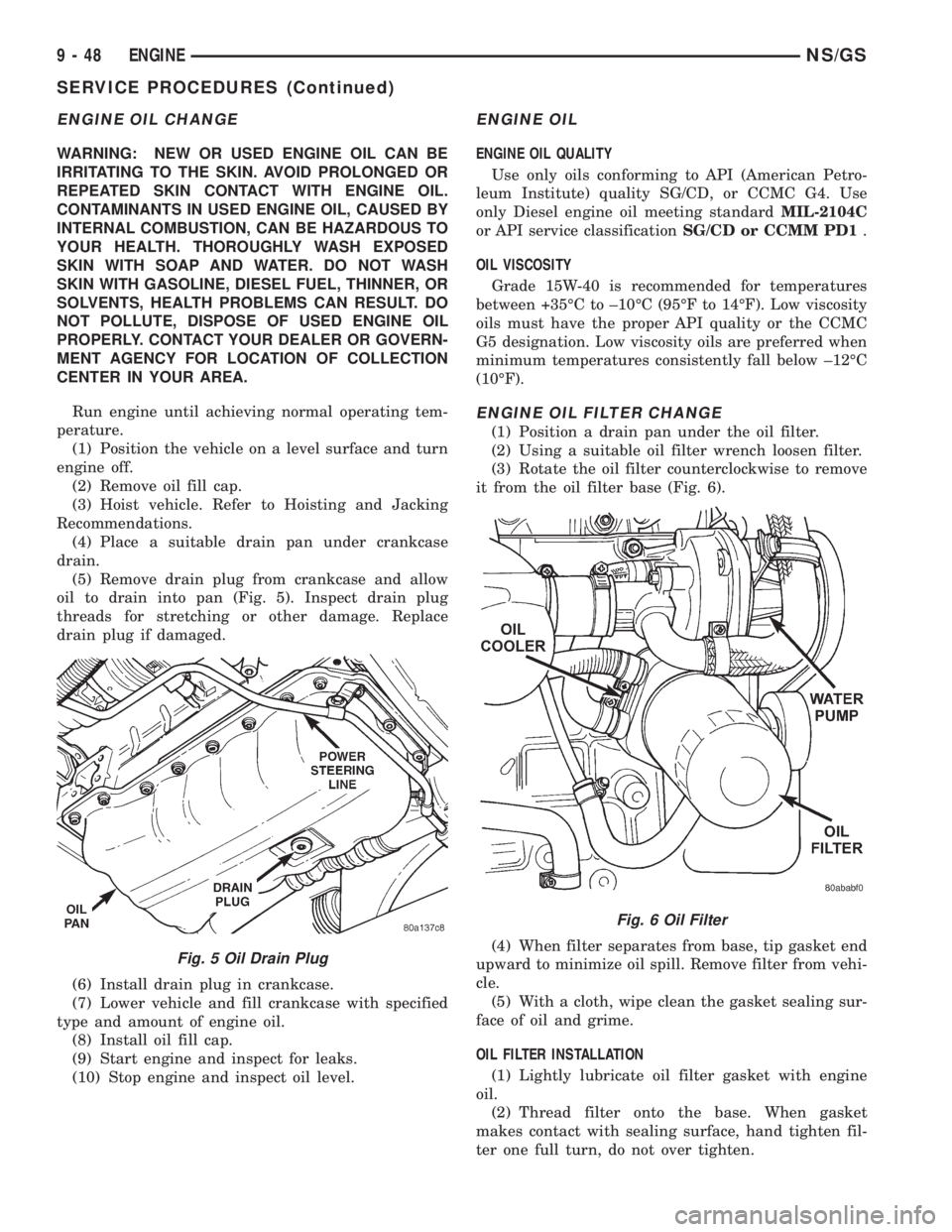
oil to drain into pan (Fig. 5). Inspect drain plug
threads for stretching or other damage. Replace
drain plug if damaged.
(6) Install drain plug in crankcase.
(7) Lower vehicle and fill crankcase with specified
type and amount of engine oil.
(8) Install oil fill cap.
(9) Start engine and inspect for leaks.
(10) Stop engine and inspect oil level.
ENGINE OIL
ENGINE OIL QUALITY
Use only oils conforming to API (American Petro-
leum Institute) quality SG/CD, or CCMC G4. Use
only Diesel engine oil meeting standardMIL-2104C
or API service classificationSG/CD or CCMM PD1.
OIL VISCOSITY
Grade 15W-40 is recommended for temperatures
between +35ÉC to ±10ÉC (95ÉF to 14ÉF). Low viscosity
oils must have the proper API quality or the CCMC
G5 designation. Low viscosity oils are preferred when
minimum temperatures consistently fall below ±12ÉC
(10ÉF).
ENGINE OIL FILTER CHANGE
(1) Position a drain pan under the oil filter.
(2) Using a suitable oil filter wrench loosen filter.
(3) Rotate the oil filter counterclockwise to remove
it from the oil filter base (Fig. 6).
(4) When filter separates from base, tip gasket end
upward to minimize oil spill. Remove filter from vehi-
cle.
(5) With a cloth, wipe clean the gasket sealing sur-
face of oil and grime.
OIL FILTER INSTALLATION
(1) Lightly lubricate oil filter gasket with engine
oil.
(2) Thread filter onto the base. When gasket
makes contact with sealing surface, hand tighten fil-
ter one full turn, do not over tighten.
Fig. 5 Oil Drain Plug
Fig. 6 Oil Filter
9 - 48 ENGINENS/GS
SERVICE PROCEDURES (Continued)
Page 1231 of 1938
ENGINE ASSEMBLY
REMOVAL
(1) Disconnect the battery.
(2) Remove the air cleaner assembly and inlet
hose.
(3) Remove both hoses at intercooler and engine.
(4) Disconnect EGR vacuum hose.
(5) Disconnect brake booster vacuum hose.
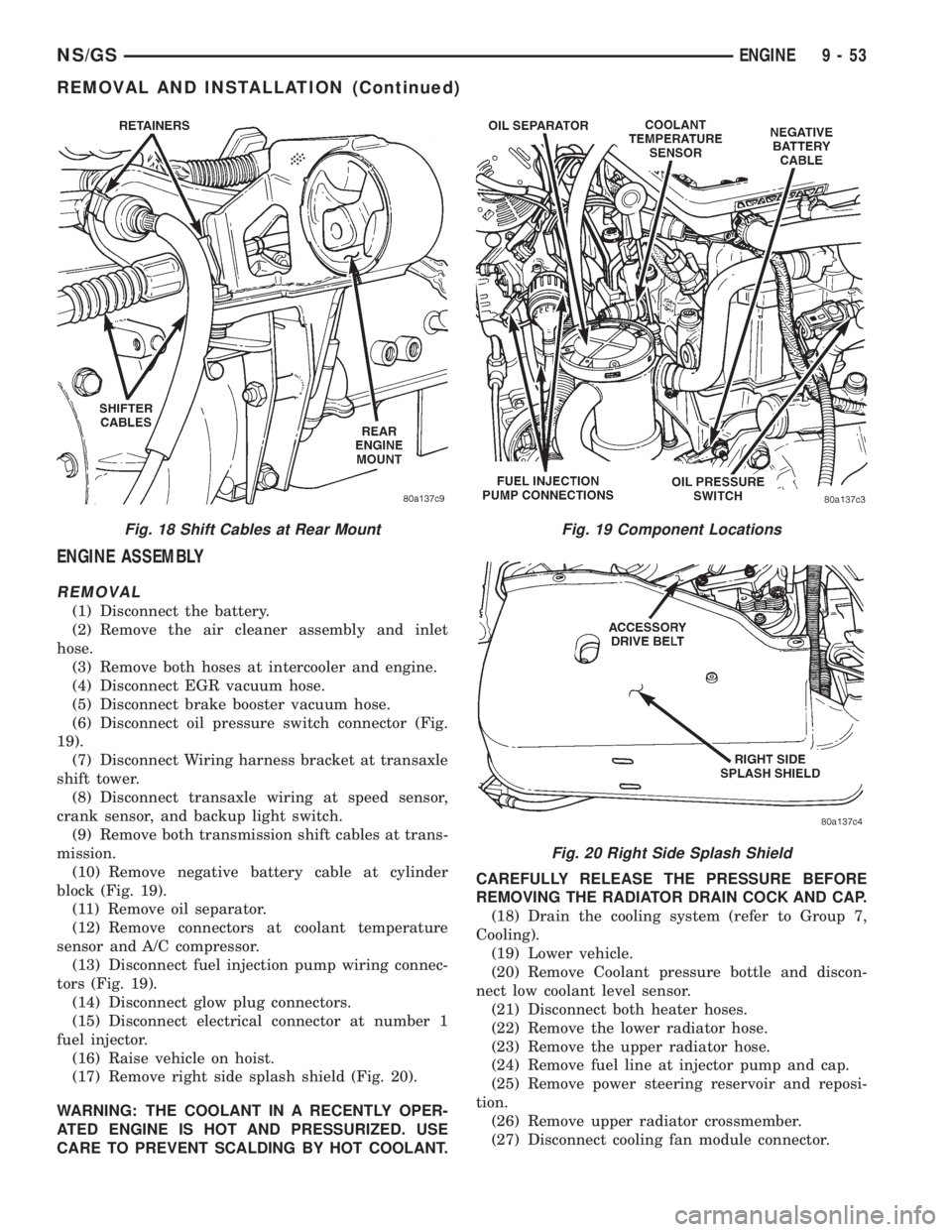
(6) Disconnect oil pressure switch connector (Fig.
19).
(7) Disconnect Wiring harness bracket at transaxle
shift tower.
(8) Disconnect transaxle wiring at speed sensor,
crank sensor, and backup light switch.
(9) Remove both transmission shift cables at trans-
mission.
(10) Remove negative battery cable at cylinder
block (Fig. 19).
(11) Remove oil separator.
(12) Remove connectors at coolant temperature
sensor and A/C compressor.
(13) Disconnect fuel injection pump wiring connec-
tors (Fig. 19).
(14) Disconnect glow plug connectors.
(15) Disconnect electrical connector at number 1
fuel injector.
(16) Raise vehicle on hoist.
(17) Remove right side splash shield (Fig. 20).
WARNING: THE COOLANT IN A RECENTLY OPER-
ATED ENGINE IS HOT AND PRESSURIZED. USE
CARE TO PREVENT SCALDING BY HOT COOLANT.CAREFULLY RELEASE THE PRESSURE BEFORE
REMOVING THE RADIATOR DRAIN COCK AND CAP.
(18) Drain the cooling system (refer to Group 7,
Cooling).
(19) Lower vehicle.
(20) Remove Coolant pressure bottle and discon-
nect low coolant level sensor.
(21) Disconnect both heater hoses.
(22) Remove the lower radiator hose.
(23) Remove the upper radiator hose.
(24) Remove fuel line at injector pump and cap.
(25) Remove power steering reservoir and reposi-
tion.
(26) Remove upper radiator crossmember.
(27) Disconnect cooling fan module connector.
Fig. 18 Shift Cables at Rear MountFig. 19 Component Locations
Fig. 20 Right Side Splash Shield
NS/GSENGINE 9 - 53
REMOVAL AND INSTALLATION (Continued)
Page 1307 of 1938
WARNING: RELEASE FUEL SYSTEM PRESSURE
BEFORE DISCONNECTING QUICK-CONNECT FIT-
TINGS AT FUEL FILTER. REFER TO THE FUEL
PRESSURE RELEASE PROCEDURE.
REMOVAL
(1) Perform fuel system pressure release.
(2) Disconnect quick-connect fittings from fuel
pump module and chassis fuel supply tube. Refer to
Quick-Connect Fittings in this section.
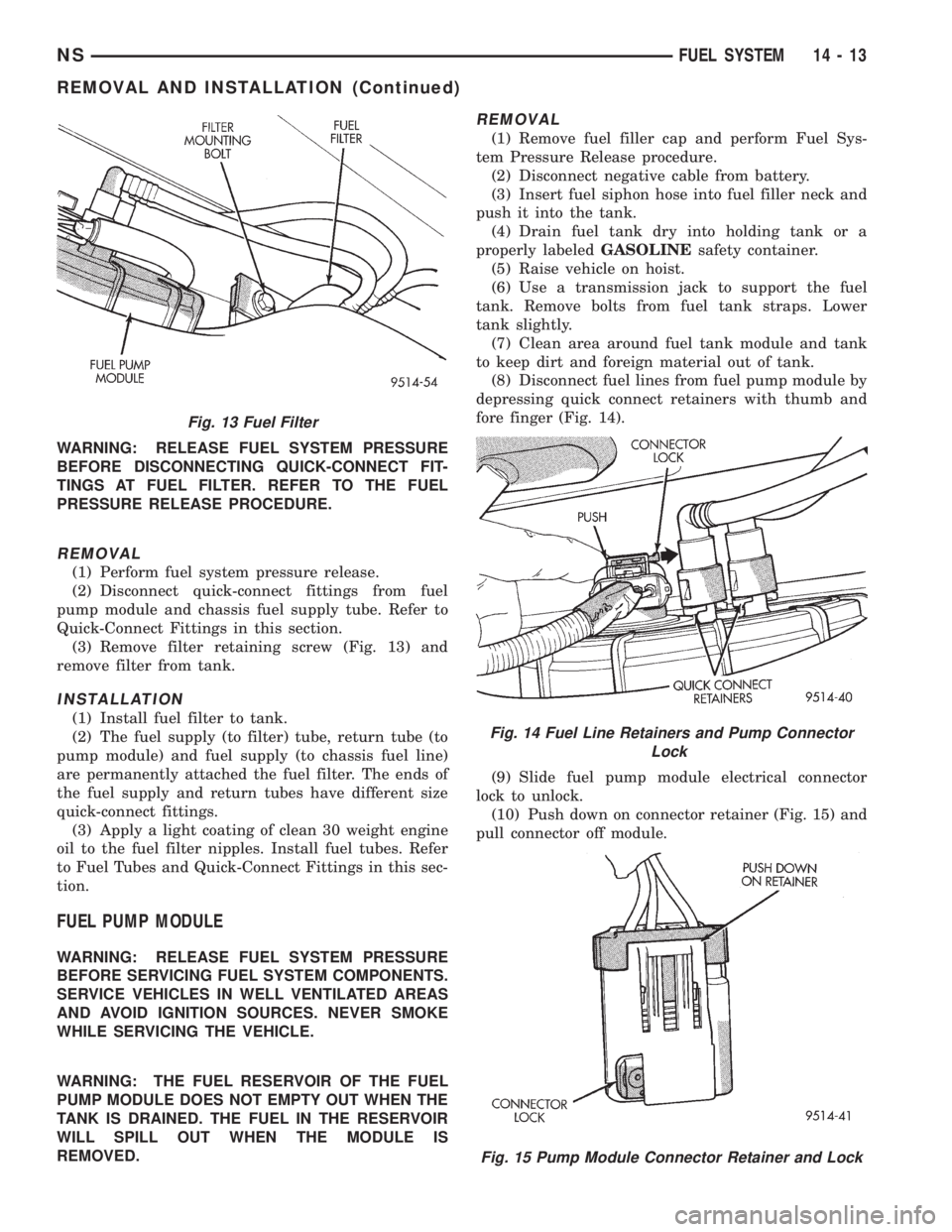
(3) Remove filter retaining screw (Fig. 13) and
remove filter from tank.
INSTALLATION
(1) Install fuel filter to tank.
(2) The fuel supply (to filter) tube, return tube (to
pump module) and fuel supply (to chassis fuel line)
are permanently attached the fuel filter. The ends of
the fuel supply and return tubes have different size
quick-connect fittings.
(3) Apply a light coating of clean 30 weight engine
oil to the fuel filter nipples. Install fuel tubes. Refer
to Fuel Tubes and Quick-Connect Fittings in this sec-
tion.
FUEL PUMP MODULE
WARNING: RELEASE FUEL SYSTEM PRESSURE
BEFORE SERVICING FUEL SYSTEM COMPONENTS.
SERVICE VEHICLES IN WELL VENTILATED AREAS
AND AVOID IGNITION SOURCES. NEVER SMOKE
WHILE SERVICING THE VEHICLE.
WARNING: THE FUEL RESERVOIR OF THE FUEL
PUMP MODULE DOES NOT EMPTY OUT WHEN THE
TANK IS DRAINED. THE FUEL IN THE RESERVOIR
WILL SPILL OUT WHEN THE MODULE IS
REMOVED.
REMOVAL
(1) Remove fuel filler cap and perform Fuel Sys-
tem Pressure Release procedure.
(2) Disconnect negative cable from battery.
(3) Insert fuel siphon hose into fuel filler neck and
push it into the tank.
(4) Drain fuel tank dry into holding tank or a
properly labeledGASOLINEsafety container.
(5) Raise vehicle on hoist.
(6) Use a transmission jack to support the fuel
tank. Remove bolts from fuel tank straps. Lower
tank slightly.
(7) Clean area around fuel tank module and tank
to keep dirt and foreign material out of tank.
(8) Disconnect fuel lines from fuel pump module by
depressing quick connect retainers with thumb and
fore finger (Fig. 14).
(9) Slide fuel pump module electrical connector
lock to unlock.
(10) Push down on connector retainer (Fig. 15) and
pull connector off module.
Fig. 13 Fuel Filter
Fig. 14 Fuel Line Retainers and Pump Connector
Lock
Fig. 15 Pump Module Connector Retainer and Lock
NSFUEL SYSTEM 14 - 13
REMOVAL AND INSTALLATION (Continued)