shaft CHRYSLER VOYAGER 1996 Service Manual
[x] Cancel search | Manufacturer: CHRYSLER, Model Year: 1996, Model line: VOYAGER, Model: CHRYSLER VOYAGER 1996Pages: 1938, PDF Size: 55.84 MB
Page 1713 of 1938
been replaced, you must perform the differential
bearing preload shim adjustment. If the transaxle
case has been replaced, you must perform both pro-
cedures.
GENERAL RULES ON SERVICING BEARINGS
(1) Use extreme care when removing and install-
ing bearing cups and cones. Burrs or nicks on the
bearing seat will give a false end play reading while
gauging for proper shims. Improperly seated bearing
cups and cones are subject to low±mileage failure.
(2) Bearing cups and cones should be replaced if
they show signs of pitting or heat distress. If distress
is seen on either the cup or bearing rollers, both cup
and cone must be replaced.(3) Bearing preload and drag torque specifications
must be maintained to avoid premature bearing fail-
ures. Used (original) bearings may lose up to 50% of
their original drag torque after break in. All bearing
adjustments must be made with no other component
interference or gear intermesh.
(4) Replace bearings as a pair: If one differential
bearing is defective, replace both differential bear-
ings.
(5) Bearing cones must not be reused if removed.
(6) Turning torque readings should be obtained
while smoothly rotating in either direction.
INTERMEDIATE SHAFT BEARING PRELOAD
The intermediate shaft preload must be checked if
the housing, intermediate shaft, bearing plate, bear-
ings, or transaxle case are replaced.
The intermediate shaft bearing preload procedure
must be done with the transaxle out of the vehicle
and on a bench.
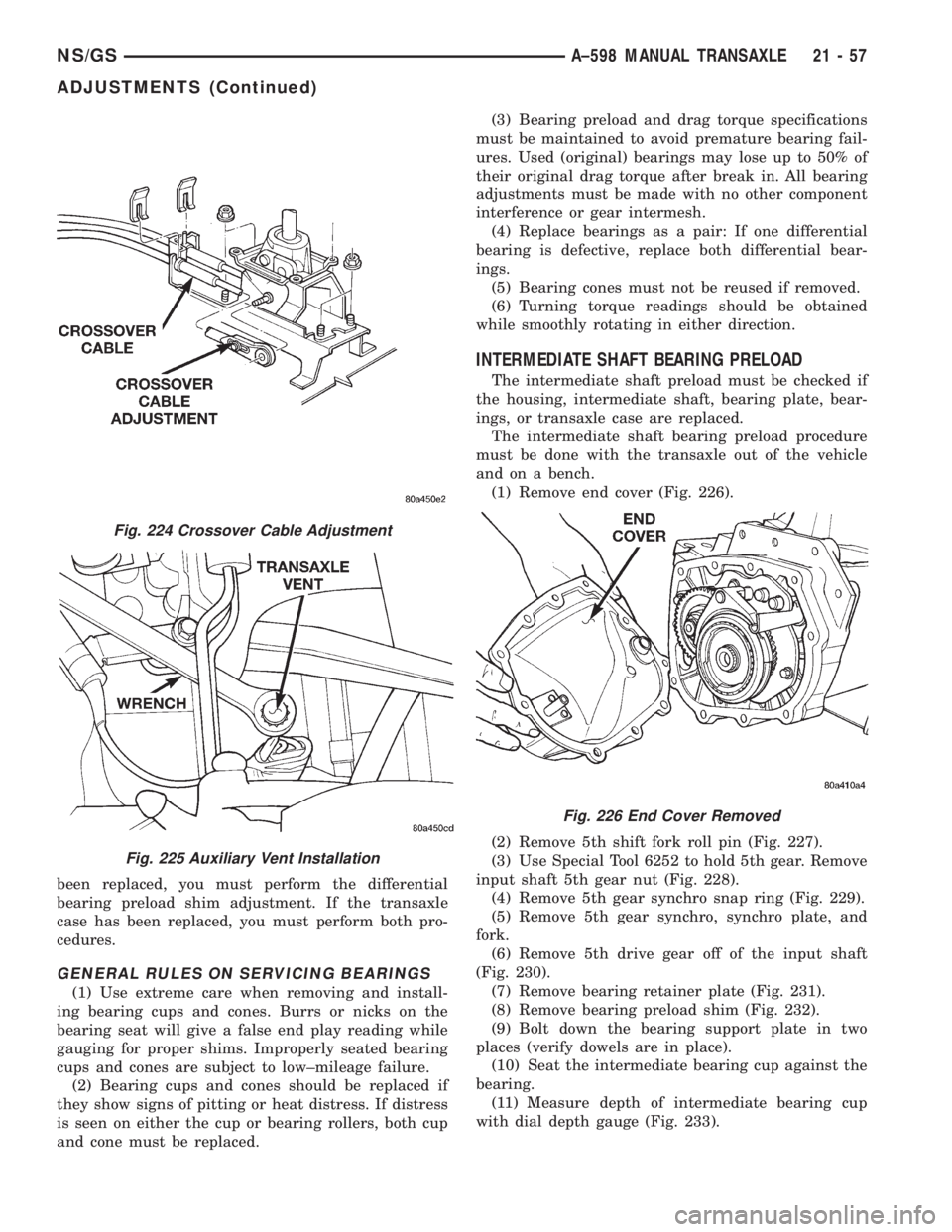
(1) Remove end cover (Fig. 226).
(2) Remove 5th shift fork roll pin (Fig. 227).
(3) Use Special Tool 6252 to hold 5th gear. Remove
input shaft 5th gear nut (Fig. 228).
(4) Remove 5th gear synchro snap ring (Fig. 229).
(5) Remove 5th gear synchro, synchro plate, and
fork.
(6) Remove 5th drive gear off of the input shaft
(Fig. 230).
(7) Remove bearing retainer plate (Fig. 231).
(8) Remove bearing preload shim (Fig. 232).
(9) Bolt down the bearing support plate in two
places (verify dowels are in place).
(10) Seat the intermediate bearing cup against the
bearing.
(11) Measure depth of intermediate bearing cup
with dial depth gauge (Fig. 233).
Fig. 224 Crossover Cable Adjustment
Fig. 225 Auxiliary Vent Installation
Fig. 226 End Cover Removed
NS/GSA±598 MANUAL TRANSAXLE 21 - 57
ADJUSTMENTS (Continued)
Page 1715 of 1938

(14) Apply a bead of MopartGasket Maker or
equivalent onto bearing support plate. Install bearing
support plate.
(15) Install necessary shim calculated from Step
12
(16) Install bearing retainer plate. Tighten bearing
retainer plate to 17 N´m (250 in. lbs.).
(17) Install 5th drive gear onto the input shaft.
(18) Install 5th gear, synchro, fork, and plate.
(19) Install 5th gear synchro snap ring.
(20) Install 5th gear shift fork roll pin.
(21) Use Special Tool 6252 to hold 5th gear and
install new 5th gear nut at input shaft. Tighten the
retaining nut to 176 N´m (130 ft. lbs.).
(22) Use Special Tool 6930 to stake the 5th gear
retaining nut onto the input shaft (Fig. 234).
(23) Apply a bead of MopartGasket Maker or
equivalent onto end cover. Install 5th gear/synchro
end cover. Tighten bolts to 28 N´m (250 in. lbs.).
SPECIFICATIONS
A-598 (T-750) MANUAL TRANSAXLE
DESCRIPTION TORQUE
Back-up Lamp Switch..........27N´m(20ft.lbs.)
Bearing Retainer Plate........28N´m(250 in. lbs.)
Crossover Cable Adj. Screw......8N´m(70in.lbs.)
Drain Plug..................23N´m(17ft.lbs.)
Differential Housing...........54N´m(40ft.lbs.)
Diff. Bearing Retainer.........61N´m(45ft.lbs.)
Diff. Ring Gear Bolts..........94N´m(70ft.lbs.)
End Cover Bolts..............28N´m(21ft.lbs.)
Extension Housing...........28N´m(250 in. lbs.)
Gearshift Housing...........28N´m(250 in. lbs.)
*Input Gear Nut............176 N´m (130 ft. lbs.)
Input Retainer..............28N´m(250 in. lbs.)
Reverse Blocker.............12N´m(105 in. lbs.)
Transaxle Case Bolts..........29N´m(21ft.lbs.)
Vehicle Speed Sensor...........7N´m(60in.lbs.)
Vent........................6N´m(60in.lbs.)
NOTE: *The 5th/input gear is torqued to specifica-
tion and then staked in two places using Special
Tool 6930.
NOTE: Bolts that have thread sealer or torque lock
patches should not be reused. Always install new
bolts in these applications.
A-558 MANUAL TRANSAXLEÐRHD VEHICLES
DESCRIPTION TORQUE
Back-up Lamp Switch..........27N´m(20ft.lbs.)
Bearing Retainer Plate........28N´m(250 in. lbs.)
Crossover Cable Adj. Screw......8N´m(70in.lbs.)
Drain Plug..................23N´m(17ft.lbs.)
Modular Clutch to Drive
Plate Bolts................74N´m(55ft.lbs.)
Transaxle Case Bolts..........29N´m(21ft.lbs.)
Vehicle Speed Sensor...........7N´m(60in.lbs.)
Vent........................6N´m(60in.lbs.)
Fig. 233 Measure Depth Of Cup
Fig. 234 Staking 5th Gear Retaining Nut
NV T750 (A-598) MANUAL TRANSAXLE FLUID
FILL
TRANSAXLEMETRIC MEA-
SUREU.S. MEASURE
NV T750 1.9-2.2 Liters 2.0-2.3 Quarts
NS/GSA±598 MANUAL TRANSAXLE 21 - 59
ADJUSTMENTS (Continued)
Page 1750 of 1938
POWER SEAT SWITCH
Diagnostic information for power seat switch is
located in Group 8R, Power Seats.
REMOVAL
(1) Remove seat cushion side cover.
(2) Disconnect wire connector from power seat
switch.
(3) Pry power seat switch knobs straight off switch
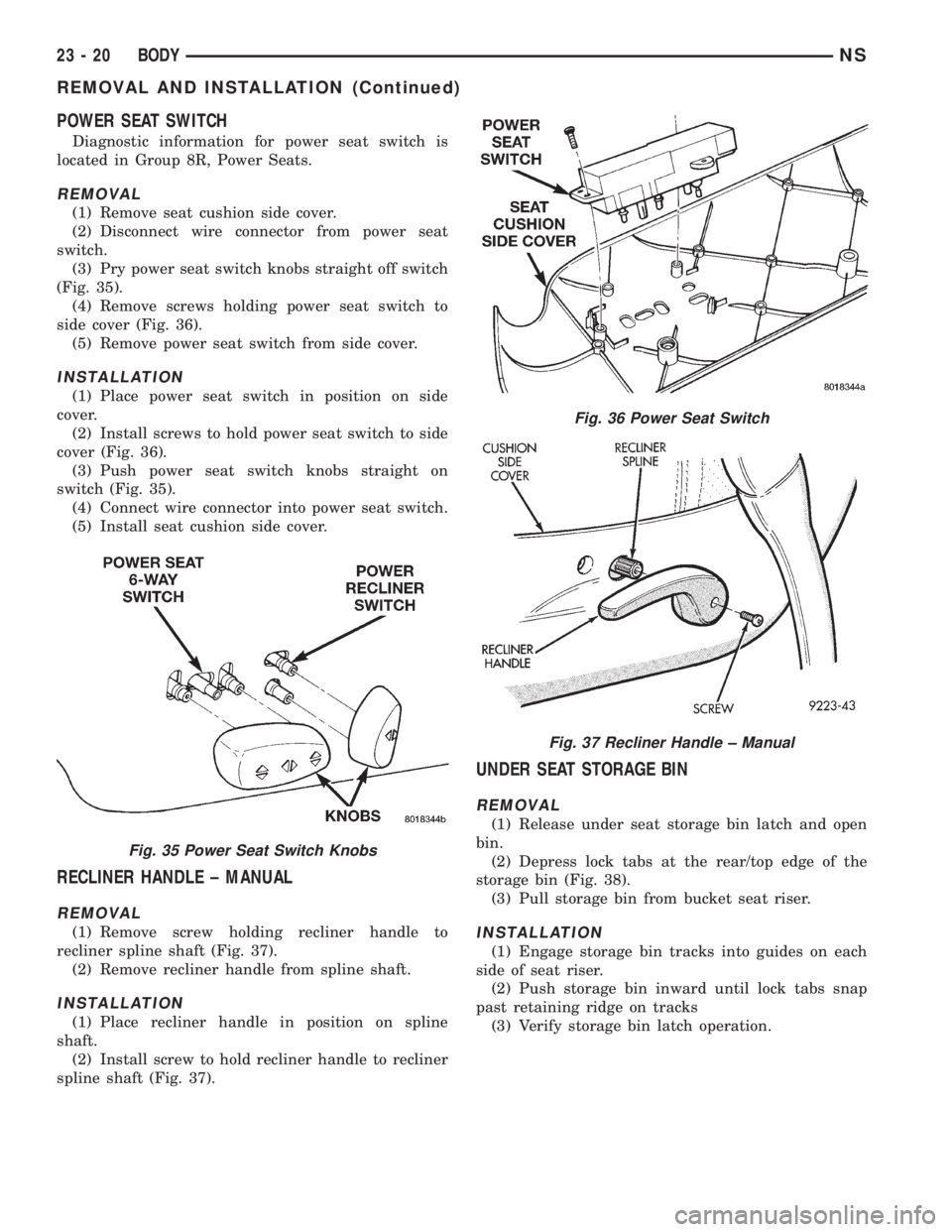
(Fig. 35).
(4) Remove screws holding power seat switch to
side cover (Fig. 36).
(5) Remove power seat switch from side cover.
INSTALLATION
(1) Place power seat switch in position on side
cover.
(2) Install screws to hold power seat switch to side
cover (Fig. 36).
(3) Push power seat switch knobs straight on
switch (Fig. 35).
(4) Connect wire connector into power seat switch.
(5) Install seat cushion side cover.
RECLINER HANDLE ± MANUAL
REMOVAL
(1) Remove screw holding recliner handle to
recliner spline shaft (Fig. 37).
(2) Remove recliner handle from spline shaft.
INSTALLATION
(1) Place recliner handle in position on spline
shaft.
(2) Install screw to hold recliner handle to recliner
spline shaft (Fig. 37).
UNDER SEAT STORAGE BIN
REMOVAL
(1) Release under seat storage bin latch and open
bin.
(2) Depress lock tabs at the rear/top edge of the
storage bin (Fig. 38).
(3) Pull storage bin from bucket seat riser.
INSTALLATION
(1) Engage storage bin tracks into guides on each
side of seat riser.
(2) Push storage bin inward until lock tabs snap
past retaining ridge on tracks
(3) Verify storage bin latch operation.
Fig. 35 Power Seat Switch Knobs
Fig. 36 Power Seat Switch
Fig. 37 Recliner Handle ± Manual
23 - 20 BODYNS
REMOVAL AND INSTALLATION (Continued)
Page 1766 of 1938
(15) If equipped, install screw to attach door pull
cup to inner door panel.
(16) If equipped, install screws to attach door
assist handle to inner door panel.
(17) Connect wire connector into courtesy lamp.
(18) Install lamp in door trim.
FRONT DOOR WEATHER-STRIP
REMOVAL
(1) Open front door.
(2) Using fork tool (C-4829), remove push-in fas-
teners holding front door weather-strip to end frames
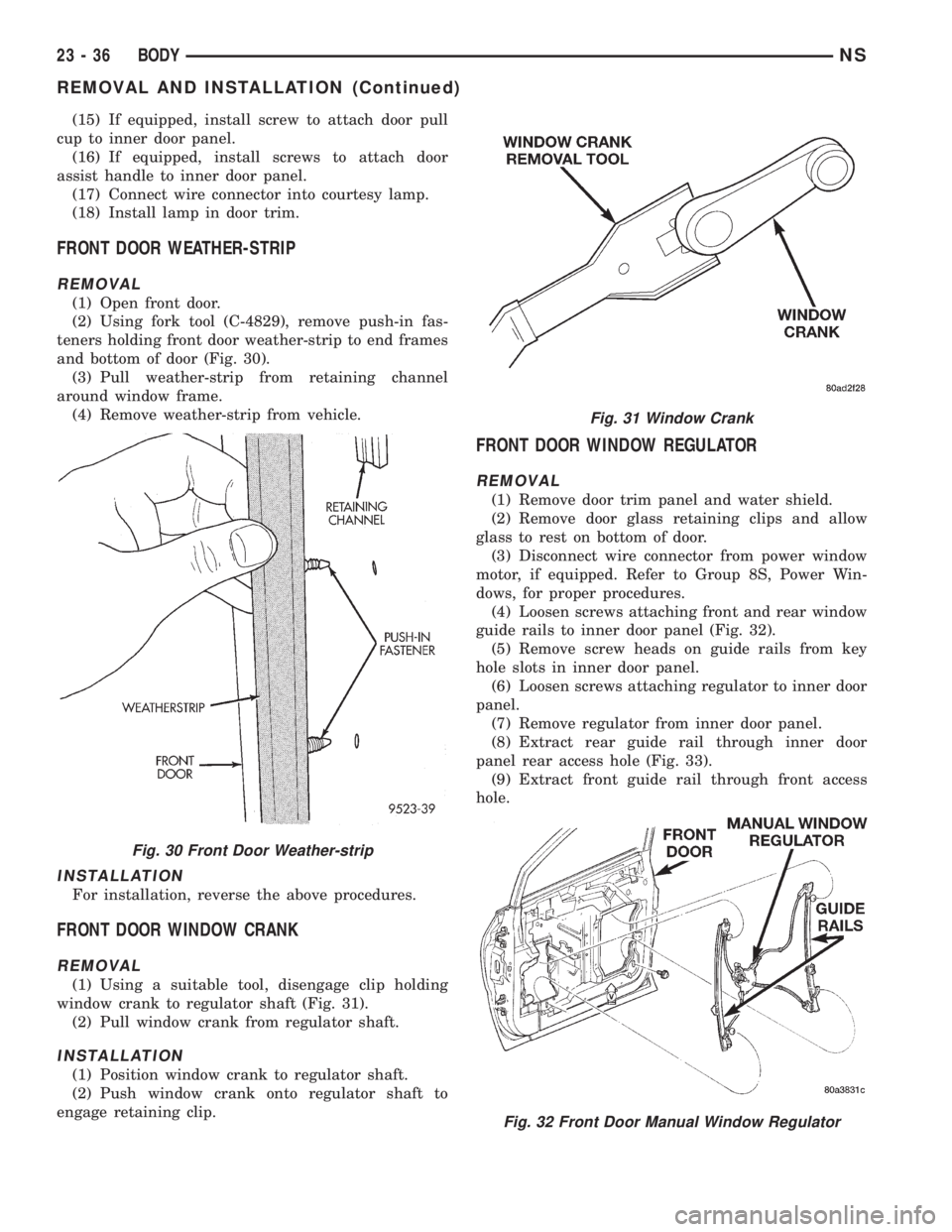
and bottom of door (Fig. 30).
(3) Pull weather-strip from retaining channel
around window frame.
(4) Remove weather-strip from vehicle.
INSTALLATION
For installation, reverse the above procedures.
FRONT DOOR WINDOW CRANK
REMOVAL
(1) Using a suitable tool, disengage clip holding
window crank to regulator shaft (Fig. 31).
(2) Pull window crank from regulator shaft.
INSTALLATION
(1) Position window crank to regulator shaft.
(2) Push window crank onto regulator shaft to
engage retaining clip.
FRONT DOOR WINDOW REGULATOR
REMOVAL
(1) Remove door trim panel and water shield.
(2) Remove door glass retaining clips and allow
glass to rest on bottom of door.
(3) Disconnect wire connector from power window
motor, if equipped. Refer to Group 8S, Power Win-
dows, for proper procedures.
(4) Loosen screws attaching front and rear window
guide rails to inner door panel (Fig. 32).
(5) Remove screw heads on guide rails from key
hole slots in inner door panel.
(6) Loosen screws attaching regulator to inner door
panel.
(7) Remove regulator from inner door panel.
(8) Extract rear guide rail through inner door
panel rear access hole (Fig. 33).
(9) Extract front guide rail through front access
hole.
Fig. 30 Front Door Weather-strip
Fig. 31 Window Crank
Fig. 32 Front Door Manual Window Regulator
23 - 36 BODYNS
REMOVAL AND INSTALLATION (Continued)
Page 1839 of 1938
COMPRESSOR
REMOVAL
WARNING: REFER TO REFRIGERANT SERVICE
PROCEDURES FOR INFORMATION REGARDING
PROPER RECOVERY OF THE REFRIGERANT
BEFORE ATTEMPTING TO REMOVE THE COM-
PRESSOR.
(1) Disconnect negative battery cable.
(2) Pinch off coolant lines to rear Heat unit (if
equipped). Drain engine coolant.
(3) Remove upper radiator hose.
(4) Remove drive belt (refer to Group 7, Cooling
System). Disconnect compressor clutch wire lead.
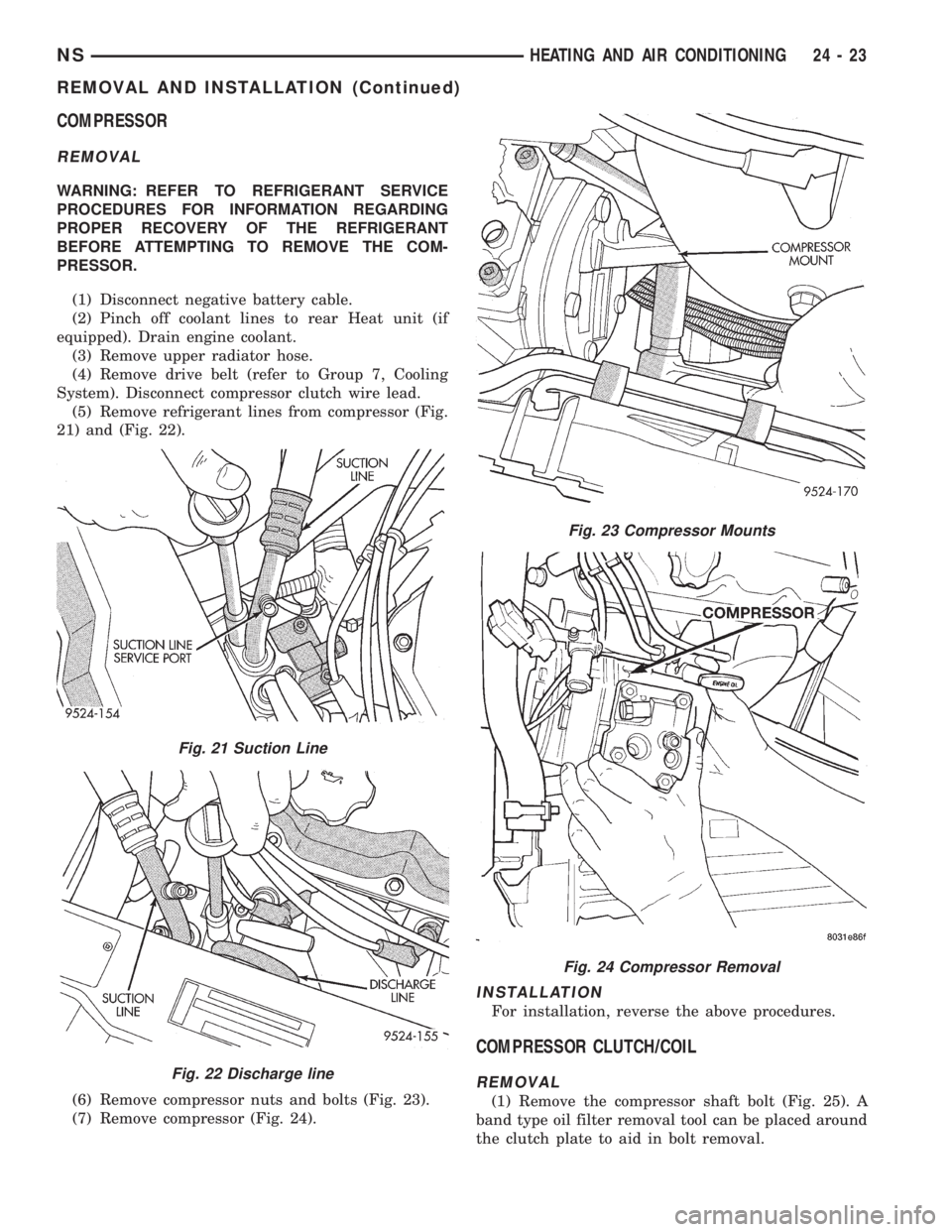
(5) Remove refrigerant lines from compressor (Fig.
21) and (Fig. 22).
(6) Remove compressor nuts and bolts (Fig. 23).
(7) Remove compressor (Fig. 24).
INSTALLATION
For installation, reverse the above procedures.
COMPRESSOR CLUTCH/COIL
REMOVAL
(1) Remove the compressor shaft bolt (Fig. 25). A
band type oil filter removal tool can be placed around
the clutch plate to aid in bolt removal.
Fig. 21 Suction Line
Fig. 22 Discharge line
Fig. 23 Compressor Mounts
Fig. 24 Compressor Removal
NSHEATING AND AIR CONDITIONING 24 - 23
REMOVAL AND INSTALLATION (Continued)
Page 1840 of 1938
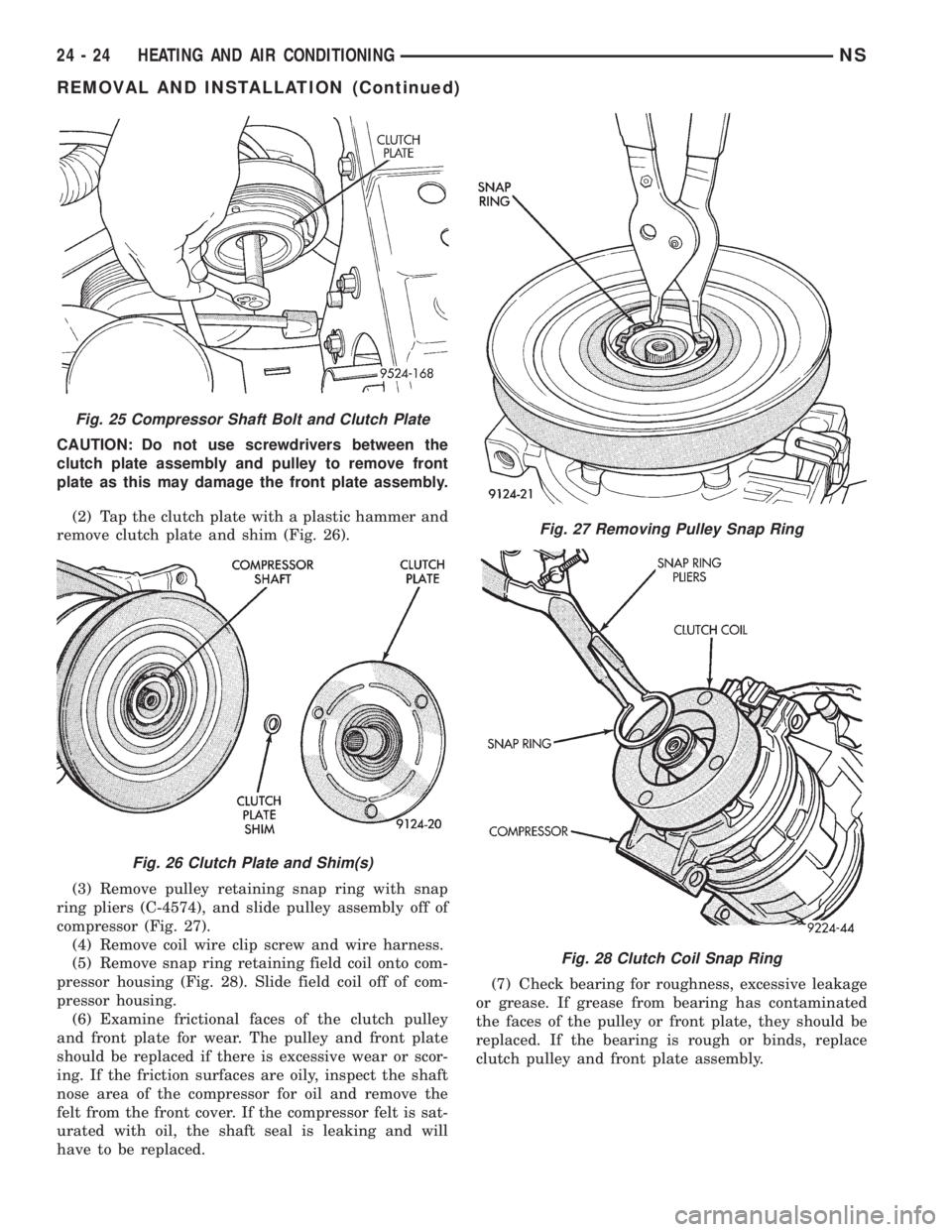
CAUTION: Do not use screwdrivers between the
clutch plate assembly and pulley to remove front
plate as this may damage the front plate assembly.
(2) Tap the clutch plate with a plastic hammer and
remove clutch plate and shim (Fig. 26).
(3) Remove pulley retaining snap ring with snap
ring pliers (C-4574), and slide pulley assembly off of
compressor (Fig. 27).
(4) Remove coil wire clip screw and wire harness.
(5) Remove snap ring retaining field coil onto com-
pressor housing (Fig. 28). Slide field coil off of com-
pressor housing.
(6) Examine frictional faces of the clutch pulley
and front plate for wear. The pulley and front plate
should be replaced if there is excessive wear or scor-
ing. If the friction surfaces are oily, inspect the shaft
nose area of the compressor for oil and remove the
felt from the front cover. If the compressor felt is sat-
urated with oil, the shaft seal is leaking and will
have to be replaced.(7) Check bearing for roughness, excessive leakage
or grease. If grease from bearing has contaminated
the faces of the pulley or front plate, they should be
replaced. If the bearing is rough or binds, replace
clutch pulley and front plate assembly.
Fig. 25 Compressor Shaft Bolt and Clutch Plate
Fig. 26 Clutch Plate and Shim(s)
Fig. 27 Removing Pulley Snap Ring
Fig. 28 Clutch Coil Snap Ring
24 - 24 HEATING AND AIR CONDITIONINGNS
REMOVAL AND INSTALLATION (Continued)
Page 1841 of 1938
CAUTION: The clutch pulley and the front plate
were mated at the factory by a burnishing opera-
tion. No attempt should be made to separately
replace either part. This will result in clutch slip-
page due to insufficient contact area.
INSTALLATION
(1) Align pin in back of field coil with hole in com-
pressor end housing, and position field coil into place.
Make sure that lead wires are properly routed, and
fasten with the wire clip screw.
(2) Install field coil retaining snap ring with snap
ring pliers. The bevel side of the snap ring facing
outward. Also both snap ring eyelets must be to the
right or left of the pin on compressor. Press snap ring
to make sure it is properly seated in the groove.
CAUTION: If snap ring is not fully seated it will
vibrate out, resulting in a clutch failure and severe
damage to the front face of the compressor.
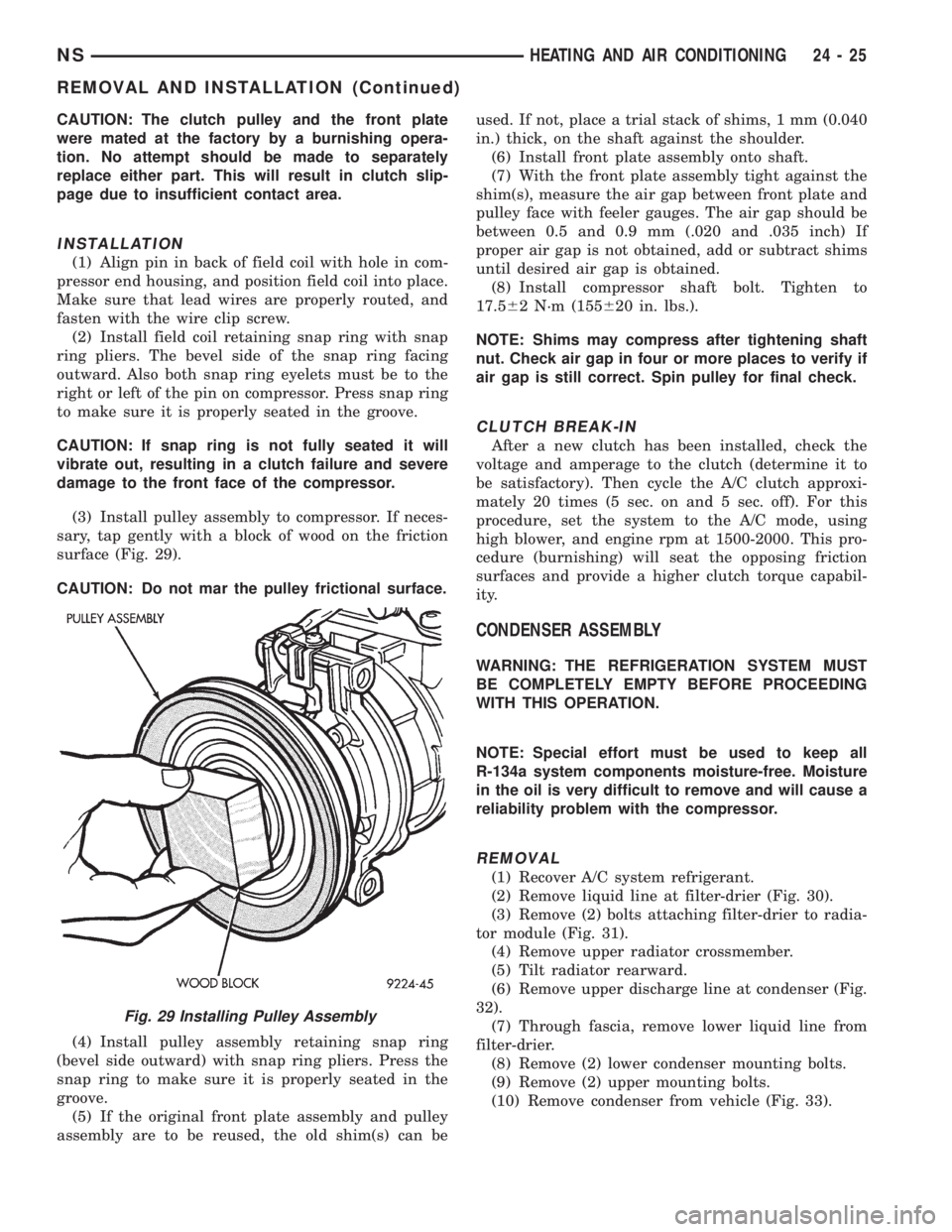
(3) Install pulley assembly to compressor. If neces-
sary, tap gently with a block of wood on the friction
surface (Fig. 29).
CAUTION: Do not mar the pulley frictional surface.
(4) Install pulley assembly retaining snap ring
(bevel side outward) with snap ring pliers. Press the
snap ring to make sure it is properly seated in the
groove.
(5) If the original front plate assembly and pulley
assembly are to be reused, the old shim(s) can beused. If not, place a trial stack of shims, 1 mm (0.040
in.) thick, on the shaft against the shoulder.
(6) Install front plate assembly onto shaft.
(7) With the front plate assembly tight against the
shim(s), measure the air gap between front plate and
pulley face with feeler gauges. The air gap should be
between 0.5 and 0.9 mm (.020 and .035 inch) If
proper air gap is not obtained, add or subtract shims
until desired air gap is obtained.
(8) Install compressor shaft bolt. Tighten to
17.562 N´m (155620 in. lbs.).
NOTE: Shims may compress after tightening shaft
nut. Check air gap in four or more places to verify if
air gap is still correct. Spin pulley for final check.
CLUTCH BREAK-IN
After a new clutch has been installed, check the
voltage and amperage to the clutch (determine it to
be satisfactory). Then cycle the A/C clutch approxi-
mately 20 times (5 sec. on and 5 sec. off). For this
procedure, set the system to the A/C mode, using
high blower, and engine rpm at 1500-2000. This pro-
cedure (burnishing) will seat the opposing friction
surfaces and provide a higher clutch torque capabil-
ity.
CONDENSER ASSEMBLY
WARNING: THE REFRIGERATION SYSTEM MUST
BE COMPLETELY EMPTY BEFORE PROCEEDING
WITH THIS OPERATION.
NOTE: Special effort must be used to keep all
R-134a system components moisture-free. Moisture
in the oil is very difficult to remove and will cause a
reliability problem with the compressor.
REMOVAL
(1) Recover A/C system refrigerant.
(2) Remove liquid line at filter-drier (Fig. 30).
(3) Remove (2) bolts attaching filter-drier to radia-
tor module (Fig. 31).
(4) Remove upper radiator crossmember.
(5) Tilt radiator rearward.
(6) Remove upper discharge line at condenser (Fig.
32).
(7) Through fascia, remove lower liquid line from
filter-drier.
(8) Remove (2) lower condenser mounting bolts.
(9) Remove (2) upper mounting bolts.
(10) Remove condenser from vehicle (Fig. 33).
Fig. 29 Installing Pulley Assembly
NSHEATING AND AIR CONDITIONING 24 - 25
REMOVAL AND INSTALLATION (Continued)
Page 1846 of 1938
(10) Disconnect the two upper mounts from the
upper reinforcement and the lower mount from the
tunnel.
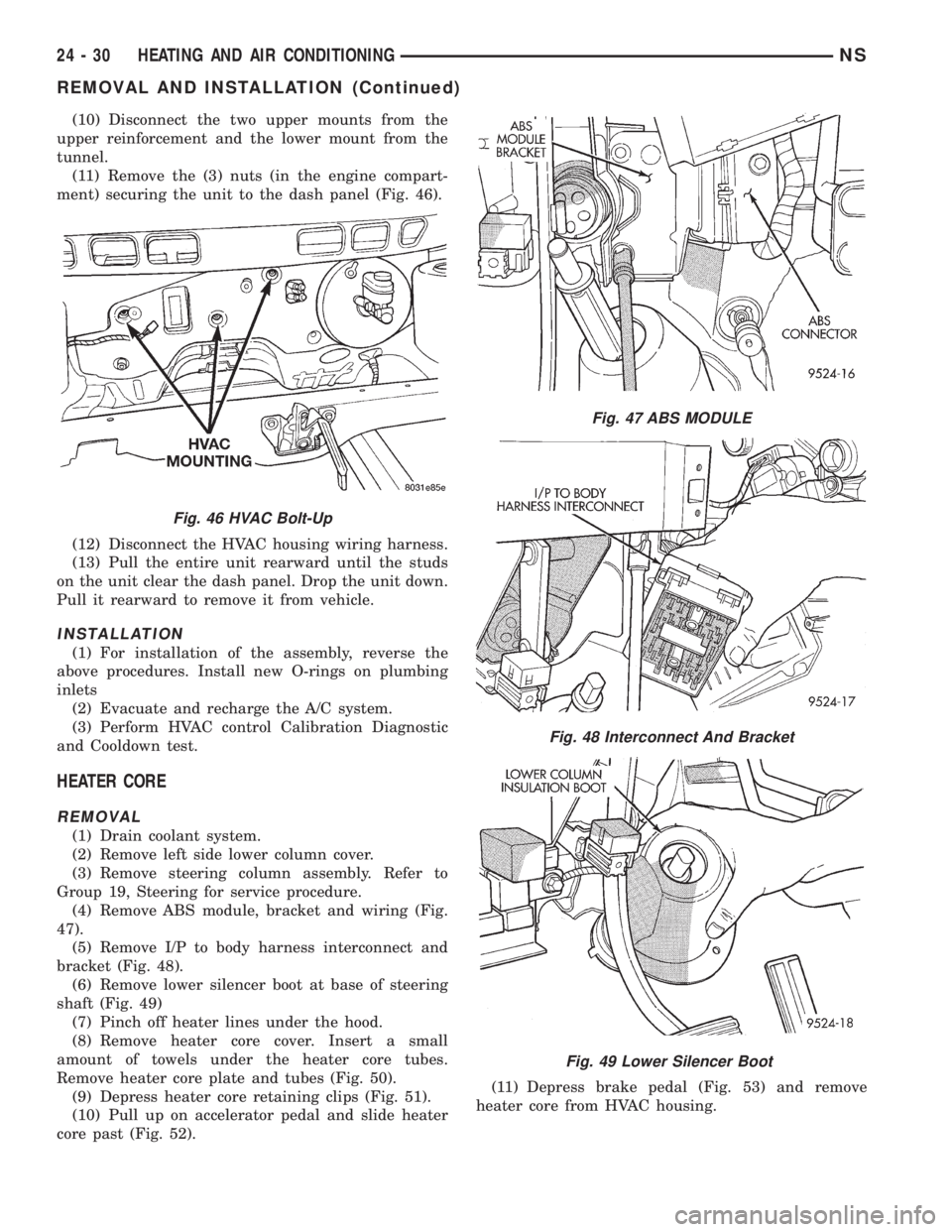
(11) Remove the (3) nuts (in the engine compart-
ment) securing the unit to the dash panel (Fig. 46).
(12) Disconnect the HVAC housing wiring harness.
(13) Pull the entire unit rearward until the studs
on the unit clear the dash panel. Drop the unit down.
Pull it rearward to remove it from vehicle.
INSTALLATION
(1) For installation of the assembly, reverse the
above procedures. Install new O-rings on plumbing
inlets
(2) Evacuate and recharge the A/C system.
(3) Perform HVAC control Calibration Diagnostic
and Cooldown test.
HEATER CORE
REMOVAL
(1) Drain coolant system.
(2) Remove left side lower column cover.
(3) Remove steering column assembly. Refer to
Group 19, Steering for service procedure.
(4) Remove ABS module, bracket and wiring (Fig.
47).
(5) Remove I/P to body harness interconnect and
bracket (Fig. 48).
(6) Remove lower silencer boot at base of steering
shaft (Fig. 49)
(7) Pinch off heater lines under the hood.
(8) Remove heater core cover. Insert a small
amount of towels under the heater core tubes.
Remove heater core plate and tubes (Fig. 50).
(9) Depress heater core retaining clips (Fig. 51).
(10) Pull up on accelerator pedal and slide heater
core past (Fig. 52).(11) Depress brake pedal (Fig. 53) and remove
heater core from HVAC housing.
Fig. 46 HVAC Bolt-Up
Fig. 47 ABS MODULE
Fig. 48 Interconnect And Bracket
Fig. 49 Lower Silencer Boot
24 - 30 HEATING AND AIR CONDITIONINGNS
REMOVAL AND INSTALLATION (Continued)
Page 1855 of 1938
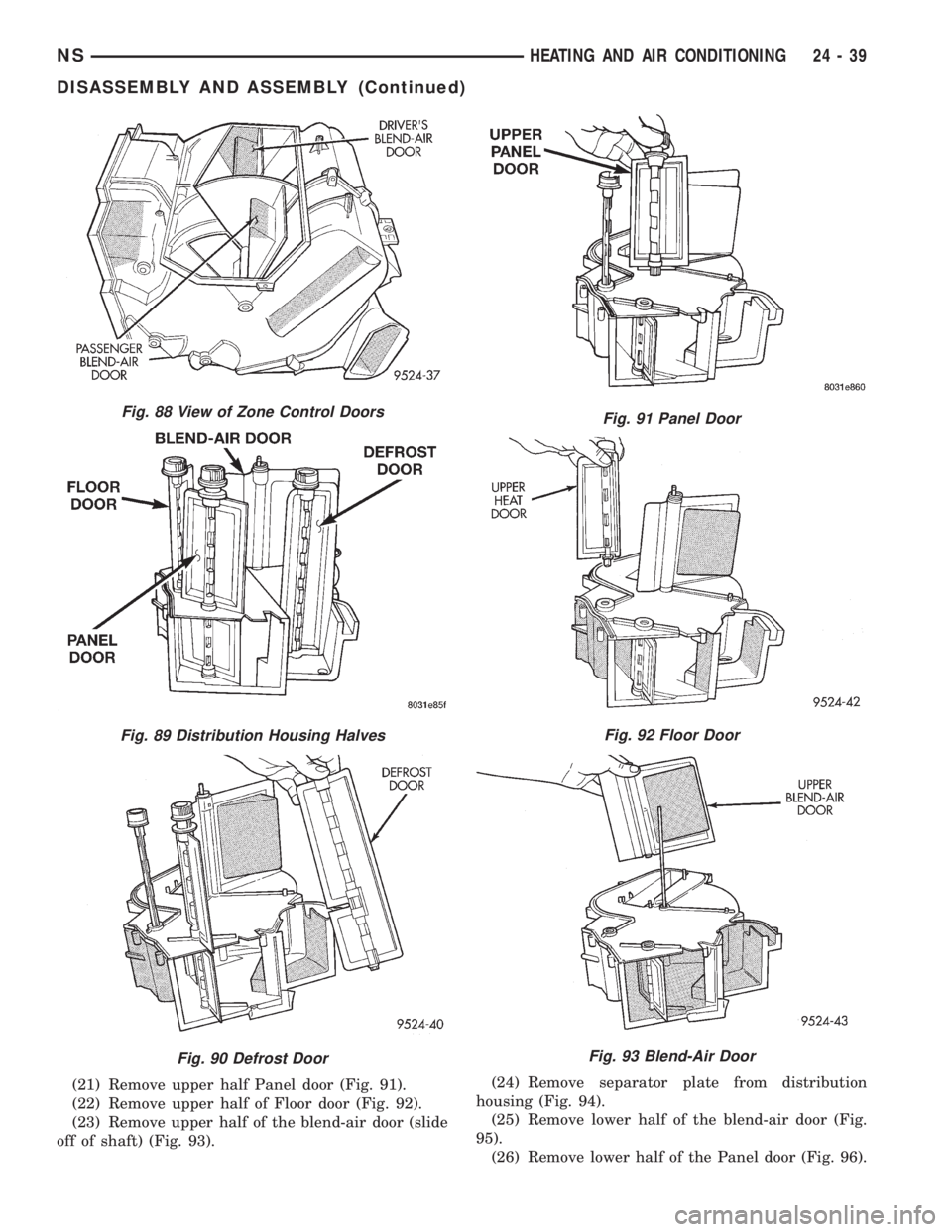
(21) Remove upper half Panel door (Fig. 91).
(22) Remove upper half of Floor door (Fig. 92).
(23) Remove upper half of the blend-air door (slide
off of shaft) (Fig. 93).(24) Remove separator plate from distribution
housing (Fig. 94).
(25) Remove lower half of the blend-air door (Fig.
95).
(26) Remove lower half of the Panel door (Fig. 96).
Fig. 88 View of Zone Control Doors
Fig. 89 Distribution Housing Halves
Fig. 90 Defrost Door
Fig. 91 Panel Door
Fig. 92 Floor Door
Fig. 93 Blend-Air Door
NSHEATING AND AIR CONDITIONING 24 - 39
DISASSEMBLY AND ASSEMBLY (Continued)
Page 1892 of 1938
(2) Hand-start the stud into the expansion valve
and torque to7-11N´m(64-96in.lbs.).
(3) Carefully install the expansion valve to the
sealing plate. Install the two screws and tighten 8 to
14 N´m (70 to 130 in. lbs.) torque.
(4) Carefully install the refrigerant lines and seal-
ing plate to the expansion valve. Install the nut and
tighten 20 to 26 N´m (170 to 230 in. lbs.) torque.
(5) Install the ground wire at dash panel.
(6) Pull generator back into the proper position for
bracket mounting.
(7) Install generator field wire connector.
(8) Install the upper generator bracket.
(9) Install accessory drive belt.
(10) Evacuate and recharge system.
(11) After expansion valve is installed, the system
is charged, and leaks have checked repeat the A/C
performance check.
FILTER-DRIER ASSEMBLY
REMOVAL
WARNING: THE REFRIGERATION SYSTEM MUST
BE COMPLETELY EMPTY BEFORE PROCEEDING
WITH THIS OPERATION.
(1) Recover A/C system refrigerant.
(2) Remove liquid line at filter-drier (Fig. 21).
(3) Remove the (2) bolts holding filter-drier bracket
to radiator fan module bracket.
(4) Remove the lower liquid line at condenser.
(5) Remove the upper radiator crossmember.
(6) Pull up on radiator and slide filter-drier from
the mounting location.
INSTALLATION
(1) Before installation, replace both refrigerant
line O-rings. Then reverse the above procedures.
(2) Evacuate and recharge system.
HEATER A/C UNIT HOUSING
REMOVAL
WARNING: IF EQUIPPED WITH AIR CONDITIONING,
THE REFRIGERATION SYSTEM MUST BE COM-
PLETELY EMPTY BEFORE PROCEEDING.
(1) Set parking brake.
(2) Disconnect battery negative cable.
(3) Using a refrigerant recovery machine, remove
refrigerant from the A/C system.
(4) Remove wiper module. Refer to Group 8K,
Windshield Wipers and Washers.
(5) Drain engine coolant. Remove heater hoses at
the heater core, refer to Heater Hoses Removal and
Installation procedures. Plug coolant lines.(6) Remove suction and liquid lines at the expan-
sion valve (Fig. 27).
(7) Remove the Instrument Panel Assembly. Refer
to Group 8E, Instrument Panel and Systems.
(8) Remove heater ducts.
(9) Disconnect the two upper mounts from the
upper reinforcement and the lower mount from the
tunnel.
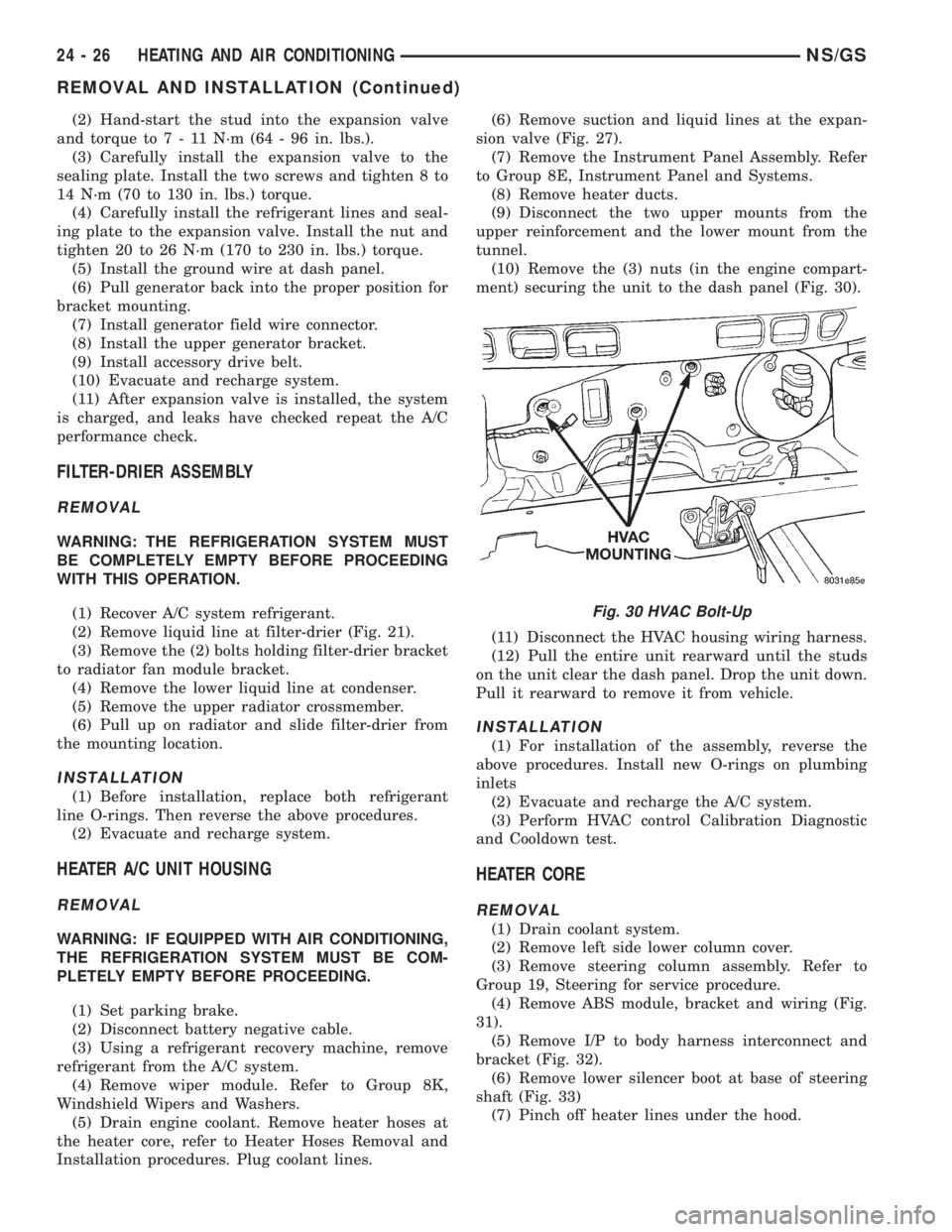
(10) Remove the (3) nuts (in the engine compart-
ment) securing the unit to the dash panel (Fig. 30).
(11) Disconnect the HVAC housing wiring harness.
(12) Pull the entire unit rearward until the studs
on the unit clear the dash panel. Drop the unit down.
Pull it rearward to remove it from vehicle.
INSTALLATION
(1) For installation of the assembly, reverse the
above procedures. Install new O-rings on plumbing
inlets
(2) Evacuate and recharge the A/C system.
(3) Perform HVAC control Calibration Diagnostic
and Cooldown test.
HEATER CORE
REMOVAL
(1) Drain coolant system.
(2) Remove left side lower column cover.
(3) Remove steering column assembly. Refer to
Group 19, Steering for service procedure.
(4) Remove ABS module, bracket and wiring (Fig.
31).
(5) Remove I/P to body harness interconnect and
bracket (Fig. 32).
(6) Remove lower silencer boot at base of steering
shaft (Fig. 33)
(7) Pinch off heater lines under the hood.
Fig. 30 HVAC Bolt-Up
24 - 26 HEATING AND AIR CONDITIONINGNS/GS
REMOVAL AND INSTALLATION (Continued)