wheel CHRYSLER VOYAGER 1996 Workshop Manual
[x] Cancel search | Manufacturer: CHRYSLER, Model Year: 1996, Model line: VOYAGER, Model: CHRYSLER VOYAGER 1996Pages: 1938, PDF Size: 55.84 MB
Page 82 of 1938
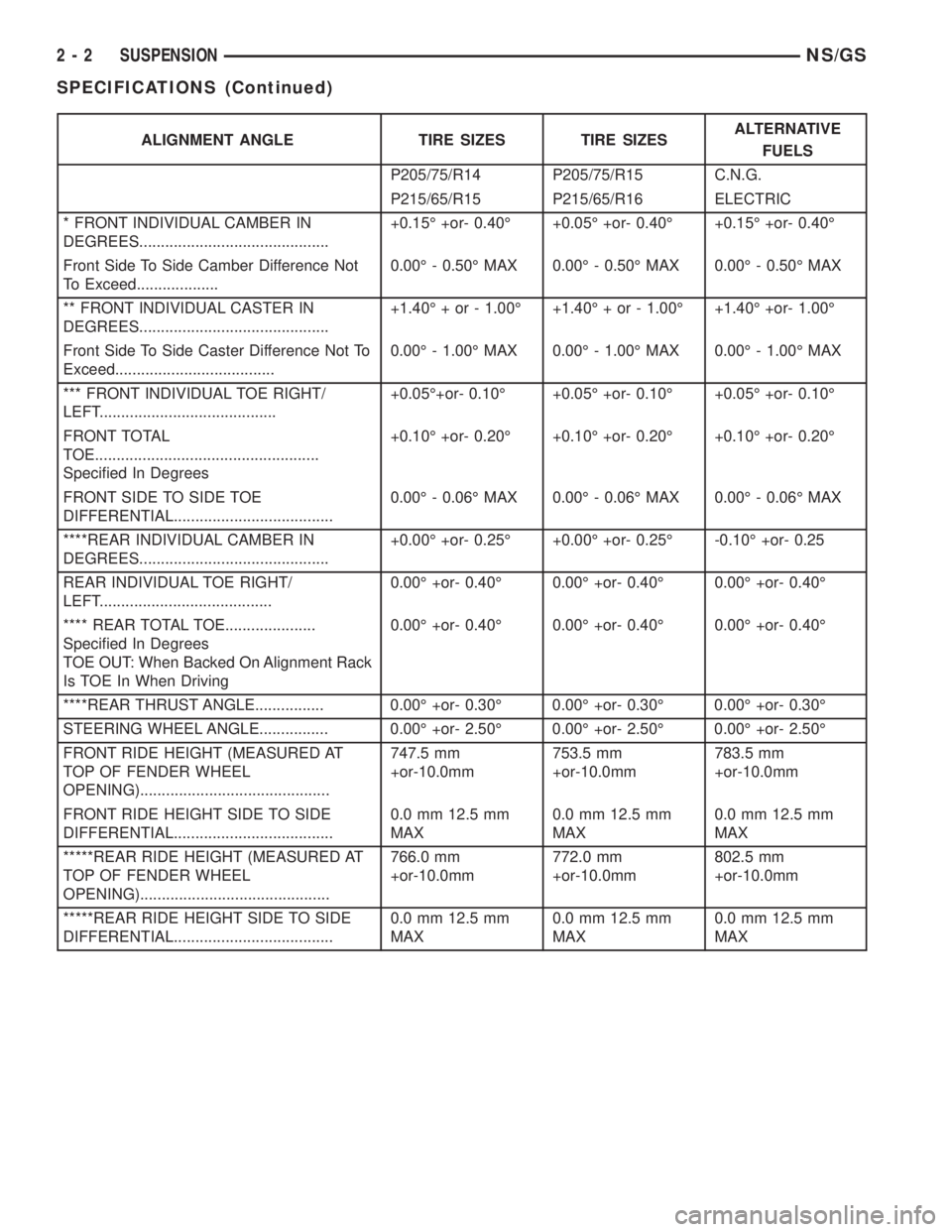
ALIGNMENT ANGLE TIRE SIZES TIRE SIZESALTERNATIVE
FUELS
P205/75/R14 P205/75/R15 C.N.G.
P215/65/R15 P215/65/R16 ELECTRIC
* FRONT INDIVIDUAL CAMBER IN
DEGREES............................................+0.15É +or- 0.40É +0.05É +or- 0.40É +0.15É +or- 0.40É
Front Side To Side Camber Difference Not
To Exceed...................0.00É - 0.50É MAX 0.00É - 0.50É MAX 0.00É - 0.50É MAX
** FRONT INDIVIDUAL CASTER IN
DEGREES............................................+1.40É + or - 1.00É +1.40É + or - 1.00É +1.40É +or- 1.00É
Front Side To Side Caster Difference Not To
Exceed.....................................0.00É - 1.00É MAX 0.00É - 1.00É MAX 0.00É - 1.00É MAX
*** FRONT INDIVIDUAL TOE RIGHT/
LEFT.........................................+0.05É+or- 0.10É +0.05É +or- 0.10É +0.05É +or- 0.10É
FRONT TOTAL
TOE....................................................
Specified In Degrees+0.10É +or- 0.20É +0.10É +or- 0.20É +0.10É +or- 0.20É
FRONT SIDE TO SIDE TOE
DIFFERENTIAL.....................................0.00É - 0.06É MAX 0.00É - 0.06É MAX 0.00É - 0.06É MAX
****REAR INDIVIDUAL CAMBER IN
DEGREES............................................+0.00É +or- 0.25É +0.00É +or- 0.25É -0.10É +or- 0.25
REAR INDIVIDUAL TOE RIGHT/
LEFT........................................0.00É +or- 0.40É 0.00É +or- 0.40É 0.00É +or- 0.40É
**** REAR TOTAL TOE.....................
Specified In Degrees
TOE OUT: When Backed On Alignment Rack
Is TOE In When Driving0.00É +or- 0.40É 0.00É +or- 0.40É 0.00É +or- 0.40É
****REAR THRUST ANGLE................ 0.00É +or- 0.30É 0.00É +or- 0.30É 0.00É +or- 0.30É
STEERING WHEEL ANGLE................ 0.00É +or- 2.50É 0.00É +or- 2.50É 0.00É +or- 2.50É
FRONT RIDE HEIGHT (MEASURED AT
TOP OF FENDER WHEEL
OPENING)............................................747.5 mm
+or-10.0mm753.5 mm
+or-10.0mm783.5 mm
+or-10.0mm
FRONT RIDE HEIGHT SIDE TO SIDE
DIFFERENTIAL.....................................0.0 mm 12.5 mm
MAX0.0 mm 12.5 mm
MAX0.0 mm 12.5 mm
MAX
*****REAR RIDE HEIGHT (MEASURED AT
TOP OF FENDER WHEEL
OPENING)............................................766.0 mm
+or-10.0mm772.0 mm
+or-10.0mm802.5 mm
+or-10.0mm
*****REAR RIDE HEIGHT SIDE TO SIDE
DIFFERENTIAL.....................................0.0 mm 12.5 mm
MAX0.0 mm 12.5 mm
MAX0.0 mm 12.5 mm
MAX
2 - 2 SUSPENSIONNS/GS
SPECIFICATIONS (Continued)
Page 83 of 1938
BRAKES
CONTENTS
page page
ANTILOCK BRAKE SYSTEM ±
TEVES MARK-20....................... 85BASE BRAKE SYSTEM..................... 3
GENERAL INFORMATION................... 1
GENERAL INFORMATION
INDEX
page page
GENERAL INFORMATION
BASE BRAKE SYSTEM COMPONENT
DESCRIPTION......................... 1GENERAL VEHICLE SERVICE CAUTIONS...... 1
GENERAL INFORMATION
GENERAL VEHICLE SERVICE CAUTIONS
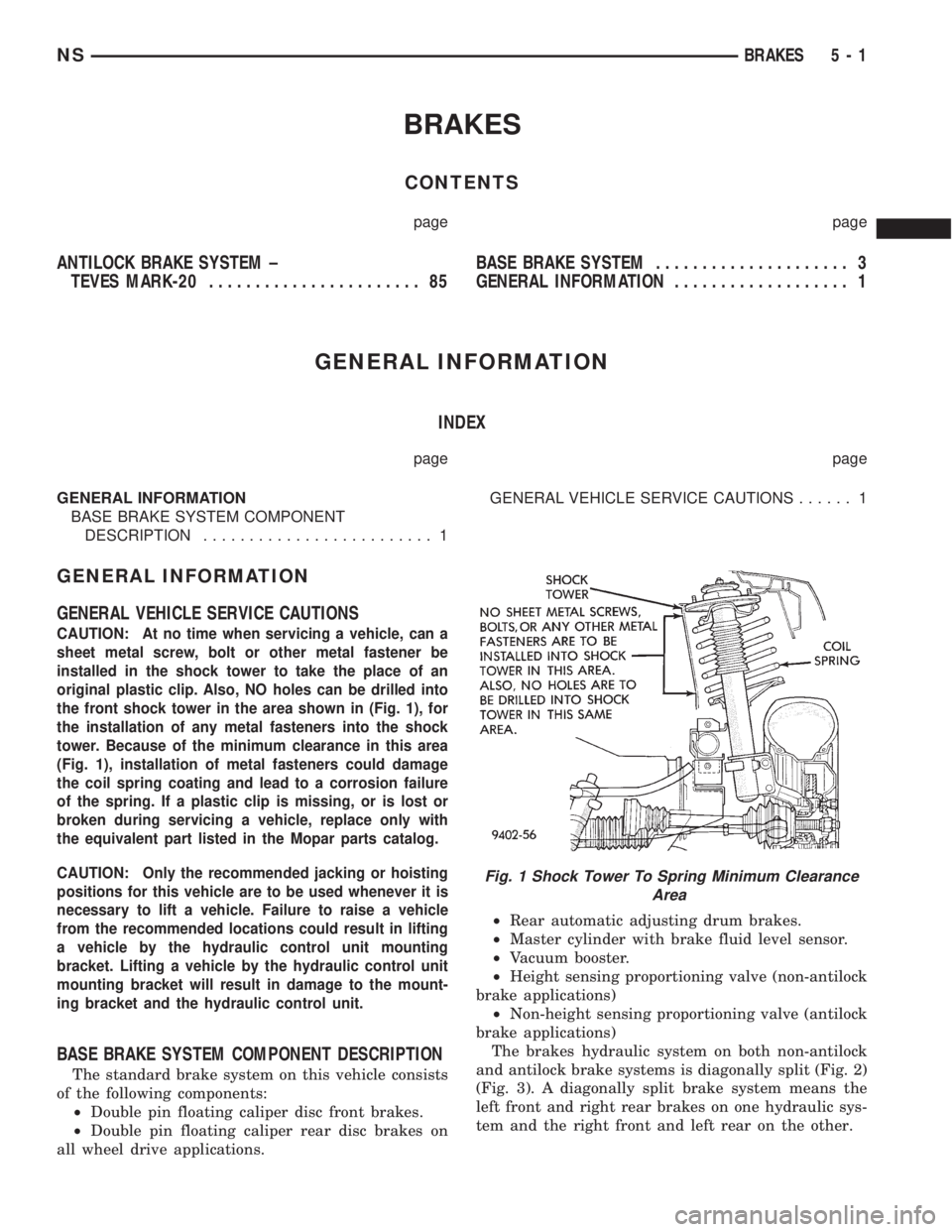
CAUTION: At no time when servicing a vehicle, can a
sheet metal screw, bolt or other metal fastener be
installed in the shock tower to take the place of an
original plastic clip. Also, NO holes can be drilled into
the front shock tower in the area shown in (Fig. 1), for
the installation of any metal fasteners into the shock
tower. Because of the minimum clearance in this area
(Fig. 1), installation of metal fasteners could damage
the coil spring coating and lead to a corrosion failure
of the spring. If a plastic clip is missing, or is lost or
broken during servicing a vehicle, replace only with
the equivalent part listed in the Mopar parts catalog.
CAUTION: Only the recommended jacking or hoisting
positions for this vehicle are to be used whenever it is
necessary to lift a vehicle. Failure to raise a vehicle
from the recommended locations could result in lifting
a vehicle by the hydraulic control unit mounting
bracket. Lifting a vehicle by the hydraulic control unit
mounting bracket will result in damage to the mount-
ing bracket and the hydraulic control unit.
BASE BRAKE SYSTEM COMPONENT DESCRIPTION
The standard brake system on this vehicle consists
of the following components:
²Double pin floating caliper disc front brakes.
²Double pin floating caliper rear disc brakes on
all wheel drive applications.²Rear automatic adjusting drum brakes.
²Master cylinder with brake fluid level sensor.
²Vacuum booster.
²Height sensing proportioning valve (non-antilock
brake applications)
²Non-height sensing proportioning valve (antilock
brake applications)
The brakes hydraulic system on both non-antilock
and antilock brake systems is diagonally split (Fig. 2)
(Fig. 3). A diagonally split brake system means the
left front and right rear brakes on one hydraulic sys-
tem and the right front and left rear on the other.
Fig. 1 Shock Tower To Spring Minimum Clearance
Area
NSBRAKES 5 - 1
Page 85 of 1938
BASE BRAKE SYSTEM
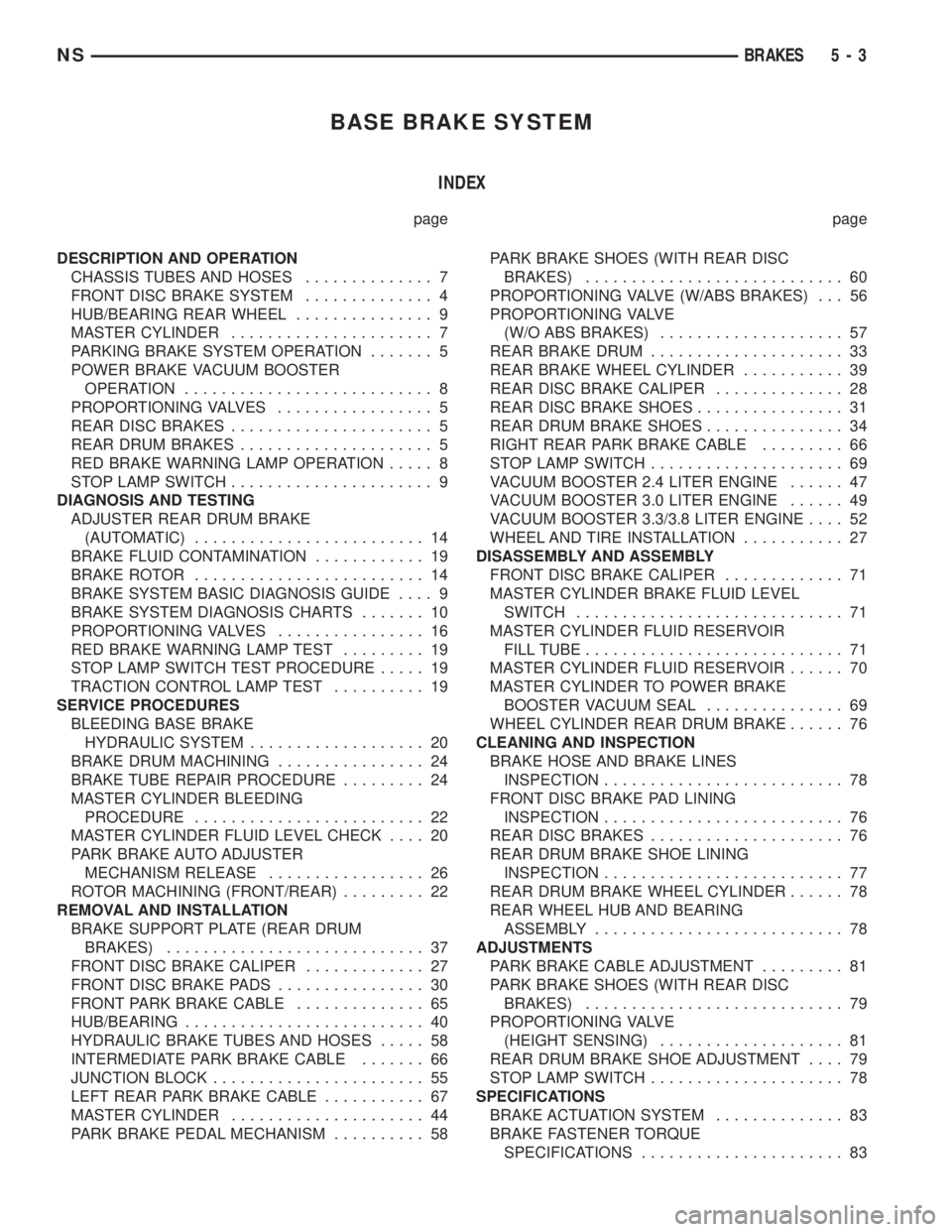
INDEX
page page
DESCRIPTION AND OPERATION
CHASSIS TUBES AND HOSES.............. 7
FRONT DISC BRAKE SYSTEM.............. 4
HUB/BEARING REAR WHEEL............... 9
MASTER CYLINDER...................... 7
PARKING BRAKE SYSTEM OPERATION....... 5
POWER BRAKE VACUUM BOOSTER
OPERATION........................... 8
PROPORTIONING VALVES................. 5
REAR DISC BRAKES...................... 5
REAR DRUM BRAKES..................... 5
RED BRAKE WARNING LAMP OPERATION..... 8
STOP LAMP SWITCH...................... 9
DIAGNOSIS AND TESTING
ADJUSTER REAR DRUM BRAKE
(AUTOMATIC)......................... 14
BRAKE FLUID CONTAMINATION............ 19
BRAKE ROTOR......................... 14
BRAKE SYSTEM BASIC DIAGNOSIS GUIDE.... 9
BRAKE SYSTEM DIAGNOSIS CHARTS....... 10
PROPORTIONING VALVES................ 16
RED BRAKE WARNING LAMP TEST......... 19
STOP LAMP SWITCH TEST PROCEDURE..... 19
TRACTION CONTROL LAMP TEST.......... 19
SERVICE PROCEDURES
BLEEDING BASE BRAKE
HYDRAULIC SYSTEM................... 20
BRAKE DRUM MACHINING................ 24
BRAKE TUBE REPAIR PROCEDURE......... 24
MASTER CYLINDER BLEEDING
PROCEDURE......................... 22
MASTER CYLINDER FLUID LEVEL CHECK.... 20
PARK BRAKE AUTO ADJUSTER
MECHANISM RELEASE................. 26
ROTOR MACHINING (FRONT/REAR)......... 22
REMOVAL AND INSTALLATION
BRAKE SUPPORT PLATE (REAR DRUM
BRAKES)............................ 37
FRONT DISC BRAKE CALIPER............. 27
FRONT DISC BRAKE PADS................ 30
FRONT PARK BRAKE CABLE.............. 65
HUB/BEARING.......................... 40
HYDRAULIC BRAKE TUBES AND HOSES..... 58
INTERMEDIATE PARK BRAKE CABLE....... 66
JUNCTION BLOCK....................... 55
LEFT REAR PARK BRAKE CABLE........... 67
MASTER CYLINDER..................... 44
PARK BRAKE PEDAL MECHANISM.......... 58PARK BRAKE SHOES (WITH REAR DISC
BRAKES)............................ 60
PROPORTIONING VALVE (W/ABS BRAKES) . . . 56
PROPORTIONING VALVE
(W/O ABS BRAKES).................... 57
REAR BRAKE DRUM..................... 33
REAR BRAKE WHEEL CYLINDER........... 39
REAR DISC BRAKE CALIPER.............. 28
REAR DISC BRAKE SHOES................ 31
REAR DRUM BRAKE SHOES............... 34
RIGHT REAR PARK BRAKE CABLE......... 66
STOP LAMP SWITCH..................... 69
VACUUM BOOSTER 2.4 LITER ENGINE...... 47
VACUUM BOOSTER 3.0 LITER ENGINE...... 49
VACUUM BOOSTER 3.3/3.8 LITER ENGINE.... 52
WHEEL AND TIRE INSTALLATION........... 27
DISASSEMBLY AND ASSEMBLY
FRONT DISC BRAKE CALIPER............. 71
MASTER CYLINDER BRAKE FLUID LEVEL
SWITCH............................. 71
MASTER CYLINDER FLUID RESERVOIR
FILL TUBE............................ 71
MASTER CYLINDER FLUID RESERVOIR...... 70
MASTER CYLINDER TO POWER BRAKE
BOOSTER VACUUM SEAL............... 69
WHEEL CYLINDER REAR DRUM BRAKE...... 76
CLEANING AND INSPECTION
BRAKE HOSE AND BRAKE LINES
INSPECTION.......................... 78
FRONT DISC BRAKE PAD LINING
INSPECTION.......................... 76
REAR DISC BRAKES..................... 76
REAR DRUM BRAKE SHOE LINING
INSPECTION.......................... 77
REAR DRUM BRAKE WHEEL CYLINDER...... 78
REAR WHEEL HUB AND BEARING
ASSEMBLY........................... 78
ADJUSTMENTS
PARK BRAKE CABLE ADJUSTMENT......... 81
PARK BRAKE SHOES (WITH REAR DISC
BRAKES)............................ 79
PROPORTIONING VALVE
(HEIGHT SENSING).................... 81
REAR DRUM BRAKE SHOE ADJUSTMENT.... 79
STOP LAMP SWITCH..................... 78
SPECIFICATIONS
BRAKE ACTUATION SYSTEM.............. 83
BRAKE FASTENER TORQUE
SPECIFICATIONS...................... 83
NSBRAKES 5 - 3
Page 87 of 1938
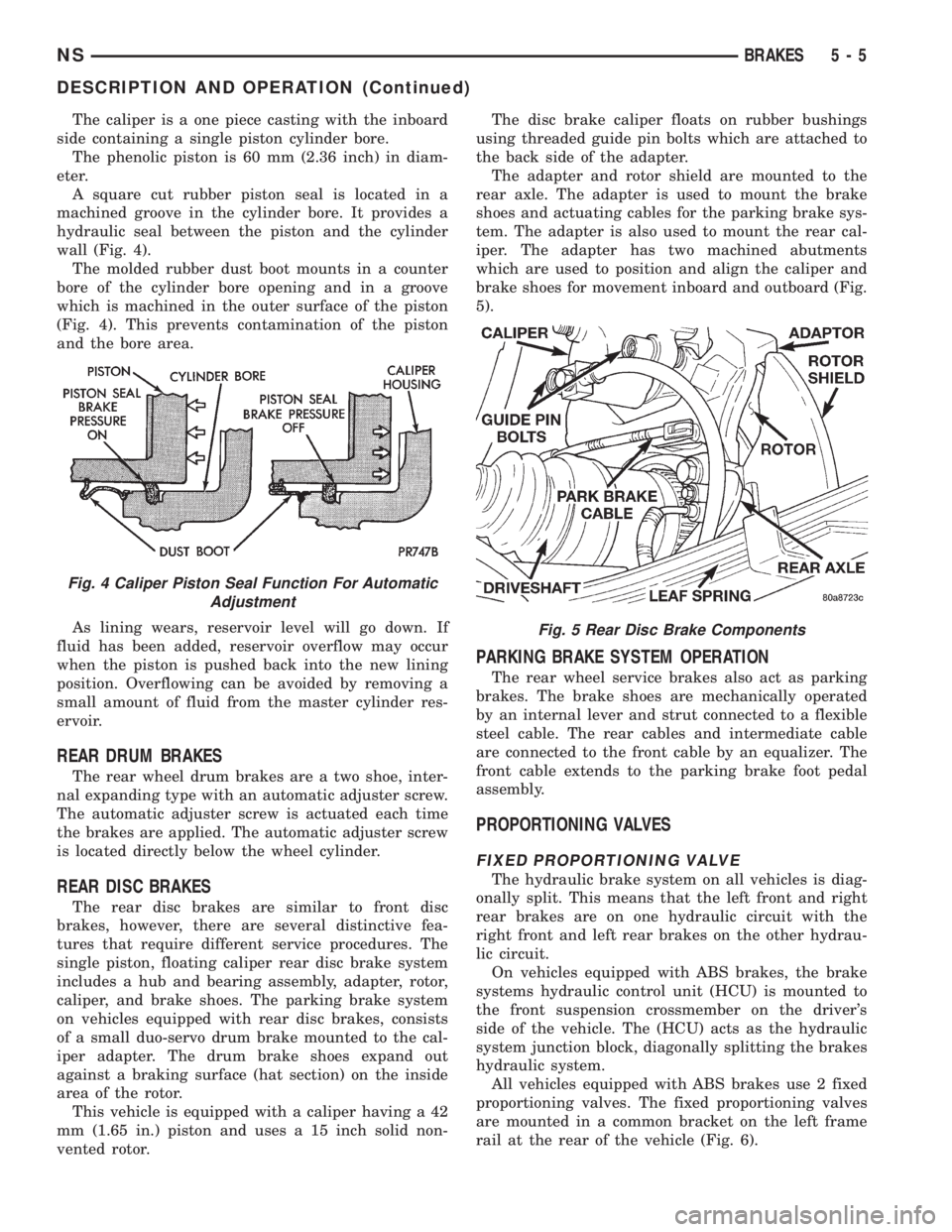
The caliper is a one piece casting with the inboard
side containing a single piston cylinder bore.
The phenolic piston is 60 mm (2.36 inch) in diam-
eter.
A square cut rubber piston seal is located in a
machined groove in the cylinder bore. It provides a
hydraulic seal between the piston and the cylinder
wall (Fig. 4).
The molded rubber dust boot mounts in a counter
bore of the cylinder bore opening and in a groove
which is machined in the outer surface of the piston
(Fig. 4). This prevents contamination of the piston
and the bore area.
As lining wears, reservoir level will go down. If
fluid has been added, reservoir overflow may occur
when the piston is pushed back into the new lining
position. Overflowing can be avoided by removing a
small amount of fluid from the master cylinder res-
ervoir.
REAR DRUM BRAKES
The rear wheel drum brakes are a two shoe, inter-
nal expanding type with an automatic adjuster screw.
The automatic adjuster screw is actuated each time
the brakes are applied. The automatic adjuster screw
is located directly below the wheel cylinder.
REAR DISC BRAKES
The rear disc brakes are similar to front disc
brakes, however, there are several distinctive fea-
tures that require different service procedures. The
single piston, floating caliper rear disc brake system
includes a hub and bearing assembly, adapter, rotor,
caliper, and brake shoes. The parking brake system
on vehicles equipped with rear disc brakes, consists
of a small duo-servo drum brake mounted to the cal-
iper adapter. The drum brake shoes expand out
against a braking surface (hat section) on the inside
area of the rotor.
This vehicle is equipped with a caliper having a 42
mm (1.65 in.) piston and uses a 15 inch solid non-
vented rotor.The disc brake caliper floats on rubber bushings
using threaded guide pin bolts which are attached to
the back side of the adapter.
The adapter and rotor shield are mounted to the
rear axle. The adapter is used to mount the brake
shoes and actuating cables for the parking brake sys-
tem. The adapter is also used to mount the rear cal-
iper. The adapter has two machined abutments
which are used to position and align the caliper and
brake shoes for movement inboard and outboard (Fig.
5).
PARKING BRAKE SYSTEM OPERATION
The rear wheel service brakes also act as parking
brakes. The brake shoes are mechanically operated
by an internal lever and strut connected to a flexible
steel cable. The rear cables and intermediate cable
are connected to the front cable by an equalizer. The
front cable extends to the parking brake foot pedal
assembly.
PROPORTIONING VALVES
FIXED PROPORTIONING VALVE
The hydraulic brake system on all vehicles is diag-
onally split. This means that the left front and right
rear brakes are on one hydraulic circuit with the
right front and left rear brakes on the other hydrau-
lic circuit.
On vehicles equipped with ABS brakes, the brake
systems hydraulic control unit (HCU) is mounted to
the front suspension crossmember on the driver's
side of the vehicle. The (HCU) acts as the hydraulic
system junction block, diagonally splitting the brakes
hydraulic system.
All vehicles equipped with ABS brakes use 2 fixed
proportioning valves. The fixed proportioning valves
are mounted in a common bracket on the left frame
rail at the rear of the vehicle (Fig. 6).
Fig. 4 Caliper Piston Seal Function For Automatic
Adjustment
Fig. 5 Rear Disc Brake Components
NSBRAKES 5 - 5
DESCRIPTION AND OPERATION (Continued)
Page 88 of 1938
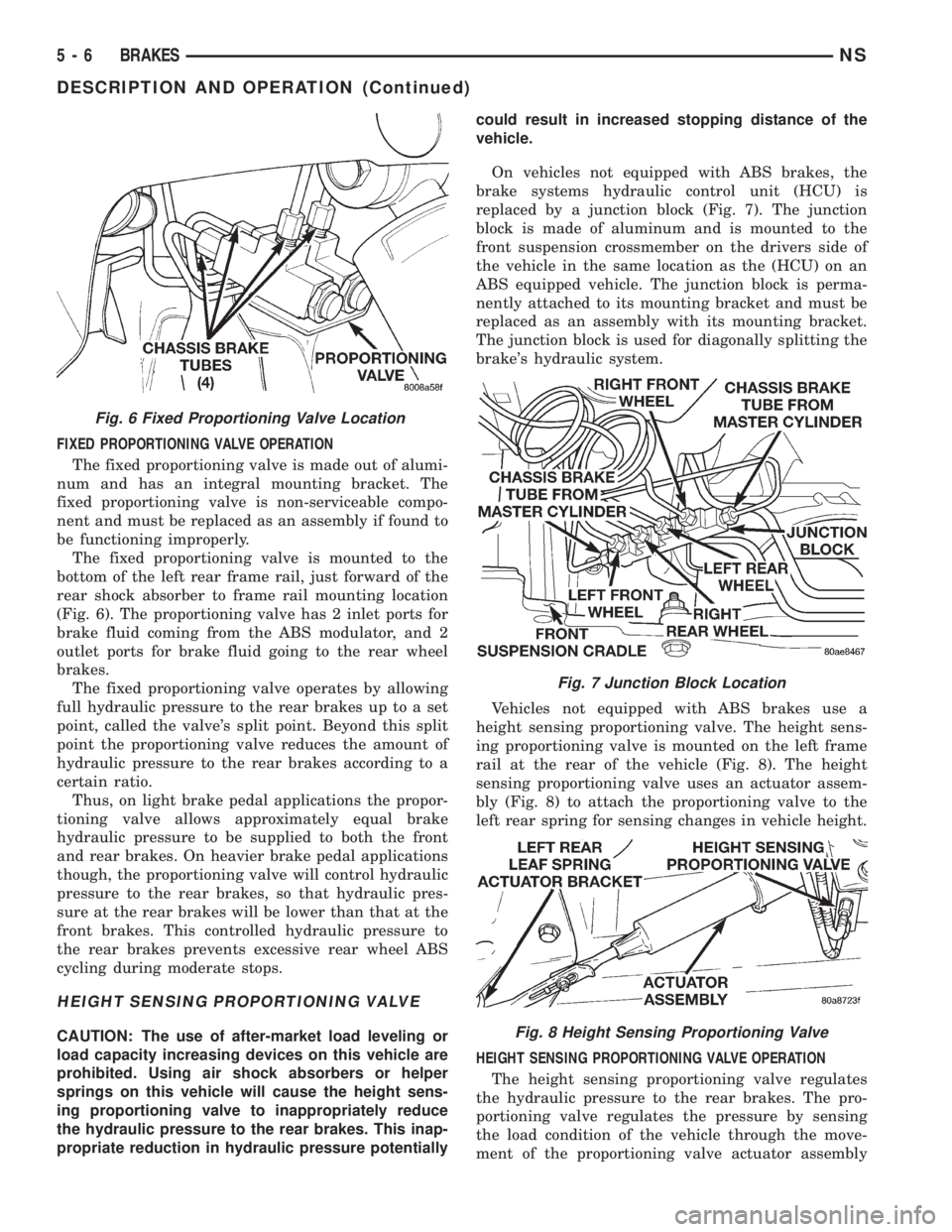
FIXED PROPORTIONING VALVE OPERATION
The fixed proportioning valve is made out of alumi-
num and has an integral mounting bracket. The
fixed proportioning valve is non-serviceable compo-
nent and must be replaced as an assembly if found to
be functioning improperly.
The fixed proportioning valve is mounted to the
bottom of the left rear frame rail, just forward of the
rear shock absorber to frame rail mounting location
(Fig. 6). The proportioning valve has 2 inlet ports for
brake fluid coming from the ABS modulator, and 2
outlet ports for brake fluid going to the rear wheel
brakes.
The fixed proportioning valve operates by allowing
full hydraulic pressure to the rear brakes up to a set
point, called the valve's split point. Beyond this split
point the proportioning valve reduces the amount of
hydraulic pressure to the rear brakes according to a
certain ratio.
Thus, on light brake pedal applications the propor-
tioning valve allows approximately equal brake
hydraulic pressure to be supplied to both the front
and rear brakes. On heavier brake pedal applications
though, the proportioning valve will control hydraulic
pressure to the rear brakes, so that hydraulic pres-
sure at the rear brakes will be lower than that at the
front brakes. This controlled hydraulic pressure to
the rear brakes prevents excessive rear wheel ABS
cycling during moderate stops.
HEIGHT SENSING PROPORTIONING VALVE
CAUTION: The use of after-market load leveling or
load capacity increasing devices on this vehicle are
prohibited. Using air shock absorbers or helper
springs on this vehicle will cause the height sens-
ing proportioning valve to inappropriately reduce
the hydraulic pressure to the rear brakes. This inap-
propriate reduction in hydraulic pressure potentiallycould result in increased stopping distance of the
vehicle.
On vehicles not equipped with ABS brakes, the
brake systems hydraulic control unit (HCU) is
replaced by a junction block (Fig. 7). The junction
block is made of aluminum and is mounted to the
front suspension crossmember on the drivers side of
the vehicle in the same location as the (HCU) on an
ABS equipped vehicle. The junction block is perma-
nently attached to its mounting bracket and must be
replaced as an assembly with its mounting bracket.
The junction block is used for diagonally splitting the
brake's hydraulic system.
Vehicles not equipped with ABS brakes use a
height sensing proportioning valve. The height sens-
ing proportioning valve is mounted on the left frame
rail at the rear of the vehicle (Fig. 8). The height
sensing proportioning valve uses an actuator assem-
bly (Fig. 8) to attach the proportioning valve to the
left rear spring for sensing changes in vehicle height.
HEIGHT SENSING PROPORTIONING VALVE OPERATION
The height sensing proportioning valve regulates
the hydraulic pressure to the rear brakes. The pro-
portioning valve regulates the pressure by sensing
the load condition of the vehicle through the move-
ment of the proportioning valve actuator assembly
Fig. 6 Fixed Proportioning Valve Location
Fig. 7 Junction Block Location
Fig. 8 Height Sensing Proportioning Valve
5 - 6 BRAKESNS
DESCRIPTION AND OPERATION (Continued)
Page 89 of 1938
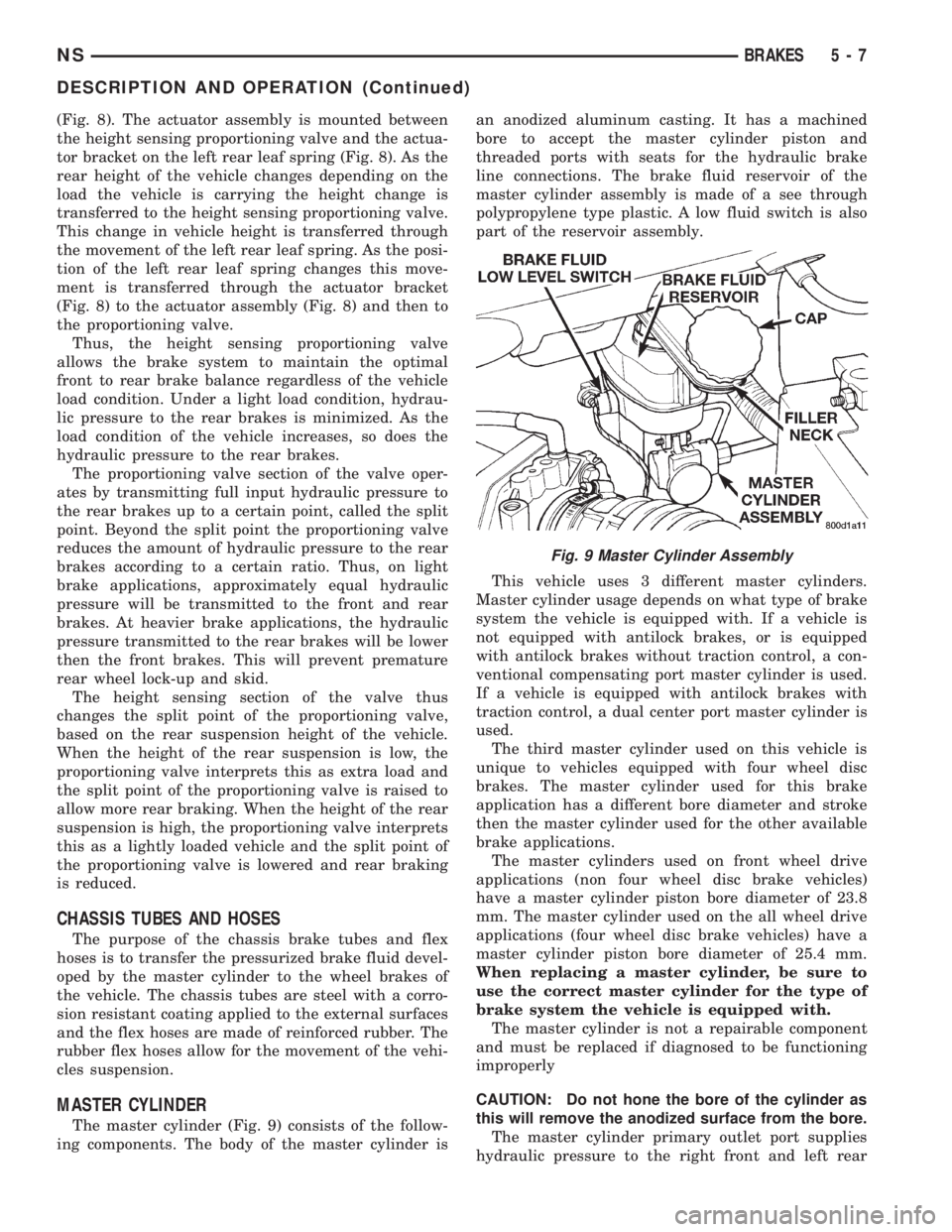
(Fig. 8). The actuator assembly is mounted between
the height sensing proportioning valve and the actua-
tor bracket on the left rear leaf spring (Fig. 8). As the
rear height of the vehicle changes depending on the
load the vehicle is carrying the height change is
transferred to the height sensing proportioning valve.
This change in vehicle height is transferred through
the movement of the left rear leaf spring. As the posi-
tion of the left rear leaf spring changes this move-
ment is transferred through the actuator bracket
(Fig. 8) to the actuator assembly (Fig. 8) and then to
the proportioning valve.
Thus, the height sensing proportioning valve
allows the brake system to maintain the optimal
front to rear brake balance regardless of the vehicle
load condition. Under a light load condition, hydrau-
lic pressure to the rear brakes is minimized. As the
load condition of the vehicle increases, so does the
hydraulic pressure to the rear brakes.
The proportioning valve section of the valve oper-
ates by transmitting full input hydraulic pressure to
the rear brakes up to a certain point, called the split
point. Beyond the split point the proportioning valve
reduces the amount of hydraulic pressure to the rear
brakes according to a certain ratio. Thus, on light
brake applications, approximately equal hydraulic
pressure will be transmitted to the front and rear
brakes. At heavier brake applications, the hydraulic
pressure transmitted to the rear brakes will be lower
then the front brakes. This will prevent premature
rear wheel lock-up and skid.
The height sensing section of the valve thus
changes the split point of the proportioning valve,
based on the rear suspension height of the vehicle.
When the height of the rear suspension is low, the
proportioning valve interprets this as extra load and
the split point of the proportioning valve is raised to
allow more rear braking. When the height of the rear
suspension is high, the proportioning valve interprets
this as a lightly loaded vehicle and the split point of
the proportioning valve is lowered and rear braking
is reduced.
CHASSIS TUBES AND HOSES
The purpose of the chassis brake tubes and flex
hoses is to transfer the pressurized brake fluid devel-
oped by the master cylinder to the wheel brakes of
the vehicle. The chassis tubes are steel with a corro-
sion resistant coating applied to the external surfaces
and the flex hoses are made of reinforced rubber. The
rubber flex hoses allow for the movement of the vehi-
cles suspension.
MASTER CYLINDER
The master cylinder (Fig. 9) consists of the follow-
ing components. The body of the master cylinder isan anodized aluminum casting. It has a machined
bore to accept the master cylinder piston and
threaded ports with seats for the hydraulic brake
line connections. The brake fluid reservoir of the
master cylinder assembly is made of a see through
polypropylene type plastic. A low fluid switch is also
part of the reservoir assembly.
This vehicle uses 3 different master cylinders.
Master cylinder usage depends on what type of brake
system the vehicle is equipped with. If a vehicle is
not equipped with antilock brakes, or is equipped
with antilock brakes without traction control, a con-
ventional compensating port master cylinder is used.
If a vehicle is equipped with antilock brakes with
traction control, a dual center port master cylinder is
used.
The third master cylinder used on this vehicle is
unique to vehicles equipped with four wheel disc
brakes. The master cylinder used for this brake
application has a different bore diameter and stroke
then the master cylinder used for the other available
brake applications.
The master cylinders used on front wheel drive
applications (non four wheel disc brake vehicles)
have a master cylinder piston bore diameter of 23.8
mm. The master cylinder used on the all wheel drive
applications (four wheel disc brake vehicles) have a
master cylinder piston bore diameter of 25.4 mm.
When replacing a master cylinder, be sure to
use the correct master cylinder for the type of
brake system the vehicle is equipped with.
The master cylinder is not a repairable component
and must be replaced if diagnosed to be functioning
improperly
CAUTION: Do not hone the bore of the cylinder as
this will remove the anodized surface from the bore.
The master cylinder primary outlet port supplies
hydraulic pressure to the right front and left rear
Fig. 9 Master Cylinder Assembly
NSBRAKES 5 - 7
DESCRIPTION AND OPERATION (Continued)
Page 91 of 1938

normal. This may indicate:(1)Abnormal loss of
brake fluid in the master cylinder fluid reservoir
resulting from a leak in the hydraulic system.(2)
Brake shoe linings which have worn to a point
requiring replacement.
As the brake fluid drops below the minimum level,
the brake fluid level sensor closes to ground the
brake warning light circuit. This will turn on the red
brake warning light. At this time, master cylinder
fluid reservoir should be checked and filled to the full
mark with DOT 3 brake fluid.If brake fluid level
has dropped below the add line in the master
cylinder fluid reservoir, the entire brake
hydraulic system should be checked for evi-
dence of a leak.
STOP LAMP SWITCH
The stop lamp switch controls operation of the
vehicles stop lamps. Also, if the vehicle is equippedwith speed control, the stop lamp switch will deacti-
vate speed control when the brake pedal is
depressed.
The stop lamp switch controls operation of the
right and left tail, stop and turn signal lamp and
CHMSL lamp, by supplying battery current to these
lamps.
The stop lamp switch controls the lamp operation
by opening and closing the electrical circuit to the
stop lamps.
HUB/BEARING REAR WHEEL
The rear hub and bearing assembly used on this
vehicle is serviceable only as a complete assembly. No
attempt should be made to disassemble a rear hub
and bearing assembly in an effort to repair it.
The rear hub and bearing assembly is attached to
the rear axle using 4 mounting bolts that are remov-
able from the back of the rear hub/bearing.
DIAGNOSIS AND TESTING
BRAKE SYSTEM BASIC DIAGNOSIS GUIDE
SYMPTOMCHART 1
MISC.
COND.CHART 2
WARNING
LIGHTCHART 3
POWER
BRAKESCHART 4
BRAKE
NOISECHART 5
WHEEL
BRAKES
Brake Warning Light On X NO NO
Excessive Pedal Travel 6 X NO O
Pedal Goes To The Floor 6 X
Stop Light On Without Brakes 3
All Brakes Drag 5
Rear Brakes Drag 2 NO NO
Grabby Brakes O X
Spongy Brake Pedal X NO
Premature Rear Brake Lockup 4 NO NO O
Excessive Pedal Effort 1 O
Rough Engine Idle NO O
Brake Chatter (Rough) NO NO X
Surge During Braking NO NO X
Noise During Braking NO NO X
Rattle Or Clunking Noise NO NO X
Pedal Pulsates During Braking NO NO X
Pull To Right Or Left NO NO X
No: Not A Possible Cause X: Most Likely Cause O: Possible Cause
NSBRAKES 5 - 9
DESCRIPTION AND OPERATION (Continued)
Page 96 of 1938
ADJUSTER REAR DRUM BRAKE (AUTOMATIC)
The rear drum brakes on this vehicle automatically
adjust, when required, during the normal operation
of the vehicle every time the brakes are applied. Use
the following procedure to test the operation of the
automatic adjuster.
Place the vehicle on a hoist with a helper in the
driver's seat to apply the brakes. Remove the access
plug from the adjustment hole in each brake support
plate to provide visual access of the brake adjuster
star wheel.
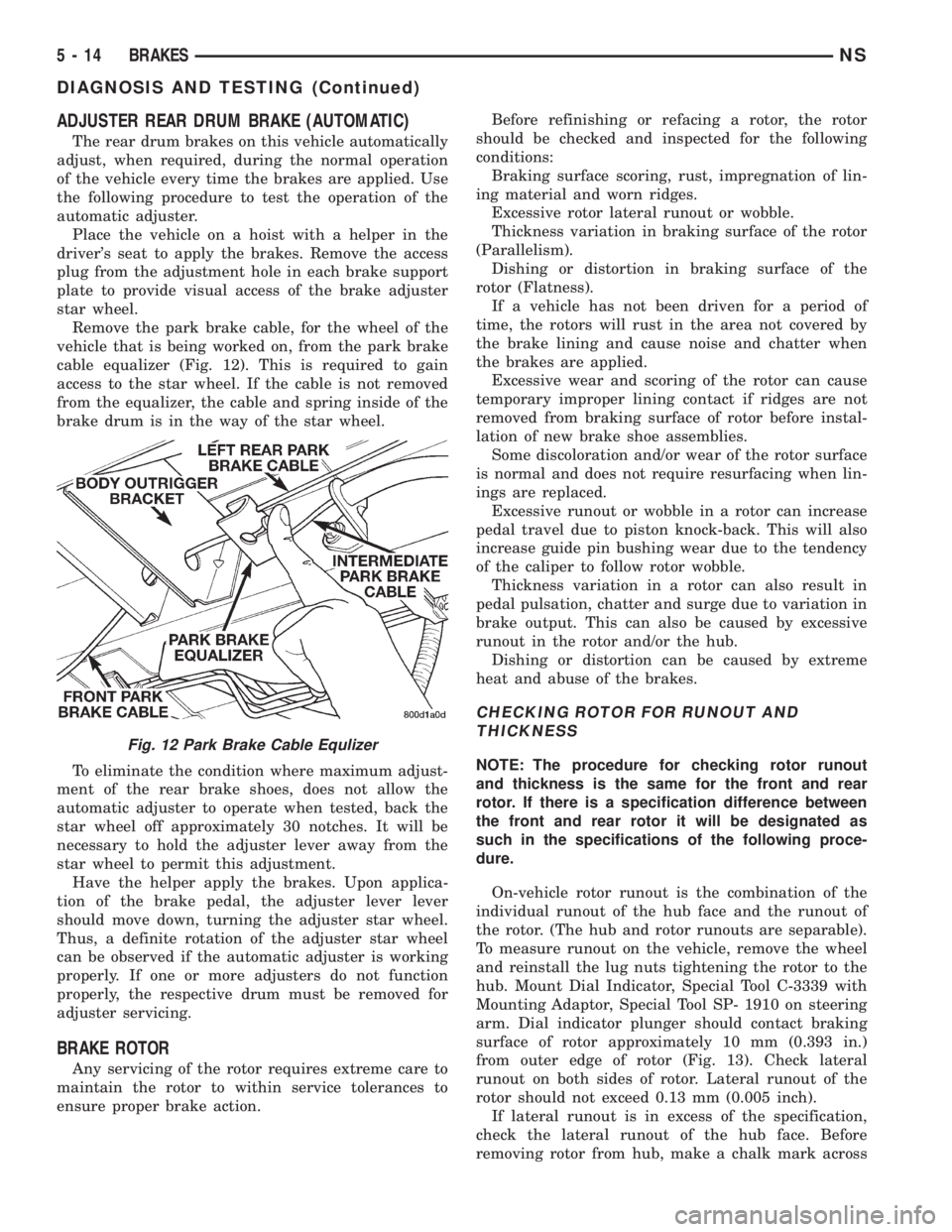
Remove the park brake cable, for the wheel of the
vehicle that is being worked on, from the park brake
cable equalizer (Fig. 12). This is required to gain
access to the star wheel. If the cable is not removed
from the equalizer, the cable and spring inside of the
brake drum is in the way of the star wheel.
To eliminate the condition where maximum adjust-
ment of the rear brake shoes, does not allow the
automatic adjuster to operate when tested, back the
star wheel off approximately 30 notches. It will be
necessary to hold the adjuster lever away from the
star wheel to permit this adjustment.
Have the helper apply the brakes. Upon applica-
tion of the brake pedal, the adjuster lever lever
should move down, turning the adjuster star wheel.
Thus, a definite rotation of the adjuster star wheel
can be observed if the automatic adjuster is working
properly. If one or more adjusters do not function
properly, the respective drum must be removed for
adjuster servicing.
BRAKE ROTOR
Any servicing of the rotor requires extreme care to
maintain the rotor to within service tolerances to
ensure proper brake action.Before refinishing or refacing a rotor, the rotor
should be checked and inspected for the following
conditions:
Braking surface scoring, rust, impregnation of lin-
ing material and worn ridges.
Excessive rotor lateral runout or wobble.
Thickness variation in braking surface of the rotor
(Parallelism).
Dishing or distortion in braking surface of the
rotor (Flatness).
If a vehicle has not been driven for a period of
time, the rotors will rust in the area not covered by
the brake lining and cause noise and chatter when
the brakes are applied.
Excessive wear and scoring of the rotor can cause
temporary improper lining contact if ridges are not
removed from braking surface of rotor before instal-
lation of new brake shoe assemblies.
Some discoloration and/or wear of the rotor surface
is normal and does not require resurfacing when lin-
ings are replaced.
Excessive runout or wobble in a rotor can increase
pedal travel due to piston knock-back. This will also
increase guide pin bushing wear due to the tendency
of the caliper to follow rotor wobble.
Thickness variation in a rotor can also result in
pedal pulsation, chatter and surge due to variation in
brake output. This can also be caused by excessive
runout in the rotor and/or the hub.
Dishing or distortion can be caused by extreme
heat and abuse of the brakes.
CHECKING ROTOR FOR RUNOUT AND
THICKNESS
NOTE: The procedure for checking rotor runout
and thickness is the same for the front and rear
rotor. If there is a specification difference between
the front and rear rotor it will be designated as
such in the specifications of the following proce-
dure.
On-vehicle rotor runout is the combination of the
individual runout of the hub face and the runout of
the rotor. (The hub and rotor runouts are separable).
To measure runout on the vehicle, remove the wheel
and reinstall the lug nuts tightening the rotor to the
hub. Mount Dial Indicator, Special Tool C-3339 with
Mounting Adaptor, Special Tool SP- 1910 on steering
arm. Dial indicator plunger should contact braking
surface of rotor approximately 10 mm (0.393 in.)
from outer edge of rotor (Fig. 13). Check lateral
runout on both sides of rotor. Lateral runout of the
rotor should not exceed 0.13 mm (0.005 inch).
If lateral runout is in excess of the specification,
check the lateral runout of the hub face. Before
removing rotor from hub, make a chalk mark across
Fig. 12 Park Brake Cable Equlizer
5 - 14 BRAKESNS
DIAGNOSIS AND TESTING (Continued)
Page 97 of 1938
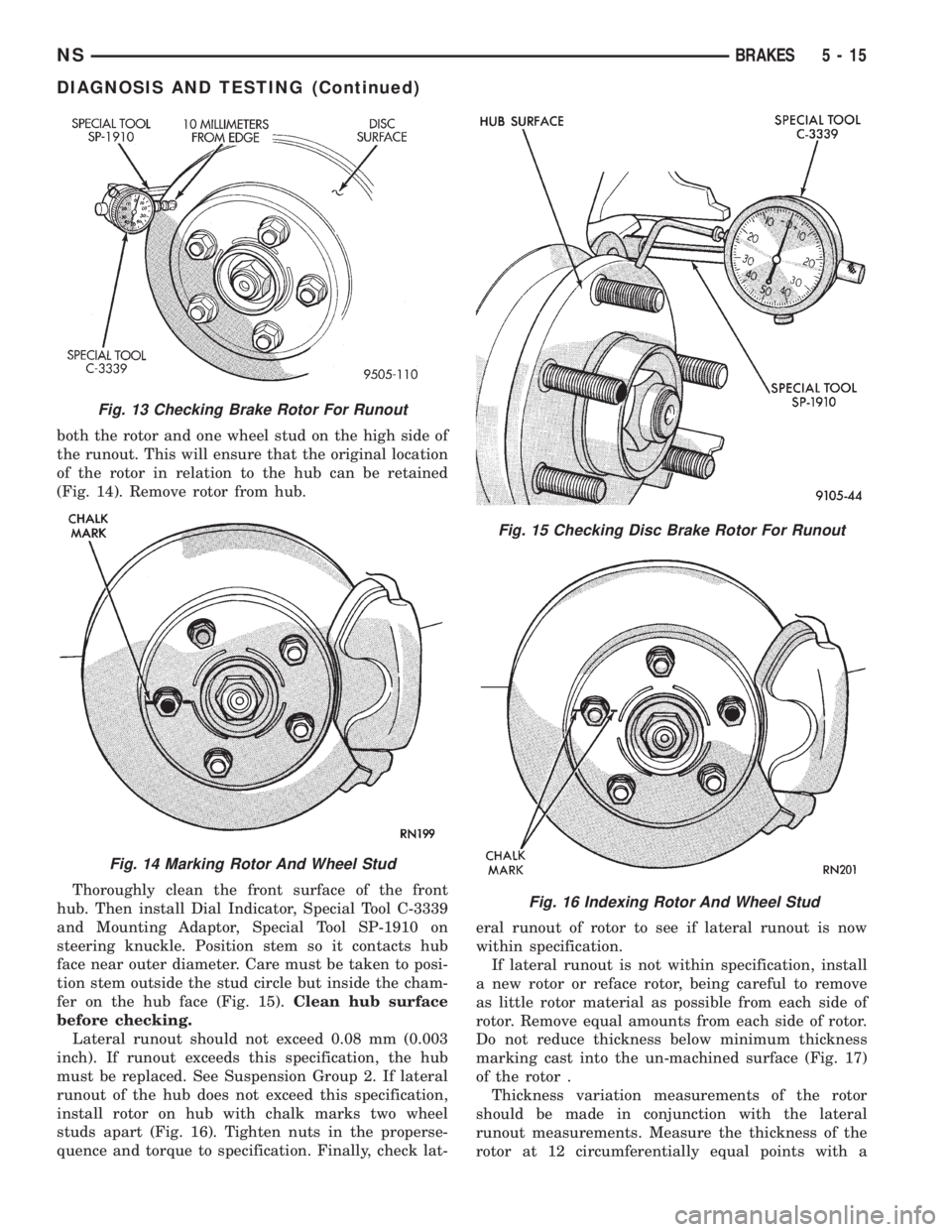
both the rotor and one wheel stud on the high side of
the runout. This will ensure that the original location
of the rotor in relation to the hub can be retained
(Fig. 14). Remove rotor from hub.
Thoroughly clean the front surface of the front
hub. Then install Dial Indicator, Special Tool C-3339
and Mounting Adaptor, Special Tool SP-1910 on
steering knuckle. Position stem so it contacts hub
face near outer diameter. Care must be taken to posi-
tion stem outside the stud circle but inside the cham-
fer on the hub face (Fig. 15).Clean hub surface
before checking.
Lateral runout should not exceed 0.08 mm (0.003
inch). If runout exceeds this specification, the hub
must be replaced. See Suspension Group 2. If lateral
runout of the hub does not exceed this specification,
install rotor on hub with chalk marks two wheel
studs apart (Fig. 16). Tighten nuts in the properse-
quence and torque to specification. Finally, check lat-eral runout of rotor to see if lateral runout is now
within specification.
If lateral runout is not within specification, install
a new rotor or reface rotor, being careful to remove
as little rotor material as possible from each side of
rotor. Remove equal amounts from each side of rotor.
Do not reduce thickness below minimum thickness
marking cast into the un-machined surface (Fig. 17)
of the rotor .
Thickness variation measurements of the rotor
should be made in conjunction with the lateral
runout measurements. Measure the thickness of the
rotor at 12 circumferentially equal points with a
Fig. 16 Indexing Rotor And Wheel Stud
Fig. 13 Checking Brake Rotor For Runout
Fig. 14 Marking Rotor And Wheel Stud
Fig. 15 Checking Disc Brake Rotor For Runout
NSBRAKES 5 - 15
DIAGNOSIS AND TESTING (Continued)
Page 98 of 1938
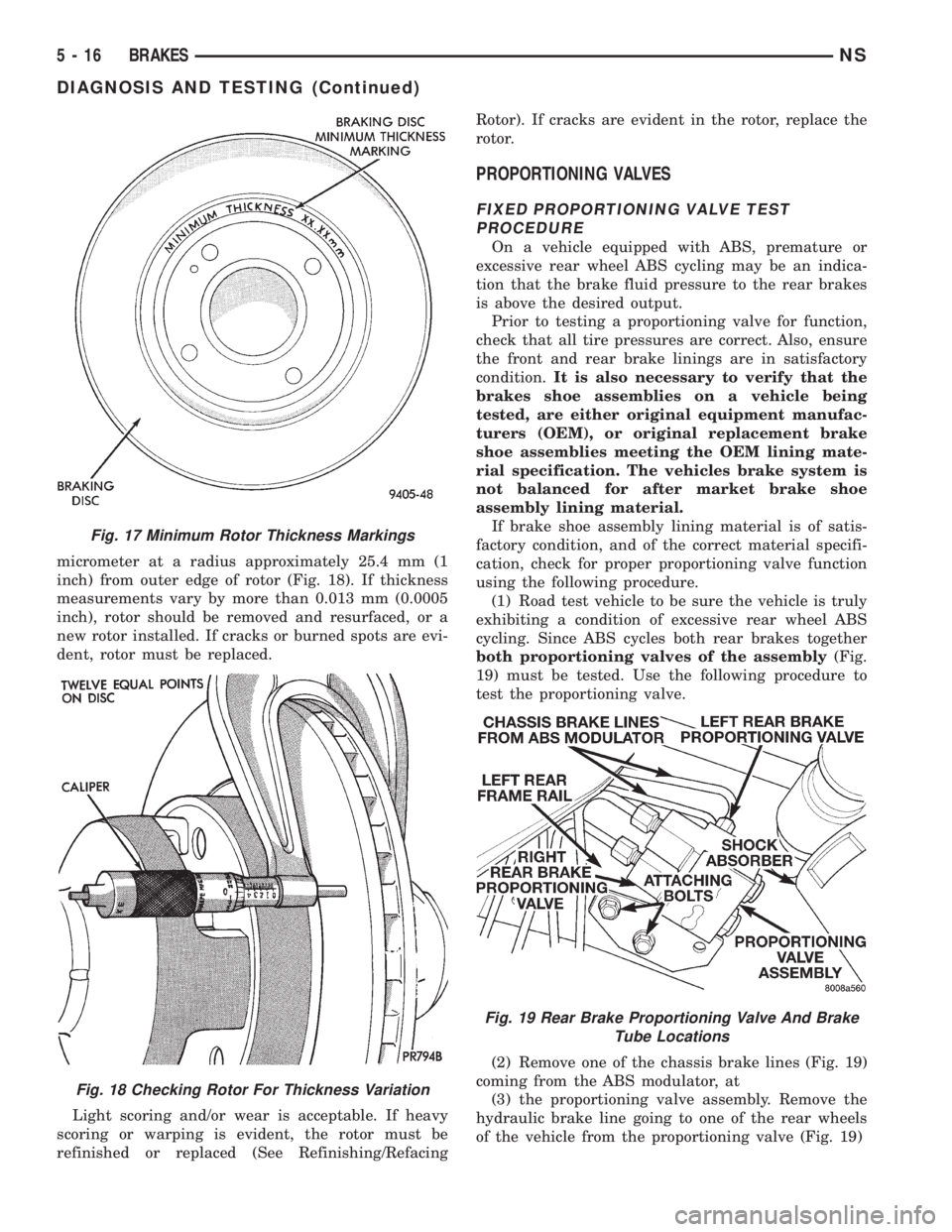
micrometer at a radius approximately 25.4 mm (1
inch) from outer edge of rotor (Fig. 18). If thickness
measurements vary by more than 0.013 mm (0.0005
inch), rotor should be removed and resurfaced, or a
new rotor installed. If cracks or burned spots are evi-
dent, rotor must be replaced.
Light scoring and/or wear is acceptable. If heavy
scoring or warping is evident, the rotor must be
refinished or replaced (See Refinishing/RefacingRotor). If cracks are evident in the rotor, replace the
rotor.
PROPORTIONING VALVES
FIXED PROPORTIONING VALVE TEST
PROCEDURE
On a vehicle equipped with ABS, premature or
excessive rear wheel ABS cycling may be an indica-
tion that the brake fluid pressure to the rear brakes
is above the desired output.
Prior to testing a proportioning valve for function,
check that all tire pressures are correct. Also, ensure
the front and rear brake linings are in satisfactory
condition.It is also necessary to verify that the
brakes shoe assemblies on a vehicle being
tested, are either original equipment manufac-
turers (OEM), or original replacement brake
shoe assemblies meeting the OEM lining mate-
rial specification. The vehicles brake system is
not balanced for after market brake shoe
assembly lining material.
If brake shoe assembly lining material is of satis-
factory condition, and of the correct material specifi-
cation, check for proper proportioning valve function
using the following procedure.
(1) Road test vehicle to be sure the vehicle is truly
exhibiting a condition of excessive rear wheel ABS
cycling. Since ABS cycles both rear brakes together
both proportioning valves of the assembly(Fig.
19) must be tested. Use the following procedure to
test the proportioning valve.
(2) Remove one of the chassis brake lines (Fig. 19)
coming from the ABS modulator, at
(3) the proportioning valve assembly. Remove the
hydraulic brake line going to one of the rear wheels
of the vehicle from the proportioning valve (Fig. 19)
Fig. 17 Minimum Rotor Thickness Markings
Fig. 18 Checking Rotor For Thickness Variation
Fig. 19 Rear Brake Proportioning Valve And Brake
Tube Locations
5 - 16 BRAKESNS
DIAGNOSIS AND TESTING (Continued)