wheel CHRYSLER VOYAGER 1996 Manual PDF
[x] Cancel search | Manufacturer: CHRYSLER, Model Year: 1996, Model line: VOYAGER, Model: CHRYSLER VOYAGER 1996Pages: 1938, PDF Size: 55.84 MB
Page 143 of 1938
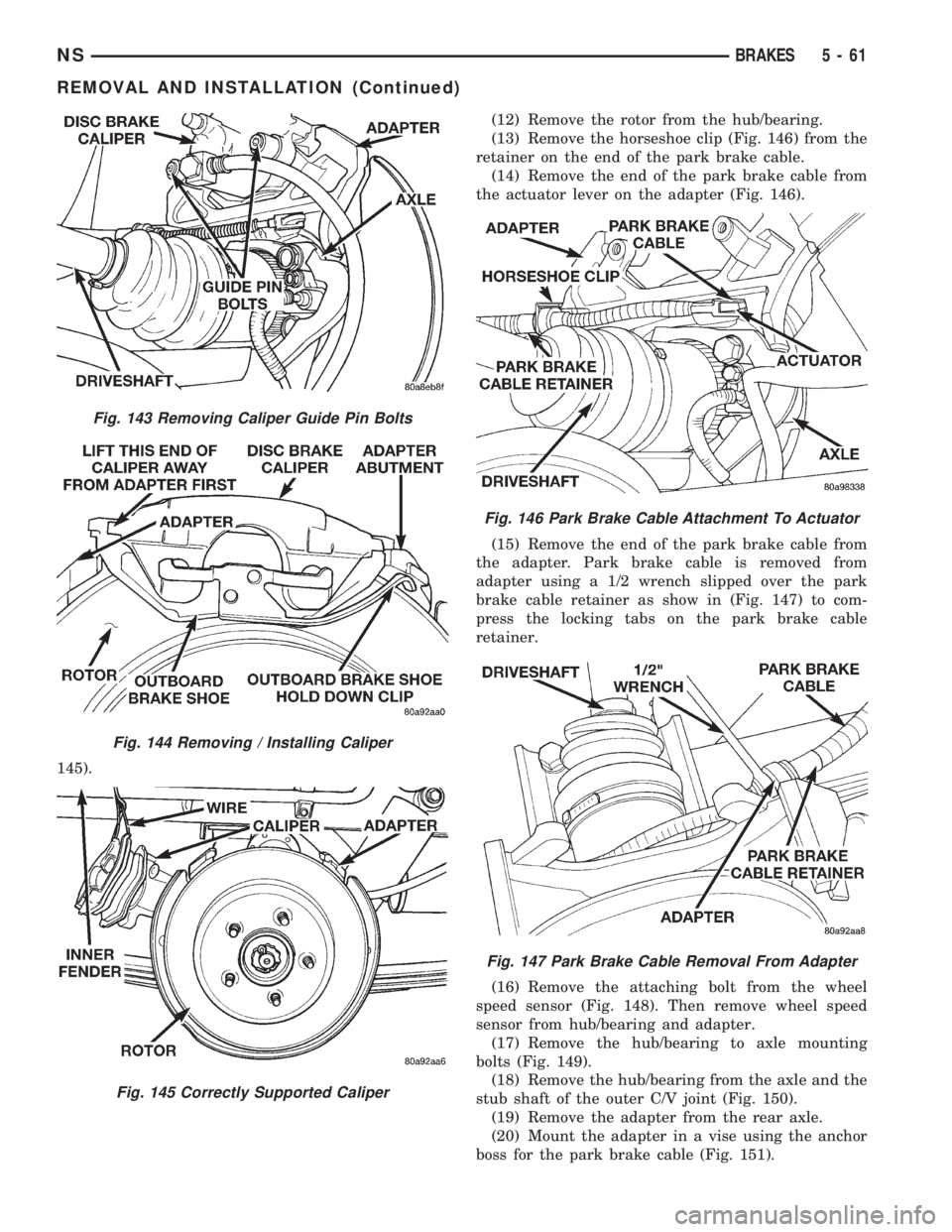
145).(12) Remove the rotor from the hub/bearing.
(13) Remove the horseshoe clip (Fig. 146) from the
retainer on the end of the park brake cable.
(14) Remove the end of the park brake cable from
the actuator lever on the adapter (Fig. 146).
(15) Remove the end of the park brake cable from
the adapter. Park brake cable is removed from
adapter using a 1/2 wrench slipped over the park
brake cable retainer as show in (Fig. 147) to com-
press the locking tabs on the park brake cable
retainer.
(16) Remove the attaching bolt from the wheel
speed sensor (Fig. 148). Then remove wheel speed
sensor from hub/bearing and adapter.
(17) Remove the hub/bearing to axle mounting
bolts (Fig. 149).
(18) Remove the hub/bearing from the axle and the
stub shaft of the outer C/V joint (Fig. 150).
(19) Remove the adapter from the rear axle.
(20) Mount the adapter in a vise using the anchor
boss for the park brake cable (Fig. 151).
Fig. 143 Removing Caliper Guide Pin Bolts
Fig. 144 Removing / Installing Caliper
Fig. 145 Correctly Supported Caliper
Fig. 146 Park Brake Cable Attachment To Actuator
Fig. 147 Park Brake Cable Removal From Adapter
NSBRAKES 5 - 61
REMOVAL AND INSTALLATION (Continued)
Page 146 of 1938
NOTE: When the hold down pin is installed, the
long part of the hold down pin is to be positioned
strait up and down. This will ensure that the hold
down pin is correctly engaged with the adapter.
(6) Install the hold down spring and pin (Fig. 153)
on the leading park brake shoe.
(7) Install the lower return spring (Fig. 152) on
the leading and trailing park brake shoes.When
installing the hold down spring it is to be
installed behind the park brake shoes (Fig.
152).
(8) Install the 4 mounting bolts for the adapter
and hub/bearing into the bolt holes in the axle.
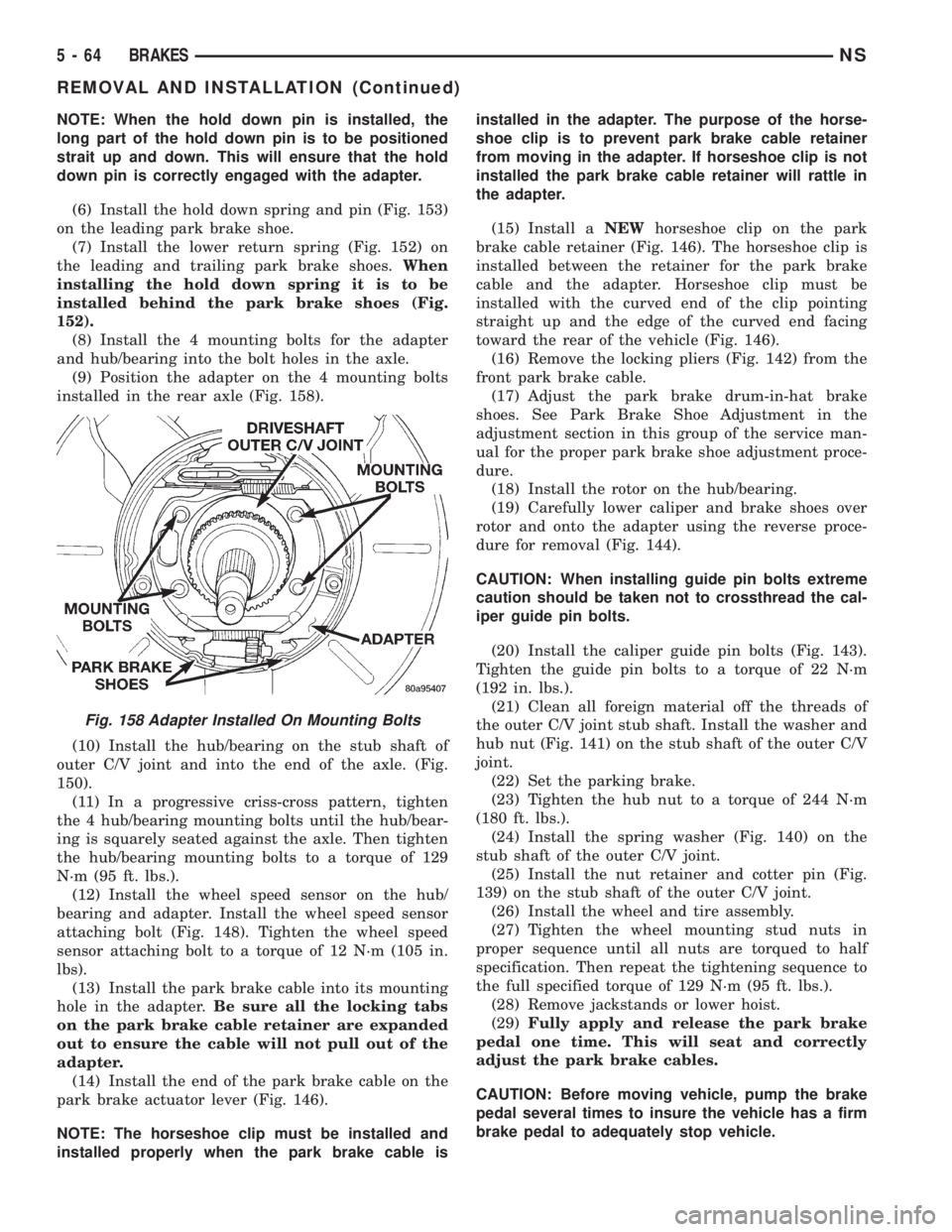
(9) Position the adapter on the 4 mounting bolts
installed in the rear axle (Fig. 158).
(10) Install the hub/bearing on the stub shaft of
outer C/V joint and into the end of the axle. (Fig.
150).
(11) In a progressive criss-cross pattern, tighten
the 4 hub/bearing mounting bolts until the hub/bear-
ing is squarely seated against the axle. Then tighten
the hub/bearing mounting bolts to a torque of 129
N´m (95 ft. lbs.).
(12) Install the wheel speed sensor on the hub/
bearing and adapter. Install the wheel speed sensor
attaching bolt (Fig. 148). Tighten the wheel speed
sensor attaching bolt to a torque of 12 N´m (105 in.
lbs).
(13) Install the park brake cable into its mounting
hole in the adapter.Be sure all the locking tabs
on the park brake cable retainer are expanded
out to ensure the cable will not pull out of the
adapter.
(14) Install the end of the park brake cable on the
park brake actuator lever (Fig. 146).
NOTE: The horseshoe clip must be installed and
installed properly when the park brake cable isinstalled in the adapter. The purpose of the horse-
shoe clip is to prevent park brake cable retainer
from moving in the adapter. If horseshoe clip is not
installed the park brake cable retainer will rattle in
the adapter.
(15) Install aNEWhorseshoe clip on the park
brake cable retainer (Fig. 146). The horseshoe clip is
installed between the retainer for the park brake
cable and the adapter. Horseshoe clip must be
installed with the curved end of the clip pointing
straight up and the edge of the curved end facing
toward the rear of the vehicle (Fig. 146).
(16) Remove the locking pliers (Fig. 142) from the
front park brake cable.
(17) Adjust the park brake drum-in-hat brake
shoes. See Park Brake Shoe Adjustment in the
adjustment section in this group of the service man-
ual for the proper park brake shoe adjustment proce-
dure.
(18) Install the rotor on the hub/bearing.
(19) Carefully lower caliper and brake shoes over
rotor and onto the adapter using the reverse proce-
dure for removal (Fig. 144).
CAUTION: When installing guide pin bolts extreme
caution should be taken not to crossthread the cal-
iper guide pin bolts.
(20) Install the caliper guide pin bolts (Fig. 143).
Tighten the guide pin bolts to a torque of 22 N´m
(192 in. lbs.).
(21) Clean all foreign material off the threads of
the outer C/V joint stub shaft. Install the washer and
hub nut (Fig. 141) on the stub shaft of the outer C/V
joint.
(22) Set the parking brake.
(23) Tighten the hub nut to a torque of 244 N´m
(180 ft. lbs.).
(24) Install the spring washer (Fig. 140) on the
stub shaft of the outer C/V joint.
(25) Install the nut retainer and cotter pin (Fig.
139) on the stub shaft of the outer C/V joint.
(26) Install the wheel and tire assembly.
(27) Tighten the wheel mounting stud nuts in
proper sequence until all nuts are torqued to half
specification. Then repeat the tightening sequence to
the full specified torque of 129 N´m (95 ft. lbs.).
(28) Remove jackstands or lower hoist.
(29)Fully apply and release the park brake
pedal one time. This will seat and correctly
adjust the park brake cables.
CAUTION: Before moving vehicle, pump the brake
pedal several times to insure the vehicle has a firm
brake pedal to adequately stop vehicle.
Fig. 158 Adapter Installed On Mounting Bolts
5 - 64 BRAKESNS
REMOVAL AND INSTALLATION (Continued)
Page 148 of 1938
(9) Assemble the park brake cables onto the park
brake cable equalizer (Fig. 159).
(10) Release the automatic adjuster mechanism on
the park brake pedal assembly. Refer to Parking
Brake Automatic Adjuster in the Service Procedures
Section in this group of the service manual for the
required procedure.
(11) Lower vehicle and apply the park brake pedal
1 time, this will seat the park brake cables.
INTERMEDIATE PARK BRAKE CABLE
REMOVE
(1) Raise vehicle on jackstands or centered on a
hoist. See Hoisting in the Lubrication and Mainte-
nance group of this service manual.
(2) Manually lockout the automatic self adjusting
mechanism of the park brake pedal assembly. Refer
to Manual Lockout Of Auto Adjuster Mechanism in
this section of the service manual for the required
procedure.
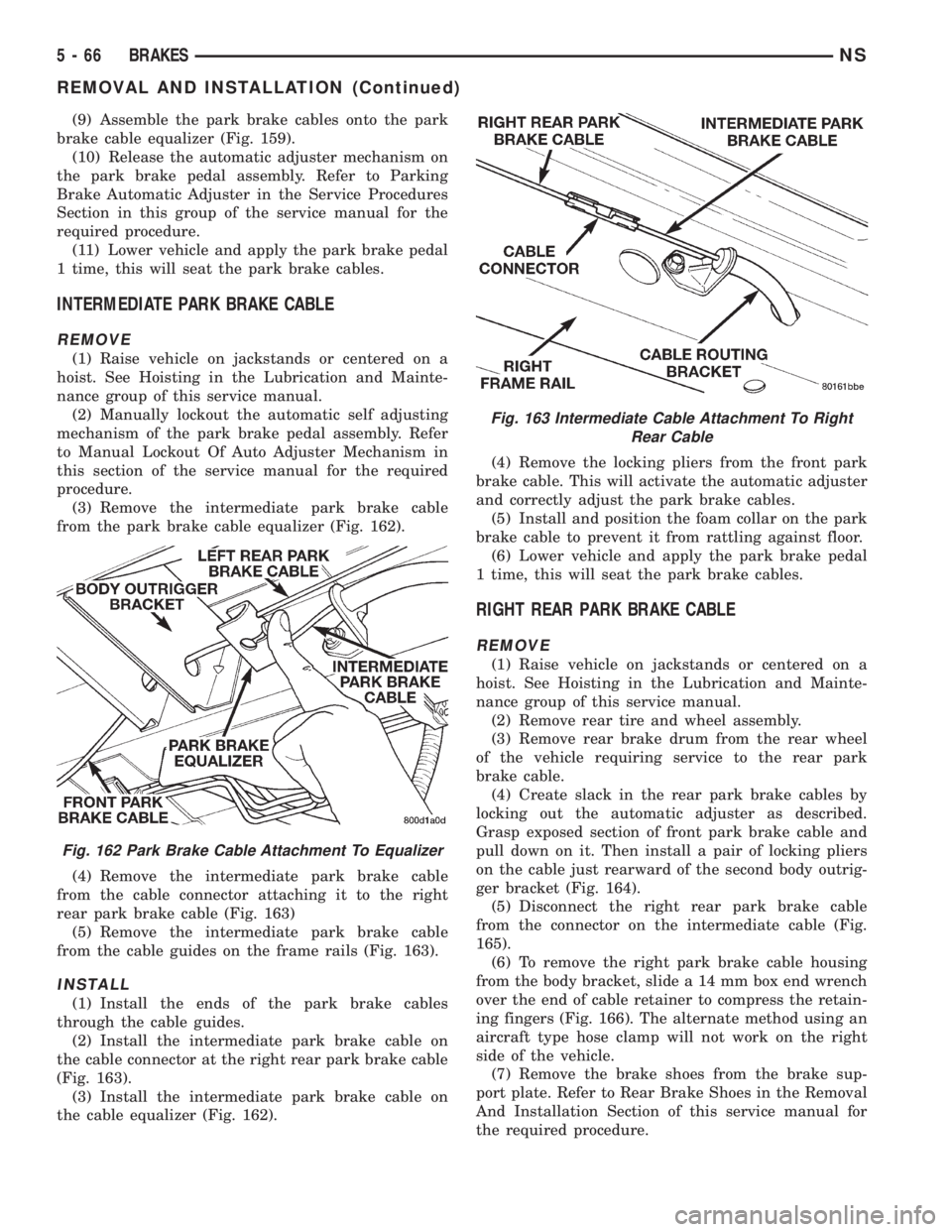
(3) Remove the intermediate park brake cable
from the park brake cable equalizer (Fig. 162).
(4) Remove the intermediate park brake cable
from the cable connector attaching it to the right
rear park brake cable (Fig. 163)
(5) Remove the intermediate park brake cable
from the cable guides on the frame rails (Fig. 163).
INSTALL
(1) Install the ends of the park brake cables
through the cable guides.
(2) Install the intermediate park brake cable on
the cable connector at the right rear park brake cable
(Fig. 163).
(3) Install the intermediate park brake cable on
the cable equalizer (Fig. 162).(4) Remove the locking pliers from the front park
brake cable. This will activate the automatic adjuster
and correctly adjust the park brake cables.
(5) Install and position the foam collar on the park
brake cable to prevent it from rattling against floor.
(6) Lower vehicle and apply the park brake pedal
1 time, this will seat the park brake cables.
RIGHT REAR PARK BRAKE CABLE
REMOVE
(1) Raise vehicle on jackstands or centered on a
hoist. See Hoisting in the Lubrication and Mainte-
nance group of this service manual.
(2) Remove rear tire and wheel assembly.
(3) Remove rear brake drum from the rear wheel
of the vehicle requiring service to the rear park
brake cable.
(4) Create slack in the rear park brake cables by
locking out the automatic adjuster as described.
Grasp exposed section of front park brake cable and
pull down on it. Then install a pair of locking pliers
on the cable just rearward of the second body outrig-
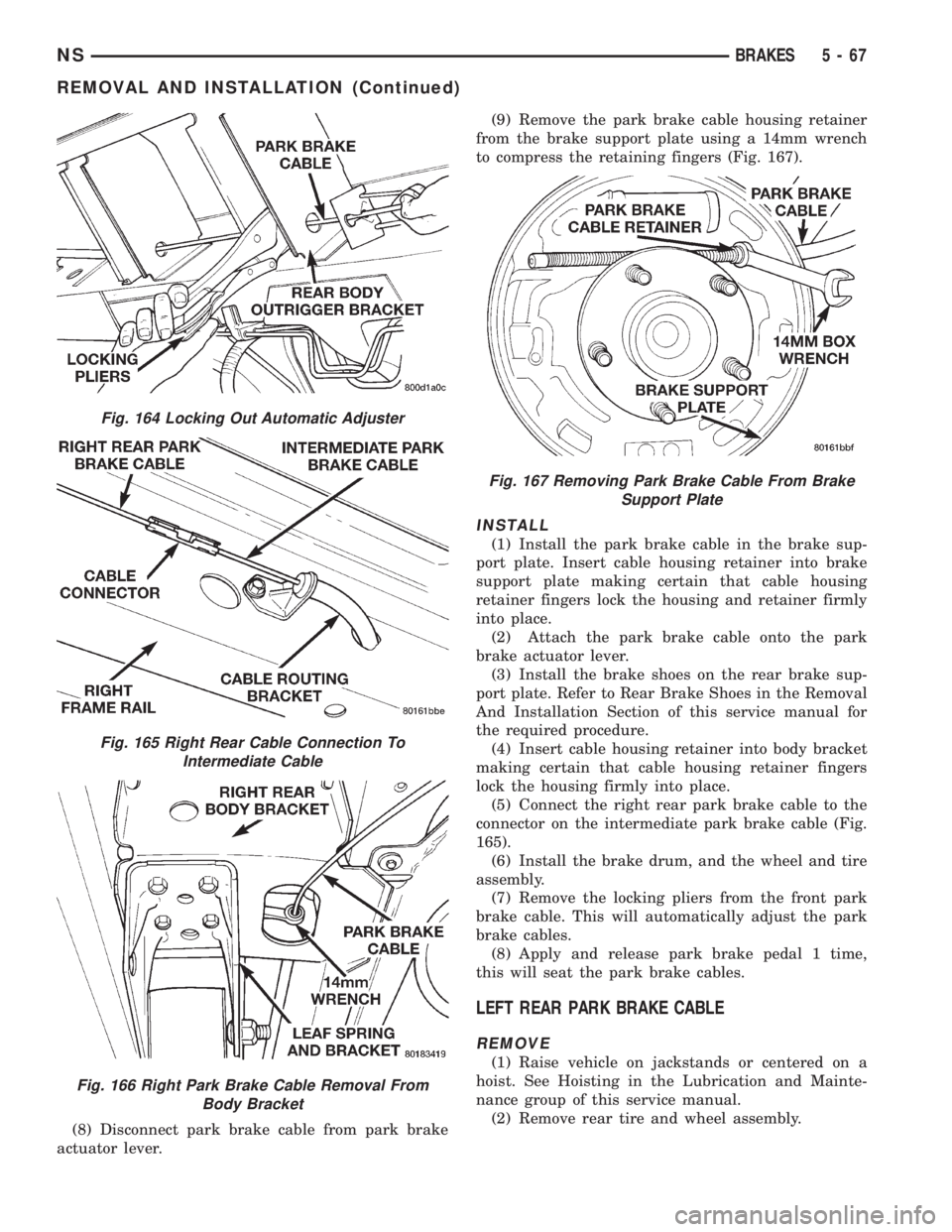
ger bracket (Fig. 164).
(5) Disconnect the right rear park brake cable
from the connector on the intermediate cable (Fig.
165).
(6) To remove the right park brake cable housing
from the body bracket, slide a 14 mm box end wrench
over the end of cable retainer to compress the retain-
ing fingers (Fig. 166). The alternate method using an
aircraft type hose clamp will not work on the right
side of the vehicle.
(7) Remove the brake shoes from the brake sup-
port plate. Refer to Rear Brake Shoes in the Removal
And Installation Section of this service manual for
the required procedure.
Fig. 162 Park Brake Cable Attachment To Equalizer
Fig. 163 Intermediate Cable Attachment To Right
Rear Cable
5 - 66 BRAKESNS
REMOVAL AND INSTALLATION (Continued)
Page 149 of 1938
(8) Disconnect park brake cable from park brake
actuator lever.(9) Remove the park brake cable housing retainer
from the brake support plate using a 14mm wrench
to compress the retaining fingers (Fig. 167).
INSTALL
(1) Install the park brake cable in the brake sup-
port plate. Insert cable housing retainer into brake
support plate making certain that cable housing
retainer fingers lock the housing and retainer firmly
into place.
(2) Attach the park brake cable onto the park
brake actuator lever.
(3) Install the brake shoes on the rear brake sup-
port plate. Refer to Rear Brake Shoes in the Removal
And Installation Section of this service manual for
the required procedure.
(4) Insert cable housing retainer into body bracket
making certain that cable housing retainer fingers
lock the housing firmly into place.
(5) Connect the right rear park brake cable to the
connector on the intermediate park brake cable (Fig.
165).
(6) Install the brake drum, and the wheel and tire
assembly.
(7) Remove the locking pliers from the front park
brake cable. This will automatically adjust the park
brake cables.
(8) Apply and release park brake pedal 1 time,
this will seat the park brake cables.
LEFT REAR PARK BRAKE CABLE
REMOVE
(1) Raise vehicle on jackstands or centered on a
hoist. See Hoisting in the Lubrication and Mainte-
nance group of this service manual.
(2) Remove rear tire and wheel assembly.
Fig. 164 Locking Out Automatic Adjuster
Fig. 165 Right Rear Cable Connection To
Intermediate Cable
Fig. 166 Right Park Brake Cable Removal From
Body Bracket
Fig. 167 Removing Park Brake Cable From Brake
Support Plate
NSBRAKES 5 - 67
REMOVAL AND INSTALLATION (Continued)
Page 150 of 1938
(3) Remove rear brake drum from the rear wheel
of the vehicle requiring service to the rear park
brake cable.
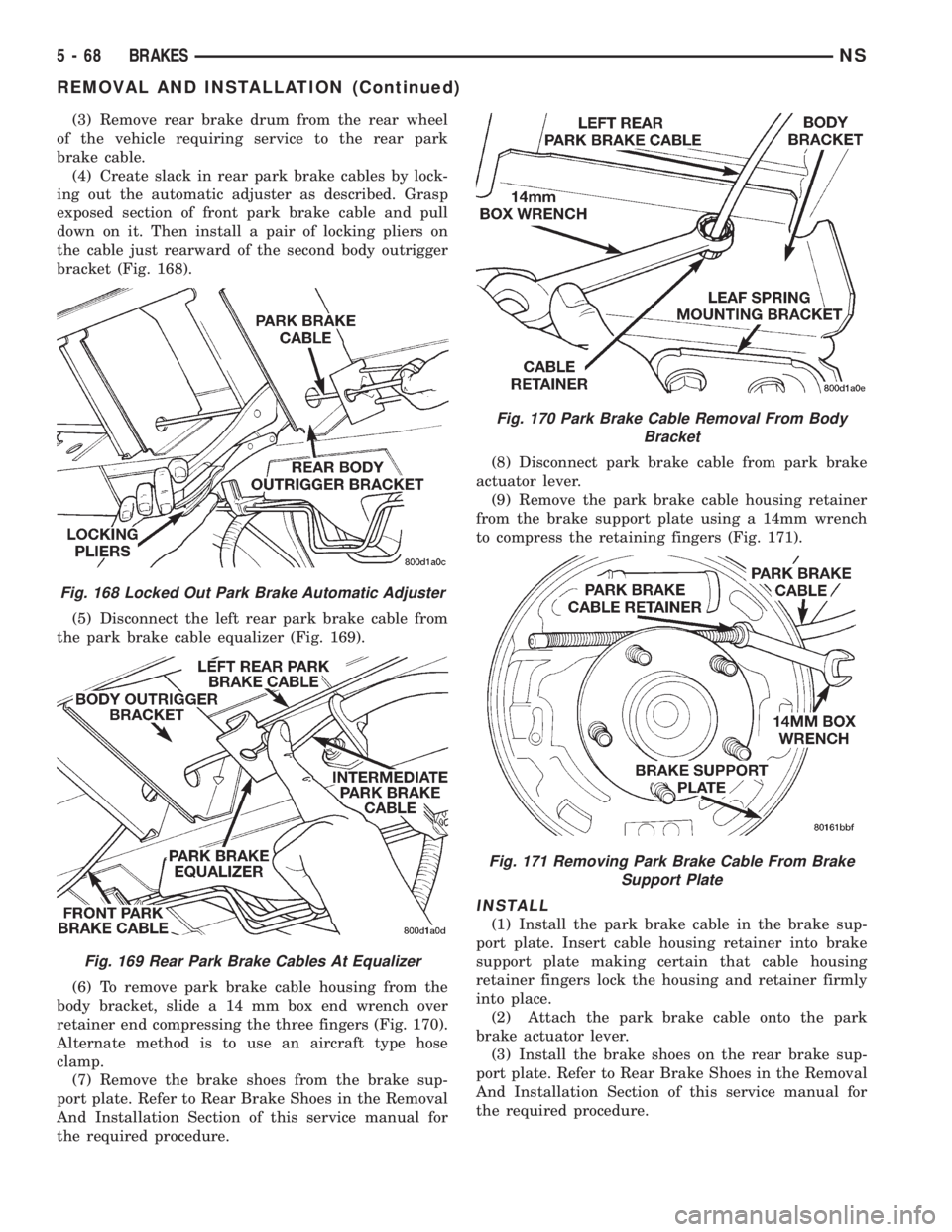
(4) Create slack in rear park brake cables by lock-
ing out the automatic adjuster as described. Grasp
exposed section of front park brake cable and pull
down on it. Then install a pair of locking pliers on
the cable just rearward of the second body outrigger
bracket (Fig. 168).
(5) Disconnect the left rear park brake cable from
the park brake cable equalizer (Fig. 169).
(6) To remove park brake cable housing from the
body bracket, slide a 14 mm box end wrench over
retainer end compressing the three fingers (Fig. 170).
Alternate method is to use an aircraft type hose
clamp.
(7) Remove the brake shoes from the brake sup-
port plate. Refer to Rear Brake Shoes in the Removal
And Installation Section of this service manual for
the required procedure.(8) Disconnect park brake cable from park brake
actuator lever.
(9) Remove the park brake cable housing retainer
from the brake support plate using a 14mm wrench
to compress the retaining fingers (Fig. 171).
INSTALL
(1) Install the park brake cable in the brake sup-
port plate. Insert cable housing retainer into brake
support plate making certain that cable housing
retainer fingers lock the housing and retainer firmly
into place.
(2) Attach the park brake cable onto the park
brake actuator lever.
(3) Install the brake shoes on the rear brake sup-
port plate. Refer to Rear Brake Shoes in the Removal
And Installation Section of this service manual for
the required procedure.
Fig. 168 Locked Out Park Brake Automatic Adjuster
Fig. 169 Rear Park Brake Cables At Equalizer
Fig. 170 Park Brake Cable Removal From Body
Bracket
Fig. 171 Removing Park Brake Cable From Brake
Support Plate
5 - 68 BRAKESNS
REMOVAL AND INSTALLATION (Continued)
Page 151 of 1938
(4) Insert cable housing retainer into body outrig-
ger bracket making certain that cable housing
retainer fingers lock the housing firmly into place.
(5) Connect rear park brake cable to the equalizer
bracket (Fig. 169).
(6) Install brake drum, and wheel and tire assem-
bly.
(7) Remove the locking pliers from the front park
brake cable. This will automatically adjust the park
brake cables.
(8) Apply and release park brake pedal 1 time,
this will seat the park brake cables.
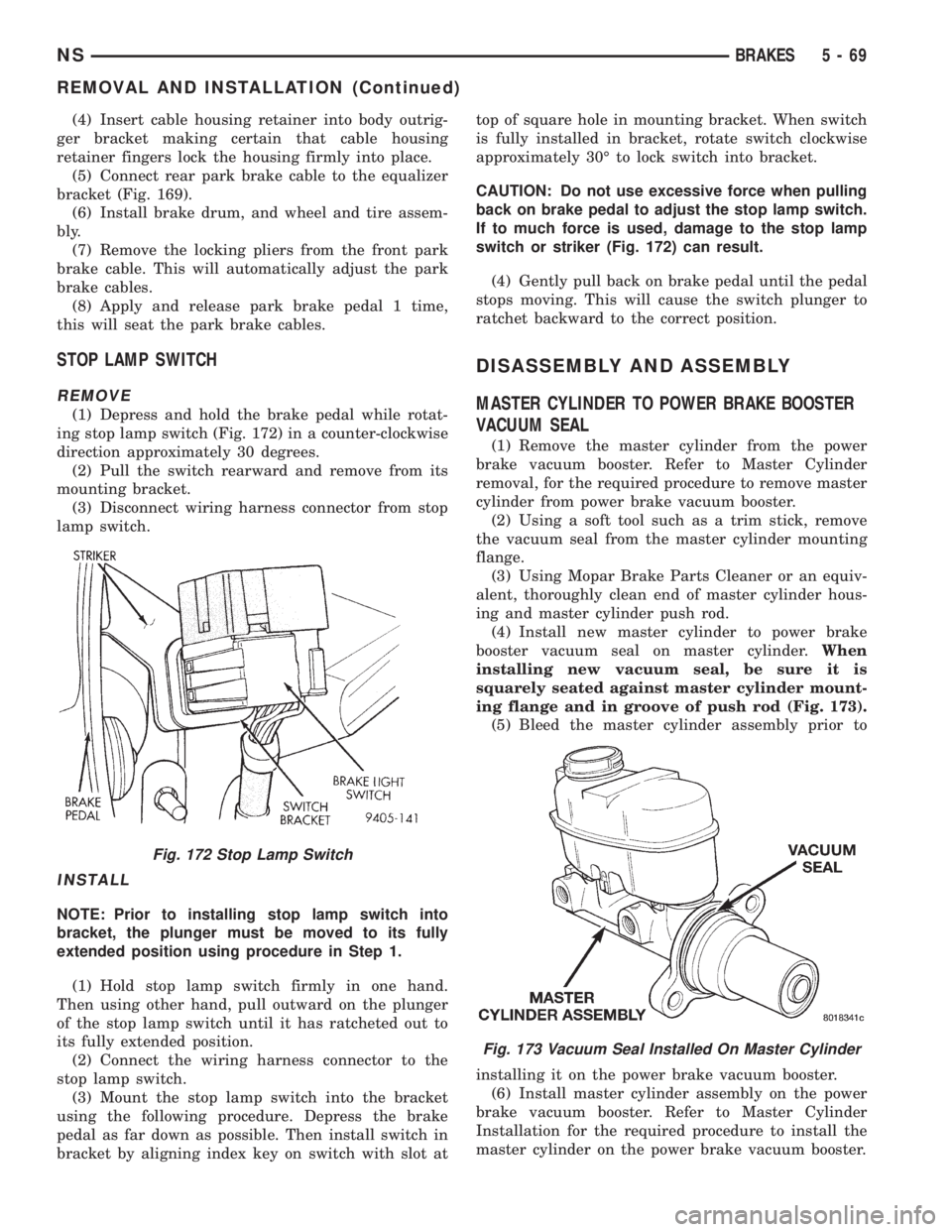
STOP LAMP SWITCH
REMOVE
(1) Depress and hold the brake pedal while rotat-
ing stop lamp switch (Fig. 172) in a counter-clockwise
direction approximately 30 degrees.
(2) Pull the switch rearward and remove from its
mounting bracket.
(3) Disconnect wiring harness connector from stop
lamp switch.
INSTALL
NOTE: Prior to installing stop lamp switch into
bracket, the plunger must be moved to its fully
extended position using procedure in Step 1.
(1) Hold stop lamp switch firmly in one hand.
Then using other hand, pull outward on the plunger
of the stop lamp switch until it has ratcheted out to
its fully extended position.
(2) Connect the wiring harness connector to the
stop lamp switch.
(3) Mount the stop lamp switch into the bracket
using the following procedure. Depress the brake
pedal as far down as possible. Then install switch in
bracket by aligning index key on switch with slot attop of square hole in mounting bracket. When switch
is fully installed in bracket, rotate switch clockwise
approximately 30É to lock switch into bracket.
CAUTION: Do not use excessive force when pulling
back on brake pedal to adjust the stop lamp switch.
If to much force is used, damage to the stop lamp
switch or striker (Fig. 172) can result.
(4) Gently pull back on brake pedal until the pedal
stops moving. This will cause the switch plunger to
ratchet backward to the correct position.
DISASSEMBLY AND ASSEMBLY
MASTER CYLINDER TO POWER BRAKE BOOSTER
VACUUM SEAL
(1) Remove the master cylinder from the power
brake vacuum booster. Refer to Master Cylinder
removal, for the required procedure to remove master
cylinder from power brake vacuum booster.
(2) Using a soft tool such as a trim stick, remove
the vacuum seal from the master cylinder mounting
flange.
(3) Using Mopar Brake Parts Cleaner or an equiv-
alent, thoroughly clean end of master cylinder hous-
ing and master cylinder push rod.
(4) Install new master cylinder to power brake
booster vacuum seal on master cylinder.When
installing new vacuum seal, be sure it is
squarely seated against master cylinder mount-
ing flange and in groove of push rod (Fig. 173).
(5) Bleed the master cylinder assembly prior to
installing it on the power brake vacuum booster.
(6) Install master cylinder assembly on the power
brake vacuum booster. Refer to Master Cylinder
Installation for the required procedure to install the
master cylinder on the power brake vacuum booster.
Fig. 172 Stop Lamp Switch
Fig. 173 Vacuum Seal Installed On Master Cylinder
NSBRAKES 5 - 69
REMOVAL AND INSTALLATION (Continued)
Page 158 of 1938
MUST always be used when installing brake
hose to caliper.
(12) Bleed the brake system (see Bleeding Brake
System).
WHEEL CYLINDER REAR DRUM BRAKE
DISASSEMBLE
To disassemble the wheel cylinders, proceed as fol-
lows:
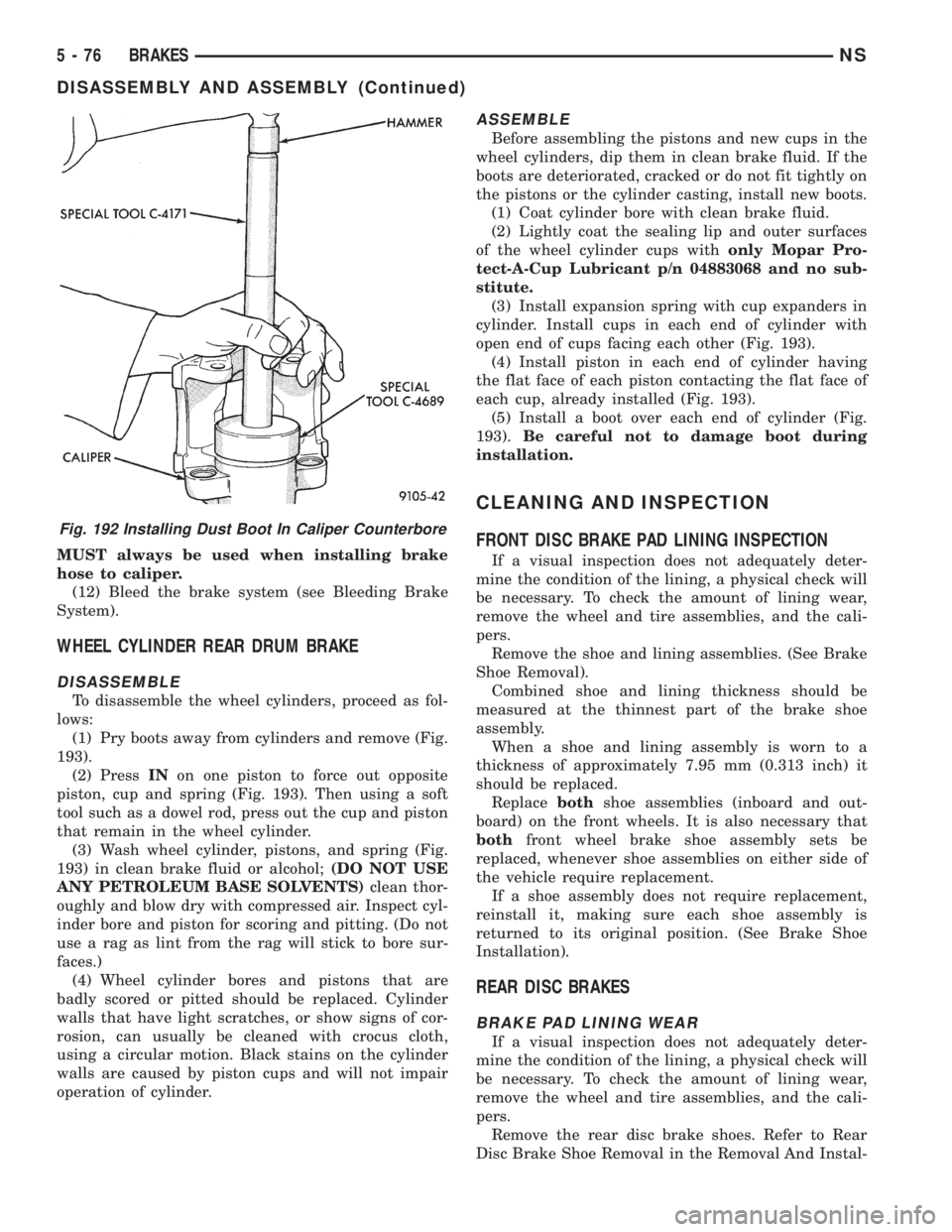
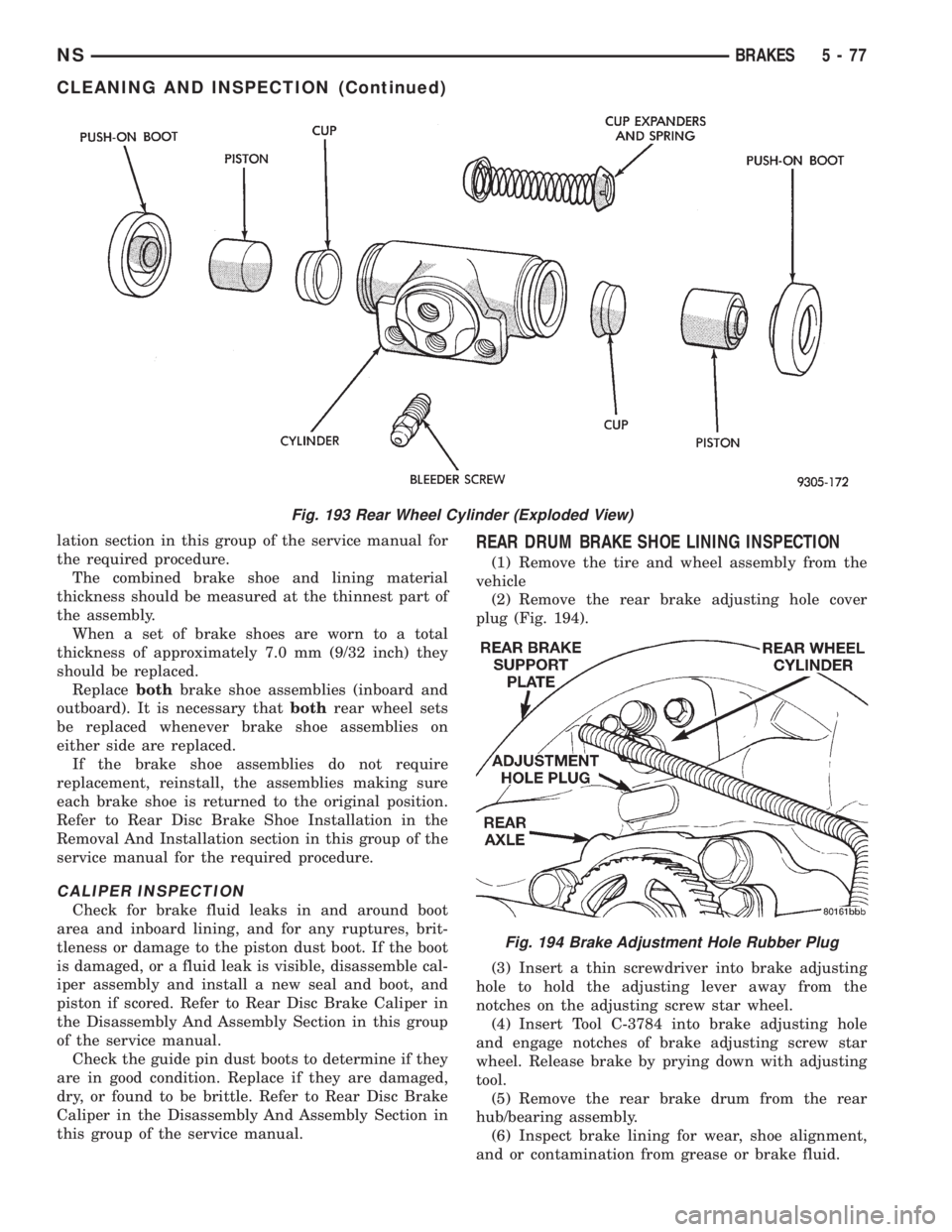
(1) Pry boots away from cylinders and remove (Fig.
193).
(2) PressINon one piston to force out opposite
piston, cup and spring (Fig. 193). Then using a soft
tool such as a dowel rod, press out the cup and piston
that remain in the wheel cylinder.
(3) Wash wheel cylinder, pistons, and spring (Fig.
193) in clean brake fluid or alcohol;(DO NOT USE
ANY PETROLEUM BASE SOLVENTS)clean thor-
oughly and blow dry with compressed air. Inspect cyl-
inder bore and piston for scoring and pitting. (Do not
use a rag as lint from the rag will stick to bore sur-
faces.)
(4) Wheel cylinder bores and pistons that are
badly scored or pitted should be replaced. Cylinder
walls that have light scratches, or show signs of cor-
rosion, can usually be cleaned with crocus cloth,
using a circular motion. Black stains on the cylinder
walls are caused by piston cups and will not impair
operation of cylinder.
ASSEMBLE
Before assembling the pistons and new cups in the
wheel cylinders, dip them in clean brake fluid. If the
boots are deteriorated, cracked or do not fit tightly on
the pistons or the cylinder casting, install new boots.
(1) Coat cylinder bore with clean brake fluid.
(2) Lightly coat the sealing lip and outer surfaces
of the wheel cylinder cups withonly Mopar Pro-
tect-A-Cup Lubricant p/n 04883068 and no sub-
stitute.
(3) Install expansion spring with cup expanders in
cylinder. Install cups in each end of cylinder with
open end of cups facing each other (Fig. 193).
(4) Install piston in each end of cylinder having
the flat face of each piston contacting the flat face of
each cup, already installed (Fig. 193).
(5) Install a boot over each end of cylinder (Fig.
193).Be careful not to damage boot during
installation.
CLEANING AND INSPECTION
FRONT DISC BRAKE PAD LINING INSPECTION
If a visual inspection does not adequately deter-
mine the condition of the lining, a physical check will
be necessary. To check the amount of lining wear,
remove the wheel and tire assemblies, and the cali-
pers.
Remove the shoe and lining assemblies. (See Brake
Shoe Removal).
Combined shoe and lining thickness should be
measured at the thinnest part of the brake shoe
assembly.
When a shoe and lining assembly is worn to a
thickness of approximately 7.95 mm (0.313 inch) it
should be replaced.
Replacebothshoe assemblies (inboard and out-
board) on the front wheels. It is also necessary that
bothfront wheel brake shoe assembly sets be
replaced, whenever shoe assemblies on either side of
the vehicle require replacement.
If a shoe assembly does not require replacement,
reinstall it, making sure each shoe assembly is
returned to its original position. (See Brake Shoe
Installation).
REAR DISC BRAKES
BRAKE PAD LINING WEAR
If a visual inspection does not adequately deter-
mine the condition of the lining, a physical check will
be necessary. To check the amount of lining wear,
remove the wheel and tire assemblies, and the cali-
pers.
Remove the rear disc brake shoes. Refer to Rear
Disc Brake Shoe Removal in the Removal And Instal-
Fig. 192 Installing Dust Boot In Caliper Counterbore
5 - 76 BRAKESNS
DISASSEMBLY AND ASSEMBLY (Continued)
Page 159 of 1938
lation section in this group of the service manual for
the required procedure.
The combined brake shoe and lining material
thickness should be measured at the thinnest part of
the assembly.
When a set of brake shoes are worn to a total
thickness of approximately 7.0 mm (9/32 inch) they
should be replaced.
Replacebothbrake shoe assemblies (inboard and
outboard). It is necessary thatbothrear wheel sets
be replaced whenever brake shoe assemblies on
either side are replaced.
If the brake shoe assemblies do not require
replacement, reinstall, the assemblies making sure
each brake shoe is returned to the original position.
Refer to Rear Disc Brake Shoe Installation in the
Removal And Installation section in this group of the
service manual for the required procedure.
CALIPER INSPECTION
Check for brake fluid leaks in and around boot
area and inboard lining, and for any ruptures, brit-
tleness or damage to the piston dust boot. If the boot
is damaged, or a fluid leak is visible, disassemble cal-
iper assembly and install a new seal and boot, and
piston if scored. Refer to Rear Disc Brake Caliper in
the Disassembly And Assembly Section in this group
of the service manual.
Check the guide pin dust boots to determine if they
are in good condition. Replace if they are damaged,
dry, or found to be brittle. Refer to Rear Disc Brake
Caliper in the Disassembly And Assembly Section in
this group of the service manual.
REAR DRUM BRAKE SHOE LINING INSPECTION
(1) Remove the tire and wheel assembly from the
vehicle
(2) Remove the rear brake adjusting hole cover
plug (Fig. 194).
(3) Insert a thin screwdriver into brake adjusting
hole to hold the adjusting lever away from the
notches on the adjusting screw star wheel.
(4) Insert Tool C-3784 into brake adjusting hole
and engage notches of brake adjusting screw star
wheel. Release brake by prying down with adjusting
tool.
(5) Remove the rear brake drum from the rear
hub/bearing assembly.
(6) Inspect brake lining for wear, shoe alignment,
and or contamination from grease or brake fluid.
Fig. 193 Rear Wheel Cylinder (Exploded View)
Fig. 194 Brake Adjustment Hole Rubber Plug
NSBRAKES 5 - 77
CLEANING AND INSPECTION (Continued)
Page 160 of 1938
REAR DRUM BRAKE WHEEL CYLINDER
With brake drums removed, inspect the wheel cyl-
inder boots for evidence of a brake fluid leak. Visu-
ally check the boots for cuts, tears, or heat cracks. If
any of these conditions exist, the wheel cylinders
should be completely cleaned, inspected and new
parts installed.
If a wheel cylinder is leaking and the brake lining
material is saturated with brake fluid, the brake
shoes must be replaced.
BRAKE HOSE AND BRAKE LINES INSPECTION
Flexible rubber hose is used at both front brakes
and at the rear axle. Inspection of brake hoses
should be performed whenever the brake system is
serviced and every 7,500 miles or 12 months, which-
ever comes first (every engine oil change). Inspect
hydraulic brake hoses for surface cracking, scuffing,
or worn spots. If the fabric casing of the rubber hose
becomes exposed due to cracks or abrasions in the
rubber hose cover, the hose should be replaced imme-
diately. Eventual deterioration of the hose can take
place with possible burst failure. Faulty installation
can cause twisting, resulting in wheel, tire, or chassis
interference.
The steel brake tubing should be inspected period-
ically for evidence of physical damage or contact with
moving or hot components.
The flexible brake tube sections used on this vehi-
cle in the primary and secondary tubes from the
master cylinder to the ABS hydraulic control unit
connections and the chassis brake tubes between the
hydraulic control unit and the proportioning valve
must also be inspected. This flexible tubing must be
inspected for kinks, fraying and its contact with
other components of the vehicle or contact with the
body of the vehicle.
REAR WHEEL HUB AND BEARING ASSEMBLY
The rear hub and bearing assembly is designed for
the life of the vehicle and should require no mainte-
nance. The following procedure may be used for eval-
uation of bearing condition.
With wheel and brake drum removed, rotate
flanged outer ring of hub. Excessive roughness, lat-
eral play or resistance to rotation may indicate dirt
intrusion or bearing failure. If the rear wheel bear-
ings exhibit these conditions during inspection, the
hub and bearing assembly should be replaced.
Damaged bearing seals and resulting excessive
grease loss may also require bearing replacement.
Moderate grease loss from bearing is considered nor-
mal and should not require replacement of the hub
and bearing assembly.
ADJUSTMENTS
STOP LAMP SWITCH
(1) Remove stop lamp switch from its bracket by
rotating it approximately 30É in a counter-clockwise
direction.
(2) Disconnect wiring harness connector from stop
lamp switch.
(3) Hold stop lamp switch firmly in one hand.
Then using other hand, pull outward on the plunger
of the stop lamp switch until it has ratcheted out to
its fully extended position.
(4) Install the stop lamp switch into the bracket
using the following procedure. Depress the brake
pedal as far down as possible. Then while keeping
the brake pedal depressed, install the stop lamp
switch into the bracket by aligning index key on
switch with slot at top of square hole in mounting
bracket. When switch is fully installed in the square
hole of the bracket, rotate switch clockwise approxi-
mately 30É to lock the switch into the bracket.
CAUTION: Do not use excessive force when pulling
back on brake pedal to adjust the stop lamp switch.
If too much force is used, damage to the vacuum
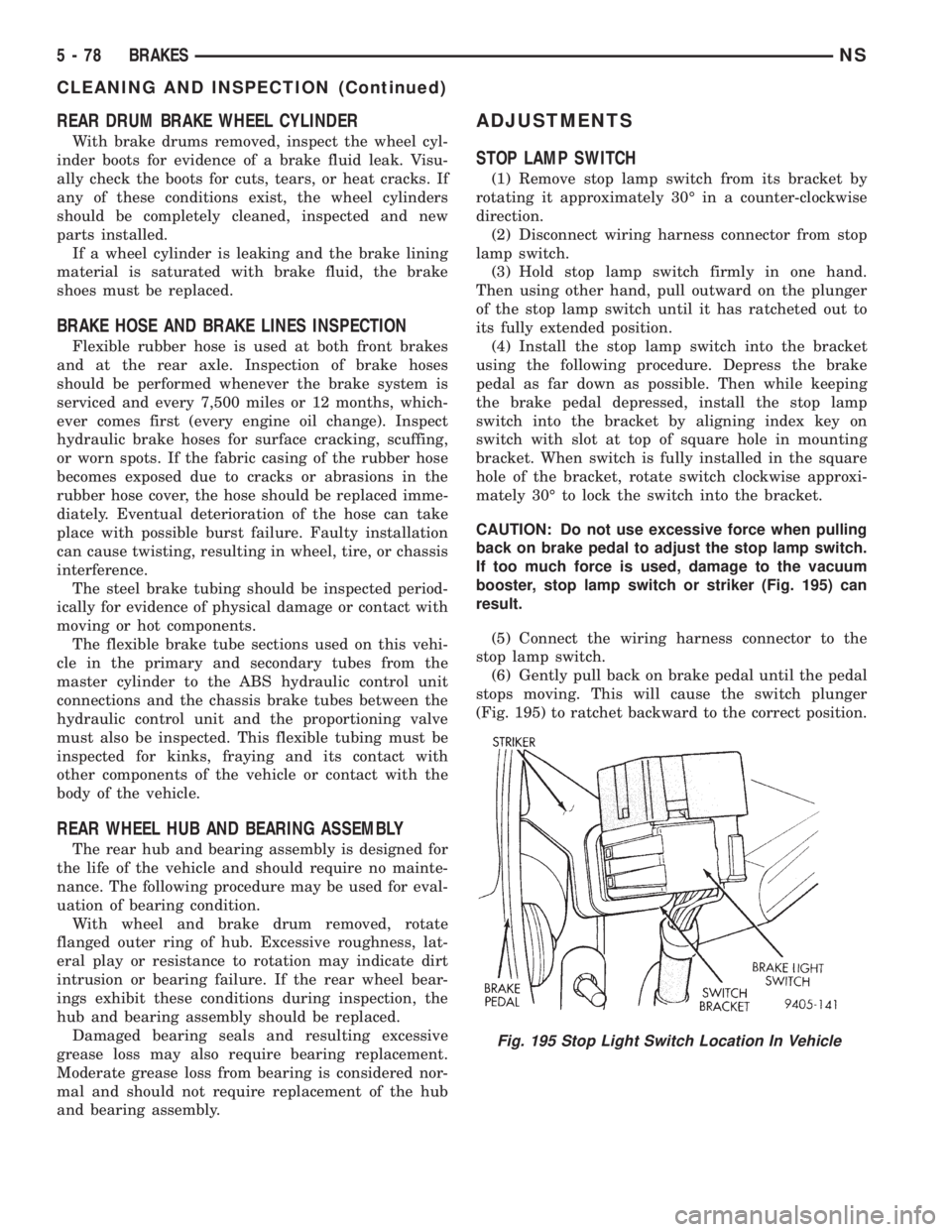
booster, stop lamp switch or striker (Fig. 195) can
result.
(5) Connect the wiring harness connector to the
stop lamp switch.
(6) Gently pull back on brake pedal until the pedal
stops moving. This will cause the switch plunger
(Fig. 195) to ratchet backward to the correct position.
Fig. 195 Stop Light Switch Location In Vehicle
5 - 78 BRAKESNS
CLEANING AND INSPECTION (Continued)
Page 161 of 1938
REAR DRUM BRAKE SHOE ADJUSTMENT
NOTE: Normally, self adjusting drum brakes will
not require manual brake shoe adjustment.
Although in the event of a brake reline it is advis-
able to make the initial adjustment manually to
speed up the adjusting time.
(1) Raise the vehicle so that the rear wheels are
free to turn. See Hoisting Recommendations in the
Lubrication And Maintenance Section, at the front of
this service manual.
Remove the park brake cable, for the wheel of the
vehicle that is being worked on, from the park brake
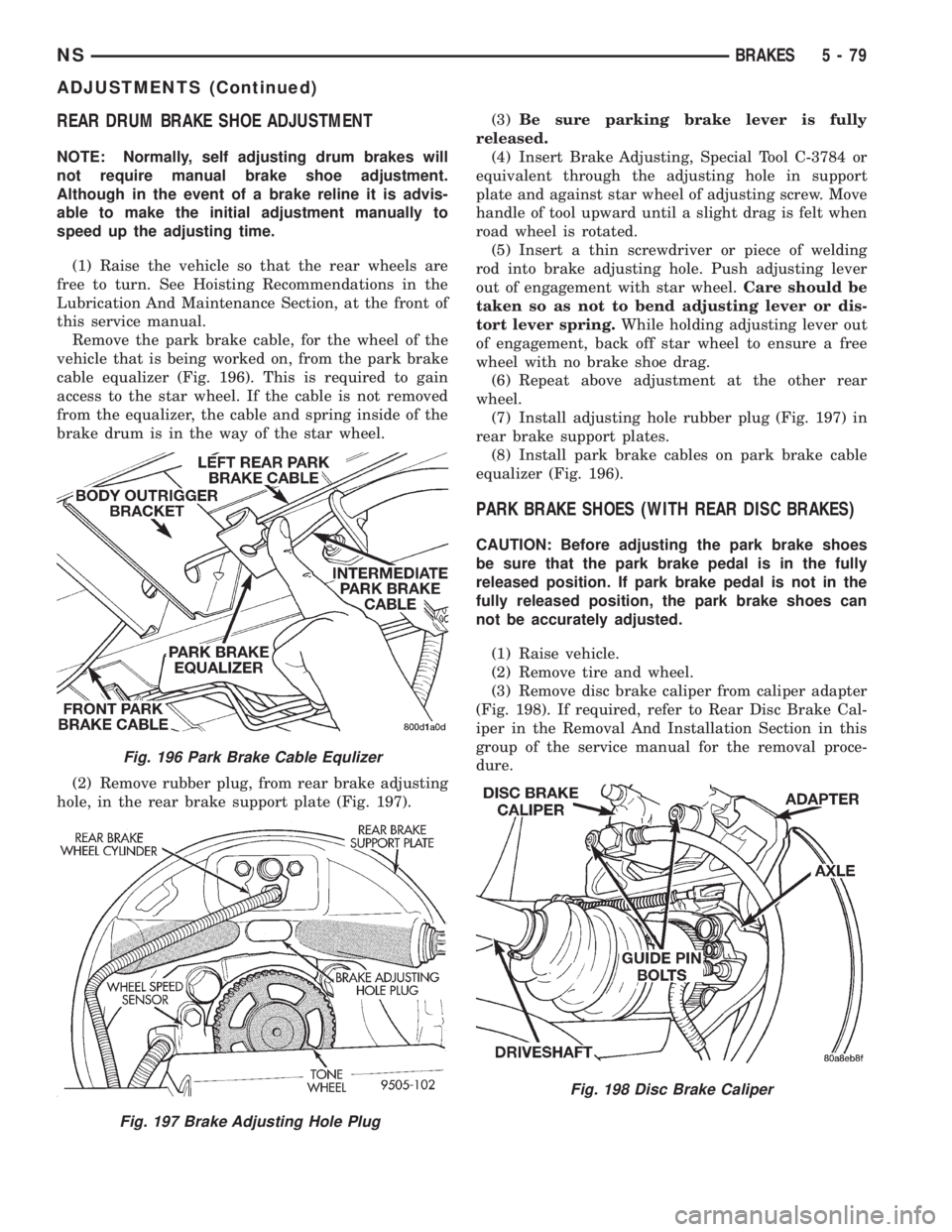
cable equalizer (Fig. 196). This is required to gain
access to the star wheel. If the cable is not removed
from the equalizer, the cable and spring inside of the
brake drum is in the way of the star wheel.
(2) Remove rubber plug, from rear brake adjusting
hole, in the rear brake support plate (Fig. 197).(3)Be sure parking brake lever is fully
released.
(4) Insert Brake Adjusting, Special Tool C-3784 or
equivalent through the adjusting hole in support
plate and against star wheel of adjusting screw. Move
handle of tool upward until a slight drag is felt when
road wheel is rotated.
(5) Insert a thin screwdriver or piece of welding
rod into brake adjusting hole. Push adjusting lever
out of engagement with star wheel.Care should be
taken so as not to bend adjusting lever or dis-
tort lever spring.While holding adjusting lever out
of engagement, back off star wheel to ensure a free
wheel with no brake shoe drag.
(6) Repeat above adjustment at the other rear
wheel.
(7) Install adjusting hole rubber plug (Fig. 197) in
rear brake support plates.
(8) Install park brake cables on park brake cable
equalizer (Fig. 196).
PARK BRAKE SHOES (WITH REAR DISC BRAKES)
CAUTION: Before adjusting the park brake shoes
be sure that the park brake pedal is in the fully
released position. If park brake pedal is not in the
fully released position, the park brake shoes can
not be accurately adjusted.
(1) Raise vehicle.
(2) Remove tire and wheel.
(3) Remove disc brake caliper from caliper adapter
(Fig. 198). If required, refer to Rear Disc Brake Cal-
iper in the Removal And Installation Section in this
group of the service manual for the removal proce-
dure.
Fig. 196 Park Brake Cable Equlizer
Fig. 197 Brake Adjusting Hole Plug
Fig. 198 Disc Brake Caliper
NSBRAKES 5 - 79
ADJUSTMENTS (Continued)