engine CHRYSLER VOYAGER 1996 Manual Online
[x] Cancel search | Manufacturer: CHRYSLER, Model Year: 1996, Model line: VOYAGER, Model: CHRYSLER VOYAGER 1996Pages: 1938, PDF Size: 55.84 MB
Page 276 of 1938
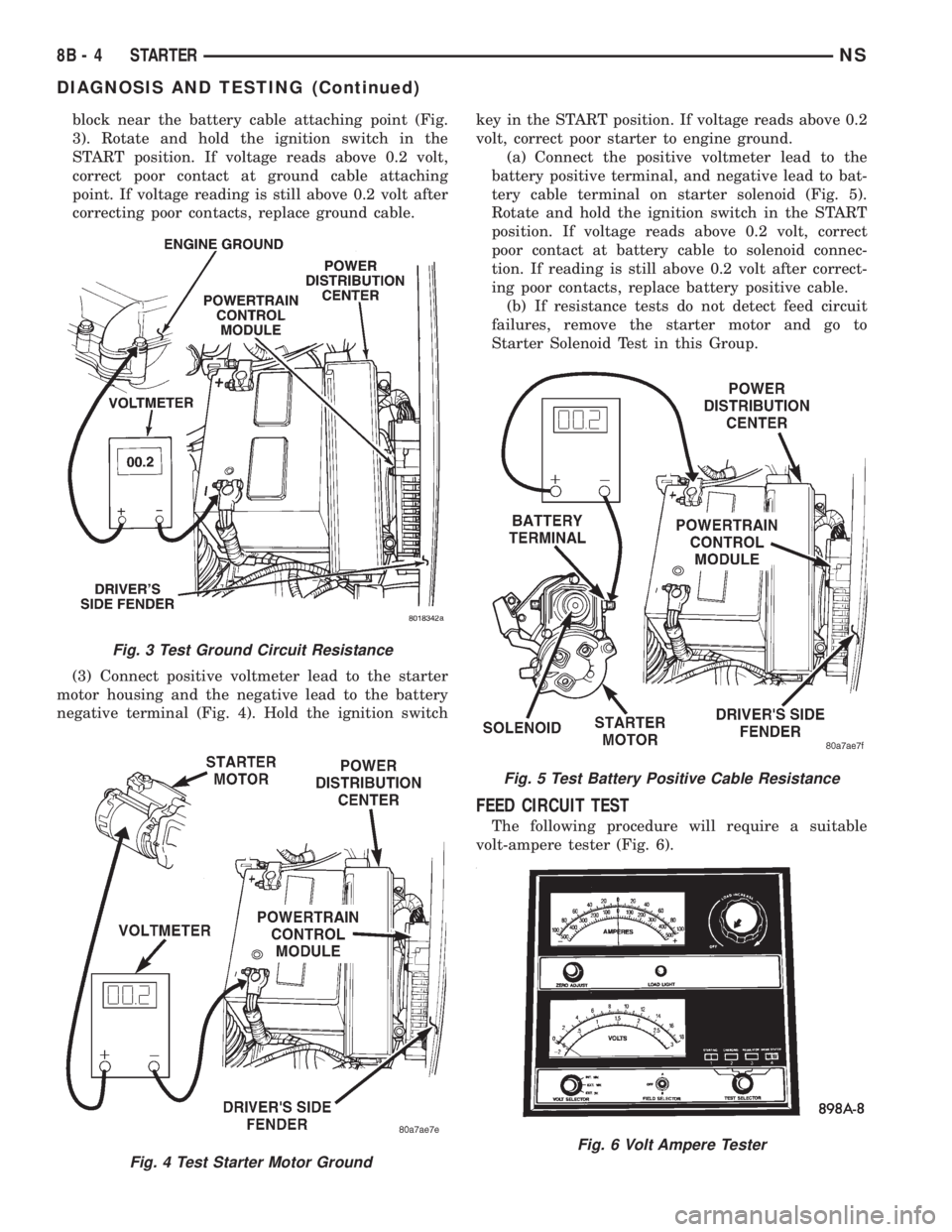
block near the battery cable attaching point (Fig.
3). Rotate and hold the ignition switch in the
START position. If voltage reads above 0.2 volt,
correct poor contact at ground cable attaching
point. If voltage reading is still above 0.2 volt after
correcting poor contacts, replace ground cable.
(3) Connect positive voltmeter lead to the starter
motor housing and the negative lead to the battery
negative terminal (Fig. 4). Hold the ignition switchkey in the START position. If voltage reads above 0.2
volt, correct poor starter to engine ground.
(a) Connect the positive voltmeter lead to the
battery positive terminal, and negative lead to bat-
tery cable terminal on starter solenoid (Fig. 5).
Rotate and hold the ignition switch in the START
position. If voltage reads above 0.2 volt, correct
poor contact at battery cable to solenoid connec-
tion. If reading is still above 0.2 volt after correct-
ing poor contacts, replace battery positive cable.
(b) If resistance tests do not detect feed circuit
failures, remove the starter motor and go to
Starter Solenoid Test in this Group.
FEED CIRCUIT TEST
The following procedure will require a suitable
volt-ampere tester (Fig. 6).
Fig. 4 Test Starter Motor Ground
Fig. 3 Test Ground Circuit Resistance
Fig. 5 Test Battery Positive Cable Resistance
Fig. 6 Volt Ampere Tester
8B - 4 STARTERNS
DIAGNOSIS AND TESTING (Continued)
Page 277 of 1938
CAUTION: Before performing any starter tests, the
ignition and fuel systems must be disabled.
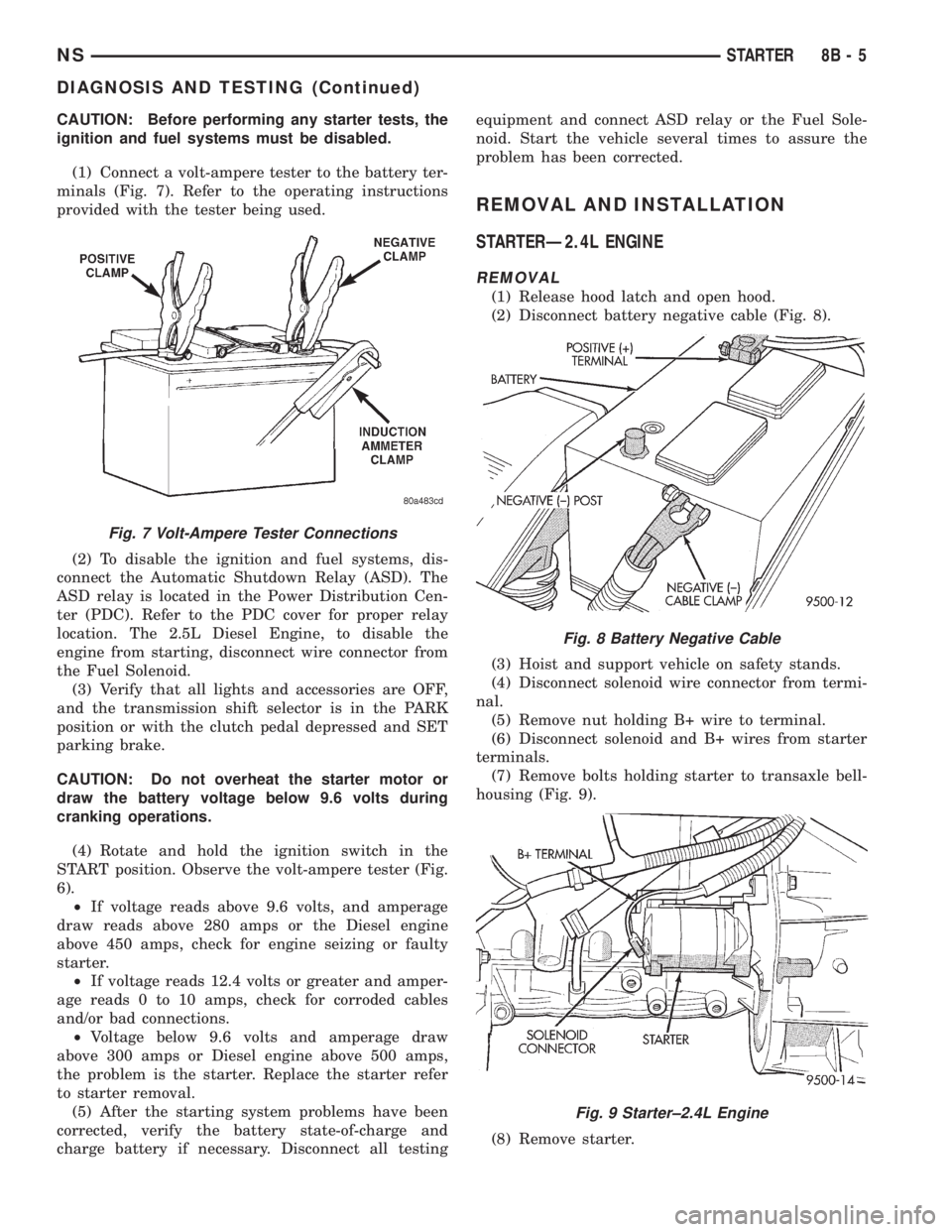
(1) Connect a volt-ampere tester to the battery ter-
minals (Fig. 7). Refer to the operating instructions
provided with the tester being used.
(2) To disable the ignition and fuel systems, dis-
connect the Automatic Shutdown Relay (ASD). The
ASD relay is located in the Power Distribution Cen-
ter (PDC). Refer to the PDC cover for proper relay
location. The 2.5L Diesel Engine, to disable the
engine from starting, disconnect wire connector from
the Fuel Solenoid.
(3) Verify that all lights and accessories are OFF,
and the transmission shift selector is in the PARK
position or with the clutch pedal depressed and SET
parking brake.
CAUTION: Do not overheat the starter motor or
draw the battery voltage below 9.6 volts during
cranking operations.
(4) Rotate and hold the ignition switch in the
START position. Observe the volt-ampere tester (Fig.
6).
²If voltage reads above 9.6 volts, and amperage
draw reads above 280 amps or the Diesel engine
above 450 amps, check for engine seizing or faulty
starter.
²If voltage reads 12.4 volts or greater and amper-
age reads 0 to 10 amps, check for corroded cables
and/or bad connections.
²Voltage below 9.6 volts and amperage draw
above 300 amps or Diesel engine above 500 amps,
the problem is the starter. Replace the starter refer
to starter removal.
(5) After the starting system problems have been
corrected, verify the battery state-of-charge and
charge battery if necessary. Disconnect all testingequipment and connect ASD relay or the Fuel Sole-
noid. Start the vehicle several times to assure the
problem has been corrected.
REMOVAL AND INSTALLATION
STARTERÐ2.4L ENGINE
REMOVAL
(1) Release hood latch and open hood.
(2) Disconnect battery negative cable (Fig. 8).
(3) Hoist and support vehicle on safety stands.
(4) Disconnect solenoid wire connector from termi-
nal.
(5) Remove nut holding B+ wire to terminal.
(6) Disconnect solenoid and B+ wires from starter
terminals.
(7) Remove bolts holding starter to transaxle bell-
housing (Fig. 9).
(8) Remove starter.
Fig. 7 Volt-Ampere Tester Connections
Fig. 8 Battery Negative Cable
Fig. 9 Starter±2.4L Engine
NSSTARTER 8B - 5
DIAGNOSIS AND TESTING (Continued)
Page 278 of 1938
INSTALLATION
(1) Place starter in position on vehicle.
(2) Install bolts to hold starter to transaxle bell-
housing.
(3) Place solenoid and B+ wires in position on
starter terminals.
(4) Install nut to hold B+ wire to terminal.
(5) Connect solenoid wire connector onto terminal.
(6) Lower vehicle.
(7) Connect battery negative cable.
(8) Verify starter operation.
STARTERÐ3.0L ENGINE
REMOVAL
(1) Release hood latch and open hood.
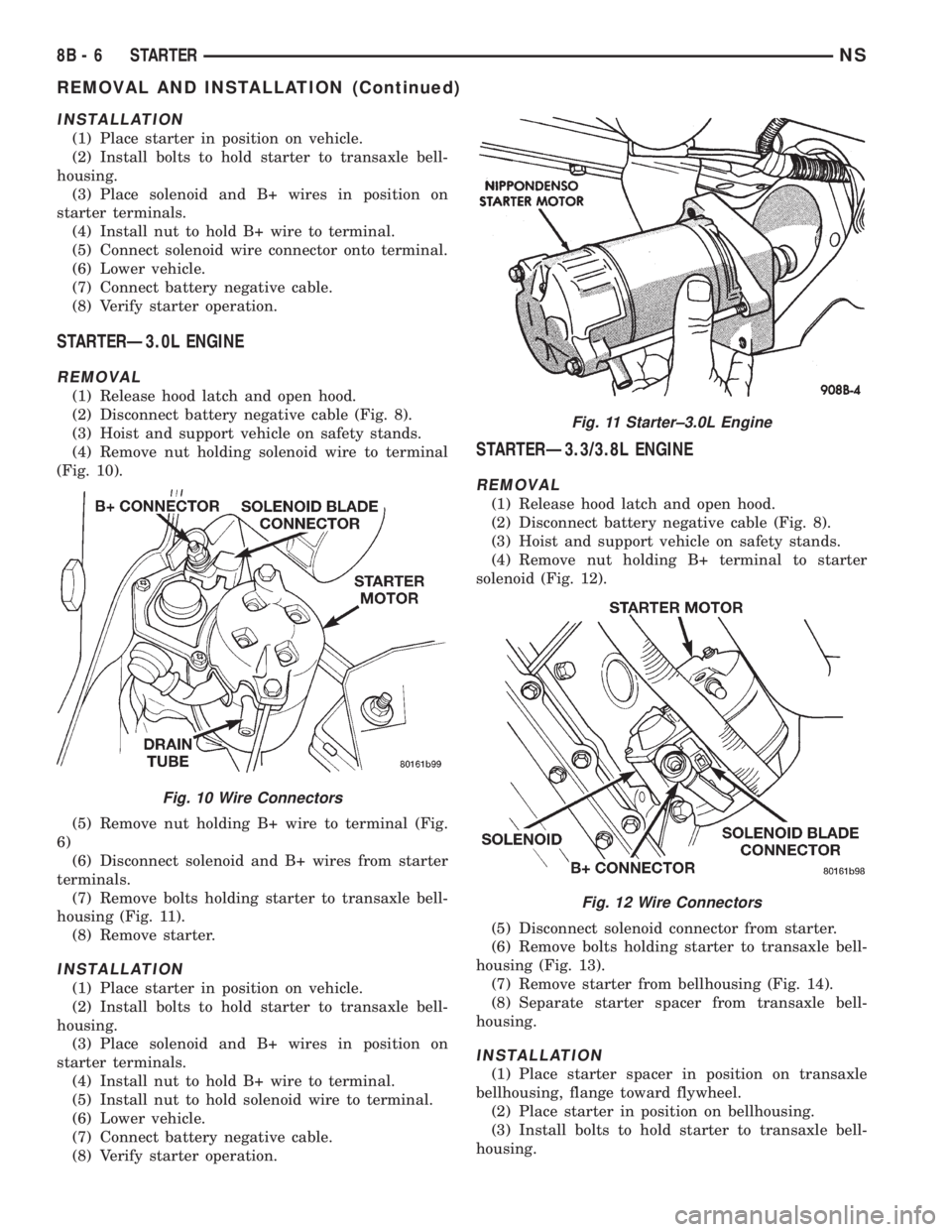
(2) Disconnect battery negative cable (Fig. 8).
(3) Hoist and support vehicle on safety stands.
(4) Remove nut holding solenoid wire to terminal
(Fig. 10).
(5) Remove nut holding B+ wire to terminal (Fig.
6)
(6) Disconnect solenoid and B+ wires from starter
terminals.
(7) Remove bolts holding starter to transaxle bell-
housing (Fig. 11).
(8) Remove starter.
INSTALLATION
(1) Place starter in position on vehicle.
(2) Install bolts to hold starter to transaxle bell-
housing.
(3) Place solenoid and B+ wires in position on
starter terminals.
(4) Install nut to hold B+ wire to terminal.
(5) Install nut to hold solenoid wire to terminal.
(6) Lower vehicle.
(7) Connect battery negative cable.
(8) Verify starter operation.
STARTERÐ3.3/3.8L ENGINE
REMOVAL
(1) Release hood latch and open hood.
(2) Disconnect battery negative cable (Fig. 8).
(3) Hoist and support vehicle on safety stands.
(4) Remove nut holding B+ terminal to starter
solenoid (Fig. 12).
(5) Disconnect solenoid connector from starter.
(6) Remove bolts holding starter to transaxle bell-
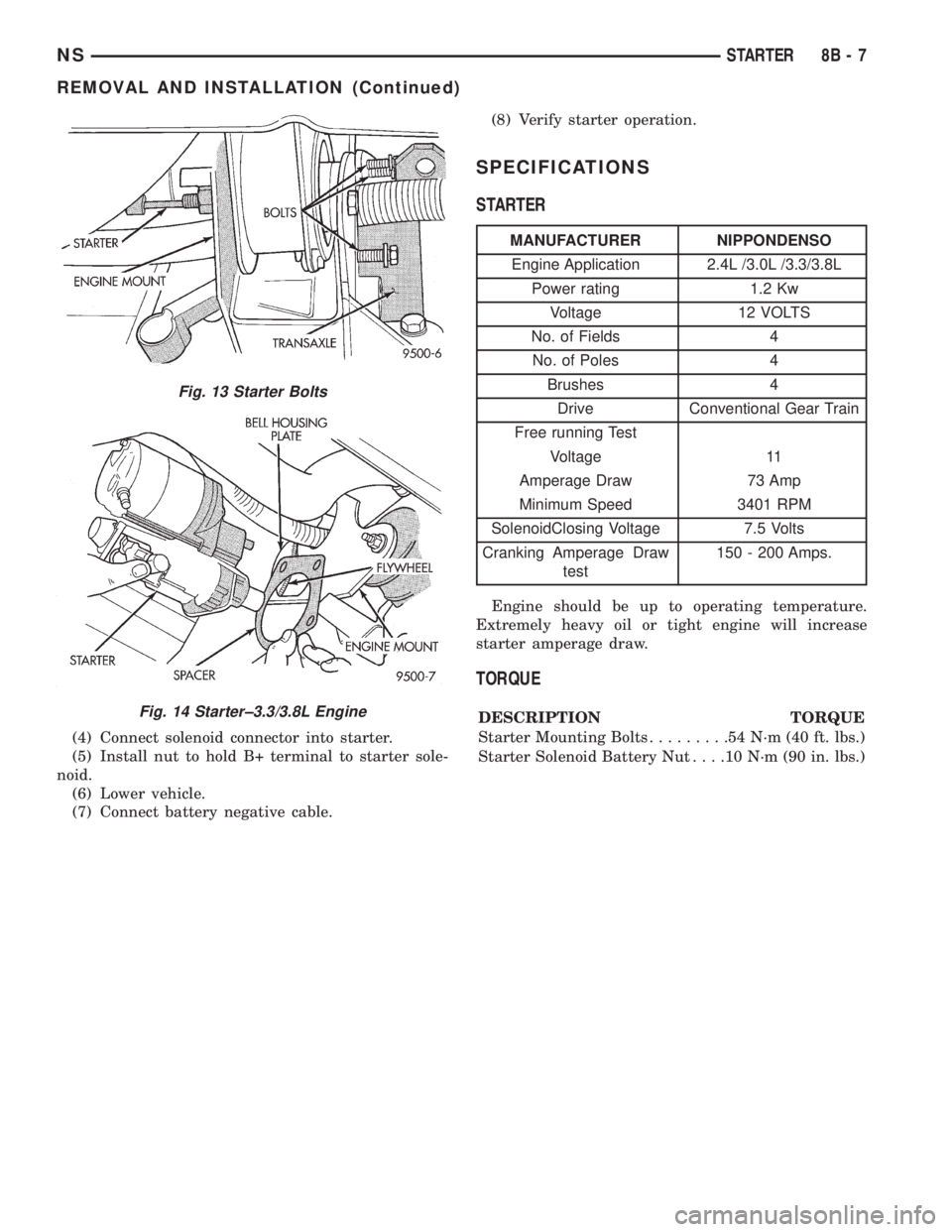
housing (Fig. 13).
(7) Remove starter from bellhousing (Fig. 14).
(8) Separate starter spacer from transaxle bell-
housing.
INSTALLATION
(1) Place starter spacer in position on transaxle
bellhousing, flange toward flywheel.
(2) Place starter in position on bellhousing.
(3) Install bolts to hold starter to transaxle bell-
housing.
Fig. 10 Wire Connectors
Fig. 11 Starter±3.0L Engine
Fig. 12 Wire Connectors
8B - 6 STARTERNS
REMOVAL AND INSTALLATION (Continued)
Page 279 of 1938
(4) Connect solenoid connector into starter.
(5) Install nut to hold B+ terminal to starter sole-
noid.
(6) Lower vehicle.
(7) Connect battery negative cable.(8) Verify starter operation.
SPECIFICATIONS
STARTER
Engine should be up to operating temperature.
Extremely heavy oil or tight engine will increase
starter amperage draw.
TORQUE
DESCRIPTION TORQUE
Starter Mounting Bolts.........54N´m(40ft.lbs.)
Starter Solenoid Battery Nut. . . .10 N´m (90 in. lbs.)
Fig. 13 Starter Bolts
Fig. 14 Starter±3.3/3.8L Engine
MANUFACTURER NIPPONDENSO
Engine Application 2.4L /3.0L /3.3/3.8L
Power rating 1.2 Kw
Voltage 12 VOLTS
No. of Fields 4
No. of Poles 4
Brushes 4
Drive Conventional Gear Train
Free running Test
Voltage 11
Amperage Draw 73 Amp
Minimum Speed 3401 RPM
SolenoidClosing Voltage 7.5 Volts
Cranking Amperage Draw
test150 - 200 Amps.
NSSTARTER 8B - 7
REMOVAL AND INSTALLATION (Continued)
Page 281 of 1938
STARTING SYSTEM
CONTENTS
page
REMOVAL AND INSTALLATION
STARTER ............................. 1
REMOVAL AND INSTALLATION
STARTER
2.0L ENGINE
REMOVAL
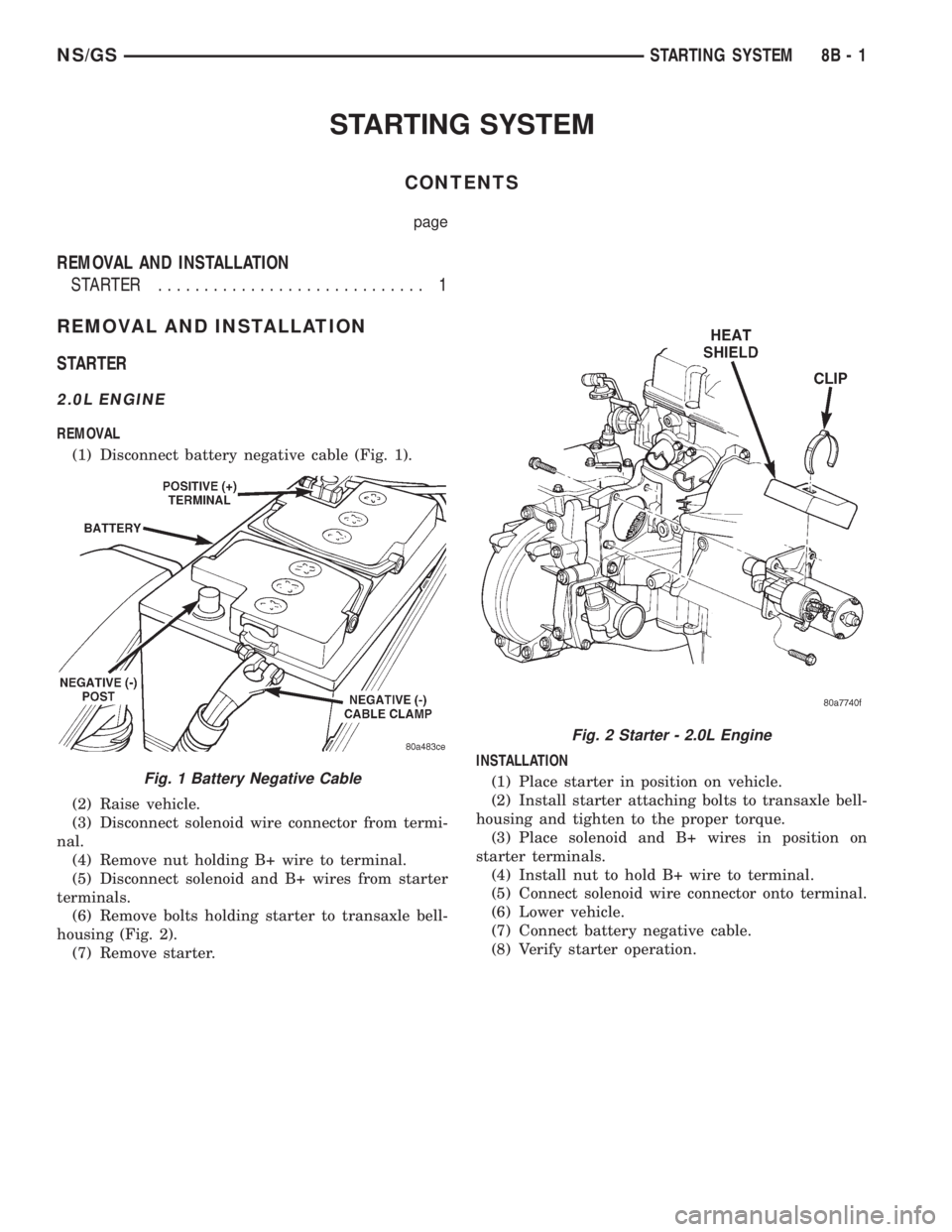
(1) Disconnect battery negative cable (Fig. 1).
(2) Raise vehicle.
(3) Disconnect solenoid wire connector from termi-
nal.
(4) Remove nut holding B+ wire to terminal.
(5) Disconnect solenoid and B+ wires from starter
terminals.
(6) Remove bolts holding starter to transaxle bell-
housing (Fig. 2).
(7) Remove starter.INSTALLATION
(1) Place starter in position on vehicle.
(2) Install starter attaching bolts to transaxle bell-
housing and tighten to the proper torque.
(3) Place solenoid and B+ wires in position on
starter terminals.
(4) Install nut to hold B+ wire to terminal.
(5) Connect solenoid wire connector onto terminal.
(6) Lower vehicle.
(7) Connect battery negative cable.
(8) Verify starter operation.
Fig. 1 Battery Negative Cable
Fig. 2 Starter - 2.0L Engine
NS/GSSTARTING SYSTEM 8B - 1
Page 282 of 1938
2.4L ENGINE - With Manual Transaxle
REMOVAL
(1) Release hood latch and open hood.
(2) Disconnect battery negative cable (Fig. 1).
(3) Hoist and support vehicle on safety stands.
(4) Disconnect solenoid wire connector from termi-
nal.
(5) Remove nut holding B+ wire to terminal.
(6) Disconnect solenoid and B+ wires from starter
terminals.
(7) Remove bolts holding starter to transaxle bell-
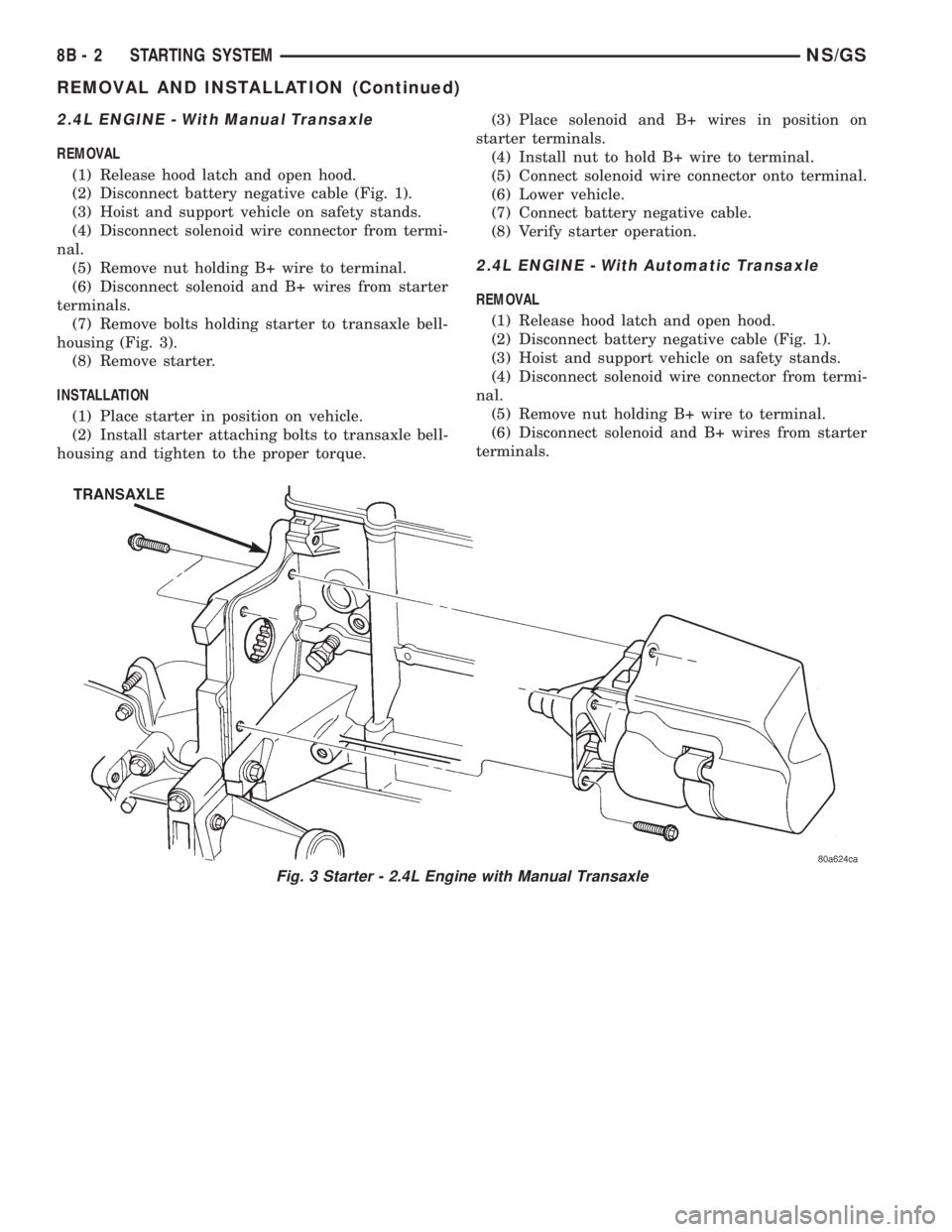
housing (Fig. 3).
(8) Remove starter.
INSTALLATION
(1) Place starter in position on vehicle.
(2) Install starter attaching bolts to transaxle bell-
housing and tighten to the proper torque.(3) Place solenoid and B+ wires in position on
starter terminals.
(4) Install nut to hold B+ wire to terminal.
(5) Connect solenoid wire connector onto terminal.
(6) Lower vehicle.
(7) Connect battery negative cable.
(8) Verify starter operation.
2.4L ENGINE - With Automatic Transaxle
REMOVAL
(1) Release hood latch and open hood.
(2) Disconnect battery negative cable (Fig. 1).
(3) Hoist and support vehicle on safety stands.
(4) Disconnect solenoid wire connector from termi-
nal.
(5) Remove nut holding B+ wire to terminal.
(6) Disconnect solenoid and B+ wires from starter
terminals.
Fig. 3 Starter - 2.4L Engine with Manual Transaxle
8B - 2 STARTING SYSTEMNS/GS
REMOVAL AND INSTALLATION (Continued)
Page 283 of 1938
(7) Remove bolts holding starter to transaxle bell-
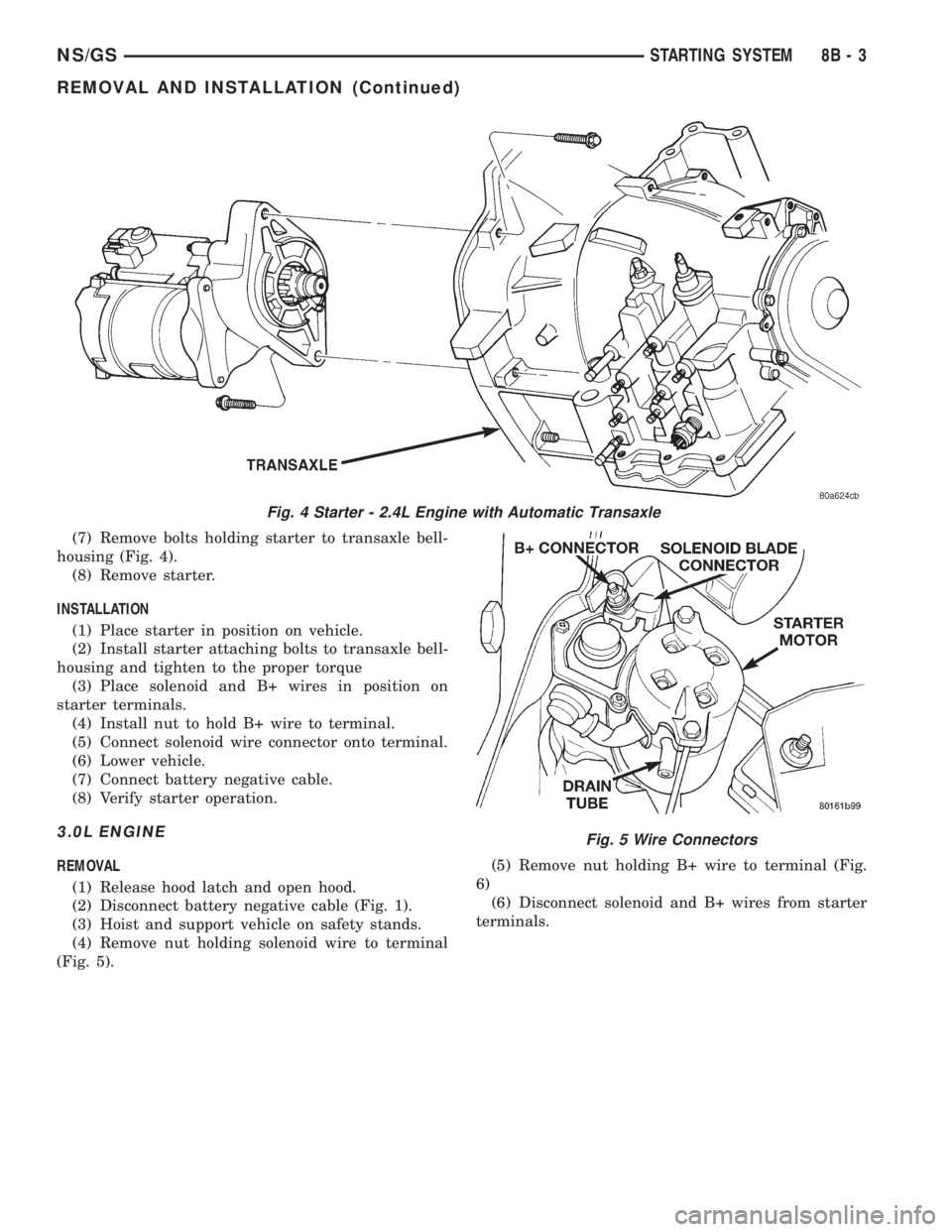
housing (Fig. 4).
(8) Remove starter.
INSTALLATION
(1) Place starter in position on vehicle.
(2) Install starter attaching bolts to transaxle bell-
housing and tighten to the proper torque
(3) Place solenoid and B+ wires in position on
starter terminals.
(4) Install nut to hold B+ wire to terminal.
(5) Connect solenoid wire connector onto terminal.
(6) Lower vehicle.
(7) Connect battery negative cable.
(8) Verify starter operation.
3.0L ENGINE
REMOVAL
(1) Release hood latch and open hood.
(2) Disconnect battery negative cable (Fig. 1).
(3) Hoist and support vehicle on safety stands.
(4) Remove nut holding solenoid wire to terminal
(Fig. 5).(5) Remove nut holding B+ wire to terminal (Fig.
6)
(6) Disconnect solenoid and B+ wires from starter
terminals.
Fig. 4 Starter - 2.4L Engine with Automatic Transaxle
Fig. 5 Wire Connectors
NS/GSSTARTING SYSTEM 8B - 3
REMOVAL AND INSTALLATION (Continued)
Page 284 of 1938
(7) Remove bolts holding starter to transaxle bell-
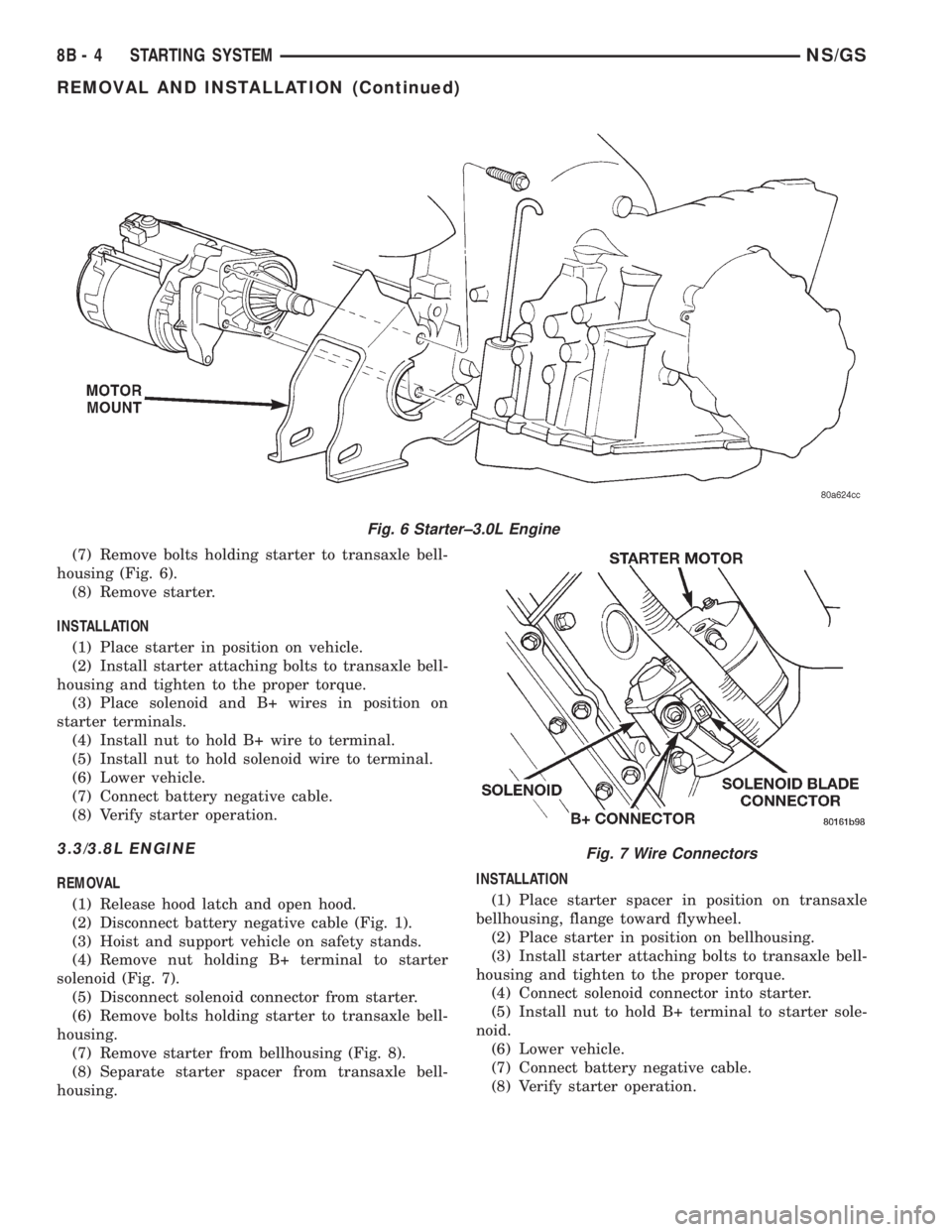
housing (Fig. 6).
(8) Remove starter.
INSTALLATION
(1) Place starter in position on vehicle.
(2) Install starter attaching bolts to transaxle bell-
housing and tighten to the proper torque.
(3) Place solenoid and B+ wires in position on
starter terminals.
(4) Install nut to hold B+ wire to terminal.
(5) Install nut to hold solenoid wire to terminal.
(6) Lower vehicle.
(7) Connect battery negative cable.
(8) Verify starter operation.
3.3/3.8L ENGINE
REMOVAL
(1) Release hood latch and open hood.
(2) Disconnect battery negative cable (Fig. 1).
(3) Hoist and support vehicle on safety stands.
(4) Remove nut holding B+ terminal to starter
solenoid (Fig. 7).
(5) Disconnect solenoid connector from starter.
(6) Remove bolts holding starter to transaxle bell-
housing.
(7) Remove starter from bellhousing (Fig. 8).
(8) Separate starter spacer from transaxle bell-
housing.INSTALLATION
(1) Place starter spacer in position on transaxle
bellhousing, flange toward flywheel.
(2) Place starter in position on bellhousing.
(3) Install starter attaching bolts to transaxle bell-
housing and tighten to the proper torque.
(4) Connect solenoid connector into starter.
(5) Install nut to hold B+ terminal to starter sole-
noid.
(6) Lower vehicle.
(7) Connect battery negative cable.
(8) Verify starter operation.
Fig. 6 Starter±3.0L Engine
Fig. 7 Wire Connectors
8B - 4 STARTING SYSTEMNS/GS
REMOVAL AND INSTALLATION (Continued)
Page 285 of 1938
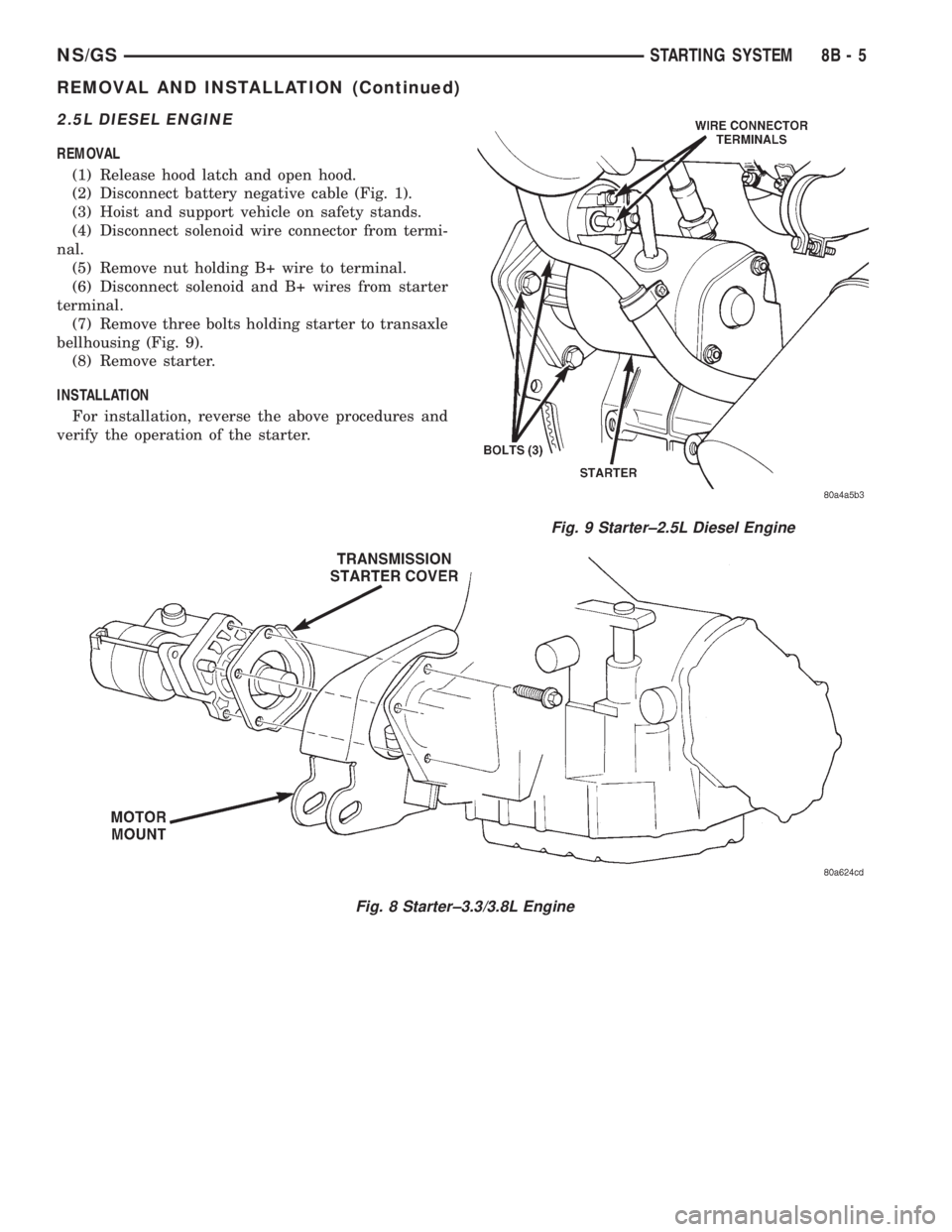
2.5L DIESEL ENGINE
REMOVAL
(1) Release hood latch and open hood.
(2) Disconnect battery negative cable (Fig. 1).
(3) Hoist and support vehicle on safety stands.
(4) Disconnect solenoid wire connector from termi-
nal.
(5) Remove nut holding B+ wire to terminal.
(6) Disconnect solenoid and B+ wires from starter
terminal.
(7) Remove three bolts holding starter to transaxle
bellhousing (Fig. 9).
(8) Remove starter.
INSTALLATION
For installation, reverse the above procedures and
verify the operation of the starter.
Fig. 8 Starter±3.3/3.8L Engine
Fig. 9 Starter±2.5L Diesel Engine
NS/GSSTARTING SYSTEM 8B - 5
REMOVAL AND INSTALLATION (Continued)
Page 287 of 1938
CHARGING SYSTEM
CONTENTS
page page
GENERAL INFORMATION
OVERVIEW............................. 1
DESCRIPTION AND OPERATION
BATTERY TEMPERATURE SENSOR.......... 2
CHARGING SYSTEM OPERATION........... 1
ELECTRONIC VOLTAGE REGULATOR......... 2
GENERATOR............................ 2
DIAGNOSIS AND TESTING
CHARGING SYSTEM RESISTANCE TESTS..... 4
CHARGING SYSTEM...................... 2CURRENT OUTPUT TEST.................. 4
ON-BOARD DIAGNOSTIC SYSTEM TEST...... 7
REMOVAL AND INSTALLATION
GENERATORÐ2.4L ENGINE................ 9
GENERATORÐ3.0L ENGINE................ 9
GENERATORÐ3.3/3.8 L ENGINE........... 10
SPECIFICATIONS
GENERATOR........................... 11
TORQUE.............................. 11
GENERAL INFORMATION
OVERVIEW
The battery, starting, and charging systems oper-
ate with one another, and must be tested as a com-
plete system. In order for the vehicle to start and
charge properly, all of the components involved in
these systems must perform within specifications.
Group 8A covers the battery, Group 8B covers the
starting system, and Group 8C covers the charging
system. Refer to Group 8W - Wiring Diagrams for
complete circuit descriptions and diagrams. We have
separated these systems to make it easier to locate
the information you are seeking within this Service
Manual. However, when attempting to diagnose any
of these systems, it is important that you keep their
interdependency in mind.
The diagnostic procedures used in these groups
include the most basic conventional diagnostic meth-
ods to the more sophisticated On-Board Diagnostics
(OBD) built into the Powertrain Control Module
(PCM). Use of an induction ammeter, volt/ohmmeter,
battery charger, carbon pile rheostat (load tester),
and 12-volt test lamp may be required.
All OBD-sensed systems are monitored by the
PCM. Each monitored circuit is assigned a Diagnos-
tic Trouble Code (DTC). The PCM will store a DTC in
electronic memory for any failure it detects. See the
On-Board Diagnostics Test in Group 8C - Charging
System for more information.
DESCRIPTION AND OPERATION
CHARGING SYSTEM OPERATION
The charging system consists of:
²Generator
²Electronic Voltage Regulator (EVR) circuitry
within the Powertrain Control Module (PCM)
²Ignition switch (refer to Group 8D, Ignition Sys-
tem for information)
²Battery (refer to Group 8A, Battery for informa-
tion)
²Temperature is measured by a sensor in the
PCM circuitry
²Wiring harness and connections (refer to Group
8W, Wiring for information)
The charging system is turned on and off with the
ignition switch. When the ignition switch is turned to
the ON position, battery voltage is applied to the
generator rotor through one of the two field termi-
nals to produce a magnetic field. The generator is
driven by the engine through a serpentine belt and
pulley arrangement.
The amount of DC current produced by the gener-
ator is controlled by the EVR (field control) circuitry,
contained within the PCM. This circuitry is con-
nected in series with the second rotor field terminal
and ground.
All vehicles are equipped with On-Board Diagnos-
tics (OBD). All OBD-sensed systems, including the
EVR (field control) circuitry, are monitored by the
PCM. Each monitored circuit is assigned a Diagnos-
tic Trouble Code (DTC). The PCM will store a DTC in
electronic memory for any failure it detects. See On-
Board Diagnostic System Test in this group for more
information.
NSCHARGING SYSTEM 8C - 1