gas type CHRYSLER VOYAGER 1996 Service Manual
[x] Cancel search | Manufacturer: CHRYSLER, Model Year: 1996, Model line: VOYAGER, Model: CHRYSLER VOYAGER 1996Pages: 1938, PDF Size: 55.84 MB
Page 5 of 1938
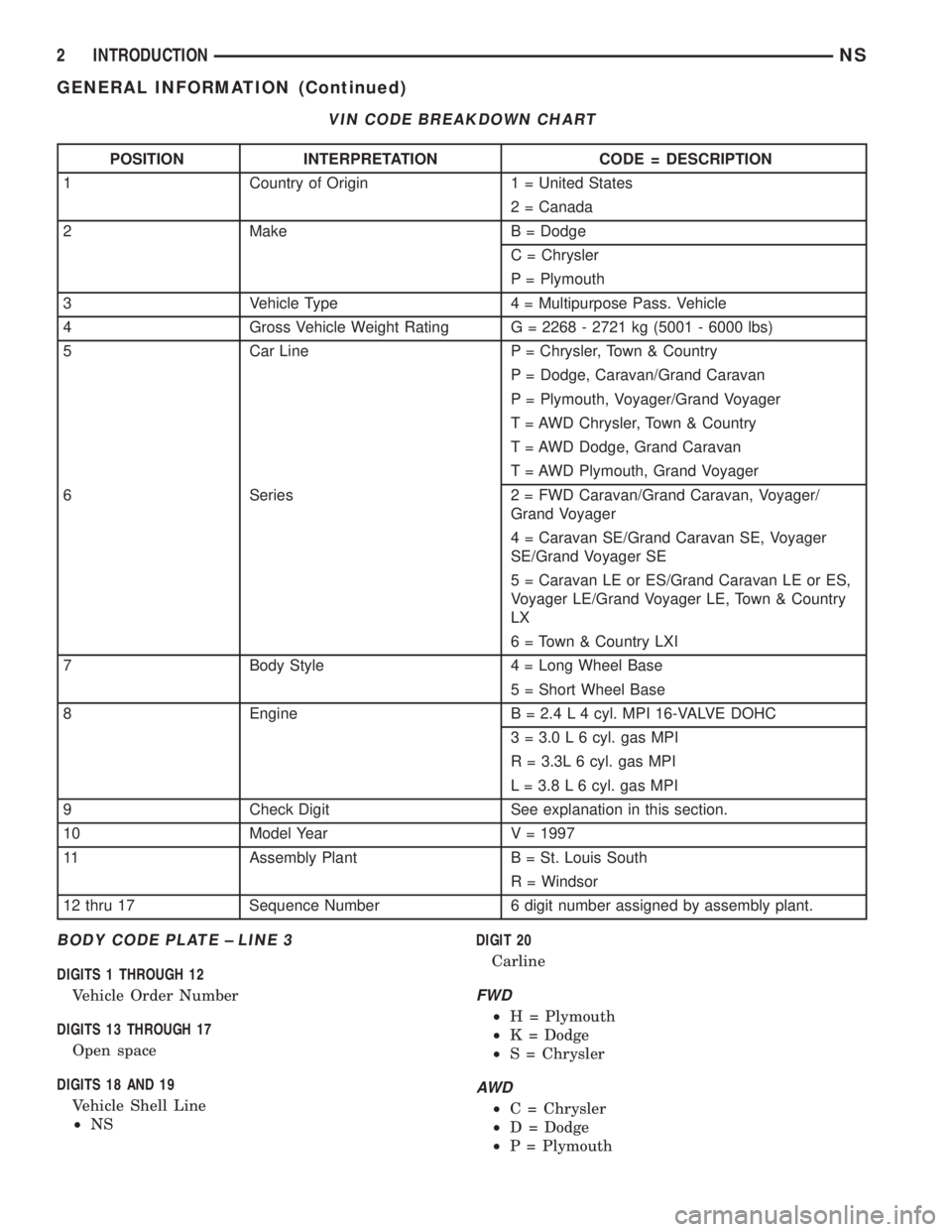
BODY CODE PLATE ± LINE 3
DIGITS 1 THROUGH 12
Vehicle Order Number
DIGITS 13 THROUGH 17
Open space
DIGITS 18 AND 19
Vehicle Shell Line
²NSDIGIT 20
Carline
FWD
²H = Plymouth
²K = Dodge
²S = Chrysler
AW D
²C = Chrysler
²D = Dodge
²P = Plymouth
VIN CODE BREAKDOWN CHART
POSITION INTERPRETATION CODE = DESCRIPTION
1 Country of Origin 1 = United States
2 = Canada
2 Make B = Dodge
C = Chrysler
P = Plymouth
3 Vehicle Type 4 = Multipurpose Pass. Vehicle
4 Gross Vehicle Weight Rating G = 2268 - 2721 kg (5001 - 6000 lbs)
5 Car Line P = Chrysler, Town & Country
P = Dodge, Caravan/Grand Caravan
P = Plymouth, Voyager/Grand Voyager
T = AWD Chrysler, Town & Country
T = AWD Dodge, Grand Caravan
T = AWD Plymouth, Grand Voyager
6 Series 2 = FWD Caravan/Grand Caravan, Voyager/
Grand Voyager
4 = Caravan SE/Grand Caravan SE, Voyager
SE/Grand Voyager SE
5 = Caravan LE or ES/Grand Caravan LE or ES,
Voyager LE/Grand Voyager LE, Town & Country
LX
6 = Town & Country LXI
7 Body Style 4 = Long Wheel Base
5 = Short Wheel Base
8 Engine B = 2.4 L 4 cyl. MPI 16-VALVE DOHC
3 = 3.0 L 6 cyl. gas MPI
R = 3.3L 6 cyl. gas MPI
L = 3.8 L 6 cyl. gas MPI
9 Check Digit See explanation in this section.
10 Model Year V = 1997
11 Assembly Plant B = St. Louis South
R = Windsor
12 thru 17 Sequence Number 6 digit number assigned by assembly plant.
2 INTRODUCTIONNS
GENERAL INFORMATION (Continued)
Page 6 of 1938
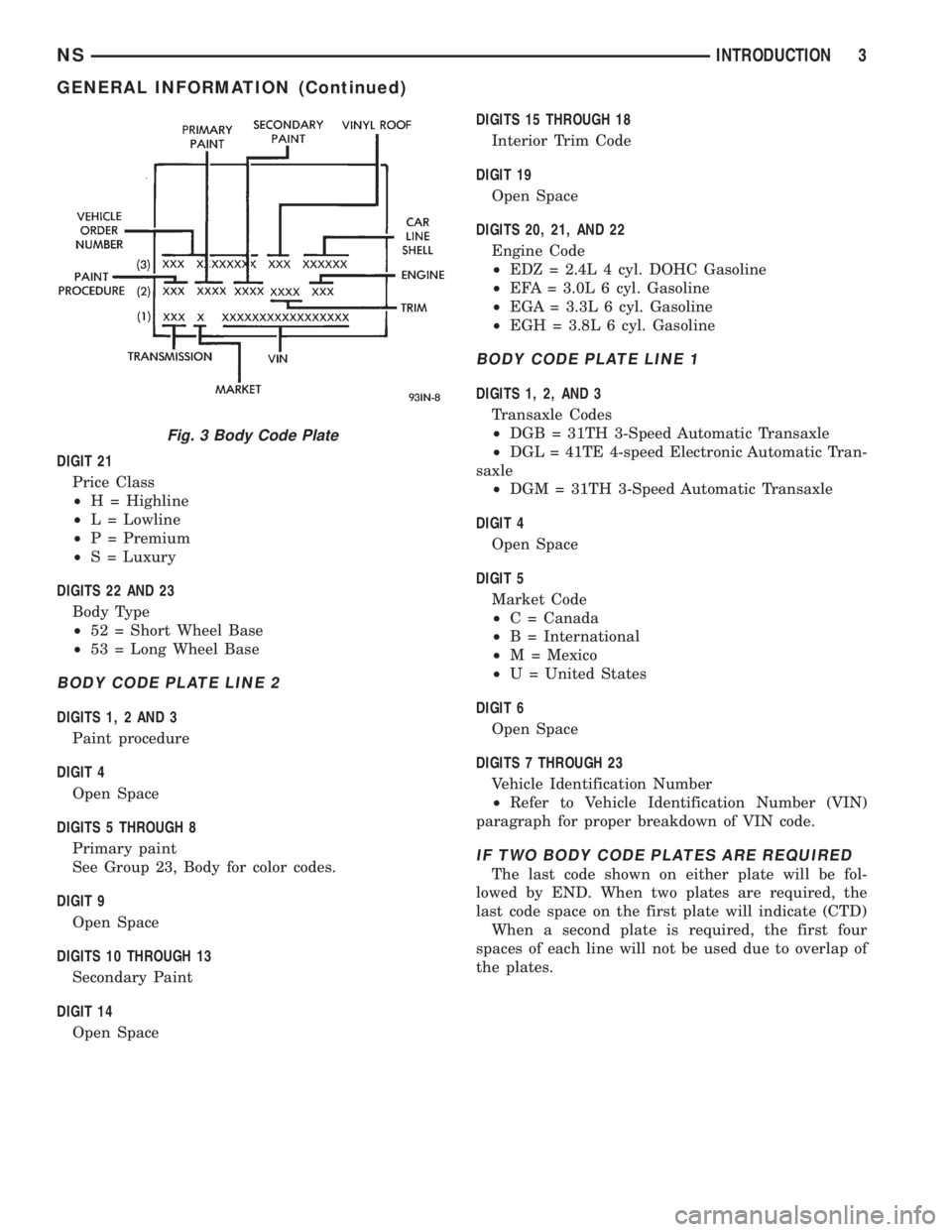
DIGIT 21
Price Class
²H = Highline
²L = Lowline
²P = Premium
²S = Luxury
DIGITS 22 AND 23
Body Type
²52 = Short Wheel Base
²53 = Long Wheel Base
BODY CODE PLATE LINE 2
DIGITS 1, 2 AND 3
Paint procedure
DIGIT 4
Open Space
DIGITS 5 THROUGH 8
Primary paint
See Group 23, Body for color codes.
DIGIT 9
Open Space
DIGITS 10 THROUGH 13
Secondary Paint
DIGIT 14
Open SpaceDIGITS 15 THROUGH 18
Interior Trim Code
DIGIT 19
Open Space
DIGITS 20, 21, AND 22
Engine Code
²EDZ = 2.4L 4 cyl. DOHC Gasoline
²EFA = 3.0L 6 cyl. Gasoline
²EGA = 3.3L 6 cyl. Gasoline
²EGH = 3.8L 6 cyl. Gasoline
BODY CODE PLATE LINE 1
DIGITS 1, 2, AND 3
Transaxle Codes
²DGB = 31TH 3-Speed Automatic Transaxle
²DGL = 41TE 4-speed Electronic Automatic Tran-
saxle
²DGM = 31TH 3-Speed Automatic Transaxle
DIGIT 4
Open Space
DIGIT 5
Market Code
²C = Canada
²B = International
²M = Mexico
²U = United States
DIGIT 6
Open Space
DIGITS 7 THROUGH 23
Vehicle Identification Number
²Refer to Vehicle Identification Number (VIN)
paragraph for proper breakdown of VIN code.
IF TWO BODY CODE PLATES ARE REQUIRED
The last code shown on either plate will be fol-
lowed by END. When two plates are required, the
last code space on the first plate will indicate (CTD)
When a second plate is required, the first four
spaces of each line will not be used due to overlap of
the plates.
Fig. 3 Body Code Plate
NSINTRODUCTION 3
GENERAL INFORMATION (Continued)
Page 14 of 1938
DIGITS 16, 17, AND 18
Vehicle Shell Car Line
²GSYH = Voyager/Grand Voyager SE FWD
²GSYP = Voyager/Grand Voyager LE FWD
²GSYS = Voyager LX FWD
²GSCP = Voyager/Grand Voyager LE AWD
²GSCS = Voyager LX AWD
DIGIT 19
Price Class
²H = High Line
²P = Premium
²S = Special/SportDIGITS 20 AND 21
Body Type
²52 = Short Wheel Base
²53 = Long Wheel Base
BODY CODE PLATEÐLINE 2
DIGITS 1,2, AND 3
Paint Procedure
DIGIT 4
Open Space
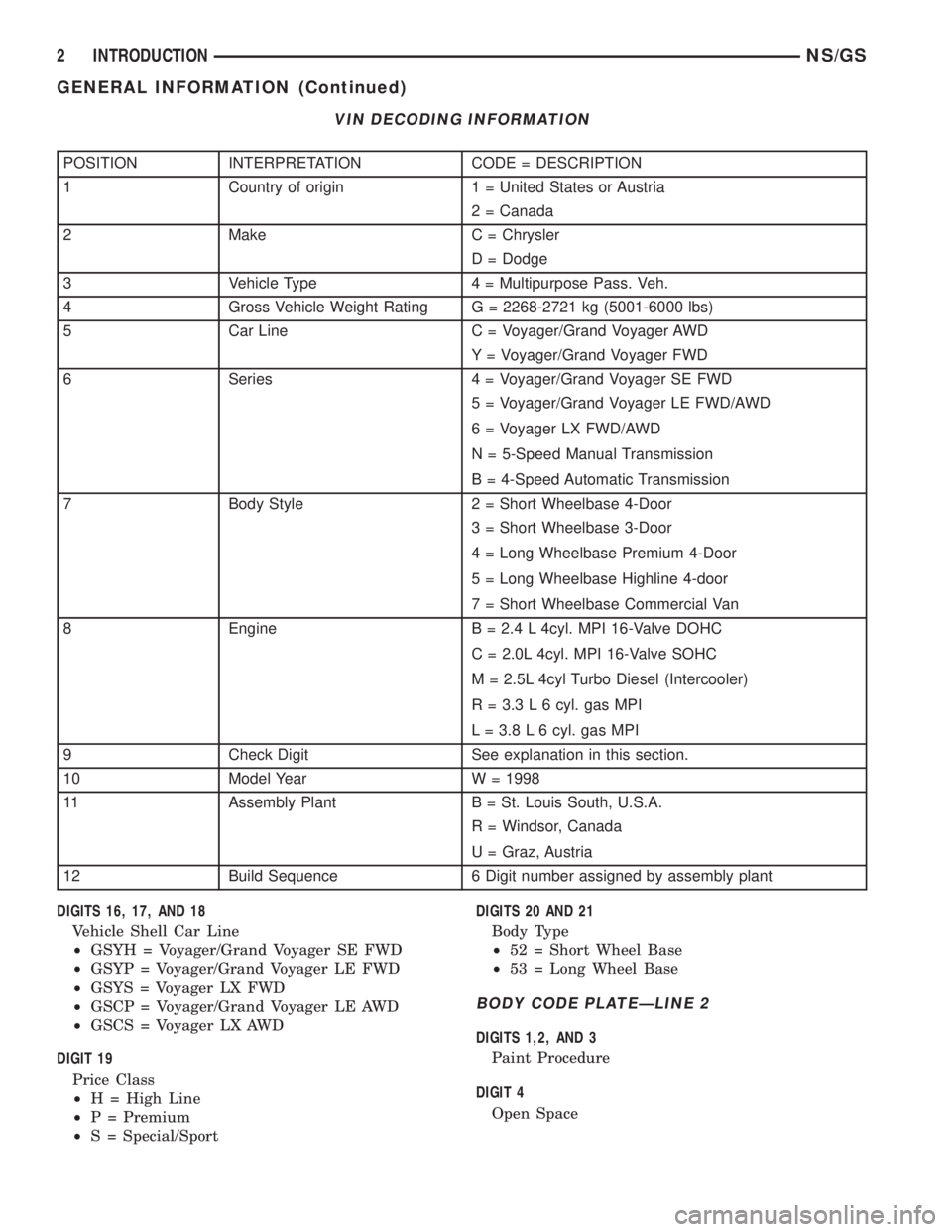
VIN DECODING INFORMATION
POSITION INTERPRETATION CODE = DESCRIPTION
1 Country of origin 1 = United States or Austria
2 = Canada
2 Make C = Chrysler
D = Dodge
3 Vehicle Type 4 = Multipurpose Pass. Veh.
4 Gross Vehicle Weight Rating G = 2268-2721 kg (5001-6000 lbs)
5 Car Line C = Voyager/Grand Voyager AWD
Y = Voyager/Grand Voyager FWD
6 Series 4 = Voyager/Grand Voyager SE FWD
5 = Voyager/Grand Voyager LE FWD/AWD
6 = Voyager LX FWD/AWD
N = 5-Speed Manual Transmission
B = 4-Speed Automatic Transmission
7 Body Style 2 = Short Wheelbase 4-Door
3 = Short Wheelbase 3-Door
4 = Long Wheelbase Premium 4-Door
5 = Long Wheelbase Highline 4-door
7 = Short Wheelbase Commercial Van
8 Engine B = 2.4 L 4cyl. MPI 16-Valve DOHC
C = 2.0L 4cyl. MPI 16-Valve SOHC
M = 2.5L 4cyl Turbo Diesel (Intercooler)
R = 3.3 L 6 cyl. gas MPI
L = 3.8 L 6 cyl. gas MPI
9 Check Digit See explanation in this section.
10 Model Year W = 1998
11 Assembly Plant B = St. Louis South, U.S.A.
R = Windsor, Canada
U = Graz, Austria
12 Build Sequence 6 Digit number assigned by assembly plant
2 INTRODUCTIONNS/GS
GENERAL INFORMATION (Continued)
Page 72 of 1938
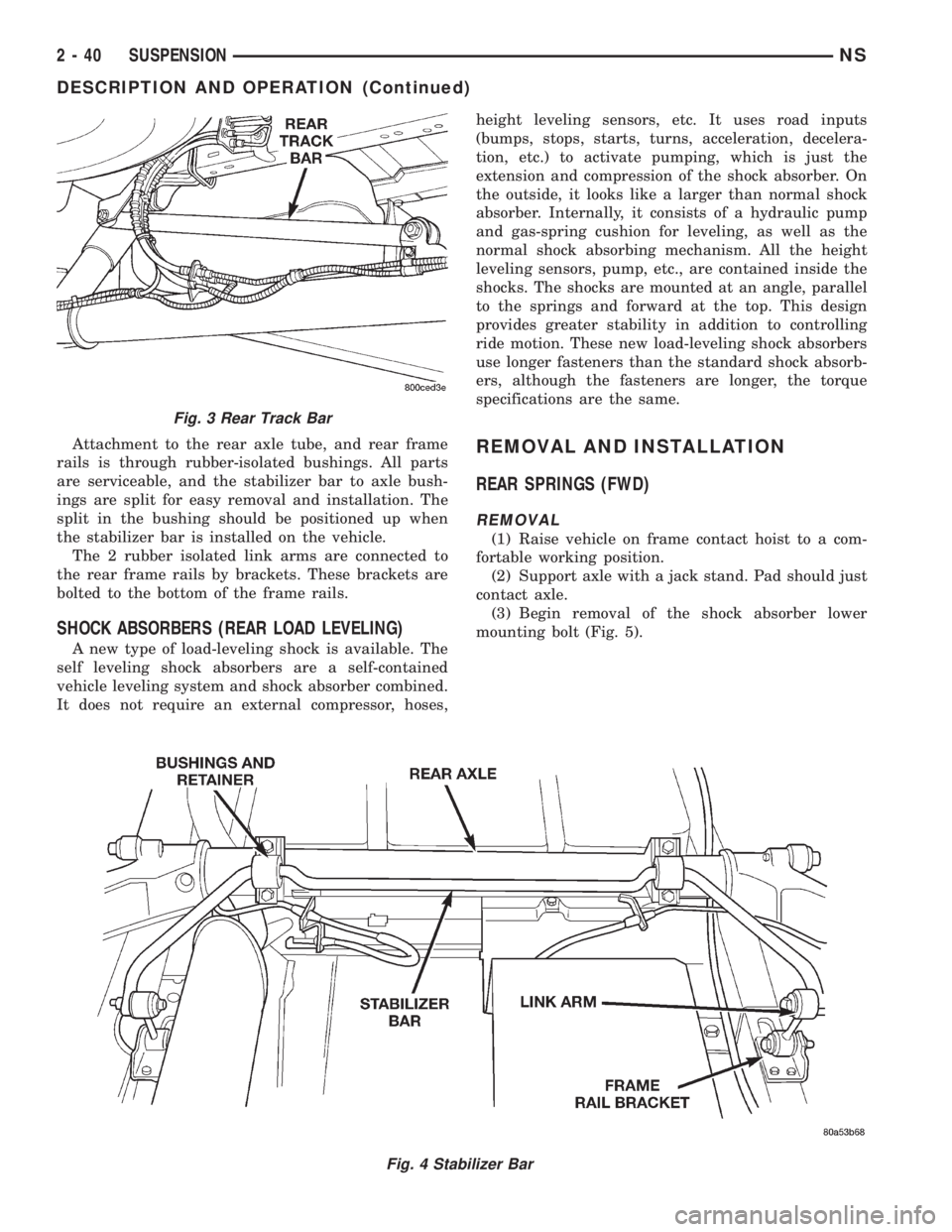
Attachment to the rear axle tube, and rear frame
rails is through rubber-isolated bushings. All parts
are serviceable, and the stabilizer bar to axle bush-
ings are split for easy removal and installation. The
split in the bushing should be positioned up when
the stabilizer bar is installed on the vehicle.
The 2 rubber isolated link arms are connected to
the rear frame rails by brackets. These brackets are
bolted to the bottom of the frame rails.
SHOCK ABSORBERS (REAR LOAD LEVELING)
A new type of load-leveling shock is available. The
self leveling shock absorbers are a self-contained
vehicle leveling system and shock absorber combined.
It does not require an external compressor, hoses,height leveling sensors, etc. It uses road inputs
(bumps, stops, starts, turns, acceleration, decelera-
tion, etc.) to activate pumping, which is just the
extension and compression of the shock absorber. On
the outside, it looks like a larger than normal shock
absorber. Internally, it consists of a hydraulic pump
and gas-spring cushion for leveling, as well as the
normal shock absorbing mechanism. All the height
leveling sensors, pump, etc., are contained inside the
shocks. The shocks are mounted at an angle, parallel
to the springs and forward at the top. This design
provides greater stability in addition to controlling
ride motion. These new load-leveling shock absorbers
use longer fasteners than the standard shock absorb-
ers, although the fasteners are longer, the torque
specifications are the same.
REMOVAL AND INSTALLATION
REAR SPRINGS (FWD)
REMOVAL
(1) Raise vehicle on frame contact hoist to a com-
fortable working position.
(2) Support axle with a jack stand. Pad should just
contact axle.
(3) Begin removal of the shock absorber lower
mounting bolt (Fig. 5).
Fig. 4 Stabilizer Bar
Fig. 3 Rear Track Bar
2 - 40 SUSPENSIONNS
DESCRIPTION AND OPERATION (Continued)
Page 122 of 1938

(3) Remove the rear wheel cylinder attaching bolts
(Fig. 81). Then pull wheel cylinder assembly off the
brake support plate.
INSTALL
(1) Apply MopartGasket In-A-Tube or equivalent
sealant around wheel cylinder mounting surface in
brake support plate.
(2) Install wheel cylinder onto brake support, and
tighten the wheel cylinder to brake support plate
attaching bolts (Fig. 81) to 8 N´m (75 in. lbs.).
(3) Attach hydraulic brake tube to wheel cylinder,
(Fig. 81) and tighten tube to wheel cylinder fitting to
16 N´m (142 in. lbs.).
(4) Install brake shoes on support plate.
(5) Install rear brake drum onto rear hub. Install
rear wheel and tire assembly, tighten wheel stud
nuts to 129 N´m (95 ft. lbs.).
(6) Adjust the rear brakes, (See Adjusting Service
Brakes) in Service Adjustments section in this group
of the service manual.
(7) Bleed the entire brake system. See (Bleeding
Brake System) in Service Adjustments section in this
group of the service manual.
HUB/BEARING
FRONT WHEEL DRIVE
REMOVE
(1) Raise vehicle on jackstands or centered on a
frame contact type hoist. See Hoisting in the Lubri-
cation and Maintenance section of this service man-
ual for required lifting procedure.
(2) Remove wheel and tire.
(3) Remove brake drum from hub/bearing.
(4) Remove rear wheel speed sensor from rear hub/
bearing (Fig. 82). This will prevent damage to the
speed sensor during removal and installation of the
hub/bearing.The rear wheel speed sensor bolts
to the hub/bearing. It can not be removed
unless the speed sensor is removed first.
CAUTION: When working in the area of the rear
hub/bearing and when removing it from the rear
axle, care must be used so the teeth on the tone
wheel are not damaged. Damage to the teeth on the
tone wheel will result in false ABS cycling and cor-
rosion of the tone wheel.
(5) Remove the 4 bolts (Fig. 83) attaching the hub/
bearing to the rear axle.
CAUTION: Corrosion may occur between the hub/
bearing and the axle. If this occurs the hub/bearing
will be difficult to remove from the axle. If the hub/
bearing will not come out of the axle by pulling onit by hand, do not pound on the hub/bearing to
remove it from the axle. Pounding on the hub/bear-
ing to remove it from the axle will damage the hub/
bearing. This damage will result in noise or failure
of the bearing.
(6) If hub/bearing cannot be removed from the axle
by hand, use Remover Special Tool 8214 (Fig. 84) and
following procedure to press the hub/bearing out of
the axle.
(a) Place Special Tool 8214-1 over tone wheel
and against cast flange of hub/bearing (Fig. 84)
(b) Put a dab of grease in the bolt pilot hole on
the back of Special Tool 8214-1.
(c) Insert Special Tool 8214-2 into the hole in the
bottom of the end casting on the axle (Fig. 84).
Special Tool 8214-2 should be against and sup-
ported by the axle plate (Fig. 84) when pressing
the wheel bearing out of the axle.If Special Tool
8214-2 will not fit into the hole in the end
casting, file or grind the flashing from the
hole until tool fits properly.
Fig. 82 Rear Wheel Speed Sensor
Fig. 83 Rear Hub/Bearing Mounting Bolts
5 - 40 BRAKESNS
REMOVAL AND INSTALLATION (Continued)
Page 220 of 1938
DESCRIPTION AND OPERATION
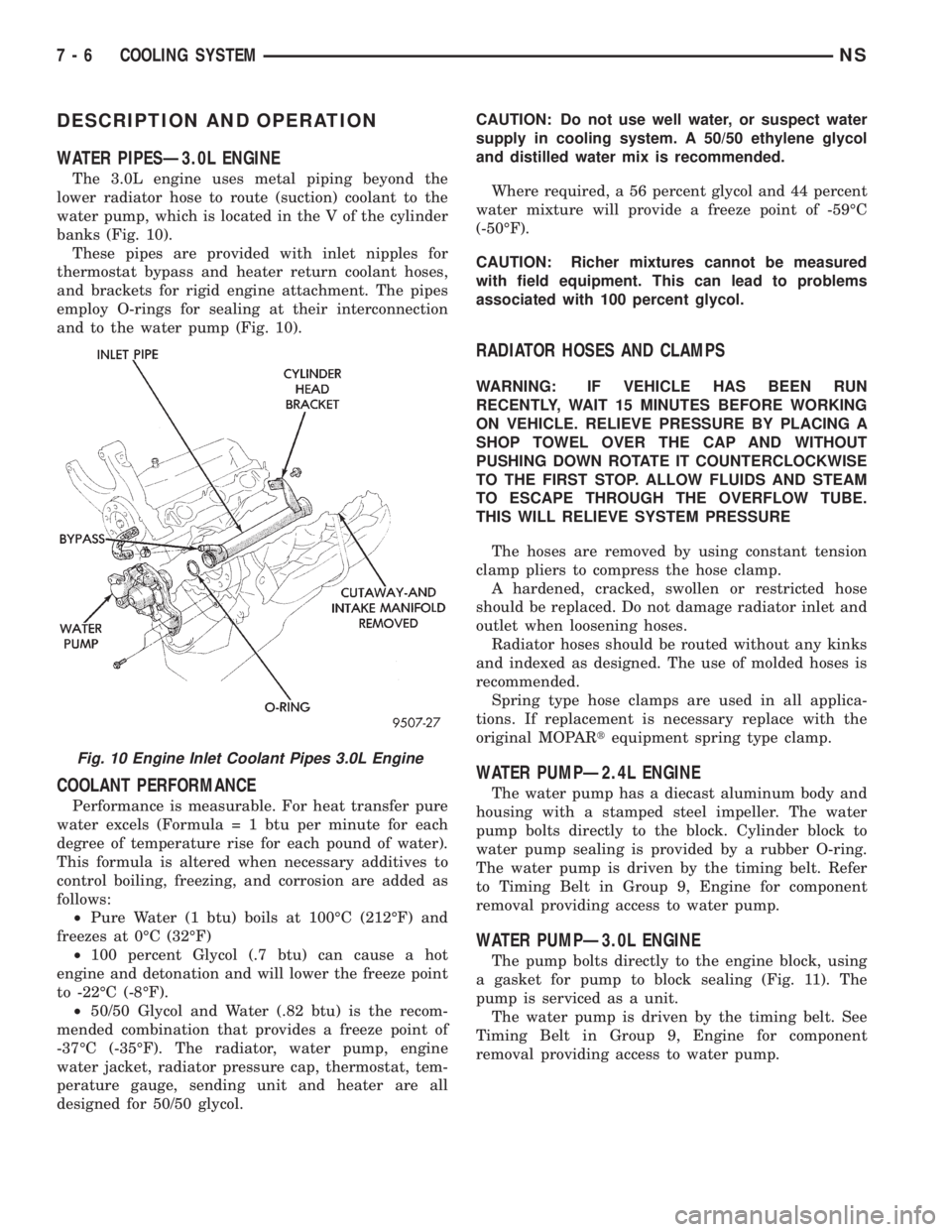
WATER PIPESÐ3.0L ENGINE
The 3.0L engine uses metal piping beyond the
lower radiator hose to route (suction) coolant to the
water pump, which is located in the V of the cylinder
banks (Fig. 10).
These pipes are provided with inlet nipples for
thermostat bypass and heater return coolant hoses,
and brackets for rigid engine attachment. The pipes
employ O-rings for sealing at their interconnection
and to the water pump (Fig. 10).
COOLANT PERFORMANCE
Performance is measurable. For heat transfer pure
water excels (Formula = 1 btu per minute for each
degree of temperature rise for each pound of water).
This formula is altered when necessary additives to
control boiling, freezing, and corrosion are added as
follows:
²Pure Water (1 btu) boils at 100ÉC (212ÉF) and
freezes at 0ÉC (32ÉF)
²100 percent Glycol (.7 btu) can cause a hot
engine and detonation and will lower the freeze point
to -22ÉC (-8ÉF).
²50/50 Glycol and Water (.82 btu) is the recom-
mended combination that provides a freeze point of
-37ÉC (-35ÉF). The radiator, water pump, engine
water jacket, radiator pressure cap, thermostat, tem-
perature gauge, sending unit and heater are all
designed for 50/50 glycol.CAUTION: Do not use well water, or suspect water
supply in cooling system. A 50/50 ethylene glycol
and distilled water mix is recommended.
Where required, a 56 percent glycol and 44 percent
water mixture will provide a freeze point of -59ÉC
(-50ÉF).
CAUTION: Richer mixtures cannot be measured
with field equipment. This can lead to problems
associated with 100 percent glycol.
RADIATOR HOSES AND CLAMPS
WARNING: IF VEHICLE HAS BEEN RUN
RECENTLY, WAIT 15 MINUTES BEFORE WORKING
ON VEHICLE. RELIEVE PRESSURE BY PLACING A
SHOP TOWEL OVER THE CAP AND WITHOUT
PUSHING DOWN ROTATE IT COUNTERCLOCKWISE
TO THE FIRST STOP. ALLOW FLUIDS AND STEAM
TO ESCAPE THROUGH THE OVERFLOW TUBE.
THIS WILL RELIEVE SYSTEM PRESSURE
The hoses are removed by using constant tension
clamp pliers to compress the hose clamp.
A hardened, cracked, swollen or restricted hose
should be replaced. Do not damage radiator inlet and
outlet when loosening hoses.
Radiator hoses should be routed without any kinks
and indexed as designed. The use of molded hoses is
recommended.
Spring type hose clamps are used in all applica-
tions. If replacement is necessary replace with the
original MOPARtequipment spring type clamp.
WATER PUMPÐ2.4L ENGINE
The water pump has a diecast aluminum body and
housing with a stamped steel impeller. The water
pump bolts directly to the block. Cylinder block to
water pump sealing is provided by a rubber O-ring.
The water pump is driven by the timing belt. Refer
to Timing Belt in Group 9, Engine for component
removal providing access to water pump.
WATER PUMPÐ3.0L ENGINE
The pump bolts directly to the engine block, using
a gasket for pump to block sealing (Fig. 11). The
pump is serviced as a unit.
The water pump is driven by the timing belt. See
Timing Belt in Group 9, Engine for component
removal providing access to water pump.
Fig. 10 Engine Inlet Coolant Pipes 3.0L Engine
7 - 6 COOLING SYSTEMNS
Page 230 of 1938

at running operating temperature the high pressure
inlet tank runs full and the low pressure outlet tank
drops:
²Transmission oil will become hotter.
²High reading shown on the temperature gauge.
²Air in the coolant can cause loss of flow through
the heater.
²Exhaust gas leaks into the coolant also can
cause the same problems.
DEAERATION
Air can only be removed from the system by gath-
ering under the pressure cap. On the next heat up it
will be pushed past the pressure cap into the CRS
tank by thermal expansion of the coolant. It then
escapes to the atmosphere in the CRS tank and is
replaced with solid coolant on cool down.
TEMPERATURE GAUGE INDICATION
At idle with Air Conditioning off the temperature
gauge will rise slowly to about 5/8 gauge travel, the
fan will come on and the gauge will quickly drop to
about 1/2 gauge travel. This is normal.
SERVICE PROCEDURES
COOLANT LEVEL CHECKÐROUTINE
Do not remove radiator cap for routine cool-
ant level inspections.
The coolant reserve system provides a quick visual
method for determining the coolant level without
removing the radiator cap.With the engine cold
and not running,simply observe the level of the
coolant in the reserve tank (Fig. 3). The coolant level
should be between the minimum and maximum
marks.
COOLANTÐADDING ADDITIONAL
The radiator cap should not be removed.
When additional coolant is needed to maintain this
level, it should be added to the coolant reserve tank.
Use only 50/50 mix of ethylene glycol type antifreeze
and water.
CAUTION: Do not use well water, or suspect water
supply in cooling system. A 50/50 ethylene glycol
and distilled water mix is recommended.
COOLANT LEVEL SERVICE
The cooling system is closed and designed to main-
tain coolant level to the top of the radiator.
When servicing requires a coolant level check in
the radiator, the engine must beoffandnotunder
pressure. Drain several ounces of coolant from the
radiator draincock while observing the CoolantRecovery System (CRS) Tank. Coolant level in the
CRS tank should drop slightly. Then remove the radi-
ator cap. The radiator should be full to the top. If
not, and the coolant level in the CRS tank is at the
MIN mark there is an air leak in the CRS system.
Check hose or hose connections to the CRS tank,
radiator filler neck or the pressure cap seal to the
radiator filler neck for leaks.
COOLING SYSTEMÐDRAINING
Without removing radiator pressure cap and
with system not under pressure,shut engine off
and open draincock. The coolant reserve tank should
empty first, then remove radiator pressure cap. (if
not, see Testing Cooling System for leaks). To vent
2.4L engine remove the coolant temperature sensor
located above water outlet housing (Fig. 15). The 3.0/
3.3/3.8L engines have an air bleed vent on the ther-
mostat.
Removal of a sensor is required because the ther-
mostat does not have an air vent. Sensor removal
allows an air bleed for coolant to drain from the
engine block.
COOLING SYSTEMÐREFILLING
First clean system to remove old coolant, see Cool-
ing System Cleaning.
Fill the system, using the correct antifreeze as
described in the Coolant Section. Fill the system to
50 percent of its capacity with 100 percent glycol.
Then complete filling system with water. The 2.4L
engine requires venting by removal of the coolant
sensor on top of the water outlet connector (Fig. 15).
When coolant reaches this hole:
²Install coolant sensor and tighten to 7 N´m (60
in. lbs.) for 2.4L Engines.
Fig. 15 Coolant Temperature SensorÐ2.4L Engine
Drain/Fill
7 - 16 COOLING SYSTEMNS
DIAGNOSIS AND TESTING (Continued)
Page 239 of 1938
NOTE: It is normal for the water pump to weep a
small amount of coolant from the weep hole (black
stain on water pump body). Do not replace the
water pump if this condition exists. Replace the
water pump if a heavy deposit or a steady flow of
green/brown engine coolant is evident on water
pump body from the weep hole (shaft seal failure).
Be sure to perform a thorough analysis before
replacing water pump.
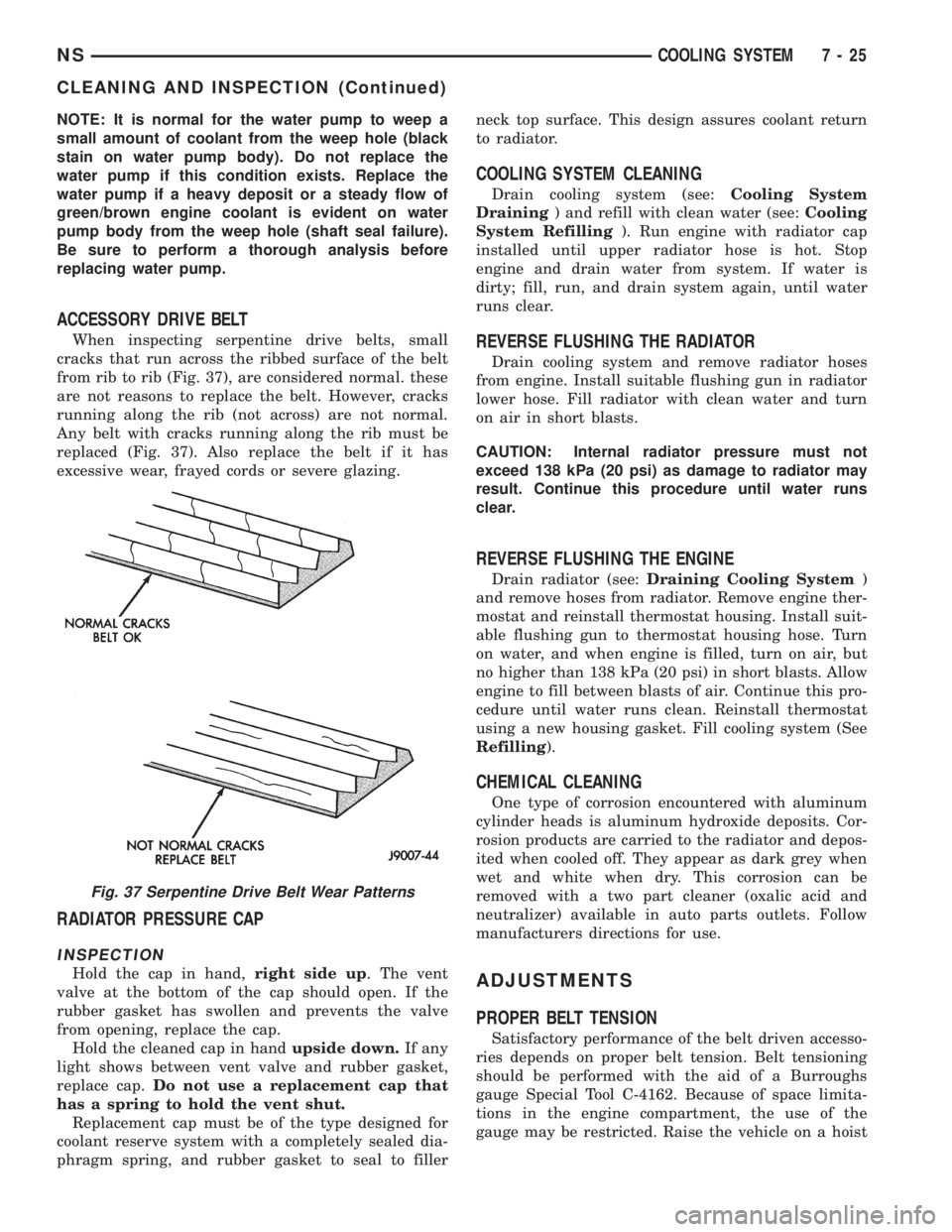
ACCESSORY DRIVE BELT
When inspecting serpentine drive belts, small
cracks that run across the ribbed surface of the belt
from rib to rib (Fig. 37), are considered normal. these
are not reasons to replace the belt. However, cracks
running along the rib (not across) are not normal.
Any belt with cracks running along the rib must be
replaced (Fig. 37). Also replace the belt if it has
excessive wear, frayed cords or severe glazing.
RADIATOR PRESSURE CAP
INSPECTION
Hold the cap in hand,right side up. The vent
valve at the bottom of the cap should open. If the
rubber gasket has swollen and prevents the valve
from opening, replace the cap.
Hold the cleaned cap in handupside down.If any
light shows between vent valve and rubber gasket,
replace cap.Do not use a replacement cap that
has a spring to hold the vent shut.
Replacement cap must be of the type designed for
coolant reserve system with a completely sealed dia-
phragm spring, and rubber gasket to seal to fillerneck top surface. This design assures coolant return
to radiator.
COOLING SYSTEM CLEANING
Drain cooling system (see:Cooling System
Draining) and refill with clean water (see:Cooling
System Refilling). Run engine with radiator cap
installed until upper radiator hose is hot. Stop
engine and drain water from system. If water is
dirty; fill, run, and drain system again, until water
runs clear.
REVERSE FLUSHING THE RADIATOR
Drain cooling system and remove radiator hoses
from engine. Install suitable flushing gun in radiator
lower hose. Fill radiator with clean water and turn
on air in short blasts.
CAUTION: Internal radiator pressure must not
exceed 138 kPa (20 psi) as damage to radiator may
result. Continue this procedure until water runs
clear.
REVERSE FLUSHING THE ENGINE
Drain radiator (see:Draining Cooling System)
and remove hoses from radiator. Remove engine ther-
mostat and reinstall thermostat housing. Install suit-
able flushing gun to thermostat housing hose. Turn
on water, and when engine is filled, turn on air, but
no higher than 138 kPa (20 psi) in short blasts. Allow
engine to fill between blasts of air. Continue this pro-
cedure until water runs clean. Reinstall thermostat
using a new housing gasket. Fill cooling system (See
Refilling).
CHEMICAL CLEANING
One type of corrosion encountered with aluminum
cylinder heads is aluminum hydroxide deposits. Cor-
rosion products are carried to the radiator and depos-
ited when cooled off. They appear as dark grey when
wet and white when dry. This corrosion can be
removed with a two part cleaner (oxalic acid and
neutralizer) available in auto parts outlets. Follow
manufacturers directions for use.
ADJUSTMENTS
PROPER BELT TENSION
Satisfactory performance of the belt driven accesso-
ries depends on proper belt tension. Belt tensioning
should be performed with the aid of a Burroughs
gauge Special Tool C-4162. Because of space limita-
tions in the engine compartment, the use of the
gauge may be restricted. Raise the vehicle on a hoist
Fig. 37 Serpentine Drive Belt Wear Patterns
NSCOOLING SYSTEM 7 - 25
CLEANING AND INSPECTION (Continued)
Page 244 of 1938
THERMOSTAT OPERATION
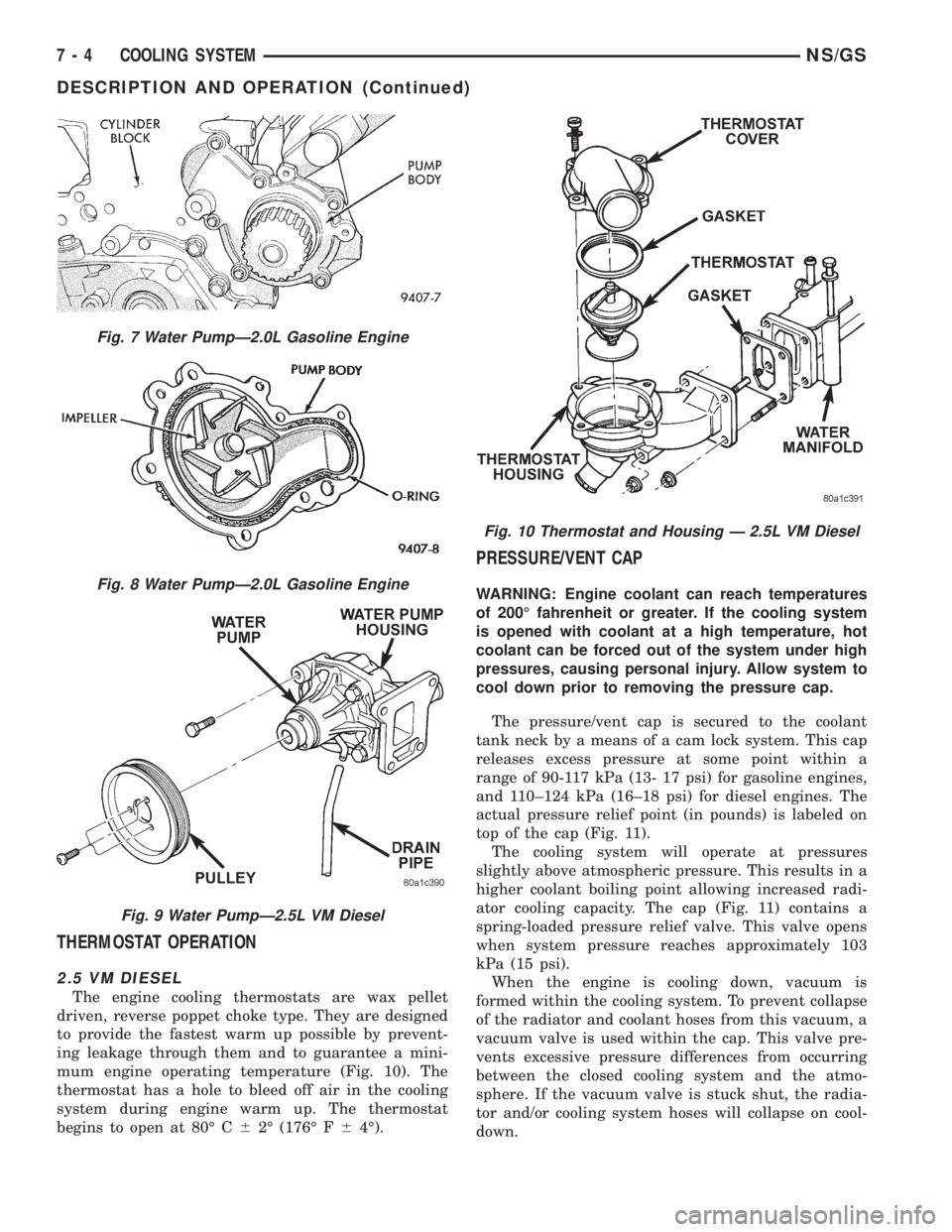
2.5 VM DIESEL
The engine cooling thermostats are wax pellet
driven, reverse poppet choke type. They are designed
to provide the fastest warm up possible by prevent-
ing leakage through them and to guarantee a mini-
mum engine operating temperature (Fig. 10). The
thermostat has a hole to bleed off air in the cooling
system during engine warm up. The thermostat
begins to open at 80É C62É (176É F64É).
PRESSURE/VENT CAP
WARNING: Engine coolant can reach temperatures
of 200É fahrenheit or greater. If the cooling system
is opened with coolant at a high temperature, hot
coolant can be forced out of the system under high
pressures, causing personal injury. Allow system to
cool down prior to removing the pressure cap.
The pressure/vent cap is secured to the coolant
tank neck by a means of a cam lock system. This cap
releases excess pressure at some point within a
range of 90-117 kPa (13- 17 psi) for gasoline engines,
and 110±124 kPa (16±18 psi) for diesel engines. The
actual pressure relief point (in pounds) is labeled on
top of the cap (Fig. 11).
The cooling system will operate at pressures
slightly above atmospheric pressure. This results in a
higher coolant boiling point allowing increased radi-
ator cooling capacity. The cap (Fig. 11) contains a
spring-loaded pressure relief valve. This valve opens
when system pressure reaches approximately 103
kPa (15 psi).
When the engine is cooling down, vacuum is
formed within the cooling system. To prevent collapse
of the radiator and coolant hoses from this vacuum, a
vacuum valve is used within the cap. This valve pre-
vents excessive pressure differences from occurring
between the closed cooling system and the atmo-
sphere. If the vacuum valve is stuck shut, the radia-
tor and/or cooling system hoses will collapse on cool-
down.
Fig. 7 Water PumpÐ2.0L Gasoline Engine
Fig. 8 Water PumpÐ2.0L Gasoline Engine
Fig. 9 Water PumpÐ2.5L VM Diesel
Fig. 10 Thermostat and Housing Ð 2.5L VM Diesel
7 - 4 COOLING SYSTEMNS/GS
DESCRIPTION AND OPERATION (Continued)
Page 247 of 1938
SERVICE PROCEDURES
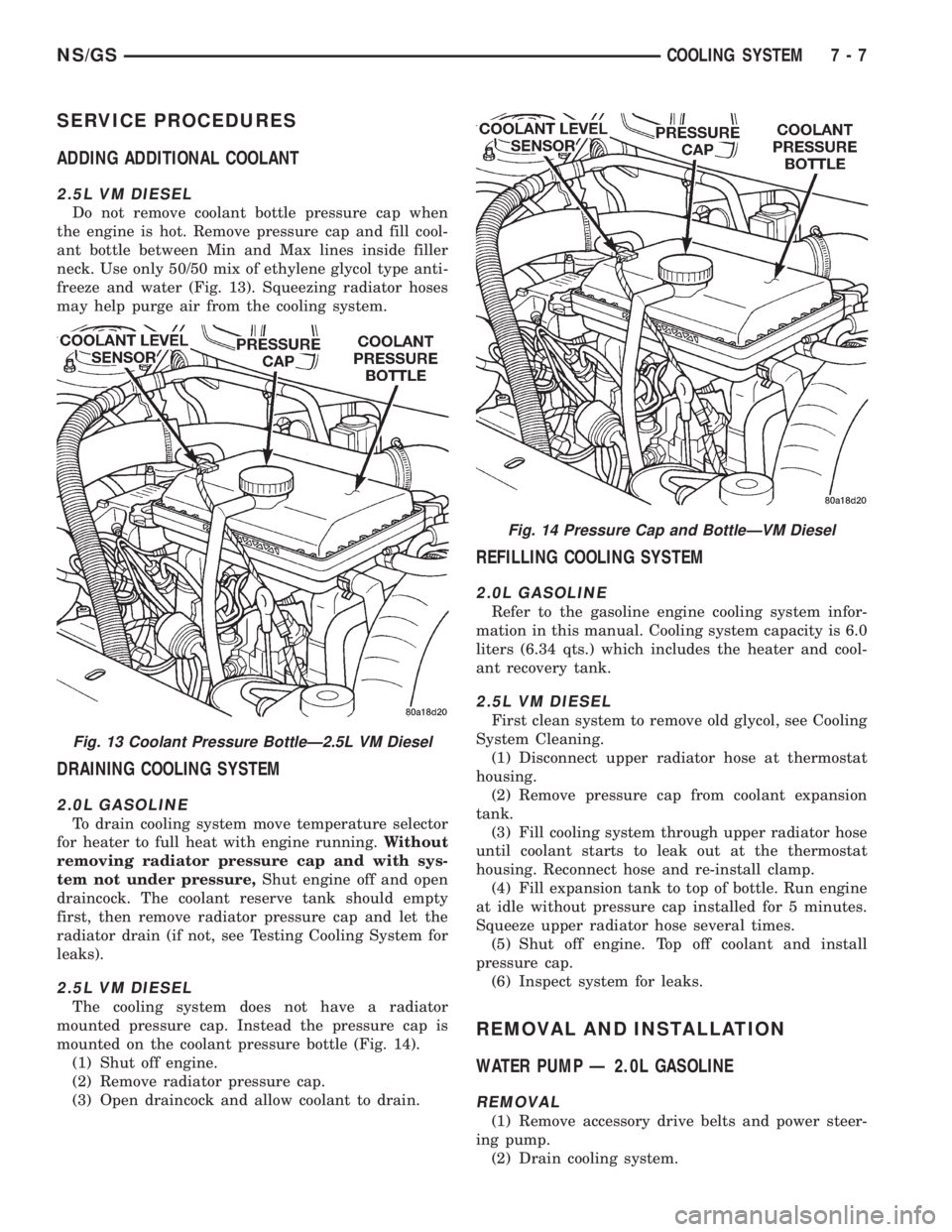
ADDING ADDITIONAL COOLANT
2.5L VM DIESEL
Do not remove coolant bottle pressure cap when
the engine is hot. Remove pressure cap and fill cool-
ant bottle between Min and Max lines inside filler
neck. Use only 50/50 mix of ethylene glycol type anti-
freeze and water (Fig. 13). Squeezing radiator hoses
may help purge air from the cooling system.
DRAINING COOLING SYSTEM
2.0L GASOLINE
To drain cooling system move temperature selector
for heater to full heat with engine running.Without
removing radiator pressure cap and with sys-
tem not under pressure,Shut engine off and open
draincock. The coolant reserve tank should empty
first, then remove radiator pressure cap and let the
radiator drain (if not, see Testing Cooling System for
leaks).
2.5L VM DIESEL
The cooling system does not have a radiator
mounted pressure cap. Instead the pressure cap is
mounted on the coolant pressure bottle (Fig. 14).
(1) Shut off engine.
(2) Remove radiator pressure cap.
(3) Open draincock and allow coolant to drain.
REFILLING COOLING SYSTEM
2.0L GASOLINE
Refer to the gasoline engine cooling system infor-
mation in this manual. Cooling system capacity is 6.0
liters (6.34 qts.) which includes the heater and cool-
ant recovery tank.
2.5L VM DIESEL
First clean system to remove old glycol, see Cooling
System Cleaning.
(1) Disconnect upper radiator hose at thermostat
housing.
(2) Remove pressure cap from coolant expansion
tank.
(3) Fill cooling system through upper radiator hose
until coolant starts to leak out at the thermostat
housing. Reconnect hose and re-install clamp.
(4) Fill expansion tank to top of bottle. Run engine
at idle without pressure cap installed for 5 minutes.
Squeeze upper radiator hose several times.
(5) Shut off engine. Top off coolant and install
pressure cap.
(6) Inspect system for leaks.
REMOVAL AND INSTALLATION
WATER PUMP Ð 2.0L GASOLINE
REMOVAL
(1) Remove accessory drive belts and power steer-
ing pump.
(2) Drain cooling system.
Fig. 13 Coolant Pressure BottleÐ2.5L VM Diesel
Fig. 14 Pressure Cap and BottleÐVM Diesel
NS/GSCOOLING SYSTEM 7 - 7