timing belt CHRYSLER VOYAGER 1996 Service Manual
[x] Cancel search | Manufacturer: CHRYSLER, Model Year: 1996, Model line: VOYAGER, Model: CHRYSLER VOYAGER 1996Pages: 1938, PDF Size: 55.84 MB
Page 20 of 1938
52,500 Miles (84 000 km) or at 42 months
²Change engine oil.
²Flush and replace engine coolant if not done at
36 months.
60,000 Miles (96 000 km) or at 48 months
²Change engine oil.
²Replace engine oil filter.
²Replace air cleaner element.
²Check PCV valve and replace, if necessary.
*
²Inspect serpentine drive belt, replace if neces-
sary.
²Inspect tie rod ends and boot seals.
67,500 Miles (108 000 km) or at 54 months
²Change engine oil.
²Inspect brake linings.
75,000 Miles (120 000 km) or at 60 months
²Change engine oil.
²Replace engine oil filter.
²Inspect serpentine drive belt, replace if neces-
sary. This maintenance is not required if belt was
previously replaced.
²Flush and replace engine coolant if it has been
30,000 miles (48 000 km) or 24 months since last
change.
82,500 Miles (132 000 km) or at 66 months
²Change engine oil.
²Flush and replace engine coolant if it has been
30,000 miles (48 000 km) or 24 months since last
change.
90,000 Miles (144 000 km) or at 72 months
²Change engine oil.
²Replace engine oil filter.
²Replace air cleaner element.
²Check PCV valve and replace, if necessary.
Not required if previously changed. *
²Inspect serpentine drive belt, replace if neces-
sary. This maintenance is not required if belt was
previously replaced.
²Inspect tie rod ends and boot seals.
²Inspect brake linings.
97,500 Miles (156 000 km) or at 78 months
²Change engine oil.
100,000 Miles (160,000 km)
²Replace spark plugs on 3.3L and 3.8L
engines.
²Replace ignition cables on 3.3L and 3.8L
engines.
105,000 Miles (168 000 km) or at 84 months
²Change engine oil.
²Replace engine oil filter.
²Inspect serpentine drive belt, replace if neces-
sary. This maintenance is not required if belt was
previously replaced.
²Flush and replace engine coolant if it has been
30,000 miles (48 000 km) or 24 months since last
change.
112,500 Miles (180 000 km) or at 90 months
²Change engine oil.
²Inspect brake linings.
²Flush and replace engine coolant if it has been
30,000 miles (48 000 km) or 24 months since last
change.
120,000 Miles (192 000 km) or at 96 months
²Change engine oil.
²Replace engine oil filter.
²Replace automatic transmission fluid.
²Replace engine air cleaner element.
²Check and replace PCV valve, if necessary.
*
²Inspect serpentine drive belt. Not required if
replaced at 75,000, 90,000 or 105,000 miles.
²Inspect tie rod ends and boot seals.
* This maintenance is recommended by Chrysler to
the owner but is not required to maintain the war-
ranty on the PCV valve.
** If California vehicle, this maintenance is recom-
mended by Chrysler to the owner but is not required
to maintain the warranty of the timing belt.
SCHEDULE ± B
3,000 Miles (5 000 km)
²Change engine oil.
6,000 Miles (10 000 km)
²Change engine oil.
²Replace engine oil filter.
9,000 Miles (14 000 km)
²Change engine oil.
²Inspect brake linings.
12,000 Miles (19 000 km)
²Change engine oil.
²Replace engine oil filter.
15,000 Miles (24 000 km)
²Change engine oil.
²Inspect air cleaner element. Replace as
necessary.
0 - 4 LUBRICATION AND MAINTENANCENS
GENERAL INFORMATION (Continued)
Page 22 of 1938
²Replace spark plugs.
²Replace ignition cables.
²Inspect serpentine drive belt, replace if neces-
sary. This maintenance is not required if belt was
previously replaced.
²Drain and refill automatic transaxle fluid and
replace filter. Adjust band, if so equipped. (See note)
²Change AWD power transfer unit fluid.
78,000 Miles (125 000 km)
²Change engine oil.
²Replace engine oil filter.
81,000 Miles (130 000 km)
²Change engine oil.
²Inspect brake linings.
²Flush and replace engine coolant.
84,000 Miles (134 000 km)
²Change engine oil.
²Replace engine oil filter.
²Change AWD overrunning clutch and rear car-
rier fluid.
87,000 Miles (139 000 km)
²Change engine oil.
90,000 Miles (144 000 km)
²Change engine oil.
²Replace engine oil filter.
²Replace air cleaner element.
²Check PCV valve and replace if necessary.
Not required if previously changed. *
²Inspect serpentine drive belt, replace if neces-
sary. This maintenance is not required if belt was
previously replaced.
²Drain and refill automatic transmission fluid
and replace filter. Adjust bands, if so equipped. (See
note)
²Change AWD power transfer unit fluid.
²Inspect tie rod ends and boot seals.
²Inspect brake linings.
93,000 Miles (149 000 km)
²Change engine oil.
96,000 Miles (154 000 km)
²Change engine oil.
²Replace engine oil filter.
99,000 Miles (158 000 km)
²Change engine oil.
²Inspect brake linings.
102,000 Miles (163 000 km)
²Change engine oil.
²Replace engine oil filter.
105,000 Miles (168 000 km)
²Change engine oil.
²Inspect air cleaner element. Replace as
necessary.
²Inspect serpentine drive belt, replace if neces-
sary. This maintenance is not required if belt was
previously replaced.
²Drain and refill automatic transmission fluid
and filter. Adjust bands, if so equipped. (See note)
²Change AWD power transfer unit fluid.
²Change AWD overrunning clutch and rear car-
rier fluid.
108,000 Miles (173 000 km)
²Change engine oil.
²Replace engine oil filter.
²Inspect brake linings.
111,000 Miles (178 000 km)
²Change engine oil.
²Flush and replace engine coolant.
114,000 Miles (182 000 km)
²Change engine oil.
²Replace engine oil filter.
117,000 Miles (187 000 km)
²Change engine oil.
²Inspect brake linings.
120,000 Miles (192 000 km)
²Change engine oil.
²Replace engine oil filter.
²Replace air cleaner element.
²Inspect PCV valve. Replace as necessary. *
²Inspect serpentine drive belt. Not required if
replaced at 75,000, 90,000 or 105,000 miles.
²Drain and refill automatic transmission fluid
and replace filter. Adjust bands, if so equipped.
²Change AWD power transfer unit fluid.
²Inspect tie rod ends and boot seals.
* This maintenance is recommended by Chrysler to
the owner but is not required to maintain the war-
ranty on the PCV valve.
** If California vehicle, this maintenance is recom-
mended by Chrysler to the owner but is not required
to maintain the warranty of the timing belt.
NOTE: Operating vehicle more than 50% in heavy
traffic during hot weather, above 90ÉF (32ÉC), using
vehicle for police, taxi, limousine type operation or
trailer towing require the more frequent transaxle
service noted in Schedule ± B. Perform these ser-
vices if vehicle is usually operated under these con-
ditions.
Inspection and service should also be performed
anytime a malfunction is observed or suspected.
0 - 6 LUBRICATION AND MAINTENANCENS
GENERAL INFORMATION (Continued)
Page 220 of 1938
DESCRIPTION AND OPERATION
WATER PIPESÐ3.0L ENGINE
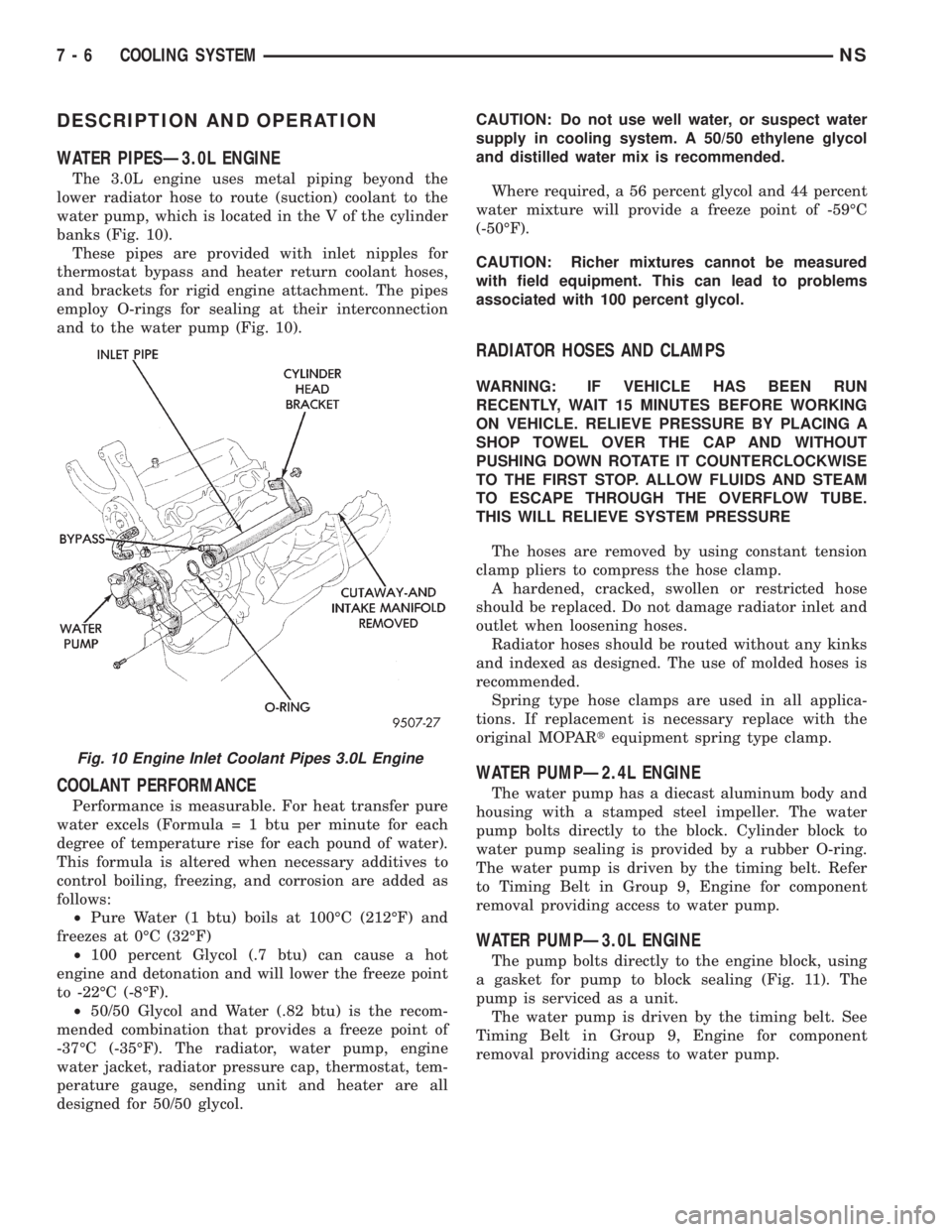
The 3.0L engine uses metal piping beyond the
lower radiator hose to route (suction) coolant to the
water pump, which is located in the V of the cylinder
banks (Fig. 10).
These pipes are provided with inlet nipples for
thermostat bypass and heater return coolant hoses,
and brackets for rigid engine attachment. The pipes
employ O-rings for sealing at their interconnection
and to the water pump (Fig. 10).
COOLANT PERFORMANCE
Performance is measurable. For heat transfer pure
water excels (Formula = 1 btu per minute for each
degree of temperature rise for each pound of water).
This formula is altered when necessary additives to
control boiling, freezing, and corrosion are added as
follows:
²Pure Water (1 btu) boils at 100ÉC (212ÉF) and
freezes at 0ÉC (32ÉF)
²100 percent Glycol (.7 btu) can cause a hot
engine and detonation and will lower the freeze point
to -22ÉC (-8ÉF).
²50/50 Glycol and Water (.82 btu) is the recom-
mended combination that provides a freeze point of
-37ÉC (-35ÉF). The radiator, water pump, engine
water jacket, radiator pressure cap, thermostat, tem-
perature gauge, sending unit and heater are all
designed for 50/50 glycol.CAUTION: Do not use well water, or suspect water
supply in cooling system. A 50/50 ethylene glycol
and distilled water mix is recommended.
Where required, a 56 percent glycol and 44 percent
water mixture will provide a freeze point of -59ÉC
(-50ÉF).
CAUTION: Richer mixtures cannot be measured
with field equipment. This can lead to problems
associated with 100 percent glycol.
RADIATOR HOSES AND CLAMPS
WARNING: IF VEHICLE HAS BEEN RUN
RECENTLY, WAIT 15 MINUTES BEFORE WORKING
ON VEHICLE. RELIEVE PRESSURE BY PLACING A
SHOP TOWEL OVER THE CAP AND WITHOUT
PUSHING DOWN ROTATE IT COUNTERCLOCKWISE
TO THE FIRST STOP. ALLOW FLUIDS AND STEAM
TO ESCAPE THROUGH THE OVERFLOW TUBE.
THIS WILL RELIEVE SYSTEM PRESSURE
The hoses are removed by using constant tension
clamp pliers to compress the hose clamp.
A hardened, cracked, swollen or restricted hose
should be replaced. Do not damage radiator inlet and
outlet when loosening hoses.
Radiator hoses should be routed without any kinks
and indexed as designed. The use of molded hoses is
recommended.
Spring type hose clamps are used in all applica-
tions. If replacement is necessary replace with the
original MOPARtequipment spring type clamp.
WATER PUMPÐ2.4L ENGINE
The water pump has a diecast aluminum body and
housing with a stamped steel impeller. The water
pump bolts directly to the block. Cylinder block to
water pump sealing is provided by a rubber O-ring.
The water pump is driven by the timing belt. Refer
to Timing Belt in Group 9, Engine for component
removal providing access to water pump.
WATER PUMPÐ3.0L ENGINE
The pump bolts directly to the engine block, using
a gasket for pump to block sealing (Fig. 11). The
pump is serviced as a unit.
The water pump is driven by the timing belt. See
Timing Belt in Group 9, Engine for component
removal providing access to water pump.
Fig. 10 Engine Inlet Coolant Pipes 3.0L Engine
7 - 6 COOLING SYSTEMNS
Page 231 of 1938
Continue filling system until full, this provides bet-
ter heater performance.Be careful not to spill
coolant on drive belts or the generator.
Fill coolant reserve system to at least the MAX
mark with 50/50 solution. It may be necessary to add
coolant to the reserve tank after three or four warm
up/cool down cycles to maintain coolant level between
the MAX and MIN mark. This will allow trapped air
to be removed from the system.
REMOVAL AND INSTALLATION
WATER PUMPÐ2.4L ENGINE
REMOVAL
(1) Disconnect negative cable from battery.
(2) Raise vehicle on a hoist. Remove right inner
splash shield.
(3) Remove accessory drive belts. Refer to Acces-
sory Drive Belt service in this section.
(4) Drain cooling system. Refer to Cooling System
Draining in this section.
(5) Support engine from the bottom and remove
right engine mount.
(6) Remove right engine mount bracket.
(7) Remove timing belt. Refer to Group 9, Engine
for procedure.
(8) Remove timing belt idler pulley.
(9) Hold camshaft sprocket with Special tool
C-4687 and adaptor C-4687-1 while removing bolt.
Remove both cam sprockets.
(10) Remove rear timing belt cover.
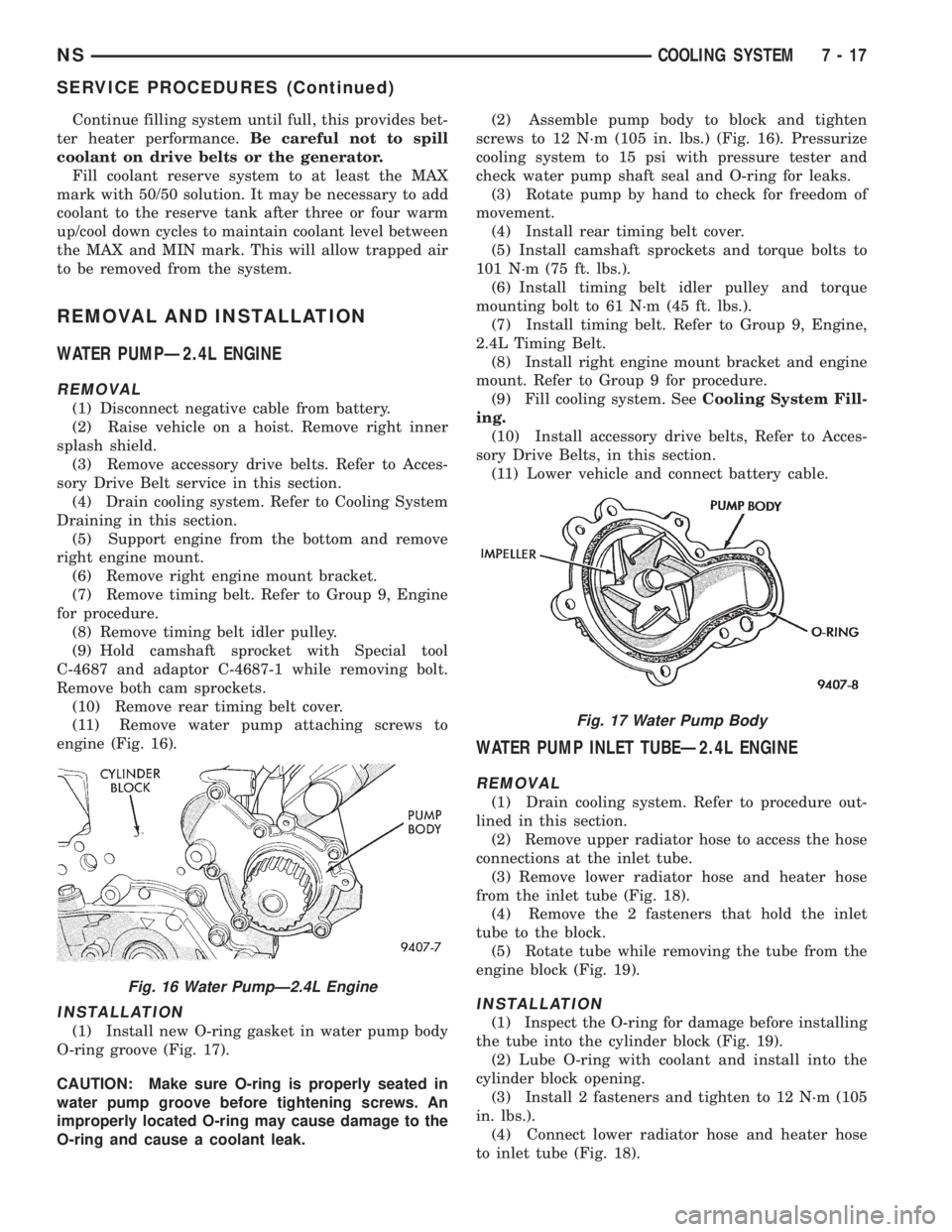
(11) Remove water pump attaching screws to
engine (Fig. 16).
INSTALLATION
(1) Install new O-ring gasket in water pump body
O-ring groove (Fig. 17).
CAUTION: Make sure O-ring is properly seated in
water pump groove before tightening screws. An
improperly located O-ring may cause damage to the
O-ring and cause a coolant leak.(2) Assemble pump body to block and tighten
screws to 12 N´m (105 in. lbs.) (Fig. 16). Pressurize
cooling system to 15 psi with pressure tester and
check water pump shaft seal and O-ring for leaks.
(3) Rotate pump by hand to check for freedom of
movement.
(4) Install rear timing belt cover.
(5) Install camshaft sprockets and torque bolts to
101 N´m (75 ft. lbs.).
(6) Install timing belt idler pulley and torque
mounting bolt to 61 N´m (45 ft. lbs.).
(7) Install timing belt. Refer to Group 9, Engine,
2.4L Timing Belt.
(8) Install right engine mount bracket and engine
mount. Refer to Group 9 for procedure.
(9) Fill cooling system. SeeCooling System Fill-
ing.
(10) Install accessory drive belts, Refer to Acces-
sory Drive Belts, in this section.
(11) Lower vehicle and connect battery cable.
WATER PUMP INLET TUBEÐ2.4L ENGINE
REMOVAL
(1) Drain cooling system. Refer to procedure out-
lined in this section.
(2) Remove upper radiator hose to access the hose
connections at the inlet tube.
(3) Remove lower radiator hose and heater hose
from the inlet tube (Fig. 18).
(4) Remove the 2 fasteners that hold the inlet
tube to the block.
(5) Rotate tube while removing the tube from the
engine block (Fig. 19).
INSTALLATION
(1) Inspect the O-ring for damage before installing
the tube into the cylinder block (Fig. 19).
(2) Lube O-ring with coolant and install into the
cylinder block opening.
(3) Install 2 fasteners and tighten to 12 N´m (105
in. lbs.).
(4) Connect lower radiator hose and heater hose
to inlet tube (Fig. 18).
Fig. 16 Water PumpÐ2.4L Engine
Fig. 17 Water Pump Body
NSCOOLING SYSTEM 7 - 17
SERVICE PROCEDURES (Continued)
Page 232 of 1938
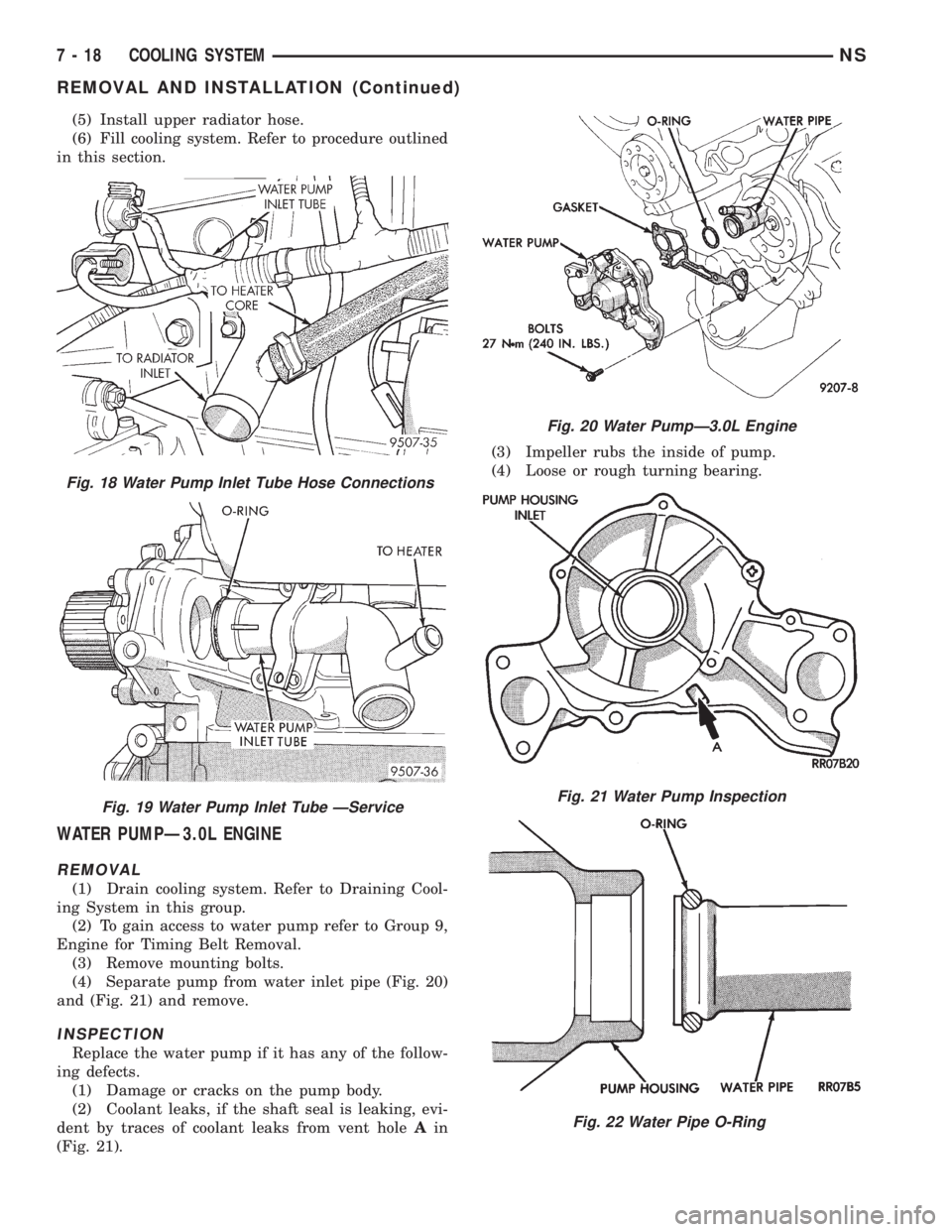
(5) Install upper radiator hose.
(6) Fill cooling system. Refer to procedure outlined
in this section.
WATER PUMPÐ3.0L ENGINE
REMOVAL
(1) Drain cooling system. Refer to Draining Cool-
ing System in this group.
(2) To gain access to water pump refer to Group 9,
Engine for Timing Belt Removal.
(3) Remove mounting bolts.
(4) Separate pump from water inlet pipe (Fig. 20)
and (Fig. 21) and remove.
INSPECTION
Replace the water pump if it has any of the follow-
ing defects.
(1) Damage or cracks on the pump body.
(2) Coolant leaks, if the shaft seal is leaking, evi-
dent by traces of coolant leaks from vent holeAin
(Fig. 21).(3) Impeller rubs the inside of pump.
(4) Loose or rough turning bearing.
Fig. 18 Water Pump Inlet Tube Hose Connections
Fig. 19 Water Pump Inlet Tube ÐService
Fig. 20 Water PumpÐ3.0L Engine
Fig. 21 Water Pump Inspection
Fig. 22 Water Pipe O-Ring
7 - 18 COOLING SYSTEMNS
REMOVAL AND INSTALLATION (Continued)
Page 233 of 1938
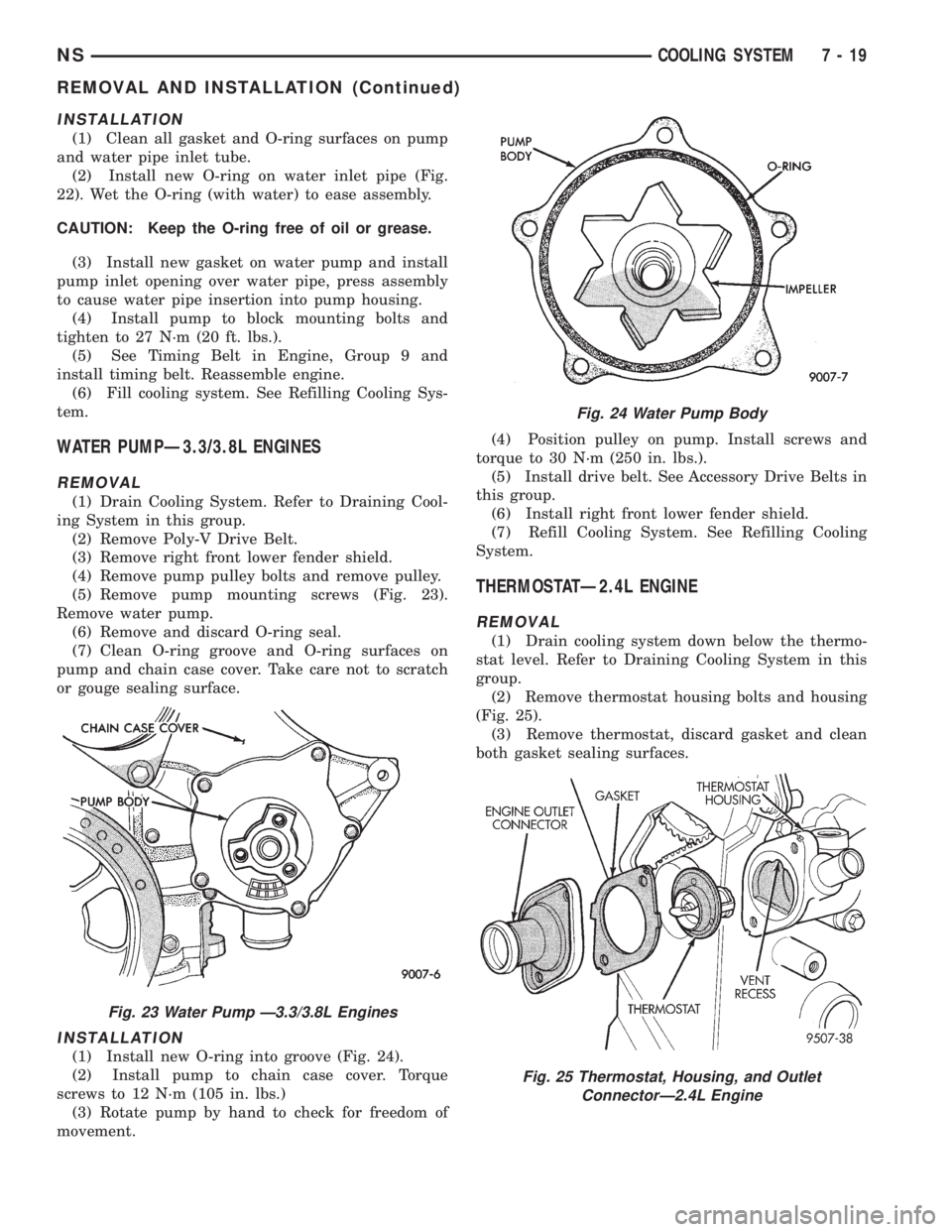
INSTALLATION
(1) Clean all gasket and O-ring surfaces on pump
and water pipe inlet tube.
(2) Install new O-ring on water inlet pipe (Fig.
22). Wet the O-ring (with water) to ease assembly.
CAUTION: Keep the O-ring free of oil or grease.
(3) Install new gasket on water pump and install
pump inlet opening over water pipe, press assembly
to cause water pipe insertion into pump housing.
(4) Install pump to block mounting bolts and
tighten to 27 N´m (20 ft. lbs.).
(5) See Timing Belt in Engine, Group 9 and
install timing belt. Reassemble engine.
(6) Fill cooling system. See Refilling Cooling Sys-
tem.
WATER PUMPÐ3.3/3.8L ENGINES
REMOVAL
(1) Drain Cooling System. Refer to Draining Cool-
ing System in this group.
(2) Remove Poly-V Drive Belt.
(3) Remove right front lower fender shield.
(4) Remove pump pulley bolts and remove pulley.
(5) Remove pump mounting screws (Fig. 23).
Remove water pump.
(6) Remove and discard O-ring seal.
(7) Clean O-ring groove and O-ring surfaces on
pump and chain case cover. Take care not to scratch
or gouge sealing surface.
INSTALLATION
(1) Install new O-ring into groove (Fig. 24).
(2) Install pump to chain case cover. Torque
screws to 12 N´m (105 in. lbs.)
(3) Rotate pump by hand to check for freedom of
movement.(4) Position pulley on pump. Install screws and
torque to 30 N´m (250 in. lbs.).
(5) Install drive belt. See Accessory Drive Belts in
this group.
(6) Install right front lower fender shield.
(7) Refill Cooling System. See Refilling Cooling
System.
THERMOSTATÐ2.4L ENGINE
REMOVAL
(1) Drain cooling system down below the thermo-
stat level. Refer to Draining Cooling System in this
group.
(2) Remove thermostat housing bolts and housing
(Fig. 25).
(3) Remove thermostat, discard gasket and clean
both gasket sealing surfaces.
Fig. 23 Water Pump Ð3.3/3.8L Engines
Fig. 24 Water Pump Body
Fig. 25 Thermostat, Housing, and Outlet
ConnectorÐ2.4L Engine
NSCOOLING SYSTEM 7 - 19
REMOVAL AND INSTALLATION (Continued)
Page 243 of 1938

ties to keep the engine satisfactorily cooled (Fig. 5)
and (Fig. 6).
CAUTION: Plastic tanks, while stronger then brass
are subject to damage by impact, such as wrenches
etc., or by excessive torque on hose clamps.
If the plastic tank is damaged, replace the radia-
tor.
DESCRIPTION AND OPERATION
WATER PUMP
2.0L GASOLINE
The water has a diecast aluminum body and hous-
ing with a stamped steel impeller. The water pumpbolts directly to the block (Fig. 7). Cylinder block to
water pump sealing is provided by a rubber O-ring.
The water pump is driven by the timing belt. Refer
to Group 9, Engine section for component removal to
access the water pump.
NOTE: The water pump on all models can be
replaced without discharging the air conditioning
system.
2.5L VM DIESEL
The Diesel engine water pump has an aluminum
body and housing with a stamped steel impeller. The
pump uses an O-ring gasket between body and hous-
ing. The water pump is driven by the accessory drive
belt, and the pump housing is bolted to the cylinder
block (Fig. 9).
NOTE: The water pump on all models can be
replaced without discharging the air conditioning
system.
Fig. 4 Low Coolant Level Sensor
Fig. 5 Cooling Module Ð2.0LGasoline
Fig. 6 Cooling Module ÐVM Diesel
NS/GSCOOLING SYSTEM 7 - 3
GENERAL INFORMATION (Continued)
Page 248 of 1938
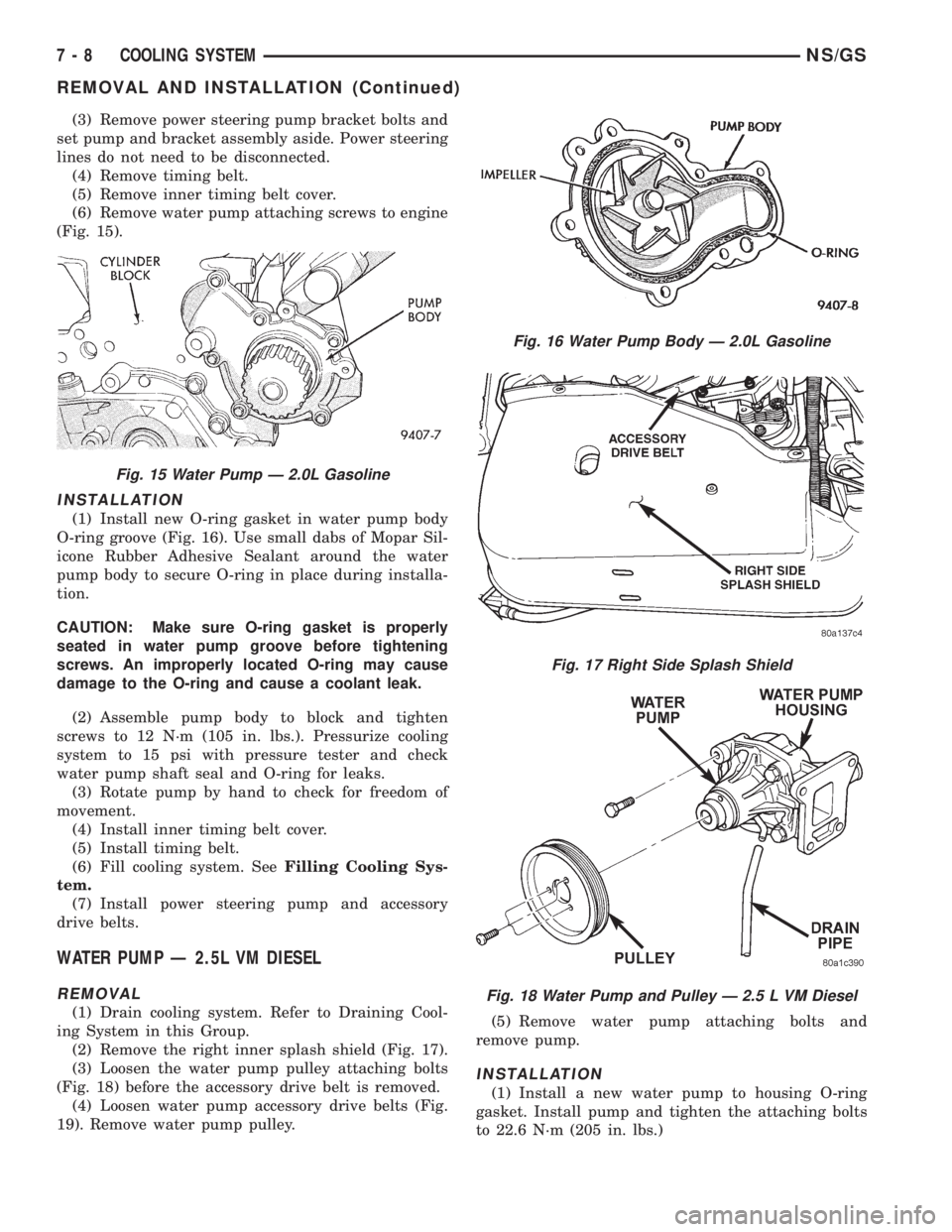
(3) Remove power steering pump bracket bolts and
set pump and bracket assembly aside. Power steering
lines do not need to be disconnected.
(4) Remove timing belt.
(5) Remove inner timing belt cover.
(6) Remove water pump attaching screws to engine
(Fig. 15).
INSTALLATION
(1) Install new O-ring gasket in water pump body
O-ring groove (Fig. 16). Use small dabs of Mopar Sil-
icone Rubber Adhesive Sealant around the water
pump body to secure O-ring in place during installa-
tion.
CAUTION: Make sure O-ring gasket is properly
seated in water pump groove before tightening
screws. An improperly located O-ring may cause
damage to the O-ring and cause a coolant leak.
(2) Assemble pump body to block and tighten
screws to 12 N´m (105 in. lbs.). Pressurize cooling
system to 15 psi with pressure tester and check
water pump shaft seal and O-ring for leaks.
(3) Rotate pump by hand to check for freedom of
movement.
(4) Install inner timing belt cover.
(5) Install timing belt.
(6) Fill cooling system. SeeFilling Cooling Sys-
tem.
(7) Install power steering pump and accessory
drive belts.
WATER PUMP Ð 2.5L VM DIESEL
REMOVAL
(1) Drain cooling system. Refer to Draining Cool-
ing System in this Group.
(2) Remove the right inner splash shield (Fig. 17).
(3) Loosen the water pump pulley attaching bolts
(Fig. 18) before the accessory drive belt is removed.
(4) Loosen water pump accessory drive belts (Fig.
19). Remove water pump pulley.(5) Remove water pump attaching bolts and
remove pump.
INSTALLATION
(1) Install a new water pump to housing O-ring
gasket. Install pump and tighten the attaching bolts
to 22.6 N´m (205 in. lbs.)
Fig. 15 Water Pump Ð 2.0L Gasoline
Fig. 16 Water Pump Body Ð 2.0L Gasoline
Fig. 17 Right Side Splash Shield
Fig. 18 Water Pump and Pulley Ð 2.5 L VM Diesel
7 - 8 COOLING SYSTEMNS/GS
REMOVAL AND INSTALLATION (Continued)
Page 1052 of 1938
made to seal the area between the bedplate and cyl-
inder block without disturbing the bearing clearance
or alignment of these components.
GASKET DISASSEMBLY
Parts assembled with form-in-place gaskets may be
disassembled without unusual effort. In some
instances, it may be necessary to lightly tap the part
with a mallet or other suitable tool to break the seal
between the mating surfaces. A flat gasket scraper
may also be lightly tapped into the joint but care
must be taken not to damage the mating surfaces.
SURFACE PREPARATION
Scrape clean or wire brush all gasket surfaces to
remove all loose material. Inspect stamped parts to
ensure gasket rails are flat. Gasket surfaces must be
free of oil and dirt. Make sure old gasket material is
removed from blind attaching holes.
FORM-IN-PLACE GASKET APPLICATION
Assembling parts using a form-in-place gasket
requires care but it's easier then using precut gas-
kets.
MopartGasket Maker material should be applied
sparingly 1 mm (0.040 in.) diameter or less of sealant
to one gasket surface. Be certain the material sur-
rounds each mounting hole. Excess material can eas-
ily be wiped off. Components should be torqued in
place within 15 minutes. The use of a locating dowel
is recommended during assembly to prevent smear-
ing the material off location.
TheMopartSilicone Rubber Adhesive Sealant
gasket material or equivalent should be applied in a
continuous bead approximately 3 mm (0.120 in.) in
diameter. All mounting holes must be circled. For
corner sealing, a 3.17 or 6.35 mm (1/8 or 1/4 in.) drop
is placed in the center of the gasket contact area.
Uncured sealant may be removed with a shop towels.
Components should be torqued in place while the
sealant is still wet to the touch (within 10 minutes).
The usage of a locating dowel is recommended during
assembly to prevent smearing of material off loca-
tion.
CRANKSHAFT SPROCKET BOLT ACCESS PLUG
An Access plug is located in the right inner fender
shield. Remove the plug and insert the proper size
socket, extension and ratchet, when crankshaft rota-
tion is necessary.
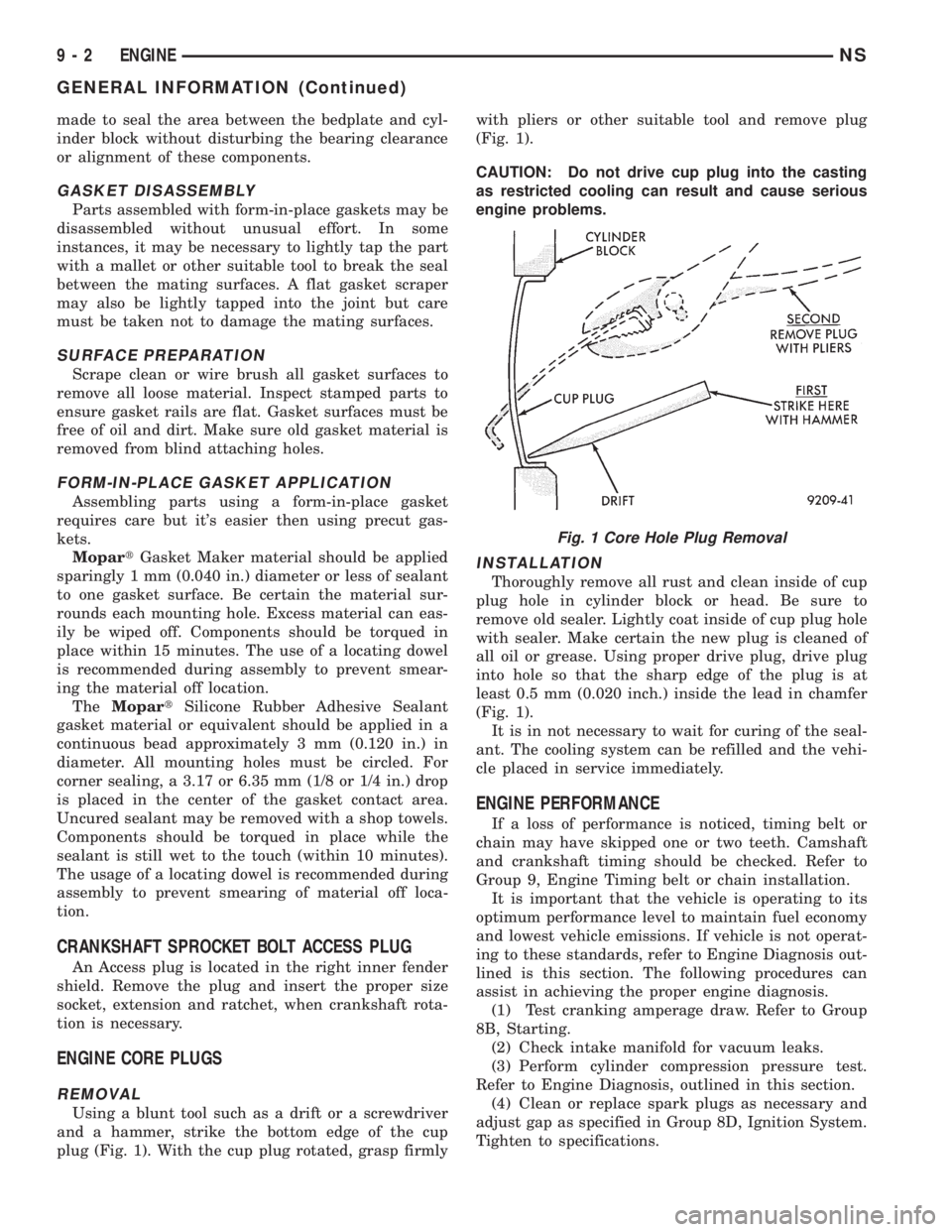
ENGINE CORE PLUGS
REMOVAL
Using a blunt tool such as a drift or a screwdriver
and a hammer, strike the bottom edge of the cup
plug (Fig. 1). With the cup plug rotated, grasp firmlywith pliers or other suitable tool and remove plug
(Fig. 1).
CAUTION: Do not drive cup plug into the casting
as restricted cooling can result and cause serious
engine problems.
INSTALLATION
Thoroughly remove all rust and clean inside of cup
plug hole in cylinder block or head. Be sure to
remove old sealer. Lightly coat inside of cup plug hole
with sealer. Make certain the new plug is cleaned of
all oil or grease. Using proper drive plug, drive plug
into hole so that the sharp edge of the plug is at
least 0.5 mm (0.020 inch.) inside the lead in chamfer
(Fig. 1).
It is in not necessary to wait for curing of the seal-
ant. The cooling system can be refilled and the vehi-
cle placed in service immediately.
ENGINE PERFORMANCE
If a loss of performance is noticed, timing belt or
chain may have skipped one or two teeth. Camshaft
and crankshaft timing should be checked. Refer to
Group 9, Engine Timing belt or chain installation.
It is important that the vehicle is operating to its
optimum performance level to maintain fuel economy
and lowest vehicle emissions. If vehicle is not operat-
ing to these standards, refer to Engine Diagnosis out-
lined is this section. The following procedures can
assist in achieving the proper engine diagnosis.
(1) Test cranking amperage draw. Refer to Group
8B, Starting.
(2) Check intake manifold for vacuum leaks.
(3) Perform cylinder compression pressure test.
Refer to Engine Diagnosis, outlined in this section.
(4) Clean or replace spark plugs as necessary and
adjust gap as specified in Group 8D, Ignition System.
Tighten to specifications.
Fig. 1 Core Hole Plug Removal
9 - 2 ENGINENS
GENERAL INFORMATION (Continued)
Page 1064 of 1938
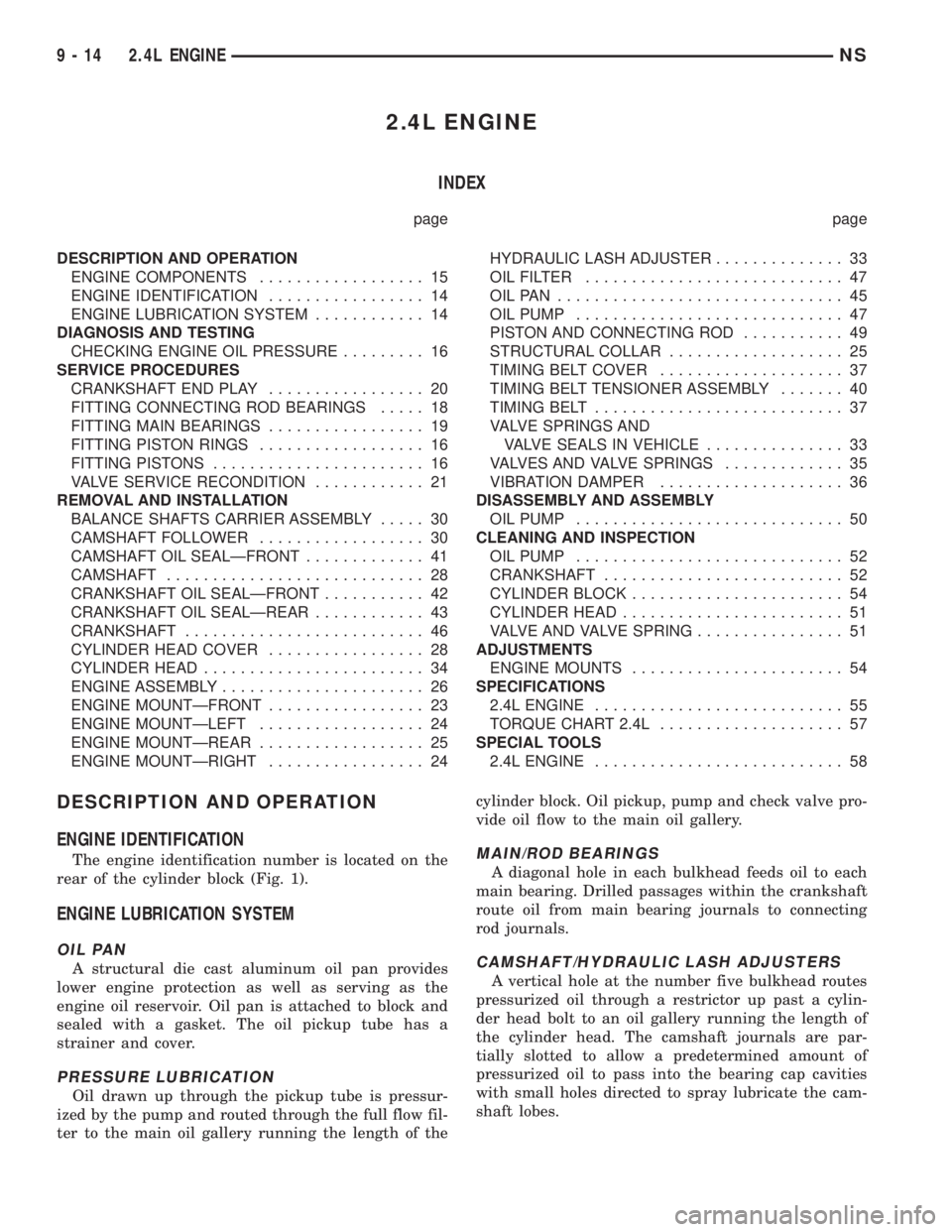
2.4L ENGINE
INDEX
page page
DESCRIPTION AND OPERATION
ENGINE COMPONENTS.................. 15
ENGINE IDENTIFICATION................. 14
ENGINE LUBRICATION SYSTEM............ 14
DIAGNOSIS AND TESTING
CHECKING ENGINE OIL PRESSURE......... 16
SERVICE PROCEDURES
CRANKSHAFT END PLAY................. 20
FITTING CONNECTING ROD BEARINGS..... 18
FITTING MAIN BEARINGS................. 19
FITTING PISTON RINGS.................. 16
FITTING PISTONS....................... 16
VALVE SERVICE RECONDITION............ 21
REMOVAL AND INSTALLATION
BALANCE SHAFTS CARRIER ASSEMBLY..... 30
CAMSHAFT FOLLOWER.................. 30
CAMSHAFT OIL SEALÐFRONT............. 41
CAMSHAFT............................ 28
CRANKSHAFT OIL SEALÐFRONT........... 42
CRANKSHAFT OIL SEALÐREAR............ 43
CRANKSHAFT.......................... 46
CYLINDER HEAD COVER................. 28
CYLINDER HEAD........................ 34
ENGINE ASSEMBLY...................... 26
ENGINE MOUNTÐFRONT................. 23
ENGINE MOUNTÐLEFT.................. 24
ENGINE MOUNTÐREAR.................. 25
ENGINE MOUNTÐRIGHT................. 24HYDRAULIC LASH ADJUSTER.............. 33
OILFILTER ............................ 47
OILPAN ............................... 45
OIL PUMP............................. 47
PISTON AND CONNECTING ROD........... 49
STRUCTURAL COLLAR................... 25
TIMING BELT COVER.................... 37
TIMING BELT TENSIONER ASSEMBLY....... 40
TIMING BELT........................... 37
VALVE SPRINGS AND
VALVE SEALS IN VEHICLE............... 33
VALVES AND VALVE SPRINGS............. 35
VIBRATION DAMPER.................... 36
DISASSEMBLY AND ASSEMBLY
OIL PUMP............................. 50
CLEANING AND INSPECTION
OIL PUMP............................. 52
CRANKSHAFT.......................... 52
CYLINDER BLOCK....................... 54
CYLINDER HEAD........................ 51
VALVE AND VALVE SPRING................ 51
ADJUSTMENTS
ENGINE MOUNTS....................... 54
SPECIFICATIONS
2.4L ENGINE........................... 55
TORQUE CHART 2.4L.................... 57
SPECIAL TOOLS
2.4L ENGINE........................... 58
DESCRIPTION AND OPERATION
ENGINE IDENTIFICATION
The engine identification number is located on the
rear of the cylinder block (Fig. 1).
ENGINE LUBRICATION SYSTEM
OIL PAN
A structural die cast aluminum oil pan provides
lower engine protection as well as serving as the
engine oil reservoir. Oil pan is attached to block and
sealed with a gasket. The oil pickup tube has a
strainer and cover.
PRESSURE LUBRICATION
Oil drawn up through the pickup tube is pressur-
ized by the pump and routed through the full flow fil-
ter to the main oil gallery running the length of thecylinder block. Oil pickup, pump and check valve pro-
vide oil flow to the main oil gallery.
MAIN/ROD BEARINGS
A diagonal hole in each bulkhead feeds oil to each
main bearing. Drilled passages within the crankshaft
route oil from main bearing journals to connecting
rod journals.
CAMSHAFT/HYDRAULIC LASH ADJUSTERS
A vertical hole at the number five bulkhead routes
pressurized oil through a restrictor up past a cylin-
der head bolt to an oil gallery running the length of
the cylinder head. The camshaft journals are par-
tially slotted to allow a predetermined amount of
pressurized oil to pass into the bearing cap cavities
with small holes directed to spray lubricate the cam-
shaft lobes.
9 - 14 2.4L ENGINENS