service CHRYSLER VOYAGER 2000 Diagnostic Manual
[x] Cancel search | Manufacturer: CHRYSLER, Model Year: 2000, Model line: VOYAGER, Model: CHRYSLER VOYAGER 2000Pages: 364, PDF Size: 2.17 MB
Page 283 of 364

Symptom:
* CHECKING THE ENGINE MECHANICAL SYSTEMS
POSSIBLE CAUSES
ENGINE COMPRESSION OUT OF SPECIFICATION
VALVE TIMING OUT OF SPECIFICATION
POWERTRAIN CONTROL MODULE DEFECTIVE
CLEAN SPARK PLUGS
SPARK PLUG CABLES POSITIONED INCORRECTLY
TEST ACTION APPLICABILITY
1 Turn Ignition off.
Inspect Spark Plug Cables for correct placement.
Are all Spark Plug Cables positioned correctly?All
Ye s®Go To 2
No®Reinstall Spark Plug Cables as necessary.
2 Turn Ignition off.
Remove all Spark Plugs and inspect the tips for wet fuel.
Are the Spark Plug tips wet?All
Ye s®Clean the spark plugs.
No®Go To 3
3 Turn Ignition off.
Using service information procedures, check Engine compression.
Is Engine compression within specifications?All
Ye s®Go To 4
No®Repair the Engine as necessary.
Perform Verification Test VER-1A.
4 Turn Ignition off.
Using service information procedures, check Engine Valve timing.
Is Valve timing within specifications?All
Ye s®Go To 5
No®Repair Valve timing as necessary.
Perform Verification Test VER-1A.
5 If there are no potential causes or DTCs remaining, the Powertrain Control Module
is assumed to be defective.
View repair options.All
Repair
Replace the Powertrain Control Module.
Perform Powertrain Verification Test VER-1A.
277
STARTING
ProCarManuals.com
Page 304 of 364

TEST ACTION APPLICABILITY
8 If there are no potential causes remaining, the Powertrain Control Module is
assumed to be defective.
View repair options.All
Repair
Replace the Powertrain Control Module.
Perform Powertrain Verification Test VER-1A.
9 Ignition Off.
Ensure the Transmission is in Park.
With the DRB, read the Park/Neutral Position Switch.
Does the Switch show Park?All
Ye s®Go To 10
No®Repair Park/Neutral Switch.
Perform Powertrain Verification Test VER-1A.
10 Ignition Off
Disconnect the Starter Relay Connector.
Note: Check connectors - Clean/repair as necessary.
Warning: The Engine may be cranked in the next step. Keep away from
moving parts.
Warning: The engine may be cranked in the next step. Keep away from
moving parts.
Briefly connect a jumper wire between Starter Relay Output and Fused B(+)
Circuits.
Did the Starter Solenoid click when the jumper wire was connected?All
Ye s®Go To 11
No®Go To 15
11 Ignition Off
Check the Battery Cables for high resistance. (Use Service Manual procedure.)
Did either Battery Circuit have a voltage drop greater than 0.2 volt?All
Ye s®Repair the Battery Circuit for high resistance.
Perform Powertrain Verification Test VER-1A.
No®Go To 12
12 Ignition Off
Attempt to manually rotate the Crankshaft 360 degrees.
Is the Crankshaft able to rotate 360 degrees?All
Ye s®Go To 13
No®Repair the Engine mechanical problem as necessary.
Perform Powertrain Verification Test VER-1A.
13 Ignition Off.
Disconnect the Starter Relay Connector.
Note: Check connectors - Clean/repair as necessary.
With a Voltmeter, measure the Fused B(+) Circuit.
Is the voltage above 11.6 volts?All
Ye s®Go To 14
No®Repair open Fused B(+) Circuit. (check Ignition Switch Fuse in
PDC).
Perform Powertrain Verification Test VER-1A.
298
STARTING
* NO CRANK CONDITION ÐContinued
ProCarManuals.com
Page 305 of 364

TEST ACTION APPLICABILITY
14 Ignition Off.
Disconnect Starter Relay Output Wire from the Starter Solenoid.
Disconnect the Starter Relay Connector.
Note: Check connectors - Clean/repair as necessary.
Using an ohmmeter, measure Starter Relay Output Circuit.
Is the resistance below 5.0 ohms?All
Ye s®Go To 19
No®Repair open Starter Relay Output Circuit.
Perform Powertrain Verification Test VER-1A.
15 Ignition Off
Check the Battery Cables for high resistance. (Use Service Manual procedure.)
Did either Battery Circuit have a voltage drop greater than 0.2 volt?All
Ye s®Repair the Battery Circuit for high resistance.
Perform Powertrain Verification Test VER-1A.
No®Go To 16
16 Ignition Off
Attempt to manually rotate the Crankshaft 360 degrees.
Is the Crankshaft able to rotate 360 degrees?All
Ye s®Go To 17
No®Repair the Engine mechanical problem as necessary.
Perform Powertrain Verification Test VER-1A.
17 Ignition Off.
Disconnect Starter Relay Output Wire from the Starter Solenoid.
Disconnect the Starter Relay Connector.
Note: Check connectors - Clean/repair as necessary.
Using an ohmmeter, measure Starter Relay Output Circuit.
Is the resistance below 5.0 ohms?All
Ye s®Go To 18
No®Repair open Starter Relay Output Circuit.
Perform Powertrain Verification Test VER-1A.
18 Ignition Off.
Disconnect the Starter Relay Connector.
Note: Check connectors - Clean/repair as necessary.
With a Voltmeter, measure the Fused B(+) Circuit.
Is the voltage above 11.6 volts?All
Ye s®Go To 19
No®Repair open Fused B(+) Circuit. (check Ignition Switch Fuse in
PDC).
Perform Powertrain Verification Test VER-1A.
299
STARTING
* NO CRANK CONDITION ÐContinued
ProCarManuals.com
Page 307 of 364
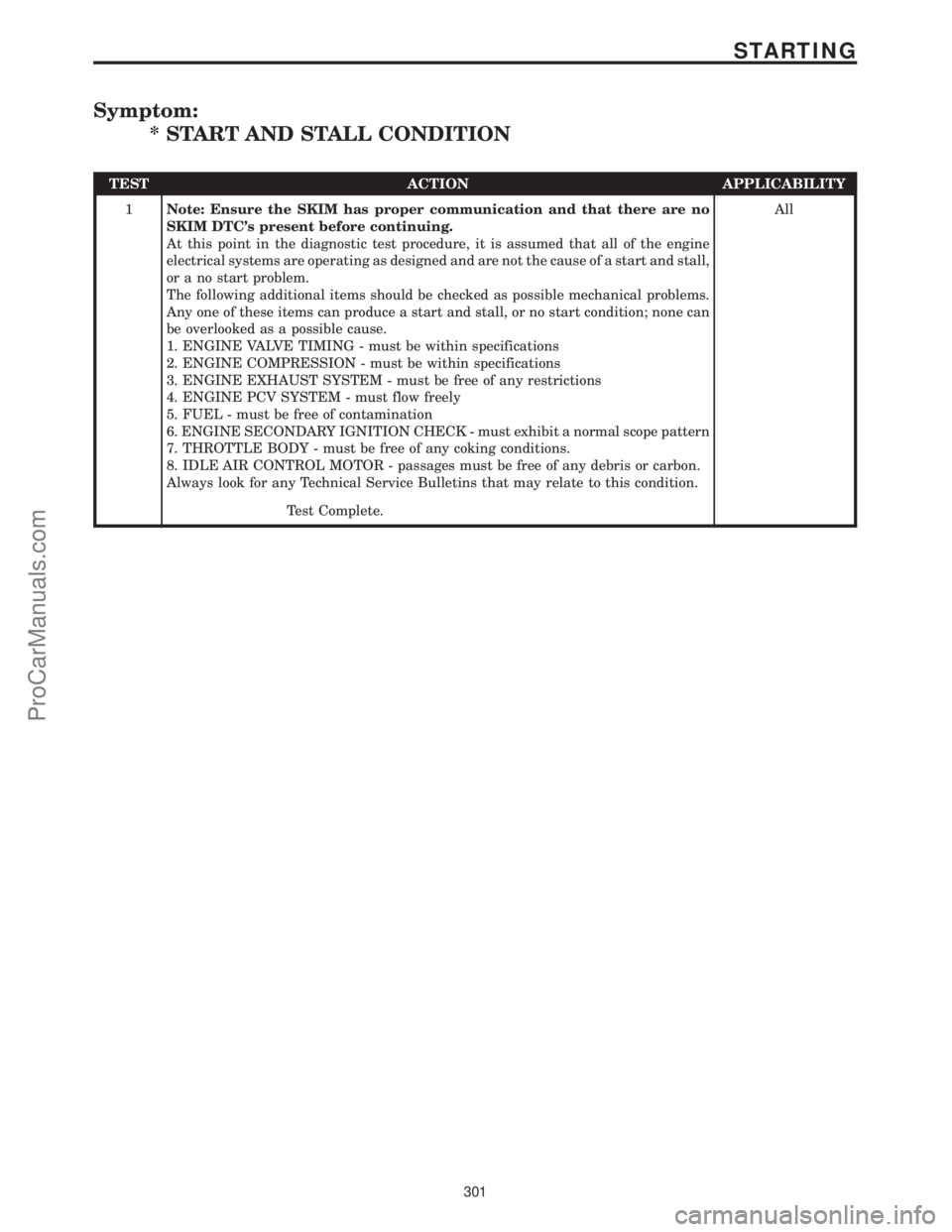
Symptom:
* START AND STALL CONDITION
TEST ACTION APPLICABILITY
1Note: Ensure the SKIM has proper communication and that there are no
SKIM DTC's present before continuing.
At this point in the diagnostic test procedure, it is assumed that all of the engine
electrical systems are operating as designed and are not the cause of a start and stall,
or a no start problem.
The following additional items should be checked as possible mechanical problems.
Any one of these items can produce a start and stall, or no start condition; none can
be overlooked as a possible cause.
1. ENGINE VALVE TIMING - must be within specifications
2. ENGINE COMPRESSION - must be within specifications
3. ENGINE EXHAUST SYSTEM - must be free of any restrictions
4. ENGINE PCV SYSTEM - must flow freely
5. FUEL - must be free of contamination
6. ENGINE SECONDARY IGNITION CHECK - must exhibit a normal scope pattern
7. THROTTLE BODY - must be free of any coking conditions.
8. IDLE AIR CONTROL MOTOR - passages must be free of any debris or carbon.
Always look for any Technical Service Bulletins that may relate to this condition.All
Test Complete.
301
STARTING
ProCarManuals.com
Page 308 of 364

Symptom:
P-0740 TORQUE CONV CLUTCH, NO RPM DROP AT LOCKUP
When Monitored and Set Condition:
P-0740 TORQUE CONV CLUTCH, NO RPM DROP AT LOCKUP
When Monitored: Continuously when no matured or maturing Trouble Code and throttle
position >10% and constant for 4.4 seconds before TCC engagement requested: No TCC
solenoid circuit, any cam/crank-related code, VSS, any TPS-related code and Battery
voltage >11.0
Set Condition: Torque Converter malfunctions that are detected are the FTC not locking
up properly when desired, and the torque converter not unlocking properly when desired.
3 consecutive test failures over one trip will store the code. 2 bad trips will set the code.
POSSIBLE CAUSES
FUSED IGNITION SWITCH OUTPUT CIRCUIT OPEN
DIFF, SHAFT, OR GEARS DEFECTIVE
TCC SOL DEFECTIVE
TORQUE CONVERTER ASSEMBLY DEF OR TCC SOL STUCK
TRANSMISSION FLUID DIRTY OR LEVEL LOW
VEHICLE CONFIGURATION NON-STANDARD
TEST ACTION APPLICABILITY
1 Ignition On, Engine Not Running
With the DRB, read codes.
Is the Global Good Trip displayed and equal to 0?TRANSMISSION -
AUTOMATIC
3-SPD, 31TH
Ye s®Go To 2
No®Test Complete.
2 Ignition Off
At the9Cooler In9port puta0to300PSIgauge using a9T9. Ensure line is long
enough to reach in driver's side of vehicle so gauge can be monitored while driving.
Road test vehicle. Gear select in drive. While monitoring DRB, achieve 50 MPH.
While doing this, notice the gauge will read around 15 PSI until lockup is achieved
in 3rd gear. If the TCC Solenoid is operating properly, the gauge pressure will
fluctuate when lockup is achieved.
Did gauge fluctuate?TRANSMISSION -
AUTOMATIC
3-SPD, 31TH
Ye s®Go To 3
No®Refer to service instructions for proper service procedure on
Torque Converter Assembly or stuck TCC Solenoid and repair as
necessary.
Perform Powertrain Verification Test VER-5A.
302
TRANSMISSION
ProCarManuals.com
Page 309 of 364

TEST ACTION APPLICABILITY
3 Ignition Off
Check Transmission Fluid level and ensure it is clear of any debris.
Is the Transmission Fluid okay?TRANSMISSION -
AUTOMATIC
3-SPD, 31TH
Ye s®Go To 4
No®Repair as necessary.
Perform Powertrain Verification Test VER-5A.
4 Ignition Off
Disconnect the TCC Solenoid connector.
Note: Check connectors - Clean/repair as necessary.
Turn key on.
Use a Voltmeter in the following step.
Using a Voltmeter, measure the Fused Ignition Switch Output Circuit at Solenoid
Connector.
Is the voltage above 10.0 volts?TRANSMISSION -
AUTOMATIC
3-SPD, 31TH
Ye s®Go To 5
No®Repair the open Fused Ignition Switch Output Circuit.
Perform Powertrain Verification Test VER-5A.
5 Ignition Off
Disconnect the TCC Solenoid connector.
Note: Check connectors - Clean/repair as necessary.
With an Ohmmeter, measure across the Solenoid for resistance.
Was resistance between 30.0 and 50.0 ohms?TRANSMISSION -
AUTOMATIC
3-SPD, 31TH
Ye s®Go To 6
No®Replace TCC Solenoid.
Perform Powertrain Verification Test VER-5A.
6 Drive Vehicle
Maintain 50 MPH per DRB. Wait 10 seconds in lockup. Record Engine RPM.
Was engine RPM 2200 +/- 50 RPM?TRANSMISSION -
AUTOMATIC
3-SPD, 31TH
Ye s®Go To 7
No®Inspect Differential, Output Shaft, or Gear Box. Refer to service
instructions for proper diagnosis.
Perform Powertrain Verification Test VER-5A.
7 Ignition Off
Remove VSS.
Note: Check connectors - Clean/repair as necessary.
Inspect sensor and gear for damage, also improper wheel size.
Were any problems found?TRANSMISSION -
AUTOMATIC
3-SPD, 31TH
Ye s®Repair as necessary.
Perform Powertrain Verification Test VER-5A.
No®Test Complete.
303
TRANSMISSION
P-0740 TORQUE CONV CLUTCH, NO RPM DROP AT LOCKUP ÐContinued
ProCarManuals.com
Page 318 of 364
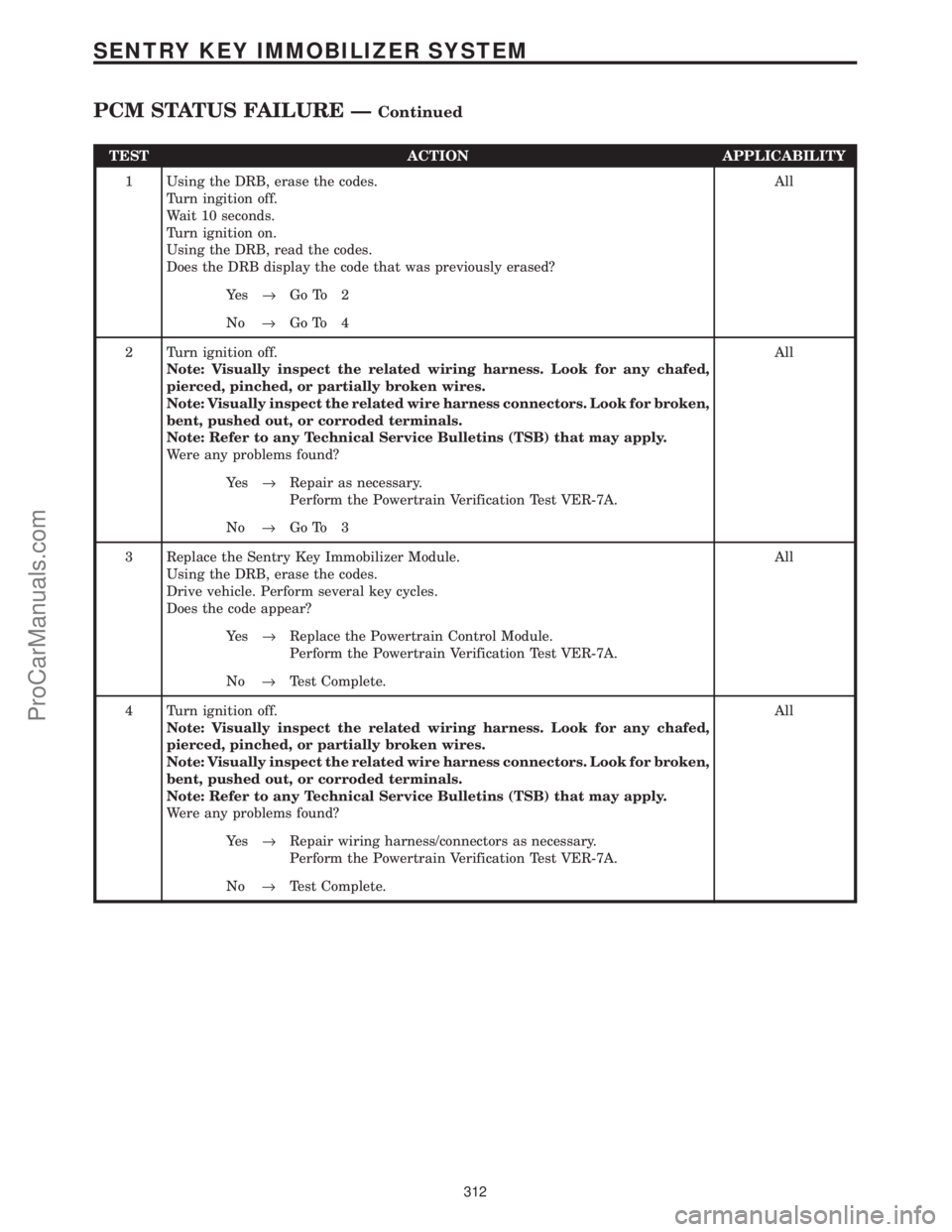
TEST ACTION APPLICABILITY
1 Using the DRB, erase the codes.
Turn ingition off.
Wait 10 seconds.
Turn ignition on.
Using the DRB, read the codes.
Does the DRB display the code that was previously erased?All
Ye s®Go To 2
No®Go To 4
2 Turn ignition off.
Note: Visually inspect the related wiring harness. Look for any chafed,
pierced, pinched, or partially broken wires.
Note: Visually inspect the related wire harness connectors. Look for broken,
bent, pushed out, or corroded terminals.
Note: Refer to any Technical Service Bulletins (TSB) that may apply.
Were any problems found?All
Ye s®Repair as necessary.
Perform the Powertrain Verification Test VER-7A.
No®Go To 3
3 Replace the Sentry Key Immobilizer Module.
Using the DRB, erase the codes.
Drive vehicle. Perform several key cycles.
Does the code appear?All
Ye s®Replace the Powertrain Control Module.
Perform the Powertrain Verification Test VER-7A.
No®Test Complete.
4 Turn ignition off.
Note: Visually inspect the related wiring harness. Look for any chafed,
pierced, pinched, or partially broken wires.
Note: Visually inspect the related wire harness connectors. Look for broken,
bent, pushed out, or corroded terminals.
Note: Refer to any Technical Service Bulletins (TSB) that may apply.
Were any problems found?All
Ye s®Repair wiring harness/connectors as necessary.
Perform the Powertrain Verification Test VER-7A.
No®Test Complete.
312
SENTRY KEY IMMOBILIZER SYSTEM
PCM STATUS FAILURE ÐContinued
ProCarManuals.com
Page 320 of 364
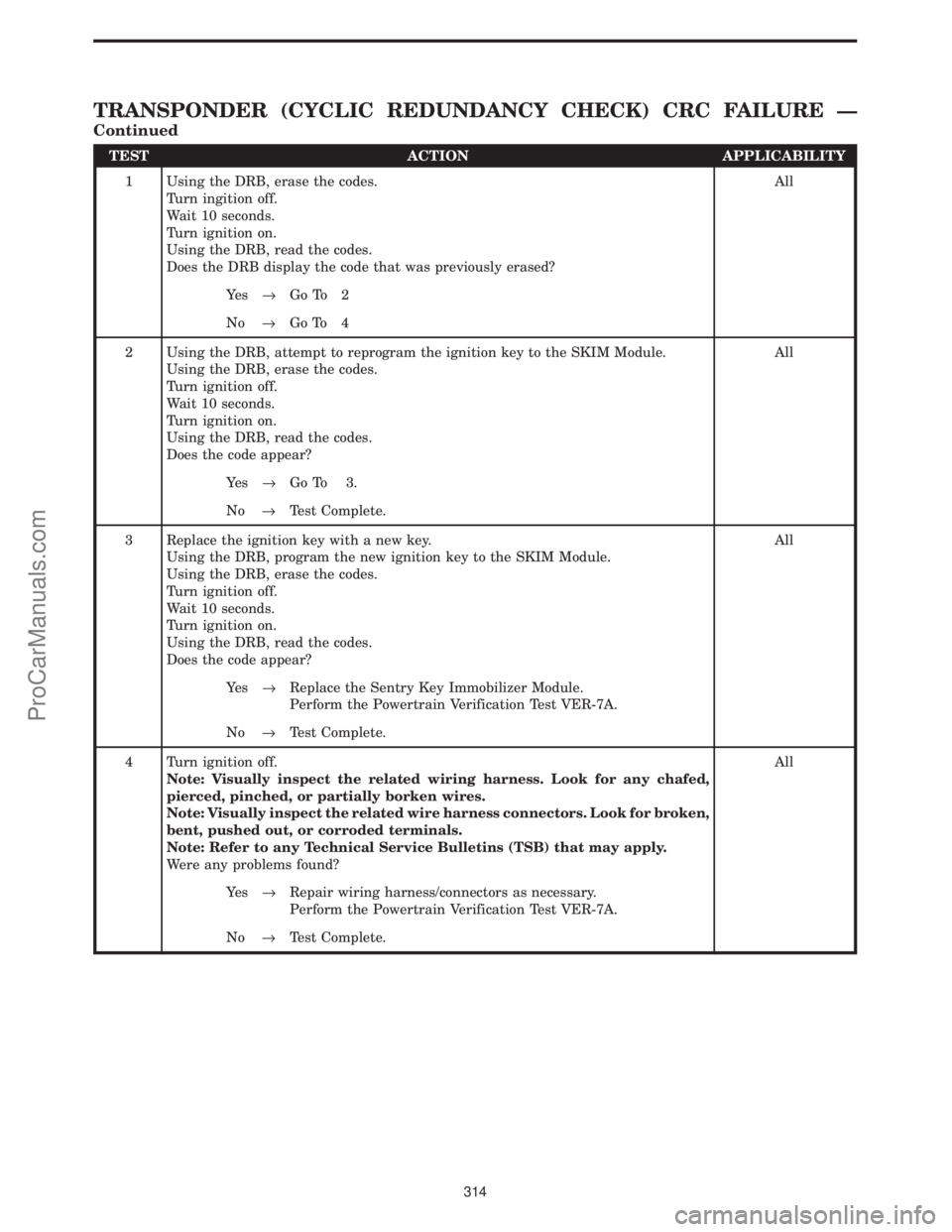
TEST ACTION APPLICABILITY
1 Using the DRB, erase the codes.
Turn ingition off.
Wait 10 seconds.
Turn ignition on.
Using the DRB, read the codes.
Does the DRB display the code that was previously erased?All
Ye s®Go To 2
No®Go To 4
2 Using the DRB, attempt to reprogram the ignition key to the SKIM Module.
Using the DRB, erase the codes.
Turn ignition off.
Wait 10 seconds.
Turn ignition on.
Using the DRB, read the codes.
Does the code appear?All
Ye s®Go To 3.
No®Test Complete.
3 Replace the ignition key with a new key.
Using the DRB, program the new ignition key to the SKIM Module.
Using the DRB, erase the codes.
Turn ignition off.
Wait 10 seconds.
Turn ignition on.
Using the DRB, read the codes.
Does the code appear?All
Ye s®Replace the Sentry Key Immobilizer Module.
Perform the Powertrain Verification Test VER-7A.
No®Test Complete.
4 Turn ignition off.
Note: Visually inspect the related wiring harness. Look for any chafed,
pierced, pinched, or partially borken wires.
Note: Visually inspect the related wire harness connectors. Look for broken,
bent, pushed out, or corroded terminals.
Note: Refer to any Technical Service Bulletins (TSB) that may apply.
Were any problems found?All
Ye s®Repair wiring harness/connectors as necessary.
Perform the Powertrain Verification Test VER-7A.
No®Test Complete.
314
TRANSPONDER (CYCLIC REDUNDANCY CHECK) CRC FAILURE Ð
Continued
ProCarManuals.com
Page 322 of 364
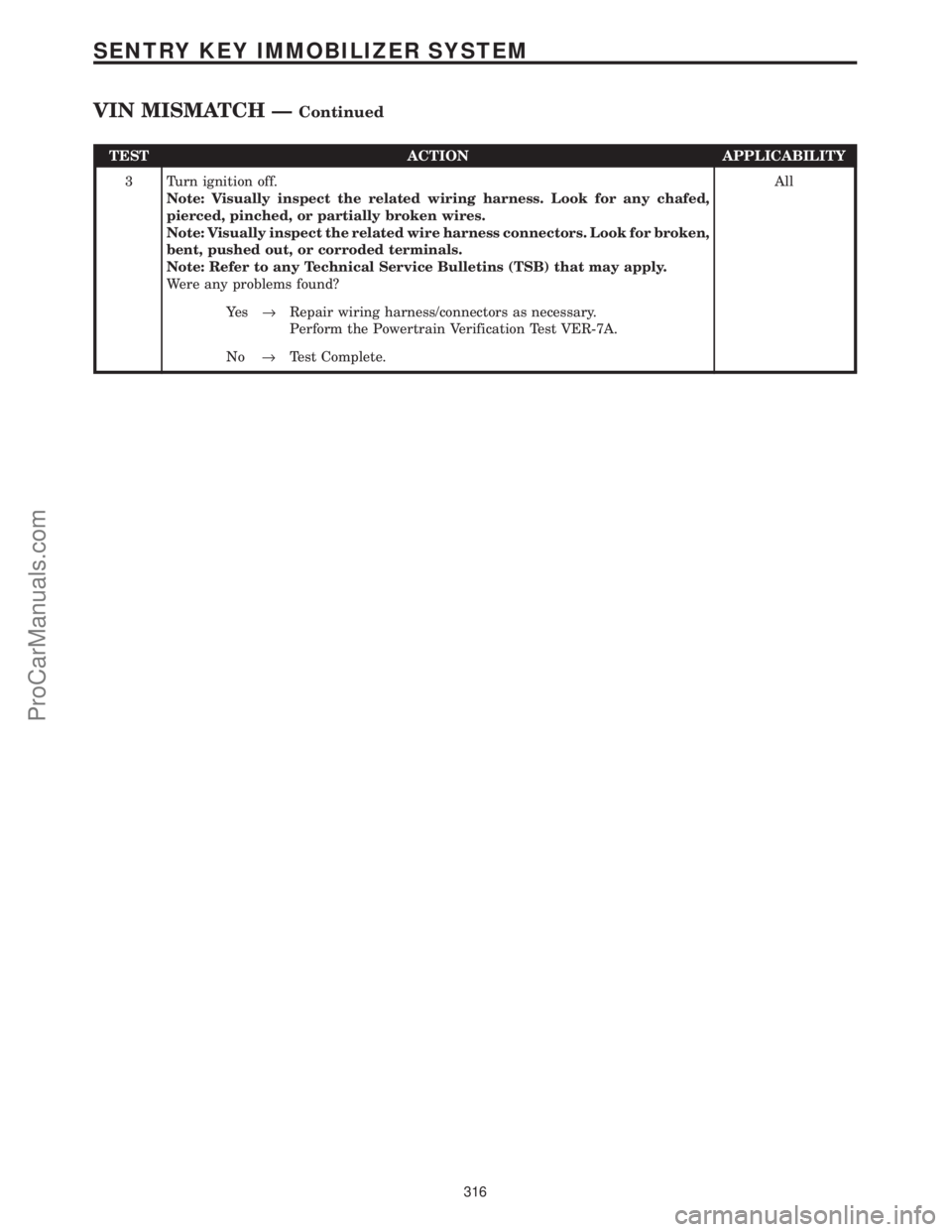
TEST ACTION APPLICABILITY
3 Turn ignition off.
Note: Visually inspect the related wiring harness. Look for any chafed,
pierced, pinched, or partially broken wires.
Note: Visually inspect the related wire harness connectors. Look for broken,
bent, pushed out, or corroded terminals.
Note: Refer to any Technical Service Bulletins (TSB) that may apply.
Were any problems found?All
Ye s®Repair wiring harness/connectors as necessary.
Perform the Powertrain Verification Test VER-7A.
No®Test Complete.
316
SENTRY KEY IMMOBILIZER SYSTEM
VIN MISMATCH ÐContinued
ProCarManuals.com
Page 323 of 364

Verification Tests
VERIFICATION TEST VER-1A APPLICABILITY
No Start Verification
Use this test to verify that a No Start condition has been repaired and that the vehicle can be
returned to the customer.
Note: If the Powertrain Control Module has been replaced and the correct VIN and
mileage have not been programmed, a DTC will be set in the ABS, Airbag and the
SKIM modules. In addition, if the vehicle is equipped with a Sentry Key Immobilizer
Module (SKIM), Secret Key data must be updated to enable starting. Refer to
GENERAL INFORMATION section for programming information for the PCM, SKIM
and the Transponder (ignition key).
1. Inspect the vehicle to ensure that all components related to the repair are connected
properly.
2. Inspect the engine oil for fuel contamination. Replace the oil and filter as necessary
3. Attempt to start the engine.
4. If the No Start condition is still present, refer to the symptom list and perform diagnostic
testing as necessary. Refer to any Technical Service Bulletins that may apply.
5. Run the engine for one warm-up cycle to verify proper operation. With the DRBIIIt, confirm
that no DTC's are present and that all components are functioning properly.
6. If DTC's are present, refer to the symptom list and perform diagnostic testing as necessary.ALL
VERIFICATION TEST VER-2A APPLICABILITY
Non-OBDII Verification
Use this test to verify that a non-OBDII symptom has been repaired and that the vehicle can
be returned to the customer. A non-OBDII symptom is a comprehensive component related
symptom that is not the result of a failed OBDII major monitor.
Note: If the Powertrain Control Module has been replaced and the correct VIN and
mileage have not been programmed, a DTC will be set in the ABS, Airbag and the
SKIM modules. In addition, if the vehicle is equipped with a Sentry Key Immobilizer
Module (SKIM), Secret Key data must be updated to enable starting. Refer to
GENERAL INFORMATION section for programming information for the PCM, SKIM
and the Transponder (ignition key).
1. Inspect the vehicle to ensure that all components related to the repair are connected
properly.
2. With the DRBIIIt, Clear DTC's and Reset Memory (all engine values).
3. Run the engine for one warm-up cycle to verify proper operation.
4. Road test the vehicle. Use all accessories that may be related to this repair.
With the DRBIIIt, confirm that no DTC's are present and that all components are functioning
properly.
6. If this test is being performed after a No Trouble Code test, verify that the symptom is no
longer present. If the symptom is still present, or any other symptom or DTC is present, refer
to the symptom list for further diagnostic testing procedures. Check for any Technical Service
Bulletins that may apply.
7. If there are no DTC's present and all components are functioning properly, repair is
complete.ALL
317
VERIFICATION TESTS
ProCarManuals.com