charging CHRYSLER VOYAGER 2001 User Guide
[x] Cancel search | Manufacturer: CHRYSLER, Model Year: 2001, Model line: VOYAGER, Model: CHRYSLER VOYAGER 2001Pages: 4284, PDF Size: 83.53 MB
Page 673 of 4284

Symptom:
CHARGING VOLTAGE LOW MESSAGE
When Monitored and Set Condition:
CHARGING VOLTAGE LOW MESSAGE
When Monitored: During cranking or with the engine running.
Set Condition: When the Memory Seat Mirror Module receives three low charging system
voltage messages below 9 volts over the PCI Bus. Code will remain for 50 ignition cycles.
POSSIBLE CAUSES
PCM TROUBLE CODES
STORED CODE COMMUNICATION PROBLEMS
MEMORY SEAT MIRROR MODULE
INTERMITTENT PROBLEM
TEST ACTION APPLICABILITY
1 Turn ignition on.
With the DRBIIItread Engine DTCs.
Is the DTC P1682 Charging System Voltage Too Low set in the Power Control
Module?All
Ye s®Refer to symptom *P1682-CHARGING SYSTEM VOLTAGE TOO
LOW in the CHARGING category
Perform MEMORY SYSTEM VERIFICATION TEST - VER 1.
No®Go To 2
2 With the DRBIIIt, erase the DTC from Memory Seat Mirror Module.
Turn the ignition switch to the Off position then start the engine and let run for one
minute.
With the DRB check for the same DTC to reset in the MSMM.
Did the same DTC reset?All
Ye s®Go To 3
No®Test complete.
Perform MEMORY SYSTEM VERIFICATION TEST - VER 1.
3Note: Visually inspect the related wiring harness. Look for any chafed,
pierced, pinched, or partially broken wires.
Note: Visually inspect the related wiring harness connectors. Look for
broken, bent, pushed out, or corroded terminals.
Note: Refer to any technical service bulletins that may apply.
Were any problems found?All
No®Replace the Memory Seat Mirror Module.
Perform MEMORY SYSTEM VERIFICATION TEST - VER 1.
Ye s®Repair as necessary.
Perform MEMORY SYSTEM VERIFICATION TEST - VER 1.
644
MEMORY SEAT
Page 1186 of 4284

TEST ACTION APPLICABILITY
3 Turn the ignition off.
Disconnect the CAB connector.
Note: Check connector - Clean/repair as necessary.
Start the engine.
Raise engine speed above 1,800 RPM.
Measure the battery voltage.
Is the voltage above 16.5 volts ?All
Ye s®Refer to appropriate service information for charging system
testing and repair.
Perform ABS VERIFICATION TEST - VER 1.
No®Go To 4
4 Turn the ignition off.
Disconnect the CAB connector.
Note: Check connector - Clean/repair as necessary.
Measure the resistance of the ground circuits.
Is the resistance below 1.0 ohm?All
Ye s®Go To 5
No®Repair the Ground circuit for an open.
Perform ABS VERIFICATION TEST - VER 1.
5 If there are no potential causes remaining, view repair. All
Repair
Replace the Controller Antilock Brake.
Perform ABS VERIFICATION TEST - VER 1.
6 Turn the ignition off.
Visually inspect the related wiring harness. Look for any chafed, pierced, pinched, or
partially broken wires.
Visually inspect the related wire harness connectors. Look for broken, bent, pushed
out, or corroded terminals.
Refer to any Hotline letters or Technical Service Bulletins that may apply.
Were any problems found?All
Ye s®Repair as necessary.
Perform ABS VERIFICATION TEST - VER 1.
No®Test Complete.
29
BRAKES (CAB)
SYSTEM OVERVOLTAGE ÐContinued
Page 1187 of 4284

Symptom:
SYSTEM UNDERVOLTAGE
When Monitored and Set Condition:
SYSTEM UNDERVOLTAGE
When Monitored: Ignition on. The CAB monitors the Fused Ignition Switch Output
circuit voltage above 10 km/h (6 mph) every 7 milliseconds for proper system voltage.
Set Condition: If the voltage is below 9.5 volts, the Diagnostic Trouble Code (DTC) is set.
POSSIBLE CAUSES
BATTERY VOLTAGE LOW
INTERMITTENT DTC
FUSED IGNITION SWITCH OUTPUT CIRCUIT HIGH RESISTANCE
CAB - INTERNAL FAULT
TEST ACTION APPLICABILITY
1 Turn the ignition on.
With the DRBIIIt, erase DTC's.
Turn the ignition off.
Turn the ignition on.
Start the engine.
Drive the vehicle above 16 km/h (10 mph) for at least 20 seconds.
Stop the vehicle
With the DRBIIIt, read DTC's.
Does the DRBIIItdisplay System Undervoltage DTC?All
Ye s®Go To 2
No®Go To 5
2 Engine Running.
Measure the battery voltage.
Is the battery voltage below 10 volts?All
Ye s®Refer to appropriate service information for charging system
testing and repair.
Perform ABS VERIFICATION TEST - VER 1.
No®Go To 3
3 Disconnect the CAB harness connector.
Turn the ignition on.
Measure the voltage of the Fused Ignition Switch circuit.
Is the voltage above 10 volts?All
Ye s®Go To 4
No®Repair the Fused Ignition Switch Output Circuit for high resis-
tance
Perform ABS VERIFICATION TEST - VER 1.
30
BRAKES (CAB)
Page 1216 of 4284
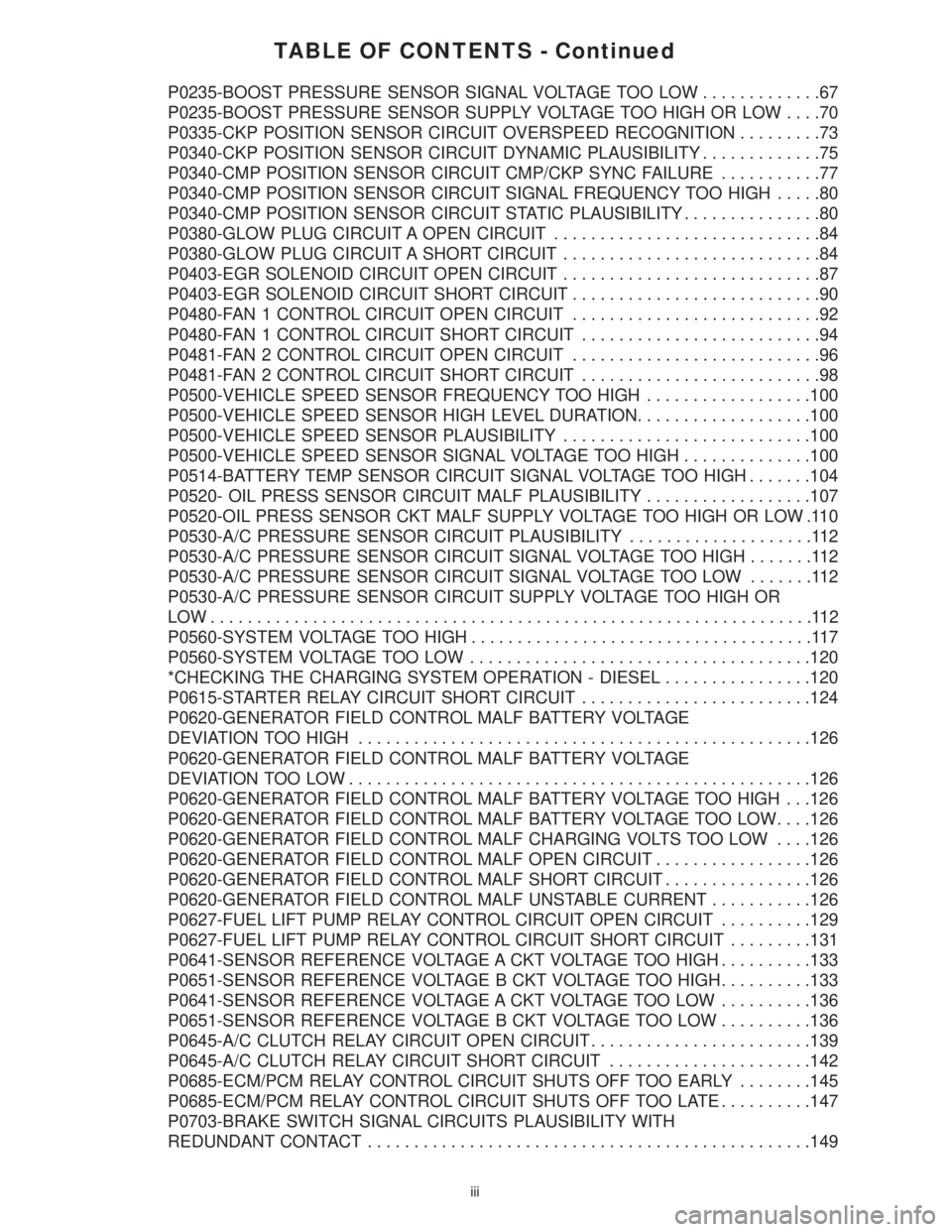
TABLE OF CONTENTS - Continued
P0235-BOOST PRESSURE SENSOR SIGNAL VOLTAGE TOO LOW.............67
P0235-BOOST PRESSURE SENSOR SUPPLY VOLTAGE TOO HIGH OR LOW....70
P0335-CKP POSITION SENSOR CIRCUIT OVERSPEED RECOGNITION.........73
P0340-CKP POSITION SENSOR CIRCUIT DYNAMIC PLAUSIBILITY.............75
P0340-CMP POSITION SENSOR CIRCUIT CMP/CKP SYNC FAILURE...........77
P0340-CMP POSITION SENSOR CIRCUIT SIGNAL FREQUENCY TOO HIGH.....80
P0340-CMP POSITION SENSOR CIRCUIT STATIC PLAUSIBILITY...............80
P0380-GLOW PLUG CIRCUIT A OPEN CIRCUIT.............................84
P0380-GLOW PLUG CIRCUIT A SHORT CIRCUIT............................84
P0403-EGR SOLENOID CIRCUIT OPEN CIRCUIT............................87
P0403-EGR SOLENOID CIRCUIT SHORT CIRCUIT...........................90
P0480-FAN 1 CONTROL CIRCUIT OPEN CIRCUIT...........................92
P0480-FAN 1 CONTROL CIRCUIT SHORT CIRCUIT..........................94
P0481-FAN 2 CONTROL CIRCUIT OPEN CIRCUIT...........................96
P0481-FAN 2 CONTROL CIRCUIT SHORT CIRCUIT..........................98
P0500-VEHICLE SPEED SENSOR FREQUENCY TOO HIGH..................100
P0500-VEHICLE SPEED SENSOR HIGH LEVEL DURATION...................100
P0500-VEHICLE SPEED SENSOR PLAUSIBILITY...........................100
P0500-VEHICLE SPEED SENSOR SIGNAL VOLTAGE TOO HIGH..............100
P0514-BATTERY TEMP SENSOR CIRCUIT SIGNAL VOLTAGE TOO HIGH.......104
P0520- OIL PRESS SENSOR CIRCUIT MALF PLAUSIBILITY..................107
P0520-OIL PRESS SENSOR CKT MALF SUPPLY VOLTAGE TOO HIGH OR LOW .110
P0530-A/C PRESSURE SENSOR CIRCUIT PLAUSIBILITY....................112
P0530-A/C PRESSURE SENSOR CIRCUIT SIGNAL VOLTAGE TOO HIGH.......112
P0530-A/C PRESSURE SENSOR CIRCUIT SIGNAL VOLTAGE TOO LOW.......112
P0530-A/C PRESSURE SENSOR CIRCUIT SUPPLY VOLTAGE TOO HIGH OR
LOW.................................................................112
P0560-SYSTEM VOLTAGE TOO HIGH.....................................117
P0560-SYSTEM VOLTAGE TOO LOW.....................................120
*CHECKING THE CHARGING SYSTEM OPERATION - DIESEL................120
P0615-STARTER RELAY CIRCUIT SHORT CIRCUIT.........................124
P0620-GENERATOR FIELD CONTROL MALF BATTERY VOLTAGE
DEVIATION TOO HIGH.................................................126
P0620-GENERATOR FIELD CONTROL MALF BATTERY VOLTAGE
DEVIATION TOO LOW..................................................126
P0620-GENERATOR FIELD CONTROL MALF BATTERY VOLTAGE TOO HIGH . . .126
P0620-GENERATOR FIELD CONTROL MALF BATTERY VOLTAGE TOO LOW. . . .126
P0620-GENERATOR FIELD CONTROL MALF CHARGING VOLTS TOO LOW. . . .126
P0620-GENERATOR FIELD CONTROL MALF OPEN CIRCUIT.................126
P0620-GENERATOR FIELD CONTROL MALF SHORT CIRCUIT................126
P0620-GENERATOR FIELD CONTROL MALF UNSTABLE CURRENT...........126
P0627-FUEL LIFT PUMP RELAY CONTROL CIRCUIT OPEN CIRCUIT..........129
P0627-FUEL LIFT PUMP RELAY CONTROL CIRCUIT SHORT CIRCUIT.........131
P0641-SENSOR REFERENCE VOLTAGE A CKT VOLTAGE TOO HIGH..........133
P0651-SENSOR REFERENCE VOLTAGE B CKT VOLTAGE TOO HIGH..........133
P0641-SENSOR REFERENCE VOLTAGE A CKT VOLTAGE TOO LOW..........136
P0651-SENSOR REFERENCE VOLTAGE B CKT VOLTAGE TOO LOW..........136
P0645-A/C CLUTCH RELAY CIRCUIT OPEN CIRCUIT........................139
P0645-A/C CLUTCH RELAY CIRCUIT SHORT CIRCUIT......................142
P0685-ECM/PCM RELAY CONTROL CIRCUIT SHUTS OFF TOO EARLY........145
P0685-ECM/PCM RELAY CONTROL CIRCUIT SHUTS OFF TOO LATE..........147
P0703-BRAKE SWITCH SIGNAL CIRCUITS PLAUSIBILITY WITH
REDUNDANT CONTACT................................................149
iii
Page 1224 of 4284
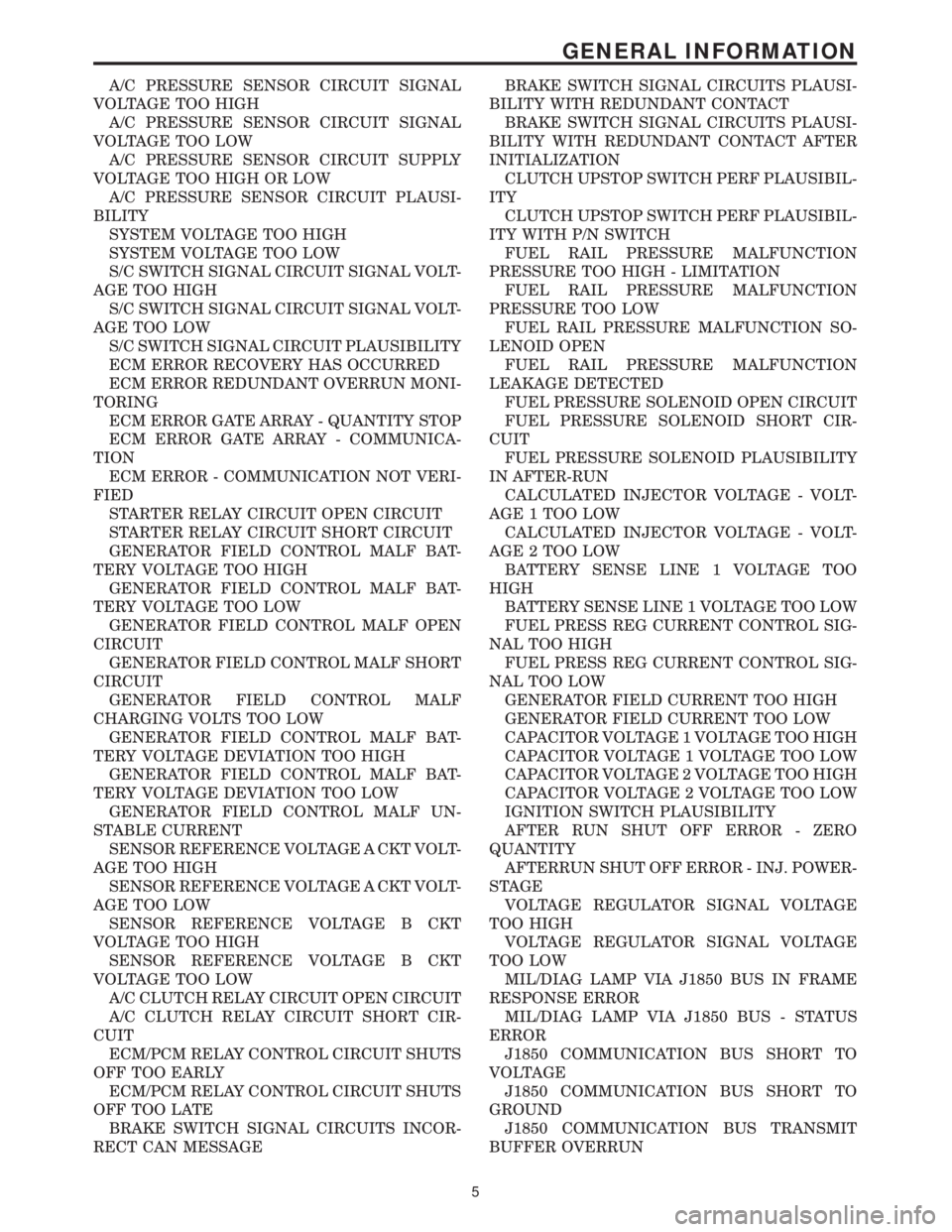
A/C PRESSURE SENSOR CIRCUIT SIGNAL
VOLTAGE TOO HIGH
A/C PRESSURE SENSOR CIRCUIT SIGNAL
VOLTAGE TOO LOW
A/C PRESSURE SENSOR CIRCUIT SUPPLY
VOLTAGE TOO HIGH OR LOW
A/C PRESSURE SENSOR CIRCUIT PLAUSI-
BILITY
SYSTEM VOLTAGE TOO HIGH
SYSTEM VOLTAGE TOO LOW
S/C SWITCH SIGNAL CIRCUIT SIGNAL VOLT-
AGE TOO HIGH
S/C SWITCH SIGNAL CIRCUIT SIGNAL VOLT-
AGE TOO LOW
S/C SWITCH SIGNAL CIRCUIT PLAUSIBILITY
ECM ERROR RECOVERY HAS OCCURRED
ECM ERROR REDUNDANT OVERRUN MONI-
TORING
ECM ERROR GATE ARRAY - QUANTITY STOP
ECM ERROR GATE ARRAY - COMMUNICA-
TION
ECM ERROR - COMMUNICATION NOT VERI-
FIED
STARTER RELAY CIRCUIT OPEN CIRCUIT
STARTER RELAY CIRCUIT SHORT CIRCUIT
GENERATOR FIELD CONTROL MALF BAT-
TERY VOLTAGE TOO HIGH
GENERATOR FIELD CONTROL MALF BAT-
TERY VOLTAGE TOO LOW
GENERATOR FIELD CONTROL MALF OPEN
CIRCUIT
GENERATOR FIELD CONTROL MALF SHORT
CIRCUIT
GENERATOR FIELD CONTROL MALF
CHARGING VOLTS TOO LOW
GENERATOR FIELD CONTROL MALF BAT-
TERY VOLTAGE DEVIATION TOO HIGH
GENERATOR FIELD CONTROL MALF BAT-
TERY VOLTAGE DEVIATION TOO LOW
GENERATOR FIELD CONTROL MALF UN-
STABLE CURRENT
SENSOR REFERENCE VOLTAGE A CKT VOLT-
AGE TOO HIGH
SENSOR REFERENCE VOLTAGE A CKT VOLT-
AGE TOO LOW
SENSOR REFERENCE VOLTAGE B CKT
VOLTAGE TOO HIGH
SENSOR REFERENCE VOLTAGE B CKT
VOLTAGE TOO LOW
A/C CLUTCH RELAY CIRCUIT OPEN CIRCUIT
A/C CLUTCH RELAY CIRCUIT SHORT CIR-
CUIT
ECM/PCM RELAY CONTROL CIRCUIT SHUTS
OFF TOO EARLY
ECM/PCM RELAY CONTROL CIRCUIT SHUTS
OFF TOO LATE
BRAKE SWITCH SIGNAL CIRCUITS INCOR-
RECT CAN MESSAGEBRAKE SWITCH SIGNAL CIRCUITS PLAUSI-
BILITY WITH REDUNDANT CONTACT
BRAKE SWITCH SIGNAL CIRCUITS PLAUSI-
BILITY WITH REDUNDANT CONTACT AFTER
INITIALIZATION
CLUTCH UPSTOP SWITCH PERF PLAUSIBIL-
ITY
CLUTCH UPSTOP SWITCH PERF PLAUSIBIL-
ITY WITH P/N SWITCH
FUEL RAIL PRESSURE MALFUNCTION
PRESSURE TOO HIGH - LIMITATION
FUEL RAIL PRESSURE MALFUNCTION
PRESSURE TOO LOW
FUEL RAIL PRESSURE MALFUNCTION SO-
LENOID OPEN
FUEL RAIL PRESSURE MALFUNCTION
LEAKAGE DETECTED
FUEL PRESSURE SOLENOID OPEN CIRCUIT
FUEL PRESSURE SOLENOID SHORT CIR-
CUIT
FUEL PRESSURE SOLENOID PLAUSIBILITY
IN AFTER-RUN
CALCULATED INJECTOR VOLTAGE - VOLT-
AGE 1 TOO LOW
CALCULATED INJECTOR VOLTAGE - VOLT-
AGE 2 TOO LOW
BATTERY SENSE LINE 1 VOLTAGE TOO
HIGH
BATTERY SENSE LINE 1 VOLTAGE TOO LOW
FUEL PRESS REG CURRENT CONTROL SIG-
NAL TOO HIGH
FUEL PRESS REG CURRENT CONTROL SIG-
NAL TOO LOW
GENERATOR FIELD CURRENT TOO HIGH
GENERATOR FIELD CURRENT TOO LOW
CAPACITOR VOLTAGE 1 VOLTAGE TOO HIGH
CAPACITOR VOLTAGE 1 VOLTAGE TOO LOW
CAPACITOR VOLTAGE 2 VOLTAGE TOO HIGH
CAPACITOR VOLTAGE 2 VOLTAGE TOO LOW
IGNITION SWITCH PLAUSIBILITY
AFTER RUN SHUT OFF ERROR - ZERO
QUANTITY
AFTERRUN SHUT OFF ERROR - INJ. POWER-
STAGE
VOLTAGE REGULATOR SIGNAL VOLTAGE
TOO HIGH
VOLTAGE REGULATOR SIGNAL VOLTAGE
TOO LOW
MIL/DIAG LAMP VIA J1850 BUS IN FRAME
RESPONSE ERROR
MIL/DIAG LAMP VIA J1850 BUS - STATUS
ERROR
J1850 COMMUNICATION BUS SHORT TO
VOLTAGE
J1850 COMMUNICATION BUS SHORT TO
GROUND
J1850 COMMUNICATION BUS TRANSMIT
BUFFER OVERRUN
5
GENERAL INFORMATION
Page 1336 of 4284

Symptom:
P0560-SYSTEM VOLTAGE TOO HIGH
When Monitored and Set Condition:
P0560-SYSTEM VOLTAGE TOO HIGH
When Monitored: With the engine running.
Set Condition: The ECM detects battery voltage is above 17.5 volts.
POSSIBLE CAUSES
INTERMITTENT CONDITION
ECM - TARGET CHARGING VOLTAGE TOO LOW
GENERATOR FIELD DRIVER CIRCUIT SHORTED TO GROUND
GROUND CIRCUIT HIGH RESISTANCE
BATTERY SUPPLY CIRCUIT HIGH RESISTANCE
GENERATOR INTERNALLY SHORTED TO GROUND
ECM - FIELD DRIVER SHORTED TO GROUND
TEST ACTION APPLICABILITY
1NOTE: The battery must be fully charged and the generator belt must be in
good condition and tensioned properly before continuing.
Turn the ignition on.
With the DRB, actuate the Generator Field.
Measure the voltage between ground and the Generator Field Driver circuit by back
probing the Generator Field harness connector with a voltmeter.
Does the voltage cycle from B+ to below 2.0 volts?All
Ye s®Go To 2
No®Go To 6
NOTE: With the DRB, stop the Generator Field actuation.
2 Start the engine.
With the DRB, read the Target Charging voltage.
Is the Target Charging voltage above 13.0 volts?All
Ye s®Go To 3
No®Replace and program the Engine Control Module in accordance
with the Service Information.
Perform CHARGING VERIFICATION - VER-3.
11 7
DRIVEABILITY - DIESEL
Page 1337 of 4284

TEST ACTION APPLICABILITY
3 Turn the ignition off.
Disconnect the ECM harness connectors.
Using a 12-volt test light connected to 12-volts, check all of the ECM Ground circuits.
Does the test light illuminate brightly for each circuit?All
Ye s®Go To 4
No®Repair the Ground circuit(s) for high resistance.
Perform CHARGING VERIFICATION - VER-3.
4 Turn the ignition off.
Disconnect the ECM harness connectors.
Using a 12-volt test light connected to ground, check all of the ECM Battery Supply
circuits.
Does the test light illuminate brightly for each circuit?All
Ye s®Go To 5
No®Repair the Battery Supply circuit(s) for high resistance.
Perform CHARGING VERIFICATION - VER-3.
5WARNING: WHEN THE ENGINE IS OPERATING, DO NOT STAND IN A
DIRECT LINE WITH THE FAN. DO NOT PUT YOUR HANDS NEAR THE
PULLEYS, BELTS OR FAN. DO NOT WEAR LOOSE CLOTHING.
NOTE: The conditions that set the DTC are not present at this time. The
following list may help in identifying the intermittent condition.
With the engine running at normal operating temperature, monitor the DRB
parameters related to the DTC while wiggling the wiring harness. Look for param-
eter values to change and/or a DTC to set.
Review the DTC When Monitored and Set Conditions. If possible, try to duplicate the
conditions under which the DTC was set.
Refer to any Technical Service Bulletins (TSB) that may apply.
Visually inspect the related wiring harness. Look for any chafed, pierced, pinched, or
partially broken wires.
Visually inspect the related wiring harness connectors. Look for broken, bent, pushed
out, or corroded terminals.
Were any of the above conditions present?All
Ye s®Repair as necessary
Perform CHARGING VERIFICATION - VER-3.
No®Test Complete.
6 Turn the ignition off.
Disconnect ECM harness connectors.
Disconnect the Generator Field harness connector.
Measure the resistance between ground and the Generator Field Driver circuit.
Is the resistance above 100k ohms?All
Ye s®Go To 7
No®Repair the Generator Field Driver circuit for a short to ground.
Perform CHARGING VERIFICATION - VER-3.
11 8
DRIVEABILITY - DIESEL
P0560-SYSTEM VOLTAGE TOO HIGH ÐContinued
Page 1338 of 4284

TEST ACTION APPLICABILITY
7 Turn the ignition off.
Disconnect the Generator Field harness connector.
Measure the resistance between ground and the Generator Field Driver terminal on
the back of the Generator.
Is the resistance above 100k ohms?All
Ye s®Go To 8
No®Repair or replace the Generator as necessary.
Perform CHARGING VERIFICATION - VER-3.
8 If there are no possible causes remaining, view repair. All
Repair
Replace and program the Engine Control Module in accordance
with the Service Information.
Perform CHARGING VERIFICATION - VER-3.
11 9
DRIVEABILITY - DIESEL
P0560-SYSTEM VOLTAGE TOO HIGH ÐContinued
Page 1339 of 4284

Symptom List:
P0560-SYSTEM VOLTAGE TOO LOW
*CHECKING THE CHARGING SYSTEM OPERATION - DIESEL
Test Note: All symptoms listed above are diagnosed using the same tests.
The title for the tests will be P0560-SYSTEM VOLTAGE TOO
LOW.
When Monitored and Set Condition:
P0560-SYSTEM VOLTAGE TOO LOW
When Monitored: With the engine running.
Set Condition: The ECM detects the system voltage at least 0.5 volt below the target
charging voltage for at least 3 seconds.
POSSIBLE CAUSES
CHECK FOR CYCLING VOLTAGE ON THE GENERATOR FIELD DRIVER CIRCUIT
INTERMITTENT CONDITION
GENERATOR BELT CONDITION OR TENSION
HIGH RESISTANCE IN THE FUEL HEATER RELAY OUTPUT CIRCUIT TO THE ECM
GENERATOR FIELD DRIVER CIRCUIT SHORTED TO VOLTAGE
GENERATOR FUSED B+ CIRCUIT HIGH RESISTANCE
ECM/PCM RELAY OUTPUT CIRCUIT OPEN
GENERATOR GROUND CIRCUIT HIGH RESISTANCE
GENERATOR FIELD DRIVER CIRCUIT OPEN
ENGINE CONTROL MODULE
TEST ACTION APPLICABILITY
1NOTE: If there are any Battery Sense DTCs (P1511 or P1512) present with
this DTC, diagnose the Battery Sense DTCs first.
NOTE: Inspect the vehicle for aftermarket accessories that may exceed the
Generator capacity.
NOTE: The battery must be fully charged before continuing.
Inspect the generator belt condition and tension.
Is the generator belt in good condition and tensioned properly?All
Ye s®Go To 2
No®Repair as necessary.
Perform CHARGING VERIFICATION - VER-3.
120
DRIVEABILITY - DIESEL
Page 1340 of 4284

TEST ACTION APPLICABILITY
2 Turn the ignition on.
With the DRB, actuate the Generator Field.
Measure the voltage between ground and the Generator Field Driver circuit by back
probing the Generator Field harness connector with a voltmeter.
NOTE: The voltage should cycle from Battery voltage to below 2.0 volts
every 1.4 seconds.
While monitoring the voltmeter, wiggle the generator field harness and connectors
between the generator, ECM and the ECM/PCM Relay (in the PDC).
Was there any interruption of the normal voltage cycling?All
Ye s®Repair the harness as necessary where the wiggling caused the
interruption.
Perform CHARGING VERIFICATION - VER-3.
No®Go To 3
NOTE: With the DRB, stop the Generator Field actuation.
3 Connect the positive lead of a voltmeter to the generator B+ (12V) terminal and the
negative lead to the battery positive (+) post.
WARNING: WHEN THE ENGINE IS OPERATING, DO NOT STAND IN A
DIRECT LINE WITH THE FAN. DO NOT PUT YOUR HANDS NEAR THE
PULLEYS, BELTS OR FAN. DO NOT WEAR LOOSE CLOTHING.
Start the engine.
Is the voltage on the voltmeter below 0.4 volt?All
Ye s®Go To 4
No®Repair the Generator Fused B+ circuit for high resistance.
Perform CHARGING VERIFICATION - VER-3.
4 Connect the positive lead of a voltmeter to the generator case (housing) and the
negative lead to the battery negative (-) post.
WARNING: WHEN THE ENGINE IS OPERATING, DO NOT STAND IN A
DIRECT LINE WITH THE FAN. DO NOT PUT YOUR HANDS NEAR THE
PULLEYS, BELTS OR FAN. DO NOT WEAR LOOSE CLOTHING.
Start the engine.
Is the voltage on the voltmeter below 0.4 volt?All
Ye s®Go To 5
No®Repair the Generator Ground circuit for high resistance.
Perform CHARGING VERIFICATION - VER-3.
5 Turn the ignition off, then on.
With the DRB, read and record the Battery Voltage.
With a voltmeter, measure and record the voltage between the Battery terminals.
Compare the DRB Battery Voltage reading to the voltmeter reading.
Is the difference between the two readings less than 0.5 volt?All
Ye s®Go To 6
No®Go To 7
121
DRIVEABILITY - DIESEL
P0560-SYSTEM VOLTAGE TOO LOW ÐContinued