service schedule CHRYSLER VOYAGER 2001 Owner's Manual
[x] Cancel search | Manufacturer: CHRYSLER, Model Year: 2001, Model line: VOYAGER, Model: CHRYSLER VOYAGER 2001Pages: 4284, PDF Size: 83.53 MB
Page 3062 of 4284
FLUID
STANDARD PROCEDURE - FLUID LEVEL AND
CONDITION CHECK
NOTE: The transmission and differential sump have
a common oil sump with a communicating opening
between the two.
FLUID LEVEL CHECK
The torque converter fills in both the P Park and N
Neutral positions. Place the selector lever in P Park
to be sure that the fluid level check is accurate.The
engine should be running at idle speed for at
least one minute, with the vehicle on level
ground. This will assure complete oil level sta-
bilization between differential and transmis-
sion.The fluid should be at normal operating
temperature (approximately 82 C. or 180 F.). The
fluid level is correct if it is in the HOT region (cross-
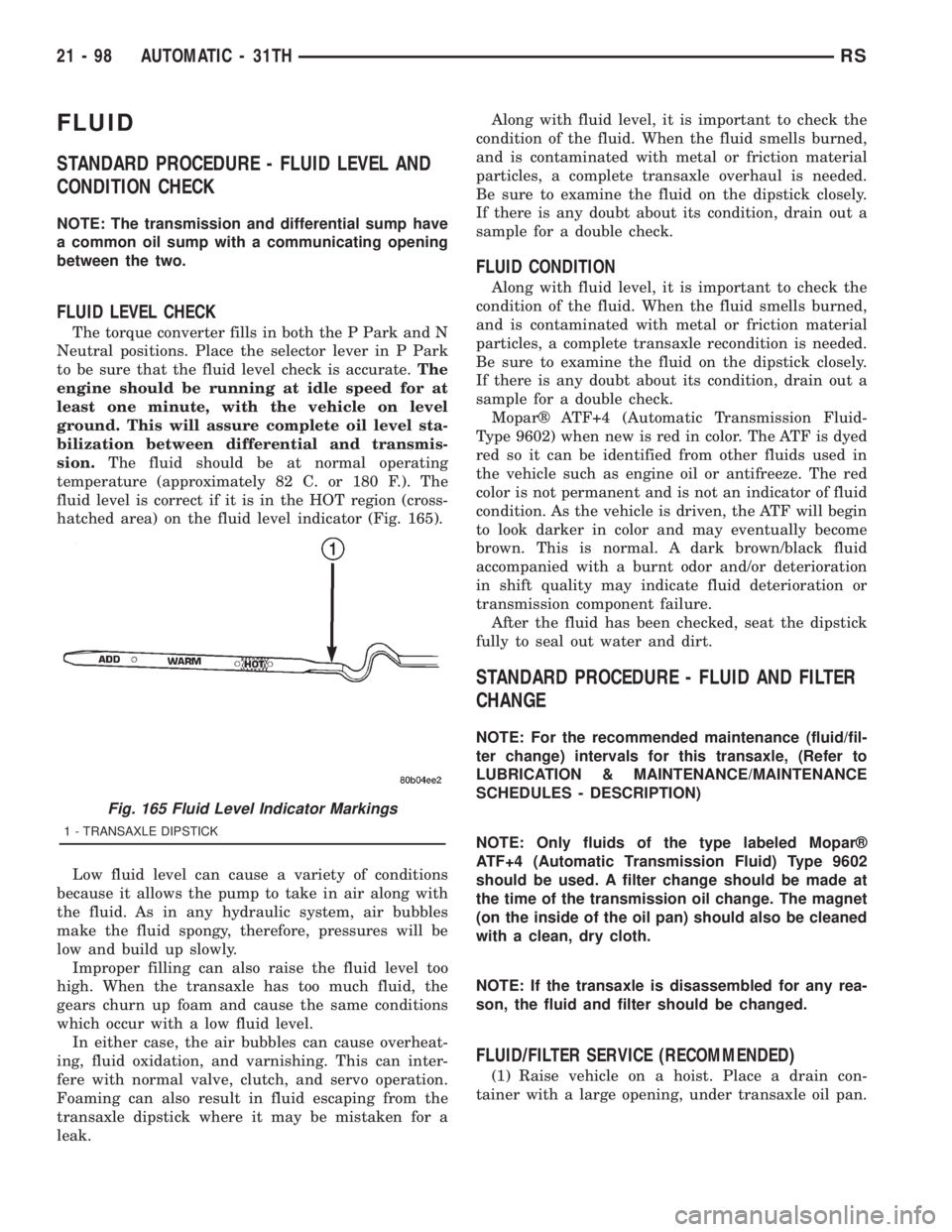
hatched area) on the fluid level indicator (Fig. 165).
Low fluid level can cause a variety of conditions
because it allows the pump to take in air along with
the fluid. As in any hydraulic system, air bubbles
make the fluid spongy, therefore, pressures will be
low and build up slowly.
Improper filling can also raise the fluid level too
high. When the transaxle has too much fluid, the
gears churn up foam and cause the same conditions
which occur with a low fluid level.
In either case, the air bubbles can cause overheat-
ing, fluid oxidation, and varnishing. This can inter-
fere with normal valve, clutch, and servo operation.
Foaming can also result in fluid escaping from the
transaxle dipstick where it may be mistaken for a
leak.Along with fluid level, it is important to check the
condition of the fluid. When the fluid smells burned,
and is contaminated with metal or friction material
particles, a complete transaxle overhaul is needed.
Be sure to examine the fluid on the dipstick closely.
If there is any doubt about its condition, drain out a
sample for a double check.
FLUID CONDITION
Along with fluid level, it is important to check the
condition of the fluid. When the fluid smells burned,
and is contaminated with metal or friction material
particles, a complete transaxle recondition is needed.
Be sure to examine the fluid on the dipstick closely.
If there is any doubt about its condition, drain out a
sample for a double check.
Moparž ATF+4 (Automatic Transmission Fluid-
Type 9602) when new is red in color. The ATF is dyed
red so it can be identified from other fluids used in
the vehicle such as engine oil or antifreeze. The red
color is not permanent and is not an indicator of fluid
condition. As the vehicle is driven, the ATF will begin
to look darker in color and may eventually become
brown. This is normal. A dark brown/black fluid
accompanied with a burnt odor and/or deterioration
in shift quality may indicate fluid deterioration or
transmission component failure.
After the fluid has been checked, seat the dipstick
fully to seal out water and dirt.
STANDARD PROCEDURE - FLUID AND FILTER
CHANGE
NOTE: For the recommended maintenance (fluid/fil-
ter change) intervals for this transaxle, (Refer to
LUBRICATION & MAINTENANCE/MAINTENANCE
SCHEDULES - DESCRIPTION)
NOTE: Only fluids of the type labeled Moparž
ATF+4 (Automatic Transmission Fluid) Type 9602
should be used. A filter change should be made at
the time of the transmission oil change. The magnet
(on the inside of the oil pan) should also be cleaned
with a clean, dry cloth.
NOTE: If the transaxle is disassembled for any rea-
son, the fluid and filter should be changed.
FLUID/FILTER SERVICE (RECOMMENDED)
(1) Raise vehicle on a hoist. Place a drain con-
tainer with a large opening, under transaxle oil pan.
Fig. 165 Fluid Level Indicator Markings
1 - TRANSAXLE DIPSTICK
21 - 98 AUTOMATIC - 31THRS
Page 3210 of 4284
FLUID
STANDARD PROCEDURE - FLUID LEVEL AND
CONDITION CHECK
NOTE: Only transmission fluid of the type labeled
Mopar ATF+4 (Automatic Transmission Fluid±Type
9602) should be used in this transaxle.
FLUID LEVEL CHECK
The transmission sump has a fluid level indicator
(dipstick) to check oil similar to most automatic
transmissions. It is located on the left side of the
engine. Be sure to wipe all dirt from dipstick handle
before removing.
The torque converter fills in both the P Park and N
Neutral positions. Place the selector lever in P Park
to be sure that the fluid level check is accurate.The
engine should be running at idle speed for at
least one minute, with the vehicle on level
ground.At normal operating temperature (approxi-
mately 82 C. or 180 F.), the fluid level is correct if it
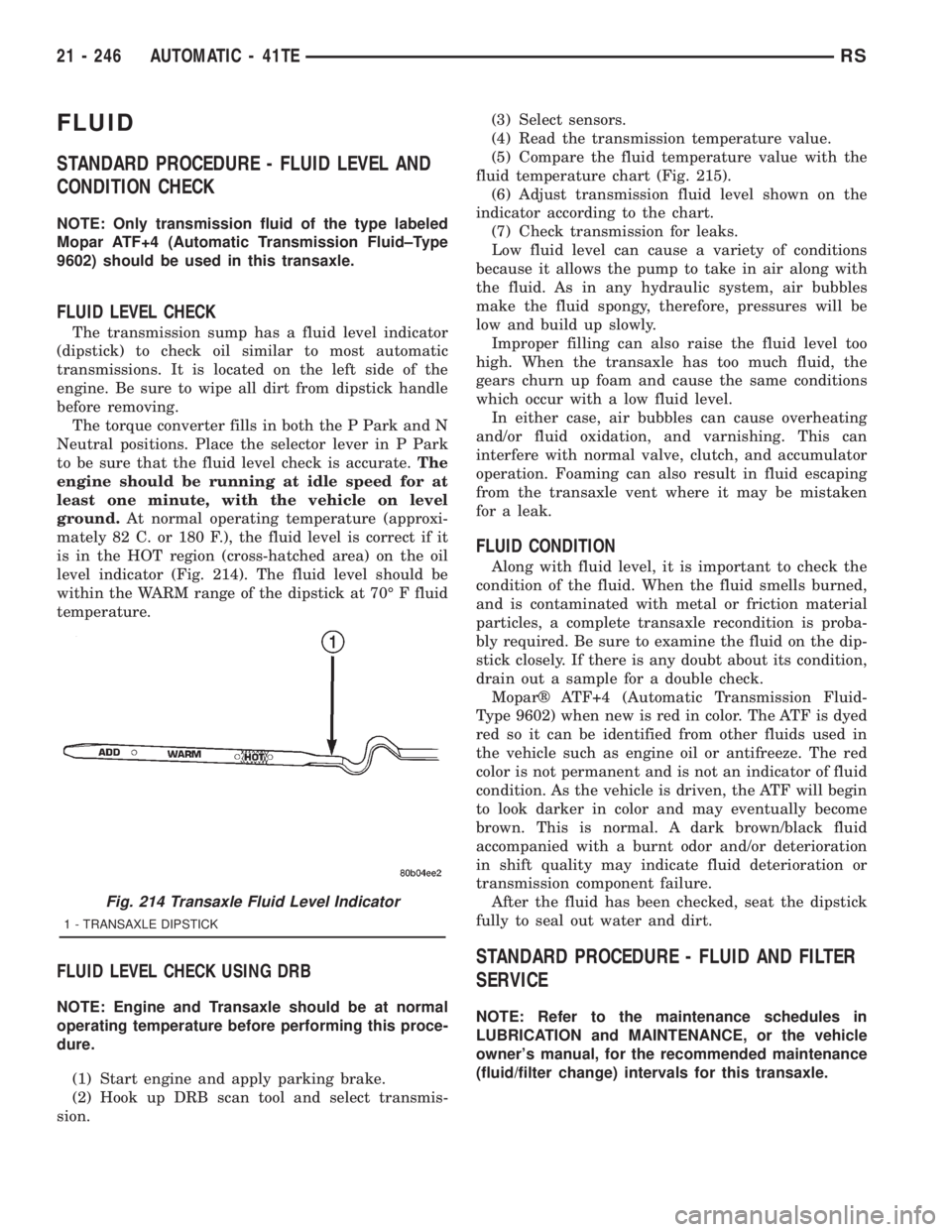
is in the HOT region (cross-hatched area) on the oil
level indicator (Fig. 214). The fluid level should be
within the WARM range of the dipstick at 70É F fluid
temperature.
FLUID LEVEL CHECK USING DRB
NOTE: Engine and Transaxle should be at normal
operating temperature before performing this proce-
dure.
(1) Start engine and apply parking brake.
(2) Hook up DRB scan tool and select transmis-
sion.(3) Select sensors.
(4) Read the transmission temperature value.
(5) Compare the fluid temperature value with the
fluid temperature chart (Fig. 215).
(6) Adjust transmission fluid level shown on the
indicator according to the chart.
(7) Check transmission for leaks.
Low fluid level can cause a variety of conditions
because it allows the pump to take in air along with
the fluid. As in any hydraulic system, air bubbles
make the fluid spongy, therefore, pressures will be
low and build up slowly.
Improper filling can also raise the fluid level too
high. When the transaxle has too much fluid, the
gears churn up foam and cause the same conditions
which occur with a low fluid level.
In either case, air bubbles can cause overheating
and/or fluid oxidation, and varnishing. This can
interfere with normal valve, clutch, and accumulator
operation. Foaming can also result in fluid escaping
from the transaxle vent where it may be mistaken
for a leak.
FLUID CONDITION
Along with fluid level, it is important to check the
condition of the fluid. When the fluid smells burned,
and is contaminated with metal or friction material
particles, a complete transaxle recondition is proba-
bly required. Be sure to examine the fluid on the dip-
stick closely. If there is any doubt about its condition,
drain out a sample for a double check.
Moparž ATF+4 (Automatic Transmission Fluid-
Type 9602) when new is red in color. The ATF is dyed
red so it can be identified from other fluids used in
the vehicle such as engine oil or antifreeze. The red
color is not permanent and is not an indicator of fluid
condition. As the vehicle is driven, the ATF will begin
to look darker in color and may eventually become
brown. This is normal. A dark brown/black fluid
accompanied with a burnt odor and/or deterioration
in shift quality may indicate fluid deterioration or
transmission component failure.
After the fluid has been checked, seat the dipstick
fully to seal out water and dirt.
STANDARD PROCEDURE - FLUID AND FILTER
SERVICE
NOTE: Refer to the maintenance schedules in
LUBRICATION and MAINTENANCE, or the vehicle
owner's manual, for the recommended maintenance
(fluid/filter change) intervals for this transaxle.
Fig. 214 Transaxle Fluid Level Indicator
1 - TRANSAXLE DIPSTICK
21 - 246 AUTOMATIC - 41TERS
Page 3251 of 4284

TRANSMISSION CONTROL
RELAY
DESCRIPTION
The transmission control relay (Fig. 340) is located
in the Intelligent Power Module (IPM), which is
located on the left side of the engine compartment
between the battery and left fender.
OPERATION
The relay is supplied fused B+ voltage, energized
by the TCM, and is used to supply power to the sole-
noid pack when the transmission is in normal oper-
ating mode. When the relay is ªoffº, no power is
supplied to the solenoid pack and the transmission is
in ªlimp-inº mode. After a controller reset (ignition
key turned to the ªrunº position or after cranking
engine), the TCM energizes the relay. Prior to this,
the TCM verifies that the contacts are open by check-
ing for no voltage at the switched battery terminals.
After this is verified, the voltage at the solenoid pack
pressure switches is checked. After the relay is ener-
gized, the TCM monitors the terminals to verify that
the voltage is greater than 3 volts.
TRANSMISSION RANGE
SENSOR
DESCRIPTION
The Transmission Range Sensor (TRS) is mounted
to the top of the valve body inside the transaxle and
can only be serviced by removing the valve body. The
electrical connector extends through the transaxle
case (Fig. 341) .
The Transmission Range Sensor (TRS) has four
switch contacts that monitor shift lever position and
send the information to the TCM.
The TRS also has an integrated temperature sen-
sor (thermistor) that communicates transaxle tem-
perature to the TCM and PCM (Fig. 342) .
OPERATION
The Transmission Range Sensor (TRS) (Fig. 341)
communicates shift lever position (SLP) to the TCM
as a combination of open and closed switches. Each
shift lever position has an assigned combination of
switch states (open/closed) that the TCM receives
from four sense circuits. The TCM interprets this
information and determines the appropriate trans-
axle gear position and shift schedule.
Fig. 340 Transmission Control Relay Location
1 - TRANSMISSION CONTROL RELAY
2 - LEFT FENDER
3 - INTELLIGENT POWER MODULE (IPM)
4 - BATTERYFig. 341 Transmission Range Sensor (TRS)
Location
1 - TRANSMISSION RANGE SENSOR
RSAUTOMATIC - 41TE21 - 287
Page 4118 of 4284

± Solenoid pack (UD pressure in 4th gear)
Code P0734(54) - Excludes geartrain failures which
should be obvious upon disassembly
> If code P1791(35) is also set, follow diagnostic
procedure for code P1791(35) first
> Failed or slipping OD clutch - may also set code
P0733(53)
± OD and Reverse inner and outer lip seal leak-
age (usually hard code)
± Sticky OD accumulator seals (intermittent)
± Worn reaction shaft support seal rings (hard
code at heavy throttle)
± Broken OD/UD tapered snap ring - (hard code
at heavy throttle)
> Failed or slipping 2-4 clutch - may also set code
P0732(52)
± 2-4 seal leakage (intermittent)
± Sticky accumulator seals (intermittent)
Codes P0715(56) and P0720(57)
> Failed input or output speed sensor (intermittent
or hard code)
> Shorted or open wiring between TCM and speed
sensor(s) (intermittent)
> Connector problems at 60 TCM connector and/or
speed sensor connector
Code P1794(58)
> Open or shorted speed sensor ground (speed
sensor ground is different from chassis ground)
> Open or shorted Temperature Sensor wiring to
TRS
> TRS - Will also set code P1799(74)
> TCM
Name of code:P1796(70) - Autostick Sensor Cir-
cuit (If equipped)
Note: RS is a MUXED Autostick system
When monitored:Whenever the engine is run-
ning.
Set condition:
1) The transmission shift lever is not in AutoStick
and either the upshift or downshift switch is closed.
2) Upshift and downshift switches closed at the
same time.
Theory of operation:In the AutoStick Mode
(manual shift mode), upshifts and downshifts are
actuated manually. Shift requests are detected by
monitoring the MUXED upshift and downshift
switches. The Transmission Control Module (TCM)
monitors the above set conditions. A set condition
will be tolerated for up to 15 seconds before setting
a code.Transmission Effects:The OD position shift
schedule is substituted while operating in the au-
tostick gear selector position. No limp-in mode
occurs.
Possible causes:
> Wiring or connector problems
> AutoStick switch failure
> TCM
Name of code:P1797(71)- Manual Shift Overheat
When monitored:Whenever the engine is run-
ning.
Set condition:1) If the engine temperature ex-
ceeds 124C (255 ÉF) while operating in AutoStick
mode.
2) If the transmission temperature exceeds 135C
(275 ÉF) while in AutoStick mode
Theory of operation:Transmission and engine
temperatures are monitored during vehicle opera-
tion. If conditions occur causing the engine or
transmission to overheat, the AutoStick mode will
be canceled, and a code will be set.
Transmission Effects:The 3 position shift sched-
ule that is used in non-AutoStick applications is
substituted while operating in the AutoStick gear
selector position. No limp-in mode occurs.
Possible causes:
> Engine overheat - refer to service manual for
diagnosis and repair
> Transmission Overheat
± Restricted transmission cooling system
± Transmission fluid overfilled
± Radiator fan not functioning properly
± Extended driving in low gear
Note:Strenuous driving conditions may cause the
vehicle to overheat. If the driver operates in or
initiates AutoStick with an overheated vehicle, the
code will be set.
Name of code:P1798 (73) - Deteriorated Transaxle
Fluid
When monitored:At every Fully Electronically
Modulated Converter Clutch (FEMCC) to Partial
Electronically Modulated Converter Clutch (PEM-
CC) transition miles when A/C compressor clutch is
being cycled.
Set condition:The code will be set if vehicle
shudder is detected 20 times when the A/C clutch is
cycled.
Theory of operation:While in 3rd or 4th gear
FEMCC and just before the A/C clutch engages, the
Powertrain Control Module (PCM) requests the
Transmission Control Module (TCM) to momen-
tarily establish PEMCC operation. If vehicle shud-
der is detected during the FEMCC to PEMCC
transition, a counter is incremented. If the count
reaches 20, the trouble code is set. The driver may
14
GENERAL INFORMATION
Page 4187 of 4284

Symptom:
P1738-HIGH TEMPERATURE OPERATION ACTIVATED
When Monitored and Set Condition:
P1738-HIGH TEMPERATURE OPERATION ACTIVATED
When Monitored: Whenever the engine is running.
Set Condition: Immediately when the Overheat shift schedule is activated (240 degrees
Trans oil temp).
POSSIBLE CAUSES
ENGINE COOLING SYSTEM MALFUNCTION
INCORRECT FLUID LEVEL
TRANSMISSION OIL COOLER PLUGGED
HIGH TEMPERATURE OPERATIONS ACTIVATED
TEST ACTION APPLICABILITY
1 Perform Engine Cooling System diagnostics per Service Information
Is the engine cooling system functioning properly?All
Ye s®Go To 2
No®Repair cause of engine overheating. Refer to Service Information
for additional repair information.
Perform 41TE TRANSMISSION VERIFICATION TEST - VER 1.
2 Check the Transmission Fluid level per the Service Information.
Is the Transmission Fluid Level at the proper level?All
Ye s®Go To 3
No®Repair any Transmission Fluid leak as necessary and adjust the
Transmission Fluid Level in accordance with the Service Infor-
mation.
Perform 41TE TRANSMISSION VERIFICATION TEST - VER 1.
3 Perform Cooler Flow Check per Service Information.
Did the cooler flow test pass?All
Ye s®Go To 4
No®Repair cause of plugged Transmission Oil Cooler. Flush or replace
Transmission Oil Cooler(s) as necessary per Service Information.
Perform 41TE TRANSMISSION VERIFICATION TEST - VER 1.
83
TRANSMISSION