ignition CHRYSLER VOYAGER 2001 Service Manual
[x] Cancel search | Manufacturer: CHRYSLER, Model Year: 2001, Model line: VOYAGER, Model: CHRYSLER VOYAGER 2001Pages: 4284, PDF Size: 83.53 MB
Page 451 of 4284
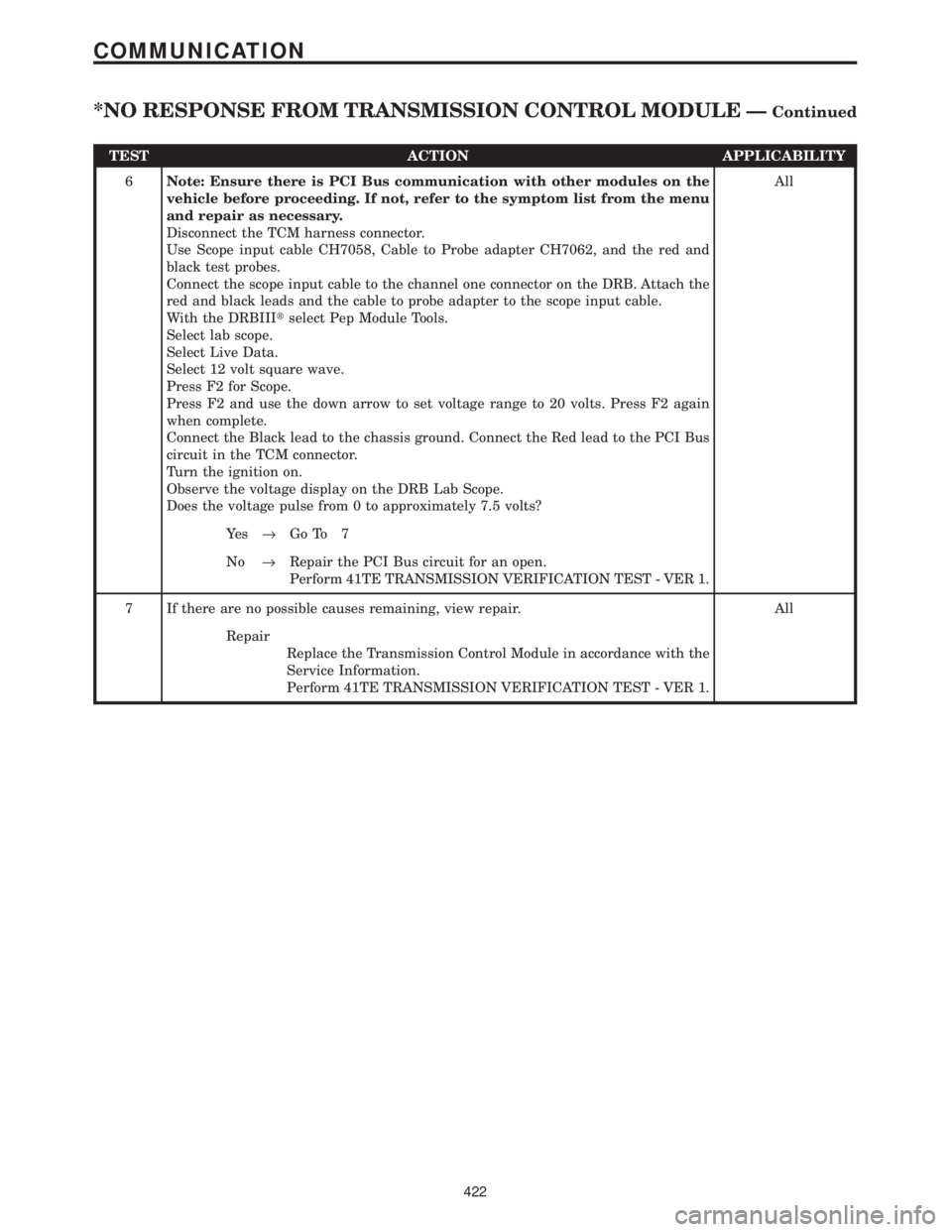
TEST ACTION APPLICABILITY
6Note: Ensure there is PCI Bus communication with other modules on the
vehicle before proceeding. If not, refer to the symptom list from the menu
and repair as necessary.
Disconnect the TCM harness connector.
Use Scope input cable CH7058, Cable to Probe adapter CH7062, and the red and
black test probes.
Connect the scope input cable to the channel one connector on the DRB. Attach the
red and black leads and the cable to probe adapter to the scope input cable.
With the DRBIIItselect Pep Module Tools.
Select lab scope.
Select Live Data.
Select 12 volt square wave.
Press F2 for Scope.
Press F2 and use the down arrow to set voltage range to 20 volts. Press F2 again
when complete.
Connect the Black lead to the chassis ground. Connect the Red lead to the PCI Bus
circuit in the TCM connector.
Turn the ignition on.
Observe the voltage display on the DRB Lab Scope.
Does the voltage pulse from 0 to approximately 7.5 volts?All
Ye s®Go To 7
No®Repair the PCI Bus circuit for an open.
Perform 41TE TRANSMISSION VERIFICATION TEST - VER 1.
7 If there are no possible causes remaining, view repair. All
Repair
Replace the Transmission Control Module in accordance with the
Service Information.
Perform 41TE TRANSMISSION VERIFICATION TEST - VER 1.
422
COMMUNICATION
*NO RESPONSE FROM TRANSMISSION CONTROL MODULE ÐContinued
Page 452 of 4284
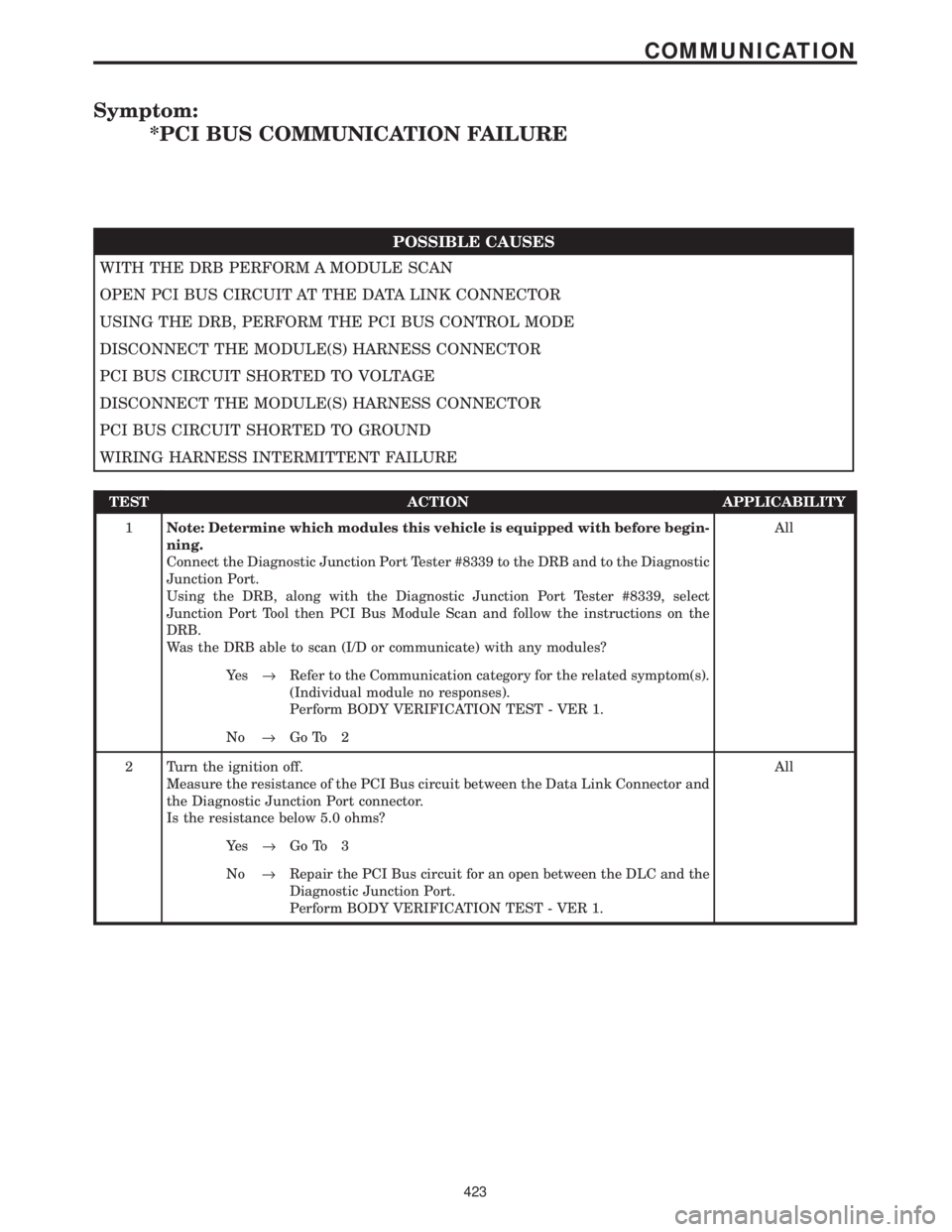
Symptom:
*PCI BUS COMMUNICATION FAILURE
POSSIBLE CAUSES
WITH THE DRB PERFORM A MODULE SCAN
OPEN PCI BUS CIRCUIT AT THE DATA LINK CONNECTOR
USING THE DRB, PERFORM THE PCI BUS CONTROL MODE
DISCONNECT THE MODULE(S) HARNESS CONNECTOR
PCI BUS CIRCUIT SHORTED TO VOLTAGE
DISCONNECT THE MODULE(S) HARNESS CONNECTOR
PCI BUS CIRCUIT SHORTED TO GROUND
WIRING HARNESS INTERMITTENT FAILURE
TEST ACTION APPLICABILITY
1Note: Determine which modules this vehicle is equipped with before begin-
ning.
Connect the Diagnostic Junction Port Tester #8339 to the DRB and to the Diagnostic
Junction Port.
Using the DRB, along with the Diagnostic Junction Port Tester #8339, select
Junction Port Tool then PCI Bus Module Scan and follow the instructions on the
DRB.
Was the DRB able to scan (I/D or communicate) with any modules?All
Ye s®Refer to the Communication category for the related symptom(s).
(Individual module no responses).
Perform BODY VERIFICATION TEST - VER 1.
No®Go To 2
2 Turn the ignition off.
Measure the resistance of the PCI Bus circuit between the Data Link Connector and
the Diagnostic Junction Port connector.
Is the resistance below 5.0 ohms?All
Ye s®Go To 3
No®Repair the PCI Bus circuit for an open between the DLC and the
Diagnostic Junction Port.
Perform BODY VERIFICATION TEST - VER 1.
423
COMMUNICATION
Page 453 of 4284
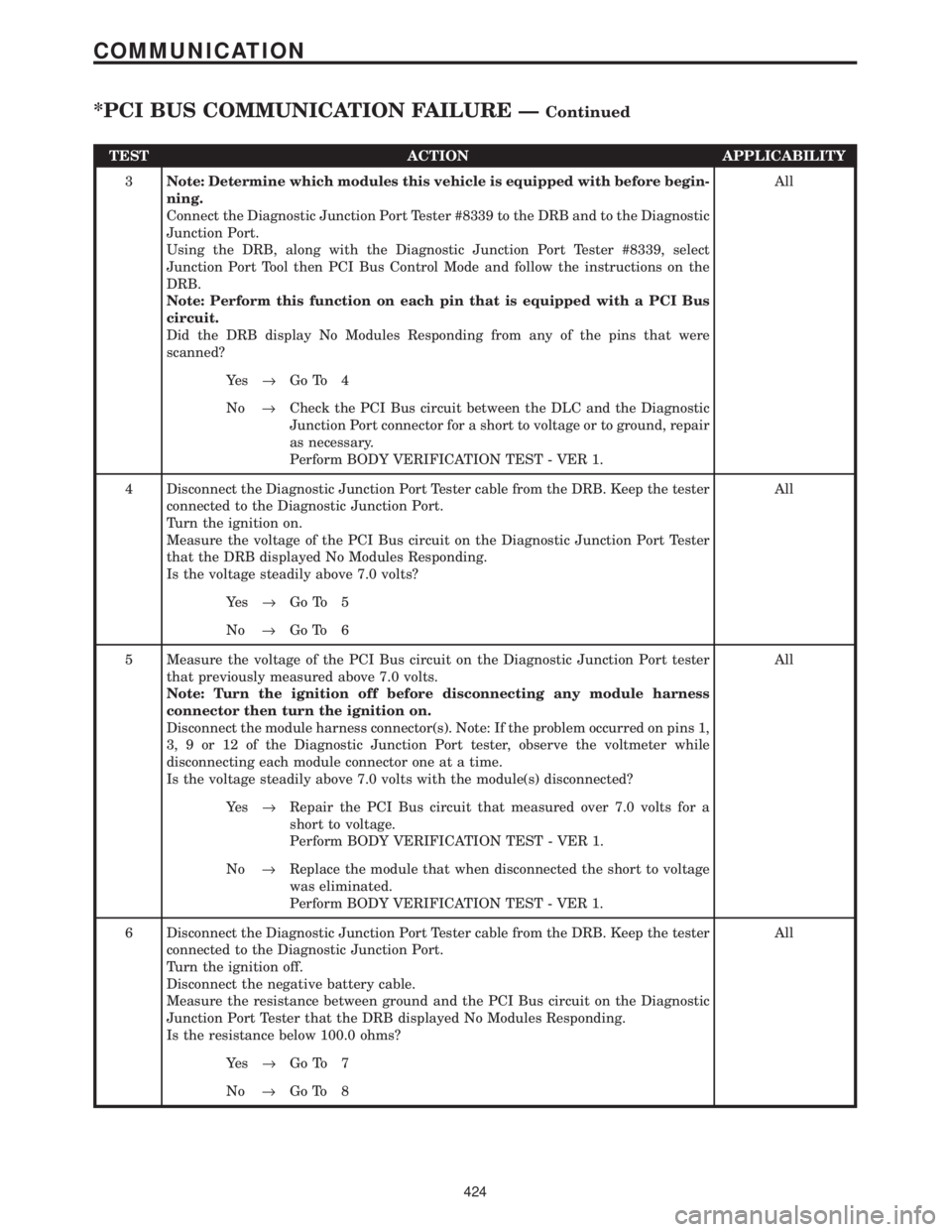
TEST ACTION APPLICABILITY
3Note: Determine which modules this vehicle is equipped with before begin-
ning.
Connect the Diagnostic Junction Port Tester #8339 to the DRB and to the Diagnostic
Junction Port.
Using the DRB, along with the Diagnostic Junction Port Tester #8339, select
Junction Port Tool then PCI Bus Control Mode and follow the instructions on the
DRB.
Note: Perform this function on each pin that is equipped with a PCI Bus
circuit.
Did the DRB display No Modules Responding from any of the pins that were
scanned?All
Ye s®Go To 4
No®Check the PCI Bus circuit between the DLC and the Diagnostic
Junction Port connector for a short to voltage or to ground, repair
as necessary.
Perform BODY VERIFICATION TEST - VER 1.
4 Disconnect the Diagnostic Junction Port Tester cable from the DRB. Keep the tester
connected to the Diagnostic Junction Port.
Turn the ignition on.
Measure the voltage of the PCI Bus circuit on the Diagnostic Junction Port Tester
that the DRB displayed No Modules Responding.
Is the voltage steadily above 7.0 volts?All
Ye s®Go To 5
No®Go To 6
5 Measure the voltage of the PCI Bus circuit on the Diagnostic Junction Port tester
that previously measured above 7.0 volts.
Note: Turn the ignition off before disconnecting any module harness
connector then turn the ignition on.
Disconnect the module harness connector(s). Note: If the problem occurred on pins 1,
3, 9 or 12 of the Diagnostic Junction Port tester, observe the voltmeter while
disconnecting each module connector one at a time.
Is the voltage steadily above 7.0 volts with the module(s) disconnected?All
Ye s®Repair the PCI Bus circuit that measured over 7.0 volts for a
short to voltage.
Perform BODY VERIFICATION TEST - VER 1.
No®Replace the module that when disconnected the short to voltage
was eliminated.
Perform BODY VERIFICATION TEST - VER 1.
6 Disconnect the Diagnostic Junction Port Tester cable from the DRB. Keep the tester
connected to the Diagnostic Junction Port.
Turn the ignition off.
Disconnect the negative battery cable.
Measure the resistance between ground and the PCI Bus circuit on the Diagnostic
Junction Port Tester that the DRB displayed No Modules Responding.
Is the resistance below 100.0 ohms?All
Ye s®Go To 7
No®Go To 8
424
COMMUNICATION
*PCI BUS COMMUNICATION FAILURE ÐContinued
Page 454 of 4284
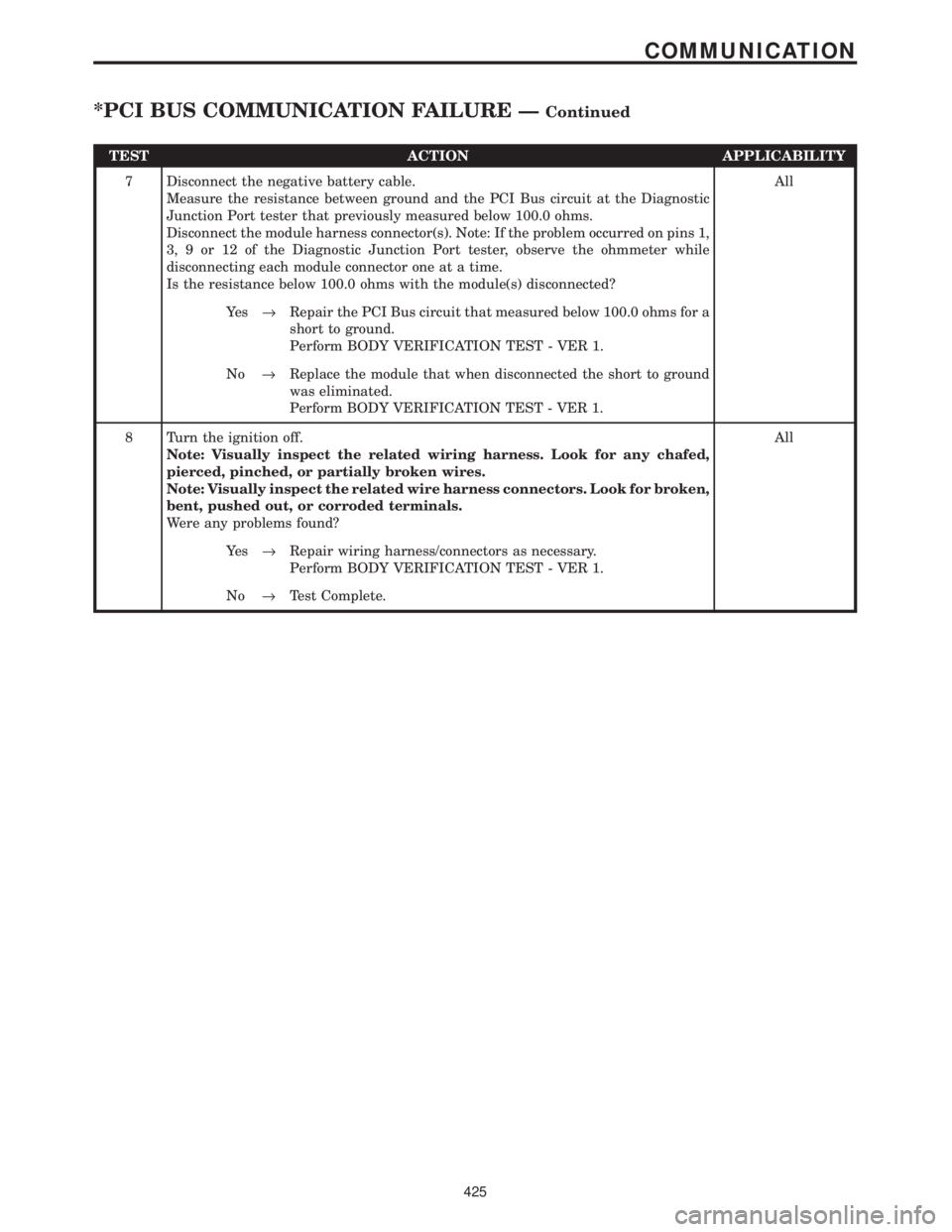
TEST ACTION APPLICABILITY
7 Disconnect the negative battery cable.
Measure the resistance between ground and the PCI Bus circuit at the Diagnostic
Junction Port tester that previously measured below 100.0 ohms.
Disconnect the module harness connector(s). Note: If the problem occurred on pins 1,
3, 9 or 12 of the Diagnostic Junction Port tester, observe the ohmmeter while
disconnecting each module connector one at a time.
Is the resistance below 100.0 ohms with the module(s) disconnected?All
Ye s®Repair the PCI Bus circuit that measured below 100.0 ohms for a
short to ground.
Perform BODY VERIFICATION TEST - VER 1.
No®Replace the module that when disconnected the short to ground
was eliminated.
Perform BODY VERIFICATION TEST - VER 1.
8 Turn the ignition off.
Note: Visually inspect the related wiring harness. Look for any chafed,
pierced, pinched, or partially broken wires.
Note: Visually inspect the related wire harness connectors. Look for broken,
bent, pushed out, or corroded terminals.
Were any problems found?All
Ye s®Repair wiring harness/connectors as necessary.
Perform BODY VERIFICATION TEST - VER 1.
No®Test Complete.
425
COMMUNICATION
*PCI BUS COMMUNICATION FAILURE ÐContinued
Page 469 of 4284
Symptom:
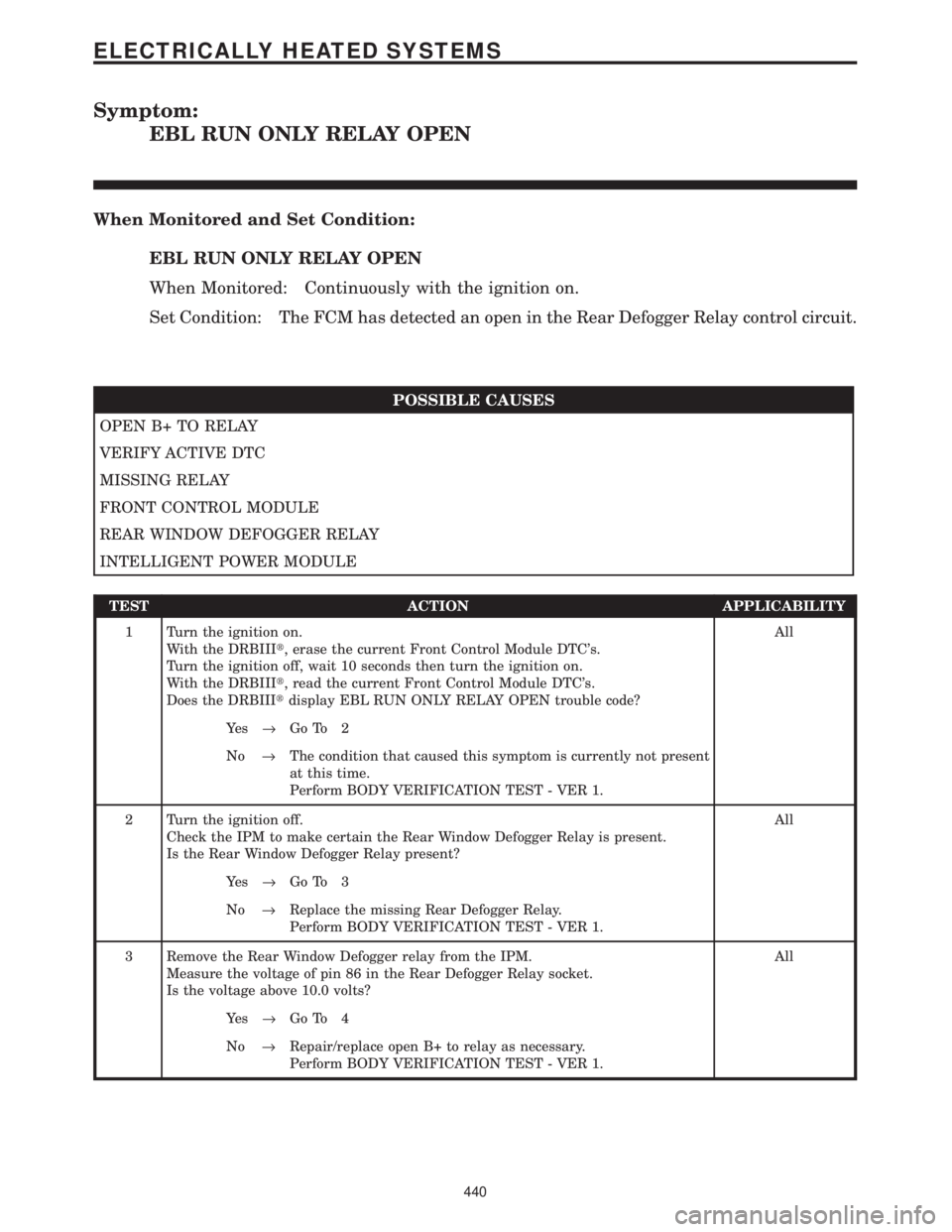
EBL RUN ONLY RELAY OPEN
When Monitored and Set Condition:
EBL RUN ONLY RELAY OPEN
When Monitored: Continuously with the ignition on.
Set Condition: The FCM has detected an open in the Rear Defogger Relay control circuit.
POSSIBLE CAUSES
OPEN B+ TO RELAY
VERIFY ACTIVE DTC
MISSING RELAY
FRONT CONTROL MODULE
REAR WINDOW DEFOGGER RELAY
INTELLIGENT POWER MODULE
TEST ACTION APPLICABILITY
1 Turn the ignition on.
With the DRBIIIt, erase the current Front Control Module DTC's.
Turn the ignition off, wait 10 seconds then turn the ignition on.
With the DRBIIIt, read the current Front Control Module DTC's.
Does the DRBIIItdisplay EBL RUN ONLY RELAY OPEN trouble code?All
Ye s®Go To 2
No®The condition that caused this symptom is currently not present
at this time.
Perform BODY VERIFICATION TEST - VER 1.
2 Turn the ignition off.
Check the IPM to make certain the Rear Window Defogger Relay is present.
Is the Rear Window Defogger Relay present?All
Ye s®Go To 3
No®Replace the missing Rear Defogger Relay.
Perform BODY VERIFICATION TEST - VER 1.
3 Remove the Rear Window Defogger relay from the IPM.
Measure the voltage of pin 86 in the Rear Defogger Relay socket.
Is the voltage above 10.0 volts?All
Ye s®Go To 4
No®Repair/replace open B+ to relay as necessary.
Perform BODY VERIFICATION TEST - VER 1.
440
ELECTRICALLY HEATED SYSTEMS
Page 470 of 4284
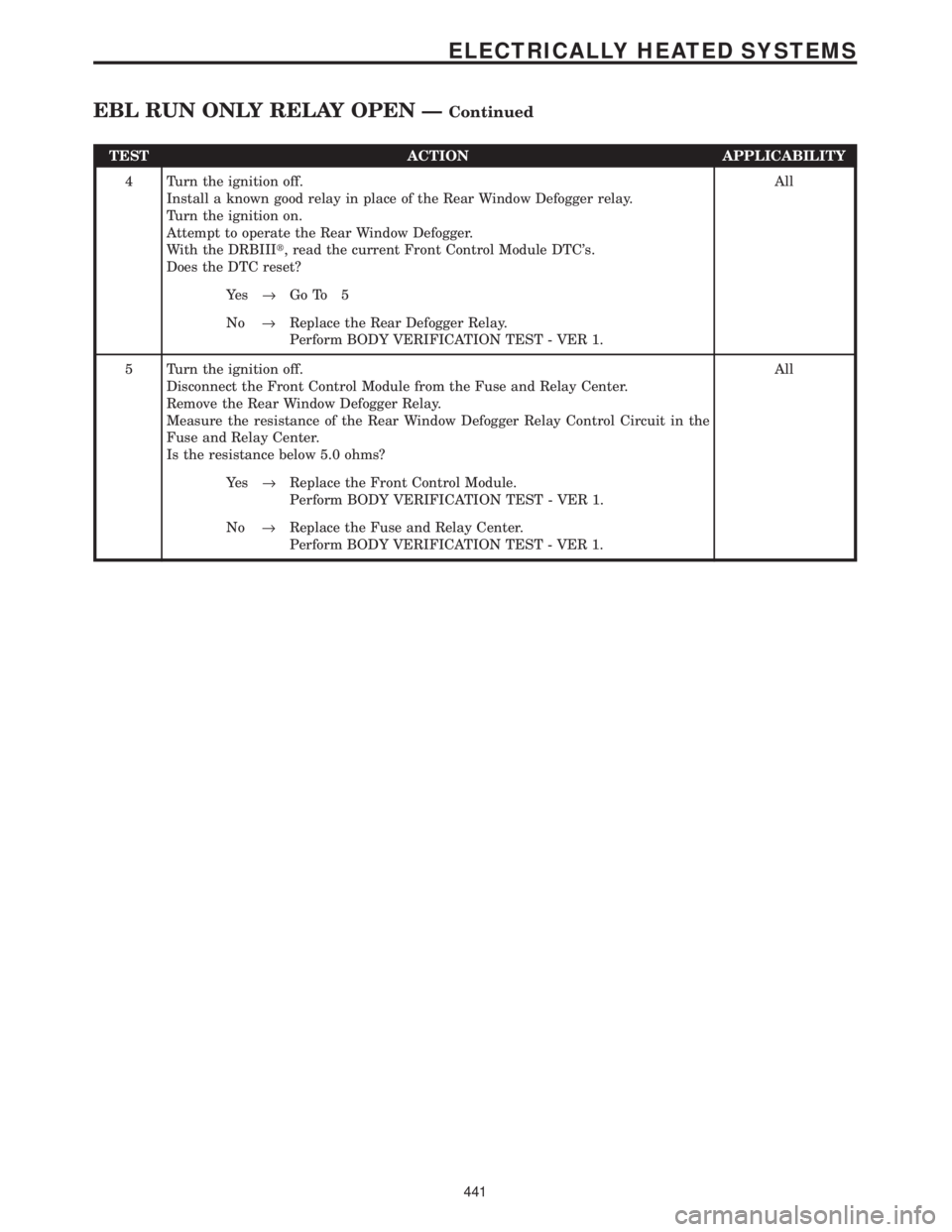
TEST ACTION APPLICABILITY
4 Turn the ignition off.
Install a known good relay in place of the Rear Window Defogger relay.
Turn the ignition on.
Attempt to operate the Rear Window Defogger.
With the DRBIIIt, read the current Front Control Module DTC's.
Does the DTC reset?All
Ye s®Go To 5
No®Replace the Rear Defogger Relay.
Perform BODY VERIFICATION TEST - VER 1.
5 Turn the ignition off.
Disconnect the Front Control Module from the Fuse and Relay Center.
Remove the Rear Window Defogger Relay.
Measure the resistance of the Rear Window Defogger Relay Control Circuit in the
Fuse and Relay Center.
Is the resistance below 5.0 ohms?All
Ye s®Replace the Front Control Module.
Perform BODY VERIFICATION TEST - VER 1.
No®Replace the Fuse and Relay Center.
Perform BODY VERIFICATION TEST - VER 1.
441
ELECTRICALLY HEATED SYSTEMS
EBL RUN ONLY RELAY OPEN ÐContinued
Page 471 of 4284
Symptom:
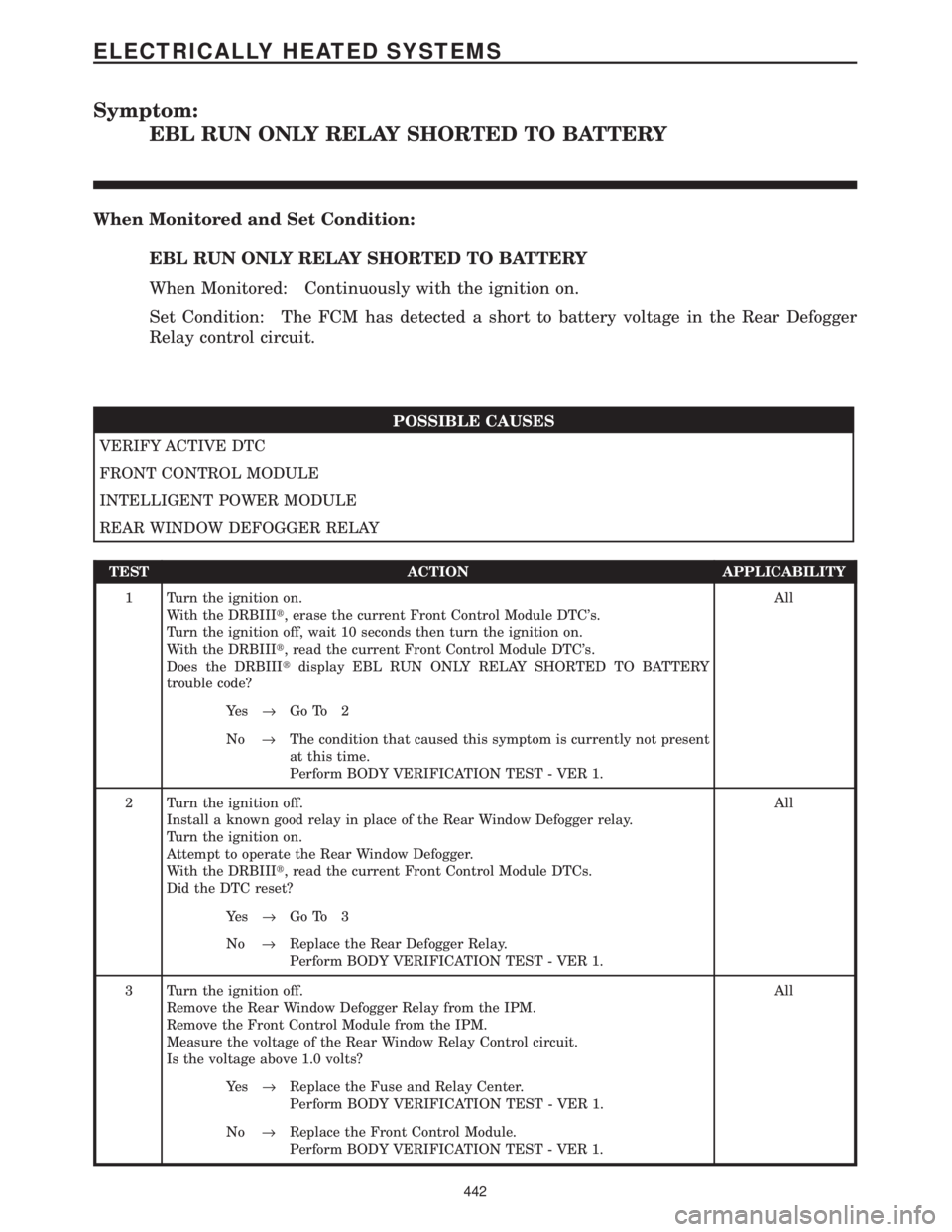
EBL RUN ONLY RELAY SHORTED TO BATTERY
When Monitored and Set Condition:
EBL RUN ONLY RELAY SHORTED TO BATTERY
When Monitored: Continuously with the ignition on.
Set Condition: The FCM has detected a short to battery voltage in the Rear Defogger
Relay control circuit.
POSSIBLE CAUSES
VERIFY ACTIVE DTC
FRONT CONTROL MODULE
INTELLIGENT POWER MODULE
REAR WINDOW DEFOGGER RELAY
TEST ACTION APPLICABILITY
1 Turn the ignition on.
With the DRBIIIt, erase the current Front Control Module DTC's.
Turn the ignition off, wait 10 seconds then turn the ignition on.
With the DRBIIIt, read the current Front Control Module DTC's.
Does the DRBIIItdisplay EBL RUN ONLY RELAY SHORTED TO BATTERY
trouble code?All
Ye s®Go To 2
No®The condition that caused this symptom is currently not present
at this time.
Perform BODY VERIFICATION TEST - VER 1.
2 Turn the ignition off.
Install a known good relay in place of the Rear Window Defogger relay.
Turn the ignition on.
Attempt to operate the Rear Window Defogger.
With the DRBIIIt, read the current Front Control Module DTCs.
Did the DTC reset?All
Ye s®Go To 3
No®Replace the Rear Defogger Relay.
Perform BODY VERIFICATION TEST - VER 1.
3 Turn the ignition off.
Remove the Rear Window Defogger Relay from the IPM.
Remove the Front Control Module from the IPM.
Measure the voltage of the Rear Window Relay Control circuit.
Is the voltage above 1.0 volts?All
Ye s®Replace the Fuse and Relay Center.
Perform BODY VERIFICATION TEST - VER 1.
No®Replace the Front Control Module.
Perform BODY VERIFICATION TEST - VER 1.
442
ELECTRICALLY HEATED SYSTEMS
Page 472 of 4284
Symptom:
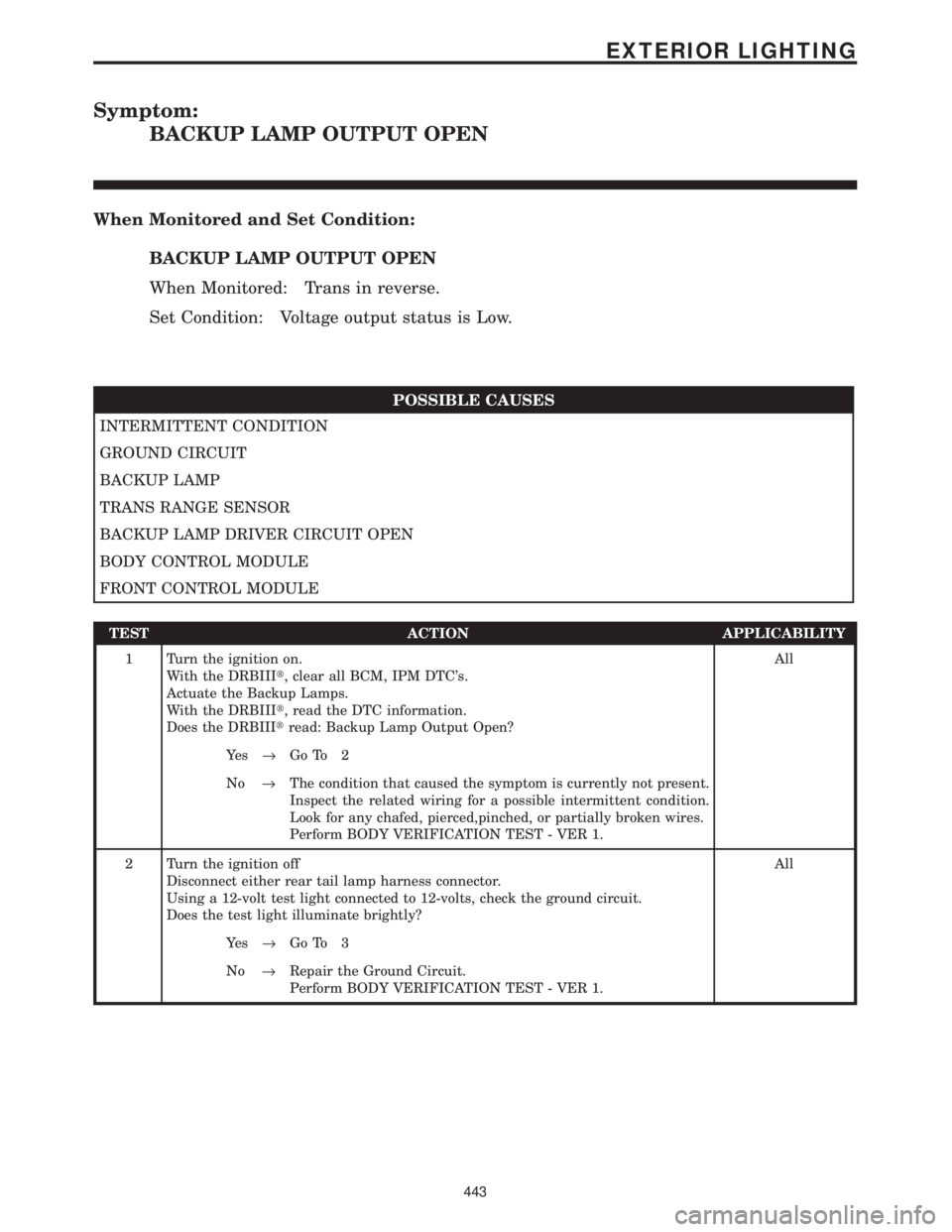
BACKUP LAMP OUTPUT OPEN
When Monitored and Set Condition:
BACKUP LAMP OUTPUT OPEN
When Monitored: Trans in reverse.
Set Condition: Voltage output status is Low.
POSSIBLE CAUSES
INTERMITTENT CONDITION
GROUND CIRCUIT
BACKUP LAMP
TRANS RANGE SENSOR
BACKUP LAMP DRIVER CIRCUIT OPEN
BODY CONTROL MODULE
FRONT CONTROL MODULE
TEST ACTION APPLICABILITY
1 Turn the ignition on.
With the DRBIIIt, clear all BCM, IPM DTC's.
Actuate the Backup Lamps.
With the DRBIIIt, read the DTC information.
Does the DRBIIItread: Backup Lamp Output Open?All
Ye s®Go To 2
No®The condition that caused the symptom is currently not present.
Inspect the related wiring for a possible intermittent condition.
Look for any chafed, pierced,pinched, or partially broken wires.
Perform BODY VERIFICATION TEST - VER 1.
2 Turn the ignition off
Disconnect either rear tail lamp harness connector.
Using a 12-volt test light connected to 12-volts, check the ground circuit.
Does the test light illuminate brightly?All
Ye s®Go To 3
No®Repair the Ground Circuit.
Perform BODY VERIFICATION TEST - VER 1.
443
EXTERIOR LIGHTING
Page 473 of 4284
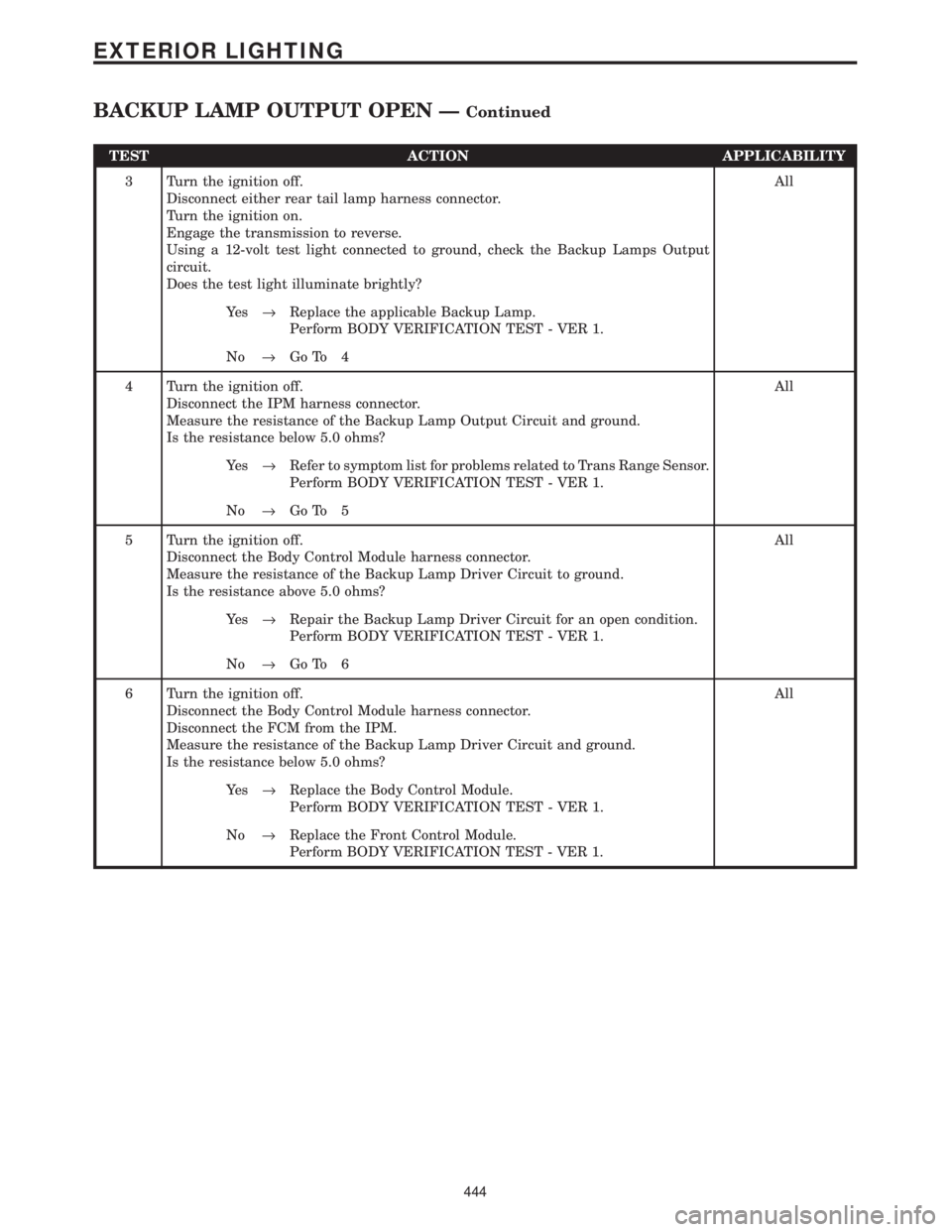
TEST ACTION APPLICABILITY
3 Turn the ignition off.
Disconnect either rear tail lamp harness connector.
Turn the ignition on.
Engage the transmission to reverse.
Using a 12-volt test light connected to ground, check the Backup Lamps Output
circuit.
Does the test light illuminate brightly?All
Ye s®Replace the applicable Backup Lamp.
Perform BODY VERIFICATION TEST - VER 1.
No®Go To 4
4 Turn the ignition off.
Disconnect the IPM harness connector.
Measure the resistance of the Backup Lamp Output Circuit and ground.
Is the resistance below 5.0 ohms?All
Ye s®Refer to symptom list for problems related to Trans Range Sensor.
Perform BODY VERIFICATION TEST - VER 1.
No®Go To 5
5 Turn the ignition off.
Disconnect the Body Control Module harness connector.
Measure the resistance of the Backup Lamp Driver Circuit to ground.
Is the resistance above 5.0 ohms?All
Ye s®Repair the Backup Lamp Driver Circuit for an open condition.
Perform BODY VERIFICATION TEST - VER 1.
No®Go To 6
6 Turn the ignition off.
Disconnect the Body Control Module harness connector.
Disconnect the FCM from the IPM.
Measure the resistance of the Backup Lamp Driver Circuit and ground.
Is the resistance below 5.0 ohms?All
Ye s®Replace the Body Control Module.
Perform BODY VERIFICATION TEST - VER 1.
No®Replace the Front Control Module.
Perform BODY VERIFICATION TEST - VER 1.
444
EXTERIOR LIGHTING
BACKUP LAMP OUTPUT OPEN ÐContinued
Page 474 of 4284
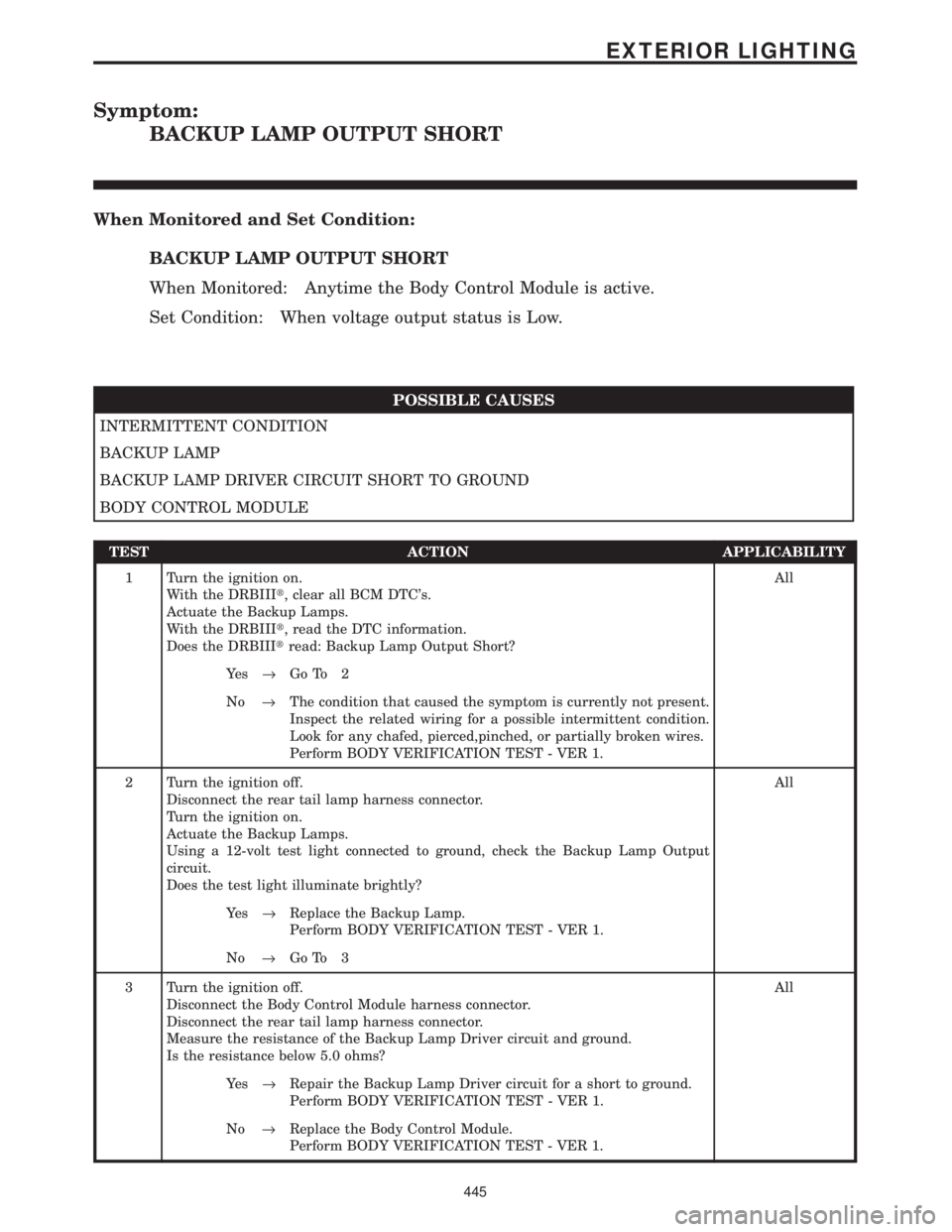
Symptom:
BACKUP LAMP OUTPUT SHORT
When Monitored and Set Condition:
BACKUP LAMP OUTPUT SHORT
When Monitored: Anytime the Body Control Module is active.
Set Condition: When voltage output status is Low.
POSSIBLE CAUSES
INTERMITTENT CONDITION
BACKUP LAMP
BACKUP LAMP DRIVER CIRCUIT SHORT TO GROUND
BODY CONTROL MODULE
TEST ACTION APPLICABILITY
1 Turn the ignition on.
With the DRBIIIt, clear all BCM DTC's.
Actuate the Backup Lamps.
With the DRBIIIt, read the DTC information.
Does the DRBIIItread: Backup Lamp Output Short?All
Ye s®Go To 2
No®The condition that caused the symptom is currently not present.
Inspect the related wiring for a possible intermittent condition.
Look for any chafed, pierced,pinched, or partially broken wires.
Perform BODY VERIFICATION TEST - VER 1.
2 Turn the ignition off.
Disconnect the rear tail lamp harness connector.
Turn the ignition on.
Actuate the Backup Lamps.
Using a 12-volt test light connected to ground, check the Backup Lamp Output
circuit.
Does the test light illuminate brightly?All
Ye s®Replace the Backup Lamp.
Perform BODY VERIFICATION TEST - VER 1.
No®Go To 3
3 Turn the ignition off.
Disconnect the Body Control Module harness connector.
Disconnect the rear tail lamp harness connector.
Measure the resistance of the Backup Lamp Driver circuit and ground.
Is the resistance below 5.0 ohms?All
Ye s®Repair the Backup Lamp Driver circuit for a short to ground.
Perform BODY VERIFICATION TEST - VER 1.
No®Replace the Body Control Module.
Perform BODY VERIFICATION TEST - VER 1.
445
EXTERIOR LIGHTING