engine overheat CHRYSLER VOYAGER 2001 Owner's Guide
[x] Cancel search | Manufacturer: CHRYSLER, Model Year: 2001, Model line: VOYAGER, Model: CHRYSLER VOYAGER 2001Pages: 4284, PDF Size: 83.53 MB
Page 3730 of 4284

(2) Lubricate new rubber O-ring seals with clean
refrigerant oil and install them on the evaporator
tube fittings.
(3) Position the expansion valve onto the evapora-
tor tubes (Fig. 4).
(4) Install and tighten the two screws that secure
the expansion valve to the evaporator tube sealing
plate. Tighten the screws to 11 N´m (97 in. lbs.).
(5) If the vehicle is equipped with the optional
Automatic Temperature Control (ATC) system, recon-
nect the expansion valve solenoid pigtail wire connec-
tor to the rear HVAC wire harness connector for the
solenoid.
(6) Reinstall the rear evaporator line extension
onto the expansion valve. (Refer to 24 - HEATING &
AIR CONDITIONING/PLUMBING - REAR/EVAPO-
RATOR - INSTALLATION - EVAPORATOR LINE
EXTENSION).
(7) Install the foam insulator wrap over the rear
expansion valve.
(8) Reinstall the rear heater-A/C unit housing into
the vehicle. (Refer to 24 - HEATING & AIR CONDI-
TIONING/DISTRIBUTION - REAR/REAR HEATER-
A/C HOUSING - INSTALLATION).
HEATER CORE
DESCRIPTION
The rear heater core is located near the front of
the rear heater-A/C unit housing, behind the right
rear wheel house. It is a heat exchanger made ofrows of tubes and fins. One end of the core is fitted
with a molded plastic tank that includes integral
heater core inlet and outlet nipples. The heater core
can be serviced without removing the rear heater-A/C
unit housing from the vehicle. The heater core cannot
be repaired and, if faulty or damaged, it must be
replaced.
OPERATION
Engine coolant is circulated through heater hoses
to the heater core at all times. As the coolant flows
through the heater core, heat removed from the
engine is transferred to the heater core fins and
tubes. Air directed through the heater core picks up
the heat from the heater core fins. The blend air door
allows control of the heater output air temperature
by controlling how much of the air flowing through
the rear heater-A/C unit housing is directed through
the heater core.
STANDARD PROCEDURE - HEATER CORE
FILLING
In its final installed position, the rear heater core
is positioned higher than the radiator fill cap. There-
fore, when the cooling system is drained and refilled,
gravity will not refill the heater core with coolant to
the proper level. This may result in two problems:1.
Insufficient coolant level in the engine cooling sys-
tem, which may result in engine overheating.2.Air
entrapped within the rear heater core, which may
result in insufficient rear heater performance. There
are two methods that may be employed to prevent
these problems:1.Pre-filling of the rear heater core.
2.Thermal cycling of the engine cooling system. Fol-
lowing are descriptions of both prevention methods,
as well as a method to verify rear heater perfor-
mance.
WARNING: REFER TO THE APPLICABLE WARN-
INGS AND CAUTIONS FOR THIS SYSTEM BEFORE
PERFORMING THE FOLLOWING OPERATION.
(Refer to 24 - HEATING & AIR CONDITIONING/
PLUMBING FRONT - WARNING - HEATER PLUMB-
ING).
PRE-FILLING
If the rear heater core or the rear heater-A/C hous-
ing have been removed from the vehicle for service,
the rear heater core may be pre-filled with the proper
engine coolant mixture prior to reconnecting the
heater hoses to the heater core hose fittings.
(1) The heater core should be installed in the rear
heater-A/C unit housing, and the rear heater-A/C
unit housing should be installed in the vehicle.
Fig. 4 Expansion Valve
1 - SOLENOID
2 - SOLENOID CONNECTOR
3 - SEALING PLATE
4 - EXPANSION VALVE
5 - SEALING PLATE
6 - HVAC CONNECTOR
24 - 100 PLUMBING - REARRS
EXPANSION VALVE (Continued)
Page 3925 of 4284

Symptom:
P0420-1/1 CATALYTIC CONVERTER EFFICIENCY
When Monitored and Set Condition:
P0420-1/1 CATALYTIC CONVERTER EFFICIENCY
When Monitored: After engine warm up to 70ÉC (158ÉF), 180 seconds of open throttle
operation, at a speed greater than 18 mph and less than 55 mph, with the engine at
1200-1700 rpm and MAP vacuum between 15.0 and 21.0 inches of mercury (Hg).
Set Condition: As catalyst efficiency deteriorates, the switch rate of the downstream O2
sensor approaches that of the upstream O2 sensor. If at any point during the test the
switch ratio reaches a predetermined value a counter is incremented by one.
POSSIBLE CAUSES
INTERMITTENT CONDITION
VISUALLY INSPECT CATALYTIC CONVERTER
EXHAUST LEAK
ENGINE MECHANICAL CONDITION
AGING O2 SENSOR
CATALYTIC CONVERTER
TEST ACTION APPLICABILITY
1NOTE: If a O2 Sensor DTC(s) set along with the Catalytic Converter
Efficiency DTC diagnose the O2 Sensor DTC(s) before continuing.
NOTE: Check for contaminates that may have damaged the O2 Sensor and
Catalytic Converter: contaminated fuel, unapproved silicone, oil and cool-
ant, repair necessary.
Turn the ignition on.
With the DRBIIIt, read DTC's.
Is the Good Trip displayed and equal to zero?All
Ye s®Go To 2
No®Go To 7
2 Inspect the Catalytic Converter for the following damage.
Damage Catalytic Converter, dent and holes.
Severe discoloration caused by overheating the Catalytic Converter.
Catalytic Converter broke internally.
Leaking Catalytic Converter.
Were any problems found?All
Ye s®Replace the Catalytic Converter. Repair the condition that may
have caused the failure.
Perform POWERTRAIN VERIFICATION TEST VER - 5.
No®Go To 3
131
DRIVEABILITY - GAS
Page 4102 of 4284
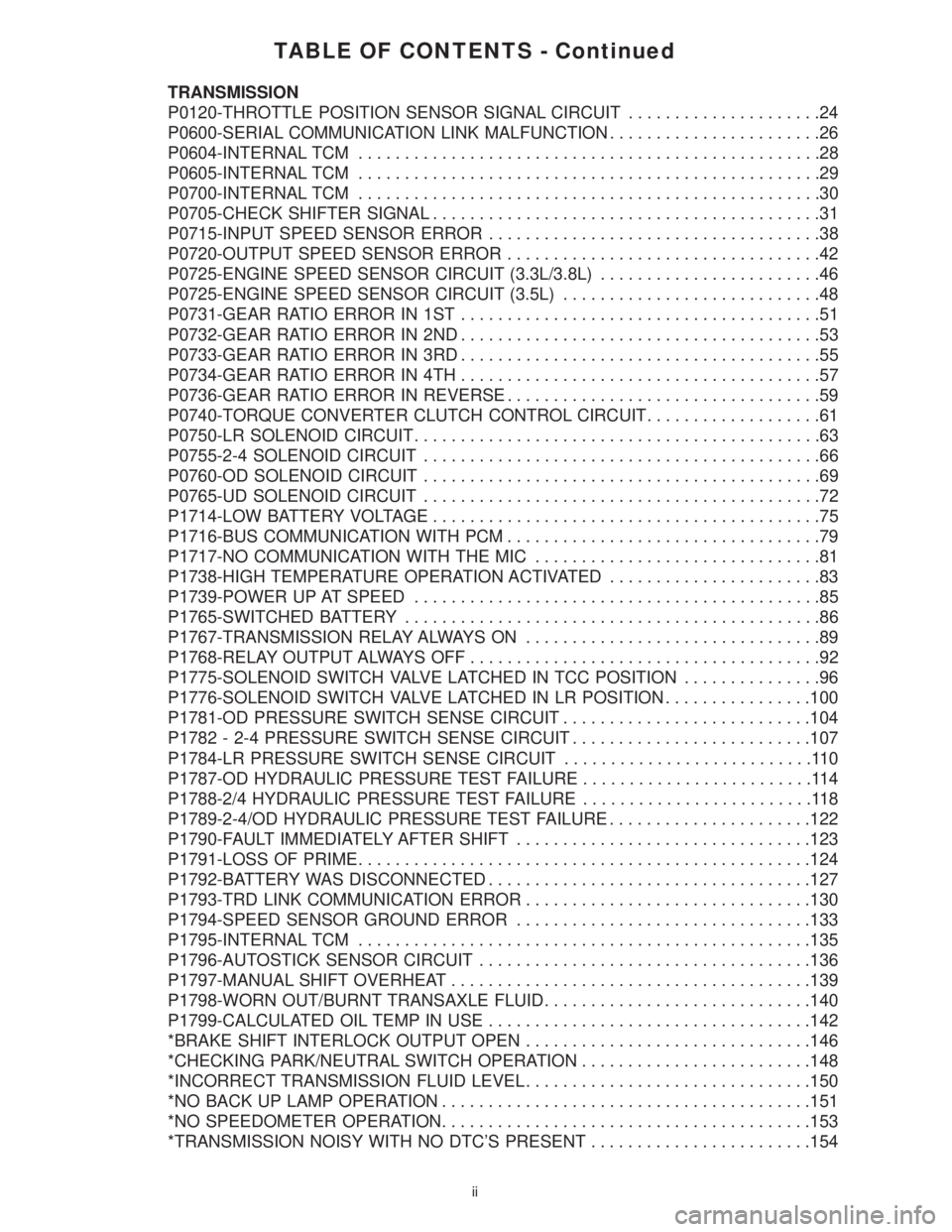
TABLE OF CONTENTS - Continued
TRANSMISSION
P0120-THROTTLE POSITION SENSOR SIGNAL CIRCUIT.....................24
P0600-SERIAL COMMUNICATION LINK MALFUNCTION.......................26
P0604-INTERNAL TCM..................................................28
P0605-INTERNAL TCM..................................................29
P0700-INTERNAL TCM..................................................30
P0705-CHECK SHIFTER SIGNAL..........................................31
P0715-INPUT SPEED SENSOR ERROR....................................38
P0720-OUTPUT SPEED SENSOR ERROR..................................42
P0725-ENGINE SPEED SENSOR CIRCUIT (3.3L/3.8L)........................46
P0725-ENGINE SPEED SENSOR CIRCUIT (3.5L)............................48
P0731-GEAR RATIO ERROR IN 1ST.......................................51
P0732-GEAR RATIO ERROR IN 2ND.......................................53
P0733-GEAR RATIO ERROR IN 3RD.......................................55
P0734-GEAR RATIO ERROR IN 4TH.......................................57
P0736-GEAR RATIO ERROR IN REVERSE..................................59
P0740-TORQUE CONVERTER CLUTCH CONTROL CIRCUIT...................61
P0750-LR SOLENOID CIRCUIT............................................63
P0755-2-4 SOLENOID CIRCUIT...........................................66
P0760-OD SOLENOID CIRCUIT...........................................69
P0765-UD SOLENOID CIRCUIT...........................................72
P1714-LOW BATTERY VOLTAGE..........................................75
P1716-BUS COMMUNICATION WITH PCM..................................79
P1717-NO COMMUNICATION WITH THE MIC...............................81
P1738-HIGH TEMPERATURE OPERATION ACTIVATED.......................83
P1739-POWER UP AT SPEED............................................85
P1765-SWITCHED BATTERY.............................................86
P1767-TRANSMISSION RELAY ALWAYS ON................................89
P1768-RELAY OUTPUT ALWAYS OFF......................................92
P1775-SOLENOID SWITCH VALVE LATCHED IN TCC POSITION...............96
P1776-SOLENOID SWITCH VALVE LATCHED IN LR POSITION................100
P1781-OD PRESSURE SWITCH SENSE CIRCUIT...........................104
P1782 - 2-4 PRESSURE SWITCH SENSE CIRCUIT..........................107
P1784-LR PRESSURE SWITCH SENSE CIRCUIT...........................110
P1787-OD HYDRAULIC PRESSURE TEST FAILURE.........................114
P1788-2/4 HYDRAULIC PRESSURE TEST FAILURE.........................118
P1789-2-4/OD HYDRAULIC PRESSURE TEST FAILURE......................122
P1790-FAULT IMMEDIATELY AFTER SHIFT................................123
P1791-LOSS OF PRIME.................................................124
P1792-BATTERY WAS DISCONNECTED...................................127
P1793-TRD LINK COMMUNICATION ERROR...............................130
P1794-SPEED SENSOR GROUND ERROR................................133
P1795-INTERNAL TCM.................................................135
P1796-AUTOSTICK SENSOR CIRCUIT....................................136
P1797-MANUAL SHIFT OVERHEAT.......................................139
P1798-WORN OUT/BURNT TRANSAXLE FLUID.............................140
P1799-CALCULATED OIL TEMP IN USE...................................142
*BRAKE SHIFT INTERLOCK OUTPUT OPEN...............................146
*CHECKING PARK/NEUTRAL SWITCH OPERATION.........................148
*INCORRECT TRANSMISSION FLUID LEVEL...............................150
*NO BACK UP LAMP OPERATION........................................151
*NO SPEEDOMETER OPERATION........................................153
*TRANSMISSION NOISY WITH NO DTC'S PRESENT........................154
ii
Page 4106 of 4284
3.2.2 TRANSMISSION OPERATION AND
SHIFT SCHEDULING AT VARIOUS
OIL TEMPERATURES.
The transmission covered in this manual has
unique shift schedules depending on the tempera-
ture of the transmission oil. The shift schedule is
modified to extend the life of the transmission while
operating under extreme conditions.
The oil temperature is measured with a Temper-
ature Sensor on the 41TE/AE transmission. The
Temperature Sensor is an integral component of the
Transmission Range Sensor (TRS). If the Tempera-
ture Sensor is faulty, (DTC P1799(74)) the trans-
mission will default to a calculated oil temperature.
Oil temperature will then be calculated through a
complex heat transfer equation which uses engine
coolant temperature, battery/ambient temperature,
and engine off time from the Body Control Module
(BCM). These inputs are received from the PCI bus
periodically and used to initialize the oil tempera-
ture at start up. Once the engine is started, the
TCM updates the transmission oil temperature
based on torque converter slip speed, vehicle speed,
gear, and engine coolant temperature to determine
an estimated oil temperature during vehicle opera-
tion. Vehicles using a calculated oil temperature
track oil temperature reasonably accurate during
normal operation. However, if a transmission is
overfilled, a transmission oil cooler becomes re-
stricted, or if a customer drives aggressively in low
gear, the calculated oil temperature will be inaccu-
rate. Consequently the shift schedule selected may
be inappropriate for the current conditions. The key
highlights of the various shift schedules are as
follows:
Extreme Cold:Oil temperature at start up below
-26.6C (-16ÉF)
> Goes to a Cold schedule above -24C (-12ÉF) oil
temperature
> Park, Reverse, Neutral and 2nd gear only (pre-
vents shifting which may fail a clutch with fre-
quent shifts)
Cold:Oil temperature at start up above -24C
(-12ÉF) and below 2.2C (36ÉF)
> Goes to a Warm schedule above 4.4C (40ÉF) oil
temperature
> Delayed 2-3 upshift approximately 35-50 Km/h
(22-31 MPH)
> Delayed 3-4 upshift 72-85 Km/h (45-53 MPH)
> Early 4-3 coastdown shift approximately 48
Km/h (30 MPH)
> Early 3-2 coastdown shift approximately 27
Km/h (17 MPH)> High speed 4-2, 3-2, 2-1 kickdown shifts are
prevented
> No EMCC
Warm:Oil temperature at start up above 2.2C
(36ÉF) and below 27C (80ÉF)
> Goes to a Hot schedule above 27C (80ÉF) oil
temperature
> Normal operation (upshifts, kickdowns, and
coastdowns)
> No EMCC
Hot:Oil temperature at start up above 27C (80ÉF)
> Goes to a Overheat schedule above 115C (240ÉF)
oil temperature
> Normal operation (upshifts, kickdowns, and
coastdowns)
> Full EMCC, No PEMCC except to engage
FEMCC
(Except at closed throttle at speeds above 113-133
Km/h (70 - 83 MPH)
Overheat:Oil temperature above 115C (240ÉF) or
engine coolant temperature above 118C (244ÉF)
> Goes to a Hot below 110C (230ÉF) oil temperature
or a Super Overheat above 115C (240ÉF) oil
temperature
> Delayed 2-3 upshift 40-51 Km/h (25-32 MPH)
> Delayed 3-4 upshift 66-77 Km/h (41-48 MPH)
> 3rd gear FEMCC from 48-77 Km/h (30-48 MPH)
> 3rd gear PEMCC from 43-50 Km/h (27-31 MPH)
Super Overheat:Oil temperature above 127C
(260ÉF)
> Goes back to a Overheat below 115C (240ÉF) oil
temperature
> All a Overheat shift schedules features apply
> 2nd gear PEMCC above 35 Km/h (22 MPH)
> Above 35 Km/h (22 MPH) the torque converter
will not unlock unless the throttle is closed (i.e. at
80 Km/h (50 MPH) a 4th FEMCC to 3rd FEMCC
shift will be made during a part throttle kick-
down or a 4th FEMCC to 2nd PEMCC shift will
be made at wide open throttle) or if a wide open
throttle 2nd PEMCC to 1 kickdown is made.
Causes for operation in the wrong tempera-
ture shift schedule:
Extreme Cold or Cold shift schedule at start up:
> Temperature Sensor circuit.
Overheat or Super Overheat shift schedule after
extended operation:
> Operation in city traffic or stop and go traffic
> Engine idle speed too high
> Aggressive driving in low gear
2
GENERAL INFORMATION
Page 4107 of 4284
> Trailer towing in OD gear position (use 3 position
(or A/S 3rd) if frequent shifting occurs)
> Cooling system failure causing engine to operate
over 110C (230ÉF)
> Engine coolant temperature stays low too long -
If engine coolant temperature drops below 65C
(150ÉF), the transmission will disengage EMCC.
Extended operation with the EMCC disengaged
will cause the transmission to overheat.
> A brake switch issue will cause the EMCC to
disengage. Extended operation with the EMCC
disengaged will cause the transmission to over-
heat.
> Transmission fluid overfilled
> Transmission cooler or cooler lines restricted
> Transmission Temperature Sensor circuit
3.3 DIAGNOSTIC TROUBLE CODES
Diagnostic trouble codes (DTC's) are codes stored
by the Transmission Control Module (TCM) that
help us diagnose Transmission problems. They are
viewed using the DRBIIItscan tool.
Always begin by performing a visual inspection of
the wiring, connectors, cooler lines and the trans-
mission. Any obvious wiring problems or leaks
should be repaired prior to performing any diagnos-
tic test procedures. Some engine driveability prob-
lems can be misinterpreted as a transmission prob-
lem. Ensure that the engine is running properly
and that no PCM DTC's are present that could
cause a transmission complaint.
If there is a communication bus problem, trouble
codes will not be accessible until the problem is
fixed. The DRBIIItwill display an appropriate
message. The following is a possible list of causes
for a bus problem:
± open or short to ground/battery in PCI bus
circuit (pin 43).
± internal failure of any module or component on
the bus
Each diagnostic trouble code is diagnosed by
following a specific testing sequence. The diagnostic
test procedures contain step-by-step instructions
for determining the cause of a transmission diag-
nostic trouble code. Possible sources of the code are
checked and eliminated one by one. It is not neces-
sary to perform all of the tests in this book to
diagnose an individual code. These tests are based
on the problem being present at the time that the
test is run.All testing should be done with a
fully charged battery.
If the TCM records a DTC that will adversely
affect vehicle emissions, it will request (via the
communication bus) that the PCM illuminate the
Malfunction Indicator Lamp (MIL). Although theseDTC's will be stored in the TCM immediately as a 1
trip failure, it may take up to five minutes of
accumulated trouble confirmation set the DTC and
illuminate the MIL. Three consecutive successful
OBDII (EURO STAGE III OBD) trips or clearing
the DTC's with a diagnostic tool (DRBIIItor equiv-
alent) is required to extinguish the MIL. When the
TCM requests that the PCM illuminate the MIL,
the PCM sets a DTC P0700(89) to alert the techni-
cian that there are DTC's in the TCM. This must
also be erased in the PCM in order to extinguish the
MIL.
3.3.1 HARD CODE
Any Diagnostic Trouble Code (DTC) that is set
whenever the system or component is monitored is
a HARD code. This means that the problem is there
every time the TCM checks that system or compo-
nent. Some codes will set immediately at start up
and others will require a road test under specific
conditions. It must be determined if a code is
repeatable (Hard) or intermittent before attempt-
ing diagnosis.
3.3.2 ONE TRIP FAILURES
A One Trip Failure, when read from the TCM, is
a hard OBDII (EURO STAGE III OBD) code that
has not matured for the full 5 minutes. This applies
to codes that will only set after 5 minutes of
substituted gear operation.
3.3.3 INTERMITTENT CODE
A diagnostic trouble code that is not there every
time the TCM checks the circuit or function is an a
intermittent code. Some intermittent codes, such as
codes P1792(12), P1767(14), P1768(15), P0725(18),
P1716(19), P1781(21), P1782(22), P1724(24),
P0705(28), P0120(29), P0750(41), P0755(42),
P0760(43), P0765(44), P1793(48), P0715(56),
P0720(57), P1794(58), P1796(70), P1799(74),
P1739(76), P1717(77), and P0600(78) are caused by
wiring or connector problems. However intermit-
tent codes 50 - 54 are usually caused by intermit-
tent hydraulic seal leakage in the clutch and/or
accumulator circuits. Problems that come and go
like this are the most difficult to diagnose, they
must be looked for under the specific conditions
that cause them.
3.3.4 STARTS SINCE SET COUNTER
For the most recent code (Code 1), the Starts
Since Set counter counts the number of times the
vehicle has started since it was last set. The counter
will count up to 255 starts. Note that this code only
applies to the last code set.
When there are no diagnostic trouble codes stored
in memory, the DRBIIItwill display ``NO DTC'S
3
GENERAL INFORMATION
Page 4111 of 4284

Name of code:P1781(21) - OD Pressure Switch
Sense Circuit
When monitored:Whenever the engine is run-
ning.
Set condition:This code is set if the OD pressure
switch is open or closed at the wrong time in a given
gear (see chart below).
Theory of operation:The Transmission system
uses three pressure switches to monitor the fluid
pressure in the L-R, 2-4, and OD clutch circuits.
The pressure switches are continuously monitored
for the correct states in each gear as shown below.
Normal Pressure Switch States
Gear
L-R2-4OD
R OPOPOP
NCLOPOP
1st CL OP OP
2nd OP CL OP
3rd OP OP CL
4th OP CL CL
OP = switch is open
CL = switch is closed
Transmission Effects:Normal operation will be
experienced if no other codes are present. TCM will
ignore the code. Limp-in condition will only occur if
code P1781(21) is present with a code P0705(28).
Possible causes:
> If code P1791(35) is present, ignore code
P1781(21) and perform code P1791 diagnostic
procedures
> OD pressure switch sense circuit open or shorted
to ground between TCM and solenoid pack
> OD pressure switch sense circuit shorted to bat-
tery
> Solenoid pack
> Loose valve body bolts
> Plugged filter - internal transmission or torque
converter failure
> TCM
Name of code:P1782(22) - 2-4 Pressure Switch
Sense Circuit
When monitored:Whenever the engine is run-
ning.
Set condition:This code is set if the 2-4 pressure
switch is open or closed at the wrong time in a given
gear (see chart below).
Theory of operation:The Transmission system
uses three pressure switches to monitor the fluid
pressure in the L-R, 2-4, and OD elements. The
pressure switches are continuously monitored for
the correct states in each gear as shown below.
Normal Pressure Switch States
Gear
L-R2-4OD
R OPOPOP
NCLOPOP
1st CL OP OP
2nd OP CL OP
3rd OP OP CL
4th OP CL CL
OP = switch is open
CL = switch is closed
Transmission Effects: If the 2-4 pressure switch is
identified as closed in P or N, the code will imme-
diately be set and normal operation will be allowed
for that given key start. If the problem is identified
for 3 successive key starts, the transmission will go
into relay open limp-in mode. If the 2-4 pressure
switch is identified as being closed in 1st or 3rd gear
and was not identified as being closed in P or N,
then 2nd gear or 4th gear will be substituted for 1st
or 3rd gear depending on throttle angle and vehicle
speed. A short period of time after the gear substi-
tution, the transmission will return to normal op-
erating mode. If the transmission is shifted back
into 1st or 3rd gear through normal operation, and
the 2-4 pressure switch remains closed, 2nd or 4th
gear will be substituted briefly and then resume
normal operation. If four gear substitutions occur in
a given key start, the transmission will go into relay
open limp-in mode.
If the 2-4 pressure switch is open (indicating no
2-4 clutch pressure) in 2nd or 4th gear, the TCM
sets code P1782(22) and continues with normal
operation. The transmission will only go into relay
open limp-in mode if a code P0705(28) is also
present. If no 2-4 clutch pressure is present a speed
ratio code P0732(52) or P0734(54) will be set and
cause the limp-in condition.
Possible causes:
> If code P1791(35) is present, ignore code
P1782(22) and perform code P1791 diagnostic
procedures
> 2-4 pressure switch sense circuit open or shorted
to ground between TCM and solenoid pack
>
2-4 pressure switch sense circuit shorted to battery
> Solenoid pack
> Transmission overheated - Excessive regulator
valve leakage in valve body causing high line
pressure which results in 2-4 solenoid blow-off in
1st or 3rd gear. May require new valve body if it
happens only when hot.
> Loose valve body bolts
> Plugged filter - internal transmission or torque
converter failure
> TCM
7
GENERAL INFORMATION
Page 4118 of 4284

± Solenoid pack (UD pressure in 4th gear)
Code P0734(54) - Excludes geartrain failures which
should be obvious upon disassembly
> If code P1791(35) is also set, follow diagnostic
procedure for code P1791(35) first
> Failed or slipping OD clutch - may also set code
P0733(53)
± OD and Reverse inner and outer lip seal leak-
age (usually hard code)
± Sticky OD accumulator seals (intermittent)
± Worn reaction shaft support seal rings (hard
code at heavy throttle)
± Broken OD/UD tapered snap ring - (hard code
at heavy throttle)
> Failed or slipping 2-4 clutch - may also set code
P0732(52)
± 2-4 seal leakage (intermittent)
± Sticky accumulator seals (intermittent)
Codes P0715(56) and P0720(57)
> Failed input or output speed sensor (intermittent
or hard code)
> Shorted or open wiring between TCM and speed
sensor(s) (intermittent)
> Connector problems at 60 TCM connector and/or
speed sensor connector
Code P1794(58)
> Open or shorted speed sensor ground (speed
sensor ground is different from chassis ground)
> Open or shorted Temperature Sensor wiring to
TRS
> TRS - Will also set code P1799(74)
> TCM
Name of code:P1796(70) - Autostick Sensor Cir-
cuit (If equipped)
Note: RS is a MUXED Autostick system
When monitored:Whenever the engine is run-
ning.
Set condition:
1) The transmission shift lever is not in AutoStick
and either the upshift or downshift switch is closed.
2) Upshift and downshift switches closed at the
same time.
Theory of operation:In the AutoStick Mode
(manual shift mode), upshifts and downshifts are
actuated manually. Shift requests are detected by
monitoring the MUXED upshift and downshift
switches. The Transmission Control Module (TCM)
monitors the above set conditions. A set condition
will be tolerated for up to 15 seconds before setting
a code.Transmission Effects:The OD position shift
schedule is substituted while operating in the au-
tostick gear selector position. No limp-in mode
occurs.
Possible causes:
> Wiring or connector problems
> AutoStick switch failure
> TCM
Name of code:P1797(71)- Manual Shift Overheat
When monitored:Whenever the engine is run-
ning.
Set condition:1) If the engine temperature ex-
ceeds 124C (255 ÉF) while operating in AutoStick
mode.
2) If the transmission temperature exceeds 135C
(275 ÉF) while in AutoStick mode
Theory of operation:Transmission and engine
temperatures are monitored during vehicle opera-
tion. If conditions occur causing the engine or
transmission to overheat, the AutoStick mode will
be canceled, and a code will be set.
Transmission Effects:The 3 position shift sched-
ule that is used in non-AutoStick applications is
substituted while operating in the AutoStick gear
selector position. No limp-in mode occurs.
Possible causes:
> Engine overheat - refer to service manual for
diagnosis and repair
> Transmission Overheat
± Restricted transmission cooling system
± Transmission fluid overfilled
± Radiator fan not functioning properly
± Extended driving in low gear
Note:Strenuous driving conditions may cause the
vehicle to overheat. If the driver operates in or
initiates AutoStick with an overheated vehicle, the
code will be set.
Name of code:P1798 (73) - Deteriorated Transaxle
Fluid
When monitored:At every Fully Electronically
Modulated Converter Clutch (FEMCC) to Partial
Electronically Modulated Converter Clutch (PEM-
CC) transition miles when A/C compressor clutch is
being cycled.
Set condition:The code will be set if vehicle
shudder is detected 20 times when the A/C clutch is
cycled.
Theory of operation:While in 3rd or 4th gear
FEMCC and just before the A/C clutch engages, the
Powertrain Control Module (PCM) requests the
Transmission Control Module (TCM) to momen-
tarily establish PEMCC operation. If vehicle shud-
der is detected during the FEMCC to PEMCC
transition, a counter is incremented. If the count
reaches 20, the trouble code is set. The driver may
14
GENERAL INFORMATION
Page 4119 of 4284

then notice harsh bumps when the A/C clutch is
being cycled, but vehicle shudder will be elimi-
nated. After 35 OBDII (EURO STAGE III OBD)
warm-up starts or if the code is cleared, PEMCC
will be reactivated to see if shudder is still present.
If one shudder event occurs, the code will be reset.
Clearing the code and running battery disconnect
with the DRBIIItis the only way to reset the
shudder counter from 20 back to zero.
Transmission Effects:This code does not cause
the transmission to go into limp-in mode. However,
once the code is set, FEMCC to PEMCC operation
before the A/C clutch engagement will be disabled
for 35 OBDII (EURO STAGE III OBD) warm up
starts.
Possible causes:
> Degraded transmission fluid
> Wheels severely out of alignment
> Internal torque converter problem
Name of Code:P1799(74) - Calculated Oil Temper-
ature in Use
When Monitored:When ever the Engine is run-
ning.
Set condition:The code is set if any of the follow-
ing conditions exist for three consecutive key starts:
> The Temperature Sensor voltage is out of range
(below 0.07 volts or greater than 4.94 volts)
> If continuous erratic Temperature Sensor voltage
is sensed.
> The Temperature Sensor temperature stays be-
low 27C (80ÉF) for an extended period of time.
Theory of Operation:The TCM uses a Tempera-
ture Sensor to monitor the transmission sump tem-
perature. This temperature is used to determine
which shift schedule the TCM is to use. (See Trans-
mission Operation and Shift Scheduling at Various
Sump Temperatures in this diagnostic manual) If
the Temperature Sensor circuit fails to operate
properly the TCM will use the calculated oil tem-
perature routine found in prior model year TCM. If
this occurs for three consecutive key starts, the code
will be set. The TCM will then test the Temperature
Sensor circuit after every 35 OBDII (EURO STAGE
III OBD) warm-up starts. If the Temperature Sen-
sor circuit is OK, the Temperature Sensor data is
used in place of the Calculated Oil Temperature
data.
Transmission Effects:If the Temperature Sensor
indicates a temperature below -18C (0É F) or above
115C (240É F) at start up, The TCM compares the
calculated oil temperature to the indicated Temper-
ature Sensor oil temperature. If the calculated oil
temperature differs significantly from the Temper-
ature Sensor value, the calculated oil temperature
will be used for that key start.Possible Causes:
> Wiring or Connector problems in the transmis-
sion temperature sensor signal circuit.
> TRS
> TCM
Name of Code:P1738(75) - High Temperature
Operation Activated.
When Monitored:Whenever the engine is running.
Set Condition:Immediately once the Overheat
Shift Schedule is activated.
Theory of Operation:If the transmission oil tem-
perature rises above 115C (240ÉF), the overheat
shift schedule is activated refer to Transmission
Operation as a function of Transmission Oil Tem-
perature and the code is set. The DTC is an infor-
mation code only and is being set to aid the techni-
cian in determining root cause of a customer
driveability issue. The code is also intended to alert
the technician to determine if a cooling system
malfunction has occurred or if an additional trans-
mission air to oil cooler should be added to the
vehicle if the customer regularly drives in a manner
that overheats the transmission. Extended opera-
tion above 115C (240ÉF) will reduce the durability of
the transmission and should be avoided. Correcting
the cooling system malfunction or installing an
additional transmission oil cooler will improve
transmission durability especially for customers
who operate in city/construction stop and go traffic,
tow trailers regularly, drive aggressively in low gear
or drive regularly in mountainous areas.
Transmission Effects:Information only code. -
Overheat shift schedule was activated, no limp-in
condition occurs. 2nd gear partial EMCC above 40
Km/h (25 MPH), 3rd gear EMCC from 45-69 Km/h
(28-43 MPH), delayed 3-4 upshift at 69 Km/h (43
MPH), early 4-3 coastdown at 66 Km/h (41 MPH),
EMCC operation under all conditions above 40
Km/h (25 MPH) except at closed throttle or 1st gear.
Possible Causes:
± Transmission Overfilled with Oil
± Engine cooling fan failure
± Engine thermostat stuck closed
± Radiator corroded or packed with dirt
± Transmission Oil Cooler Plugged
± Customer driving pattern requires additional
transmission cooling
Name Of Code:P1739(76) - Power-Up at Speed
When Monitored:When TCM (transmission con-
trol module) initially powers-up.
Set Condition:If the TCM powers up while in the
9Drive9position and the vehicle is going above 32
Km/h (20 MPH), the code is set.
Theory of Operation:If a vehicle loses power to
the TCM, the vehicle will go to the 2nd gear mode
15
GENERAL INFORMATION
Page 4124 of 4284
4.3 WARNINGS
4.3.1 VEHICLE DAMAGE WARNINGS
Before disconnecting any control module, make
sure the ignition is ªoffº. Failure to do so could
damage the module.
When testing voltage or continuity at any control
module, use the terminal side (not the wire end) of
the connector. Do not probe a wire through the
insulation; this will damage it and eventually cause
it to fail because of corrosion.
Be careful when performing electrical tests so as
to prevent accidental shorting of terminals. Such
mistakes can damage fuses or components. Also, a
second code could be set, making diagnosis of the
original problem more difficult.
4.3.2 ROAD TEST COMPLAINT VEHICLE
Some complaints will require a test drive as part
of the repair verification procedure. The purpose of
the test drive is to try to duplicate the diagnostic
code or symptom condition.
CAUTION: BEFORE ROAD TESTING A
VEHICLE, BE SURE THAT ALL
COMPONENTS ARE REASSEMBLED.
DURING THE TEST DRIVE, DO NOT TRY TO
READ THE DRBIIITSCREEN WHILE IN
MOTION. DO NOT HANG THE DRBIIITFROM
THE REAR VIEW MIRROR OR OPERATE IT
YOURSELF. HAVE AN ASSISTANT
AVAILABLE TO OPERATE THE DRBIIIT.
Road testing is an essential step in the diagnostic
process that must not be overlooked. Along with
diagnostic information obtained from the DRBIIIt
Scan Tool and the original customer concern, the
road test helps to verify the problem and observe
operation under actual vehicle driving conditions.
Just as important as the road test is, there are
preliminary inspections that should be carried out
prior to the road test. Always check the fluid level
and condition before going on a road test or per-
forming other tests. Also try to determine the type
of fluid being used. Improper fluid can result in
problems. Additionally, a variety of complaints can
be caused by incorrect fluid level. Some of the
conditions caused by incorrect fluid level are as
follows:
²Delayed engagement
²Poor shifting or erratic shifts
²Excessive noise
²Overheating
The next step is to verify that the shift linkage is
correctly adjusted. If the gearshift linkage is incor-rectly adjusted because of wear or incorrect adjust-
ment, a number of complaints can result.
The TCM monitors the Shift Lever Position (SLP)
Sensor at all times. If the linkage is incorrectly
adjusted, the TCM may sense a shift lever position
that is not correct for the gear range chosen by the
driver. This may cause diagnostic trouble codes to
be set and a possible limp-in situation.
The following complaints may also be the result
of an incorrectly adjusted or worn linkage.
²Delayed clutch engagement or erratic shifts
²Vehicle able to drive in Neutral
²Engine not able to crank in Park or Neutral
²Gearshift linkage able to be shifted without the
key in the ignition
²Not able to remove the ignition key in Reverse
²Parking pawl not engaging
The shift linkage should also be adjusted when
replacing the transaxle, repairing the valve body or
repairing any component between the shift lever
and the transaxle.
Some questions to ask yourself when considering
the road test are listed below:
²Is the complaint or concern what you think it is,
based the driver 's description of the problem?
²Is the transaxle operating normally, or is there a
real problem?
²When does the malfunction occur?
²Is the problem in only one gear range?
²What temperature does the complaint occur?
²Is the transaxle in limp-in mode?
4.3.3 ELECTRONIC PINION FACTOR
WARNINGS
The pinion factor must be set for all new trans-
mission control modules. If the pinion factor is not
set or if it is set incorrectly, any speedometer, speed
control, rolling door locks, and other devices that
are operated by the powertrain and body controllers
will not function properly.
4.3.4 BULLETINS AND RECALLS
The service procedures contained in this manual
are correct. provided that all applicable Safety
Recalls and Technical Service Bulletins have been
performed.
5.0 REQUIRED TOOLS AND
EQUIPMENT
> DRBIIIt(diagnostic read-out box) - Must be at
latest release level.
20
GENERAL INFORMATION
Page 4187 of 4284

Symptom:
P1738-HIGH TEMPERATURE OPERATION ACTIVATED
When Monitored and Set Condition:
P1738-HIGH TEMPERATURE OPERATION ACTIVATED
When Monitored: Whenever the engine is running.
Set Condition: Immediately when the Overheat shift schedule is activated (240 degrees
Trans oil temp).
POSSIBLE CAUSES
ENGINE COOLING SYSTEM MALFUNCTION
INCORRECT FLUID LEVEL
TRANSMISSION OIL COOLER PLUGGED
HIGH TEMPERATURE OPERATIONS ACTIVATED
TEST ACTION APPLICABILITY
1 Perform Engine Cooling System diagnostics per Service Information
Is the engine cooling system functioning properly?All
Ye s®Go To 2
No®Repair cause of engine overheating. Refer to Service Information
for additional repair information.
Perform 41TE TRANSMISSION VERIFICATION TEST - VER 1.
2 Check the Transmission Fluid level per the Service Information.
Is the Transmission Fluid Level at the proper level?All
Ye s®Go To 3
No®Repair any Transmission Fluid leak as necessary and adjust the
Transmission Fluid Level in accordance with the Service Infor-
mation.
Perform 41TE TRANSMISSION VERIFICATION TEST - VER 1.
3 Perform Cooler Flow Check per Service Information.
Did the cooler flow test pass?All
Ye s®Go To 4
No®Repair cause of plugged Transmission Oil Cooler. Flush or replace
Transmission Oil Cooler(s) as necessary per Service Information.
Perform 41TE TRANSMISSION VERIFICATION TEST - VER 1.
83
TRANSMISSION