low beam CHRYSLER VOYAGER 2001 Owner's Guide
[x] Cancel search | Manufacturer: CHRYSLER, Model Year: 2001, Model line: VOYAGER, Model: CHRYSLER VOYAGER 2001Pages: 4284, PDF Size: 83.53 MB
Page 1079 of 4284

LEFT FRONT DOOR LOCK MOTOR/AJAR SWITCH (EXCEPT BASE) - BLACK 4 WAYCAV CIRCUIT FUNCTION
1 G75 20VT LEFT FRONT DOOR AJAR SWITCH SENSE
2 Z75 20BK/VT GROUND
3 P1 20TN/LG LEFT FRONT DOOR UNLOCK DRIVER
4 P3 20TN/WT LEFT FRONT DOOR LOCK DRIVER
LEFT FRONT PARK/TURN SIGNAL LAMP (EXCEPT BUILT-UP-EXPORT) - BLACK 3 WAYCAV CIRCUIT FUNCTION
1 L61 18WT/LG LEFT FRONT TURN SIGNAL DRIVER
2 L77 18WT/BR FUSED PARK LAMP RELAY OUTPUT (LEFT)
3 Z377 18BK/BR GROUND
LEFT FULL OPEN SWITCH (POWER SLIDING DOOR) - BLACK 2 WAYCAV CIRCUIT FUNCTION
1 Q53 20OR LEFT FULL OPEN SWITCH SENSE
2 Z77 20BK/GY GROUND
LEFT HEADLAMP (EXCEPT BUILT-UP-EXPORT) - BLACK 3 WAYCAV CIRCUIT FUNCTION
1 L43 18WT/DB LEFT LOW BEAM DRIVER
2 Z343 18BK/LG GROUND
3 L33 18WT/LG LEFT HIGH BEAM DRIVER
C
O
N
N
E
C
T
O
R
P
I
N
O
U
T
S
1050
CONNECTOR PINOUTS
Page 1080 of 4284
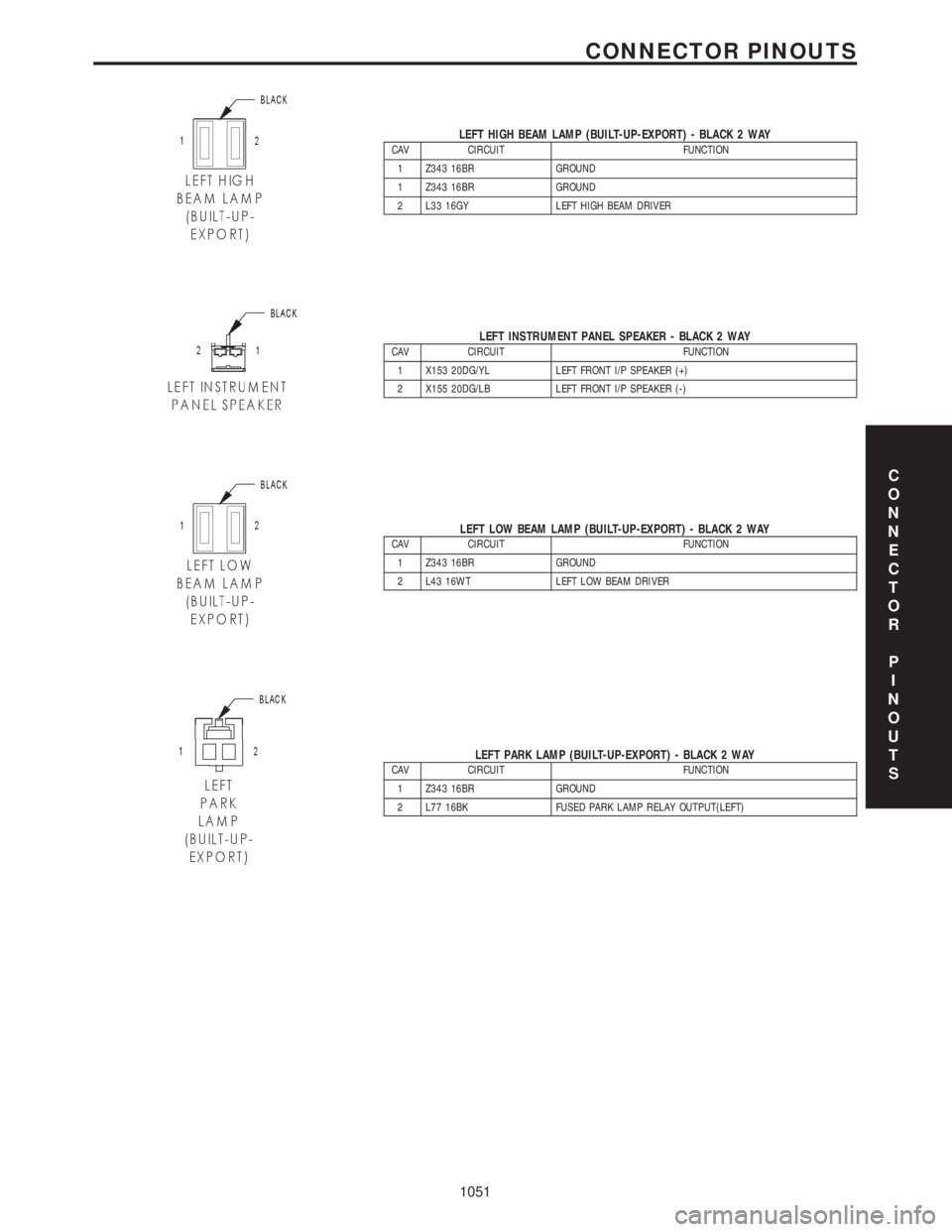
LEFT HIGH BEAM LAMP (BUILT-UP-EXPORT) - BLACK 2 WAYCAV CIRCUIT FUNCTION
1 Z343 16BR GROUND
1 Z343 16BR GROUND
2 L33 16GY LEFT HIGH BEAM DRIVER
LEFT INSTRUMENT PANEL SPEAKER - BLACK 2 WAYCAV CIRCUIT FUNCTION
1 X153 20DG/YL LEFT FRONT I/P SPEAKER (+)
2 X155 20DG/LB LEFT FRONT I/P SPEAKER (-)
LEFT LOW BEAM LAMP (BUILT-UP-EXPORT) - BLACK 2 WAYCAV CIRCUIT FUNCTION
1 Z343 16BR GROUND
2 L43 16WT LEFT LOW BEAM DRIVER
LEFT PARK LAMP (BUILT-UP-EXPORT) - BLACK 2 WAYCAV CIRCUIT FUNCTION
1 Z343 16BR GROUND
2 L77 16BK FUSED PARK LAMP RELAY OUTPUT(LEFT)
C
O
N
N
E
C
T
O
R
P
I
N
O
U
T
S
1051
CONNECTOR PINOUTS
Page 1096 of 4284
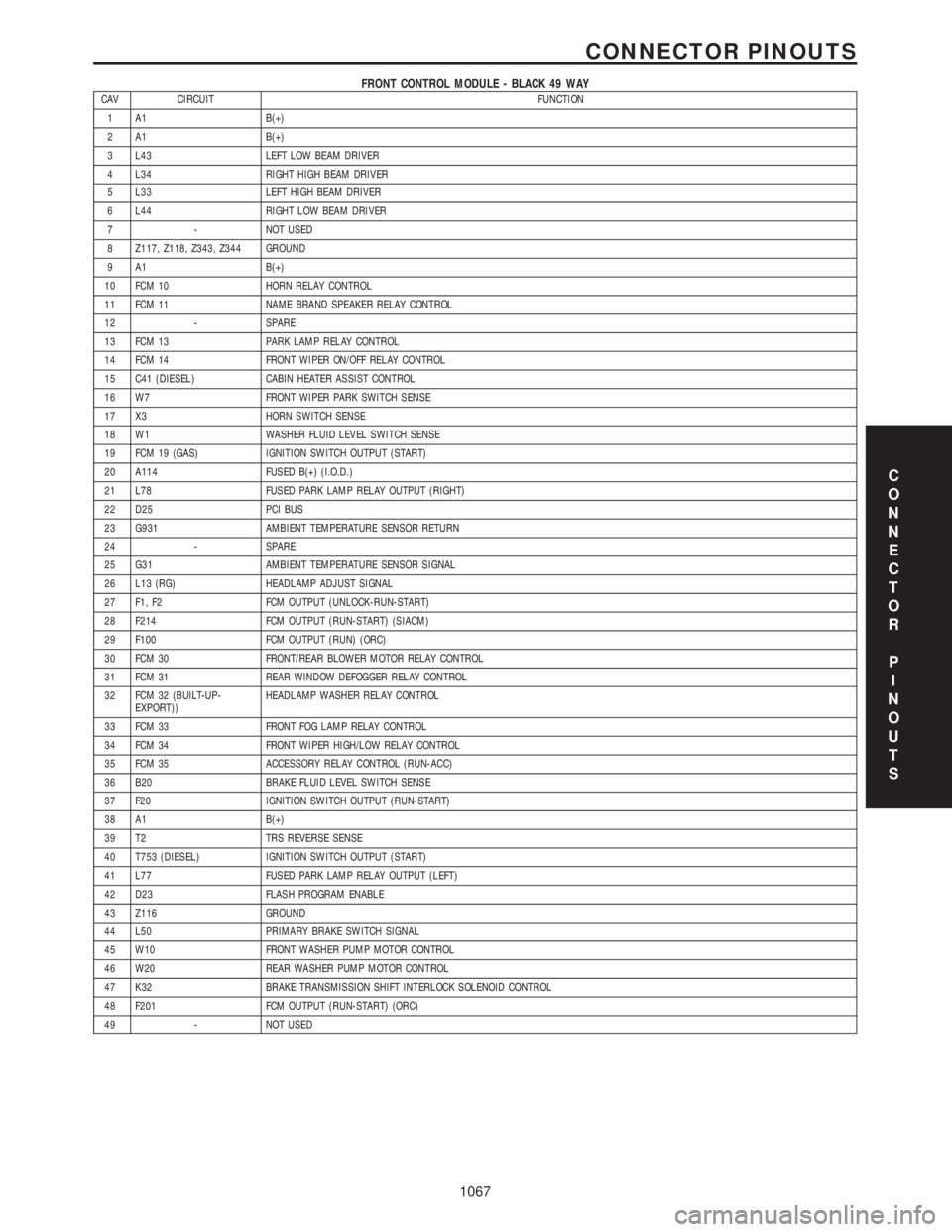
FRONT CONTROL MODULE - BLACK 49 WAYCAV CIRCUIT FUNCTION
1 A1 B(+)
2 A1 B(+)
3 L43 LEFT LOW BEAM DRIVER
4 L34 RIGHT HIGH BEAM DRIVER
5 L33 LEFT HIGH BEAM DRIVER
6 L44 RIGHT LOW BEAM DRIVER
7 - NOT USED
8 Z117, Z118, Z343, Z344 GROUND
9 A1 B(+)
10 FCM 10 HORN RELAY CONTROL
11 FCM 11 NAME BRAND SPEAKER RELAY CONTROL
12 - SPARE
13 FCM 13 PARK LAMP RELAY CONTROL
14 FCM 14 FRONT WIPER ON/OFF RELAY CONTROL
15 C41 (DIESEL) CABIN HEATER ASSIST CONTROL
16 W7 FRONT WIPER PARK SWITCH SENSE
17 X3 HORN SWITCH SENSE
18 W1 WASHER FLUID LEVEL SWITCH SENSE
19 FCM 19 (GAS) IGNITION SWITCH OUTPUT (START)
20 A114 FUSED B(+) (I.O.D.)
21 L78 FUSED PARK LAMP RELAY OUTPUT (RIGHT)
22 D25 PCI BUS
23 G931 AMBIENT TEMPERATURE SENSOR RETURN
24 - SPARE
25 G31 AMBIENT TEMPERATURE SENSOR SIGNAL
26 L13 (RG) HEADLAMP ADJUST SIGNAL
27 F1, F2 FCM OUTPUT (UNLOCK-RUN-START)
28 F214 FCM OUTPUT (RUN-START) (SIACM)
29 F100 FCM OUTPUT (RUN) (ORC)
30 FCM 30 FRONT/REAR BLOWER MOTOR RELAY CONTROL
31 FCM 31 REAR WINDOW DEFOGGER RELAY CONTROL
32 FCM 32 (BUILT-UP-
EXPORT))HEADLAMP WASHER RELAY CONTROL
33 FCM 33 FRONT FOG LAMP RELAY CONTROL
34 FCM 34 FRONT WIPER HIGH/LOW RELAY CONTROL
35 FCM 35 ACCESSORY RELAY CONTROL (RUN-ACC)
36 B20 BRAKE FLUID LEVEL SWITCH SENSE
37 F20 IGNITION SWITCH OUTPUT (RUN-START)
38 A1 B(+)
39 T2 TRS REVERSE SENSE
40 T753 (DIESEL) IGNITION SWITCH OUTPUT (START)
41 L77 FUSED PARK LAMP RELAY OUTPUT (LEFT)
42 D23 FLASH PROGRAM ENABLE
43 Z116 GROUND
44 L50 PRIMARY BRAKE SWITCH SIGNAL
45 W10 FRONT WASHER PUMP MOTOR CONTROL
46 W20 REAR WASHER PUMP MOTOR CONTROL
47 K32 BRAKE TRANSMISSION SHIFT INTERLOCK SOLENOID CONTROL
48 F201 FCM OUTPUT (RUN-START) (ORC)
49 - NOT USED
C
O
N
N
E
C
T
O
R
P
I
N
O
U
T
S
1067
CONNECTOR PINOUTS
Page 1108 of 4284

RIGHT FRONT PARK/TURN SIGNAL LAMP (EXCEPT BUILT-UP-EXPORT) - BLACK 3 WAYCAV CIRCUIT FUNCTION
1 L60 18WT/TN RIGHT FRONT TURN SIGNAL DRIVER
2 L78 18WT/OR FUSED PARK LAMP RELAY OUTPUT (RIGHT)
3 Z378 18BK/TN GROUND
RIGHT FULL OPEN SWITCH (POWER SLIDING DOOR) - BLACK 2 WAYCAV CIRCUIT FUNCTION
1 Q52 20OR RIGHT FULL OPEN SWITCH SENSE
2 Z76 20BK/YL GROUND
RIGHT HEADLAMP (EXCEPT BUILT-UP-EXPORT) - BLACK 3 WAYCAV CIRCUIT FUNCTION
1 L44 16WT/TN RIGHT LOW BEAM DRIVER
2 Z344 16BK/TN GROUND
3 L34 16WT/GY RIGHT HIGH BEAM DRIVER
RIGHT HIGH BEAM LAMP (BUILT-UP-EXPORT) - BLACK 2 WAYCAV CIRCUIT FUNCTION
1 Z344 16BR GROUND
1 Z344 16BR GROUND
2 L34 16GY RIGHT HIGH BEAM DRIVER
C
O
N
N
E
C
T
O
R
P
I
N
O
U
T
S
1079
CONNECTOR PINOUTS
Page 1109 of 4284
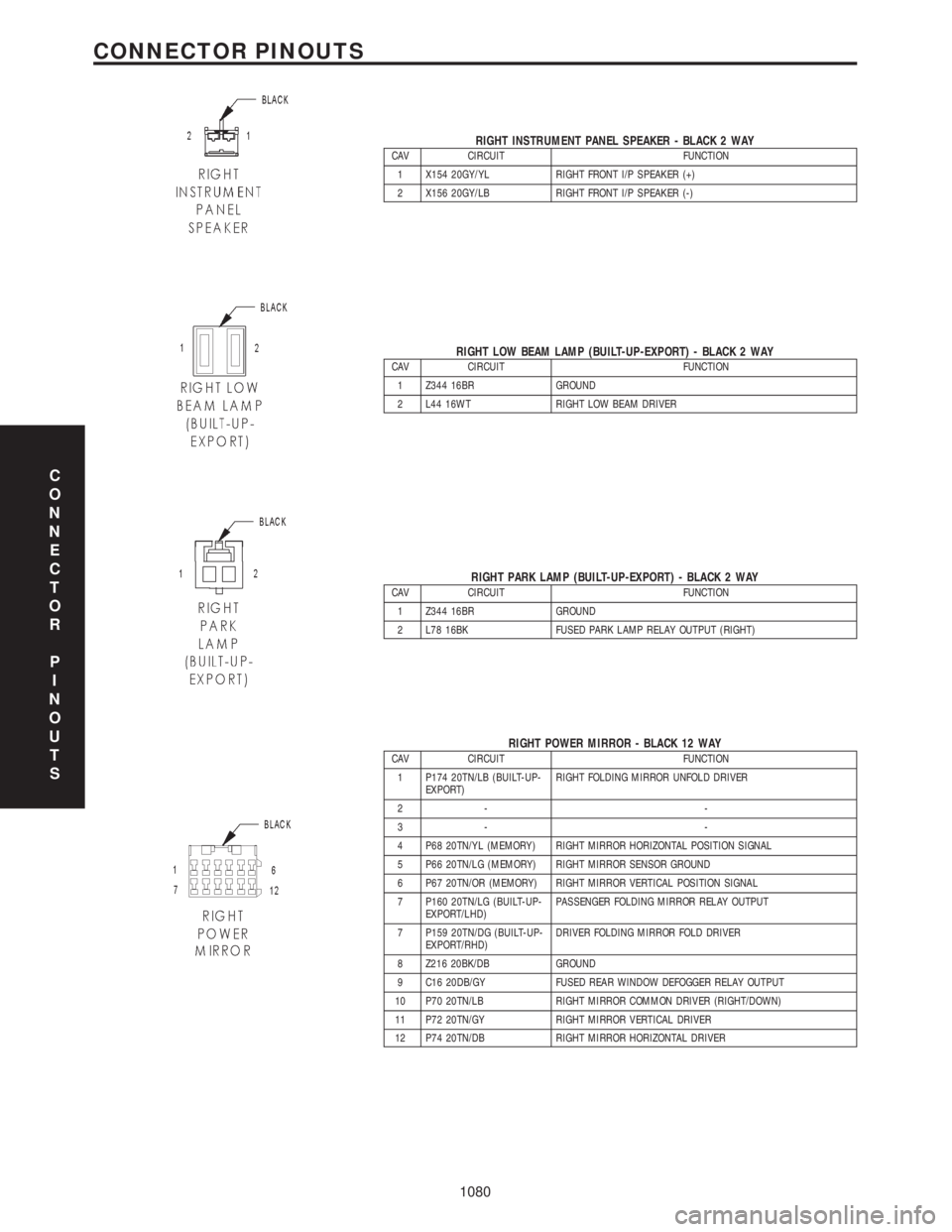
RIGHT INSTRUMENT PANEL SPEAKER - BLACK 2 WAYCAV CIRCUIT FUNCTION
1 X154 20GY/YL RIGHT FRONT I/P SPEAKER (+)
2 X156 20GY/LB RIGHT FRONT I/P SPEAKER (-)
RIGHT LOW BEAM LAMP (BUILT-UP-EXPORT) - BLACK 2 WAYCAV CIRCUIT FUNCTION
1 Z344 16BR GROUND
2 L44 16WT RIGHT LOW BEAM DRIVER
RIGHT PARK LAMP (BUILT-UP-EXPORT) - BLACK 2 WAYCAV CIRCUIT FUNCTION
1 Z344 16BR GROUND
2 L78 16BK FUSED PARK LAMP RELAY OUTPUT (RIGHT)
RIGHT POWER MIRROR - BLACK 12 WAYCAV CIRCUIT FUNCTION
1 P174 20TN/LB (BUILT-UP-
EXPORT)RIGHT FOLDING MIRROR UNFOLD DRIVER
2- -
3- -
4 P68 20TN/YL (MEMORY) RIGHT MIRROR HORIZONTAL POSITION SIGNAL
5 P66 20TN/LG (MEMORY) RIGHT MIRROR SENSOR GROUND
6 P67 20TN/OR (MEMORY) RIGHT MIRROR VERTICAL POSITION SIGNAL
7 P160 20TN/LG (BUILT-UP-
EXPORT/LHD)PASSENGER FOLDING MIRROR RELAY OUTPUT
7 P159 20TN/DG (BUILT-UP-
EXPORT/RHD)DRIVER FOLDING MIRROR FOLD DRIVER
8 Z216 20BK/DB GROUND
9 C16 20DB/GY FUSED REAR WINDOW DEFOGGER RELAY OUTPUT
10 P70 20TN/LB RIGHT MIRROR COMMON DRIVER (RIGHT/DOWN)
11 P72 20TN/GY RIGHT MIRROR VERTICAL DRIVER
12 P74 20TN/DB RIGHT MIRROR HORIZONTAL DRIVER
C
O
N
N
E
C
T
O
R
P
I
N
O
U
T
S
1080
CONNECTOR PINOUTS
Page 1483 of 4284

FASTENER USAGE
DESCRIPTION
WARNING: USE OF AN INCORRECT FASTENER
MAY RESULT IN COMPONENT DAMAGE OR PER-
SONAL INJURY.
Figure art, specifications and torque references in
this Service Manual are identified in metric and SAE
format.
During any maintenance or repair procedures, it is
important to salvage all fasteners (nuts, bolts, etc.)
for reassembly. If the fastener is not salvageable, a
fastener of equivalent specification must be used.
THREADED HOLE REPAIR
DESCRIPTION
Most stripped threaded holes can be repaired using
a Helicoilt. Follow the vehicle or Helicoiltrecommen-
dations for application and repair procedures.
INTERNATIONAL VEHICLE
CONTROL & DISPLAY
SYMBOLS
DESCRIPTION
The graphic symbols illustrated in the following
International Control and Display Symbols Chart
(Fig. 4) are used to identify various instrument con-
trols. The symbols correspond to the controls and dis-
plays that are located on the instrument panel.
Fig. 4 INTERNATIONAL CONTROL AND DISPLAY SYMBOLS
1 High Beam 13 Rear Window Washer
2 Fog Lamps 14 Fuel
3 Headlamp, Parking Lamps, Panel Lamps 15 Engine Coolant Temperature
4 Turn Warning 16 Battery Charging Condition
5 Hazard Warning 17 Engine Oil
6 Windshield Washer 18 Seat Belt
7 Windshield Wiper 19 Brake Failure
8 Windshield Wiper and Washer 20 Parking Brake
9 Windscreen Demisting and Defrosting 21 Front Hood
10 Ventilating Fan 22 Rear hood (Decklid)
11 Rear Window Defogger 23 Horn
12 Rear Window Wiper 24 Lighter
RGINTRODUCTION5a
Page 1763 of 4284
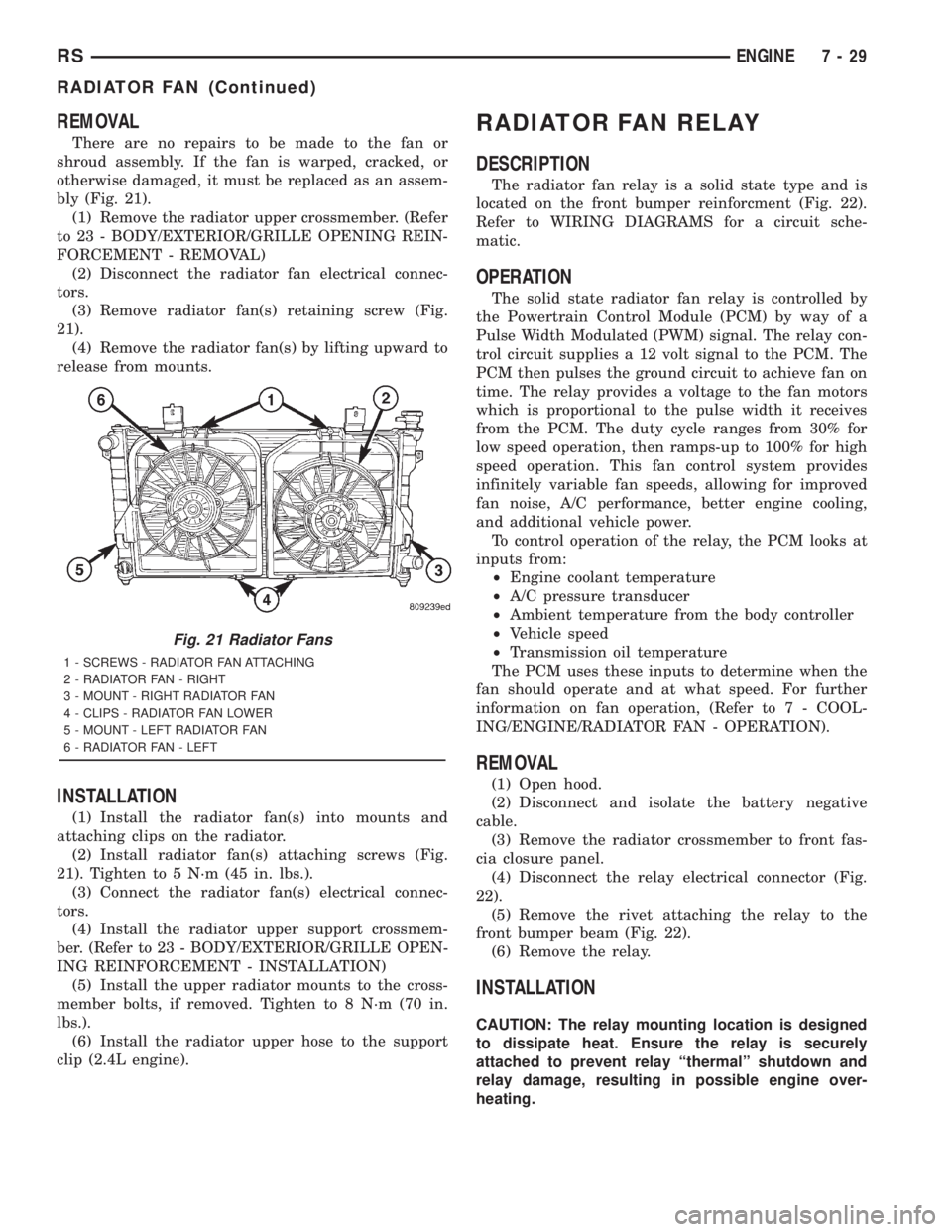
REMOVAL
There are no repairs to be made to the fan or
shroud assembly. If the fan is warped, cracked, or
otherwise damaged, it must be replaced as an assem-
bly (Fig. 21).
(1) Remove the radiator upper crossmember. (Refer
to 23 - BODY/EXTERIOR/GRILLE OPENING REIN-
FORCEMENT - REMOVAL)
(2) Disconnect the radiator fan electrical connec-
tors.
(3) Remove radiator fan(s) retaining screw (Fig.
21).
(4) Remove the radiator fan(s) by lifting upward to
release from mounts.
INSTALLATION
(1) Install the radiator fan(s) into mounts and
attaching clips on the radiator.
(2) Install radiator fan(s) attaching screws (Fig.
21). Tighten to 5 N´m (45 in. lbs.).
(3) Connect the radiator fan(s) electrical connec-
tors.
(4) Install the radiator upper support crossmem-
ber. (Refer to 23 - BODY/EXTERIOR/GRILLE OPEN-
ING REINFORCEMENT - INSTALLATION)
(5) Install the upper radiator mounts to the cross-
member bolts, if removed. Tighten to 8 N´m (70 in.
lbs.).
(6) Install the radiator upper hose to the support
clip (2.4L engine).
RADIATOR FAN RELAY
DESCRIPTION
The radiator fan relay is a solid state type and is
located on the front bumper reinforcment (Fig. 22).
Refer to WIRING DIAGRAMS for a circuit sche-
matic.
OPERATION
The solid state radiator fan relay is controlled by
the Powertrain Control Module (PCM) by way of a
Pulse Width Modulated (PWM) signal. The relay con-
trol circuit supplies a 12 volt signal to the PCM. The
PCM then pulses the ground circuit to achieve fan on
time. The relay provides a voltage to the fan motors
which is proportional to the pulse width it receives
from the PCM. The duty cycle ranges from 30% for
low speed operation, then ramps-up to 100% for high
speed operation. This fan control system provides
infinitely variable fan speeds, allowing for improved
fan noise, A/C performance, better engine cooling,
and additional vehicle power.
To control operation of the relay, the PCM looks at
inputs from:
²Engine coolant temperature
²A/C pressure transducer
²Ambient temperature from the body controller
²Vehicle speed
²Transmission oil temperature
The PCM uses these inputs to determine when the
fan should operate and at what speed. For further
information on fan operation, (Refer to 7 - COOL-
ING/ENGINE/RADIATOR FAN - OPERATION).
REMOVAL
(1) Open hood.
(2) Disconnect and isolate the battery negative
cable.
(3) Remove the radiator crossmember to front fas-
cia closure panel.
(4) Disconnect the relay electrical connector (Fig.
22).
(5) Remove the rivet attaching the relay to the
front bumper beam (Fig. 22).
(6) Remove the relay.
INSTALLATION
CAUTION: The relay mounting location is designed
to dissipate heat. Ensure the relay is securely
attached to prevent relay ªthermalº shutdown and
relay damage, resulting in possible engine over-
heating.
Fig. 21 Radiator Fans
1 - SCREWS - RADIATOR FAN ATTACHING
2 - RADIATOR FAN - RIGHT
3 - MOUNT - RIGHT RADIATOR FAN
4 - CLIPS - RADIATOR FAN LOWER
5 - MOUNT - LEFT RADIATOR FAN
6 - RADIATOR FAN - LEFT
RSENGINE7-29
RADIATOR FAN (Continued)
Page 1942 of 4284
LAMPS/LIGHTING - EXTERIOR
DESCRIPTION
LAMP SYSTEMS
RS vehicles use lighting on the interior and exte-
rior of the vehicle for illuminating and indicating
purposes. Lighting circuits are protected by fuses.
Lighting circuits require an overload protected power
source, on/off device, lamps and body ground to oper-
ate properly. Plastic lamps require a wire in the har-
ness to supply body ground to the lamp socket.
Replace sockets and bulbs that are corroded.
Some of the interior and exterior lighting functions
are governed by the Body Control Module. The head-
lamp, dome, and the door ajar switches provide sig-
nals to the Body Control Module. The Body Control
Module in turn sends a J1850 message to the Front
Control Module (FCM) to enable the necessary driv-
ers to set the required illumination configuration.
Wire connectors can make intermittent contact or
become corroded. Before coupling wire connectors,
inspect the terminals inside the connector. Male termi-
nals should not be bent or disengaged from the insu-
lator. Female terminals should not be sprung open or
disengaged from the insulator. Bent and sprung termi-
nals can be repaired using needle nose pliers and pick
tool. Corroded terminals appear chalky or green. Cor-
roded terminals should be replaced to avoid recur-
rence of the problem symptoms.
Begin electrical system failure diagnosis by testing
related fuses in the fuse block and intelligent power
module. Verify that bulbs are in good condition and
test continuity of the circuit ground. Refer to the
appropriate wiring information. The wiring informa-
tion includes wiring diagrams, proper wire and con-
nector repair procedures, details of wire harness
routing and retention, connector pin-out information
and location views for the various wire harness con-
nectors, splices and grounds.
AUTOMATIC HEADLAMP SYSTEM
The Automatic Headlamp system turns the instru-
mentation and exterior illumination lamps ON when
the ambient light levels are Night and OFF when
light levels are Day.
DAYTIME RUNNING LAMPS
Operating the high-beam headlamps at reduced
power provides daytime running lamps, which are
required on all new Canadian vehicles.
HEADLAMPS ON WITH WINDSHIELD WIPERS
For vehicles equipped with the Automatic Head-
lamp System, the instrumentation and exterior illu-
mination lamps will be turned ON when theheadlamp switch is in the AUTO position, RPM >
450 and the windshield wipers have been in the
intermittent, low or high mode of operation for more
than ten seconds. When the windshield wipers are
turned OFF the Body Control Module will determine
if the instrumentation and exterior illumination
lamps should remain ON base upon the current
ambient light level.
HEADLAMP SYSTEM
The configuration of the headlamp system of head-
lamps, park lamps and fog lamps is determined by
the BCM. The BCM determines the lighting configu-
ration as a result of the inputs from the ignition
switch, headlamp switch and multifunction switch. A
J1850 is transmitted from the BCM to the FCM to
enable the necessary drivers to set the illumination
configuration. Four wires are connected between the
headlamp switch and the BCM. The first wire con-
tains information regarding the position of the head-
lamp switch (Off, Automatic Headlamps, Automatic
Headlamp switch fog, Park with Fog, Head, or Head
with Fog Lamps). The second wire contains informa-
tion regarding the position of the dimmer switch
(Dome Lamp, Daytime Brightness, Dimming Level or
Off). The third wire is a dedicated signal return
(ground) wire. The fourth wire provides power to the
front fog lamp indicator.
HEADLAMP TIME DELAY SYSTEM
The headlamp time delay system is controlled by
the Body Control Module (BCM) via a J1850 message
transmitted by the BCM to the FCM to turn off the
headlamps.
OPERATION
AUTOMATIC HEADLAMP SYSTEM
Automatic headlamps are controlled by the Body
Control Module (BCM). With the headlamp switch in
the AUTO position, the BCM will control the head-
lamp, parking, side marker, tail and instrumentation
lamps based on ambient light levels. Ambient light
levels are monitored by the BCM using the Day/
Night signal and Electrochromatic Mirror (ECM)
present from the Compass Mini Trip (CMTC) located
on the front windshield in front of the rear view mir-
ror (ECM). Ambient light readings are averaged to
limit cycling the lamps ON and OFF when passing
through areas with varying light levels. The auto-
matic headlamps will only function when the engine
is running with RPM > 450. When the headlamp
switch is in the AUTO position (Automatic mode), the
Headlamp Time Delay system will function when the
ignition switch is placed in any position other than
run/start.
8L - 2 LAMPS/LIGHTING - EXTERIORRS
Page 1943 of 4284
DAYTIME RUNNING LAMPS
Power is reduced using pulse-width modulation to
the high beams, where by the power is switched on
and off rapidly instead of remaining on continuously.
The duration and interval of the power pulses is pro-
grammed into the Front Control Module (FCM).
HEADLAMP SYSTEM
The headlamp system will default to headlamps
ON position when ignition switch is ON and when an
open or short circuit failure occurs on the headlamp
switch input. The system will return to normal oper-
ation when the open or short is repaired. A fault will
be reported by the BCM when a failure occurs on the
dimmer or headlamp switch input.
If the exterior lamps are ON and the headlamp
switch is in any position other than OFF or AUTO
and with the ignition switch OFF (LOCK) after 3
minutes the BCM sends a message via J1850 to the
FCM informing the FCM to turn off the headlamps,
park lamps and fog lamps. This feature prevents the
vehicle battery from being discharged when the vehi-
cle lights have been left ON.
HEADLAMP TIME DELAY SYSTEM
The headlamp time delay system is activated by
turning the headlamps ON (high or low beam) while
the engine is running, turning the ignition switch
OFF, and then turning the headlamp switch OFF
within 45 seconds. The system will not activate if
more than 45 seconds elapse between ignition switch
OFF and headlamp switch OFF. The BCM will allow
the headlamps to remain ON for 90 seconds (config-
urable) before they automatically turn off (If the key
is in the ignition during the headlamp time delay
mode, then both the headlamps and park lamps
(including panel dimming) will be ON). Refer to the
Owner's Manual for more information.
If the headlamp switch is in the Auto Headlamp
Position, the headlamps are ON due to the night sig-
nal from the CMTC and the ignition switch is in any
position other than run/start, the BCM shall enter a
90 second (configurable) Auto Headlamps time delay
mode. If the key is in the ignition during the head-
lamp time delay mode, then both the headlamps and
park lamps (including panel dimming) will be ON. If
the key is not in the ignition, then only the head-
lamps will be ON. The BCM will allow the head-
lamps to remain ON for 90 seconds before they
automatically turn OFF. Refer to the Owner's Man-
ual for more information.
LAMP OUTAGE
If one or more of the following lamps (Low and/or
High beams) are out, then a ªlamps outº indicator
located in the cluster will illuminate.
OPTICAL HORN/HIGH BEAMS
When the multifunction switch is pulled to the first
detent (optical horn) signal, the headlamps are ON,
key-in the ignition the BCM shall send a message via
J1850 to the FCM to turn on the headlamps drivers
to illuminate all four filaments (Low and High
beams). When the multifunction switch is pulled to
the second detent (high beam) signal and the head-
lamps are ON, the BCM shall send a message via
J1850 to the FCM to turn on the headlamps drivers.
The High Beams are illuminated and the Low Beams
and Fog Lamps (if ON) are extinguished. If the head-
lamps were in the high beam configuration when
power was removed from the headlamps, the head-
lamps will be configured as low beam the next time
they are activated.
DIAGNOSIS AND TESTING
WARNING: EYE PROTECTION SHOULD BE USED
WHEN SERVICING GLASS COMPONENTS. PER-
SONAL INJURY CAN RESULT.
CAUTION: Do not touch the glass of halogen bulbs
with fingers or other possibly oily surface, reduced
bulb life will result. Do not use bulbs other than
those indicated in the Bulb Application table. Dam-
age to lamp and/or Daytime Running Lamp Module
can result. Do not use fuses, circuit breakers or
relays having greater amperage value than indi-
cated on the fuse panel or in the Owners Manual.
When a vehicle experiences problems with the
headlamp system, verify the condition of the battery
connections, fuses, charging system, headlamp bulbs,
wire connectors, relay, high beam switch, dimmer
switch, and headlamp switch. Refer to the appropri-
ate wiring information. The wiring information
includes wiring diagrams, proper wire and connector
repair procedures, details of wire harness routing
and retention, connector pin-out information and
location views for the various wire harness connec-
tors, splices and grounds.
Each vehicle is equipped with various lamp assem-
blies. A good ground is necessary for proper lighting
operation. Grounding is provided by the lamp socket
when it comes in contact with the metal body, or
through a separate ground wire.
When changing lamp bulbs check the socket for
corrosion. If corrosion is present, clean it with a wire
brush.
When it is necessary to remove components to ser-
vice another, it should not be necessary to apply
excessive force or bend a component to remove it.
Before damaging a trim component, verify hidden
fasteners or captured edges are not holding the com-
ponent in place.
RSLAMPS/LIGHTING - EXTERIOR8L-3
LAMPS/LIGHTING - EXTERIOR (Continued)
Page 1952 of 4284

HEADLAMP UNIT
REMOVAL
(1) Disconnect and isolate the battery negative
cable.
(2) Remove the three retaining screws (Fig. 11).
(3) Disconnect the wiring harness from the bulbs
(Fig. 12).(4) Remove wire harness retainer from back of
headlamp unit.
(5) Remove the headlamp unit.INSTALLATION
(1) Reconnect wire harness to the bulbs.
(2) Install wire harness retainer to headlamp unit.
(3) Install the three retaining screws.
(4) Reconnect the battery negative cable.
ADJUSTMENT
HEADLAMP ALIGNMENT PREPARATION
(1) Verify headlamp dimmer switch and high beam
indicator operation.
(2) Inspect and correct damaged or defective com-
ponents that could interfere with proper headlamp
alignment.
(3) Verify proper tire inflation.
(4) Clean headlamp lenses.
(5) Verify that luggage area is loaded as the vehi-
cle is routinely used.
(6) Fuel tank should be FULL. Add 2.94 kg (6.5
lbs.) of weight over the fuel tank for each estimated
gallon of missing fuel.
ALIGNMENT SCREEN PREPARATION
(1) Position vehicle on a level surface perpendicu-
lar to a flat wall 7.62 meters (25 ft.) away from front
of headlamp lens (Fig. 13).
(2) If necessary, tape a line on the floor 7.62
meters (25 ft.) away from and parallel to the wall.
(3) Rock vehicle side-to-side three times and allow
suspension to stabilize.
(4) Jounce front suspension three times by pushing
downward on front bumper and releasing.
(5) Measure the distance from the center of head-
lamp lens to the floor. Transfer measurement to the
alignment screen (with tape). Use this line for
up/down adjustment reference.
Fig. 11 HEADLAMP FASTENERS
1 - HEADLAMP RETAINING SCREW
2 - HEADLAMP UNIT
Fig. 12 HEADLAMP ASSEMBLY
1 - HEADLAMP UNIT
2 - HEADLAMP BULB
3 - PARK/TURN SIGNAL BULB
4 - WIRE HARNESS RETAINER
8L - 12 LAMPS/LIGHTING - EXTERIORRS