ignition CHRYSLER VOYAGER 2001 Service Manual
[x] Cancel search | Manufacturer: CHRYSLER, Model Year: 2001, Model line: VOYAGER, Model: CHRYSLER VOYAGER 2001Pages: 4284, PDF Size: 83.53 MB
Page 743 of 4284
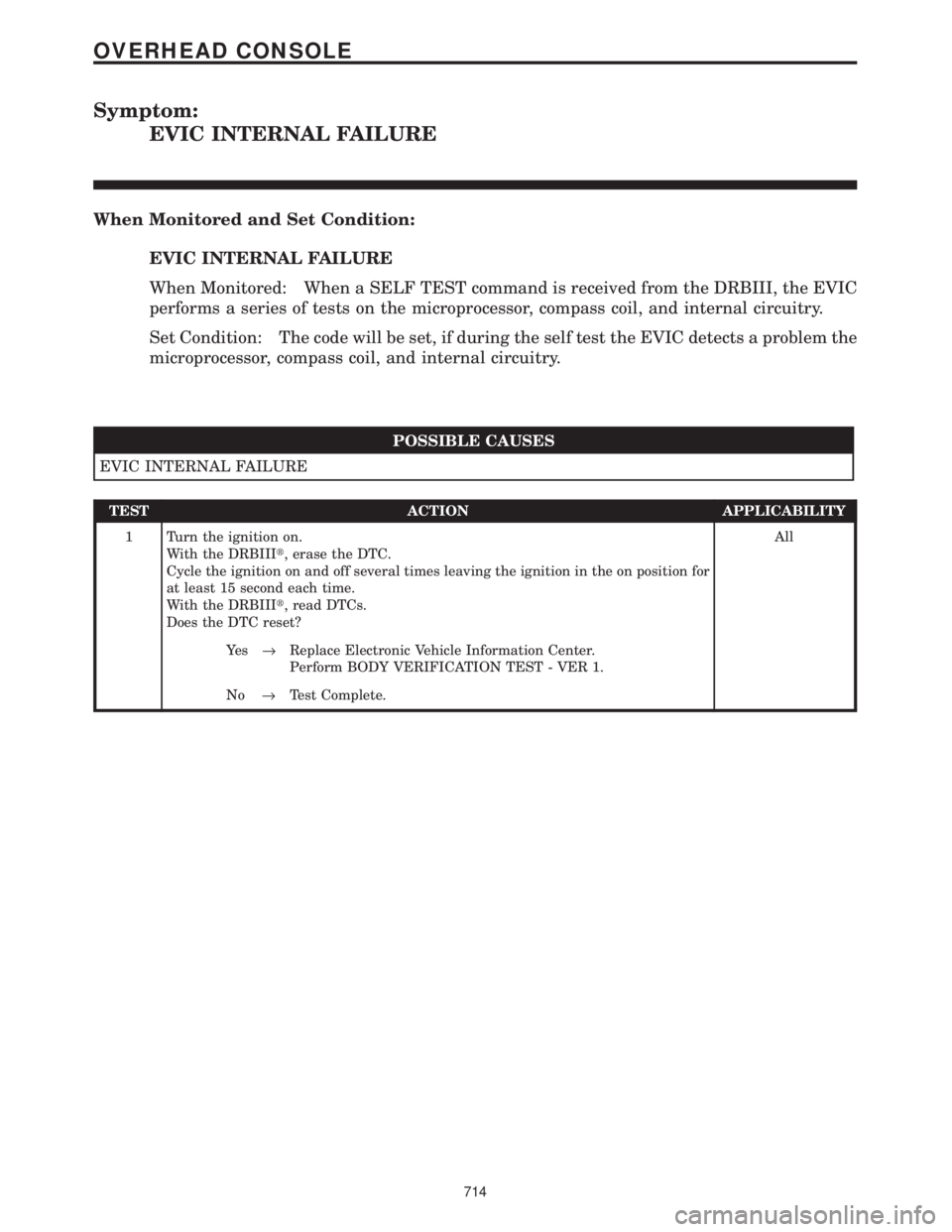
Symptom:
EVIC INTERNAL FAILURE
When Monitored and Set Condition:
EVIC INTERNAL FAILURE
When Monitored: When a SELF TEST command is received from the DRBIII, the EVIC
performs a series of tests on the microprocessor, compass coil, and internal circuitry.
Set Condition: The code will be set, if during the self test the EVIC detects a problem the
microprocessor, compass coil, and internal circuitry.
POSSIBLE CAUSES
EVIC INTERNAL FAILURE
TEST ACTION APPLICABILITY
1 Turn the ignition on.
With the DRBIIIt, erase the DTC.
Cycle the ignition on and off several times leaving the ignition in the on position for
at least 15 second each time.
With the DRBIIIt, read DTCs.
Does the DTC reset?All
Ye s®Replace Electronic Vehicle Information Center.
Perform BODY VERIFICATION TEST - VER 1.
No®Test Complete.
714
OVERHEAD CONSOLE
Page 744 of 4284
Symptom:
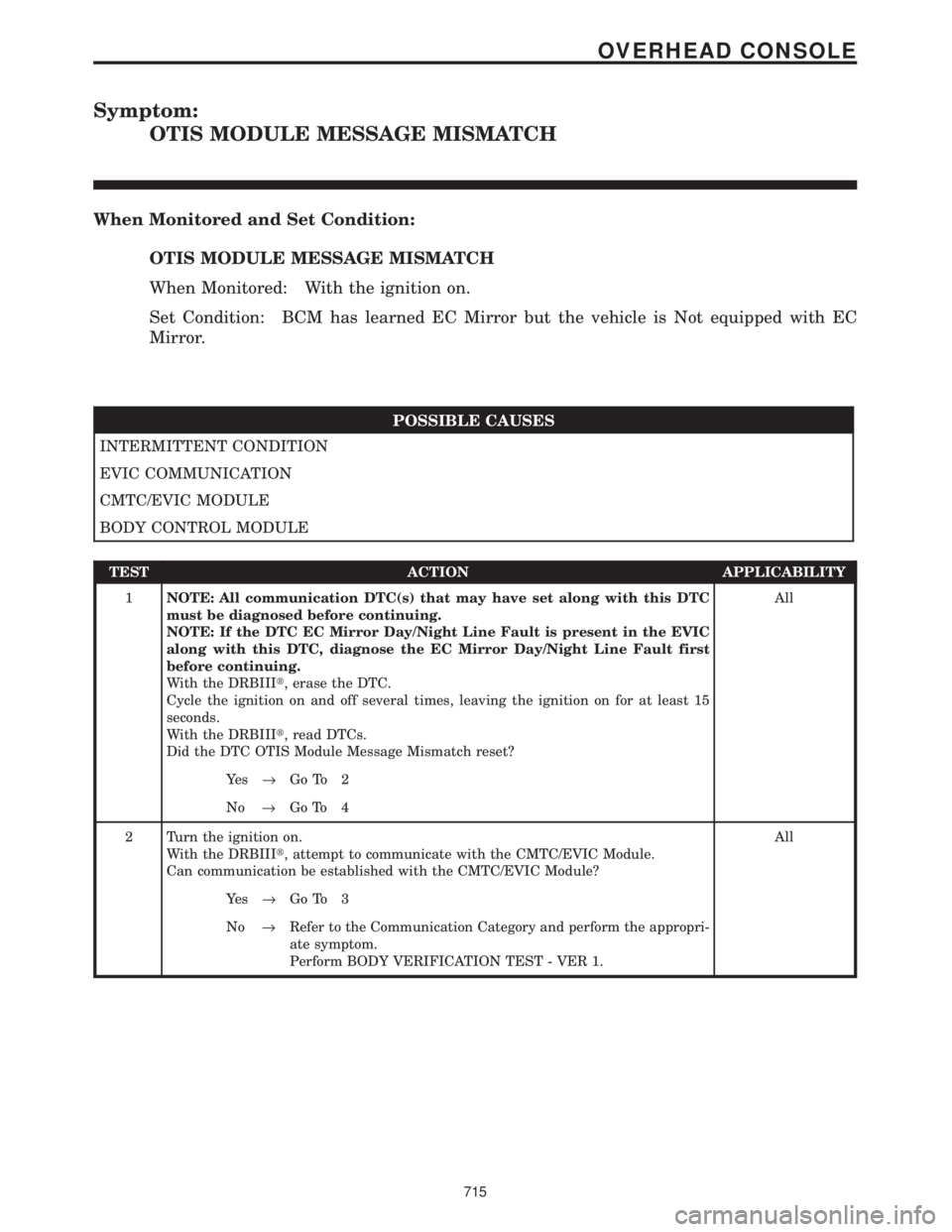
OTIS MODULE MESSAGE MISMATCH
When Monitored and Set Condition:
OTIS MODULE MESSAGE MISMATCH
When Monitored: With the ignition on.
Set Condition: BCM has learned EC Mirror but the vehicle is Not equipped with EC
Mirror.
POSSIBLE CAUSES
INTERMITTENT CONDITION
EVIC COMMUNICATION
CMTC/EVIC MODULE
BODY CONTROL MODULE
TEST ACTION APPLICABILITY
1NOTE: All communication DTC(s) that may have set along with this DTC
must be diagnosed before continuing.
NOTE: If the DTC EC Mirror Day/Night Line Fault is present in the EVIC
along with this DTC, diagnose the EC Mirror Day/Night Line Fault first
before continuing.
With the DRBIIIt, erase the DTC.
Cycle the ignition on and off several times, leaving the ignition on for at least 15
seconds.
With the DRBIIIt, read DTCs.
Did the DTC OTIS Module Message Mismatch reset?All
Ye s®Go To 2
No®Go To 4
2 Turn the ignition on.
With the DRBIIIt, attempt to communicate with the CMTC/EVIC Module.
Can communication be established with the CMTC/EVIC Module?All
Ye s®Go To 3
No®Refer to the Communication Category and perform the appropri-
ate symptom.
Perform BODY VERIFICATION TEST - VER 1.
715
OVERHEAD CONSOLE
Page 745 of 4284

TEST ACTION APPLICABILITY
3 Turn the ignition off.
Install a substitute CMTC/EVIC Module in place of the original module.
With the DRBIIIt, erase DTCs.
Turn the ignition on.
Cycle the ignition on and off, leaving the ignition in the on position for at least 15
seconds each time.
With the DRBIIIt, read DTCs.
Did the DTC reset?All
Ye s®Replace the Body Control Module.
Perform BODY VERIFICATION TEST - VER 1.
No®Replace the CMTC/EVIC Module.
Perform BODY VERIFICATION TEST - VER 1.
4WARNING: WHEN THE ENGINE IS OPERATING, DO NOT STAND IN A
DIRECT LINE WITH THE FAN. DO NOT PUT YOUR HANDS NEAR THE
PULLEYS, BELTS OR FAN. DO NOT WEAR LOOSE CLOTHING.
NOTE: The conditions that set the DTC are not present at this time. The
following list may help in identifying the intermittent condition.
With the engine running at normal operating temperature, monitor the DRB
parameters related to the DTC while wiggling the wiring harness. Look for param-
eter values to change and/or a DTC to set.
Refer to any Technical Service Bulletins (TSB) that may apply.
Visually inspect the related wiring harness. Look for any chafed, pierced, pinched, or
partially broken wires.
Visually inspect the related wiring harness connectors. Look for broken, bent, pushed
out, or corroded terminals.
Were any of the above conditions present?All
Ye s®Repair as necessary
Perform BODY VERIFICATION TEST - VER 1.
No®Test Complete.
716
OVERHEAD CONSOLE
OTIS MODULE MESSAGE MISMATCH ÐContinued
Page 746 of 4284
Symptom:
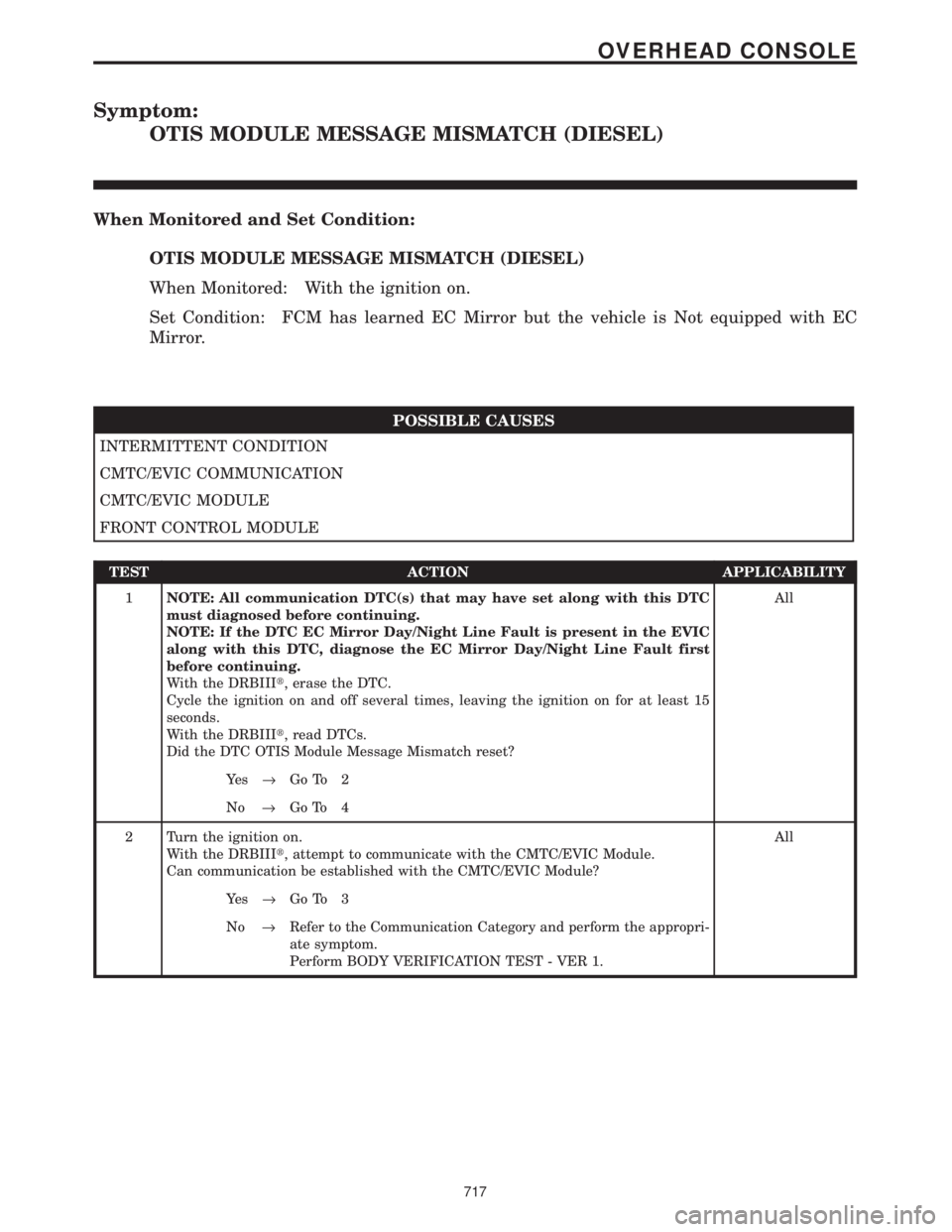
OTIS MODULE MESSAGE MISMATCH (DIESEL)
When Monitored and Set Condition:
OTIS MODULE MESSAGE MISMATCH (DIESEL)
When Monitored: With the ignition on.
Set Condition: FCM has learned EC Mirror but the vehicle is Not equipped with EC
Mirror.
POSSIBLE CAUSES
INTERMITTENT CONDITION
CMTC/EVIC COMMUNICATION
CMTC/EVIC MODULE
FRONT CONTROL MODULE
TEST ACTION APPLICABILITY
1NOTE: All communication DTC(s) that may have set along with this DTC
must diagnosed before continuing.
NOTE: If the DTC EC Mirror Day/Night Line Fault is present in the EVIC
along with this DTC, diagnose the EC Mirror Day/Night Line Fault first
before continuing.
With the DRBIIIt, erase the DTC.
Cycle the ignition on and off several times, leaving the ignition on for at least 15
seconds.
With the DRBIIIt, read DTCs.
Did the DTC OTIS Module Message Mismatch reset?All
Ye s®Go To 2
No®Go To 4
2 Turn the ignition on.
With the DRBIIIt, attempt to communicate with the CMTC/EVIC Module.
Can communication be established with the CMTC/EVIC Module?All
Ye s®Go To 3
No®Refer to the Communication Category and perform the appropri-
ate symptom.
Perform BODY VERIFICATION TEST - VER 1.
717
OVERHEAD CONSOLE
Page 747 of 4284

TEST ACTION APPLICABILITY
3 Turn the ignition off.
Install a substitute CMTC/EVIC Module in place of the original module.
With the DRBIIIt, erase DTCs.
Turn the ignition on.
Cycle the ignition on and off, leaving the ignition in the on position for at least 15
seconds each time.
With the DRBIIIt, read DTCs.
Did the DTC reset?All
Ye s®Replace the Front Control Module.
Perform BODY VERIFICATION TEST - VER 1.
No®Replace the CMTC/EVIC Module.
Perform BODY VERIFICATION TEST - VER 1.
4WARNING: WHEN THE ENGINE IS OPERATING, DO NOT STAND IN A
DIRECT LINE WITH THE FAN. DO NOT PUT YOUR HANDS NEAR THE
PULLEYS, BELTS OR FAN. DO NOT WEAR LOOSE CLOTHING.
NOTE: The conditions that set the DTC are not present at this time. The
following list may help in identifying the intermittent condition.
With the engine running at normal operating temperature, monitor the DRB
parameters related to the DTC while wiggling the wiring harness. Look for param-
eter values to change and/or a DTC to set.
Refer to any Technical Service Bulletins (TSB) that may apply.
Visually inspect the related wiring harness. Look for any chafed, pierced, pinched, or
partially broken wires.
Visually inspect the related wiring harness connectors. Look for broken, bent, pushed
out, or corroded terminals.
Were any of the above conditions present?All
Ye s®Repair as necessary
Perform BODY VERIFICATION TEST - VER 1.
No®Test Complete.
718
OVERHEAD CONSOLE
OTIS MODULE MESSAGE MISMATCH (DIESEL) ÐContinued
Page 748 of 4284
Symptom:
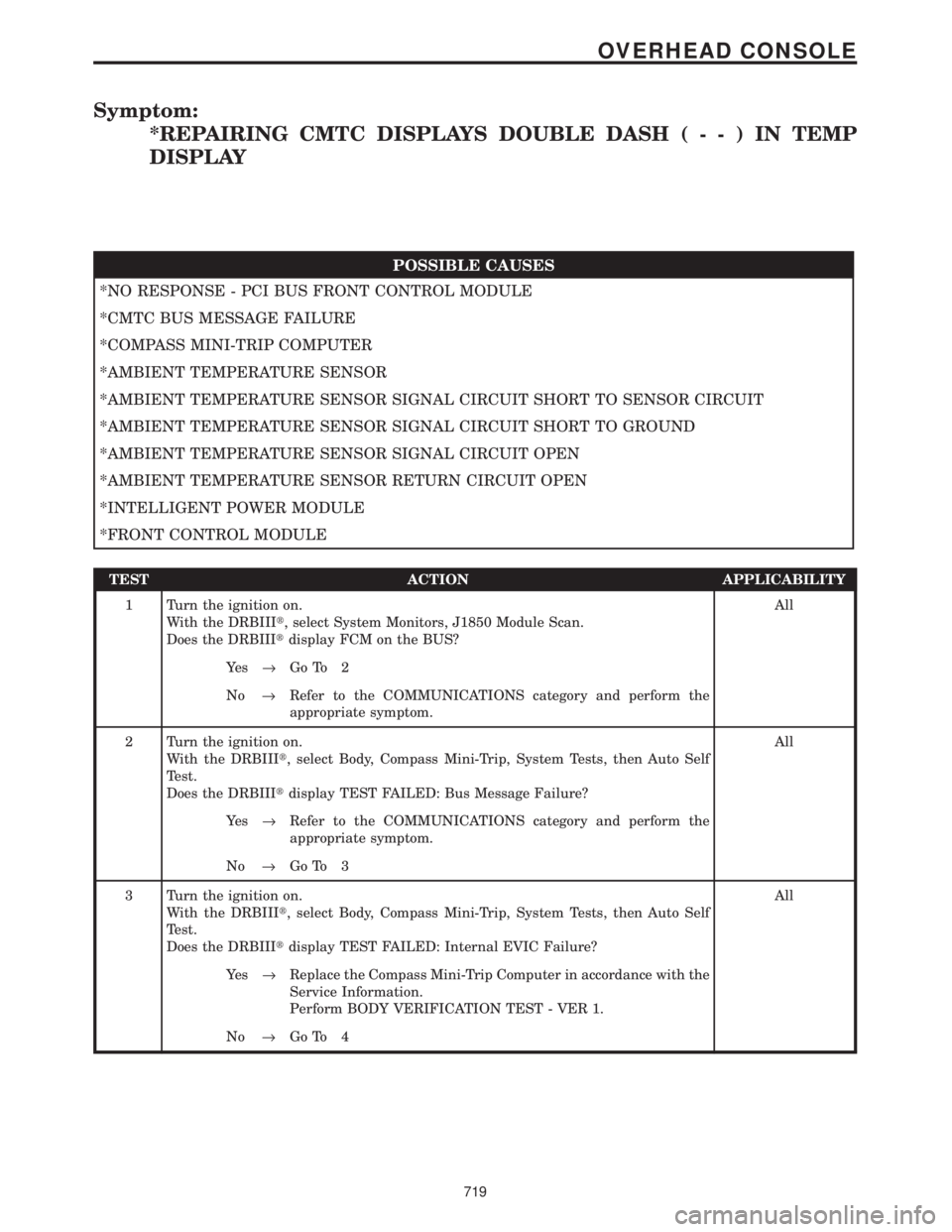
*REPAIRING CMTC DISPLAYS DOUBLE DASH(--)INTEMP
DISPLAY
POSSIBLE CAUSES
*NO RESPONSE - PCI BUS FRONT CONTROL MODULE
*CMTC BUS MESSAGE FAILURE
*COMPASS MINI-TRIP COMPUTER
*AMBIENT TEMPERATURE SENSOR
*AMBIENT TEMPERATURE SENSOR SIGNAL CIRCUIT SHORT TO SENSOR CIRCUIT
*AMBIENT TEMPERATURE SENSOR SIGNAL CIRCUIT SHORT TO GROUND
*AMBIENT TEMPERATURE SENSOR SIGNAL CIRCUIT OPEN
*AMBIENT TEMPERATURE SENSOR RETURN CIRCUIT OPEN
*INTELLIGENT POWER MODULE
*FRONT CONTROL MODULE
TEST ACTION APPLICABILITY
1 Turn the ignition on.
With the DRBIIIt, select System Monitors, J1850 Module Scan.
Does the DRBIIItdisplay FCM on the BUS?All
Ye s®Go To 2
No®Refer to the COMMUNICATIONS category and perform the
appropriate symptom.
2 Turn the ignition on.
With the DRBIIIt, select Body, Compass Mini-Trip, System Tests, then Auto Self
Test.
Does the DRBIIItdisplay TEST FAILED: Bus Message Failure?All
Ye s®Refer to the COMMUNICATIONS category and perform the
appropriate symptom.
No®Go To 3
3 Turn the ignition on.
With the DRBIIIt, select Body, Compass Mini-Trip, System Tests, then Auto Self
Test.
Does the DRBIIItdisplay TEST FAILED: Internal EVIC Failure?All
Ye s®Replace the Compass Mini-Trip Computer in accordance with the
Service Information.
Perform BODY VERIFICATION TEST - VER 1.
No®Go To 4
719
OVERHEAD CONSOLE
Page 749 of 4284
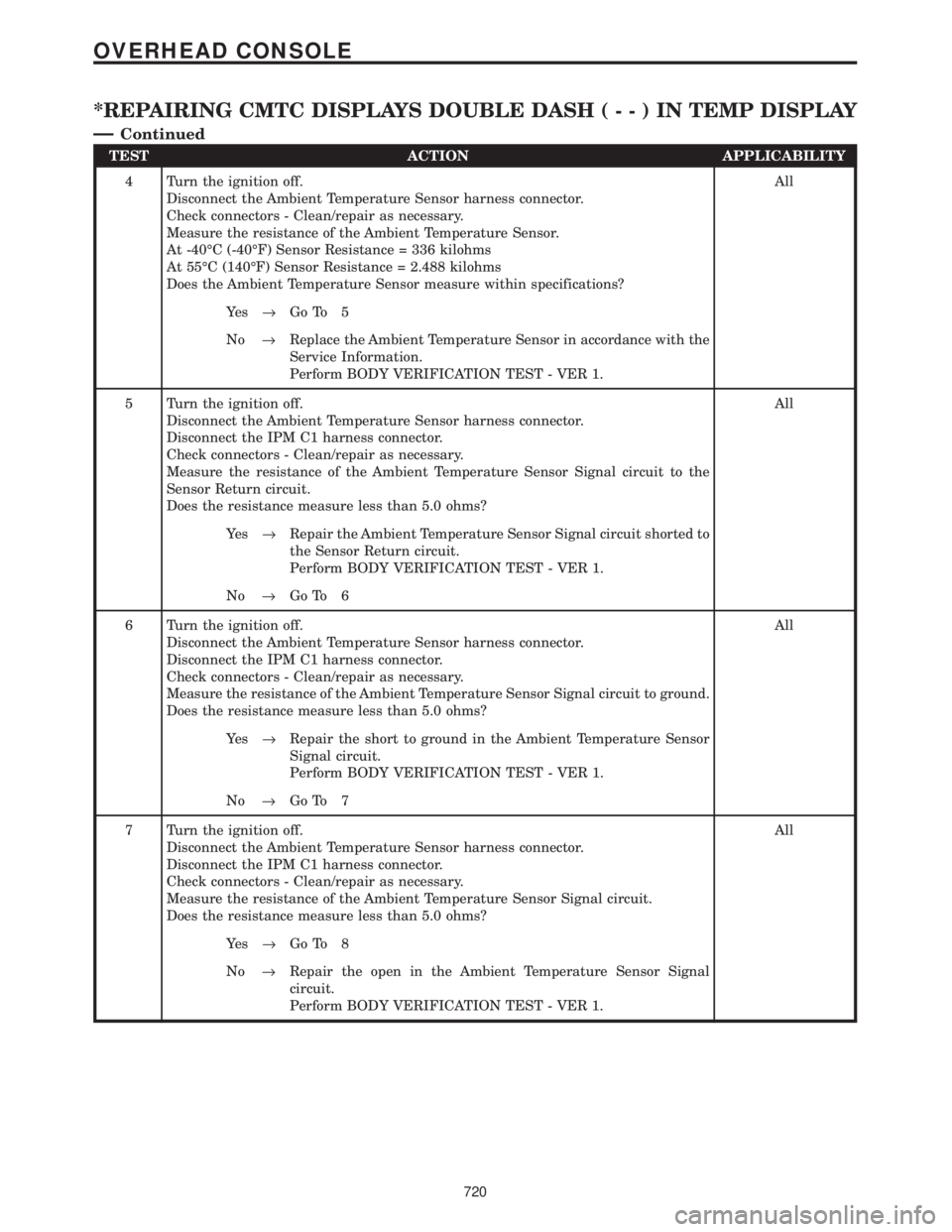
TEST ACTION APPLICABILITY
4 Turn the ignition off.
Disconnect the Ambient Temperature Sensor harness connector.
Check connectors - Clean/repair as necessary.
Measure the resistance of the Ambient Temperature Sensor.
At -40ÉC (-40ÉF) Sensor Resistance = 336 kilohms
At 55ÉC (140ÉF) Sensor Resistance = 2.488 kilohms
Does the Ambient Temperature Sensor measure within specifications?All
Ye s®Go To 5
No®Replace the Ambient Temperature Sensor in accordance with the
Service Information.
Perform BODY VERIFICATION TEST - VER 1.
5 Turn the ignition off.
Disconnect the Ambient Temperature Sensor harness connector.
Disconnect the IPM C1 harness connector.
Check connectors - Clean/repair as necessary.
Measure the resistance of the Ambient Temperature Sensor Signal circuit to the
Sensor Return circuit.
Does the resistance measure less than 5.0 ohms?All
Ye s®Repair the Ambient Temperature Sensor Signal circuit shorted to
the Sensor Return circuit.
Perform BODY VERIFICATION TEST - VER 1.
No®Go To 6
6 Turn the ignition off.
Disconnect the Ambient Temperature Sensor harness connector.
Disconnect the IPM C1 harness connector.
Check connectors - Clean/repair as necessary.
Measure the resistance of the Ambient Temperature Sensor Signal circuit to ground.
Does the resistance measure less than 5.0 ohms?All
Ye s®Repair the short to ground in the Ambient Temperature Sensor
Signal circuit.
Perform BODY VERIFICATION TEST - VER 1.
No®Go To 7
7 Turn the ignition off.
Disconnect the Ambient Temperature Sensor harness connector.
Disconnect the IPM C1 harness connector.
Check connectors - Clean/repair as necessary.
Measure the resistance of the Ambient Temperature Sensor Signal circuit.
Does the resistance measure less than 5.0 ohms?All
Ye s®Go To 8
No®Repair the open in the Ambient Temperature Sensor Signal
circuit.
Perform BODY VERIFICATION TEST - VER 1.
720
OVERHEAD CONSOLE
*REPAIRING CMTC DISPLAYS DOUBLE DASH(--)INTEMP DISPLAY
Ð
Continued
Page 750 of 4284
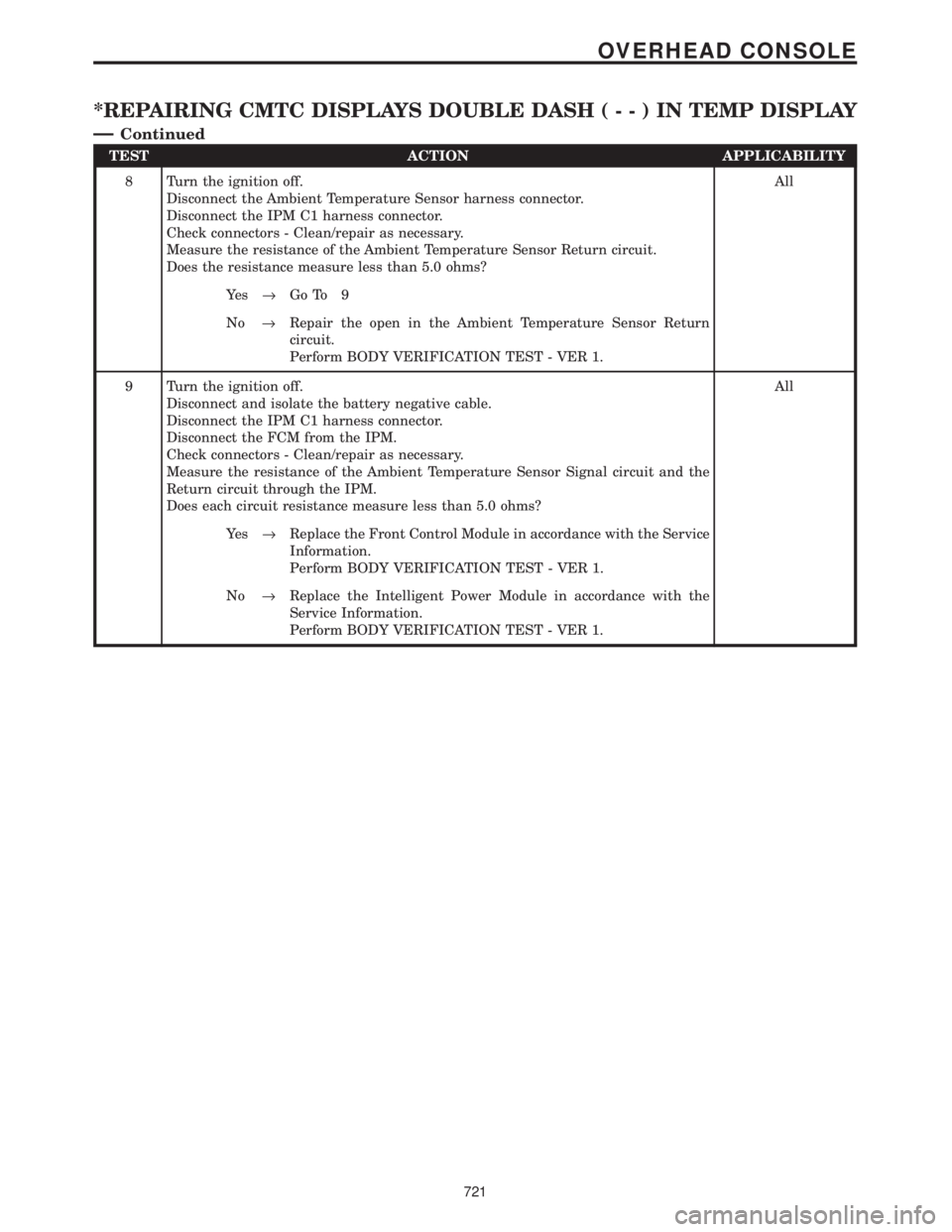
TEST ACTION APPLICABILITY
8 Turn the ignition off.
Disconnect the Ambient Temperature Sensor harness connector.
Disconnect the IPM C1 harness connector.
Check connectors - Clean/repair as necessary.
Measure the resistance of the Ambient Temperature Sensor Return circuit.
Does the resistance measure less than 5.0 ohms?All
Ye s®Go To 9
No®Repair the open in the Ambient Temperature Sensor Return
circuit.
Perform BODY VERIFICATION TEST - VER 1.
9 Turn the ignition off.
Disconnect and isolate the battery negative cable.
Disconnect the IPM C1 harness connector.
Disconnect the FCM from the IPM.
Check connectors - Clean/repair as necessary.
Measure the resistance of the Ambient Temperature Sensor Signal circuit and the
Return circuit through the IPM.
Does each circuit resistance measure less than 5.0 ohms?All
Ye s®Replace the Front Control Module in accordance with the Service
Information.
Perform BODY VERIFICATION TEST - VER 1.
No®Replace the Intelligent Power Module in accordance with the
Service Information.
Perform BODY VERIFICATION TEST - VER 1.
721
OVERHEAD CONSOLE
*REPAIRING CMTC DISPLAYS DOUBLE DASH(--)INTEMP DISPLAY
Ð
Continued
Page 751 of 4284
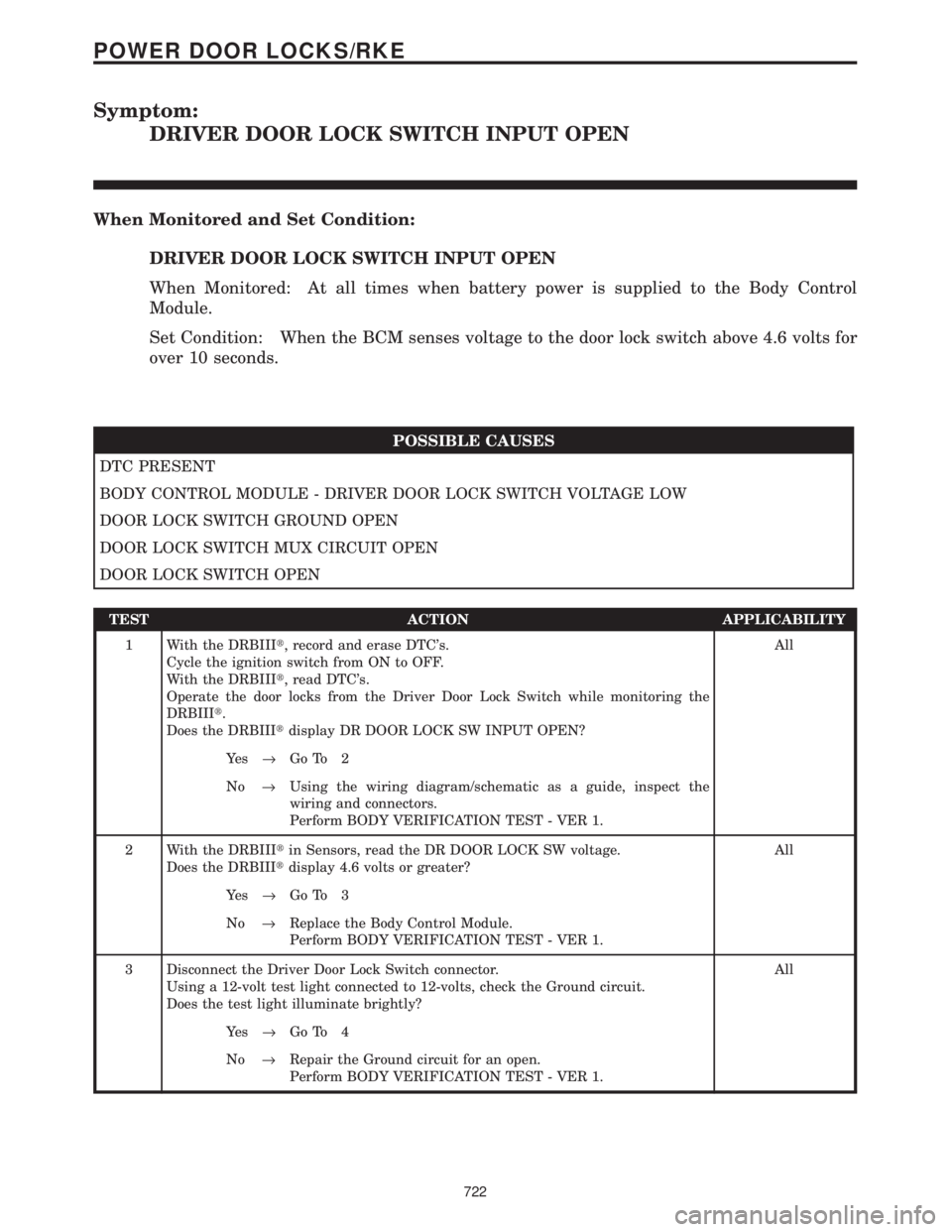
Symptom:
DRIVER DOOR LOCK SWITCH INPUT OPEN
When Monitored and Set Condition:
DRIVER DOOR LOCK SWITCH INPUT OPEN
When Monitored: At all times when battery power is supplied to the Body Control
Module.
Set Condition: When the BCM senses voltage to the door lock switch above 4.6 volts for
over 10 seconds.
POSSIBLE CAUSES
DTC PRESENT
BODY CONTROL MODULE - DRIVER DOOR LOCK SWITCH VOLTAGE LOW
DOOR LOCK SWITCH GROUND OPEN
DOOR LOCK SWITCH MUX CIRCUIT OPEN
DOOR LOCK SWITCH OPEN
TEST ACTION APPLICABILITY
1 With the DRBIIIt, record and erase DTC's.
Cycle the ignition switch from ON to OFF.
With the DRBIIIt, read DTC's.
Operate the door locks from the Driver Door Lock Switch while monitoring the
DRBIIIt.
Does the DRBIIItdisplay DR DOOR LOCK SW INPUT OPEN?All
Ye s®Go To 2
No®Using the wiring diagram/schematic as a guide, inspect the
wiring and connectors.
Perform BODY VERIFICATION TEST - VER 1.
2 With the DRBIIItin Sensors, read the DR DOOR LOCK SW voltage.
Does the DRBIIItdisplay 4.6 volts or greater?All
Ye s®Go To 3
No®Replace the Body Control Module.
Perform BODY VERIFICATION TEST - VER 1.
3 Disconnect the Driver Door Lock Switch connector.
Using a 12-volt test light connected to 12-volts, check the Ground circuit.
Does the test light illuminate brightly?All
Ye s®Go To 4
No®Repair the Ground circuit for an open.
Perform BODY VERIFICATION TEST - VER 1.
722
POWER DOOR LOCKS/RKE
Page 753 of 4284
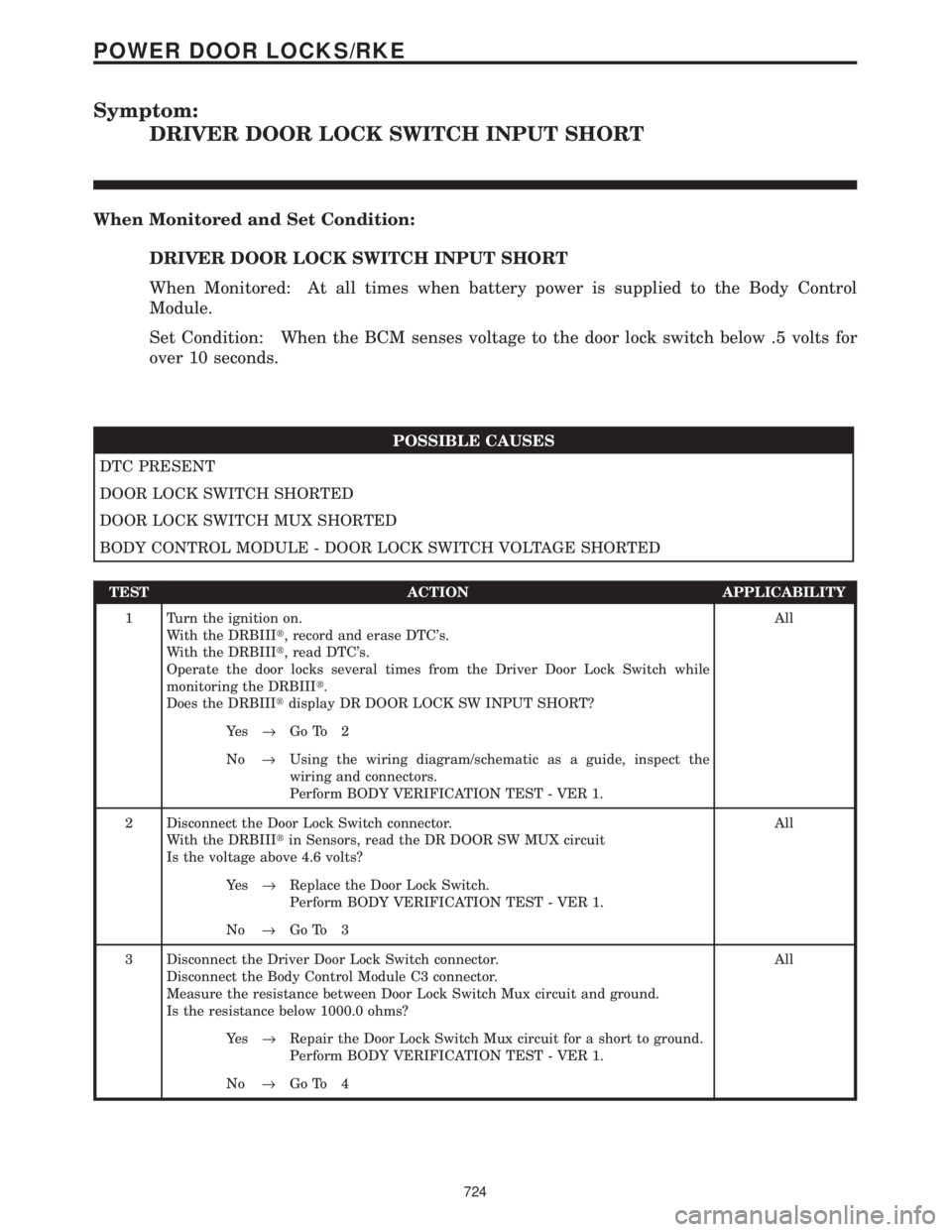
Symptom:
DRIVER DOOR LOCK SWITCH INPUT SHORT
When Monitored and Set Condition:
DRIVER DOOR LOCK SWITCH INPUT SHORT
When Monitored: At all times when battery power is supplied to the Body Control
Module.
Set Condition: When the BCM senses voltage to the door lock switch below .5 volts for
over 10 seconds.
POSSIBLE CAUSES
DTC PRESENT
DOOR LOCK SWITCH SHORTED
DOOR LOCK SWITCH MUX SHORTED
BODY CONTROL MODULE - DOOR LOCK SWITCH VOLTAGE SHORTED
TEST ACTION APPLICABILITY
1 Turn the ignition on.
With the DRBIIIt, record and erase DTC's.
With the DRBIIIt, read DTC's.
Operate the door locks several times from the Driver Door Lock Switch while
monitoring the DRBIIIt.
Does the DRBIIItdisplay DR DOOR LOCK SW INPUT SHORT?All
Ye s®Go To 2
No®Using the wiring diagram/schematic as a guide, inspect the
wiring and connectors.
Perform BODY VERIFICATION TEST - VER 1.
2 Disconnect the Door Lock Switch connector.
With the DRBIIItin Sensors, read the DR DOOR SW MUX circuit
Is the voltage above 4.6 volts?All
Ye s®Replace the Door Lock Switch.
Perform BODY VERIFICATION TEST - VER 1.
No®Go To 3
3 Disconnect the Driver Door Lock Switch connector.
Disconnect the Body Control Module C3 connector.
Measure the resistance between Door Lock Switch Mux circuit and ground.
Is the resistance below 1000.0 ohms?All
Ye s®Repair the Door Lock Switch Mux circuit for a short to ground.
Perform BODY VERIFICATION TEST - VER 1.
No®Go To 4
724
POWER DOOR LOCKS/RKE