ignition CHRYSLER VOYAGER 2001 Service Manual
[x] Cancel search | Manufacturer: CHRYSLER, Model Year: 2001, Model line: VOYAGER, Model: CHRYSLER VOYAGER 2001Pages: 4284, PDF Size: 83.53 MB
Page 1103 of 4284
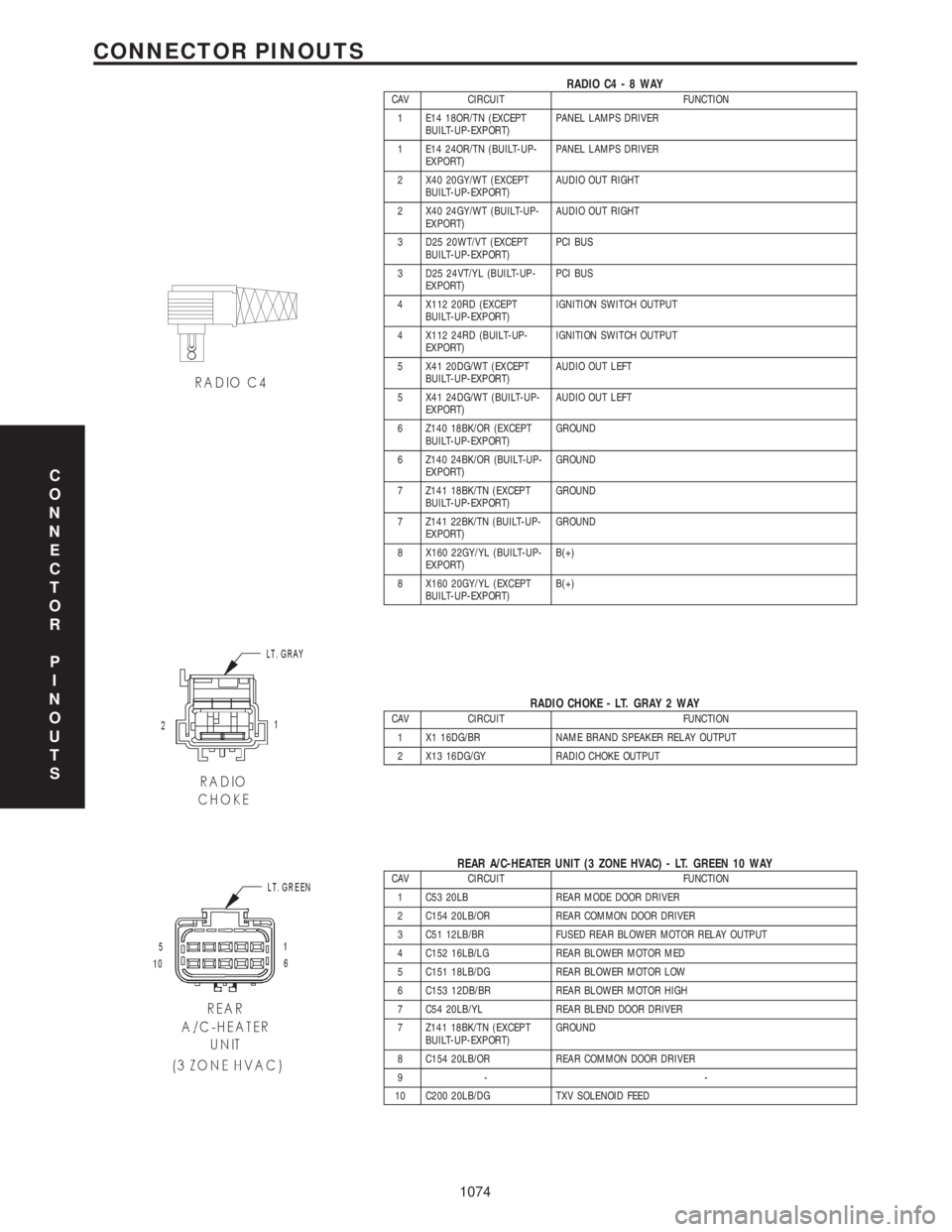
RADIO C4-8WAYCAV CIRCUIT FUNCTION
1 E14 18OR/TN (EXCEPT
BUILT-UP-EXPORT)PANEL LAMPS DRIVER
1 E14 24OR/TN (BUILT-UP-
EXPORT)PANEL LAMPS DRIVER
2 X40 20GY/WT (EXCEPT
BUILT-UP-EXPORT)AUDIO OUT RIGHT
2 X40 24GY/WT (BUILT-UP-
EXPORT)AUDIO OUT RIGHT
3 D25 20WT/VT (EXCEPT
BUILT-UP-EXPORT)PCI BUS
3 D25 24VT/YL (BUILT-UP-
EXPORT)PCI BUS
4 X112 20RD (EXCEPT
BUILT-UP-EXPORT)IGNITION SWITCH OUTPUT
4 X112 24RD (BUILT-UP-
EXPORT)IGNITION SWITCH OUTPUT
5 X41 20DG/WT (EXCEPT
BUILT-UP-EXPORT)AUDIO OUT LEFT
5 X41 24DG/WT (BUILT-UP-
EXPORT)AUDIO OUT LEFT
6 Z140 18BK/OR (EXCEPT
BUILT-UP-EXPORT)GROUND
6 Z140 24BK/OR (BUILT-UP-
EXPORT)GROUND
7 Z141 18BK/TN (EXCEPT
BUILT-UP-EXPORT)GROUND
7 Z141 22BK/TN (BUILT-UP-
EXPORT)GROUND
8 X160 22GY/YL (BUILT-UP-
EXPORT)B(+)
8 X160 20GY/YL (EXCEPT
BUILT-UP-EXPORT)B(+)
RADIO CHOKE - LT. GRAY 2 WAYCAV CIRCUIT FUNCTION
1 X1 16DG/BR NAME BRAND SPEAKER RELAY OUTPUT
2 X13 16DG/GY RADIO CHOKE OUTPUT
REAR A/C-HEATER UNIT (3 ZONE HVAC) - LT. GREEN 10 WAYCAV CIRCUIT FUNCTION
1 C53 20LB REAR MODE DOOR DRIVER
2 C154 20LB/OR REAR COMMON DOOR DRIVER
3 C51 12LB/BR FUSED REAR BLOWER MOTOR RELAY OUTPUT
4 C152 16LB/LG REAR BLOWER MOTOR MED
5 C151 18LB/DG REAR BLOWER MOTOR LOW
6 C153 12DB/BR REAR BLOWER MOTOR HIGH
7 C54 20LB/YL REAR BLEND DOOR DRIVER
7 Z141 18BK/TN (EXCEPT
BUILT-UP-EXPORT)GROUND
8 C154 20LB/OR REAR COMMON DOOR DRIVER
9- -
10 C200 20LB/DG TXV SOLENOID FEED
C
O
N
N
E
C
T
O
R
P
I
N
O
U
T
S
1074
CONNECTOR PINOUTS
Page 1104 of 4284
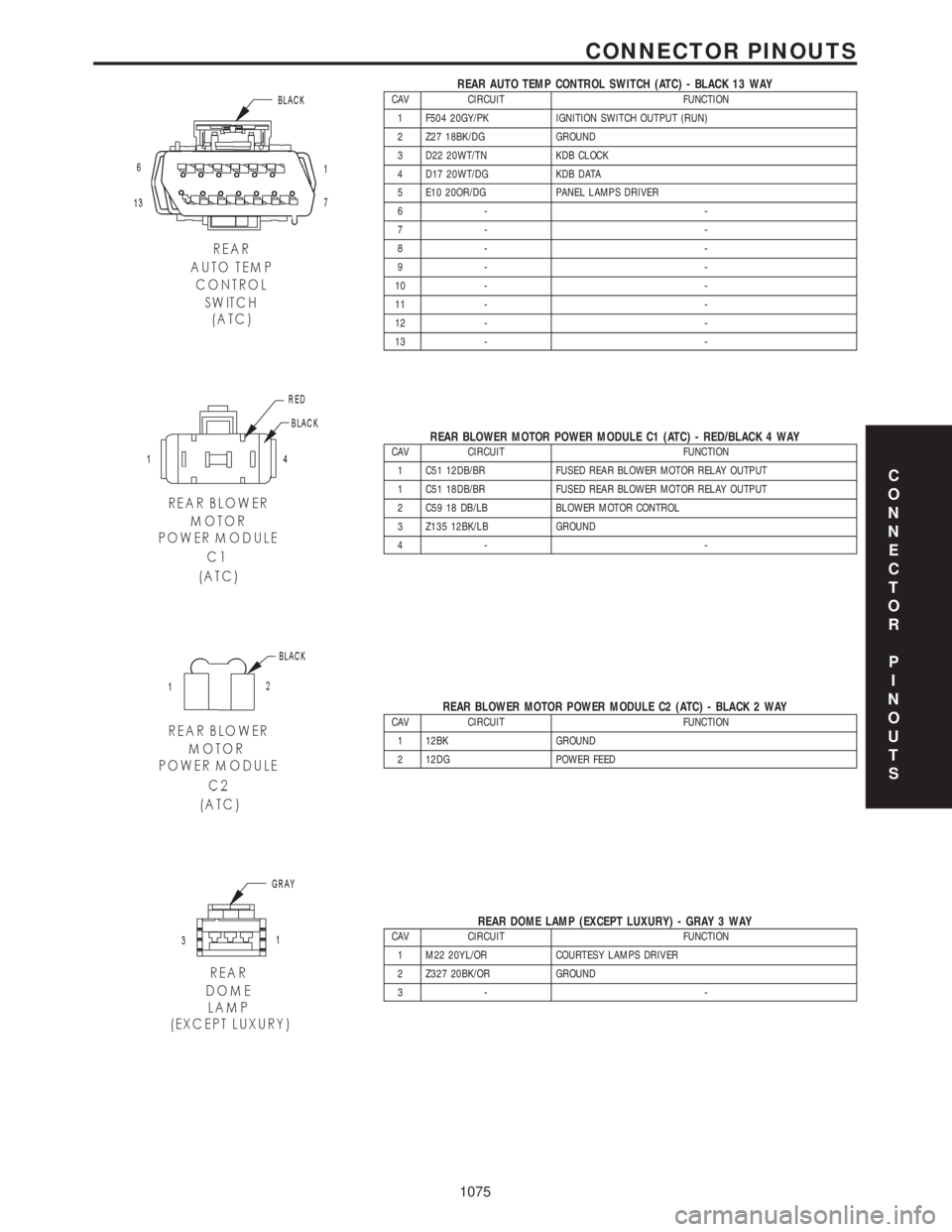
REAR AUTO TEMP CONTROL SWITCH (ATC) - BLACK 13 WAYCAV CIRCUIT FUNCTION
1 F504 20GY/PK IGNITION SWITCH OUTPUT (RUN)
2 Z27 18BK/DG GROUND
3 D22 20WT/TN KDB CLOCK
4 D17 20WT/DG KDB DATA
5 E10 20OR/DG PANEL LAMPS DRIVER
6- -
7- -
8- -
9- -
10 - -
11 - -
12 - -
13 - -
REAR BLOWER MOTOR POWER MODULE C1 (ATC) - RED/BLACK 4 WAYCAV CIRCUIT FUNCTION
1 C51 12DB/BR FUSED REAR BLOWER MOTOR RELAY OUTPUT
1 C51 18DB/BR FUSED REAR BLOWER MOTOR RELAY OUTPUT
2 C59 18 DB/LB BLOWER MOTOR CONTROL
3 Z135 12BK/LB GROUND
4- -
REAR BLOWER MOTOR POWER MODULE C2 (ATC) - BLACK 2 WAYCAV CIRCUIT FUNCTION
1 12BK GROUND
2 12DG POWER FEED
REAR DOME LAMP (EXCEPT LUXURY) - GRAY 3 WAYCAV CIRCUIT FUNCTION
1 M22 20YL/OR COURTESY LAMPS DRIVER
2 Z327 20BK/OR GROUND
3- -
C
O
N
N
E
C
T
O
R
P
I
N
O
U
T
S
1075
CONNECTOR PINOUTS
Page 1112 of 4284
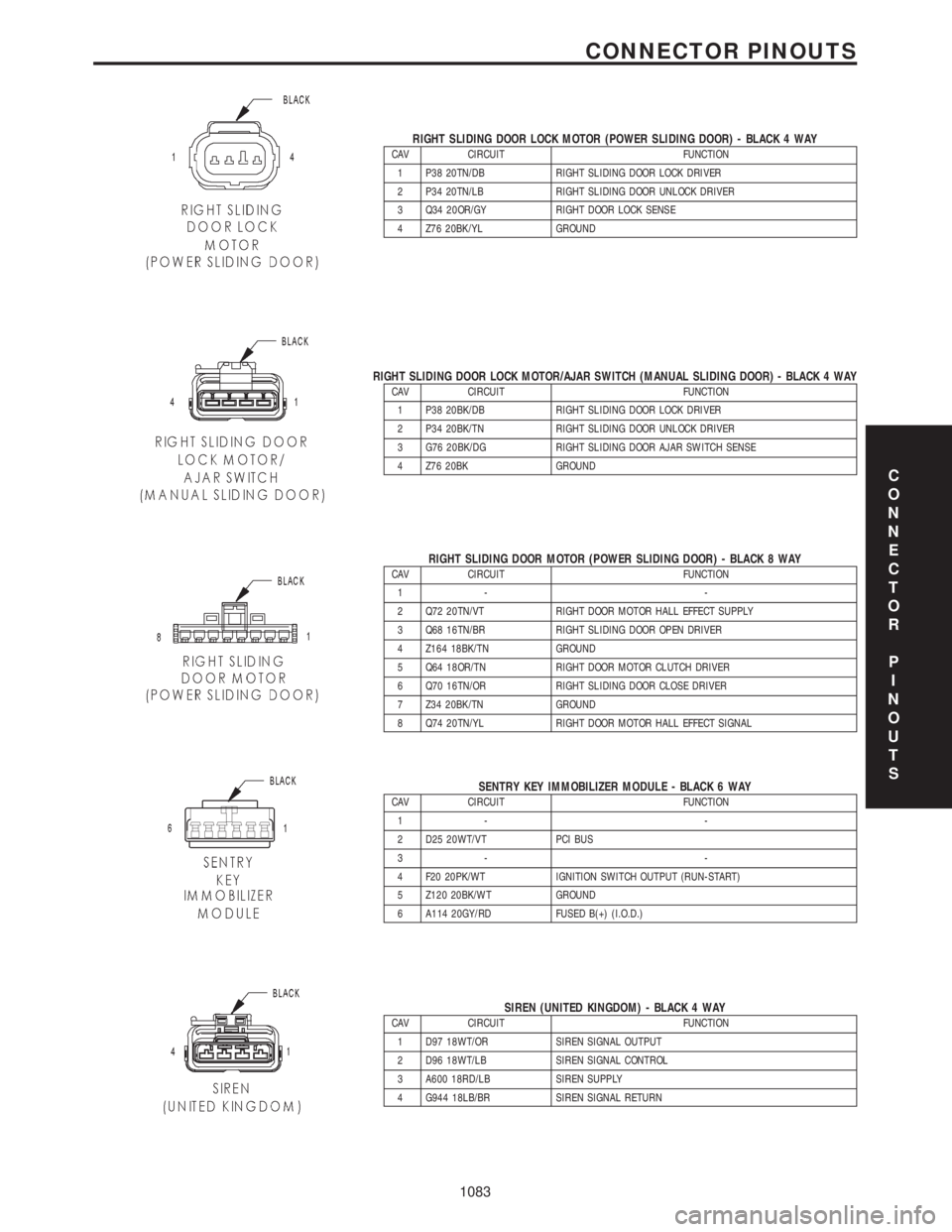
RIGHT SLIDING DOOR LOCK MOTOR (POWER SLIDING DOOR) - BLACK 4 WAYCAV CIRCUIT FUNCTION
1 P38 20TN/DB RIGHT SLIDING DOOR LOCK DRIVER
2 P34 20TN/LB RIGHT SLIDING DOOR UNLOCK DRIVER
3 Q34 20OR/GY RIGHT DOOR LOCK SENSE
4 Z76 20BK/YL GROUND
RIGHT SLIDING DOOR LOCK MOTOR/AJAR SWITCH (MANUAL SLIDING DOOR) - BLACK 4 WAYCAV CIRCUIT FUNCTION
1 P38 20BK/DB RIGHT SLIDING DOOR LOCK DRIVER
2 P34 20BK/TN RIGHT SLIDING DOOR UNLOCK DRIVER
3 G76 20BK/DG RIGHT SLIDING DOOR AJAR SWITCH SENSE
4 Z76 20BK GROUND
RIGHT SLIDING DOOR MOTOR (POWER SLIDING DOOR) - BLACK 8 WAYCAV CIRCUIT FUNCTION
1- -
2 Q72 20TN/VT RIGHT DOOR MOTOR HALL EFFECT SUPPLY
3 Q68 16TN/BR RIGHT SLIDING DOOR OPEN DRIVER
4 Z164 18BK/TN GROUND
5 Q64 18OR/TN RIGHT DOOR MOTOR CLUTCH DRIVER
6 Q70 16TN/OR RIGHT SLIDING DOOR CLOSE DRIVER
7 Z34 20BK/TN GROUND
8 Q74 20TN/YL RIGHT DOOR MOTOR HALL EFFECT SIGNAL
SENTRY KEY IMMOBILIZER MODULE - BLACK 6 WAYCAV CIRCUIT FUNCTION
1- -
2 D25 20WT/VT PCI BUS
3- -
4 F20 20PK/WT IGNITION SWITCH OUTPUT (RUN-START)
5 Z120 20BK/WT GROUND
6 A114 20GY/RD FUSED B(+) (I.O.D.)
SIREN (UNITED KINGDOM) - BLACK 4 WAYCAV CIRCUIT FUNCTION
1 D97 18WT/OR SIREN SIGNAL OUTPUT
2 D96 18WT/LB SIREN SIGNAL CONTROL
3 A600 18RD/LB SIREN SUPPLY
4 G944 18LB/BR SIREN SIGNAL RETURN
C
O
N
N
E
C
T
O
R
P
I
N
O
U
T
S
1083
CONNECTOR PINOUTS
Page 1113 of 4284
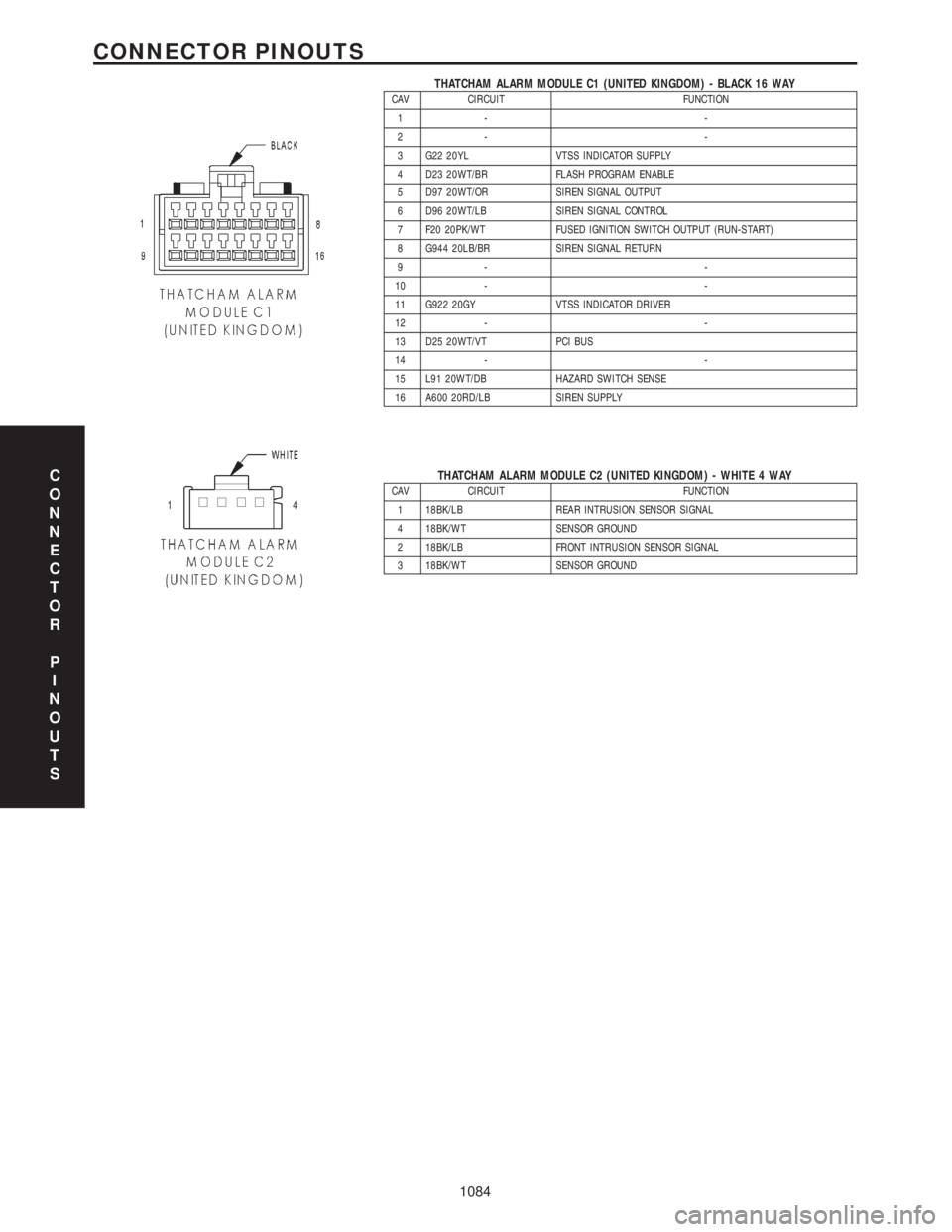
THATCHAM ALARM MODULE C1 (UNITED KINGDOM) - BLACK 16 WAYCAV CIRCUIT FUNCTION
1- -
2- -
3 G22 20YL VTSS INDICATOR SUPPLY
4 D23 20WT/BR FLASH PROGRAM ENABLE
5 D97 20WT/OR SIREN SIGNAL OUTPUT
6 D96 20WT/LB SIREN SIGNAL CONTROL
7 F20 20PK/WT FUSED IGNITION SWITCH OUTPUT (RUN-START)
8 G944 20LB/BR SIREN SIGNAL RETURN
9- -
10 - -
11 G922 20GY VTSS INDICATOR DRIVER
12 - -
13 D25 20WT/VT PCI BUS
14 - -
15 L91 20WT/DB HAZARD SWITCH SENSE
16 A600 20RD/LB SIREN SUPPLY
THATCHAM ALARM MODULE C2 (UNITED KINGDOM) - WHITE 4 WAYCAV CIRCUIT FUNCTION
1 18BK/LB REAR INTRUSION SENSOR SIGNAL
4 18BK/WT SENSOR GROUND
2 18BK/LB FRONT INTRUSION SENSOR SIGNAL
3 18BK/WT SENSOR GROUNDC
O
N
N
E
C
T
O
R
P
I
N
O
U
T
S
1084
CONNECTOR PINOUTS
Page 1114 of 4284
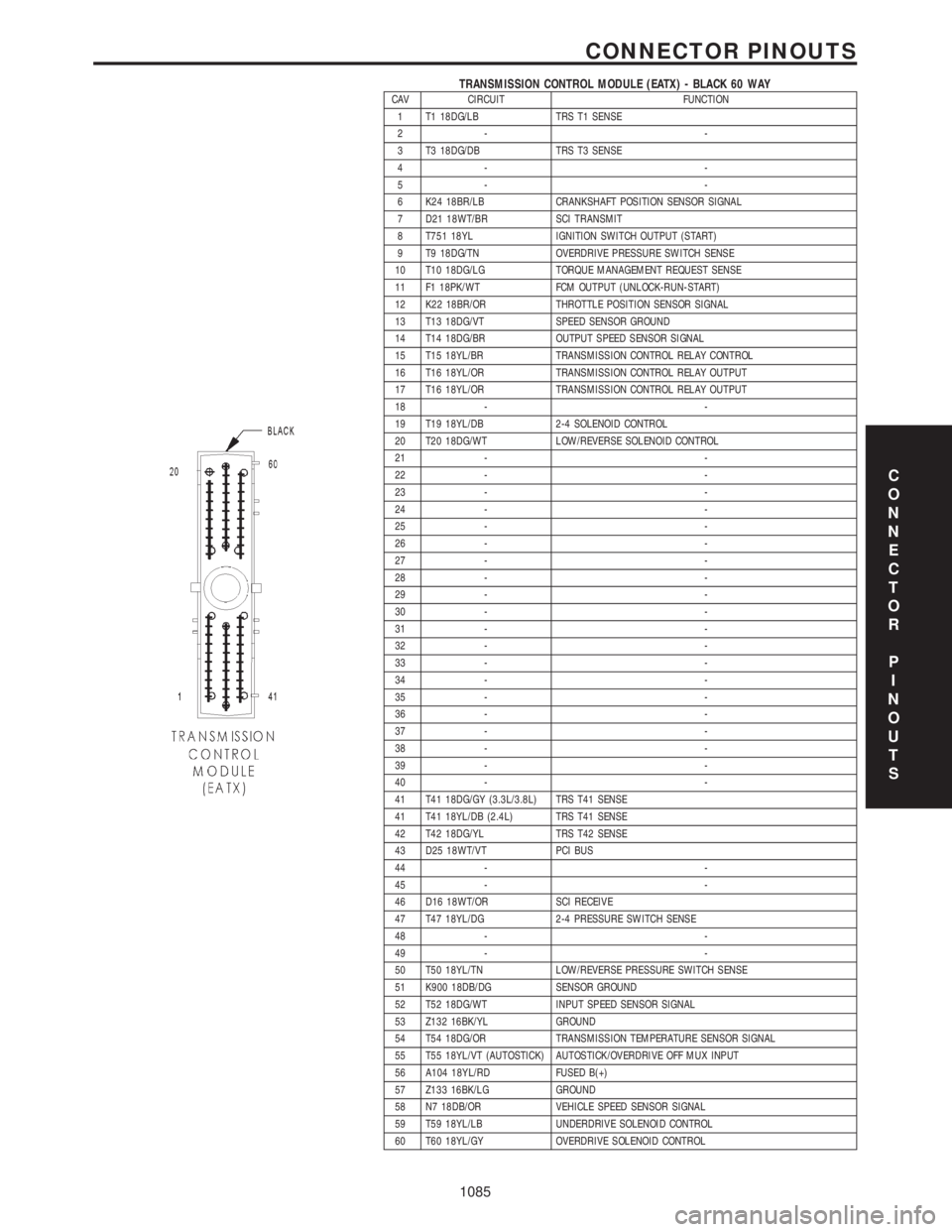
TRANSMISSION CONTROL MODULE (EATX) - BLACK 60 WAYCAV CIRCUIT FUNCTION
1 T1 18DG/LB TRS T1 SENSE
2- -
3 T3 18DG/DB TRS T3 SENSE
4- -
5- -
6 K24 18BR/LB CRANKSHAFT POSITION SENSOR SIGNAL
7 D21 18WT/BR SCI TRANSMIT
8 T751 18YL IGNITION SWITCH OUTPUT (START)
9 T9 18DG/TN OVERDRIVE PRESSURE SWITCH SENSE
10 T10 18DG/LG TORQUE MANAGEMENT REQUEST SENSE
11 F1 18PK/WT FCM OUTPUT (UNLOCK-RUN-START)
12 K22 18BR/OR THROTTLE POSITION SENSOR SIGNAL
13 T13 18DG/VT SPEED SENSOR GROUND
14 T14 18DG/BR OUTPUT SPEED SENSOR SIGNAL
15 T15 18YL/BR TRANSMISSION CONTROL RELAY CONTROL
16 T16 18YL/OR TRANSMISSION CONTROL RELAY OUTPUT
17 T16 18YL/OR TRANSMISSION CONTROL RELAY OUTPUT
18 - -
19 T19 18YL/DB 2-4 SOLENOID CONTROL
20 T20 18DG/WT LOW/REVERSE SOLENOID CONTROL
21 - -
22 - -
23 - -
24 - -
25 - -
26 - -
27 - -
28 - -
29 - -
30 - -
31 - -
32 - -
33 - -
34 - -
35 - -
36 - -
37 - -
38 - -
39 - -
40 - -
41 T41 18DG/GY (3.3L/3.8L) TRS T41 SENSE
41 T41 18YL/DB (2.4L) TRS T41 SENSE
42 T42 18DG/YL TRS T42 SENSE
43 D25 18WT/VT PCI BUS
44 - -
45 - -
46 D16 18WT/OR SCI RECEIVE
47 T47 18YL/DG 2-4 PRESSURE SWITCH SENSE
48 - -
49 - -
50 T50 18YL/TN LOW/REVERSE PRESSURE SWITCH SENSE
51 K900 18DB/DG SENSOR GROUND
52 T52 18DG/WT INPUT SPEED SENSOR SIGNAL
53 Z132 16BK/YL GROUND
54 T54 18DG/OR TRANSMISSION TEMPERATURE SENSOR SIGNAL
55 T55 18YL/VT (AUTOSTICK) AUTOSTICK/OVERDRIVE OFF MUX INPUT
56 A104 18YL/RD FUSED B(+)
57 Z133 16BK/LG GROUND
58 N7 18DB/OR VEHICLE SPEED SENSOR SIGNAL
59 T59 18YL/LB UNDERDRIVE SOLENOID CONTROL
60 T60 18YL/GY OVERDRIVE SOLENOID CONTROL
C
O
N
N
E
C
T
O
R
P
I
N
O
U
T
S
1085
CONNECTOR PINOUTS
Page 1129 of 4284
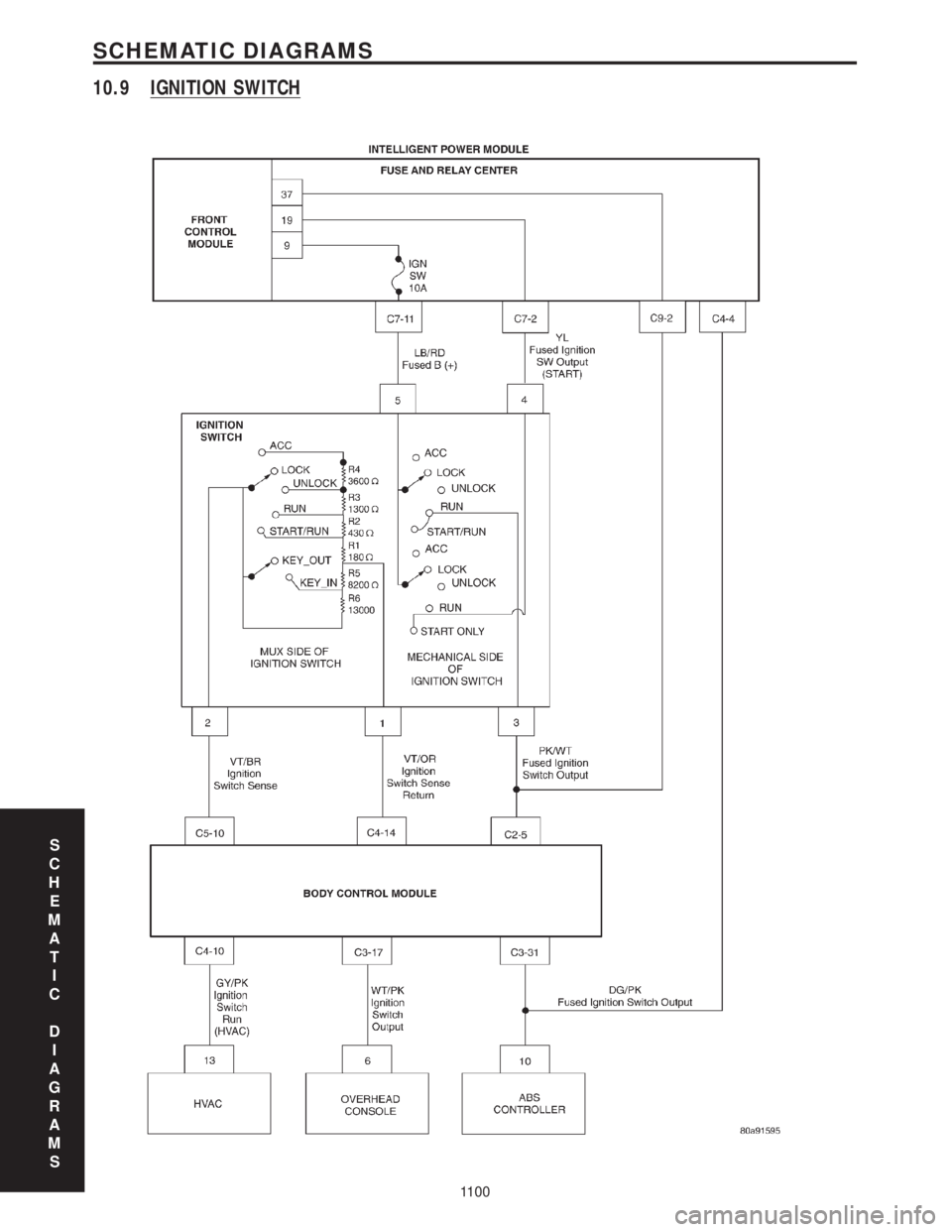
10.9 IGNITION SWITCH
S
C
H
E
M
A
T
I
C
D
I
A
G
R
A
M
S
1100
SCHEMATIC DIAGRAMS
Page 1159 of 4284
The cycling of the build and decay valves is
similar to the ABS except that they work to control
wheel spin by applying brakes. ABS function is to
control wheel skid by releasing brakes.
Two pressure relief valves allow excess fluid vol-
ume to return to the reservoir when not used by the
build/decay cycles. These are required because the
pump supplies more volume than the traction con-
trol system requires.
If at any time the brake pedal is applied during a
traction control cycle, the brake lamp switch will
trigger the CAB to switch off the traction control.
The traction control system will be enabled at
each ignition cycle. It may be turned off by depress-
ing the Traction Control Switch. The traction con-
trol system function lamp will illuminate ªTRAC
OFFº immediately upon depressing the traction
control switch button. Only the ªTRACº portion of
the ªTRAC OFFº indicator will illuminate during a
traction control event. If the CAB calculates that
the brake temperatures are high, the traction con-
trol system will become inoperative until a time-out
period has elapsed. When in this thermal protection
mode, the traction control ªTRAC OFFº lamp will
illuminate; however, a fault will not be registered.
3.3 SYSTEM COMPONENTS
²controller antilock brake (CAB)
²vacuum booster
²master cylinder
²ABS integrated electronic control module/
hydraulic control unit (HCU), valve block assem-
bly: 8 valve solenoids (4 inlet valves, 4 outlet
valves, 2 accumulators) 1 motor, 2 pump
²ABS integrated electronic control module with
traction control same as above but has 10 valve
solenoids.
²4 wheel speed sensor/tone wheel assemblies
²ABS warning indicator
²fuses and wiring harness
²fluid reservoir
²TRAC/TRAC OFF indicator
3.3.1 ABS AND BRAKE WARNING
INDICATORS
The amber ABS warning indicator is located in
the instrument cluster. It is used to inform the
driver that the antilock function has been turned
off. The ABS warning indicator is controlled by the
CAB. The CAB controls the lamp with a command
over the PCI bus.
The ABS Warning Indicator will remain lit during
every key cycle until a circuit or component fault is
repaired and the CAB no longer detects the fault.After repair of a sensor signal fault or a pump motor
fault, the CAB must sense all four wheels at 25
km/h (15 mph) before it will extinguish the ABS and
TRAC OFF Indicators.
The Instrument Cluster will illuminate the ABS
Warning Indicator if it loses communication with
the CAB.
The red BRAKE warning indicator is also located
in the instrument cluster. It can be activated in
several ways. Application of the parking brake or a
low fluid signal from the fluid level switch located in
the master cylinder reservoir will cause the indica-
tor to come on.
3.3.2 CONTROLLER ANTILOCK BRAKE
(CAB)
The Controller Antilock Brake (CAB) is a
microprocessor-based device that monitors wheel
speeds and controls the antilock functions. The
CAB contains two microprocessors that receive
identical sensor signals and then independently
process the information. The results are then com-
pared to make sure that they agree. Otherwise, the
CAB will turn off the antilock and turn on the ABS
amber warning indicator.
The primary functions of the CAB are to:
²detect wheel locking tendencies
²control fluid pressure modulation to the brakes
during antilock stop
²monitor the system for proper operation
²manage traction control functions
²provide communication to the DRBIIItwhile in
diagnostic mode
²store diagnostic information in non-volatile memory
The CAB continuously monitors the speed of each
wheel. When a wheel locking tendency is detected,
the CAB will command the appropriate valve to
modulate brake fluid pressure in its hydraulic unit.
Brake pedal position is maintained during an an-
tilock stop by being a closed system with the use of
2 accumulators. The CAB continues to control pres-
sure in individual hydraulic circuits until a wheel
locking tendency is no longer present. The CAB
turns on the pump motor during an antilock stop.
The antilock brake system is constantly moni-
tored by the CAB for proper operation. If the CAB
detects a system malfunction, it can disable the
antilock system and turn on the ABS warning
indicator. If the antilock function is disabled, the
system will revert to standard base brake system
operation.
The CAB inputs include the following:
²diagnostic communication
²four wheel speed sensors
2
GENERAL INFORMATION
Page 1163 of 4284
4.3 WARNINGS
4.3.1 VEHICLE DAMAGE WARNINGS
Before disconnecting any control module, make
sure the ignition is ``off ''. Failure to do so could
damage the module.
When testing voltage or continuity at any control
module, use the terminal side (not the wire end) of
the connector. Do not probe a wire through the
insulation, this will damage it and eventually cause
it to fail because of corrosion.
Be careful when performing electrical tests so as
to prevent accidental shorting of terminals. Such
mistakes can damage fuses or components. Also, a
second code could be set, making diagnosis of the
original problem more difficult.
4.3.2 ROAD TESTING A COMPLAINT
VEHICLE
Some complaints will require a test drive as part
of the repair verification procedure. The purpose of
the test drive is to try to duplicate the diagnostic
code or symptom condition.
WARNING: BEFORE ROAD TESTING A
VEHICLE, BE SURE THAT ALL
COMPONENTS ARE REASSEMBLED.
DURING THE TEST DRIVE, DO NOT TRY TO
READ THE DRB SCREEN WHILE IN MOTION.
DO NOT HANG THE DRBIIITFROM THE
REAR VIEW MIRROR OR OPERATE IT
YOURSELF. HAVE AN ASSISTANT
AVAILABLE TO OPERATE THE DRBIIIT.
4.4 DIAGNOSIS
1. Your diagnostic test procedure must begin with a
thorough visual inspection of the ABS system for
damaged components or disconnected connec-
tors. The brake lamps must be operational, and
if they are not, repair them prior to continuing.
2. Connect the DRBIIItto the data link connector,
which is located under the dash to the left of the
steering column. If the DRBIIItdoes not power
up, check the power and ground supplies to the
connector.
3. Turn the ignition on. Select ªAntilock Brakesº. If
the DRBIIItdisplays ªNo Responseº condition
you must diagnose that first.
4. Read and record all ABS diagnostic trouble
codes. If the ªCAB Power Feed Circuitº diagnos-
tic trouble code is present, it must be repaired
prior to addressing any other DTC's. If any
additional DTC's are present, proceed to theappropriate test by locating the matching test in
the Table of Contents and begin to diagnose the
symptom.
5. If there are no diagnostic trouble codes present,
identify the customer complaint. Select ªInputs/
Outputsº and read the brake switch input as you
press and release the brake pedal. If the display
does not match the state of the pedal, perform
the proper test by locating the matching test in
the Table of Contents and begin to diagnose the
symptom. If a problem exists with the yellow
ªABSº warning indicator or the red ªBrakeº
indicator exists, refer to the proper tests by
locating the matching test in the Table of Con-
tents and begin to diagnose the symptom. Read
the traction control switch input as you press
and release the switch. If the display does not
match the state of the indicator perform the
proper test by locating the matching test in the
Table of Contents and begin to diagnose the
symptom.
6. If no other problems are found, it will be neces-
sary to road test the vehicle. Perform several
antilock stops from above 50 Km/h (30 mph) and
then repeat step 4. If any diagnostic trouble
codes are present, proceed to the appropriate test.
7. The following conditions should be considered
ªNORMALº operation, and no repairs should be
attempted to correct them.
± Brake pedal feedback during an ABS stop
(clicking, vibrating).
± Clicking, groaning or buzzing at 25 Km/h (15
mph) or 40 Km/h (24 mph) (drive off self test).
± Groaning noise during an ABS stop.
± Slight brake pedal drop and pop noise when
ignition is initially turned on.
± Brake pedal ratcheting down at the end of an
ABS stop.
8. If the complaint is ABS ªcyclingº at the end of a
stop at low speeds, it may be caused by a
marginal wheel speed sensor signal. The sensor
air gap, tone wheel condition, and/or brakes
hanging up are possible causes of this condition.
9. After a road test in which no problems were
found, refer to any Technical Service Bulletins
that may apply.
5.0 REQUIRED TOOLS AND
EQUIPMENT
DRBIIIt(diagnostic read-out box)
jumper wires
ohmmeter
voltmeter
test light
6
GENERAL INFORMATION
Page 1167 of 4284
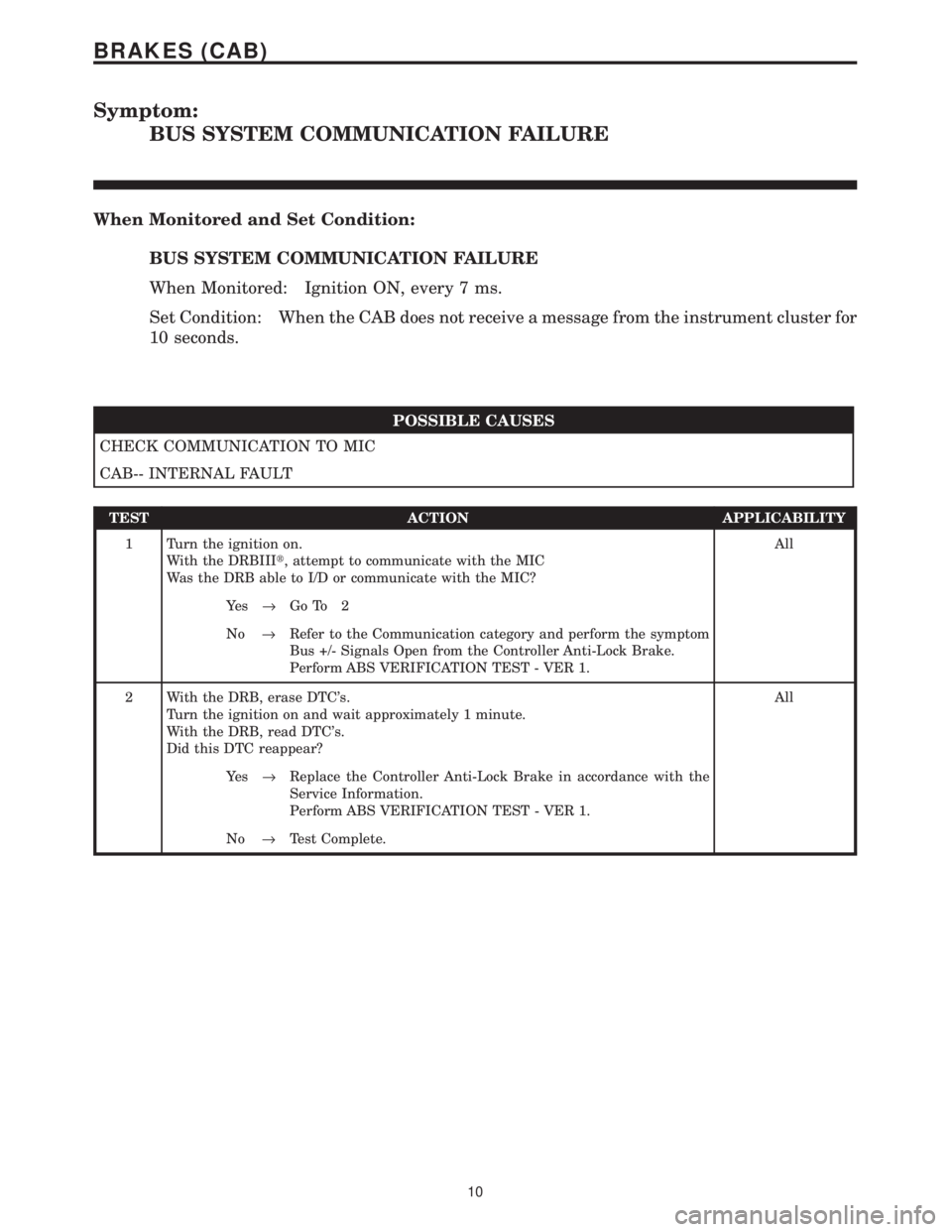
Symptom:
BUS SYSTEM COMMUNICATION FAILURE
When Monitored and Set Condition:
BUS SYSTEM COMMUNICATION FAILURE
When Monitored: Ignition ON, every 7 ms.
Set Condition: When the CAB does not receive a message from the instrument cluster for
10 seconds.
POSSIBLE CAUSES
CHECK COMMUNICATION TO MIC
CAB-- INTERNAL FAULT
TEST ACTION APPLICABILITY
1 Turn the ignition on.
With the DRBIIIt, attempt to communicate with the MIC
Was the DRB able to I/D or communicate with the MIC?All
Ye s®Go To 2
No®Refer to the Communication category and perform the symptom
Bus +/- Signals Open from the Controller Anti-Lock Brake.
Perform ABS VERIFICATION TEST - VER 1.
2 With the DRB, erase DTC's.
Turn the ignition on and wait approximately 1 minute.
With the DRB, read DTC's.
Did this DTC reappear?All
Ye s®Replace the Controller Anti-Lock Brake in accordance with the
Service Information.
Perform ABS VERIFICATION TEST - VER 1.
No®Test Complete.
10
BRAKES (CAB)
Page 1168 of 4284
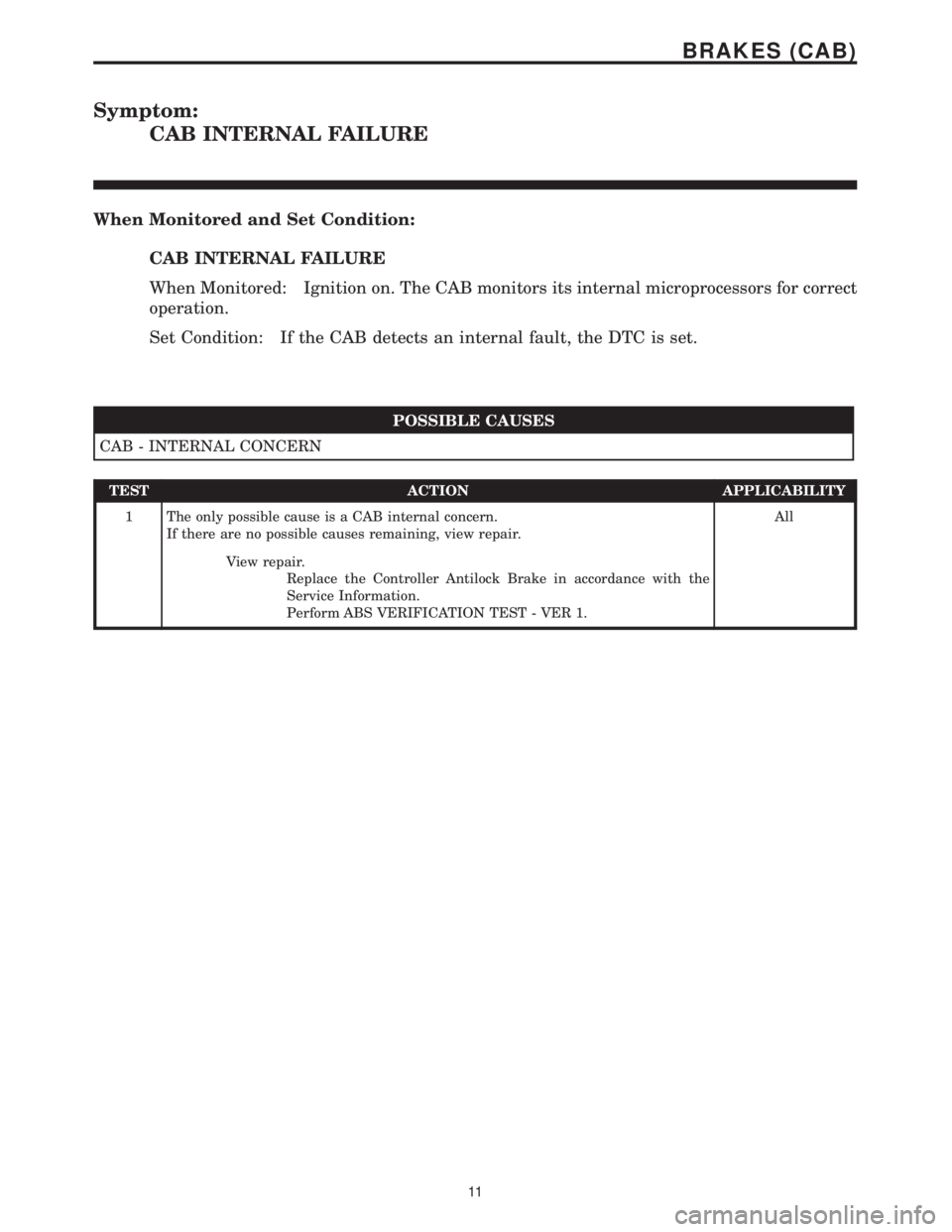
Symptom:
CAB INTERNAL FAILURE
When Monitored and Set Condition:
CAB INTERNAL FAILURE
When Monitored: Ignition on. The CAB monitors its internal microprocessors for correct
operation.
Set Condition: If the CAB detects an internal fault, the DTC is set.
POSSIBLE CAUSES
CAB - INTERNAL CONCERN
TEST ACTION APPLICABILITY
1 The only possible cause is a CAB internal concern.
If there are no possible causes remaining, view repair.All
View repair.
Replace the Controller Antilock Brake in accordance with the
Service Information.
Perform ABS VERIFICATION TEST - VER 1.
11
BRAKES (CAB)