light CHRYSLER VOYAGER 2001 Service Manual
[x] Cancel search | Manufacturer: CHRYSLER, Model Year: 2001, Model line: VOYAGER, Model: CHRYSLER VOYAGER 2001Pages: 4284, PDF Size: 83.53 MB
Page 4 of 4284
TABLE OF CONTENTS
1.0 INTRODUCTION.........................................................1
1.1SYSTEM COVERAGE...............................................1
1.2SIX-STEP TROUBLESHOOTING PROCEDURE..........................1
2.0 IDENTIFICATION OF SYSTEM.............................................1
3.0 SYSTEM DESCRIPTION AND FUNCTIONAL OPERATION......................1
3.1AIRBAG SYSTEM/OCCUPANT RESTRAINT CONTROLLER SYSTEM........2
3.1.1DRIVER AIRBAG...........................................3
3.1.2CLOCKSPRING............................................4
3.1.3PASSENGER AIRBAG......................................4
3.1.4SEAT BELT TENSIONER (SBT)...............................5
3.1.5SEAT BELT SWITCHES (SBS)................................5
3.1.6SIDE IMPACT AIRBAG CONTROL MODULE (SIACM)............5
3.1.7SEAT AIRBAGS (SAB)......................................6
3.1.8ORC/SIACM DIAGNOSTIC TROUBLE CODES..................6
3.1.9ACTIVE CODES...........................................7
3.1.10STORED CODES..........................................7
3.2AUDIO SYSTEM....................................................7
3.2.1REMOTE RADIO CONTROLS................................8
3.2.2CD CHANGER.............................................8
3.3BODY CONTROL MODULE...........................................8
3.4CHIME WARNING SYSTEM...........................................9
3.4.1CHIME PRIORITY..........................................9
3.4.2CHIME ON CONDITIONS....................................9
3.4.3WARNING LAMP ANNOUNCEMENT.........................10
3.4.4OTHER CHIME ON CONDITIONS............................10
3.5COMMUNICATION.................................................11
3.6DOOR AJAR SYSTEM..............................................12
3.7EXTERIOR LIGHTING SYSTEM......................................12
3.7.1HEADLAMP POWER......................................12
3.7.2HEADLAMP SWITCH......................................12
3.7.3PARK LAMP RELAY.......................................12
3.7.4FOG LAMP RELAY........................................12
3.7.5FOG LAMPS.............................................12
3.7.6EXTERIOR LIGHTING BATTERY SAVER......................13
3.7.7AUTO HEADLAMPS.......................................13
3.8FRONT CONTROL MODULE.........................................13
3.8.1CONTROLLED POWER FEEDS.............................13
3.8.2RELAY CONTROLS.......................................14
3.8.3ELECTRICAL INPUTS.....................................15
3.9HEATING & A/C...................................................16
3.9.1AUTOMATIC TEMPERATURE CONTROL (ATC)................16
3.9.1.1CABIN HEATER..........................................16
3.9.1.2SYSTEM OPERATION.....................................16
3.9.1.3BLOWER MOTOR OPERATION.............................16
3.9.1.4INFRARED SENSORS.....................................16
3.9.1.5REAR ATC SWITCH.......................................16
3.9.1.6COOLDOWN TESTING....................................16
3.9.1.7ACTIVE AND STORED TROUBLE CODES....................17
3.9.2MANUAL TEMPERATURE CONTROL.........................17
i
Page 5 of 4284
TABLE OF CONTENTS - Continued
3.9.2.1SYSTEM AVAILABILITY....................................17
3.9.2.2CABIN HEATER..........................................17
3.9.2.3ZONE CONTROL ± SINGLE-ZONE...........................17
3.9.2.4ZONE CONTROL ± DUAL-ZONE.............................17
3.9.2.5AIR DISTRIBUTION.......................................17
3.9.2.6DOOR ACTUATORS.......................................17
3.9.2.7DOOR ACTUATOR CONTROL..............................17
3.9.2.8HVAC SYSTEM RELAYS...................................18
3.9.2.9EVAPORATOR TEMPERATURE SENSOR.....................18
3.9.2.10A/C ± HEATER CONTROL MODULE, SWITCH OPERATION......18
3.9.2.11HVAC DIAGNOSTICS.....................................19
3.10CABIN HEATER...................................................19
3.10.1GENERAL SAFETY INFORMATION..........................19
3.10.2COMPONENT DESCRIPTION AND OPERATION...............19
3.10.2.1DCHA ASSEMBLY.........................................19
3.10.2.2COMBUSTION AIR FAN...................................20
3.10.2.3BURNER HOUSING.......................................20
3.10.2.4BURNER INSERT.........................................20
3.10.2.5CONTROL UNIT/HEAT EXCHANGER.........................20
3.10.2.6DOSING PUMP...........................................20
3.10.3OPERATION.............................................20
3.10.3.1ACTIVATION.............................................20
3.10.3.2HEATING................................................21
3.10.3.3DEACTIVATION...........................................21
3.10.4DIAGNOSTICS...........................................21
3.11INSTRUMENT CLUSTER............................................21
3.11.1INSTRUMENT CLUSTER SELF TEST........................22
3.11.2MESSAGE CENTER.......................................22
3.12INTERIOR LIGHTING...............................................22
3.12.1COURTESY LAMP CONTROL...............................22
3.12.2ILLUMINATED ENTRY.....................................22
3.12.3INTERIOR LIGHTING BATTERY SAVER......................22
3.13MEMORY SYSTEM.................................................22
3.13.1POWER SEAT............................................22
3.13.2MEMORY MIRRORS.......................................23
3.14OVERHEAD CONSOLE.............................................23
3.14.1COMPASS/MINI-TRIP COMPUTER (CMTC)....................23
3.14.2ELECTRONIC VEHICLE INFORMATION CENTER (EVIC)........23
3.14.3SETTING THE COMPASS..................................23
3.14.4SETTING THE VARIANCE..................................23
3.15POWER DOOR LOCK SYSTEM......................................24
3.15.1SLIDING DOOR MEMORY LOCK............................24
3.15.2DOOR LOCK INHIBIT......................................24
3.15.3AUTOMATIC DOOR LOCKS................................24
3.15.4REMOTE KEYLESS ENTRY (RKE)...........................24
3.16POWER FOLDING MIRRORS........................................24
3.17POWER LIFTGATE SYSTEM.........................................25
3.17.1POWER LIFTGATE........................................25
3.17.2DIAGNOSTIC FEATURES..................................25
3.17.3SYSTEM INHIBITORS.....................................25
3.18POWER SLIDING DOOR SYSTEM....................................25
3.18.1POWER SLIDING DOOR...................................25
3.18.2DIAGNOSTIC FEATURES..................................26
ii
Page 14 of 4284
TABLE OF CONTENTS - Continued
*BUS +/- SIGNALS OPEN OR NO RESPONSE FROM INSTRUMENT CLUSTER . .383
*BUS +/- SIGNALS OPEN OR NO RESPONSE FROM LEFT SLIDING DOOR
CONTROL MODULE....................................................386
*BUS +/- SIGNALS OPEN OR NO RESPONSE FROM POWER LIFTGATE
MODULE.............................................................389
*BUS +/- SIGNALS OPEN OR NO RESPONSE FROM RIGHT SLIDING DOOR
CONTROL MODULE....................................................392
*BUS +/- SIGNALS OPEN OR NO RESPONSE FROM THATCHAM ALARM
MODULE.............................................................395
*NO RESPONSE FROM CABIN HEATER ASSIST - DIESEL ONLY..............397
*NO RESPONSE FROM CONTROLLER ANTILOCK BRAKE...................399
*NO RESPONSE FROM ECM (PCI BUS) - DIESEL ONLY.....................401
*NO RESPONSE FROM ECM (SCI ONLY) - DIESEL ONLY....................402
*NO RESPONSE FROM FRONT CONTROL MODULE........................404
*NO RESPONSE FROM LEFT SIACM.....................................406
*NO RESPONSE FROM ORC............................................408
*NO RESPONSE FROM OVERHEAD CONSOLE............................410
*NO RESPONSE FROM PCM (PCI BUS)...................................412
*NO RESPONSE FROM PCM (SCI ONLY)..................................413
*NO RESPONSE FROM RADIO..........................................416
*NO RESPONSE FROM RIGHT SIACM....................................418
*NO RESPONSE FROM TRANSMISSION CONTROL MODULE................420
*PCI BUS COMMUNICATION FAILURE....................................423
DOOR AJAR
*HOOD AJAR CIRCUIT OPEN............................................426
*HOOD AJAR CIRCUIT SHORTED TO GROUND............................427
*LEFT FRONT DOOR AJAR SWITCH SENSE CIRCUIT OPEN.................428
*LEFT FRONT DOOR AJAR SWITCH SENSE CIRCUIT SHORTED TO GROUND. .429
*LEFT SLIDING DOOR AJAR SWITCH SENSE CIRCUIT OPEN................430
*LEFT SLIDING DOOR AJAR SWITCH SENSE CIRCUIT SHORTED TO
GROUND.............................................................432
*LIFTGATE AJAR CIRCUIT OPEN.........................................433
*LIFTGATE AJAR CIRCUIT SHORTED TO GROUND.........................434
*RIGHT FRONT DOOR AJAR SWITCH SENSE CIRCUIT OPEN................435
*RIGHT FRONT DOOR AJAR SWITCH SENSE CIRCUIT SHORTED TO
GROUND.............................................................436
*RIGHT SLIDING DOOR AJAR CIRCUIT OPEN.............................437
*RIGHT SLIDING DOOR AJAR CIRCUIT SHORTED TO GROUND..............439
ELECTRICALLY HEATED SYSTEMS
EBL RUN ONLY RELAY OPEN...........................................440
EBL RUN ONLY RELAY SHORTED TO BATTERY............................442
EXTERIOR LIGHTING
BACKUP LAMP OUTPUT OPEN..........................................443
BACKUP LAMP OUTPUT SHORT.........................................445
FRONT FOG LAMP RELAY OPEN........................................446
FRONT FOG LAMP SHORTED TO BATTERY...............................448
HEADLAMP SWITCH MISMATCH.........................................449
HEADLAMP SWITCH OPEN.............................................450
HEADLAMP SWITCH SHORT TO GROUND................................452
HIGH BEAM SWITCH INPUT OPEN.......................................454
xi
Page 15 of 4284

TABLE OF CONTENTS - Continued
HIGH BEAM SWITCH INPUT SHORT......................................456
LEFT FRONT TURN SIGNAL OUTPUT OPEN...............................458
LEFT FRONT TURN SIGNAL OUTPUT SHORT..............................460
LEFT HIGH BEAM HEADLAMP CIRCUIT OPEN.............................462
LEFT HIGH BEAM HEADLAMP CIRCUIT SHORTED TO GROUND.............464
LEFT HIGH BEAM HEADLAMP CIRCUIT SHORTED TO VOLTAGE.............466
LEFT LOW BEAM HEADLAMP CIRCUIT OPEN.............................468
LEFT LOW BEAM HEADLAMP CIRCUIT SHORTED TO GROUND..............470
LEFT LOW BEAM HEADLAMP CIRCUIT SHORTED TO VOLTAGE..............472
LEFT REAR TURN SIGNAL OUTPUT OPEN................................474
LEFT REAR TURN SIGNAL OUTPUT SHORT...............................476
LEFT SIDE PARK LAMP OPEN...........................................478
PARK LAMP OUTPUT 1 OPEN...........................................480
PARK LAMP OUTPUT 1 SHORT TO BATTERY..............................482
PARK LAMP OUTPUT 2 OPEN...........................................483
PARK LAMP OUTPUT 2 SHORT TO BATTERY..............................485
RIGHT FRONT TURN SIGNAL OUTPUT OPEN..............................486
RIGHT FRONT TURN SIGNAL OUTPUT SHORT............................488
RIGHT HIGH BEAM HEADLAMP CIRCUIT OPEN............................490
RIGHT HIGH BEAM HEADLAMP CIRCUIT SHORTED TO GROUND............492
RIGHT HIGH BEAM HEADLAMP CIRCUIT SHORTED TO VOLTAGE............494
RIGHT LOW BEAM HEADLAMP CIRCUIT OPEN............................496
RIGHT LOW BEAM HEADLAMP CIRCUIT SHORTED TO GROUND.............498
RIGHT LOW BEAM HEADLAMP CIRCUIT SHORTED TO VOLTAGE............500
RIGHT REAR TURN SIGNAL OUTPUT OPEN...............................502
RIGHT REAR TURN SIGNAL OUTPUT SHORT..............................504
RIGHT SIDE PARK LAMP OPEN..........................................506
TURN SIGNAL SWITCH INPUT OPEN.....................................508
TURN SIGNAL SWITCH INPUT SHORT....................................510
HEATING & A/C
A/C FAULT (ACTIVE) - MANUAL A/C......................................512
CHECKSUM FAILURE (ACTIVE) - MANUAL A/C.............................512
POWER FAULT (ACTIVE) - MANUAL A/C..................................512
REAR DEFOG FAILURE (ACTIVE) - MAN A/C...............................512
RECIRCULATION FAULT (ACTIVE) - MANUAL A/C...........................512
UNKNOWN FAULT DETECTED (ACTIVE) - MANUAL A/C.....................512
A/C FAULT (STORED) - MANUAL A/C.....................................514
BACKLIGHT DIMMING RX FAILURE (STORED) - MANUAL A/C................514
BLEND OVERCURRENT (STORED) - MANUAL A/C..........................514
CHECKSUM FAILURE (STORED) - MANUAL A/C............................514
EVAPORATOR TEMPERATURE SENSOR CIRCUIT OPEN (STORED) - MANUAL
A/C..................................................................514
EVAPORATOR TEMPERATURE SENSOR CIRCUIT SHORT (STORED) - MANUAL
A/C..................................................................514
LOOPBACK FAILURE (STORED) - MANUAL A/C............................514
LOOPBACK TEST FAILURE (STORED) - MANUAL A/C.......................514
MODE OVERCURRENT (STORED) - MANUAL A/C..........................514
NO BCM MESSAGE RECEIVED (STORED) - MANUAL A/C...................514
NO PCM MESSAGE RECEIVED (STORED) - MANUAL A/C...................514
PCM COMMUNICATION FAILURE (STORED) - MANUAL A/C..................514
POWER FAULT (STORED) - MANUAL A/C.................................514
REAR BLEND OVERCURRENT (STORED) - MANUAL A/C....................514
xii
Page 16 of 4284
TABLE OF CONTENTS - Continued
REAR BLEND POT CIRCUIT OPEN (STORED) - MANUAL A/C.................514
REAR BLEND POT CIRCUIT SHORT (STORED) - MANUAL A/C...............514
REAR DEFOG FAILURE (STORED) - MANUAL A/C..........................514
REAR MODE OVERCURRENT (STORED) - MANUAL A/C.....................514
RECIRC OVERCURRENT (STORED) - MANUAL A/C.........................514
RECIRCULATION FAULT (STORED) - MANUAL A/C..........................514
TX FAILURE (STORED) - MANUAL A/C....................................514
UNKNOWN FAULT DETECTED (STORED) - MANUAL A/C....................514
VEHICLE ODOMETER FAILURE (STORED) - MANUAL A/C...................514
ZONE OVERCURRENT (STORED) - MANUAL A/C...........................514
BACKLIGHT DIMMING RX FAILURE (ACTIVE) - MANUAL A/C.................519
NO BCM MESSAGE RECEIVED (ACTIVE) - MANUAL A/C....................519
BLEND CALIBRATION FAULT - MANUAL A/C...............................521
MODE CALIBRATION FAULT - MANUAL A/C................................521
RECIRCULATION CALIBRATION FAULT - MANUAL A/C......................521
ZONE CALIBRATION FAULT - MANUAL A/C................................521
BLEND OVERCURRENT (ACTIVE) - MANUAL A/C...........................526
MODE OVERCURRENT (ACTIVE) - MANUAL A/C...........................526
REAR BLEND OVERCURRENT (ACTIVE) - MANUAL A/C.....................526
REAR MODE OVERCURRENT (ACTIVE) - MANUAL A/C......................526
RECIRC OVERCURRENT (ACTIVE) - MANUAL A/C..........................526
ZONE OVERCURRENT (ACTIVE) - MANUAL A/C............................526
COOLDOWN TEST EXCESSIVE FAULT - MANUAL A/C.......................532
COOLDOWN TEST SENSOR FAILURE - MANUAL A/C.......................532
COOLDOWN TEST SET UP FAULT - MANUAL A/C..........................534
COOLDOWN TEST TOO COLD TO START - MANUAL A/C....................535
EVAPORATOR TEMPERATURE SENSOR CIRCUIT OPEN (ACTIVE) - MANUAL
A/C..................................................................538
EVAPORATOR TEMPERATURE SENSOR CIRCUIT SHORT (ACTIVE) - MANUAL
A/C..................................................................540
FRONT AND REAR BLOWER OUTPUT 1 OPEN............................542
FRONT AND REAR BLOWER OUTPUT 2 OPEN............................542
FRONT AND REAR BLOWER OUTPUT 1 SHORT TO BATT...................544
FRONT AND REAR BLOWER OUTPUT 2 SHORT TO BATT...................544
LOOPBACK FAILURE (ACTIVE) - MANUAL A/C.............................546
LOOPBACK TEST FAILURE (ACTIVE) - MANUAL A/C........................546
NO PCM MESSAGE RECEIVED (ACTIVE) - MANUAL A/C....................547
PCM COMMUNICATION FAILURE (ACTIVE) - MANUAL A/C...................547
VEHICLE ODOMETER FAILURE (ACTIVE) - MANUAL A/C....................547
REAR BLEND CALIBRATION FAULT - MANUAL A/C.........................549
REAR MODE CALIBRATION FAULT - MANUAL A/C..........................549
REAR BLEND POT CIRCUIT OPEN (ACTIVE) - MANUAL A/C..................553
REAR BLEND POT CIRCUIT SHORT (ACTIVE) - MANUAL A/C................556
TX FAILURE (ACTIVE) - MANUAL A/C.....................................559
INSTRUMENT CLUSTER
ABS LAMP CKT SHORT................................................561
ABS LAMP OPEN......................................................562
AIRBAG LAMP CKT SHORT.............................................563
AIRBAG LAMP OPEN...................................................564
EL PANEL SHORT.....................................................565
FRONT FOG LAMP INDICATOR OPEN....................................567
FRONT FOG LAMP INDICATOR SHORT TO GROUND.......................569
xiii
Page 17 of 4284
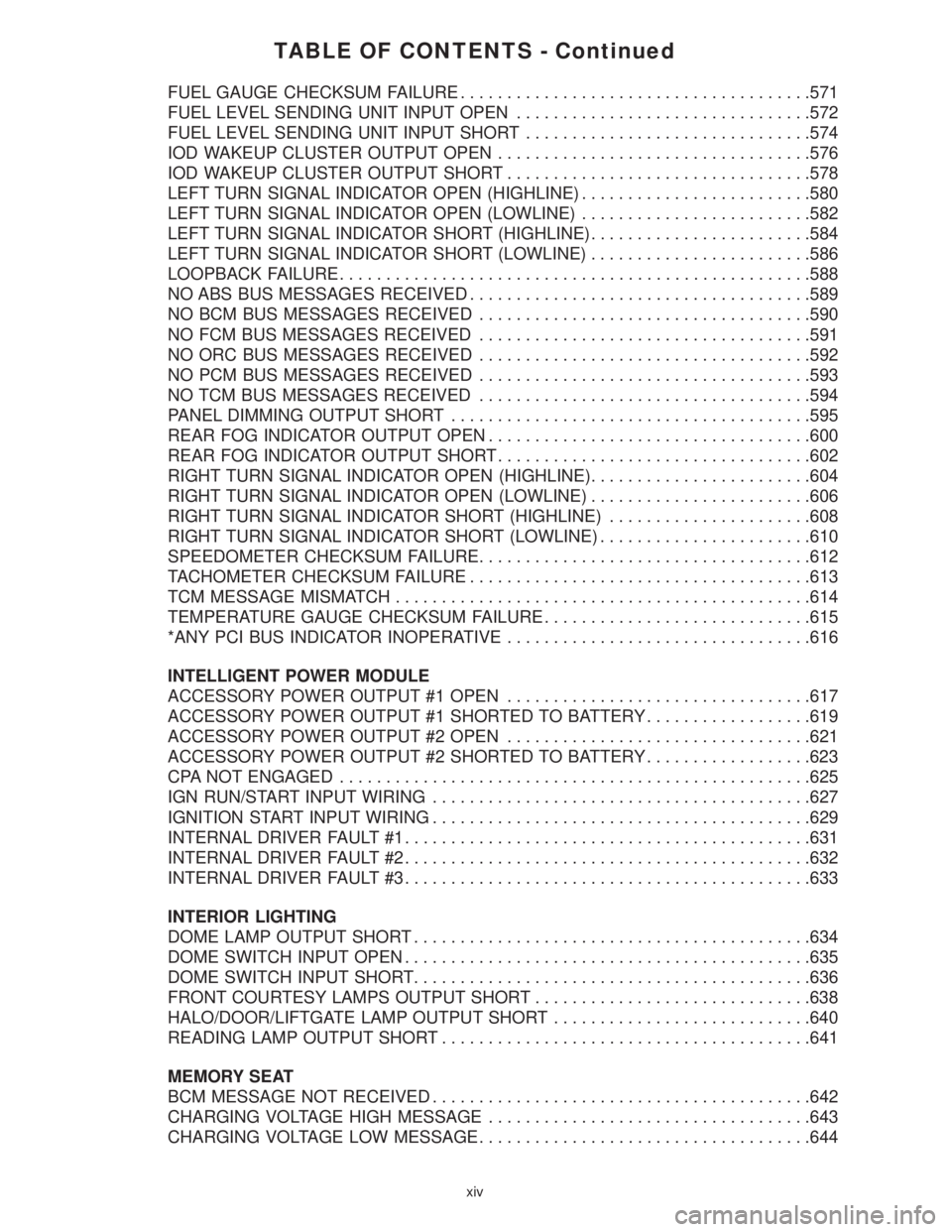
TABLE OF CONTENTS - Continued
FUEL GAUGE CHECKSUM FAILURE......................................571
FUEL LEVEL SENDING UNIT INPUT OPEN................................572
FUEL LEVEL SENDING UNIT INPUT SHORT...............................574
IOD WAKEUP CLUSTER OUTPUT OPEN..................................576
IOD WAKEUP CLUSTER OUTPUT SHORT.................................578
LEFT TURN SIGNAL INDICATOR OPEN (HIGHLINE).........................580
LEFT TURN SIGNAL INDICATOR OPEN (LOWLINE).........................582
LEFT TURN SIGNAL INDICATOR SHORT (HIGHLINE)........................584
LEFT TURN SIGNAL INDICATOR SHORT (LOWLINE)........................586
LOOPBACK FAILURE...................................................588
NO ABS BUS MESSAGES RECEIVED.....................................589
NO BCM BUS MESSAGES RECEIVED....................................590
NO FCM BUS MESSAGES RECEIVED....................................591
NO ORC BUS MESSAGES RECEIVED....................................592
NO PCM BUS MESSAGES RECEIVED....................................593
NO TCM BUS MESSAGES RECEIVED....................................594
PANEL DIMMING OUTPUT SHORT.......................................595
REAR FOG INDICATOR OUTPUT OPEN...................................600
REAR FOG INDICATOR OUTPUT SHORT..................................602
RIGHT TURN SIGNAL INDICATOR OPEN (HIGHLINE)........................604
RIGHT TURN SIGNAL INDICATOR OPEN (LOWLINE)........................606
RIGHT TURN SIGNAL INDICATOR SHORT (HIGHLINE)......................608
RIGHT TURN SIGNAL INDICATOR SHORT (LOWLINE).......................610
SPEEDOMETER CHECKSUM FAILURE....................................612
TACHOMETER CHECKSUM FAILURE.....................................613
TCM MESSAGE MISMATCH.............................................614
TEMPERATURE GAUGE CHECKSUM FAILURE.............................615
*ANY PCI BUS INDICATOR INOPERATIVE.................................616
INTELLIGENT POWER MODULE
ACCESSORY POWER OUTPUT #1 OPEN.................................617
ACCESSORY POWER OUTPUT #1 SHORTED TO BATTERY..................619
ACCESSORY POWER OUTPUT #2 OPEN.................................621
ACCESSORY POWER OUTPUT #2 SHORTED TO BATTERY..................623
CPA NOT ENGAGED...................................................625
IGN RUN/START INPUT WIRING.........................................627
IGNITION START INPUT WIRING.........................................629
INTERNAL DRIVER FAULT #1............................................631
INTERNAL DRIVER FAULT #2............................................632
INTERNAL DRIVER FAULT #3............................................633
INTERIOR LIGHTING
DOME LAMP OUTPUT SHORT...........................................634
DOME SWITCH INPUT OPEN............................................635
DOME SWITCH INPUT SHORT...........................................636
FRONT COURTESY LAMPS OUTPUT SHORT..............................638
HALO/DOOR/LIFTGATE LAMP OUTPUT SHORT............................640
READING LAMP OUTPUT SHORT........................................641
MEMORY SEAT
BCM MESSAGE NOT RECEIVED.........................................642
CHARGING VOLTAGE HIGH MESSAGE...................................643
CHARGING VOLTAGE LOW MESSAGE....................................644
xiv
Page 27 of 4284
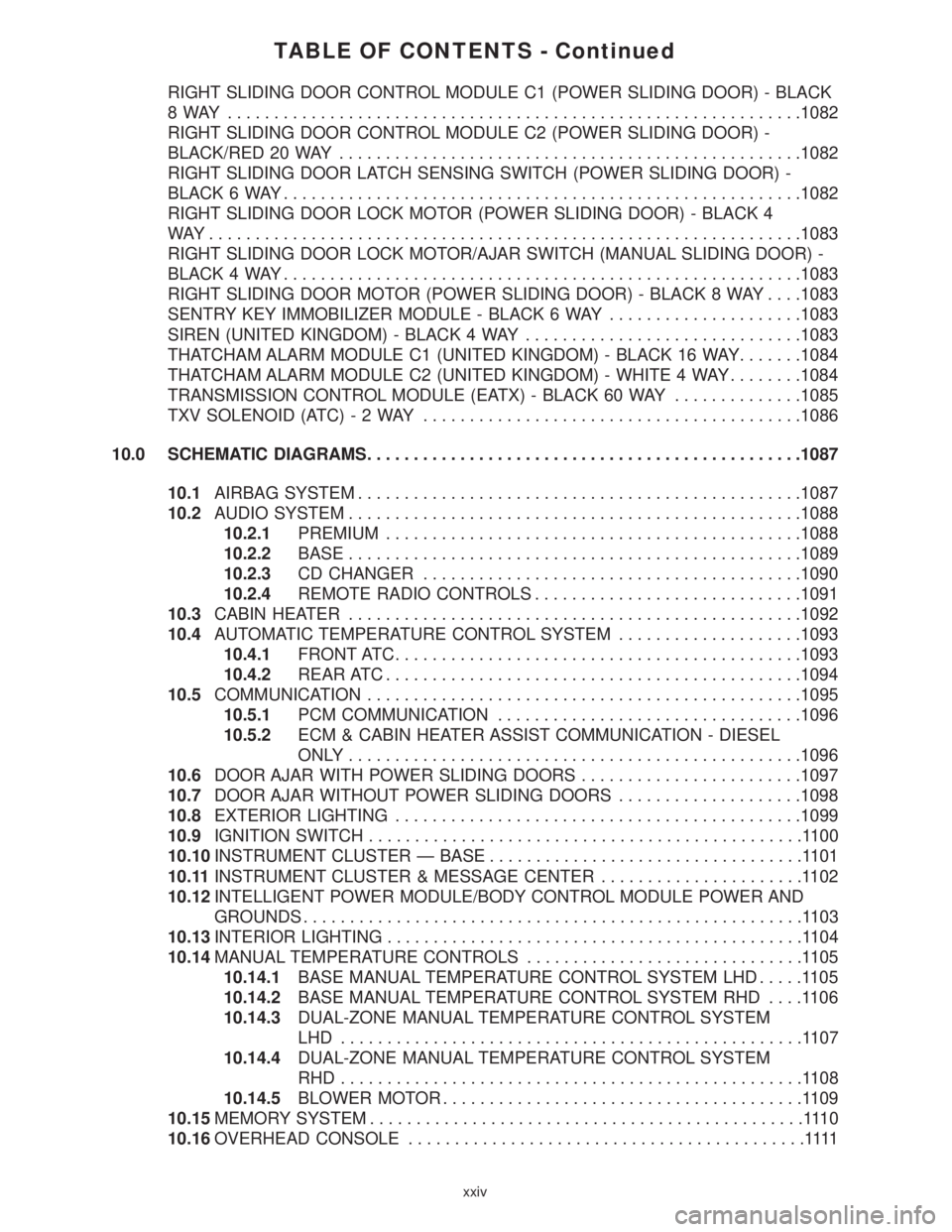
TABLE OF CONTENTS - Continued
RIGHT SLIDING DOOR CONTROL MODULE C1 (POWER SLIDING DOOR) - BLACK
8 WAY ..............................................................1082
RIGHT SLIDING DOOR CONTROL MODULE C2 (POWER SLIDING DOOR) -
BLACK/RED 20 WAY..................................................1082
RIGHT SLIDING DOOR LATCH SENSING SWITCH (POWER SLIDING DOOR) -
BLACK 6 WAY........................................................1082
RIGHT SLIDING DOOR LOCK MOTOR (POWER SLIDING DOOR) - BLACK 4
WAY................................................................1083
RIGHT SLIDING DOOR LOCK MOTOR/AJAR SWITCH (MANUAL SLIDING DOOR) -
BLACK 4 WAY........................................................1083
RIGHT SLIDING DOOR MOTOR (POWER SLIDING DOOR) - BLACK 8 WAY. . . .1083
SENTRY KEY IMMOBILIZER MODULE - BLACK 6 WAY.....................1083
SIREN (UNITED KINGDOM) - BLACK 4 WAY..............................1083
THATCHAM ALARM MODULE C1 (UNITED KINGDOM) - BLACK 16 WAY.......1084
THATCHAM ALARM MODULE C2 (UNITED KINGDOM) - WHITE 4 WAY........1084
TRANSMISSION CONTROL MODULE (EATX) - BLACK 60 WAY..............1085
TXV SOLENOID (ATC)-2WAY.........................................1086
10.0 SCHEMATIC DIAGRAMS...............................................1087
10.1AIRBAG SYSTEM................................................1087
10.2AUDIO SYSTEM.................................................1088
10.2.1PREMIUM.............................................1088
10.2.2BASE.................................................1089
10.2.3CD CHANGER.........................................1090
10.2.4REMOTE RADIO CONTROLS.............................1091
10.3CABIN HEATER.................................................1092
10.4AUTOMATIC TEMPERATURE CONTROL SYSTEM....................1093
10.4.1FRONT ATC............................................1093
10.4.2REAR ATC.............................................1094
10.5COMMUNICATION...............................................1095
10.5.1PCM COMMUNICATION.................................1096
10.5.2ECM & CABIN HEATER ASSIST COMMUNICATION - DIESEL
ONLY.................................................1096
10.6DOOR AJAR WITH POWER SLIDING DOORS........................1097
10.7DOOR AJAR WITHOUT POWER SLIDING DOORS....................1098
10.8EXTERIOR LIGHTING............................................1099
10.9IGNITION SWITCH...............................................1100
10.10INSTRUMENT CLUSTER Ð BASE..................................1101
10.11INSTRUMENT CLUSTER & MESSAGE CENTER......................1102
10.12INTELLIGENT POWER MODULE/BODY CONTROL MODULE POWER AND
GROUNDS......................................................1103
10.13INTERIOR LIGHTING.............................................1104
10.14MANUAL TEMPERATURE CONTROLS..............................1105
10.14.1BASE MANUAL TEMPERATURE CONTROL SYSTEM LHD.....1105
10.14.2BASE MANUAL TEMPERATURE CONTROL SYSTEM RHD....1106
10.14.3DUAL-ZONE MANUAL TEMPERATURE CONTROL SYSTEM
LHD ..................................................1107
10.14.4DUAL-ZONE MANUAL TEMPERATURE CONTROL SYSTEM
RHD..................................................1108
10.14.5BLOWER MOTOR.......................................1109
10.15MEMORY SYSTEM...............................................1110
10.16OVERHEAD CONSOLE...........................................1111
xxiv
Page 30 of 4284
1.0 INTRODUCTION
The procedures contained in this manual include
all the specifications, instructions and graphics
needed to diagnose 2001 body system problems. The
diagnostics in this manual are based on the failure
condition or symptom being present at the time of
diagnosis.
Please follow the recommendations below when
choosing your diagnostic path.
1. First make sure the DRBIIItis communicating
with the appropriate modules; i.e., if the
DRBIIItdisplays a ªNo Responseº or a ªBus6
Signals Openº condition, you must diagnose that
first.
2. Read DTC's (diagnostic trouble codes) with the
DRBIIIt.
3. If no DTC's are present, identify the customer
complaint.
4. Once the DTC or customer complaint is identi-
fied, locate the matching test in the Table of
Contents and begin to diagnose the symptom.
All component location views are in Section 8.0. All
connector pinouts are in Section 9.0. All schematics
are in Section 10.0. All Charts and Graphs are in
Section 11.0.
An * placed before the symptom description indi-
cated a customer complaint.
When repairs are required, refer to the appropri-
ate service information for the proper removal and
repair procedure.
Diagnostic procedures change every year. New
diagnostic systems may be added: carryover systems
may be enhanced. READ THIS MANUAL BEFORE
TRYING TO DIAGNOSE A VEHICLE DIAGNOS-
TIC TROUBLE CODE. It is recommended that you
review the entire manual to become familiar with all
the new and changed diagnostic procedures.
This book reflects many suggested changes from
readers of past issues. After using this book, if you
have any comments or suggestions, please fill out
the form in the back of this book and mail it back to
us.
1.1 SYSTEM COVERAGE
This diagnostic procedures manual covers all
2001 Chrysler Voyager and Caravan vehicles. This
diagnostic procedures manual also covers both left
hand drive (LHD) and right hand drive (RHD)
vehicles. There may be some slight differences in
the location views of components. If the location
views shown are on a LHD vehicle, a RHD vehicle
will be symmetrically opposite.
1.2 SIX-STEP TROUBLESHOOTING
PROCEDURE
Diagnosis of the body system is done in six basic
steps:
²verification of complaint
²verification of any related symptoms
²symptom analysis
²problem isolation
²repair of isolated problem
²verification of proper operation
2.0 IDENTIFICATION OF
SYSTEM
The vehicle systems that are part of the ªbodyº
system are:
²Airbag
²Audio
²Cabin Heater
²Chime
²Communication
²Door Ajar System
²Electrically heated system
²Exterior lighting
²Heating and A/C
²Instrument Cluster
²Interior Lighting
²Manual Temperature Control
²Memory Seat
²Overhead Console
²Power Door Lock/RKE
²Power Folding Mirrors
²Power Sliding Doors
²Power Liftgate
²Power windows
²Vehicle Theft Security System (VTSS)
²Windshield Wiper and Washer
3.0 SYSTEM DESCRIPTION AND
FUNCTIONAL OPERATION
The body system on the 2001 RG consists of a
combination of modules that communicate over the
PCI bus (Programmable Communication Interface
multiplex system). Through the PCI bus, informa-
tion about the operation of vehicle components and
circuits is relayed quickly to the appropriate mod-
ule(s). All modules receive all the information trans-
1
GENERAL INFORMATION
Page 37 of 4284
this type of system would only refer to this circuit.
A faulty speaker could not cause this DTC.
3.2.1 REMOTE RADIO CONTROLS
These radios can be controlled via remote radio
switches (optional). These switches are located on
the back side of the steering wheel. They control
mode, preset, seek up, seek down, volume up and
volume down functions.
These functions are inputs to the Body Control
Module and can be read with the DRBIIItunder
ªbody computerº. The switches are a multiplexed
signal to the BCM. The radio control MUX circuit is
a 5 volt line that is pulled to ground through
different value resistors built into the switches.
This causes a voltage drop to be seen by the BCM
and it sends a specific message to the radio on the
PCI Bus circuit. The radio then responses to the
message.
This circuit is fairly simple to troubleshoot. The
circuit must be complete from the switches in the
steering wheel to the BCM. The ground must be
complete so that the switches can cause the voltage
drop for the BCM to see. The circuit passes through
the clockspring so continuity through this devise
must be verified.
3.2.2 CD CHANGER
The new in-dash CD Changer is designed to fit
into the existing cubby bin in the center stack. This
new cartridge-less CD Changer is controlled by
your radio, and allows you to individually load up to
four discs at a time. However, due to its compact
design, the CD Changer can only carry out one
operation at a time. For example, you can not load
a new disc while playing another at the same time.
Each operation happens sequentially.
The radio unit installed with your system pro-
vides control over all features of the CD Changer
with the exception of the CD load and eject func-
tions, which are controlled by buttons located on the
front of the CD Changer. The radio also supplies the
power, ground, PCI Bus, left and right speaker
output thru a single DIN cable. All features you
would expect, such as Disc Up/Down, Track Up/
Down, Random and Scan are controlled by the
radio, which also displays all relevant CD Changer
information on the radio display.
The CD Changer contains a Load/Eject button
and an indicator light for each of the four disc
positions. The individual light indicates whether a
CD is currently loaded in that particular chamber of
the CD Changer. Pressing the individual Load/Eject
button for a particular chamber will eject a disc
currently present in that chamber. If the chamber iscurrently empty, actuating the Load/Eject button
will position that chamber to receive and load a new
disc in that chamber.
3.3 BODY CONTROL MODULE
The body control module (BCM) supplies vehicle
occupants with visual and audible information and
controls various vehicle functions. To provide and
receive information, the module is interfaced to the
vehicle's serial bus communications network (PCI).
This network consists of the powertrain control
module (PCM), the engine control module (ECM) -
diesel only, the transmission control module (TCM),
the mechanical instrument cluster (MIC), the front
control module (FCM), the occupant restraint con-
troller (ORC), the compass/mini-trip (CMTC), the
electronic vehicle information center (EVIC), the
controller antilock brake (CAB), the HVAC control
module (ATC & MTC), the power sliding door (Left
& Right) modules (PSD), the power liftgate module
(PLG), the Audio system, the side impact airbag
control (left & right) modules (SIACM), the memory
seat/mirror module (MSMM), the RKE/thatcham
alarm module and the sentry key immobilizer mod-
ule (SKIM). The BCM is operational when battery
power is supplied to the module.
The body control module provides the following
features:
²Power Door Locks
²Automatic Door Lock
²Door Lock Inhibit
²Central Locking (with VTSS Only)
²Battery Protection
²The BCM will automatically turn off all exterior
lamps after 3 minutes and all interior lamps after
15 minutes after the ignition is turned off, if they
are not turned off by the driver.
²Chime
²Compass/Minitrip Support
²Interior Lighting (Courtesy/Reading Lamps)
²BCM Diagnostic Reporting
²Electronic Liftgate Release (with Power Door
Locks)
²Exterior Lighting
²Power Folding Mirrors
²Remote Radio Controls
²Headlamp Time Delay (with/without Autohead-
lamps)
²Automatic Headlamps (with electrochromatic
mirror)
²Illuminated Entry
²Fade to Off
8
GENERAL INFORMATION
Page 38 of 4284
This feature dims the interior lighting (courtesy
lamps) gradually if the BCM does not receive any
new inputs that would cause the interior lamps to
remain on.
²PWM Instrument Panel Dimming
²Door Lock Inhibit
This feature disables the door lock functions if the
key is in the ignition and either front door is ajar.
Pressing the RKE lock/unlock button under these
conditions, result in normal lock/unlock activation.
²Power Sliding Door Switch Inputs
The BCM has 4 switch inputs for the power
sliding door feature: Located in the overhead con-
sole are the Left and Right side sliding door
switches to activate either or both sliding doors
under the proper conditions. Also are B-Pillar
switches located on the Left and Right B-pillar
posts.
²Power Liftgate Switch Input
The BCM has 1 Liftgate switch input located in
the overhead console
²Power Lockout Switch Input
The BCM has 1 Lockout switch that when en-
abled will disable the B-Pillar sliding door switches
from activating either sliding door when depressed.
When replacing a body control module there are 2
modules available, a Base and a Midline. The
Midline controller is used on vehicles that have
Power Door Locks. If a vehicle is equipped with the
Vehicle Theft Security System, the midline control-
ler becomes a premium when the theft feature is
enabled.
NOTE: DO NOT SWAP THE BODY CONTROL
MODULE BETWEEN VEHICLES OR BODY
CONTROL MODULES OFF THE SHELF.
Engineering does not recommend that service,
dealers or the plant swap Body Control Modules
(BCM) between vehicles or off the shelf. The BCM
has internal diagnostic capability that assists in
diagnosing the system. When an ªOpenº or a
ªShortº circuit exists, the diagnostic tool can be
used to read the BCM codes. The codes are very
descriptive in identifying the appropriate feature
that has faulted.
3.4 CHIME WARNING SYSTEM
The BCM monitors the door/liftgate ajar
switches, multifunction switches, headlight switch,
ignition switch, PCI bus, and the diagnostic tool to
perform various chime operations. The BCM uses a
low-side driver to control the chime located in the
cluster.
The chime system provides the Driver with warn-
ing chimes for:
²Seat belt
²Exterior lights on
²Key-in Ignition
²Key-in Accessory
²Engine temperature critical
²Low washer fluid
²Turn signals on
²Dome light on
²Low oil pressure
²Any warning lamp announcement
²High-speed warning Gulf Coast Countries (GCC)
only
The output sound intensity of the chime is ap-
proximately 72 decibels.
3.4.1 CHIME PRIORITY
The following list indicates the priority of the
chime when more than one chime is active at the
same time:
²Seat belt warning
²High-speed warning Gulf Coast Countries (GCC)
only
²Turn signal on
²Chime request
²Warning lamp announcement
The cluster is responsible to set priority on all
warning lamp announcement chimes.
3.4.2 CHIME ON CONDITIONS
The following is a list of the chime warnings and
when they will sound.
Driver 's Seat
belt Unbuckled:Sounds for approximately 662
seconds when the igntion is turned
on and driver 's seat belt is not
buckled, as a reminder to the
driver to buckle the seat belt.
Exterior Lights
On:Ignition is in the lock position,
the driver door is ajar, and the
headlight switch is left in any
position, other than auto or off.
The chime will sound as a warn-
ing to the driver until one of the
above conditions is removed or
until the battery protection time
of 3 minutes has expired.
Key-In Ignition: Ignition is in the lock position,
driver door is ajar and the key is
in the ignition. The chime will
sound until one of the above con-
ditions is removed or until the
battery protection time of 15 min-
utes has expired.
9
GENERAL INFORMATION