ABS CHRYSLER VOYAGER 2023 User Guide
[x] Cancel search | Manufacturer: CHRYSLER, Model Year: 2023, Model line: VOYAGER, Model: CHRYSLER VOYAGER 2023Pages: 256, PDF Size: 13.97 MB
Page 202 of 256
200SERVICING AND MAINTENANCE
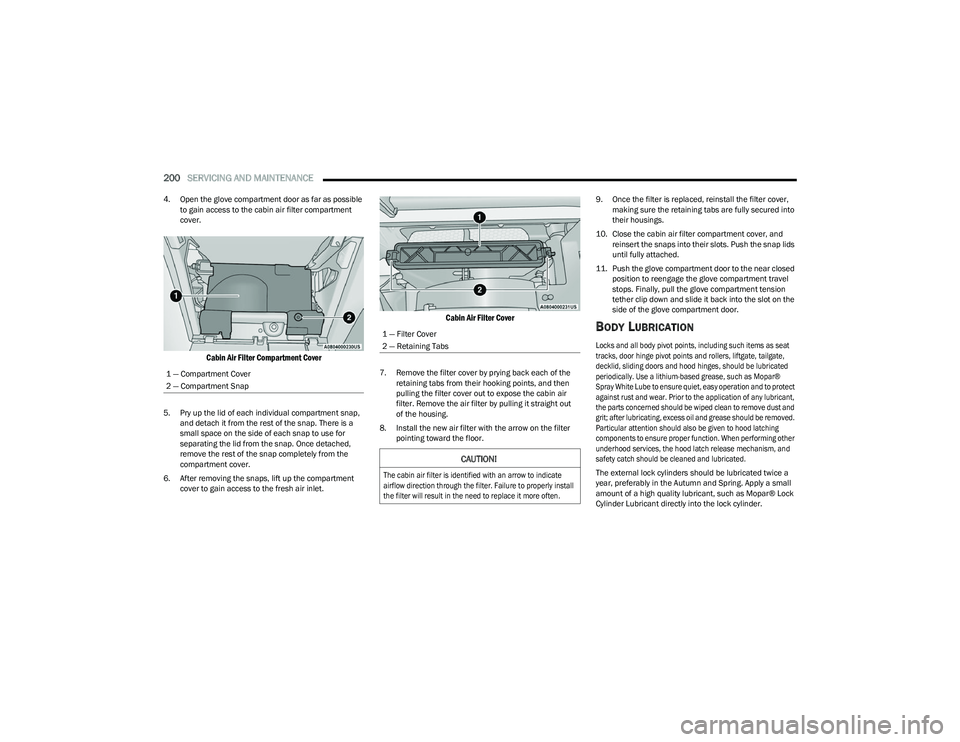
4. Open the glove compartment door as far as possible
to gain access to the cabin air filter compartment
cover.
Cabin Air Filter Compartment Cover
5. Pry up the lid of each individual compartment snap, and detach it from the rest of the snap. There is a
small space on the side of each snap to use for
separating the lid from the snap. Once detached,
remove the rest of the snap completely from the
compartment cover.
6. After removing the snaps, lift up the compartment cover to gain access to the fresh air inlet.
Cabin Air Filter Cover
7. Remove the filter cover by prying back each of the retaining tabs from their hooking points, and then
pulling the filter cover out to expose the cabin air
filter. Remove the air filter by pulling it straight out
of the housing.
8. Install the new air filter with the arrow on the filter pointing toward the floor. 9. Once the filter is replaced, reinstall the filter cover,
making sure the retaining tabs are fully secured into
their housings.
10. Close the cabin air filter compartment cover, and reinsert the snaps into their slots. Push the snap lids
until fully attached.
11. Push the glove compartment door to the near closed position to reengage the glove compartment travel
stops. Finally, pull the glove compartment tension
tether clip down and slide it back into the slot on the
side of the glove compartment door.
BODY LUBRICATION
Locks and all body pivot points, including such items as seat
tracks, door hinge pivot points and rollers, liftgate, tailgate,
decklid, sliding doors and hood hinges, should be lubricated
periodically. Use a lithium-based grease, such as Mopar®
Spray White Lube to ensure quiet, easy operation and to protect
against rust and wear. Prior to the application of any lubricant,
the parts concerned should be wiped clean to remove dust and
grit; after lubricating, excess oil and grease should be removed.
Particular attention should also be given to hood latching
components to ensure proper function. When performing other
underhood services, the hood latch release mechanism, and
safety catch should be cleaned and lubricated.
The external lock cylinders should be lubricated twice a
year, preferably in the Autumn and Spring. Apply a small
amount of a high quality lubricant, such as Mopar® Lock
Cylinder Lubricant directly into the lock cylinder.
1 — Compartment Cover
2 — Compartment Snap1 — Filter Cover
2 — Retaining Tabs
CAUTION!
The cabin air filter is identified with an arrow to indicate
airflow direction through the filter. Failure to properly install
the filter will result in the need to replace it more often.
23_RUV_OM_EN_US_t.book Page 200
Page 208 of 256
206SERVICING AND MAINTENANCE
(Continued)
As long as the engine operating temperature is satisfactory, the
coolant bottle need only be checked once a month.
When additional coolant is needed to maintain the proper
level, it should be added to the coolant bottle. Do not
overfill.
See an authorized dealer for service.
Cooling System Notes
NOTE:When the vehicle is stopped after a few miles/kilometers
of operation, you may observe vapor coming from the front
of the engine compartment. This is normally a result of
moisture from rain, snow, or high humidity accumulating
on the radiator and being vaporized when the thermostat
opens, allowing hot engine coolant (antifreeze) to enter
the radiator.
If an examination of your engine compartment shows no
evidence of radiator or hose leaks, the vehicle may be
safely driven. The vapor will soon dissipate.
Do not overfill the coolant expansion bottle.
Check the coolant freeze point in the radiator and in
the coolant expansion bottle. If engine coolant needs
to be added, the contents of the coolant expansion
bottle must also be protected against freezing.
If frequent engine coolant additions are required, the
cooling system should be pressure tested for leaks.
Maintain engine coolant concentration at a minimum
of 50% OAT coolant (conforming to MS.90032) and
distilled water for proper corrosion protection of your
engine which contains aluminum components.
Make sure that the coolant expansion bottle overflow
hoses are not kinked or obstructed.
Keep the front of the radiator clean. If your vehicle is
equipped with air conditioning, keep the front of the
condenser clean.
Do not change the thermostat for Summer or Winter
operation. If replacement is ever necessary, install
ONLY the correct type thermostat. Other designs may
result in unsatisfactory engine cooling performance,
poor gas mileage, and increased emissions.
BRAKE SYSTEM
In order to ensure brake system performance, all brake
system components should be inspected periodically.
For the proper maintenance intervals
Úpage 193.
Brake Master Cylinder
The fluid in the master cylinder should be checked when
performing under hood services or immediately if the
Brake Warning Light is illuminated.
Be sure to clean the top of the master cylinder area before
removing the cap. If necessary, add fluid to bring the fluid
level up to the requirements described on the brake fluid
reservoir. With disc brakes, fluid level can be expected to
fall as the brake pads wear. Brake fluid level should be
checked when pads are replaced. However, low fluid level
may be caused by a leak and a checkup may be needed.
Use only manufacturer recommended brake fluid
Úpage 239.
WARNING!
Riding the brakes can lead to brake failure and possibly
a collision. Driving with your foot resting or riding on
the brake pedal can result in abnormally high brake
temperatures, excessive lining wear, and possible brake
damage. You would not have your full braking capacity
in an emergency.
WARNING!
Use only manufacturer recommended brake fluid Úpage 239. Using the wrong type of brake fluid can
severely damage your brake system and/or impair its
performance. The proper type of brake fluid for your
vehicle is also identified on the original factory
installed hydraulic master cylinder reservoir.
To avoid contamination from foreign matter or moisture,
use only new brake fluid or fluid that has been in a tightly
closed container. Keep the master cylinder reservoir cap
secured at all times. Brake fluid in an open container
absorbs moisture from the air resulting in a lower boiling
point. This may cause it to boil unexpectedly during hard
or prolonged braking, resulting in sudden brake failure.
This could result in a collision.
23_RUV_OM_EN_US_t.book Page 206
Page 219 of 256
SERVICING AND MAINTENANCE217
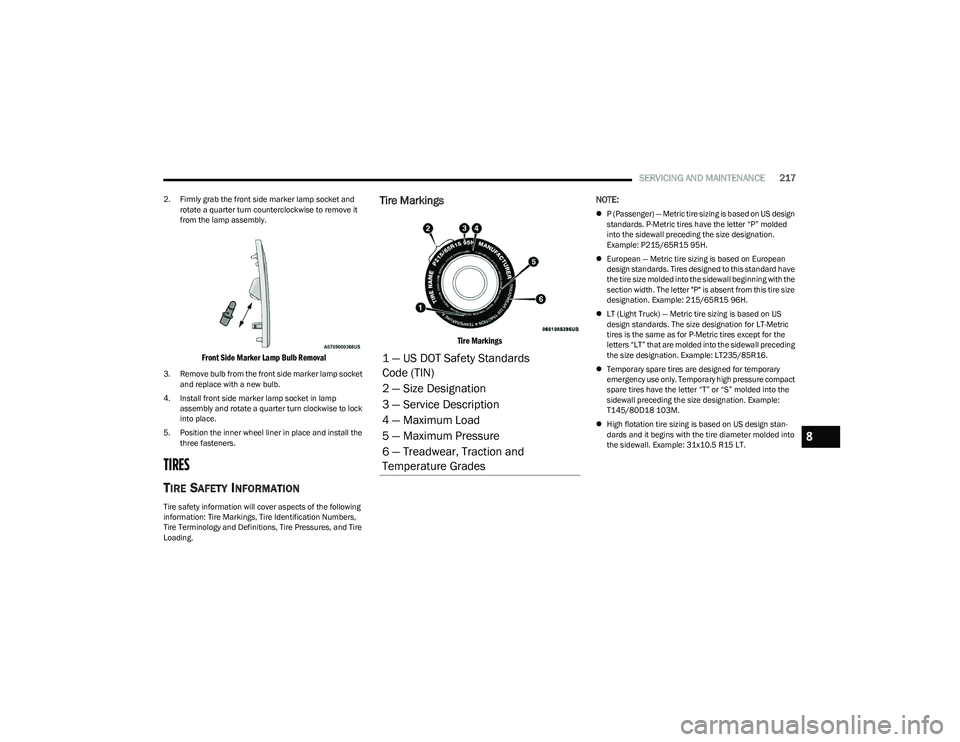
2. Firmly grab the front side marker lamp socket and
rotate a quarter turn counterclockwise to remove it
from the lamp assembly.
Front Side Marker Lamp Bulb Removal
3. Remove bulb from the front side marker lamp socket and replace with a new bulb.
4. Install front side marker lamp socket in lamp assembly and rotate a quarter turn clockwise to lock
into place.
5. Position the inner wheel liner in place and install the three fasteners.
TIRES
TIRE SAFETY INFORMATION
Tire safety information will cover aspects of the following
information: Tire Markings, Tire Identification Numbers,
Tire Terminology and Definitions, Tire Pressures, and Tire
Loading.
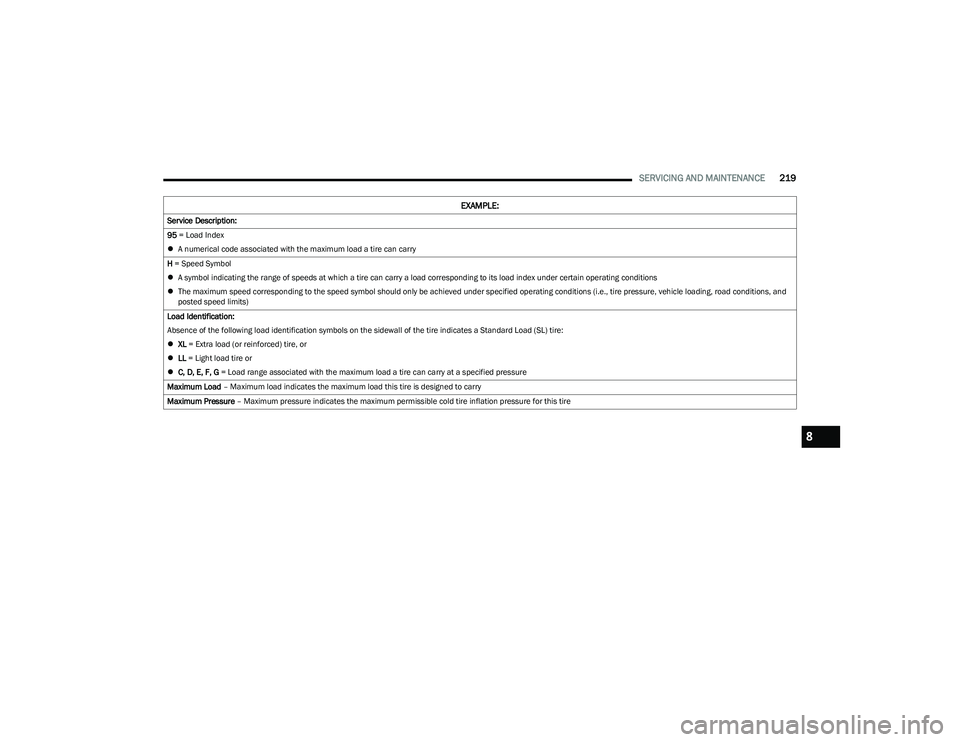
Tire Markings
Tire Markings
NOTE:
P (Passenger) — Metric tire sizing is based on US design
standards. P-Metric tires have the letter “P” molded
into the sidewall preceding the size designation.
Example: P215/65R15 95H.
European — Metric tire sizing is based on European
design standards. Tires designed to this standard have
the tire size molded into the sidewall beginning with the
section width. The letter "P" is absent from this tire size
designation. Example: 215/65R15 96H.
LT (Light Truck) — Metric tire sizing is based on US
design standards. The size designation for LT-Metric
tires is the same as for P-Metric tires except for the
letters “LT” that are molded into the sidewall preceding
the size designation. Example: LT235/85R16.
Temporary spare tires are designed for temporary
emergency use only. Temporary high pressure compact
spare tires have the letter “T” or “S” molded into the
sidewall preceding the size designation. Example:
T145/80D18 103M.
High flotation tire sizing is based on US design stan -
dards and it begins with the tire diameter molded into
the sidewall. Example: 31x10.5 R15 LT.
1 — US DOT Safety Standards
Code (TIN)
2 — Size Designation
3 — Service Description
4 — Maximum Load
5 — Maximum Pressure
6 — Treadwear, Traction and
Temperature Grades
8
23_RUV_OM_EN_US_t.book Page 217
Page 221 of 256
SERVICING AND MAINTENANCE219
Service Description:
95 = Load Index
A numerical code associated with the maximum load a tire can carry
H = Speed Symbol
A symbol indicating the range of speeds at which a tire can carry a load corresponding to its load index under certain operating conditions
The maximum speed corresponding to the speed symbol should only be achieved under specified operating conditions (i.e., tire pressure, vehicle loading, road conditions, and
posted speed limits)
Load Identification:
Absence of the following load identification symbols on the sidewall of the tire indicates a Standard Load (SL) tire:
XL = Extra load (or reinforced) tire, or
LL = Light load tire or
C, D, E, F, G = Load range associated with the maximum load a tire can carry at a specified pressure
Maximum Load – Maximum load indicates the maximum load this tire is designed to carry
Maximum Pressure – Maximum pressure indicates the maximum permissible cold tire inflation pressure for this tire
EXAMPLE:
8
23_RUV_OM_EN_US_t.book Page 219
Page 244 of 256
242CUSTOMER ASSISTANCE
PUERTO RICO AND US VIRGIN ISLANDS
FCA Caribbean LLC
P.O. Box 191857
San Juan 00919-1857
Phone: (800) 247-9753
Fax: (787) 782-3345
CUSTOMER ASSISTANCE FOR THE
H
EARING OR SPEECH IMPAIRED
(TDD/TTY)
To assist customers who have hearing difficulties, FCA US
LLC has installed special TDD (Telecommunication
Devices for the Deaf) equipment at its customer center.
Any hearing or speech impaired customer, who has access
to a TDD or a conventional teletypewriter (TTY) in the
United States, can communicate with FCA US LLC by
dialing 1-800-380-2479.
Canadian residents with hearing difficulties that require
assistance can use the special needs relay service offered
by Bell Canada. For TTY teletypewriter users, dial 711 and
for Voice callers, dial 1-800-855-0511 to connect with a
Bell Relay Service operator.
SERVICE CONTRACT
You may have purchased a service contract for a vehicle to help
protect you from the high cost of unexpected repairs after FCA
US LLC’s New Vehicle Limited Warranty expires. The Mopar®
Vehicle Protection plans are the ONLY vehicle extended
protection plans authorized, endorsed and backed by FCA US
LLC to provide additional protection beyond your vehicle’s warranty. If you purchased a Mopar® Vehicle Protection Plan,
you will receive Plan Provisions and an Owner Identification
Card in the mail within three weeks of the vehicle delivery date.
If you have any questions about the service contract, call FCA
US LLC’s Service Contract National Customer Hotline at
1-800-521-9922 (Canadian residents, call (800) 465-2001
English / (800) 387-9983 French).
FCA US LLC is not responsible for any service contract you
may have purchased from another manufacturer. If you
require service after the FCA US LLC New Vehicle Limited
Warranty expires, please refer to the contract documents,
and contact the person listed in those documents.
We appreciate that you have made a major investment
when you purchased the vehicle. An authorized dealer has
also made a major investment in facilities, tools, and
training to ensure that you are absolutely delighted with
the ownership experience.
WARRANTY INFORMATION
See the Warranty Information for the terms and provisions
of FCA US LLC warranties applicable to this vehicle and
market. Refer to www.mopar.com/om for further
information.
See the Warranty Information for the terms and provisions
of FCA Canada Inc. warranties applicable to this vehicle
and market. Refer to www.owners.mopar.ca/en for further
information.
Use this QR code to access your digital
experience.
MOPAR® PARTS
Mopar® original equipment parts & accessories and
factory filled fluids are available from an authorized
dealer. They are recommended for your vehicle to keep it
operating at its best and maintain its original condition.WARNING!
Engine exhaust (internal combustion engines only), some of
its constituents, and certain vehicle components contain, or
emit, chemicals known to the State of California to cause
cancer and birth defects, or other reproductive harm. In
addition, certain fluids contained in vehicles and certain
products of component wear contain, or emit, chemicals
known to the State of California to cause cancer and birth
defects, or other reproductive harm.
23_RUV_OM_EN_US_t.book Page 242
Page 247 of 256
245
INDEX
AAbout Your Brakes ....................................................... 235
Adding Engine Coolant (Antifreeze) ............................ 205
Additives, Fuel .............................................................. 237
AdjustDown...........................................................................33
Forward ...................................................................... 33
Rearward ....................................................................33
Up................................................................................ 33
Air Bag........................................................................... 144 Air Bag Operation.................................................... 145
Air Bag Warning Light .................................... 143
, 145
Driver Knee Air Bag ................................................ 149
Enhanced Accident Response ...................... 152
, 191
Event Data Recorder (EDR).................................... 191 Front Air Bag ........................................................... 145
If Deployment Occurs ............................................. 151
Knee Impact Bolsters ............................................. 149
Maintaining Your Air Bag System .......................... 152
Maintenance ........................................................... 152
Redundant Air Bag Warning Light ......................... 144
Side Air Bags ........................................................... 149
Transporting Pets.................................................... 167
Air Bag Light ................................................. 67
, 143, 167
Air Cleaner, Engine (Engine Air Cleaner Filter) ........... 198
Air Conditioner Maintenance ...................................... 199
Air Conditioner Refrigerant .......................................... 199
Air Conditioner System ................................................ 199
Air Conditioning Filter ........................................... 49
, 199
Air Conditioning, Operating Tips ..................................... 48 Air Filter......................................................................... 198 Air Pressure
Tires.......................................................................... 224
Alarm Arm The System......................................................... 16
Disarm The System ................................................... 16
Security Alarm............................................................ 70
Alterations/Modifications Vehicle.......................................................................... 7
Antifreeze (Engine Coolant) ............................... 204
, 238
Disposal ...................................................................205
Anti-Lock Brake System (ABS) ..................................... 121
Anti-Lock Warning Light.................................................. 70
Assist, Hill Start ............................................................. 124
Audio Jack ....................................................................... 52
Audio Systems (Radio) ................................................. 104
Auto Up Power Windows ................................................ 55
Automatic Dimming Mirror ............................................. 38 Automatic Headlights ..................................................... 40Automatic Transaxle ....................................................... 81
Automatic Transmission ................................................. 82 Adding Fluid ................................................... 207
, 239
Fluid And Filter Change ...........................................207
Fluid Change ............................................................207 Fluid Level Check ....................................................207Fluid Type ....................................................... 207
, 239
Special Additives ..................................................... 207
AutoPark .......................................................................... 75 AUX Cord.......................................................................... 52Auxiliary Electrical Outlet (Power Outlet) ....................... 52
Axle Lubrication ............................................................239
BBack Up Camera............................................................. 92
Base Instrument Cluster
b
......................................... 60
Battery.................................................................... 68, 196
Charging System Light .............................................. 68
Jump Starting .......................................................... 185
Keyless Key Fob Replacement................................. 11
Battery Saver Feature .................................................... 41
Belts, Seat..................................................................... 167
Blind Spot Monitoring .................................................. 126
Body Mechanism Lubrication ...................................... 200
B-Pillar Location ........................................................... 221
Brake Assist System..................................................... 122
Brake Control System, Electronic................................ 122
Brake Fluid.................................................................... 239
Brake System ......................................................206
, 235
Anti-Lock (ABS) ........................................................ 235 Fluid Check ..................................................... 206
, 239
Master Cylinder ....................................................... 206 Parking....................................................................... 79
Warning Light ............................................................ 68
Brake/Transmission Interlock ....................................... 82
Brightness, Interior Lights.............................................. 42
Bulb Replacement ...............................................215
, 216
Bulbs, Light ................................................ 168, 215, 216
11
23_RUV_OM_EN_US_t.book Page 245